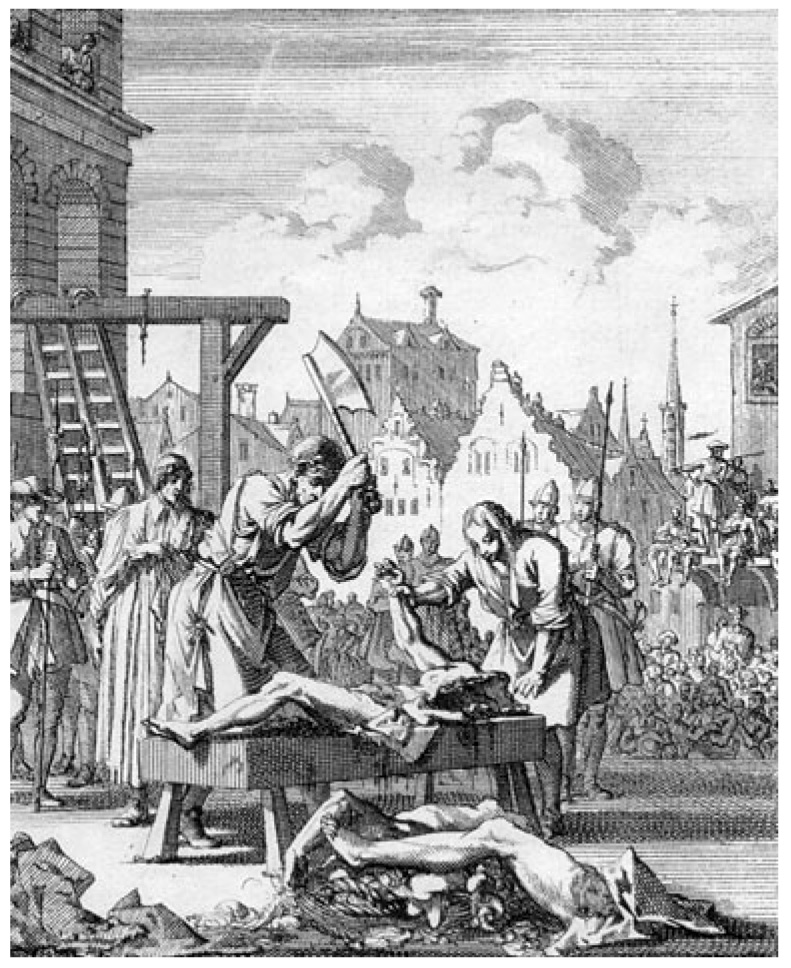
The Espy file gives June 29 for these executions, but the Wednesday of that week in 1733 (as designated in the court sentence) was June 27.
At a Court called for Goochland County the twenty-fifth day of June MDCCXXXIII, for the tryall of Champion a Negro man slave, Lucy, a Negro woman slave, both belonging to Hutchins Burton, Sampson, Harry, & George, three Negro men slaves belonging to William Randolph, Esq’r, & Valentine, a negro man slave belonging to Bowler Cocke gent.
A commission from the Hon’ble William Gooch Esq’r His Majesty’s Lieut Governor & Commander in chief of this Dominion to John Fleming, Tarlton Fleming, Allen Howard, Edward Scott, George Payne, William Cabbell, James Holman, Ishman Randolph, James Skelton, George Raine, & Anthony Hoggatt, gent to be Justices of Oyer and Terminer for the tryall of Champion a Negro man slave, Lucy a Negro woman slave both belonging to Hutchins Burgon, Sampson, Harry, & George, three Negro men slaves belonging to William Randolph Esq’e & Valentine a Negro man slave belonging to Bowler Cocke gent. being read as also the Dedimus for administering the Oaths & Test therein mentioned George Payne & Anthony Hoggatt gent. administer the oaths appointed by Act of Parliament to be taken instead of the Oaths of Allegiance and Supremacy the Oath appointed to be taken by an Act of Parliament made in the first year of the reign of his late Majesty King George the first Entitled An Act for the further security of his Majesty’s person and Government and the Succession of the Crown in the Heirs of the late Princess Sophia being Protestants and for extinguishing the hopes of the pretended Prince of Wales and his open & secret abettors, unto John Fleming & Daniel Stoner, gent. who Subscribe the Test take the Oath for duly executing the Office of a Commissioner of Oyer and Terminer, and then administer the said Oaths & Test unto Tarlton Fleming, George Payne, James Skelton & Anthony Hoggatt, gent.
Champion being brought to the Barr an Indictment against him for feloniously murdering Robert Allen of this County is read the prisoner confesses himself guilty of the said murder and it is thereupon considered by the court that he return to the place from whence he came and from thence to the place of Execution there to be hanged by the neck on Wednesday next between the hours of eleven and two till he be dead. The Court value the said Negro at thirty pounds Curr’t money.
George, Sampson & Harry, being brought to the Barr several Indictments against them for feloniously murdering Robert Allen of this County are read the prisoners plead not guilty whereupon the Witnesses & the prisoners defence being heard it is the opinion of the Court that they are not guilty and they are thereupon acquitted.
Valentine being brought to the Barr an Indictment against him for feloniously murdering Robert Allen of this County is read the prisoner pleads not guilty whereupon the Witnesses & the prisoners defence being heard it is the opinion of the Court that he is guilty and it is considered that he return to the place from whence he came and from thence to the place of Execution there to be hanged by the neck on Wednesday next between the hours of eleven & two till he be dead. The Court value the said Negro at forty pounds Curr’t money.
Lucy being brought to the Barr an Indictment against her for feloniously murdering Robert Allen of this County is read the prisoner pleads not guilty and whereupon the Witnesses and the prisoners defence being heard it is the opinion of the Court that she is not guilty of the murder but upon Consideration that she is supposed to have known of the murder after it was committed & did not discover the same it is Ordered that she receive on her bare back twenty one lashes well laid on at the Com[m]on whipping post & that she be then discharged.
It was then “Ordered that the heads & quarters of Champion & Valentine be set up in severall parts of this County.”
A century ago today* Dragutin Dimitrijevic — better known by his code name “Apis” — was shot on the outskirts of Salonika (Thessaloniki) along with two lieutenants in his legendary Serbian terrorist organization, the Black Hand.
Not to be confused with mafia extortionists of the same name, the Black Hand was the cooler brand name of Ujedinjenje Ili Smrt — “Union or Death” in the Serbo-Croatian tongue, referring to the network’s objective of aggrandizing the small Kingdom of Serbia with their ethnic brethren who, circa the fin de siècle, still answered to the Austro-Hungarian Empire.
This national aspiration would midwife the First World War.
Though it wasn’t formed as an institution until 1911** — it had its own constitution and everything — some of the Black Hand principals had entered the chessboard dramatically by conspiring in the 1903 assassination of the unpopular King Alexander Obrenovic and his consort Queen Draga. This operation is remembered as the May Coup and numbered among its leaders our very man, Apis. (English Wikipedia link| Serbian) Apis caught three bullets in the chest during the murderous palace invasion, but the hand wasn’t the only thing tough about him.
In victory, these conspirators grew into a powerful faction of a more bellicose state, the most militant exponents of Pan-Serbism — a spirit perforce directed against the Austrian polity, which called South Slavs subjects from Trieste to Montenegro. Belgrade, then as now the capital of Serbia, was at this point a border city, with the bulk of the future Yugoslavia lying to its north and west, in Austria-Hungary.
“We do not say that this war is declared yet, but we believe that it is inevitable. If Serbia wants to live in honour, she can do so only by this war,” Apis predicted to a newsman in 1912. “This war must bring about the eternal freedom of Serbia, of the South Slavs, of the Balkan peoples. Our whole race must stand together to halt the onslaught of these aliens from the north.”
I, (name), by entering into the society, do hereby swear by the Sun which shineth upon me, by the Earth which feedeth me, by God, by the blood of my forefathers, by my honour and by my life, that from this moment onward and until my death, I shall faithfully serve the task of this organisation and that I shall at all times be prepared to bear for it any sacrifice. I further swear by God, by my honour and by my life, that I shall unconditionally carry into effect all its orders and commands. I further swear by my God, by my honour and by my life, that I shall keep within myself all the secrets of this organisation and carry them with me into my grave. May God and my brothers in this organisation be my judges if at any time I should wittingly fail or break this oath.
-Black Hand induction oath
On the pregnant date of June 28, 1914, the Black Hand grasped at its historical destiny to redraw that noxious border when a cell of Bosnian Serbs whom Apis — a mere captain at the time of the 1903 coup, he by now commanded Serbian military intelligence — had dispatched for the purpose assassinated the Austrian heir presumptive Archduke Franz Ferdinand during his visit to the Bosnian capital, Sarajevo.
Their objective was the same as it had ever been, to avenge themselves upon their occupier. Moreover, Serbia had allied herself with Russia, and Vienna’s inevitable declaration of war over the provocation could be expected to draw Russia into a Great Power war, perhaps with the effect of shaking loose Austria’s Balkan provinces.
It did that, and it drew in the whole of Europe besides.
Apis’s assassins shattered the Habsburg empire and made possible a postwar Yugoslavian kingdom. That the Black Hand itself was one of the Great War’s casualties in the process was the littlest of ironies.
Its aggression had long placed it in a delicate relationship with the state which could never really be expected to acclimate to a permanent network of enragees looking to author wars and political murders.
By 1917 the Prime Minister Nikola Pasic saw an opening to move against Apis. Perhaps he feared resumed Black Hand subversion if Serbia negotiated a peace with Austria, or wanted to get rid of the guy who could tell exactly how much he, Pasic, knew about the Archduke’s assassination before it happened.
It was an effective ploy, no matter the reason. Alleging a bogus Black Hand plot to kill Serbia’s prince regent, a Serbian military investigation rolled up Dimitrijevic along with one of his original May Coup cronies, Ljobomir Vulovic and the alleged would-be assassin Rado Malobabic, a man who really had been involved in planning the Archduke Franz Ferdinand hit. Dimitrijevic was known to remark privately that whatever the charge sheet said, he was really being executed for that fateful day in Sarajevo.
The three condemned men stepped down into the ditches that had been dug for the purpose, and placed themselves in front of the stakes. Dimitrijevic on the right, Vulovic in the middle, and Malobabic on the left. After being blindfolded, Dimitrijevic and Vulovic cried: “Long live Greater Serbia!”
Malobabic succumbed after the first five shots, while the two others suffered longer, twenty shots having to be fired at each of them. No one was hit in the head. The execution was over at 4.47 in the morning.
* Different sources proposing numerous different dates in June and even July can be searched up on these here interwebs. We’re basing June 26 on primary reportage in the English-language press (e.g., the London Times of June 28, 1917, under a June 26 dateline: “The Serbian Prince Regent having confirmed the death sentences passed on Colonel Dragutin Dimitriovitch, Major Liubomir Vulovitch, and the volunteer Malobabitch for complicity in a plot to upset the existing regime, these were executed this morning in the outskirts of Salonika”). The sentences were confirmed on June 24, and both that date and its local Julian equivalent June 11 are among the notional death dates running around in the wild.
** The Black Hand from 1911 was the successor to Narodna Odbrana (“National Defense”) which formed in 1908 in response to Austria-Hungary’s annexation of Bosnia.
At 11:35 a.m. on this day in 1880, three teen boys were publicly hanged in Canton, Ohio. George E. Mann was sixteen, Gustave Adolph Ohr was somewhere between fifteen and seventeen, and John Sammet(t) had just turned eighteen the day before. Between them, they had committed two murders.
Left to right: Mann, Ohr, and Sammett.
George Mann and Gustave Ohr came from similar backgrounds: both lost a parent in early childhood — George’s mother and Gustave’s father — and both didn’t adjust well. By the summer of 1879, both boys had run away from home. They were riding the rails when they met each other and began traveling with an older tramp, John Watmough.
The trio had reached Alliance, Ohio when, on June 27, 1879, Gustave and George decided to rob Watmough as he slept. They beat him on the head with a railroad coupling pin, mortally wounding him, and the boys took his watch, money and clothes and ran away. Watmough was able to crawl to a nearby house and mumble a few words before dying. His killers were arrested within minutes.
George, although he insisted it was Gustave who’d struck the fatal blows, was convicted of first-degree murder on December 6. Gustave was convicted on December 13. On December 31, both were sentenced to death. George went to his grave saying he was innocent, but his partner-in-crime refused to cinch his clemency argument by taking full responsibility.
According to the Stark County Democrat, while awaiting their deaths, George and Gustave were both able to obtain “many luxuries” by selling copies of the gallows ballads they supposedly wrote themselves. (Mann’s | Ohr’s)
John Sammett, like George Mann, lost his mother at a very early age and lived with his father and stepmother at the time of his crime. Like the Bavaria-born Gustave Ohr, he was of German parentage, although John was born in Ohio. He developed a reputation as a petty thief and was arrested several times, but his relatives always bailed him out of trouble.
In August of 1879, John and a sixteen-year-old friend, Christopher Spahler, broke into a saloon. They were arrested, and Spahler agreed to turn state’s evidence and testify against his erstwhile friend. The burglary trial was scheduled for November 26; the day before, John tracked down Spahler and tried to get him to change his mind. Spahler would not relent, and John shot him in the chest.
People heard the shot and came running; Spahler died a short time later without speaking, but both John and the murder weapon were still at the crime scene. He was arrested immediately, and on March 2, 1880 he was convicted of murder and sentenced to death.
Meanwhile, in a different hanging circus … (widely reprinted wire story via the Milwaukee Journal of Commerce of (despite the dateline) June 23, 1880.
The public hanging of Mann and Ohr, along with John Sammett, was the occasion for a community-wide extravaganza. People came to the small town of Canton in eastern Ohio by excursion train from as far away as Chicago and Pittsburgh to witness the event. A circus was part of the extravaganza [literally, Coup‘s circus was in town at the same time -ed.] and the night before the hangings included much music, cannon firing, speech making and similar merriment. The next morning, Mann and the other two teenaged boys were hanged in the city square of Canton before an estimated crowd of 10,000 people!
After the triple hanging, sheriffs deputies placed the three bodies in the jail corridor and permitted the entire crowd to file through and view the bodies. The public viewing lasted almost four hours, with the doors being closed at 3:30 p.m.
This was the first time the state of Ohio had executed minors.
These three young killers were featured in Daniel Right Miller’s 1903 book The Criminal Classes: Causes and Cures, which remarks (speaking of Ohr specifically) “that parental neglect, impure literature, and vicious companions were all responsible for this ruined life and forced death.”
Moved like many whom the Revolution would come to devour by hope in its possibilities, she declined to flee France. She came within a month of surviving the crucible but her relationship with the beheaded king and queen played fatally against her in the end.
We catch a glimpse of this woman and her vanished possibilities through the memoirs of her fellow-artist contemporary Madame Lebrun:
drew from nature and from casts, often working by lamplight with Mlle. Boquet, with whom I was closely acquainted. I went to her house in the evenings; she lived in the Rue Saint Denis, where her father had a bric-à-brac shop. It was a long way off, since we lodged in the Rue de Cléry, opposite the Lubert mansion. My mother, therefore, insisted on my being escorted whenever I went. We likewise frequently repaired, Mlle. Boquet and I, to Briard’s, a painter, who lent us his etchings and his classical busts. Briard was but a moderate painter, although he did some ceilings of rather unusual conception. On the other hand, he could draw admirably, which was the reason why several young people went to him for lessons. His rooms were in the Louvre, and each of us brought her little dinner, carried in a basket by a nurse, in order that we might make a long day of it.
Mlle. Boquet was fifteen years old and I fourteen. We were rival beauties. I had changed completely and had become good looking. Her artistic abilities were considerable; as for mine, I made such speedy progress that I soon was talked about
…
On Sundays and saints’ days, after hearing high mass, my mother and my stepfather took me to the Palais Royal for a walk. The gardens were then far more spacious and beautiful than they are now, strangled and straightened by the houses enclosing them. There was a very broad and long avenue on the left arched by gigantic trees, which formed a vault impenetrable to the rays of the sun. There good society assembled in its best clothes. The opera house was hard by the palace. In summer the performance ended at half-past eight, and all elegant people left even before it was over, in order to ramble in the garden. It was the fashion for the women to wear huge nosegays, which, added to the perfumed powder sprinkled in everybody’s hair, really made the air one breathed quite fragrant. Later, yet still before the Revolution, I have known these assemblies to last until two in the morning. There was music by moonlight, out in the open; artists and amateurs sang songs; there was playing on the harp and the guitar; the celebrated Saint Georges often executed pieces on his violin. Crowds flocked to the spot.
We never entered this avenue, Mlle. Boquet and I, without attracting lively attention. We both were then between sixteen and seventeen years old, Mlle. Boquet being a great beauty. At nineteen she was taken with the smallpox, which called forth such general interest that numbers from all classes of society made anxious inquiries, and a string of carriages was constantly drawn up outside her door.
She had a remarkable talent for painting, but she gave up the pursuit almost immediately after her marriage with M. Filleul, when the Queen made her Gatekeeper of the Castle of La Muette. [Marie Antoinette designated the position to Madame Filleul after her husband’s death. -ed.] Would that I could speak of the dear creature without calling her dreadful end to mind. Alas! how well I remember Mme. Filleul saying to me, on the eve of my departure from France, when I was to escape from the horrors I foresaw: “You are wrong to go. I intend to stay, because I believe in the happiness the Revolution is to bring us.” And that Revolution took her to the scaffold! Before she quitted La Muette the Terror had begun. Mme. Chalgrin, a daughter of Joseph Vernet, and Mme. Filleul’s bosom friend, came to the castle to celebrate her daughter’s wedding – quietly, as a matter of course. However, the next day the Jacobins none the less proceeded to arrest Mme. Filleul and Mme. Chalgrin, who, they said, had wasted the candles of the nation. A few days later they were both guillotined.
On this date in 1505, seven women and a man were burned in the town of Cemmo in Lombardy’s Val Camonica — the first victims of that region’s outbreak of witch-hunting that would claim over 100 lives all told.
This alpine valley fell in the hinterlands remit of the city of Brescia, which meant that (since the 1420s) it answered ultimately to the Most Serene Republic of Venice.
Remotenesses like Val Camonica are among the focal points for the fancy or hope that pockets of paganism held on from antiquity even in the heart of Christendom. Brescia lay in the belt spawning doctrinal and political challenges to the medieval church — the very zone that gave rise to the Inquisition.
During two distinct periods — 1505 to 1510, and again from 1518 to 1521 — that Inquisition fastened on folk in this region who constituted “a most pernicious kind of people … utterly damned by the stain of heresy, which was causing them to renounce the sacrament of the baptism they had received, denying their Lord and giving their bodies and souls to Satan whose advice was leading them astray.” (1521 communique of Pope Leo X, quoted here)
The circumstances for these purges can only be guessed at, as most of the primary documentation, particularly of the earlier episode, is lost. But the context of Papal-Venetian rivalry all but insists upon itself. Indeed, Venice’s ruling oligarchy is known during the 1518-1521 Inquisition to have interceded to prevent the Pope’s delegate from putting torch to flesh, provoking one of the innumerable jurisdictional imbroglios between the rival city-states.
On this date in 1936, Edward Cornelius hanged at Victoria’s Pentridge Gaol for the vicarage murder.
The Murder at the Vicarage also happens to be the title of Agatha Christie’s very first Miss Marple novel, published several years before the very real vicarage murder of Rev. Cecil.
One lonesome night the preceding December, Cornelius, a mechanic, turned his spanner on the aged head of plain-living 60-year-old Rev. Harold Laceby Cecil of St. Saviour’s — the horrible conclusion to Rev. Cecil’s 18-year ministry in Fitzroy, then one of Melbourne’s roughest neighborhoods.
Cornelius’s motive was robbery, and it was hardly the first time that Rev. Cecil had been braced for the few quid in donatives he kept on hand for charity cases. Though undeterred from his mission, Cecil was philosophical about repeated robberies: “I will get them, or they will get me.” According to Cornelius’s confession, it was the getting that got Cecil killed: surprised in the course of a midnight stealth pilfering of the vicarage study, Cornelius grabbed the tool of his other trade and clobbered the intercessor, repeatedly: there would be 17 distinct head wounds discerned by investigators.
He fled the vicarage with £8 and few gold and silver trinkets. Some, like a silver watch, he would discard as too incriminating; others, like a gold crucifix, he pawned to obtain ready cash and readier eyewitnesses against him.
A death-house chum of similarly notorious Arnold Sodeman — the two passed Sodeman’s last hours on earth together, playing draughts — Cornelius followed the latter’s steps to the same gallows three weeks later.
Though the term is now best associated with these anthracite miners of eastern Pennsylvania, it enters the textual record earliest in Great Britain right around 1845 … which, no coincidence, was the dawn of Ireland’s Great Famine.
Where tenant farmers starved even as absentee landlords exported crops, militancy naturally ensued — intrinsically criminal and therefore secretive, inevitably characterized as terroristic by its foes. For this desperate movement the fictitious heroine “Molly Maguire” would be name and watchword, a mythic resistance character in the tradition of Captain Swing or Ned Ludd; legend — perhaps reality? — would hold that her earliest followers had desolated a lord’s land after he turned subsistence farmers off it in favor of cash crops by murdering new tenant after new tenant until nobody dared occupy the tract. Newspapers began to denounce her followers proportional to the publication’s proximity to London capital.
A sympathetic domestic description is provided by the Cork Examiner of July 9, 1845, which contends that Molly McGuireism is nothing but “the tenant creed.”
The spirit and letter of legislation are all for ramparting round the rights of property. The meaning of this plainly is — legislating for themselves, whilst the population of the country may perish. Hence, stone walls and bogs, and houses and fields, with all dead matter, are cared for and legislated upon by landlords, whilst the living and producing beings — the Christian inhabitants of the country, who are formed to make up the sum of its riches, naturally and artificially, are exterminated, expatriated, famished, or shot down like dogs. What is the necessary consequence of this infamous state of things? Circumspice. Look around you and behold the monument raised to the desolating idol. Its history and its effects are written in the hovelled mud, and the squalid wretches and the naked children, which form the social and rural beauties of the soil of Ireland.
Well, the people feel and say — they would be stupid and brutal if they did not — that legislation or legislators will do nothing for them. They are thus thrown upon their own resources and their own energies. By the midnight lamp they write their own fearful enactments. If the code of their specified rights be written in blood, it is awful, but it is not unnatural.
And in Pennsylvania’s coal fields, during the depression of the 1870s, this was much the condition of Irish immigrant miners — no few of whom had been driven there by the very famine that spawned the original Molly Maguires.
Since verifiable documentary evidence of Molly Maguireism as an organized movement is very scant it’s an open question for posterity to what extent we behold the traces of an international Irish Catholic labor militancy or the hysteria of the boss. In whichever dimensions, the ghost of Molly Maguire crossed the Atlantic and haunted the violent carbon-harvest business in Pennsylvania … a ghost that rattles its chains ever so faintly whenever your Monopoly piece takes a ride on the Reading.
Though it’s difficult to think it today, the Reading Railroad company was one of the world’s largest corporations in the 1870s. The firm’s captain of industry, Franklin Gowen, figures as the antagonist and perhaps the concoctor of the Mollies, whose appearance as a criminal offshoot of the fraternal Ancient Order of Hibernians he alleged as a calumny against the union he fought blood and nail.
In the course of an 1871 strike, Gowen complained that the union’s ability to achieve general compliance with the work stoppage could only be the result of a shadowy association of foreign agitators “which issues orders which no one dare disobey.”
There has never, since the middle ages, existed a tyranny like this on the face of God’s earth. There has never been, in the most despotic government in the world, such a tyranny, before which the poor laboring man has to crouch like a whipped spaniel before the lash, and dare not say that his soul is his own … I say there is an association which votes in secret, at night, that men’s lives shall be taken, and that they shall be shot before their wives, murdered in cold blood, for daring to work against the order. (Source)
Fired by his public-spirited humanitarianism, Gowen went to work against the despotism of refusing his wage by retaining the Pinkerton Detective Agency. Its agent, James McParland, would make his name** famous or infamous with his claim to have infiltrated secret Molly meetings orchestrating routine political assassinations (assassinations he notably failed to prevent). His (thrilling) allegations, supplemented by confessions of alleged Mollies who turned state’s evidence to save their own lives,† were decisive in noosing the Mollies as murderers. For this McParland would receive both laurels and death threats, and also inspire a character in the Sherlock Holmes adventures.
Cincinnati Commercial, June 22, 1877.
The hysteria Gowen, McParland et al orchestrated was so self-confirming in the moment that newsmen wrote as categorically about the Mollies as they would in our era about Iraq’s weapons of mass destruction, and their terroristic reputation would be freely wielded to bludgeon the miners’ union. But curiously these existential menaces, once prosecuted, vanished with nary a footprint from their former rollick … so was the whole network phenomenally thorough about its secrecy, or was there never any such Hibernian Black Sabbath at all? There’s never been a historical consensus save that their trials by political allies of Gowen were at the very least travesties of justice — if not outright frame-ups.
Three weeks after the Day of the Rope, deep wage cuts for railroad workers triggered the Great Railroad Strike of 1877 which soon gave the Reading Railroad company its second bloody association in as many months: the Reading Railroad Massacre.
* Six hanged in Pottsville, and four in Mauch Chunk (since renamed as Jim Thorpe). Andrew Lanahan also hanged for murder on the same day at Wilkes-Barre, giving Pennsylvania 11 executions overall for its day of the rope; Lanahan’s was not one of the Molly Maguire cases but owing to his own Irish heritage there was never-proven conjecture that his crime was “inspired” by Maguireism. Accordingly, one can find different sources claiming either 10 or 11 Mollies hanged on this occasion. After this date’s harvest, ten additional supposed Molly Maguires were hanged by Pennsylvania during the next 18 months.
† Pennsylvania deployed demonstrative ferocity here: a 15-year-old who gave an alibi for her uncle got slapped with a thirty-month perjury sentence for contradicting a Pinkerton detective.
Whig knight Sir Thomas Armstrong was hanged, drawn, and quartered on this date in 1684, for adhering to Lord Russell‘s treasonable Rye House Plot.
Armstrong had been tempting the executioner for some years: he fell foul of the Cromwell protectorate for shuttling funds to the exiled Charles II, and in 1675 he slew a Mr. Scroope at a theater brawl. Both times he kept his head.
He would not be so lucky when conniving to kidnap the king.
Armstrong was shut out of the leadership clique of the Rye House Plot but he was active scheming with Monmouth and others about “how to surprize the Kings Guards” to get at the royal person, with Armstrong observing that “the Guards were very remiss in their places, and not like Souldiers, and the thing was feasible if they had strength to do it.”*
Briefly escaped to the Low Countries along with a number of other fellow-travelers,** Armstrong was arrested in Leiden and repatriated to face royal justice.
Detail view (click for a larger image) of the dismembering of Thomas Armstrong. Condemned to drawing and quartering, Armstrong was hanged to death and only “after such time the Sufferer had hung about half an Hour, and the Executioner had divested him of his Aparrel, he was cut down according to his Sentence; his Privy Members dissected from his Body, and Burnt; his Head cut off, and shewed to the People as that of a Traytor; his Heart and Bowels taken out, and committed to the Flames; and his Body Quartered into four Parts, which, with his Head, was conveyed back to Newgate, to be disposed of according to his Majesties Pleasure, and Order.” (
In an era of bitter factional politics spiced by burgeoning print culture, Armstrong’s delayed handling gave Tory squibs ample space to gleefully taunt the Whigs through him, and savor in doggerel (via repeat reference to executioner Jack Ketch) the inevitable rending of flesh that ensued.
The Bully WHIG: OR, The Poor Whores Lamentation for the Apprehending OF Sir THOMAS ARMSTRONG.
To the Tune of, Ah! Cruel Bloody Fate! &c.
I.
AH! Cruel Bloody Tom!
What canst thou hope for more,
Than to receive the Doom
Of all thy Crimes before?
For all thy bold Conspiracies
Thy Head must pay the score;
Thy Cheats and Lies,
Thy Box and Dice,
Will serve thy turn no more.
II.
Ungrateful thankless Wretch!
How could’st thou hope in vain
(Without the reach of Ketch)
Thy Treasons to maintain?
For Murders long since done and past,
Thou Pardons hast had store,
And yet would’st still
Stab on, and kill,
As if thou hop’dst for more.
III.
Yet Tom, e’r he would starve,
More Blood resolv’d to’ve spilt;
Thy flight did only serve
To justifie thy Guilt:
While They whose harmless Innocence
Submit to Chains at home,
Are each day freed,
While Traytors bleed,
And suffer in their room.
IV.
When Whigs a PLOT did Vote,
What Peer Justice fled?
In the FANATICK PLOT
Tom durst not shew his head.
Now Sacred Justice rules above,
The Guiltless are set free,
And the Napper’s napt,
And Clapper clapt
In his CONSPIRACY.
V.
Like Cain, thou hast a Mark
Of Murder on thy Brow;
Remote, and in the dark,
Black Guilt did still pursue:
Nor England, Holland, France, or Spain,
The Traytor can defend;
He will be found
In Fetters bound,
To pay for’t in the end.
VI.
Tom might about the Town
Have bully’d, huff’d and roar’d,
By every Venus known,
Been for a Mars ador’d:
By friendly Pimping and false Dice
Thou might’st have longer liv’d,
Hector’d and shamm’d,
And swore and gam’d,
Hadst thou no Plots contriv’d.
VII.
Tom once was Cock-a-hoop
Of all the Huffs in Town;
But now his Pride must stoop,
His Courage is pull’d down:
So long his Spurs are grown, poor Tom
Can neither fly nor fight;
Ah Cruel Fate!
That at this rate
The ‘Squire shou’d foil the Knight!
VIII.
But now no remedy,
It being his just Reward;
In his own Trap, you see,
The Tygre is ensnar’d:
So may all Traytors fare, till all
Who for their Guilt did fly,
With Bully Tom
By timely Doom
Like him, unpity’d die.
Sr. Thomas Armstrongs Last Farewell to the WORLD: He being Condemned for HIGH-TREASON, and Conspiring the Death of the KING and the DUKE, and subverting the Government of these three Kingdoms A SONG.
To the Tune STATE and AMBITION [no embeddable sound file, alas, but for the arrangement see here and here]
A Due to the pleasure of murther and whoring,
Of plotting conspiring the death of a King:
Confound the temptation of Bastard Adoring,
For which I confess I deserve for to Swing.
Poor Monmouth may Curse me, ’twas I over Ruled
In all his Intreagues by Tony’s black spell,
His timerous contrivance I constantly Schooled;
And told him how safe it was then to rebell.
I shew’d him the glimps of a Crown and a Scepter,
The strength of the Crow’d, and applause of the Town
Till glory did dazle his Soul in a Rapture;
That all things inferior appear’d but a Crown:
Then I was in hopes to be second Assistant;
Therefore to unKing him our party would bring:
But now as the Devil wou’d have it I mist on’t,
For which I before the damn’d Doctor must swing.
The Doctor confused three parts of the Nation;
He murthered thirty; I murthered but two,
With long sword and Codpiss I made it the fashion
Rogues Whores to advance, and the Kingdom subdue:
Brave Monmouth I shew’d him all ways of debauching,
And ne’r let him want procurer nor Whore;
Some Aldermens Wives they were proud to approach him,
I often as Grey have stood Pimp at the door.
Nay, many were sure, that their souls would be sainted
Had they but one hour his sweet grace to enjoy
How oft in my Arms they have sighed and panted,
Untill I conveyed ’em to their Princely Boy
But now all those pleasures are faded with glory,
His Grace in Disgrace and Tom is Condemn’d;
Jack Ketch now looks sharp for to shorten my story,
And leaves me no time to murder or mend.
Yet I must confess, I was oft Monmouths taster,
For fear, least some fire-ship might blow up her Prince,
Which caused our party to flock in much faster,
All Officers from the Plot Office advance.
Old Tony took Care too, that nothing was wanting,
In Wapping, the Square, and Algers-gate-street,
I brought in Bess Mackrel, to help out the taping,
And Tony swore damn him, theres nothing so sweet.
Sweet Betty farewell, ’twas for thee I abjured,
My Lady and Children, this fourteen long years;
They always were kind, but I still was obdured,
Seeking the Destruction of King, Church, & Peers
Had I Grey and Mellvin now here to condole with
And their Recommendations to’th’ Cabals below –,
I might have Commissions in Hell to controle with
But sure I shall find some Friends where I go.
The WHIGS laid open, OR, An Honest Ballad of these sad Times.
To a Mery Tune, called Old Symon the King.
Now the Plotters & Plots are confounded,
And all their Designs are made known
Which smellt so strong of the Round-head,
And Treason of Forty One.
And all the Pious Intentions
For Property, Liberty, Laws,
Are found to be only Inventions,
To bring in their Good Old Cause.
And all the Pious, &c.
II.
By their delicate Bill of Exclusion,
So hotly pursu’d by the Rabble;
They hop’d to have made such Confusion,
As never was seen at Old Babel.
The Shaftsbury’s brave City Boys,
And M—ths Countrey Relations,
Were ready to second the Noise,
And send it throughout the 3 Nations.
Then Shaftsbury’s, &c.
III.
No more of the 5th of November,
That Dangerous Desperate Plot;
But ever with horruor remember
Old Tony, Armstrong, and Scot.
For Tony shou’d ne’re be forgotten,
Nor Ferguson’s Popular Rules;
Nor M—th, or G—y, when they’re rotten,
For Popular, Politick Fools.
For Tony shou’d, &c.
IV.
The Murder of Father and King,
And Extinguishing all the right Line,
Was a Good and a Godly thing;
And worthy the Whigs Design:
The Hanging of Prelate, and Peer,
And putting the Guards to the Sword,
And Fleying, and Slashing Lord Mayors,
Was to do the Work o’the Lord.
The Hanging of, &c.
V.
But I hope they will have their Desert,
And the Gallows will have its due,
And Jack Ketch will be more Expert,
And in time be as Rich as a Jew,
Whilst now in the Tavern we Sing,
All Joy to great York and his Right,
A Glorious long Reign to our King;
But when They’ve occasion we’ll Fight.
Whilst now in the Tavern, &c.
VI.
The name of a Whig and a Tory,
No more shall Disquiet the Nation;
We’ll Fight for the Church and her Glory,
And Pray for this Reformation.
That ev’ry Factious Professor,
And ev’ry Zealous Pretender
May humble ’em, to the Successor
Of Charles, our Nations Defender.
That every Faction &c.
An Elegie On the never to be forgotten Sir Thomas Armstrong Knight; Executed for Conspiring the Death of His most Sacred Majesty, and Royal Brother, June 20. 1684. With some Satyrical Reflections on the whole Faction.
Stand forth ye damn’d deluding Priests of Baal,
And found from out each Trumpet Mouth a Call
Let it be loud and shrill, that ev’ry Man
May hear the noise, from Beersheba to Dan;
To summon all the Faction, that they may
In doleful Hums and Haws, bewail this day,
And to their Just Confusion howl and roar,
For the great Bully of their Cause, is now no more.
But now methinks I hear the Faction cry,
Ohone! Where’s all thy Pomp and Gallantry?
Thy Great Commands, thy Interest and thy State?
The many Crouds which did upon thee wait?
When thou like Atlas on thy shoulders bore,
That mighty World which we so much adore
(That Pageant Heroe, Off-spring of a Whore.)
Behold ye stubborn Crew, the certain Fate
That waits upon the hardened Reprobate.
See; the effects of Treason’s Terrible,
In this life Infamy, and i’th’ next a Hell,
While Heav’n attends on Kings with special Care,
The Traitor to himself becomes a snare:
Drove out like Cain, to wander through the World,
By his own thoughts into Distraction hurl’d,
Despis’d by all, perplext with hourly fear,
And by his Friends push’t like the hunted Deer,
Like a mad Dog, still houted as he ran,
A just Reward for th’ base Rebellious man.
How often has kind Heaven preserv’d the Crown,
And tumbled the Audacious Rebel down?
How many Warnings have they had of late?
How often read their own impending Fate?
That still they dare their wicked Acts pursue,
And know what Heaven has ordain’d their due?
That man who cou’d not reas’nably desire
To raise his Fortunes, and his Glories higher,
Who did enjoy, unto a wish, such store,
That all his Ancestors scarce heard of more,
Shou’d by his own procuring fall so low,
As if he’d study’d his own overthrow,
Looks like a story yet without a Name,
And may be stil’d the first Novel in Fame?
So the fam’d Angels, Turbulent as Great,
Who always waited ’bout the Mercy-Seat,
Desiring to be something yet unknown,
Blunder’d at all, and would have graspt the Crown,
Till Heaven’s Great Monarch, saw they wou’d Rebel,
Then dasht their Hopes, and damn’d them down to Hell.
And now methinks I see to th’fatal place
A Troop of Whiggs with Faction in each Face,
And Red-swoln Eyes, moving with mournful pace,
Pitying the Mighty Sampson of their Cause,
Curse their Fates, and Railing at the Laws.
The Sisters too appear, with sniveling Cryes
To celebrate their Stallions Obsequies;
From th’ Play-house and from Change, how they resort,
From Country, City, nay, there’s some from Court,
From the Old C—ss wither’d and decay’d,
To a Whigg Brewers Youthful Lovely Maid.
Gods! What a Troop is here? sure Hercules
Had found enough so many Whores to please.
Repent, ye Factious Rout, Repent and be
Forewarn’d by this bold Traytors Destiny.
Go home ye Factious Dogs, and mend your Lives;
Be Loyal, and make honest all your Wives.
You keep from Conventicles first, and then
Keep all your Wives from Conventicling Men.
Leave off your Railing ‘gainst the King and State,
Your foolish Prating, and more foolish Hate.
Obey the Laws, and bravely act your parts,
And to the Church unite in Tongues and Hearts;
Be sudden too, before it proves too late,
Lest you partake of this bold Traytors Fate.
And if the Faction thinks it worth the Cost,
(To keep this Bully’s Name from being lost)
To raise a Pillar, to perpetuate
His Wond’rous Actions, and Ignoble Fate,
Let’em about it streight, and when ’tis done,
I’le Crown the Work with this Inscription.
Bold Fame thou Ly’st! Read here all you
That wou’d this Mighty Mortal know;
First, he was one of low degree,
But rose to an Hyperbole.
Famous t’ excess in ev’ry thing,
But duty to his God, and King;
In Oaths as Great as any He,
That ever Grac’d the Tripple Tree;
So Absolute, when Drencht in Wine,
He might have been the God o’th’ Vine.
His Brutal Lust was still so strong,
He never spar’d, or old, or young;
In Cards and Dice he was well known,
T’ out-cheat the Cheaters of the Town.
These were his Virtues, if you’d know
His Vices too pray read below.
Not wholly Whig, nor Atheist neither,
But something form’d of both together,
Famous in horrid Blasphemies,
Practic’d in base Adulteries.
In Murders vers’d as black, and foul
As his Degenerated Soul.
In’s Maxims too, as great a Beast,
As those his honest Father drest. [his father was a groom -ed.]
The Factions Bully, Sisters Stallion:
Now Hang’d, and Damn’d, for his Rebellion.
* Per “An impartial and full account of the life & death of the late unhappy William Lord Russel eldest son and heir of the present Earl of Bedford, who was executed for high treason July 21, 1683, in Lincolns-Inn-Fields: together with the original and rise of the earls of Bedford, giving a brief account of each of them.” (1684)
** Notably joining Armstrong in continental refuge — and narrowly escaping recapture with him — were fellow plotters Lord Thomas Grey and Robert Ferguson. Both these worthies returned in power with the rest of the Whig party come the Glorious Revolution … an event for which Ferguson, a prolific pamphleteer, wrote the definitive justification.
On this day in 1985, murderer Kent Bowers met his death by hanging at Belize Central Prison in Hattieville. Only seventeen on the date of his crime, he had reached legal age by the time of his death.
On July 4 of the previous year, Bowers had gone to the Sueno Beliceño restaurant in Belize City, where Francis and Dora Codd were having a private party to celebrate their 25th anniversary. Bowers hadn’t been invited to the party, and he was asked to leave. The Codds’ son Robert escorted him to the door, but outside, a struggle ensued and Bowers stabbed Robert in the chest and abdomen. The victim died within minutes and Bowers was arrested.
He pleaded self-defense at trial, but this argument went nowhere. An appeals court noted,
On the evidence of the prosecution witnesses it can hardly be said that the accused in producing a knife and stabbing indiscriminately was acting in self defence. None of the persons around him were armed, two were women and their efforts were directed to separating the appellant and the deceased rather than to attacking the appellant. Indeed it was never suggested to any of the witnesses in cross examination that anyone had struck the appellant or threatened him.
Kent Bowers was convicted on October 23; the death sentence was mandatory. 2,500 people signed a petition for clemency, but it was denied.
Bowers’s crime and execution were fairly forgettable, but for one detail: as of this writing, he remains the last man to have been hanged in Belize.
The death penalty is still on the books, however. Glenford Baptist was the most recent death row prisoner; he was convicted in 2001, and in 2015, his death sentence was commuted to 25 years.
As ferocious Eastern Front fighting raged near her city, Kislyak feigned affection for a German lieutenant and thereby lured him to a woodland rendezvous where her friend Roudenko ambushed him and bludgeoned him to death.
Kislyak endured German torture without admitting anything and was even released since the man’s comrades couldn’t be sure that the local flirt had anything to do with the murder. But when she and her friends pulled the trick a second time, the Germans forced the assassins to reveal themselves by threatening to shoot random hostages en masse.

 Not to be confused with


 The prodigy daughter of a Paris, young Rosalie Boquet — as she was born — exhibited several times in the 1770s when she was barely out of her teens.