In an admittedly borderline “execution”, Louis de Bourbon, the Hugueunot Prince of Conde, was killed summarily at the end of the Battle of Jarnac on this date in 1569.
This nobleman’s conversion to Protestantism had been attended with the zeal so usual to that period. In the case of Conde (English Wikipedia link | French), that meant dipping his beak into some dramatic plotting.
Though nothing could be proved about him, the Catholic faction suspected him of being a leading spirit in the 1560 Amboise Conspiracy, a plot to kidnap King Francis II.
Nothing daunted by its failure, he spearheaded the even riskier Surprise de Meaux, a design to seize not only King Charles IX but the rest of the royal family in 1567. This time, failure triggered a whole new installment of the on-again, off-again Wars of Religion.
The Year of Our Lord 1569 found Conde at the head of the principal Huguenot army in an extremely tense country. On March 13, that army met the Catholic force of Marshal Gaspard de Saulx at the Battle of Jarnac.*
The result was a smashing victory for the Catholics. As the disaster unfolded, Conde, wounded and alone, tried to offer his surrender to an enemy guardsman. He was instead shot on the spot — and his body borne back to Catholic lines for jeering.
This crippling defeat set the stage for the uneasy truce that quelled religious bloodshed in 1570 — the truce that would be shattered by the 1572 St. Bartholomew’s Day Massacre.
* The teenage Walter Raleigh fought at this battle on the Huguenot side.
David Cobb, Private, Company C, 827th Engineer Battalion (Aviation), on March 12, 1943 achieved the milestone distinction of becoming the first U.S. soldier executed in Great Britain.
On December 27, 1942 — a mere 11 days after arriving in Britain — Cobb was ordered by a Lt. Robert Cobner to surrender his weapon when the private popped off to him during a routine inspection. Instead, Cobb shot Cobner dead.
He was hanged by the British executioner Thomas Pierrepoint at Shepton Mallet prison — a fortress dating to 1610 and still in use to the present day. The U.S. Army employed part of the prison during World War II to carry out 18 military executions; over half of these men were, like Cobb, black.
Igo Sym tickles the ivories in Zona i nie zona (Wife and No Wife) … his last role.
On this date in 1941, the Germans occupying Poland took revenge for the loss of an artist.
Handsome Austrian-born silver screen luminary Igo Sym, whose silent film credits included roles opposite Marlene Dietrich and Lillian Harvey, had become a prominent fixture of the Warsaw stage when the Germans overran Poland in 1939.
This attracted the hostility of the Polish underground, which secretly condemned him to death — and executed that sentence on the morning of March 7, 1941, with a knock at Sym’s apartment door and a sudden 9 mm pistol.
In punishment for this gesture of national defiance, all of Warsaw was clapped under a harsh curfew and dozens of hostages seized as surety for the public’s promptly rendering the actor’s murderers for punishment. But the assassins were not so delivered: in revenge, the Germans executed 21 hostages at the nearby village of Palmiry.* Two University of Warsaw professors were among those hostages, biologist Stefan Kopec and historian Kazimierz Zakrzewski.
* Palmiry had the sorrow to host numerous similar mass-executions during the German occupation of Warsaw. Over 2,000 bodies have been recovered from the site.
Polish hostages (not necessarily those of March 11, 1941) being readied for execution at Palmiry. This photo (and others) via the Polish Wikipedia page on war crimes in Palmiry.
On this date in 1899, Cordelia Poirier was hanged in Ste. Scholastique, Quebec with her lover Samuel Parslow.*
Cordelia Viau by her maiden name, the femme fatale in this transaction found that in her marriage to one Isidore Poirier she was much the sturdier spirit.
“She was a masterful woman,” this old public-domain text on insurance crimes muses, “and Poirier seems to have been a man of very common mould. He was not great or strong enough to make his wife admire or respect him, yet was too obstinate to yield to her domination.”
Cordelia soon turned this gap in magnetism to good effect on Mr. Parslow, a local carpenter, to the considerable scandal of their village, Saint-Canut.
An intolerable domestic situation drove Isidore Poirier to the bottle, and Cordelia Poirier to the insurance underwriters — from whom she obtained two separate $1,000 policies on the life of her spouse. Much to the discredit of her agents (and, one must suspect, to the commission wage model), the wife’s blunt inquiries as to whether a death by assassination woud void the policies were met with simple affirmations rather than a summons to the constable.
Sure enough, Isidore Poirier suffered just such a death on November 21, 1897: after vespers (Cordelia was an organist at the church), she and Parslow barged in on the intoxicated Isidore at his home and Parslow slashed him to death with a butcher knife. The body was discovered the next day, and it wasn’t hard to put means to motive and clap the adulterers in gaol.
Having perhaps not thought this venture through, Samuel Parslow and Cordelia Poirier promptly began informing on one another in hopes of avoiding the rope. Their confessions would only cinch one another’s fates. By the time of trial, Parslow had to feebly accuse Mrs. Poirier of hypnotizing him.**
Her cynical domestic crime and vampish reputation earned her an extreme level of disapprobation: her behavior obviously inverted and betrayed the model of domestic virtue whose penumbra of sentimentality has often been counted on to save female murderers from the gallows. Cordelia Poirier was actively hated.
“The crowd inside the jail jeered [Cordelia Poirier],” it was reported — “but even then her nerve did not desert her, and at the suggestion of the executioner she turned and faced the Jeerers, and stood erect and prayed to the last.”
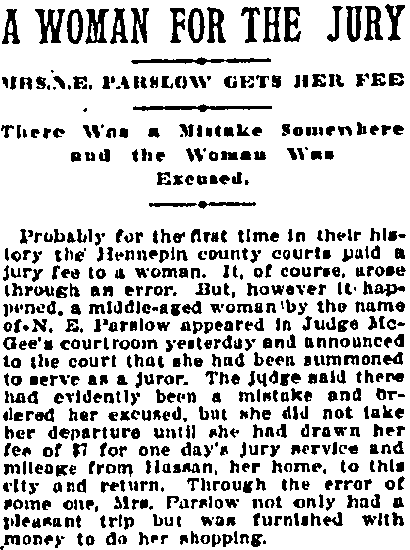
* Thanks to the wonders of database searches, research for this post also revealed a completely different legal drama off the same era related to a competely different Parslow. This story is from the Feb. 4, 1898 Minneapolis Journal.
** All reports do paint Cordelia Poirier as the stronger will in her adulterous relationship, as well as her marital one, and the instigator of the murder.
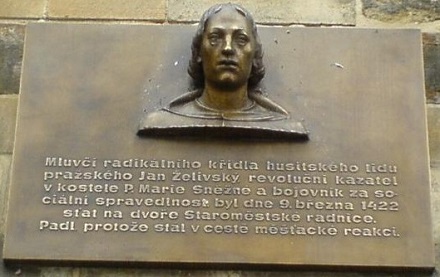
After the treacherous capture and execution of Jan Hus, the Hussite movement split between radical and moderate factions. The firebrand Zelivsky became the chief voice of the lower-class, radical Hussites and led the dramatic Defenestration of Prague wherein a Hussite mob pitched several Catholic city ministers out the window of the Prague town hall — triggering a revolution and 15 years of war.
Over the ensuing year, Zelivsky came to dominate politics in Prague. But he had to struggle for his power against both the external threat of Hapsburg armies, and the internal rivalry of moderate Hussites — and these factions did not scruple to deploy the executioner for mastery of Prague.
Zelivsky in the summer of 1421 mounted a coup against moderate Hussites who were negotiating with the Catholic nobility, and even executed some of those movement apostates. But power was wrested away from him in the ensuing months and he was arrested by surprise at a town meeting and secretly put to death.
On this date in 1715, the legendary outlaw Filip Mengstein was broken on the wheel in Dresden’s marketplace, along with four henchmen.
With the wiseguy nickname “Lips Tullian”, our cutthroat’s gangland derring-do cuts a truly timeless profile. But it happens that Lips did his cutting in the environs of Saxony and Bohemia, exploiting for many years lax domestic security in the Holy Roman Empire occasioned by the preoccupations of the Great Northern War. Legend has it that he was a former dragoon forced to take to the road around 1702 when he slew a comrade in a duel.
From wilderness haunts — there’s still a “Lips Tullian Hill” in Saxony’s Tharandt Forest — Tullian’s “Black Guard” gang sallied into towns to raid prosperous homes and churches. When caught, he had a knack for the dramatic breakout, returning again and again to his gang.
Alas, it was an unsuccessful escape attempt in 1713 that finally caused his captors of the day to realize who they had and put him to torture and, eventually, the brutal breaking-wheel execution.
Immortalized in subsequent folklore, especially in Bohemia, Lips Tullian is best noted recently as the subject of a popular 1970s Czech comic published (until Communist authorities suppressed it) by Mlady Svet. The illustrator Kaja Saudek based his Lips Tullian on the romantic 19th century interpretation of Kvidon de Felses — presenting him as a gold-hearted rogue with an impressively chiseled physique.
On this date in 1884, a Louisiana man named Noah Jackson was hanged at Lake Providence for beating in the brains of his 15-year-old wife during a fit of jealousy. (She’d been only 13 years old when they married.)
Meanwhile, in Corsicana, Tx., Harrison Williams hanged for murdering his sister-in-law Ada Sallard.
“The particulars in the murder case,” reported the Dallas Weekly Herald on June 28, 1883, “are as follows:”
Munroe Sallard and Harrison Williams, two colored men living on adjoining farms about five miles from town, married sisters. Williams has been abusing his wife ever since their marriage; on Monday morning Williams beat his wife in a brutal manner, and on being remonstrated with by her sister, Mrs. Sallard, told her that if she said a word he would kill her. Mrs. Sallard started for town on horseback to have him arrested, and when near the fairgrounds on her way home was way-laid by Williams, who took her from her horse, tied a handkerchief around her throat and then mashed her head to a shapeless mass with his boot heel. He then secreted her body in the woods, and went to her house and occupied the same bed with her husband, leaving yesterday morning [meaning June 26]. Since then he has not been seen. Her body was discovered in the woods yesterday evening, and last night an armed posse of negroes went in search of the murderer. If caught he will certainly dangle.
On this day last year, Al-Qaeda’s Ansar Al-Sharia group (Partisans of Islamic Law) executed an alleged American spy in the town of Shahr, in southeast Yemen.
Al-Qaeda also released a video (titled “An American Spy in the Arabian Peninsula”) in which a man calling himself Amin Abdullah Mohammed Al-Mu’alimi denounced himself as a spy and saboteur, who had placed tracking chips that enabled the U.S. to target militants with drones.
His bullet-riddled body was found lashed to the goalposts on a dirt football pitch.
Covenanter John Dick was hanged at the Grassmarket in Edinburgh on this date in 1684. He had been condemned for rebellion just the day before.
This divinity student had been due to swing the previous September, but broke out of Canongate Tolbooth with 24 others. Upon his re-arrest, the existing sentence was simply reinstated by the judges; Dick had only a single night between that sentence and his execution.
From the time the Protestant Reformation had launched 160-odd years prior to Dick’s death, the customary prerogative of the condemned to make a rostrum of the scaffold had become contested territory. Where once condemned thieves and murderers would make a last reconciliation with their fellows, now heretics made of their own deaths blazing confessional placards by seizing the language of martyrdom. (Paul Friedland addresses this phenomenon as part of the evolution of the execution “spectacle” in his excellent Seeing Justice Done: The Age of Spectacular Capital Punishment in France. We previously interviewed Friedland here.)
Scottish Covenanters too had this tradition — and likewise the authorities that put them to death the tradition of silencing the wrong message. All the more true given the intense partisan-religious alignments on the eve of the Glorious Revolution; the Whig party name derives from the Whiggamores — Covenanter raiders, whose association was meant to smear that faction.*
Dick, according to a friend who visited him in jail on the day of his hanging, was asked if he would pray at his gallows. “Yes, if ye permitt [sic] me,” he replied.
“You must not reflect upon authority in your prayers, so as there may be no offence taken,” one of Dick’s gaolers replied.
“I will pray no limited prayers; I will pray as Christ has taught me.”
Upon this response, there was a debate among Dick’s keepers. “Some were for suffering him to pray, and stopping him if he pleased them not,” our observer recorded, “but that was not thought fit, so he prayed none there [at the gallows].”
Although Dick had to be circumspect at his hanging, his fellow Presbyterians’ alignment with the soon-to-be-triumphant side in the Glorious Revolution would soon make Covenanter martyrologies a hot publication.
Illustration of Covenanter punishments (not Dick’s specifically) from A Cloud of Witnesses.
In Dick’s entry, we have a firm of heart last letter to his father penned on the morning of the devout youth’s execution.
Dear Sir, —
This hath been one of the pleasantest nights I have had in my lifetime. The competition is only betwixt it and that I got eleven years ago at Nesbit in Northumberland, where and when, in a barley ridge upon the Saturday’s night and Sabbath morning before the last communion I did partake of in Ford Church, the Lord firmly laid the foundation-stone of grace in my heart, by making me with my whole soul close with Him upon His own terms, that is, to take Him to be my King, Priest, and Prophet, yea, to be my all in all ; to renounce my own righteousness, which at best is but rotten rags, and to rest upon His righteousness alone for salvation; as also, to give myself entirely, without reserve, in soul, body, heart, affections, and the whole faculties of my soul and powers of my body, to be by Him disposed at His pleasure for the advancement of His glory, and the upbuilding of my own soul, and the souls of others; inserting this clause (being conscious to myself of great infirmity) that the fountain of free grace and love should stand open for me so long, and so oft as my case should call for it.
This my transaction with my ^whole soul, without the least ground of suspicion of the want of sincerity, which I found had been amissing in endeavours of that nature formerly, now my blessed Lord helped me to, or rather made in me, and solemnised that night and morning ere I came off that ridge.
I confirmed it no less than ten or twelve times, and the oftener I reiterated, the gale continued so fresh and vigorous, that I was forced to cry, Hold, Lord, for the sherd is like to burst: so that I hope my dearest Lord is now a-coming, and that the hands of Zerubbabel, who hath laid this foundation, is now about to finish it ; and, indeed, He is building very fast, for which my soul blesseth Him, desiring you may join with me in so necessary a work.
I hope, ere long, the copestone shall be put on, the result of all which shall be praises and shouting to Him that sits upon the throne, and to the Lamb throughout all the ages of eternity, of long-lasting eternity.
This, with my earnest prayers while in the body, that the Lord would help you to mind His glory, and your own soul’s eternal welfare, is all the legacy you can expect from him who is both,
Your affectionate son and Christ’s prisoner,
John Dick.
P.S. — I hope, ere I come home, to get another sight of you. Let none see this till I be in my grave. The Lord gave me to you freely, so I entreat you, be frank in giving me to Him again, and the more free this be, the less cause you shall have to repent.
* “Tories” comes from a word for an Irish (and Catholic) outlaw, and was conferred by the Whigs as a reciprocal calumny. It is not accidental that each term throws a non-English shade.
In extending [Cesare] Beccaria‘s views on capital punishment to the history of lynching in the West, one begins to see that the “violent passions” of the mob were regularly invoked to justify their actions, but as Beccaria predicted, these passions were often little more than a ruse to justify the cold-blooded — and often premeditated — lynching of an accused criminal. Taken as a whole, the case list demonstrates that by and large, lynching had as much to do with vengeance as with the pursuit of justice.
The frequent invocation of San Francisco’s vigilance committees in many of the case records is clearly intended to link extrajudicial execution to “tradition,” an essential element found in the Tuskegee definition of lynching.* On a formal level, well over 50 percent of lynching cases that give a time, record that the lynching took place between midnight and 2 a.m. when the accused was usually encouraged to confess his or her crimes before being strung up. Sometimes they were allowed to make a statement, to smoke a cigarette, or confess to a priest, and after it was over, the bodies would usually be left to hang through the night. This public display of the body can be found in every case, with the shortest times usually lasting around thirty minutes, and the longest, until the bodies decayed.
In one instance, in the small village of Newtown, an African American man known only as “Brown” was apprehended for stealing money. The evidence was completely circumstantial but he was found guilty and sentenced to be hung by the mob on March 4, 1852. Unfortunately for Brown, the rope was a little too long, and once he was hanged to the tree, the branch slowly gave way — until his legs dangled to the ground. Struggilng in agony, the poor man was cut down in order to be properly hanged. Once he was fully revived, he was tied to a higher branch and the whole process was repeated. When he was finally cut down, a physician was asked to examine the body, at which point he annunced that if Brown’s body was left above ground for five minutes that he would regain consciousness. As a result, “he was therefore hastily dumped into a grave that had been dug and was half full of water, and quickly covered from sight.” Whether completely true or not, it’s hard to imagine that anyone could argue that this killing really served the greatest good.
* The Tuskegee lynching definition: “there must be legal evidence that a person has been killed, and that he met his death illegally at the hands of a group acting under the pretext of service to justice, race, or tradition,” where “a group” connotes three or more persons.

 This nobleman’s conversion to Protestantism had been attended with the zeal so usual to that period. In the case of Conde (English Wikipedia link | French), that meant dipping his beak into some dramatic plotting.

 Cordelia Viau by her maiden name, the femme fatale in this transaction found that in her marriage to one Isidore Poirier she was much the sturdier spirit.
 With the wiseguy nickname