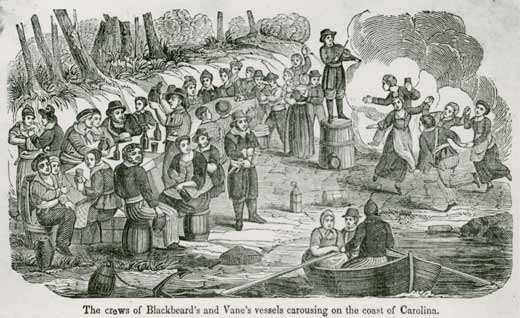
On this date in 1720, Charles Vane’s resilient pirate career finally came to the end of a noose.
Like his onetime lieutenant Calico Jack Rackham, Vane plundered the American coast and the Caribbean during the twilight heyday of the buccaneer.
The man had a gift. From 1716 to late in 1718, Vane looted dextrously, even boldly spurning a royal pardon the better to keep his loot and mounting a flamboyant escape from the armada subsequent sent to detain him.
If he had a weakness, it was not as a mariner but as a manager. A notoriously tyrannous captain, Vane saw one aide turn on him and escape with a ship and a second — the aforementioned Rackham — mount a seaborne coup after Vane judiciously refused to engage a larger French man-o-war.
Nothing daunted by the loss of his command, Vane set about rebuilding his fortunes by resuming the conquest of prizes. Little could he see that the day of piracy was fast drawing to a close, and his own hourglass running faster still.
For all the catastrophes visited on him by his confederates, it required the connivance of nature to do him in. Early in 1720, a hurricane obliterated his ship (and most of his crew); tough old Vane managed to wash up on a deserted island* … but was recognized by his “rescuers” and delivered up to the British governor of Jamaica, who strung him up within the week.
* Straight out of piracy central casting, no? Would you also believe his crew had a renowned “pirate party” rendezvous with Blackbeard’s?
On this date in 1757, Robert-Francois Damiens became the last Frenchman to suffer the dreadful punishment of drawing and quartering.
Damiens attempted to assassinate King Louis XV, inflicting, however, only a slight dagger wound.
He may be best-known today as the subject of the jarring opening passage of Foucault’s Discipline and Punish, in which the full flower of this medieval torture* is described in detail by way of contrasting it with the regimented penal institutions that would sprout up in a few decades’ time. Here’s Foucault’s rendering of the scene:
On 1 March 1757 Damiens the regicide was condemned “to make the amende honorable before the main door of the Church of Paris”, where he was to be “taken and conveyed in a cart, wearing nothing but a shirt, holding a torch of burning wax weighing two pounds”; then, “in the said cart, to the Place de Grève, where, on a scaffold that will be erected there, the flesh will be torn from his breasts, arms, thighs and claves with red-hot pincers, his right hand, holding the knife with which he committed the said parricide, burnt with sulphur, and, on those places where the flesh will be torn away, poured molten lead, boiling oil, burning resin, wax and sulphur melted together and then his body drawn and quartered by four horses and his limbs and body consumed by fire, reduced to ashes and his ashes thrown to the winds” (Pièces originales…, 372-4).
“Finally, he was quartered,” recounts the Gazette d’Amsterdam of 1 April 1757. “This last operation was very long, because the horses used were not accustomed to drawing; consequently, instead of four, six were needed; and when that did not suffice, they were forced, in order to cut off the wretch’s thighs, to sever the sinews and hack at the joints…
“It is said that, though he was always a great swearer, no blashemy escaped his lips; but the excessive pain made him utter horrible cries, and he often repeated: ‘My God, have pity on me! Jesus, help me!’ The spectators were all edified by the solicitude of the parish priest of St Paul’s who despite his great age did not spare himself in offering consolation to the patient.”
Bouton, an officer of the watch, left us his account: “The sulphur was lit, but the flame was so poor that only the top skin of the hand was burnt, and that only slightly. Then the executioner, his sleeves rolled up, took the steel pincers, which had been especially made for the occasion, and which were about a foot and a half long, and pulled first at the calf of the right leg, then at the thigh, and from there at the two fleshy parts of the right arm; then at the breasts. Though a strong, sturdy fellow, this executioner found it so difficult to tear away the pieces of flesh that he set about the same spot two or three times, twisting the pincers as he did so, and what he took away formed at each part a wound about the size of a six-pound crown piece.
“After these tearings with the pincers, Damiens, who cried out profusely, though without swearing, raised his head and looked at himself; the same executioner dipped an iron spoon in the pot containing the boiling potion, which he poured liberally over each wound. Then the ropes that were to be harnessed to the horses were attached with cords to the patient’s body; the horses were then harnessed and placed alongside the arms and legs, one at each limb.
“Monsieur Le Breton, the clerk of the court, went up to the patient several times and asked him if he had anything to say. He said he had not; at each torment, he cried out, as the damned in hell are supposed to cry out, ‘Pardon, my God! Pardon, my Lord.’ Despite all this pain, he raised his head from time to time and looked at himself boldly. The cords had been tied so tightly by the men who pulled the ends that they caused him indescribable pain. Monsieur le [sic] Breton went up to him again and asked him if he had anything to say; he said no. Several confessors went up to him and spoke to him at length; he willingly kissed the crucifix that was held out to him; he opened his lips and repeated: ‘Pardon, Lord.’
“The horses tugged hard, each pulling straight on a limb, each horse held by an executioner. After a quarter of an hour, the same ceremony was repeated and finally, after several attempts, the direction of the horses had to be changed, thus: those at the arms were made to pull towards the head, those at the thighs towards the arms, which broke the arms at the joints. This was repeated several times without success. He raised his head and looked at himself. Two more horses had to be added to those harnessed to the thighs, which made six horses in all. Without success.
“Finally, the executioner, Samson, said to Monsieur Le Breton that there was no way or hope of succeeding, and told him to ask their Lordships if they wished him to have the prisoner cut into pieces. Monsieur Le Breton, who had come down from the town, ordered that renewed efforts be made, and this was done; but the horses gave up and one of those harnessed to the thighs fell to the ground. The confessors returned and spoke to him again. He said to them (I heard him): ‘Kiss me, gentlemen.’ The parish priest of St Paul’s did not dare to, so Monsieur de Marsilly slipped under the rope holding the left arm and kissed him on the forehead. The executioners gathered round and Damiens told them not to swear, to carry out their task and that he did not think ill of them; he begged them to pray to God for him, and asked the parish priest of St Paul’s to pray for him at the first mass.
“After two or three attempts, the executioner Samson and he who had used the pincers each drew out a knife from his pocket and cut the body at the thighs instead of severing the legs at the joints; the four horses gave a tug and carried off the two thighs after them, namely, that of the right side first, the other following; then the same was done to the arms, the shoulders, the arm-pits and the four limbs; the flesh had to be cut almost to the bone, the horses pulling hard carried off the right arm first and the other afterwards.
“When the four limbs had been pulled away, the confessors came to speak to him; but his executioner told them that he was dead, though the truth was that I saw the man move, his lower jaw moving from side to side as if he were talking. One of the executioners even said shortly afterwards that when they had lifted the trunk to throw it on the stake, he was still alive. The four limbs were untied from the ropes and thrown on the stake set up in the enclosure in line with the scaffold, then the trunk and the rest were covered with logs and faggots, and fire was put to the straw mixed with this wood.
“…In accordance with the decree, the whole was reduced to ashes. The last piece to be found in the embers was still burning at half-past ten in the evening. The pieces of flesh and the trunk had taken about four hours to burn. The officers of whom I was one, as also was my son, and a detachment of archers remained in the square until nearly eleven o’clock.
“There were those who made something of the fact that a dog had lain the day before on the grass where the fire had been, had been chased away several times, and had always returned. But it is not difficult to understand that an animal found this place warmer than elsewhere” (quoted in Zevaes, 201-14).
Among the throngs in attendance that day was Casanova who, according to his memoirs, rented out a windowed flat to watch that stomach-churning torture for four hours with some male friends and female companions.
One of the legendary libertine’s friends found this moment, serenaded by the prisoner’s “piercing shrieks”, opportune for an altogether different adventure of the flesh:
The three ladies packing themselves together as tightly as possible took up their positions at the window, leaning forward on their elbows, so as to prevent us seeing from behind. The window had two steps to it, and they stood on the second; and in order to see we had to stand on the same step, for if we had stood on the first we should not have been able to see over their heads. I have my reasons for giving these minutiae, as otherwise the reader would have some difficulty in guessing at the details which I am obliged to pass over in silence.
…
Tiretta kept the pious aunt curiously engaged during the whole time of the execution, and this, perhaps, was what prevented the virtuous lady from moving or even turning her head round.
Finding himself behind her, he had taken the precaution to lift up her dress to avoid treading on it. That, no doubt, was according to the rule; but soon after, on giving an involuntary glance in their direction, I found that Tiretta had carried his precautions rather far, and, not wishing to interrupt my friend or to make the lady feel awkward, I turned my head and stood in such a way that my sweetheart could see nothing of what was going on; this put the good lady at her ease. For two hours after I heard a continuous rustling, and relishing the joke I kept quiet the whole time. I admired Tiretta’s hearty appetite still more than his courage, but what pleased me most was the touching resignation with which the pious aunt bore it all.
Casanova’s Complete Memoires are available free online; this episode is recounted in the first chapter of “Paris and Holland”.
* Damiens’ punishment was in fact already archaic at the point when it was inflicted. Somewhat unsure of itself, the court sought precedent in the last regicide executed — Francois Ravaillac, who in 1610 was also the most recent person to suffer this horrific penalty. The clumsiness of the Damiens’ execution can surely be attributed to the art being a century and a half out of practice.
On this date in 922, Sufi Mansur al-Hallaj was put to a torturous end in Baghdad — either crucifixion, dismembering, or both — for “theological error threatening the security of the state.”
Born in Persia, al-Hallaj traveled widely from India to Mecca, eventually settling in Baghdad, the capital of the Abassid Empire.
Ana al-Haqq
Al-Hallaj espoused the mystical Islamic school of Sufism and produced gorgeouspoetry.
Most particularly, saying “ana al-Haqq” — “I am God” — and poems directly identifying himself with divinity were thought by the state theologians to have mystical wisdom for initiates, but to be exceedingly dangerous sentiments to set loose among the hoi polloi, especially given popular devotion to the Abassid government that was less than ironclad.
In truth, al-Hallaj’s condemnation seems to have been rooted in contemporary imperial politics, his demise representing the (momentary) upper hand of the more autocratic elements against potentially more sympathetic parties.
He spent eleven years in a Baghdad jail, reportedly enduring torture with placidity. Accounts of his execution speak of him greeting a horrific death with joy.
Mansur al-Hallaj remains revered today among mystically inclined followers of many faiths and admired by many westerners, factors which do not quite resolve the dispute over his place within Islam. Ultimately, the rightness of his choices remains very much in the eye of the beholder.
On this date in 1977, the former president of the Congo, Alphonse Massamba-Debat, was summarily shot after his successor was assassinated.
A teacher by training and a member of the country’s powerful namesake tribe, Massamba-Debat (the link is to his French wikipedia page, which has considerably more information than the English entry) was a government minister who took power in a 1963 military coup that overthrew the former French territory’s first post-colonial government.
In a revolutionary age, Massamba-Debat swung with a Marxist-Leninist ideology. He ran a one-party state — winning a post-coup 1963 election by the comfortable margin of 100-0 — and met with Che Guevara during the latter’s African mission, while also setting up the first stirrings of industrialization.
The mix of true belief and opportunism in that formula is anyone’s guess; the brutality of his militias steadily eroded his “unanimous” popular support, and in 1968 he was toppled by another leftist, Marien Ngouabi.
That marked the end of Massamba-Debat’s meaningful political career.
Oddly, he was tried immediately after his overthrow for some of his regime’s notable political murders, but was acquitted and allowed to retire to his village: the new government plainly didn’t consider him much of a threat.
But when Ngouabi was assassinated in his turn on March 18, 1977 — for causes that remain unclear but that may have had to do with French energy interests in the region — the army seized control and purged numerous officials for supposed participation in the plot. Massamba-Debat, notwithstanding a dearth of evidence actually implicating him, was by virtue of being an overthrown former ruler far enough under the shadow of official distrust to find his name on that deadly list.
Massamba-Debat was officially rehabilitated in 1991, and is now far enough clear from the taint of treachery against his still-popular successor to have a stadium named after him. (the link is in French)
On this date in 1944, Nazi troops occupying Italy avenged a partisan attack by executing 335 Italian hostages in the Ardeatine caves outside Rome.
Part of the cave complex where the massacres took place, barred by a decorative gate.
It was six months since Germany had invaded her onetime ally, eliminating those fascists who had deposed Mussolini. Now an occupied country — an increasingly tenuous occupation as the Allied war effort bore down on Germany — Italy’s partisans multiplied.
On March 23, some of them bombed a German army column, killing 33.
The Germans ordered an immediate reprisal, although there were administrative debates over how many hostages to shoot for each casualty. Hitler initially ordered a staggering 100:1 ratio, the sort of boundary-pushing command that makes 10:1 look like the choice of moderate, reasonable mass-murderers.
A motley collection was hastily assembled to fill the quota: regular prisoners, captured partisans, men from the neighborhood and from the Jewish community rounded up randomly,* even a young Italian diplomat (the link is in Italian) being held as a political suspect. So hastily was it done, the killers miscounted the harvest — as one later explained in a deposition:
Q. It was discovered that the number of people killed was more than intended, five extra. Can you explain that to us?
A. [At the Ardeatine,] Priebke was there with the copy of the list. He got the people down [off the trucks] and canceled out their names. At a certain point, one of the prisoners was not on Priebke’s list. At the end, in fact, there were five extra men. That was when Kappler said, “What do I do with these five? They’ve seen it all.”
For much of this day, in groups of five in these manmade caves that form part of the ancient catacomb network, German soldiers went about their sanguinary business. The bodies were stacked; some of the caves dynamited — as surely many Germans realized it would not be many months before the less that was known of such crimes, the better.
But publicity is the point of reprisals, after all, and the five extra men were far from the only ones who had seen the awful business. The butchery was known from the very next morning.
Intended to alienate leftist partisans from the general populace, the massacre instead united Italians of every stripe in disgust. Even the Italian fascists were horrified; according to Richard Lamb’s War in Italy 1943-1945, Mussolini ordered all political prisoners released to safeguard them from a repeat performance.
Like many wounds of the Second World War, this infamous war crime is far from healed over.
For one thing, the Pope was notably — outrageously — silent about a crime in his own back yard and directed largely against his own flock, feeding charges of Vatican collaboration.
For another thing, there was far from a complete accounting for its authors after Italy’s liberation. An American investigative series famously caught one of the massacre’s perpetrators, onetime Gestapo officer (and little apologetic about it) Erich Priebke, living in Argentina — in 1990.
And finally, the affair, or more particularly the partisan bombing that precipitated the massacre, has been the subject of postwar critique and revisionism, especially given the years of terrorist tit-for-tat between far-right and far-left factions that followed the war. Just last year, an Italian court intervened in the historical dispute, ruling against a Berlusconi newspaper’s campaign to smear the resistance with responsibility for this day’s executions.
* Notorious informer Celeste di Porto, “the black panther,” reputedly helped fill up the rolls by fingering Jews. A childhood friend of hers, Lazzaro Anticoli, scribbled before his execution, “If I never see my family again, it is the fault of that sellout Celeste di Porto. Avenge me.” According to Susan Zuccotti, the informer had had Anticoli’s name added at the last minute to bump her own brother off the list; di Porto’s Italian Wikipedia page charges her with responsibility for 26 of the Ardeatine victims. She was almost lynched at one point after the war for collaborating; she spent seven years in jail.
[audio:John_Merbecke_Creed.mp3] (Part of John Merbecke‘s plainsong rendition of the Book of Common Prayer, as performed by the Virginia Theological Seminary motet choir. Via.)
Good Friday falls early this year, and gives pause to recollect the burning this date of Thomas Cranmer, Henry VIII’s Archbishop of Canterbury, author of this gentle prayer for Holy Week:
Almighty and everliving God, who, of thy tender love towards mankind, hast sent thy Son our Savior Jesus Christ to take upon him our flesh, and to suffer death upon the cross, that all mankind should follow the example of his great humility: Mercifully grant that we may both follow the example of his patience, and also be make partakers of his resurrection; through the same Jesus Christ our Lord, who liveth and reigneth with thee and the Holy Spirit, one God,for ever and ever. Amen.
Thomas Cranmer was an obscure middle-aged priest when happenstance acquainted him with the circle then endeavoring to engineer Anne Boleyn‘s elevation from Henry VIII‘s enamored to Queen of England.
Cranmer enthusiastically supported Henry’s position that his first marriage to Catherine of Aragon should be annulled, and the perspicacity of the doctrinal case he developed to that effect saw him admitted into the inner circle of royal theologians.
The papal case foundered because Catherine’s kinsman Charles V happened, in the course of politics on the Italian peninsula, to be holding the pope a virtual hostage in Rome. On such accidents of history do faiths arise — and the faithful burn.
The Break With Rome
The 16th century, yeasty with religious disputation widely circulated by the printing press, is thick with folk who are one sect’s martyrs and the other sect’s villains.
Cranmer is just such a character.
One could charge him — and Catholic partisans have, many times — with blowing with the wind, granting theological license to the whims of his sovereign. Henry pressed through Cranmer’s appointment as Archbishop of Canterbury in 1533, just in time for Cranmer to annul Henry’s marriage to Catherine and validate the secret vows he had taken with Anne, earning both bishop and king excommunication.
That Cranmer rose with Anne but was ready to hold against her when she fell from favor, that he authorized the king’s famous pattern of discarding his past wives, that he signed off on the crown’s seizure of monasteries — that, in the end, he navigated Henry’s bloody reign with his position intact and even enhanced puts the whiff of opportunism about him. As Cranmer expert Ashley Null says (the link is a .pdf):
Like his first royal master, Cranmer did not make himself easy to love. In an era noted for the fervent courage of many martyrs for faith, Cranmer’s very survival under a king as unprincipled, or at least unpredictable, as Henry VIII has made him suspect. His late vacillation under Mary has only seemed to confirm the image of a man ruled more by the grip of fear than the assurance of the faith.
Whatever kernel of truth one might discern in such a charge, the fact remains that the church Cranmer built has by the test of centuries proven itself far more spiritually significant than mere opportunism could have admitted.
The Archbishop truly came into his own after Henry’s death.
For six years during the regency of Henry’s sickly, doomed son Edward VI, Cranmer hammered together the Anglican liturgy, wrote prolifically and beautifully, and assembled the Book of Common Prayer, a text which still guides Anglican services to this day.
His words still retain their power, and in some cases, their recognizability:
One can read Cranmer, especially in this mature stage, through many prisms — the competing threads of Catholicism, Lutheranism and Calvinism in his developing thought; the attempt to steer his institutional church towards his vision of the Reformation; and certainly as an inconstant individual — for his recantation when the Catholic Mary Tudor took the throne shows us a man as prone as any to folly and weakness.*
It is not the headsman’s purpose, and certainly not on this day, to render judgment on Cranmer’s soul; still less to unpack his theology. If we find him a man of flaws to compensate his genius, we must do him the justice of remembering also his firmness at the last hour, dramatically abjuring the recantation that had been forced upon him and thrusting the offending right hand that had signed it first into the flames.
* Cranmer had endorsed Mary’s rival Lady Jane Grey in the contentious succession that followed Edward VI; for this, he was convicted of treason in a trial managed by his old friend and fellow-survivor Thomas Howard. (Source) The Queen spared him execution on this charge in order to have him up on heresy instead, and it was this that Cranmer attempted to avoid by submission to the pope.
On this date in 1933, Giuseppe Zangara went to Florida’s electric chair for the murder of Chicago mayor Anton Cermak — the man he had accidentally shot while attempting to assassinate President-elect Franklin Delano Roosevelt.
Zangara had to stand on a chair to take the shot: he was only five feet tall. This image is from Miami Police of Yesterday, a site by a descendant of one of the officers who arrested Zangara.
On February 15, 1933, at a Roosevelt speech in Miami’s Bayfront Park, Zangara perched himself on a metal folding chair within ten meters of the man who was then President-elect, but somehow managed to miss him. A bystander, Lillian Cross, grabbed his arm, and others in the crowd wrestled him down.
Certainly Zangara would be better remembered if he had shot Roosevelt (and Roosevelt would be very much less remembered), but his head-scratching persona accounts for at least some of his obscurity.
He’s sometimes called an anarchist — the early 20th-century equivalent of calling him a terrorist — and he talked the talk. Here, his last words:
You give me electric chair. I no afraid of that chair! You one of capitalists. You is crook man too. Put me in electric chair. I no care! Get to hell out of here, you son of a bitch [said to the chaplain] … I go sit down all by myself… Viva Italia! Goodbye to all poor peoples everywhere!… Lousy capitalists! No picture! Capitalists! No one here to take my picture. All capitalists lousy bunch of crooks. Go ahead. Pusha da button!
Zangara was a working-class immigrant. But his specific motivation for murdering Roosevelt seems murky at best — there’s no clear subversive organization or cause with which Zangara seemed a dedicated fellow-traveler. The wikipedia page about him describes his lifelong stomach pains as the cause of his act, which seems a queer thing to make a fellow shoot a president.
The major conspiracy proposal, that the anti-mob mayor Cermak was the real target all along of a mafia-engineered hit (here (.doc) is a version) is highly speculative, to put it generously. (Update: More on this here, via Chicagoland) Certainly Zangara might have been, as he claimed and most believe, a lone nut — many have done worse for less cause.
The world didn’t have long to unravel this man’s mysteries; justice moved with a rapidity terrifying even by the standards of the time — as reflected in the title of one of the books about him, The Five Weeks of Giuseppe Zangara.
Zangara had already been sentenced to a long prison term for the several bystanders his errant shots had struck when Anton Cermak finally succumbed — after 19 painful days — to a gut shot. Two weeks after that, his killer was dead, too.
During his first trial, the judge pressed him on his motivation, as reported in a press clipping that became part of Zangara’s FBI file:
Q. Have you ever been in jail before? Ever been in any trouble?
A. No, this is the first time.
Q. Did you ever hurt anyone before?
A. No, me no hurt anyone.
…
Q. Did you plan this shooting?
A. No.
Q. When did you decide to do it?
A. I got it in my mind capitalist hurt people. They are to blame for my stomach hurting. My stomach was hurting bad. It was like I was on fire. It burns my mind, I act like a drunken man. It came in my mind when I was suffering.
At this trial — the one before Cermak died — he pled unsuccessfully for execution: “I am sorry only because I did not kill. I am sorry about nothing. Put me in the electric chair.” It reads like “suicide by cop”.
Zangara might not be a name of Oswaldesque dimensions among the assassinariat, but he comes in for a scene in Stephen Sondheim’s strange musical theater, Assassins.
Officially, Zangara was punished for the man he killed, not the soon-to-be-President he was (presumably) aiming at. But such a close scrape for such a transformative American leader, a man sometimes credited with saving capitalism from itself in an age of crisis, has made Zangara’s one famous act fodder for alternative history that asks the question “what might have been?”
On this date in 1600, five former supporters of King Sigismund were beheaded at Linköping, as Sweden broke free of Poland and of Catholicism.
Eighty years before, the Swedish Vasa dynasty had established itself by surviving one bloodbath. Now, it would set its greatest scion in line for the throne by inflicting another.
Sigismund was Sweden’s legitimate heir; he was also a characteristic product of dynastic intermarriage whose loyalties were splintered between fiefdoms. But most crucially of all, he had been raised Catholic in a realm turning decisively towards Protestantism.
Born of a Polish-Italian mother, he had secured the Polish-Lithuanian throne by election in 1589; when succession added suzerainty of Sweden, his realm was a personal union stretching across central Europe from the Arctic Circle to the Black Sea.
Which looked better on paper than it would work in practice.
The persecutory stage of the Catholic counter-reformation had been in full throat this past half-century, and the accession of a Catholic prince raised a Scandinavian alarm.
Busy governing Poland, Sigismund left his Protestant uncle Duke Charles to administer Sweden; within five years, civil war had erupted between the two and in short order the victorious soon-to-be King Charles IX had occasion to make example of the nobles who had backed Sigismund’s cause.
Charles himself would be a transitional figure in Sweden, but what a transition: his victory made possible the the subsequent scintillating reign of his son, Gustavus Adolphus — the able commander who would raise Sweden into a true European power.*
There would be an interesting coda in that reign to this day’s doings. Gustavus’ greatest general, Johan Banér, was the son of one of those put to death in Linköping. In another time, between other men, that one fellow’s father had seen the other fellow’s butchered might have put a blood feud between them. But as young men — the king was just 18 months his senior — they formed a permanent friendship, upon which they founded the military collaboration that shook northern Europe.
“My dad beheaded your dad”
“Let’s play!”
* Among Gustavus Adolphus’ numerous exploits was war with his father’s old rival — that is, with his cousin Sigismund — in the 1620s. Foreign relations between Sweden and Poland had turned understandably frosty, with Sigismund spending the rest of his long life eyeballing the lost crown.
On this date in 1741,* at Tyburn‘s largest mass-execution of the mid-18th century, renowned cutpurse Jenny Diver was hanged along with 19 others.
Born Mary Young in Ireland around 1700, the girl was abandoned as a child but deserted a benefactor’s household to take passage to London where she meant to work as a seamstress.
What the Newgate Calendar reads as ingratitude, the modern reader might more sympathetically see as the allure of a burgeoning city for a teenager full of dreams.
Dreams may nurture the spirit, but flesh must have bread. Like countless others through time — indeed, like countless other clients of Tyburn — Jenny found metropolis less than convivial to aspirations of honest labor.
Unable to live on her stitching, Jenny found more lucrative employment for her manual dexterity in a sizable gang of thieves — of which her uncovered criminal puissance gave her mastery.
The Newgate Chronicle bursts with almost doting memoirs of her agile fingers, like this one:
[S]he procured a pair of false hands and arms to be made, and concealing her real ones under her clothes she repaired on a Sunday evening to the place of worship above mentioned in a sedan-chair, one of the gang going before to procure a seat among the more genteel part of the congregation, and another attending in the character of a footman.
Jenny being seated between two elderly ladies, each of whom had a gold watch by her side, she conducted herself with seeming great devotion; but when the service was nearly concluded she seized the opportunity, when the ladies were standing up, of stealing their watches, which she delivered to an accomplice in an adjoining pew.
Not neglecting also to celebrate the gang’s more Sting-like ruses, like this hilarious turn of the tables on a credulous cuckolder:
Jenny dressed herself in an elegant manner, and went to the theatre one evening when the king was to be present; and during the performance she attracted the particular attention of a young gentleman of fortune from Yorkshire, who declared, in the most passionate terms, that she had made an absolute conquest of his heart, and earnestly solicited the favour of attending her home. She at first declined a compliance, saying she was newly married, and that the appearance of a stranger might alarm her husband. At length she yielded to his entreaty, and they went together in a hackney-coach, which set the young gentleman down in the neighbourhood where Jenny lodged, after he had obtained an appointment to visit her in a few days, when she said her husband would be out of town.
…
The day of appointment being arrived, two of the gang appeared equipped in elegant liveries, and Anne Murphy [another thief] appeared as waiting-maid. The gentleman came in the evening, having a gold-headed cane in his hand, a sword with a gold hilt by his side, and wearing a gold watch in his pocket, and a diamond ring on his finger.
Being introduced to her bed-chamber, she contrived to steal her lover’s ring; and he had not been many minutes undressed before Anne Murphy rapped at the door, which being opened, she said, with an appearance of the utmost consternation, that her master was returned from the country. Jenny, affecting to be under a violent agitation of spirits, desired the gentleman to cover himself entirely with the bed-clothes, saying she would convey his apparel into another room, so that if her husband came there, nothing would appear to awaken his suspicion: adding that, under pretence of indisposition, she would prevail upon her husband to sleep in another bed, and then return to the arms of her lover.
The clothes being removed, a consultation was held, when it was agreed by the gang that they should immediately pack up all their moveables, and decamp with their booty, which, exclusive of the cane, watch, sword, and ring, amounted to an hundred guineas.
The amorous youth waited in a state of the utmost impatience till the morning, when he rang the bell, and brought the people of the house to the chamber-door, but they could not gain admittance, as the fair fugitive had turned the lock, and taken away the key; when the door was forced open the gentleman represented in what manner he had been treated; but the people of the house were deaf to his expostulations, and threatened to circulate the adventure throughout the town, unless he would indemnify them for the loss they had sustained. Rather than hazard the exposure of his character, he agreed to discharge the debt Jenny had contracted; and dispatched a messenger for clothes and money, that he might take leave of a house of which he had sufficient reason to regret having been an inhabitant.
Alas to say, they all can’t come off like clockwork. Jenny was caught a couple of times, dodging the noose in 1733 and 1738, sentenced on both occasions to transportation to the American colonies.
Finding little to recommend colonial Virginia, she returned illegally from both sentences at the risk of her life (she only survived her second arrest by passing herself off under an alias). The third time broke the charm, however: one is saddened to find her in her last adventure nabbed like a tyro trying to pick a younger woman’s pocket of a few shillings. The victim snatched Jenny’s wrist in the act: perhaps those nimble hands, now pushing 40, had finally slowed down.
Jenny Diver’s hands, in their time, had profited her far more than needlework could have; they had given her a life of some comfort to compensate its perils; and at the end, they afforded their owner the last indulgence of a “mourning coach,” an enclosed carriage separate from the carts that hauled this day’s other 19 (unrelated) victims.
It was a rowdy hanging day with an unusual guard detail of soldiery: one of the prisoners had reported a pending rescue attempt, and for her resources and gang affiliations, Jenny was thought to be its intended beneficiary. (If the stool pigeon was hoping his own tattling would reprieve him, he was disappointed.) For reasons related or not, the crowd was in an ugly mood, as reported by the Newgate Ordinary:
In this Manner were they convey’d through a vast Multitude of People to Tyburn, some of whom, notwithstanding the Guard of Soldiers, were very rude and noisy, hallooing, throwing Brickbats, Mud, &c. at the unhappy Prisoners, as they passed.
We also have a modern context** for the name “Jenny Diver” as one of several women mentioned in the song “Mack the Knife”:
This song is an English riff on a German tune from The Threepenny Opera, concerning its principal male character, the highwayman Macheath. (Possibly inspired by the recently-executed Jack Sheppard.)
The Threepenny Opera updated the 18th-century Beggar’s Opera, a satiric (and extraordinarily popular) production setting operatic tropes among society’s whores, criminals and castoffs.
The sequence of female names Bobby Darin rattles off in this version of “Mack the Knife” all draw from these operas: Suky (sometimes Sukey or Sukie) Tawdry and Jenny Diver are underworld women in The Beggar’s Opera who set Macheath up for arrest; Lucy Brown is The Threepenny Opera‘s version of the original character Lucy Lockit, who under either name is the daughter of a law enforcement officer in love with Macheath who helps him escape.†
One might suppose such a fortuitous connection of Jenny Divers was a calculated one, but it seems both the character’s name and the thief’s were independently and coevally drawn from the rich vein of English thieves’ cant.
Strictly coincidental.
“Diver” as street slang for a pickpocket dated back 150 years, according to Philip Rawlings, so it was a natural sobriquet for an expert thief … and for an author (whose script is chock full of suggestively-named characters — Wat Dreary, Molly Brazen, Jemmy Twitcher) conjuring such a character. There’s no direct evidence indicating that either the cutpurse or the dramatist knowingly cribbed from the other.
A pity it was for the real Jenny that art and life couldn’t imitate one another more strongly.
PLAYER. But, honest Friend, I hope you don’t intend that Macheath shall be really executed.
BEGGAR. Most certainly, Sir.—-To make the Piece perfect, I was for doing strict poetical Justice—-Macheath is to be hang’d; and for the other Personages of the Drama, the Audience must have suppos’d they were all hang’d or transported.
PLAYER. Why then Friend, this is a downright deep Tragedy. The Catastrophe is manifestly wrong, for an Opera must end happily.
BEGGAR. Your Objection, Sir, is very just, and is easily remov’d. For you must allow, that in this kind of Drama, ’tis no matter how absurdly things are brought about—-So—-you Rabble there—-run and cry, A Reprieve!—-let the Prisoner be brought back to his Wives in Triumph.
* 1740, according to the original documentation; 1741 by modern reckoning, since the new year’s onset was at the time not recognized on January 1.
† The fourth name of the sequence originally was Polly Peachum, Lucy’s rival for Macheath’s affections — but when Louis Armstrong made the first popular recording of Mack the Knife, he ad-libbed the line “Look out for Miss Lotte Lenya!” referring the actress who played PollyJenny in both the original German production and the then-current Broadway importation, and who also happened to be present at Armstrong’s recording. Darin’s subsequent (and eventually canonical) version followed that lead and replaced the original name outright.
On this date in 1915, four French corporals were shot at a farm in Suippes for refusing to advance out of their trenches through the carnage of a World War I no man’s land.
It was not only Corporals Theophile Maupas, Louis Lefoulon, Louis Girard and Lucien Lechat who had refused. The entire 21st Company of the 336th Infantry regiment, exhausted and already decimated by combat, was ordered over the trench at dawn on March 10.
Under withering machine gun fire, and with French artillery carelessly dropping shells just in front of their own lines, the 21st stayed put. Frantic to force the advance, the French commander ordered artillery to drive the troops ahead by shelling his own trenches — an order the artillerists refused to carry out unless someone put it in writing.*
In that slaughterhouse of trench warfare, insubordination in the ranks met stern reprisals. Generals with no strategy but to make mincemeat of their countrymen could not well abide the meat’s reluctance to be minced. Examples must be made, especially inasmuch as the impracticality of executing entire companies impressed even the brass.
On March 16, six corporals and 18 soldiers of the intransigent company faced military trial in the Suippes town hall; the four condemned were shot the next day and buried under dishonorable black crosses.
According to Shot At Dawn, a campaign for rehabilitating soldiers executed during World War I, France carried out some 600 military executions during those bloody years, more than any other country. A 1999 study numbered 550 French executions. In an essay in Handbook on Death and Dying, Prof. J. Robert Lilly suggests that many more “unofficial” executions may have taken place, especially during the war’s panicked opening stages.
Whatever their precise number, the shootings, around Europe, of hundreds of men for cowardice — most in obscurity, many chosen arbitrarily, some whose descendants still struggle for recognition to this day — is one of the enduring legacies of World War I: the collision of that most individual penalty with that most faceless and indiscriminate war. A witness to a different French military execution discomfitingly describes the near-total dehumanization of the victims:
The two condemned were tied up from head to toe like sausages. A thick bandage hid their faces. And, a horrible thing, on their chests a square of fabric was placed over their hearts. The unfortunate duo could not move. They had to be carried like two dummies on the open-backed lorry, which bore them to the rifle range. It is impossible to articulate the sinister impression the sight of those two living parcels made on me.
The padre mumbled some words and then went off to eat. Two six-strong platoons appeared, lined up with their backs to the firing posts. The guns lay on the ground. When the condemned had been attached, the men of the platoon who had not been able to see events, responding to a silent gesture, picked up their guns, abruptly turned about, aimed and opened fire. Then they turned their backs on the bodies and the sergeant ordered “Quick march!”
The men marched right passed them, without inspecting their weapons, without turning a head. No military compliments, no parade, no music, no march past; a hideous death without drums or trumpets.
The shootings this day became emblematic of those lost and obscured legions. The circumstances of the “crime” — the senselessness of the advance, the order to bombard their own troops, the fury of the reprisal — recommended it to novelist Humphrey Cobb, and subsequently to a young Stanley Kubrick who adapted a fictionalized form to the 1957 film Paths of Glory. (The title comes from this poem.)
In the film, three soldiers face a firing squad under circumstances very similar to this day’s backstory, including the detail of the general ordering his own men shelled (and that of the order being refused). Kubrick renders the insanity of the resulting court-martial against hapless soldiers each of whom did little but what anyone in their situation would have done, with one of their officers, Kirk Douglas, mounting a vain defense.
This day’s executions, as with many of the others carried out across Europe in those years, sparked a long campaign for posthumous exoneration, in this case led by Maupas’ widow. In 1934, a French panel did exonerate them — awarding the surviving widows a symbolic one franc apiece.
Maupas himself was reinterred in a cemetery in Sartilly, where a monument was erected in honor of the four; just last year, opposite the courthouse where the Frenchmen were condemned, a life-sized white stone sculpture was dedicated, showing Maupas, Girard, Lechat and Lefoulon on their execution posts just after they have been shot.
The surety of the corporals’ posthumous exoneration contrasts intriguingly with the rigor of their sentence and points to the complex and shifting terms upon which the First World War entered subsequent national consciousness in France (and elsewhere) — the never-definitive story of the individual’s right place amid social structures hopelessly beyond individual control.

 Like his onetime lieutenant Calico Jack Rackham, Vane plundered the American coast and the Caribbean during the twilight heyday of the buccaneer.
 “Finally, the executioner, Samson, said to Monsieur Le Breton that there was no way or hope of succeeding, and told him to ask their Lordships if they wished him to have the prisoner cut into pieces. Monsieur Le Breton, who had come down from the town, ordered that renewed efforts be made, and this was done; but the horses gave up and one of those harnessed to the thighs fell to the ground. The confessors returned and spoke to him again. He said to them (I heard him): ‘Kiss me, gentlemen.’ The parish priest of St Paul’s did not dare to, so Monsieur de Marsilly slipped under the rope holding the left arm and kissed him on the forehead. The executioners gathered round and Damiens told them not to swear, to carry out their task and that he did not think ill of them; he begged them to pray to God for him, and asked the parish priest of St Paul’s to pray for him at the first mass.
 A teacher by training and a member of the country’s powerful namesake tribe,