On this date in 1953, Derek William Bentley was hanged by Albert Pierrepoint in London’s Wandsworth Prison for a murder committed by a friend.
The execution of the mentally impaired 19-year-old was a lightning rod when it was pronounced the previous December and remained so over a half-century struggle for his posthumous pardon.
He had been caught robbing a warehouse with an underage friend in November 1952, and in the gunfight that ensued, a police officer was shot — 15 minutes after Bentley was arrested.
In a welter of confusing evidence, the essential fact was that the two youths had engaged a criminal enterprise and thus became jointly liable for every consequence of the crime, regardless of who pulled the trigger. Nevertheless, it rankled as a manifest injustice that the young man should hang for a murder that happened after he was in custody, while the triggerman should not. There was a sense that Bentley faced a maximal punishment in the state’s frustration that the shooter was too young to hang; and, that since the two boys’ ages were barely on either side of 18 and the 17-year-old Christopher Craig arguably the dominant member of the duo, the effect was a great injustice.
This morning’s hanging was hotly protested. Several hundred rallied outside the prison; 200 MPs presented a petition for Bentley’s clemency, and afterwards several were rebuffed attempting to debate the hanging in Parliament. The medical journal Lancet assayed the general disquietude at the situation and opined that
[W]e are obliged to ask ourselves whether in holding to the letter of justice we are letting the spirit escape … To the English, at any rate, revenge is seldom a fully satisfying experience; it carries too much guilt with it. In the case of Bentley the public sense of guilt seems to have been strong — far stronger than the desire for vengeance.*
Bentley’s 21-year-old sister Iris vowed to her brother the night before his death that she would clear his name, and she fought for the rest of her life to do so. She would win that fight in 1998 (one year after her own death) when the conviction was overturned.
In the meantime, Bentley’s fate entered the public conscience, generally but not universally in the capacity of miscarriage of justice.
Bentley is the subject of an Elvis Costello song, “Let Him Dangle”:
* Lancet also said that “in our view the perpetual public preoccupation with the condemned cell and the gallows is harmful to the mental health of society.” Executed Today does not endorse this position.
On this date in 1937, Isidore “Beansy” Zimmerman spent the day preparing for death in New York’s electric chair … but was spared by an 11th-hour clemency from New York Governor Herbert Lehman.
Here’s the scene, as laid in the anti-death penalty tome of wrongful convictions In Spite of Innocence:
As dawn broke over Sing Sing Prison, Beansy Zimmerman had every reason to think it would be his last day.
Zimmerman numbly went through the pre-execution rituals. The last meal (choose whatever you want), and music (you get to choose that, too) played on the wind-up phonograph. The barber shaves your scalp so the electrodes can fit snugly against your bare skin. The tailor slits one of your trouser legs for another electrode. Officials treat you with unaccustomed politeness. A final family visit — how do you say good-bye when you know it is forever? What should your last words be? Beansy’s mother stayed away, unable to face such finality.
Two hours before execution, Gov. Lehman commuted his sentence.
In this blog, we lay aside each story day by day, but for those affected, it’s rarely so easy — which is why the mothers of the five men condemned today put in their personal clemency appeals to the governor.
For Zimmerman and a fellow “accomplice” named Philip Chaleff whose respective roles in a robbery/murder were doubted, it had the desired effect. (Dominick Guariglia, Arthur Friedman and Joseph O’Loughlin weren’t so lucky.)
Chaleff, a diabetic being kept alive just for execution, soon succumbed. For Zimmerman, the execution that did not happen was to define the rest of his 66 years. He was alive, but to what end?
“I wasn’t dead, no,” he remembered. “But every day from now on they’d bury me a little more.”
Zimmerman fought, by becoming a skilled jailhouse lawyer and in 1962 finally winning exoneration from the New York Supreme Court, which held that the testimony against him had been perjured with the connivance of the prosecutor.
He’d spent nearly a quarter-century in prison. Now, he was just another ex-con scrabbling after dead-end employment.
For years thereafter, Zimmerman fought for a special bill that would allow him to sue the Empire State for wrongful imprisonment, finally winning approval in 1981.
His suit asked for $10 million. The judge reckoned Zimmerman’s time and trouble were worth a tenth of that.
Expenses deducted, Zimmerman walked away with $660,000 — that, and sweet vindication.
Ted Bundy is obviously one of the most iconic, written-about serial killers in history. Why a book about Ted Bundy? What’s the untold story that you set out to uncover?
The desire, or drive, if you will, to write an article about Ted Bundy and then create a 120,000 plus word book about the murders, was born out of my crossing paths with his infamous murder kit. Had Jerry Thompson [a key detective on the Bundy case -ed.] left Bundy’s stuff in Utah that May of 2005, well, it would have been an enjoyable meeting with the former detective, but I’m certain it would have all ended quietly there. Indeed, I doubt if I’d even considered writing an article for Snitch [a now-defunct crime magazine -ed.], much less a book about the killings. But it was having all that stuff in my hands, and in my home, and then being given one of the Glad bags from Ted’s VW that made it very real (or surreal) to me, and from this, a hunger to find out more about the crimes led me forward.
Ted Bundy’s gear, right where you want it — image courtesy of Kevin M. Sullivan. (Check the 1975 police photo for confirmation.)
Believe me, in a thousand years, I never would have expected such a thing to ever come my way. I can’t think of anything more odd or surreal.
ET: You mentioned that you think you’ve been able to answer some longstanding questions about Bundy’s career. Can you give us some hints? What don’t people know about Ted Bundy that they ought to know?
I must admit, when I first decided to write a book about the crimes, I wasn’t sure what I’d find, so the first thing I had to do was read every book ever written about Bundy, which took the better portion of three or four months.
From this I took a trip to Utah to again meet with Thompson and check out the sites pertaining to Bundy and the murders in that state. Next came the acquisition of case files from the various states and the tracking down of those detectives who participated in the hunt for the elusive killer.
Now, no one could have been more surprised than me to begin discovering what I was discovering about some of these murders. But as I kept hunting down the right people and the right documents, I was able to confirm these “finds” at every turn. And while I cannot reveal everything here, It’s all in the book in great detail. Indeed, you could say that my book is not a biography in the truest sense, but rather an in-depth look at Bundy and the murders from a vantage point that is quite unique. I wish I could delve further into these things now , but I must wait until it’s published.
The Bundy story has a magnetic villain and a host of victims … was there a hero? Was there a lesson?
The real heroes in this story are the detectives who worked day and night for years to bring Ted Bundy to justice. And if there’s a lesson to be learned from all of this, it is this: It doesn’t matter how handsome or articulate a person might be, or how nicely they smile at you, for behind it all, there could reside the most diabolical person you’ll ever meet! We need to remember this.
But how can you act on that lesson without living in a continual state of terror? Bundy strikes me as so far outside our normal experience, even the normal experience of criminality, that I’m inclined to wonder how much can be generalized from him.
Actually, (and I might say, thank God here!) people as “successful” as Ted Bundy don’t come our way very often. I mean, the guy was a rising star in the Republican Party in Washington, had influential friends, a law student, and certainly appeared to be going places in life. Some were even quite envious of his ascension in life. However, it was all a well-placed mask that he wore to cover his true feelings and intentions. On the outside he was perfect, but on the inside a monster. He just didn’t fit the mold we’re used to when we think of a terrible killer, does he?
Now, there are those among us — sociopaths — who can kill or do all manner of terrible things in life and maintain the nicest smile upon their faces, but again, just beneath the surface ticks the heart of a monster, or predator, or what ever you might want to call them. Having said that, I’m not a suspicious person by nature, and so I personally judge people by their outward appearance until shown otherwise. Still, it’s difficult (if not impossible) to see the “real” individual behind the person they present to us on a daily basis.
You worked with case detectives in researching your book. How did the Ted Bundy case affect the way law enforcement has subsequently investigated serial killers? If they had it to do over again, what’s the thing you think they’d have done differently?
They all agree that today, DNA would play a part of the investigation that wasn’t available then. However, in the early portion of the murders, Bundy made few if any mistakes, as he had done his homework so as to avoid detection. As such, even this wouldn’t be a panacea when it came to a very mobile killer like Bundy who understood the very real limitations sometimes surrounding homicide investigations.
I can’t help but ask about these detectives as human beings, too. Clearly they’re in a position to deal with the heart of darkness in the human soul day in and day out and still lead normal lives … is a Ted Bundy the kind of killer that haunts or scars investigators years later, or is this something most can set aside as all in a day’s work?
They are, first of all, very nice people. And you can’t be around them (either in person, or through numerous phone calls or emails) for very long before you understand how dedicated they are (or were) in their careers as police officers. They are honorable people, with a clear sense of duty, and without such people, we, as a society, would be in dire circumstances indeed.
Even before Bundy came along, these men were veteran investigators who had seen many bad things in life, so they carried a toughness which allowed them to deal with the situations they came up against in a professional manner. That said, I remember Jerry Thompson telling me how he looked at Ted one day and thought how much he reminded him of a monster, or a vampire of sorts. And my book contains a number of exchanges between the two men (including a chilling telephone call) which demonstrate why he felt this way
How about for you, as a writer — was there a frightening, creepy, traumatic moment in your research that really shook you? Was there an emotional toll for you?
Absolutely. But the degree of “shock”, if you will, depends (at least for me) on what I know as I first delve into each murder. In the Bundy cases I had a general knowledge of how Bundy killed, so there wasn’t a great deal that caught me by surprise, as it were. Even so, as a writer, you tend to get to know the victims very well through the case files, their family members or friends, and so on. Hence, I’ll continue to carry with me many of the details of their lives and deaths for the remainder of my life. And so, lasting changes are a part of what we do.
However, I did a story a few years back about a 16 year old girl who was horribly murdered here in Kentucky, and this case did cause me to wake up in the night in a cold sweat. Perhaps it was because I have a daughter that was, at the time, only a few years younger than this girl, and that some of what transpired did catch me off guard, so to speak, as I began uncovering just what had happened to this very nice kid.
Watch for Kevin M. Sullivan’s forthcomingThe Bundy Murders: A Comprehensive History from McFarland in summer or fall of 2009.
* In fact, the term “serial killer” was coined in the 1970’s by FBI profiler Robert Ressler, as an improvement on the sometimes inaccurate category of “stranger killer”.
Additional Bundy resources from the enormous comment thread:
On this date in 1903, Irish MP Arthur Alfred Lynch waited 26 minutes for a jury to convict him, then heard the sentence of a British court for having fought against the British Empire in the Boer War.
[T]he jury have found you guilty of the crime of high treason, a crime happily so rare that in the present day a trial for treason seems to be almost an anachronism — a thing of the past. There can be no doubt that in times gone by there was great abuse, and many persons were indicted, convicted, and punished for matters which would not now be thought worthy of serious or, perhaps, any notice. There has been a kind of national reaction by which many persons have been disposed to treat serious crimes against the State as if the name of treason, and as if the thing, no longer existed. One moment of reflection will show you how erroneous is such a conception …
Yes, even if the black cap gave away the ending, the judge was going to take his time getting to it.
The misdeeds which have been done in this case, and which have brought you to the lamentable pass in which you stand, must surely convince the most sceptical and apathetic of the gravity and reality of the crime. What was your action in the darkest hour of your country’s fortunes, when she was engaged in the deadly struggle from which she has just emerged? You joined the ranks of your country’s foes. Born in Australia, a land which has nobly shown its devotion to its parent country, you have indeed taken a different course from that which was adopted by her sons. You have fought against your country, not with it. You have sought, as far as you could, to dethrone Great Britain from her place among the nations, to make her name a byword and a reproach, a synonym for weakness and irresolution. …
Even allowing that this sentence was pronounced before either of the coming century’s world wars, calling the Boer War to conquer South Africa for the crown England’s “darkest hour” only underscores how very long Britannia had stayed in the sun. Were the early shadows of empire’s twilight visible from here … or was it just standard issue judicial showboating?
[Y]ou thought it safe, no doubt, to lift the parricidal hand against your country. You thought she would shrink from the costly struggle wearied out by her gigantic efforts, and that, at the worst, a general peace would be made which would comprehend a general amnesty and cover up such acts as yours and save you from personal peril. You misjudged your country and failed to appreciate that though slow to enter into a quarrel, however slow to take up arms, it has yet been her wont that in the quarrel she shall bear herself so that the opposer may beware of her, and that she is seldom so dangerous to her enemies as when the hour of national calamity has raised the dormant energies of her people — knit together every nerve and fibre of the body politic and has made her sons determined to do all, to bear all, to sacrifice all on behalf of the country that gave them birth.
…
The only — I will not say excuse, but palliation that I can find for conduct like yours is that it has been for some years past the fashion to treat lightly matters of this kind, so that men have been perhaps encouraged to play with sedition and to toy with treason, wrapt in a certain proud consciousness of strength begotten of the deep-seated and well-founded conviction that the loyalty of her people is supreme, and true authority in this country has slumbered or has treated with contemptuous indifference speeches and acts of sedition.
There’s some relish here, the kind you’d hear if Antonin Scalia had an opportunity to pass sentence on Cynthia McKinney.
This ponderous bombast was the culmination of a highly-anticipated, highly-publicized trial of a man who had returned to London and arrest as an elected Irish parliamentarian after upholding the Boer cause in print throughout Europe, and enrolling an Irish unit in the fight.*
Incidentally, this is the same judge who sentenced Oscar Wilde for the love that dare not speak its name, intoning on that occasion that “people who can do these things must be dead to all senses of shame, and one cannot hope to produce any effect upon them.” (Mr. Justice Wills’ update of his father’s classic treatise on circumstantial evidence is available from Google books, as is Wanderings Among the High Alps, which he wrote in his capacity as mountaineering hobbyist.)
But had you and those with whom you associated yourself succeeded, what fatal mischief might have been done to … that inheritance of power which it must be our work to use nobly and for good things; an inheritance of influence which will be of little effect even for good unless backed by power, and of duty which cannot be effectually performed if our power be shattered and our influence impaired. He who has attempted to do his country such irreparable wrong must be prepared to submit to the sentence which it is now my duty to pronounce upon you … that you be taken hence to the place from which you came and from thence to a place of execution there to be hanged by the neck until you are dead.
For all this sound and fury, one would hardly know that it was generally and publicly understood the sentence would be swiftly commuted — as it was, a few days later.
Arthur Lynch received a free pardon in 1907, and in 1909 was returned to parliament as an Irish nationalist delegate to resume his remarkable career as writer, physician, engineer and all-around polymath.
* Lynch’s part in the war is included in The Boer Fight for Freedom, another century-old tome in the public domain and available on Google Books.
No brutality, no torture has ever made me plead for mercy, because I prefer to die with my head up, with unshakable faith and deep confidence in the destiny of my country, rather than live in submission and spurning of scared principles.
One person’s “murdered under controversial circumstances” is another person’s “executed.” By most unbiased accounts, Patrice Lumumba was both.
A strident anti-colonialist caught in the most inflammatory of Cold War power struggles, Lumumba remains a controversial figure.
In 1956, Patrice Lumumba was a mail clerk in Belgian Congo recently out of prison for embezzlement of post office funds. Though previously involved with the Liberal Party of Belgium, a colonialist political party, after prison, he helped found the Mouvement National Congolais, a pro-independence national party (an important distinction at the time, as most pro-independence parties were at least partially tribal in nature).
Convicted in 1959 of inciting an anti-colonial riot and sentenced to 6 months in prison, Lumumba was released early as Congo won its independence and the MNC became an important political force. Just how important became apparent the following June, when the 35-year-old Lumumba was ratified as the newly independent Congo’s first prime minister.
From criminal to high statesman in just over a year, Lumumba took his new power in stride, and watched in disgust as the deposed King Baudouin of Belgium attended the new nation’s first Independence Day celebration, and before a fawning international media condescendingly congratulated Belgium’s colonial beneficence to its former slave plantation.
Struck from the day’s official celebrations in favor of the the lukewarm exhortations of the new President Kasa-Vubu, Lumumba found time on the day’s unofficial program. Strident, emotional, and unabashed in its anticolonialist, nationalist, and pan-Africanist bent, Lumumba’s famous speech was roundly criticized by the domestic and foreign press, but well-received by the crowd and ultimately delivered directly to history.
Lumumba’s tenure as prime minister was short-lived, however.
Mere weeks after independence, a mutiny on army bases broke out in reaction to Lumumba’s ill-fated decision to leave the military out of a government pay raise. The resulting anarchy quickly spread throughout the country, and the province of Katanga, with the support of King Baudouin and powerful mining companies, declared independence. As United Nations troops failed to quell the situation, Lumumba appealed to the Soviets, whose intervention succeeded only in causing Lumumba’s political support to crumble.
Kasa-Vuba dismissed Lumumba in September; in response, Lumumba declared Kasa-Vuba deposed — quite illegally, as it happens — and appealed to the Senate, from whom he managed to win a vote of confidence.
At this point, in the heat of the Cold War, things got interesting.
Deposed again, this time in a CIA-endorsed coup, Lumumba found himself under house arrest and under the protection of UN troops. Not certain whether to trust the rule of the various laws surrounding him, Lumumba slipped out under the cover of night and escaped to nearby Stanleyville (now Kisangani), where he believed he had enough supporters to set up his own government — and army, whom one supposes he had by then resolved to pay rather better.
Pursued by forces loyal to the new government, Lumumba was captured and arrested in early December 1960 and charged with “inciting the army to rebellion.” Devoid of his former UN protection, the man who would be the leader of a newly free nation watched as he became a pawn in a much larger struggle. UN Secretary General Dag Hammarskjöld appealed to the process of law –- whatever that was –- while the USSR jumped a step ahead, demanding that Lumumba be immediately released and reinstated as prime minister and all UN forces withdrawn.
So much for that. The UN Security Council convened, and, a week later, the USSR’s resolution was defeated. Another, Western-backed resolution that would have given the UN power to act as impartial arbitrator was vetoed by the USSR.
At this point, caught between hostility of Cold War politics and the ever-hazy idea of “international law,” Lumumba languished in the military barracks of an even more hostile government. Hearing of plans for his transfer to barracks at the now-subdued Katanga province, Lumumba was wild on the plane trip and was forcibly restrained after appealing to other passengers to intervene on his behalf. Late at night after his arrival at his new prison, Lumumba was driven to an isolated spot and executed by firing squad. News of his death was not released until three weeks later, when it sparked protests in several European cities over the role of the Belgian government, which denied any involvement.
On this date in 1980, a professor, a soldier, a bureaucrat and a businessman were hanged by Saddam Hussein in his campaign to cow Iraq’s Turkic ethnic minority.
The ethnic and religious quiltwork of Iraq is much more nuanced than Sunni vs. Shia — and this blog has noticed its deadly potential before.
This day’s hangings belong to an earlier era, of the Ba’athist secular pan-Arab aspiration that had Hussein quashing minority national aspirations. (Though the anti-minority stance was hardly unique to him.)
Nejdet Kochak, Abdullah Abdurrahman, Riza Demirji and Adil Sherif were ethnic Turkmen (or Turkomen), ethnically and linguistically distinct Moslem descendants of those far-flung peoples of the Eurasian steppes.
More to the point, they were relatively prominent voices for Turkoman civil rights in the face of harsh state suppression.
This being Saddam Hussein’s Iraq, the problem had an easy solution. The four were made examples of, convicted of spying for their brother Turks in Turkey, and hanged — but not forgotten.
On January 15, 1895, a Belgian colonial official in the Congo Free State hanged Charles Stokes for trading illicitly.
A British subject who’d abandoned his humdrum Liverpool desk job to become an missionary in Africa, Stokes eventually became a merchant in the mysterious continent noted for his favorable relationships with the locals. (He had two African wives.)
In 1895, operating out of German East Africa,* his caravan was detained trading into the Congo Free State — King Leopold’s hellish personal reserve — with “Arab” slavers who colonial authorities considered rebels. That “rebel Arab slavers” bit formed the charge against him, but trading outside the royal monopoly was probably at least as egregious in Belgian eyes.
It was alleged that [Stokes] had large quantities of arms, ammunition, and ivory, and that he had bought the ivory at a low price from Kibonge, the assassin of Emin Pasha. Captain Lothaire, an official, an official of the Congo State, with a strong force, was then advancing from Stanley Falls to attack this Arab chief Kibonge, in revolt against the Congo State.** On Lothaire’s arrival at Kilunga, Kibonge was already a prisoner in the hands of his own native subordinates, who refused to join him in fighting the State. Stokes applied to Lothaire for protection of his ivory and goods, which he desired to carry towards the East Coast. Lothaire claimed that letters were found among Kibonge’s effects which went to prove that Stokes had sold large quantities of arms and ammunition to this chief, to be used in war against the Congo State. Mr. Stokes was arrested by Captain Lothaire’s orders, brought before a court-martial composed of two non-commissioned officers and Lothaire, and sentenced to be hanged. The execution took place the following morning.
Though not surprising that the summary hanging of a European would provoke an international incident, one would hardly call it equitable given the unnumbered, unmourned multitudes of Africans whose lives were wrung dry and discarded for Belgium’s treasury. Still, the “Stokes Affair” made the headlines in both England and Germany, and for activist types struggling to gain any kind of traction for their tales of colonial horrors, it was something to work with.
Leopold paid off both countries. The trial of Lohaire for naughtily conducting the execution ended in an acquittal. Belgium set up a blue-ribbon commission of missionaries solemnly vowing to investigate abuses, which was never heard from again.
(Look for Charles Stokes’ appearance in this tale of the Belgian Congo’s woe, beginning at about 1:01:25.)
If the Stokes incident didn’t catch fire itself, it became a stick in the accumulating dry tinder that Sir Roger Casement set a spark to in the early 20th century.
And maybe a bit more than that, too.
The horror! The horror!
Stokes’s singular story is often thought to inform (pdf) Joseph Conrad’s great literary critique of colonialism, Heart of Darkness.
The Stokes hanging would be only one data point among many for those who had ears to listen to the horrors emerging from the Congo, to be sure. Still, Molly Mahood and Ian Watt have included Stokes — the gone-native ivory trader — as one of several possible inspirations for the novel and especially the Kurtz character. Lothaire himself probably offered fodder for the petty, tyrannous impunity of colonial officers who the narrator encounters on his way to meet Kurtz.
I gathered in snatches that this was some man supposed to be in Kurtz’s district, and of whom the manager did not approve. ‘We will not be free from unfair competition till one of these fellows is hanged for an example,’ he said. ‘Certainly,’ grunted the other; ‘get him hanged! Why not? Anything — anything can be done in this country.’
* Present-day Rwanda, Burundi and Tanzania.
** Lothaire had spent the early part of the decade wresting Belgian commercial dominance in the eastern Congo from the incumbent Arabo-Swahili elites. (The link is French.) “Arabs” in the context of the Belgian Free State meant these Moslem bantus, not (by and large) ethnic Arabs as we would think of them today.
Neither were “Arab slavers” a distinct enemy class for the Free State; those prepared to play ball with white authorities raided native settlements to obtain slaves for rubber plantations and other Belgian-authorized ventures.
“Ruthless Ruth,” as the press inevitably called her, was on the wrong side of 30 and married to a wet blanket on the wrong side of 40 from whom she couldn’t even get away during the day because they worked for the same boating magazine.
The banal hell of the bourgeoisie.
Ruth had a banal solution: commence affair with handsome, limp-willed corset salesman (also married) from New Jersey.
Given a large enough metropolis with a large enough pool of adulterous data points, it must be statistically inexorable that a certain proportion will resolve the love triangle by throttling the cuckold with a wire.
But only that remorseless calculator in the sky can compute why these two, of all those thousands, were the ones not to run off together, or let the affair fizzle, or just continue to rendezvous indefinitely into the future. They certainly weren’t constitutionally cut out for crime; they set up the room in a poor simulacrum of a robbery, and told of a couple of unknown Italians* who’d broke in and done poor Albert Snyder to death.
For their poor judgment and for the speedy collapse of their crummy alibi, journalism owes them a debt of gratitude.
The execution of a woman was quite sensational; Ruth Snyder was to be the first electrocuted since 1899.
For the occasion, The New York Daily News hired a Chicago Tribune journalist to witness the execution … and at the moment the current struck, Tom Howard hoisted his pant leg and secretly snapped with a one-use camera one of the most indelible images the death chamber offered the 20th century, to be splashed in a few hours’ time on the Daily News‘ cover under the headline
DEAD!
The Snyder-Gray adulterous melodrama and its violent conclusion inspired novelist James Cain‘s Double Indemnity, and the noir film of the same title with Barbara Stanwyck as the black widow at the center of the web.
It also inspired the state of New York to begin searching official witnesses to its electrocutions.
* Blame-the-Italians here is a Roaring Twenties Queens version of fingering the black man. The murder was committed in May 1927, just as the Sacco and Vanzetti case was approaching its climax.
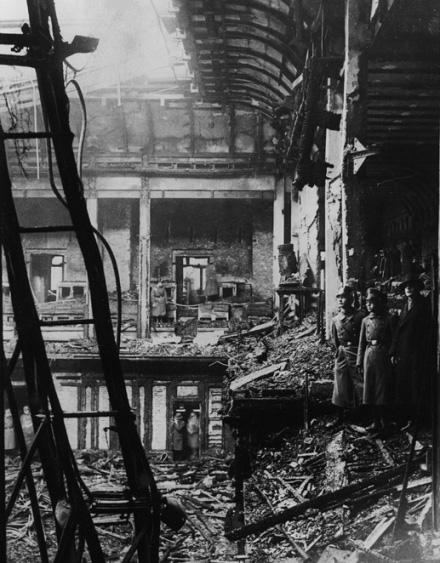
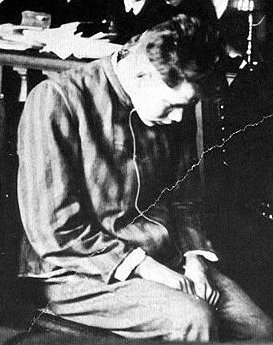
On this date in 1934, Dutch bricklayer Marinus van der Lubbe was beheaded by guillotine in Leipzig for setting the Reichstag Fire.
A watershed event* in the formation of the Nazi dictatorship, the Reichstag fire days before a parliamentary election enabled Hitler to stampede voters, suspend civil liberties, suppress left-wing parties on grounds of a suspected Communist plot, and seize “emergency” powers he would never relinquish.
Heil Hitler.
This clip from an American miniseries on Hitler with the characters chattering in unaccented English portrays the fascists’ opportunistic use of the attack on a national symbol … something not exactly unknown to later generations.
Van der Lubbe, who was arrested on the scene, suffered the predictable fate. Four other Communists charged as accomplices were acquitted, in a trial with the gratifying spectacle of Hermann Goering personally testifying, and being undressed on cross-examination by one of the reds. One is reminded here that Hitler did not yet have everything in the state apparatus at his beck and call … although he did have a great deal already, inasmuch as the arson law under which van der Lubbe died was passed after the Reichstag fire and made retroactive.
If the big-picture outcome of the Reichstag fire is pretty clear-cut, its real origin and the corresponding rightness of the judicial verdicts have remained murky ever since. The fact that the scene of the crime became Nazi ground zero for the next decade sort of obscures the evidence.
Van der Lubbe confessed, so his participation is generally taken as a given.
Whether he was really able to start the blaze acting alone, as he insisted, and the Nazis “only” exploited this fortuitous calamity; whether he was part of a larger leftist plot, as his prosecutors claimed; or whether, as Shirer and many others since have viewed him, he was a patsy in a false flag operation set up by the Nazis with an eye towards creating a politically advantageous national emergency — these possibilities remain very much up for debate.
For what it’s worth, postwar West German courts reversed and un-reversed the sentence before officially rehabilitating van der Lubbe last year on the non-specifically indisputable grounds that the legal machinery brought to bear on the Reichstag fire “enabled breaches of basic conceptions of justice.”
I do not see that one can blame the majority of Germans who, in 1933, believed that the Reichstag fire was the work of the Communists. What one can blame them for, and what shows their terrible collective weakness of character … is that this settled the matter. With sheepish submissiveness, the German people accepted that, as a result of the fire, each one of them lost what little personal freedom and dignity was guaranteed by the constitution, as though it followed as a necessary consequence. If the Communists had burned down the Reichstag, it was perfectly in order that the government took “decisive measures”!
Next morning I discussed these matters with a few other Referendars. All of them were very interested in the question of who had committed the crime, and more than one of them hinted that they had doubts about the official version; but none of them saw anything out of the ordinary in the fact that, from now on, one’s telephone would be tapped, one’s letters opened, and one’s desk might be broken into. “I consider it a personal insult,” I said, “that I should be prevented from reading whichever newspaper I wish, because allegedly a Communist set light to the Reichstag. Don’t you?” One of them cheerfully and harmlessly said, “No. Why should I? Did you read Forwards and The Red Flag up to now?”
At dawn this date in 1980, the kingdom of Saudi Arabia publicly beheaded over 60 Islamic extremists who had seized Mecca’s holy Al-Masjid al-Haram the preceding November — one of the formative and strangely forgotten events in the birth of radical Islam.
On November 20, 1979, with 100,000-plus pilgrims bustling in Islam’s holiest shrine on the hajj, a few hundred multinational messianic militants took it over with a cache of smuggled firearms.
For two embarrassing weeks, the Saudi government struggled to respond, bumbling a couple of military operations and delicately negotiating the ecclesiastical permission it would require to commit violence within the Grand Mosque. (Strict Moslim prohibitions against same had left the kingdom’s unarmed guards essentially defenseless against the initial takeover.)
In exchange for that fatwa, the House of Saud struck a Faustian bargain: agreeing to roll back secularization and impose strict Islamic law.
The balance of military materiel, of course, would prove to be no contest at all; Riyadh had troops, heavy armament, and now, permission to use them (and to damage the mosque … which they did). Most of the Mahdists were slain in the decisive assault; the survivors* (except for a few who were underage) were publicly beheaded in various cities around Saudi Arabia on this date, including the operation’s leader, Juhayman al-Otaibi.
But their deed — second-tier news at the time in a United States distracted by the Iranian Revolution — would have dramatic long-term repurcussions. Though intimations of deeper bin Laden family involvement** seem sketchy, it certainly appears to have inspired the 22-year-old Osama bin Laden; he soon made his way to fight the Soviets in Afghanistan, a war that began in earnest just days after the end of the siege and to whose prosecution Saudi Arabia and the west would gratefully direct Islamist energies.
Meanwhile, the Saudi government’s pact with the clergy that gained it permission to assail the Grand Mosque saw it subsequently bankroll Wahhabi religious instruction in Saudi Arabia and beyond … arguably the hand that rocked the cradle of present-day Islamic radical movements like al-Qaeda.

 The execution of the mentally impaired 19-year-old was a lightning rod when it was pronounced the previous December and remained so over a half-century struggle for his posthumous pardon.
 In this blog, we lay aside each story day by day, but for those affected, it’s rarely so easy — which is why the


 The ethnic and religious quiltwork of Iraq is much more nuanced than Sunni vs. Shia — and this blog has

 Van der Lubbe, who was arrested on the scene, suffered the predictable fate. Four other Communists charged as accomplices were acquitted, in a trial with the gratifying spectacle of Hermann Goering personally testifying, and being undressed on cross-examination by one of the reds. One is reminded here that Hitler did not yet have everything in the state apparatus at his beck and call … although he did have a great deal already, inasmuch as the arson law under which van der Lubbe died was passed after the Reichstag fire and made retroactive.

