1944: The Wola Massacre begins, during the Warsaw Uprising

On this date in 1944, a weeklong German slaughter of Polish civilians and resistance fighters began in the Wola district of the capital city Warsaw.
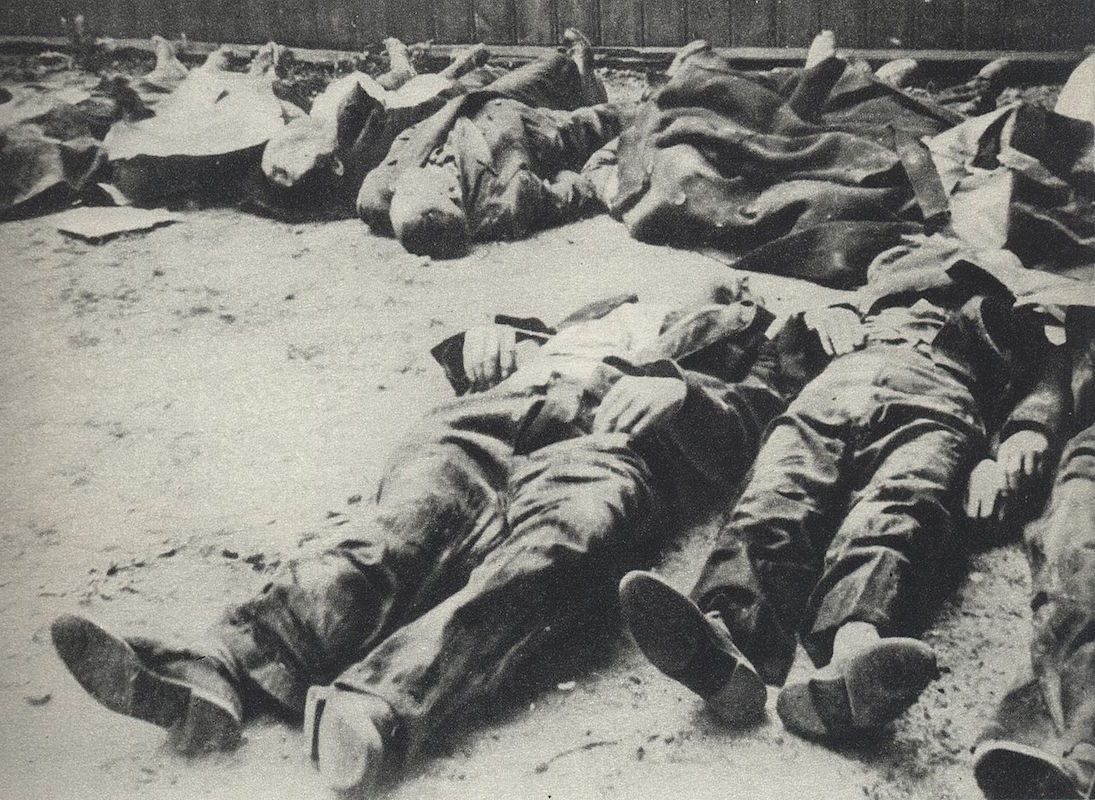
The Wola Massacre marked the start of the Reich’s counterattack against the Warsaw Uprising, the heroic and suicidal rising mounted by the Polish Home Army as the Red Army’s summer offensive brought it to the banks of the Vistula.

Aiming to claim some foothold upon which to influence events in the soon-to-be Soviet-occupied Poland, the Home Army enjoyed initial success in the first days of August. But German reserves from the Replacement Army — the vehicle by which the Valkyrie plotters had attempted their coup against Hitler just days before, and now as a consequence answering directly to Heinrich Himmler — were quick to the scene and would turn back the rising in weeks of bloody urban warfare. Himmler’s authority in crushing the Warsaw Uprising would also allow him to give rein to his SS for a campaign of atrocities intended to cow the populace into speedy submission.

Himmler wasn’t a battlefield commander, of course. Chief on the scene would be Erich von dem Bach-Zelewski; for this purpose he would enlist some of the more notorious units on the eastern front, such as the lawless Sonderbataillon Dirlewanger and the “Russian National Liberation Army” of Bronislav Kaminski. They were just the types to implement Himmler’s brutal orders* for a city they were soon to lose anyway:

  1. Captured insurrectionists shall be killed whether or not they fight in accordance with the Hague Convention.
  2. The non-fighting part of the population, women, children, shall also be killed.
  3. The whole city shall be razed to the ground, i.e. its buildings, streets, facilities, and everything within its borders.

The outcome rates as perhaps the largest battlefield massacre of World War II.

On August 5, Bach-Zelewski’s forces began a coordinated push into the western suburb of Wola. Himmler’s orders were implemented immediately, as attested by numerous civilian witnesses and lucky survivors:

I lived in the Wola district at No. 8, Elekcyjna Street. At 10 a.m. on Aug. 5, 1944 a detachment of SS-men and Vlassov’s men entered. They drove us from the cellars and brought us near the Sowinski Park at Ulrychow. They shot at us when we passed. My wife was killed on the spot: our child was wounded and cried for his mother. Soon a Ukrainian approached and killed my two-year-old child like a dog; then he approached me together with some Germans and stood on my chest to see whether I was alive or not – I shammed dead, lest I should be killed too. One of the murderers took my watch; I heard him reloading his gun. I thought he would finish me off, but he went on further, thinking I was dead. I lay thus from 10 a.m. until 9 p.m. pretending to be dead, and witnessing further atrocities. During that time I saw further groups being driven out and shot near the place where I lay. The huge heap of corpses grew still bigger. Those who gave any sign of life were shot. I was buried under other corpses and nea rly suffocated. The executions lasted until 5 p.m. At 9 p.m. a group of Poles came to take the corpses away. I gave them a sign that I was alive. They helped me to get up and I regained sufficient strength to carry with them the body of my wife and child to the Sowinski Park, where they took all the dead. After this sad duty had been performed they took me to St. Laurence’s Church at Wola, where I remained till next day. I cannot state the exact number of the victims, but I estimate that those among whom I lay amounted to some 3,000 (three thousand). I met a friend in the church who had gone through the same experience as I, having lost a boy of 8, who had been wounded and died calling for his father. I am still in hospital and the image of death is constantly before my eyes.

And another:

On August 5, 1944, between 12 and 2 p.m., I saw from a window on the first floor of Wola Hospital Germans dragging women out of the cellars of No. 28, Plocka Street. They shot them in the courtyard with machine-guns. Almost at the same time, I saw in the courtyard of No. 30, Plocka Street the hands of more then 20 people raised and visible over the fence (the people themselves could not be seen). After a volley of shots these hands fell down: this was another of the executions in Wola.

And the agonizing testimony of Wanda Lurie:

I stayed in the cellar of No. 18 until August 5, when, between 11 and 12 noon, the Germans ordered all of us to get out, and marched us to Wolska Street. This march was carried out in dreadful haste and panic. My husband was absent, taking an active part in the Rising, and I was alone with my three children, aged 4, 6 and 12, and in the last month of pregnancy. I delayed my departure, hoping they would allow me to remain, and left the cellar at the very last moment. All the inhabitants of our house had already been escorted to the “Ursus” works in Wolska Street at the corner of Skierniewicka Street, and I too was ordered to go there. I went alone, accompanied only by my three children. It was difficult to pass, the road being full of wire, cable, remains of barricades, corpses, and rubble. Houses were burning on both sides of the street; I reached the “Ursus” work’s with great difficulty. Shots, cries, supplications and groans could be heard from the factory yard. We had no doubt that this was a place for mass executions.

The people who stood at the entrance were led, no, pushed in, not all at once but in groups of 20. A boy of twelve, seeing the bodies of his parents and of his little brother through the half-open entrance door, fell in a fit and began to shriek. The Germans and Vlassov‘s men beat him and pushed him back, while he was endeavouring to get inside. He called for his father and his mother. We all knew what awaited us here; there was no possibility of escape or of buying one’s life; there was a crowd of Germans, Ukrainians (Vlassov’s men), and cars. I came last and kept in the background, continuing to let the others pass, in the hope that they would not kill a pregnant woman, but I was driven in with the last lot. In the yard I saw heaps of corpses 3 feet high, in several places. The whole right and left side of the big yard (the first yard) was strewn with bodies. We were led through the second. There were about 20 people in our group, mostly children of 10 to 12. There were children without parents, and also a paralysed old woman whose son-in-law had been carrying her all the time on his back. At her side was her daughter with two children of 4 and 7. They were all killed. The old woman was literally killed on her son-in-law’s back, and he along with her. We were called out in groups of four and led to the end of the second yard to a pile of bodies. When the four reached this point, the Germans shot them through the backs of their heads with revolvers. The victims fell on the heap, and others came. Seeing what was to be their fate, some attempted to escape; they cried, begged, and prayed for mercy. I was in the last group of four. I begged the Vlassov’s men around me to save me and the children, and they asked if I had anything with which to buy my life. I had a large amount of gold with me and gave it them. They took it all and wanted to lead me away, but the German supervising the execution would not allow them to do so, and when I begged him to let me go he pushed me off, shouting “Quicker!” I fell when he pushed me. He also hit and pushed my elder boy, shouting “hurry up, you Polish bandit”. Thus I came to the place of execution, in the last group of four, with my three children. I held my two younger children by one hand, and my elder boy by the other. The children were crying and praying. The elder boy, seeing the mass of bodies, cried out: “they are going to kill us” and called for his father. The first shot hit him, the second me; the next two killed the two younger children. I fell on my right side. The shot was not fatal. The bullet penetrated the back of my head from the right side and went out through my cheek. I spat out several teeth; I felt the left side of my body growing numb, but I was still conscious and saw everything that was going on around me.

I witnessed other executions, lying there among the dead. More groups of men were led in. I heard cries, supplications, moaning, and shots. The bodies of these men fell on me. I was covered by four bodies. Then I again saw a group of women and children; thus it went on with group after group until late in the evening. It was already quite, quite dark when the executions stopped. In the intervals between the shootings the murderers walked on the corpses, kicked them, and turned them over, finishing off those who still gave any sign of life, and stealing valuables.

German soldiers too recorded wholesale executions in their diaries and correspondence; while the accounts above are all specifically attributable to the 5th of August, those that follow are undated snapshots of environment:

Policemen with rifles under their arms trudged along. All of the police from occupied Poland came together there to show off their bravery and also to enrich themselves on the side. I did not see this activity, but others did. They saw how these policemen executed those from the procession who could not keep up, those who were sick and lagging behind, and right in front of their compatriots. What was particularly troubling about this misery is that unlike in Russia what was occurring was not a matter of a completely poor, and in any event already moaning, mass of people; rather these were people of our own social class, women in fur coats, cute children who up until two days before had been fully cared for. This memory has always caused me anguish during my short stopovers in Warsaw: the look from so many hostile eyes, people of our culture, who knew exactly what I knew. For that reason I was always glad never to have been deployed in the West. And now I stood beside these people in bitter agony, and I was shocked.

Now we arrived at the command post of the SS-commander. There were two buses parked on the right side of the street. We reported to the SS-commander, a medium-built stringent man with a sharply chiseled face. With a cold glance at the procession of women and children that was passing no farther than 10 meters from us, he said, “You see, this is our biggest problem. These refugees! I don’t have enough ammunition to kill them all!” He said this quietly and with a remorseful shrug of the shoulders, this elegant officer with the Iron Cross and pleasant manners. Meanwhile tears fell down my cheeks. What kind of human being was he?

Hans Thieme

And another:

Before each daily operation I reported to the SS commander. During one visit I witnessed an event, which sickened me to my very core. The SS officer’s office was on the upper floor of a building and had a balcony that overlooked a large courtyard. The SS had lined up near a wall about 40 or so Polish men, women, and children of all ages. I distinctly recall a young woman holding hands with two small children. It was clear to me what was about to happen. I confronted the SS commander as to why these people were about to be shot. His reply was that they were being executed as a reprisal for the Germans that had been killed in the Uprising. He informed me that it was also none of my concern. Shortly, thereafter the hostages were shot before my eyes. I was disgusted by what I had witnessed and after 60 years later it still haunts me.

Eberhard Schmalz

And another:

I was setting explosives under big doors, somewhere in Old Town. From inside we heard Nicht schiessen! Nicht schiessen! (Don’t shoot! Don’t shoot!). The doors opened and a nurse appeared with a tiny white flag. We went inside with fixed bayonets. A huge hall with beds and mattresses on the floor. Wounded were everywhere. Besides Poles there were also wounded Germans. They begged the SS-men not to kill the Poles. A Polish officer, a doctor and 15 Polish Red Cross nurses surrendered the military hospital to us. The Dirlewangerers were following us. I hid one of the nurses behind the doors and managed to lock them. I heard after the war that she has survived. The SS-men killed all the wounded. They were breaking their heads with rifle butts. The wounded Germans were screaming and crying in despair. After that, the Dirlewangerers ran after the nurses; they were ripping clothes off them. We were driven out for guard duty. We heard women screaming. In the evening, on Adolph Hitler’s Square [now Pilsudzki Square] there was a roar as loud as during boxing fights. So I and my friend climbed the wall to see what was happening there. Soldiers of all units: Wehrmacht, SS, Kaminski’s Cossacks, boys from Hitlerjugend; whistles, exhortations. Dirlewanger stood with his men and laughed. The nurses from the hospital were rushed through the square, naked with hands on their heads. Blood ran down their legs. The doctor was dragged behind them with a noose on his neck. He wore a rag, red maybe from blood and a thorn crown on top of the head. All were lead to the gallows where a few bodies were hanging already. When they were hanging one of the nurses, Dirlewanger kicked the bricks she was standing on.

Mathias Schenk

A much larger catalogue of atrocity accounts awaits at warsawuprising.org.

The massacre at Wola would run on to about the 13th at which point Bach-Zelewski abated the civilian massacre order as counterproductive: too many soldier-hours needed for focused bloodbaths were being squandered orchestrating gratuitous ones. Nevertheless, weeks of hard urban warfare lay ahead, and policy continued to embrace the summary execution of captured fighters and of all fighting-age men, resistance or no. Some 200,000 civilians are thought to have died during the Warsaw Uprising.

One legacy was eerily and unknowingly captured by a LIFE magazine photographer in 1948, of a young girl in a school for disturbed children in Poland. Her face a scramble of innocence and madness as it peers into the lens, she illustrates her “home” as an incoherent chalk vortex. It wasn’t known until many years after this photo became emblematic of a generation wracked by horror, but “Tereska” — Teresa Adwentowska — was an orphaned survivor of Wola.

* Per Bach-Zelewski’s evidence to the Nuremberg tribunal. By dint of cooperation, he saved his own life from the Nuremberg gallows.

On this day..

1952: Johann Burianek, East German saboteur

On this date in 1952, Johann Burianek became the first person executed by East Germany.

A machinist and a World War II Wehrmacht soldier, Burianek (English Wikipedia entry | German) caught a one-year sentence in the postwar Communist East Germany for having the misbegotten initiative in the dying days of the war to go out of his way to arrest a deserter who was nearly executed as a result.
From about 1950 he became affiliated with the western-backed anti-communist resistance network Kampfgruppe gegen Unmenschlichkeit (KgU) — Strike Force Against Inhumanity. Crossing liberally between East and West Berlin, which easy movement East German authorities were fretting, Burianek had a two-year stint irritating the German Democratic Republic with graffiti, subversive posters, and eventually, sabotage.

He was arrested in March 1952 shortly ahead of what would have been his derringest do, the bombing of a rail bridge; a judge named Hilde Benjamin, who in the course of 1950s show trials made her name synonymous with politically motivated severity,* hammered him with a demonstrative sentence** — the very first judicial execution meted out by the DDR, in fact. It was administered in Dresden by beheading with a fallbeil.

* Benjamin, who died on the eve of the Berlin Wall‘s fall, enjoys a poor reputation in the post-Cold War state with a variety of uncomplimentary sobriquets to prove it — such as the “Red Guillotine” and “Red Freisler“.

** She would also impose the death sentence against a fellow KgU operative, Wolfgang Kaiser, who went under the fallbeil five weeks after Burianek.

On this day..

1934: Otto Planetta and Franz Holzweber, for the Juliputsch

German-Austria must return to the great German mother country, and not because of any economic considerations. No, and again no: even if such a union were unimportant from an economic point of view; yes, even if it were harmful, it must nevertheless take place. One blood demands one Reich. Never will the German nation possess the moral right to engage in colonial politics until, at least, it embraces its own sons within a single state …

The elemental cry of the German-Austrian people for union with the German mother country, that arose in the days when the Habsburg state was collapsing, was the result of a longing that slumbered in the heart of the entire people — a longing to return to the never-forgotten ancestral home. But this would be inexplicable if the historical education of the individual German-Austrian had not given rise to so general a longing. In it lies a well which never grows dry; which, especially in times of forgetfulness, transcends all momentary prosperity and by constant reminders of the past whispers softly of a new future

-Adolf Hitler, Mein Kampf

On this date in 1934, two Nazis were hanged for their part in a failed Austrian coup.

From his political ascent in 1933 — and well before, as the quote above indicates — the Reich’s unification with his native land of Austria had been a cherished goal for Adolf Hitler. To that end, Berlin had fostered a clandestine network of Austrian Nazis branded as “SS Standarte 89” and allowed exiles to broadcast seditious propaganda from German soil.

Their “July Putsch” (English Wikipedia entry | German) was a year or so in the making, and commenced when four truckloads of SS Standarte 89 men in military attire suddenly stormed the federal chancellery in Vienna, murdering chancellor Engelbert Dollfuss in the process.

“Hitler received the tidings while listening to a performance of Das Rheingold at the annal Wagner Festival at Bayreuth,” Shirer noted in The Rise And Fall Of The Third Reich — and Wagner’s granddaughter, also in attendance, could not help observing his “excitement” and “delight” and simultaneous anxiety to feign uninvolvement.

The last of these impulses showed the emerging tyrant’s wisdom, for the coup swiftly collapsed — exposing, to Hitler’s fury, the inept organization of the plot. Basically no other coordinated actions took place to complete the coup and the Austrian army remained loyal to the existing government, leaving to the lonely SS Standarte 89 nothing but a feeble surrender.

The first targets of the resulting courts-martial were Otto Planetta (cursory English Wikipedia entry | more detailed German), who actually pulled the trigger to kill the chancellor, and Franz Holzweber, the apparent leader of the attack on the chancellery. They would be tried and condemned in a two-day hearing July 30-31 and hanged within three hours of conviction. In time, both the Planetta and the Holzweber name would adorn many city streets in the Third Reich as patriot-martyrs.

Both prisoners, when asked whether they had anything to say before hearing their sentences, addressed the Court. Planetta said: —

I do not know how many hours I have to live. But one thing I would like to say, I am no cowardly murderer. It was not my intention to kill. One thing more. As a human being I am sorry for my deed, and I beg the wife of the late Chancellor to forgive me.

Holzweber said: —

I was assured that there would be no bloodshed. I was told also that I should find Herr Rintelen at the Chancery,, that the new Government was already formed. Not meeting the leader of the operation at the Chancery, I disclosed myself at once to Major Fey. I told him, here I stand, and I do not know what I should do. More or less spontaneously I took over the responsibility for our men because no one was there to take charge of the matter.

Holzweber, who was executed first, cried out on the gallows: “We die for Germany. Heil Hitler.” Planetta said simply, “Heil Hitler.”

London Times, Aug. 1, 1934

The time was not yet ripe — and Hitler, no matter how heiled by his would-be subjects, was required by the diplomatic blowback to forswear ambitions on unifying with Austria.

But the Fuhrer’s soft whispers of a new future would grow ever more insistent in the months to come, and not four years later the Reich accomplished the Anschluss.

That July 25, in 1938, in a Vienna now successfully absorbed to greater Germany,

the fourth anniversary [of the Juliputsch] was celebrated as an heroic act comparable with the Rathenau and Erzberger murders. The survivors of ‘SS Standarte 89’ marched to the federal Austrian Chancellery, which had been renamed the Reichstatthalterei. Here the bereaved families of thirteen men were addressed by Rudolf Hess. A tablet was unveiled which proclaimed that:

154 German men of the 89th SS Standarte stood up here for Germany on 25 July, 1934. Seven found death at the hands of the hangman.

On this day..

1972: Misao Katagiri

On this date in 1972, Misao Katagiri hanged for a Tokyo gunfight he had perpetrated seven years earlier.

A gun fancying 18-year-old, Katagiri triggered a shootout by seizing some hostages in Shibuya, an event that thousands of Tokyo residents witnessed — including future spree shooter Norio Nagayama. Somewhat miraculously the death toll from Katagiri’s moment of madness numbered only one, a policeman. (Seventeen others were injured.) But the one was enough.

On this day..

1975: Dr. Mohamed Forna, former Finance Minister of Sierra Leone

On this date in 1975, Dr. Mohamed Forna and other Sierra Leone dissidents were executed as traitors.

A medical doctor who entered politics and was Minister of Finance in the government of the All People’s Congress (APC) from 1968-1970, Forna grew disenchanted with the parasitical kleptocracy of Siaka Stevens and, with another ex-state minister, Ibrahim Taqi, helped to launch the opposition United Democratic Party.

The party was swiftly banned but Forna remained in the ranks of dissidents, until he was arrested in 1973. In a mass capital trial, 15 alleged “traitors” were condemned to hang — a harvest of souls reduced by about half in the interest of moderation.

Forna’s daughter Aminatta Forna explores the legacy of this horror in her memoir The Devil That Danced on the Water. (Review | excerpt) A former journalist, Aminatta Forna reconstructed events by interviewing the people involved in them, including the witnesses who supplied suborned evidence to doom her father.

The executions began at midnight on 19 July. I was asleep in my dormitory at school. The aeroplane carrying Mum was crossing the Sahara, thirty thousand feet up in the sky.

The first two men to die were soldiers. The civilians were executed in the order in which they were indicted by the court. Mohamed Forna, First Accused, my father, walked the length of the block, past the cells of his companions, towards the noose waiting for him behind the door at the end of the building. I close my eyes and imagine his final walk: his stride, just like my own; broad, flat African feet inherited by me; his handcuffed hands: long, strong fingers, slightly flared at the tip and reborn in my brother; the broad, intelligent forehead, the same brow I see in my sister every time we meet. The men were hanged every half an hour, the men in the other blocks told me. They could tell, you see, because the music and the sounds of the guards’ bacchanal died for a few seconds, then rose up again more clamorous than before. If you listened very carefully in the moments in between, you could hear the sound of the trap door.

The next day my father’s body, and those of the seven other men who had been hanged, were displayed in open coffins before the crowds outside Pademba Road Prison. Stevens had promised a public execution; in the end he had slaughtered them in secret and displayed his trophies afterwards. Under cover of darkness the bodies were removed, loaded into military trucks and driven out to Rokupa cemetery on the road to Hastings, where they were doused with acid and dumped in a mass grave.

On this day..

1946: Draza Mihailovic, Chetnik commander

I wanted much; I began much; but the gale of the world carried away me and my work.

-Draža Mihailovic, last statement to the court

On this date in 1946, Serbian Chetnik commander Draža Mihailovic was shot in Belgrade as a World War II traitor — a verdict that remains controversial to this day.

A colonel* in the Royal Yugoslav Army, Mihailovic escaped Germany’s initial invasion into the mountainous Balkan interior with a few dozen comrades who became the nucleus of a Serbian guerrilla movement.

These royalist Chetniks made a rivalrous opposite number to Josip Tito’s fellow guerrillas, the Communist partizans; it is easy enough to see from Mihailovic’s place in these very pages how matters settled in the end. From the first months of occupation in 1941, Chetniks and Partisans alike struck Axis occupation forces who had carved up Yugoslavia, even coordinating efforts in spite of their vast ideological chasm.

But politics didn’t stop at the border forever.

As the war progressed, the Chetniks gradually found terms with the occupiers, with Mihailovic at an October 1941 meeting dramatically rejecting Tito’s proposed common front. For the Chetniks, the leftist and polyglot Partisans who meant to rule the postwar Yugoslavia were the first enemy, “a motley collection of rascals,” in Mihailovic’s words — consisting of “Jews, Croats, Dalmatians, Bulgarians, Turks, Magyars, and all other nations of the world.”

Officially, tactical partnerships with the Germans and Italians were strictly opportunistic, not a buy-in on fascism — or they denoted a calculation (and Mihailovic’s limitless time-biding greatly aggravated the Allies while the fur was flying) to cautiously preserve his movement’s strength by avoiding engagement with an overwhelming enemy. In practice this policy drove the movement towards near-quisling status, with its major actions being undertaken against other resistance fighters on team partizan,** or to purge non-Serbs from this or that locale, even accepting German and especially Italian subsidies to do it.† Mihailovic’s enemies, he said in 1943, numbered “the Ustashi, the Partisans, the Croats and the Moslems” and “when he had dealt with these, he would turn to the Germans and the Italians.” Priorities are as priorities do.

For obvious reasons this behavior contrasts unfavorably with the Partisans’ militant “death to fascism, freedom to the people” line, and this latter movement’s ferocity in resistance saw it outstrip the Chetniks and seize the initiative for the postwar order. To a far greater extent than most other guerrillas of the bloodlands, the Partisans drove their own homelands’ liberation and left Tito master of a postwar Yugoslavia never occupied by the Red Army.

Mihailovic’s fall mirrored Tito’s rise. The Chetnik commander would be taken months after the war’s end, hiding out Saddam-like in a foxhole on the Bosnian marches. There could be no question of his fate.

Mihailovic and other Chetniks faced a predictably slanted trial for war crimes against Partisans and civilians, culminating in conviction on July 15, 1946 … two days before he faced the guns, with all of eight hours granted him to make his futile appeal. While it’s certain that the charges against him were maximized for the occasion, Mihailovic’s defense citing ignorance of and incapacity to control various units’ local atrocities is also not calculated to flatter a rebel general.


Mihailovic on trial.

Mihailovich was shot along with eight others:

  • Draghi Yovanovich, chief of the Belgrade police during the German occupation;
  • Milan Gushich and Radoslav Radich, Mihailovich aides;
  • Velibor Yonich, Tanasje Dinich, and Djure Dokich, ministers in the Serbian puppet government;
  • and, General Kosta Mushicki and a deputy named Paolovich.

In 2015, a Serbian court controversially reversed Mihailovic’s conviction.

* He’d be promoted to Brigadier General during the war years.

** World sport fanciers surely know that there is a literal team Partizan, founded as soon as World War II ended and one of the major clubs in Serbia ever since (in football, basketball, and 24 other sports). Here they are stealing the Adriatic League hoops championship from Cibona Zagreb on a full-court heave in 2010:

† This last-refuge-of-scoundrels legacy was unpleasantly recapitulated by some Serbian militias assuming the Chetnik brand during the ethnic wars attending Yugoslavia’s crackup in the 1990s. The term is basically a fighting word in certain quarters of the Balkans.

On this day..

1939: Ramiro Artieda, Bolivian serial killer

On this date in 1939, Bolivian serial killer Ramiro Artieda was executed at the prison of Cochabamba.

Artieda (German Wikipedia entry) cut his teeth in the murder business at the tender age of 18 by offing his brother Luis in order to become the sole claimant of the family inheritance. In so doing he lost his girlfriend, who was more alarmed by the fratricide — evidence to charge him never equaled the heavy suspicion against him — than she was acquisitive for his newfound loot.

After a brief spell in the United States, Artieda returned with acting experience and a festering grudge against the ex, both of which would come in handy for his new career in homicide. A series of 18ish girls with a resemblance to his former flame suddenly started turning up dead … strangled by a dark-haired charmer luring them to deadly seclusion by posing as a variety of different characters (university professor, trade delegate, monk). His last would-be victim managed to escape him, and then identify him, in May of 1939; eight weeks later, having owned the slaughter of seven young women plus Luis Artieda, he stood in front of a firing squad.

On this day..

1941: Francisco Escribano, for supplying the Spanish Maquis

My name is Francisco Escribano. They accused me of stealing for the men in the mountains two sacks of chickpeas, a blanket, a pair of scissors, six socks, six handkerchiefs and 10 pesetas. For this crime they executed me on 1 July 1941. For that same crime, my father, two uncles and my cousin died with me.

-Actor Javier Bardem voicing a victim of Franco’s Spain, for Pedro Almodovar‘s documentary short. We’ve previously encountered this film in our entry on the very first execution of the Spanish Civil War.

On this day..

1996: The Abu Salim prison massacre

On this date in 1996, Muammar Qaddafi‘s Libya massacred hundreds of prisoners in mass shootings at Tripoli’s notorious prison Abu Salim.

Human Rights Watch has charged that the death toll might surpass 1,200 although the government’s long-term stonewalling has helped to obscure the scale.

The day prior, inmates had seized a guard to protest poor prison conditions. Qaddafi’s own brother-in-law Abdullah Senussi was dispatched to negotiate a settlement. It was a simple arrangement: release the guard. Have some grievances redressed.

The guard was duly released, in good faith.

And by way of reciprocity, Senussi unleashed a general slaughter. Multiple prisoners have given accounts to human rights investigators of mass murders, inmates “lined up and shot, execution-style, by young conscripts whose choices were shoot, or stand with them to be shot” and buzzard squads picking through the groaning heaps of bullet-riddled men to administer coups de grace. A kitchen worker quoted by this 2001 BBC Witness broadcast who described how

soldiers in khaki uniforms fired upon the prisoners in the courtyard from the rooftops with automatic weapons and then followed through with pistols, individual shots, and killed what he claimed were 1,200 of his fellow prisoners … the number came to him based on the amount of meals he said he had prepared prior to the incident, and thereafter.

Senussi, who was Qaddafi’s spy chief, was at last notice under sentence of death himself in post-Qaddafi Libya.


“The people want the death penalty for Abdullah Senussi for the Abu Salim massacre” reads the poster, according to the BBC.

On this day..

1906: Four Egyptians for the Denshawai Incident

If her [England’s] empire means ruling the world as Denshawai has been ruled in 1906 — and that, I am afraid, is what the Empire does mean to the main body of our aristocratic-military caste and to our Jingo plutocrats — then there can be no more sacred and urgent political duty on earth than the disruption, defeat, and suppression of the Empire, and, incidentally, the humanization of its supporters.

-George Bernard Shaw

On this date in 1906, four Egyptian villagers were hanged by the British after a UK soldier died in riot begun by a pigeon hunt.

The Denshawai Incident — which is still to this day commemorated by its own museum — as an isolated event was one of those little local indignities that comprise a foreign military occupation. By the intersection of highhandedness on the one side and accumulated anger on the other it would become what George Bernard Shaw dubbed “the Denshawai Horror.”

On June 13, a mere 15 days before the executions in this post, a gaggle of bored Tommies* set out hunting pigeons in the Nile Delta. This was for the locals an irksome pastime inasmuch as the villagers raised these tame birds in brick towers for agrarian use — as Shaw noted:

Try to imagine the feelings of an English village if a party of Chinese officers suddenly appeared and began shooting the ducks, the geese, the hens and the turkeys, and carried them off, asserting that they were wild birds, as everybody in China knew, and that the pretended indignation of the farmers was a cloak for the hatred of the Chinese, and perhaps for a plot to overthrow the religion of Confucius and establish the Church of England in its place!

On this occasion, protesting villagers dared a little more resistance than was usual and before long a gun had discharged in the struggle, injuring several and felling a local woman (she survived, though onlookers took her wound for a mortal one in the moment). As if by metaphor, somewhere in the mayhem, somebody’s wheat caught fire.

Having clumsily escalated the disturbance that their presence had provoked, the Brits at length had to flee a small riot: one of their number died in the flight, the cause never clearly ascertained but attributed by a doctor to “heat apoplexy caused or aggravated by concussion of the brain.”** Several others were collared by the villagers, who abused them but did not kill them.

As Shaw notes, in a domestic English context it might have been the gendarmes who were punished for mismanaging the situation to the detriment of the public peace.

But the English occupation of Egypt disdained the hearts-and-minds approach, preferring bile and spleen. Fifty-two(!) villagers came up on charges of murder(!!) for the heatstroked officer, and the punishments meted out by a British-controlled court† seemingly aimed to maximize rancor with the understanding that cruelty was the only language the native could comprehend.

The husband of the woman shot by the hunting party, Shaw fulminated in an incandescent essay against imperialism,

in consideration of the injury to his wife, was only sentenced to penalty servitude for life … No such sentimentality was shewn to Hassan Mahfouz. An Egyptian pigeon farmer who objects to British sport; threatens British officers and gentlemen when they shoot his pigeons; and actually hits those officers with a substantial stick, is clearly a ruffian to be made an example of.

Penal servitude was not enough for a man of 60 who looked 70, and might not have lived to suffer five years of it. So Hassan was hanged; but as a special mark of consideration for his family, he was hanged in full view of his own house, with his wives and children and grandchildren enjoying the spectacle from the roof. And lest this privilege should excite jealousy in other households, three other Denshavians were hanged with him … ages of the four hanged men respectively, 60, 50, 22 and 20.

Hanging, however, is the least sensational form of public execution: it lacks those elements of blood and torture for which the military and bureaucratic imagination lusts. So, as they had room for only one man on the gallows, and had to leave him hanging half an hour to make sure work and give his family plenty of time to watch him swinging (“slowly turning round and round on himself,” as the local papers described it), thus having two hours to kill as well as four men, they kept the entertainment going by flogging eight men with fifty lashes each: eleven more than the utmost permitted by the law of Moses in times which our Army of Occupation no doubt considers barbarous. But they Moses conceived his law as being what he called the law of God, and not simply an instrument for the gratification of his own cruelty and terror.

It is unspeakably reassuring to learn from the British official reports laid before parliament that “due dignity was observed in carrying out the executions,” that “all possible humanity was shewn in carrying them out,” and that “the arrangements were admirable, and reflect great credit on all concerned.” As this last testimonial apparently does not refer to the victims, they are evidently officially considered not to have been concerned in the proceedings at all. Finally, Lord Cromer certifies that the Englishman in charge of the proceedings is “a singularly humane man, and is very popular amongst the natives of Egypt by reason of the great sympathy he has always shewn for them.” It will be seen that Parliamentary Papers, Nos. 3 and 4., Egypt, 1906, are not lacking in unconscious humor. The official walrus pledges himself in every case for the kindliness of the official carpenter.


Edinburgh Evening News, June 29, 1906

Shaw’s determination to humanize the “natives” by analogy to English country squires unsurprisingly stands in stark contrast to the dominant thrust of domestic reportage — which consistently describes the affair as an unprovoked attack or (still better) an outrage. Shaw, however, was far from alone in his sentiment: many British elites were discomfited by the harsh and arbitrary treatment meted out in the imperial hinterlands. Another writer, Wilfrid Scawen Blunt, bemoaned the “abominable case” and took up an editorial pen in the Egyptians’ defense — albeit more in hope than expectation, for as he confided to his diary, “English feeling on these matters has become absolutely callous, and I believe if Cromer ordered a dozen of the villagers to be crucified or impaled, no serious objection would be made to it here.” And he was right to despair.

Still, gentlemen of a liberal conscience have the luxury down the decades of forgetting the individual atrocities of empire.‡

Few in the West recognized the allusion when, following 2005 bombings in London by Islamic terrorists, Ayman al-Zawahiri “announced that Britain was one of Islam’s worst enemies; it had been responsible for the deaths of thousands of Muslims across the ages, from Palestine to Afghanistan, Delhi to Denshawai.” (Source)

But it had by that time been long since that the chickens of Denshawai had come home to roost. In his autobiography, Egyptian nationalist president Anwar Sadat mused on the formative influence worked upon his childhood by the sacrifice of one of the Denshawai martyrs.

[T]he ballad which affected me most deeply was probably that of Zahran, the hero of Denshway. I recall my mother reciting it to me as I lay stretched out on top of our huge rustic oven, half-asleep while my younger brothers (and our rabbits) had all fallen asleep. It appealed to me afresh every time I listened to it. Denshway was only three miles away and the ballad dealt with a real incident … Zahran was the hero of the battle against the British and the first to be hanged. The ballad dwells on Zahran’s courage and doggedness in the battle, how he walked with his head held high to the scaffold, feeling proud that he had stood up to the aggressors and killed one of them.

I listened to that ballad night after night, half-awake, half-asleep, which perhaps made the story sink into my subconscious. My imagination roamed free. I often saw Zahran and lived his heroism in dream and reverie — I wished I were Zahran.

His wish would come as near to fruition as wishes do. Sadat had the honor of announcing to the world the Egyptian Revolution of 1952 that would expel the British occupation … and thirty years later, of also giving his life for Egypt.

* Not Dickens nor Kubrick could not have bested the names of shooting party participants Captain Bull (the eventual fatality) or Brevet-Major Pine-Coffin.

** That is, running away from a bombardment of stones. It appears to be permanently obscure (and subject to partisan slanting) precisely how these factors weighed together at the moment of Bull’s death. The diagnosis is quoted in the London Times, June 25, 1906.

† The tribunal featured mixed Egyptian and British personnel, notably including Boutros Ghali, future Egyptian Prime Minister and grandfather of the eventual United Nations head Boutros Boutros-Ghali.

‡ At least, of their own empire. According to Aliens — Uneingeburgerte: German and Austrian Writers in Exile, the Third Reich produced a German-language play about the Denshawai incident by adapting Shaw’s account.

On this day..