1610: Roger Cadwallador, English priest

On this date in 1610, the priest Roger Cadwallador was hanged, drawn, and quartered in Herefordshire, where he had maintained an illicit Catholic ministry for 16 years.

Having spent most of the morning in spiritual preparation (for his end) about ten o’clock he took some corporal food, viz. a little comfortable broth; and calling for a pint of claret wine and sugar, on occasion of a friend that was come to visit him, he made use of the words of bishop Fisher in the like case, as he said, when he was taking a cordial, before the like combat of death; fortitudinem meam ad te domine custodian, Saying in English, he took it to make himself strong to suffer for God. Then as if he had been to go to a feast, he put on his wedding-garment (viz. a new suit of cloaths) which a friend had provided for him, from top to toe, whom he requited with a good and godly exhortation, counselling him to persevere till death in the catholic faith; and giving him directions to bestow twelve pence of his money on the porter; for he kept two shillings in his own pocket to bestow on him that was to lead and drive the horse, when he went to execution.

His jailer pressed him repeatedly, as was usual, to apostasize and save his flesh. The terrors of the gallows being quite real even to martyrs, this menace surely worked for some … but never, it seems for those who reach these grim annals.

Being taken off the hurdle, and brought within sight of the gallows, and the block whereon he was to be quartered, they shewed him these and other instruments of death, leading him between two great fires, the one prepared to burn his heart and bowels, the other to boil his head and quarters: and thinking the sight of these did somewhat terrify him, they promised him once more that none of them should touch him, if he would take the oath; but his christian courage made him persist in his resolution of dying in that quarrel.

Cadwallador would need every drop of that resolution when an artlessly executed hanging unintentionally left him quite sensible to experience the horrors of having his trunk ripped open to tear out organs that would feed those great fires. When “the unskilful executioner”

came to turn the ladder … [Cadwallador] said aloud five or six times, In manus tuas Domine commendo spiritum meum. Into thy hands, O Lord, I commend my spirit. And lastly, Domine accipe spiritum meum. Lord receive my spirit. He hunt very long, and in extraordinary pain, by reason that the knot, through the unskilfulness of the hangman, came to be directly under his chin, serving only to pain, and not to dispatch him.

Insomuch that when the people were persuaded that he was thoroughly dead, he put up his hand to the halter, as if he had either meant to shew how his case stood, or else to ease himself: but bethinking himself better, and perhaps a scruple coming into his head to concur to hasten his own death; he had scarce touched the halter, but that he presently pulled away his hand. And within the space of a Pater-noster after, he lifted up his hand again to make the sign of the cross; which made all the standers by much amazed; and some of the vulgar desirous to rid him of his pain, lifted him upwards by the legs twice or thrice, letting him fall again with a swag.

Then after a little rest, when they thought him quite dead, he was cut down: but when he was brought to the block to be quartered, before the bloody butcher could pull off his doublet, he revived and began to breathe; which the multitude perceiving began to murmur; which made the under-sheriff cry out to the executioner to hasten: but before they had stripped him naked he was come to a very perfect breathing.

It was long after they had opened him before they could find his heart, which, notwithstanding, panted in their hands when it was pulled out.

As soon as the head was cut off, one of the sheriff’s men lifted it up on the point of a halbert, expecting the applause of the people, who made no sign that the fact was pleasing to them. Nay, they that were present were struck at the sight, and said, this priest’s behaviour and death would give great confirmation to all the papists of Herefordshire: which saying fell out to be true; for it ministered to them great courage and comfort.

Cadwallador was beatified in 1987.

On this day..

1806: Johann Philipp Palm, press martyr

Gentlemen, you must not mistake me. I admit that the French Emperor is a tyrant. I admit that he is a monster. I admit that he is the sworn foe of our nation, and, if you will, of the whole human race. But, gentlemen, we must be just to our great enemy. We must not forget that he once shot a bookseller.

Thomas Campbell

Nuremberg bookseller Johann Philipp Palm was shot on this date in 1806 for publishing a manifesto against the French occupation.

For centuries a proud Free Imperial City, Nuremberg had over the few months preceding Palm’s martyrdom been smushed up by the conquering Grande Armee into an amalgamated French client, the Confederation of the Rhine.

This was a huge political shakeup. Even the Empire of which Nuremberg had been a Free Imperial City was no more: the 854-year-old Holy Roman Empire was dissolved in 1806, a casualty of the Battle of Austerlitz. At just 25,000 residents and far removed from its mercantile preeminence of yesteryear,* Nuremberg wasn’t even one of the Confederation of the Rhine’s 16 constituent polities: it had been rolled up into Bavaria, in a partial cleanup of the tiny Kleinstaaten pocking the old German map.

Nuremberg’s prostration in this arrangement mirrored Germany’s as a whole vis-a-vis the Corsican. Napoleon was the official “protector” of the Confederation of the Rhine, and its end of the protection racket entailed shipping conscripts to the French army.

The Confederation of the Rhine ultimately included four kingdoms, five grand duchies, 13 duchies, 17 principalities, and the Free Hansa towns of Hamburg, Lübeck, and Bremen, and covered much of the territory of present-day Germany (sans Prussia). For some odd reason, Germans whose dreams of national unification were beginning to stir weren’t too enthusiastic about having it marshaled by France.

In July of 1806, Palm gave voice to the sentiment by publishing a 144-page treatise, Germany in its Deep Humiliation. (It’s available online in an 1877 printing at archive.org.) The identity of the seditious author(s) he resolutely kept secret, but it’s commonly attributed now to Count Friedrich Julius Heinrich von Soden.

Palm had the fortune or sense to be safely away in Prussia by the time irate Frenchmen raided his shop, but was caught after he boldly slipped back into the city against all sensible advice. He was transferred to a fortress at Braunau am Inn, and shot there.

His death made him an early national martyr (“involuntary hero”, in the words of a 2006 Braunau bicentennial remembrance), and his name is still preserved on a variety of streets in German cities. In Palm’s native Schorndorf, the Palm Pharmacy building sports plaques honoring the martyr. And a Palm Foundation awards, every two years, a Johann Philipp Palm Prize journalism prize. It’s announced on this date, each even-numbered year. (Update: Salijon Abdurakhmanov of Uzbekistan and Nazikha Saeed of Bahrain received the 2014 Palm awards.)

A publishing house, Palm und Enke, actually founded post-Napoleon by the uncle under whom our Johann Palm completed his apprenticeship, still exists today. (It is no longer in the control of any Palm relative, however.)

Braunau am Inn, now a charming little burg of 16,000 just over the border into Austria, is probably best recognized in the wider world these days as the birthplace of Adolf Hitler … and it turns out the little future Nazi was deeply stirred by Palm’s model of patriotic sacrifice, albeit less so his model of an independent press. We find out all about Hitler’s admiration of Palm in the very first stanzas of Mein Kampf.

Volume 1: A Reckoning

CHAPTER 1
IN THE HOUSE OF MY PARENTS

Today it seems to me providential that Fate should have chosen Braunau on the Inn as my birthplace. For this little town lies on the boundary between two German states which we of the younger generation at least have made it our life work to reunite by every means at our disposal.

German-Austria must return to the great German mother country, and not because of any economic considerations. No, and again no: even if such a union were unimportant from an economic point of view; yes, even if it were harmful, it must nevertheless take place. One blood demands one Reich. Never will the German nation possess the moral right to engage in colonial politics until, at least, it embraces its own sons within a single state. Only when the Reich borders include the very last German, but can no longer guarantee his daily bread, will the moral right to acquire foreign soil arise from the distress of our own people. Their sword will become our plow, and from the tears of war the daily bread of future generations will grow. And so this little city on the border seems to me the symbol of a great mission. And in another respect as well, it looms as an admonition to the present day. More than a hundred years ago, this insignificant place had the distinction of being immortalized in the annals at least of German history, for it was the scene of a tragic catastrophe which gripped the entire German nation. At the time of our fatherland’s deepest humiliation, Johannes Palm of Nuremberg, burgher, bookseller, uncompromising nationalist and French hater, died there for the Germany which he loved so passionately even in her misfortune. He had stubbornly refused to denounce his accomplices who were in fact his superiors. In thus he resembled Leo Schlageter. And like him, he was denounced to the French by a representative of his government An Augsburg police chief won this unenviable fame, thus furnishing an example for our modern German officials in Herr Severing‘s Reich.

In this little town on the Inn, gilded by the rays of German martyrdom, Bavarian by blood, technically Austrian, lived my parents in the late eighties of the past century; my father a dutiful civil servants my mother giving all her being to the household, and devoted above all to us children in eternal, loving care Little remains in my memory of this period, for after a few years my father had to leave the little border city he had learned to love, moving down the Inn to take a new position in Passau, that is, in Germany proper.

* Back when being the executioner of Nuremberg was a plum assignment.

On this day..

1944: Durga Malla

Seventy years ago today, the British in Delhi hanged Gurkha soldier Durga Malla for spying against them — and on behalf of the army of the Japanese-backed nationalist provisional government, the Azad Hind.

World War II catalyzed India’s long-running national movement and helped lead directly to postwar independence. But during the war itself, it was a delicate relationship with the British Empire that still ruled the Raj.

Activists at the time took different views of how to proceed in wartime. For Gandhi, and this was also the predominant position of his Congress Party, India’s national rights overrode the mother country’s wartime exigencies: India must be free to choose her own part in the affair, as a coequal nation.

Unsurprisingly, London saw it differently. (The Raj sent over two million soldiers into the British ranks in these years.)

This led in August of 1942 to the Quit India movement, an attempted civil disobedience campaign against continued British rule. It was suppressed with difficulty — and with mass detentions, including of Gandhi himself. But hours before the arrest that would land him in British custody for the balance of the war, he delivered his Quit India speech, which warned in part against

hatred towards the British among the people. The people say they are disgusted with their behaviour. The people make no distinction between British imperialism and the British people. To them, the two are one. This hatred would even make them welcome the Japanese. It is most dangerous. It means that they will exchange one slavery for another.

Which brings us to Durga Malla.

For Gandhi himself, there was no question of going so far as to collaborate with Britain’s wartime enemies to force the issue. But not everyone eschewed the “enemy of my enemy” line, and behavior at once treasonable and intensely patriotic has excited controversy from the moment the guns stilled down to the present day. Azad Hind established itself as a government-in-exile in Japanese-occupied Singapore, making plans to invade British India. The fervidly patriotic Durga Malla joined that exile government’s army, and was eventually caught reconnoitering British deployments, then given a military tribunal and hanged. His last words on the gallows affirmed his purpose, and would be vindicated with the passage of just a few years.

“I am sacrificing my life for the freedom of my motherland … The Sacrifice I am offering shall not go in vain. India shall be free. I am confident, this is only a matter of time.”

There are public monuments in present-day India to Durga Malla.

On this day..

1962: James Dukes, philosophical

(Thanks to Robert Elder of Last Words of the Executed — the blog, and the book — for the guest post. Fans of this here site are highly likely to enjoy following Elder’s own pithy, almanac-style collection of last words on the scaffold. -ed.)

A circled passage in the section “He Is Sentenced to Death,” in Plato’s Apology:

The hour of departure has arrived and we go our ways, I to die and you to live. Which is better God only knows.

— James Dukes, convicted of murder, electric chair, Illinois.
Executed August 24, 1962

Dukes was executed for killing Detective John Blyth Sr., who had pursued him after he had beaten his girlfriend in church and shot two other men who tried to stop him. On Dukes’s execution day, Detective Daniel Rolewicz, who took part in the final gun battle, told a newspaperman, “I’ve been waiting a long time for this night.”

Dukes made no oral statement but left behind a copy of the Apology for the press.

(Dukes was the last person executed in Illinois prior to the national death penalty hiatus of the late 1960s. He was also the last person electrocuted in Illinois, and the last put to death in Chicago’s Cook County. -ed.)

On this day..

1833: A 13-year-old slave girl

(Thanks to Meaghan Good of the Charley Project for the guest post. -ed.)

On Tuesday, the 23rd inst., Harriet, slave of JAMES H. SHEPPERD, JR., aged about 13 years, was convicted of the murder, by drowning, of a son of ALEXANDER McKENZIE, Esq., of Hardeman county; she was sentenced to be hung on the 23rd of August. The boy deceased, was aged about 5 years, and was drowned in a common flour barrel fixed in a spring near the residence of his father. (Source)

On this date in 1833, a thirteen-year-old slave girl was hanged for murder in Bolivar, Tennessee.

The teenager, called Harriet, belonged to James H. Shepperd, Jr. On some unspecified date, she drowned a five-year-old boy, the son of Alexander McKenzie, in a flour barrel near his home in Hardeman County.

A local news account noted, “The circumstances as detailed by the witnesses on the trial, show the transaction to have been one of the most wanton and aggravated murders, perhaps ever committed by a female so young, and created considerable excitement in the minds of a virtuous community.” Harriet was convicted on July 23 and executed exactly a month later.

Harriet was the youngest female ever legally executed in Tennessee. She was not, however, the youngest person in the state to meet with that fate. That honor goes to twelve-year-old Jesse Ward, also a slave, who was hanged for arson in Knoxville in 1809. He burned down his master’s house and several barns because he was angry at being whipped.

On this day..

1879: Joseph Davidenko, Sergei Chubarov, and Dmitri Lizogoub

On this date in 1879, three Russian nihilists were hanged for an attempted regicide.

Revolutionary nihilism flowered in 1870s Russia; in the words of the movement’s expatriate crier Stepniak,

In 1870 the whole of advanced Russia was anarchist … The socialists of this epoch based all their hopes upon the peasants. Thousands of young people of both sexes went upon a crusade among the peasants; the more exalted with the object of calling them to open rebellion, the more moderate with the intention of preparing the ground for future revolution by peaceful socialist propaganda. This was one of the most touching and characteristic episodes of the younger movement, when the motto “All for the people and nothing for ourselves” was the order of the day.

This socialist crusade was a complete failure. … In the course of 1873 and 1874 fifteen hundred propagandists and agitators, or their friends and supposed accomplices, were arrested in the thirty-seven provinces of the empire, and thrown into prison. Half of them were released after a few months’ detention; the rest were kept in preliminary confinement from two to four years, during which seventy-three either died or lost their reason. In 1877 one hundred ninety-three were tried and condemned to various punishments, from simple exile to ten years of hard labor in the mines of Siberia …

But theories, once adopted, do not disappear so easily. The passions spoke first; and men began to act in the right direction before they had reasoned out their action. The wanton cruelty with which political prisoners were treated, the horrors of preliminary detention, the barbarous punishment inflicted for trifling offences — all this proved unendurable even to the mild, patient Russians. The spirit of revenge was kindled, giving birth to the first attacks upon the Government, known by the name of terrorism.

We have met these passionate Russians time and again in these pages, of course. And like this group, the movement’s ne plus ultra objective was taking out the tsar himself.

The reader will have noticed that Stepniak’s leading players are elites gone to rouse the masses to rebellion rather than creatures of the masses themselves. One of the leading figures in this date’s group, Dmitri Lizogoub — many transliterations are possible: Lissogub, Lizogoob, etc. — was a wealthy nobleman; indeed, he was one of his comrades’ chief financiers. The “Saint of Nihilism” was turned in by his own steward for the opportunity to collect as his bounty the small remainder of Lizogoub’s estate. Sergei Chubarov, another nobleman, instigated the assassination plan for which they die: to greet a state visit by the much-targeted Alexander II to Nikolaev explosively.

It was after a dragnet of putative subversives in the wake of Soloviev‘s April 1879 assassination attempt that our batch for today was rounded up and put before a military proceeding among a group of 28 terrorists. Others received terms of prison or Siberian exile; Lizogoub, Chubarov, and a Black Sea fleet deserter named Joseph Davidenko publicly hanged together at the Odessa race-course. Two others of their circle, Wittenberg and Lobovenko, were executed in the subsequent days at Nikolaev.

This particular conspiracy was detected in time, but conspiracies in general did not abate in the wake of harsh punishment: if anything, dreams of tyrannicide redoubled. Given the sheer volume of plots against the Autocrat of All the Russias, one, inevitably, finally got through.

On this day..

1851: John McCaffary, the last hanged by Wisconsin

On this date in 1851, the domestic abuser John McCaffary (or McCaffrey) was publicly hanged in Kenosha, Wisconsin.* His crime — singularly ill-concealed — was a noisy row with his wife Bridgett that ended with him tipping her into a rain barrell and holding her in it until she stopped moving.

Neighbors alerted by Bridgett’s shrieks arrived to find the newly-minted widower redwet-handed, and his late wife stuffed in the backyard butt.

There had been a few executions in Wisconsin before McCaffary’s, but this was the first one after Wisconsin attained statehood in 1848. It was attended by a large crowd of 2,000 to 3,000 onlookers — a third of them female, to the special chagrin of newsmen.

And those 2,000 to 3,000 onlookers, as it turned out, witnessed something never to be repeated. From that day until this, the state of Wisconsin has never again put a human to death.**

The crowd played a part in that eventuality. Wisconsin was a reforming northern state — in a few years, the anti-slavery Republican Party would be founded there — and the spectacle of public enjoyment under the gallows struck as regrettable the sorts of people who, say, write Madison Democrat editorials. (“Murder before the people, with its horrors removed by the respectability of those engaged in its execution.” (Source))

Christopher Latham Sholes, a Kenosha publisher whose main claim to historic fame was later inventing the first commercially successful typewriter,† was seated in the Wisconsin State Assembly in 1852 as a Free Soiler. He too had denounced the execution in his newspaper — “the crowd has been indulged in its insane passion for the sight of a judicially murdered man … we hope this will be the last execution that shall ever disgrace the mercy-expecting citizens of the State of Wisconsin.” (See It Happened In Wisconsin, 2nd, or this link.) As a legislator, he put his political capital where his editorials were and spearheaded a successful campaign to get rid of capital punishment.

On July 12, 1853, Wisconsin followed the example of its neighbor, Michigan, and abolished the death penalty full stop.


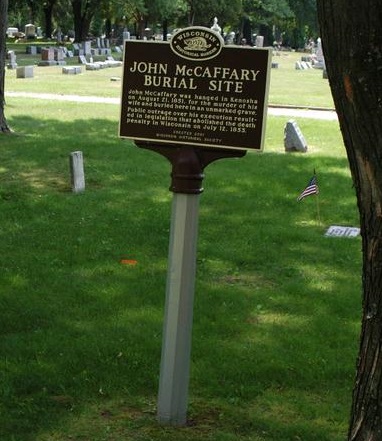
Burial marker for McCaffary in Kenosha’s Green Ridge Cemetery, erected in 2001. ((cc) image from Matt Hucke.) The McCaffary house on Court Street is also a registered historic landmark, and possibly haunted by Bridgett’s ghost.

There’s a handy roundup of resources related to the McCaffary execution here.

* The present-day name. Kenosha was then known as Southport.

** According to Invitation to an Execution: A History of the Death Penalty in the United States, there was an 1868 Wisconsin execution under Oneida (not Wisconsin) law, conducted on tribal lands.

† Said typewriter also debuted the now-standard QWERTY keyboard layout.

On this day..

1897: Michele Angiolillo, assassin of Canovas

On this date in 1897,* anarchist Michele Angiolillo was garroted in Vergara prison for assassinating the Spanish Prime Minister.

Angiolillo (English Wikipedia entry | Spanish) was an Italian expatriate in England who was so incensed by the procesos de Montjuic — a spasm of indiscriminate arrests and torture that followed an anarchist bombing in Barcelona — that he resolved to avenge the crime against his brothers.

“He read of the great wave of human sympathy with the helpless victims at Montjuich,” Emma Goldman wrote of Angiolillo. “On Trafalgar Square he saw with his own eyes the results of those atrocities, when the few Spaniards, who escaped Castillo’s clutches, came to seek asylum in England. There, at the great meeting, these men opened their shirts and showed the horrible scars of burned flesh. Angiolillo saw, and the effect surpassed a thousand theories; the impetus was beyond words, beyond arguments, beyond himself even.”

That named “Castillo” whose clutches rent so much flesh was the Spanish Prime Minister Antonio Canovas del Castillo, a statesman whose pioneering contribution to the art of manufactured consent was the turno system whereby two major Spanish political parties alternated turns in power/opposition and mutually connived to engineer ceremonial elections to that effect.

Upon his shoulders rested responsibility for the Barcelona torture regime.

And Angiolillo took it upon his shoulders to hold the executive to account.

Slipping into Spain with false papers, Angiolillo found Canovas taking a restorative visit to the Santa Agueda thermal baths and shot him dead on August 8.

As guards overcame the gunman — much too late — Canovas’s wife shrieked at him, “Murderer! Murderer!” The shooter gave her a bow and asked her pardon, for “I respect you, because you are an honorable lady, but I have done my duty and I am now easy in my mind, for I have avenged my friends and brothers of Montjuich.” (There are different versions of this bit of faux-politesse reported; suffice to say that in any form the remark was more pleasurable for Angiolillo to deliver than for the widow to receive.)

Official undesirables, by no means limited to anarchists who had survived Inquisition tactics in Montjuic, could scarcely contain their glee. New York anarchists avowed their support. Cuban and Puerto Rican separatists fretted only that the glory of the deed did not belong to one of their own. The Cubans specifically (and correctly) anticipated that the death of Canovas spelled the imminent recall of “Butcher” Weyler, the island’s strongman governor who had brutally crushed a rebellion there.**

His trial was undertaken within days, a mere formality considering that Angiolillo obviously shared the pride taken in his act by his overseas supporters. He justified the murder with reference not only to the torture and execution of anarchists at Montjuic, but of the execution of Philippines independence martyr Jose Rizal a few months prior.

* There are some sites proposing August 19 or 21. Period press reports are unambiguous that the correct execution date is August 20.

** William Randolph Hearst’s New York Journal would publish a banner headline during the imminent Spanish-American War triumphantly asking readers, “How do you like the Journal’s war?” Its claim to ownership stemmed in part from Hearst’s relentless hyping of Weyler’s (very real) atrocities over the preceding years.

On this day..

1738: Helena Curtens and Agnes Olmans, inviolable dignity

On this date in 1738, the last victims of witch trials in the Lower Rhine were burned at the stake in Gerresheim, an ancient German city today subsumed by Düsseldorf.

More eccentric than demoniacal, the sicky 14-year-old Helena Curtens reported having seen some ghostly apparition during a curative pilgrimage to Kevelaer, and received from him some towels with weird occult inscription. (She actually did have such towels.)

This adolescent attention-seeking turned into a whole thing when judge Johann Weyrich Sigismund Schwarz’s long ears caught hold of Gerresheim’s wagging tongues.

The whole idea of witches and witchcraft was trending ever less fashionable at this time, but not for Schwarz: he routed Curtens’s occult encounter into the judicial Hexenprozess and got on record an accusation against her neighbor Agnes Olmans as well as the usual stuff about playing the harlot with a visiting devil.

Their case extended for more than a year; Helena Curtens was 16 by the time she burned.

In that time, Curtens stayed curiously committed to her crazy story, even knowing that it was putting her under the shadow of the stake.

Olmans, by contrast, fought with every fiber the allegations that her young neighbor kept confirming. Olmans even fell ironic victim to the uneven development of rational witch-law reform when she tried to demand that she be put to the ordeal of water to prove her innocence: it turned out that this backwards practice of pseudo-forensics had been barred in 1555, so Schwarz could not order it. At trial, her denials were easily overcome by the gossip of neighbors, and even her own husband — who recalled that the mother-in-law had a distinctly witchy reputation. Hey, ’til death do us part, babe.

Today, there’s a public stone monument to these milestone sorceresses, the Gerresheimer Hexenstein (“Gerresheim witches’ stone”)

Its inscription reads:

Human dignity is inviolable.
For Helene Mechthildis Curtens and Agnes Olmanns.
Burned in Gerresheim on August 19, 1738.
After the last witch trial in the Lower Rhine
and for all those tortured and outcast

On this day..

1877: Leon Vitalis, inamorato

(Thanks to Harry Brodribb Irving for the guest post, originally published in his Book of Remarkable Criminals. Some formatting has been adjusted for readability. -ed.)

In the May of 1874, in the town of Montpellier, M. Boyer, a retired merchant, some forty-six years of age, lay dying. For some months previous to his death he had been confined to his bed, crippled by rheumatic gout. As the hour of his death drew near, M. Boyer was filled with a great longing to see his daughter, Marie, a girl of fifteen, and embrace her for the last time. The girl was being educated in a convent at Marseilles. One of M. Boyer’s friends offered to go there to fetch her. On arriving at the convent, he was told that Marie had become greatly attracted by the prospect of a religious life. “You are happy,” the Mother Superior had written to her mother, “very happy never to have allowed the impure breath of the world to have soiled this little flower. She loves you and her father more than one can say.”

Her father’s friend found the girl dressed in the costume of a novice, and was told that she had expressed her desire to take, one day, her final vows. He informed Marie of her father’s dying state, of his earnest wish to see her for the last time, and told her that he had come to take her to his bedside. “Take me away from here?” she exclaimed. The Mother Superior, surprised at her apparent reluctance to go, impressed on her the duty of acceding to her father’s wish. To the astonishment of both, Marie refused to leave the convent. If she could save her father’s life, she said, she would go, but, as that was impossible and she dreaded going out into the world again, she would stay and pray for her father in the chapel of the convent, where her prayers would be quite as effective as by his bedside. In vain the friend and the Mother Superior tried to bend her resolution.

Happily M. Boyer died before he could learn of his daughter’s singular refusal. But it had made an unfavourable impression on the friend’s mind. He looked on Marie as a girl without real feeling, an egoist, her religion purely superficial, hiding a cold and selfish disposition; he felt some doubt as to the future development of her character.

M. Boyer left a widow, a dark handsome woman, forty years of age.

Some twenty years before his death, Marie Salat had come to live with M. Boyer as a domestic servant. He fell in love with her, she became his mistress, and a few months before the birth of Marie, M. Boyer made her his wife. Madame Boyer was at heart a woman of ardent and voluptuous passions that only wanted opportunity to become careless in their gratification. Her husband’s long illness gave her such an opportunity. At the time of his death she was carrying on an intrigue with a bookseller’s assistant, Leon Vitalis, a young man of twenty-one. Her bed-ridden husband, ignorant of her infidelity, accepted gratefully the help of Vitalis, whom his wife described as a relative, in the regulation of his affairs. At length the unsuspecting Boyer died. The night of his death Madame Boyer spent with her lover.

The mother had never felt any great affection for her only child.

During her husband’s lifetime she was glad to have Marie out of the way at the convent. But the death of M. Boyer changed the situation. He had left almost the whole of his fortune, about 100,000 francs, to his daughter, appointing her mother her legal guardian with a right to the enjoyment of the income on the capital until Marie should come of age. Madame Boyer had not hitherto taken her daughter’s religious devotion very seriously. But now that the greater part of her husband’s fortune was left to Marie, she realised that, should her daughter persist in her intention of taking the veil, that fortune would in a very few years pass into the hands of the sisterhood. Without delay Madame Boyer exercised her authority, and withdrew Marie from the convent. The girl quitted it with every demonstration of genuine regret.

Marie Boyer when she left the convent was growing into a tall and attractive woman, her figure slight and elegant, her hair and eyes dark, dainty and charming in her manner. Removed from the influences of convent life, her religious devotion became a thing of the past. In her new surroundings she gave herself up to the enjoyments of music and the theatre. She realised that she was a pretty girl, whose beauty well repaid the hours she now spent in the adornment of her person.

The charms of Marie were not lost on Leon Vitalis.

Mean and significant in appearance, Vitalis would seem to have been one of those men who, without any great physical recommendation, have the knack of making themselves attractive to women. After her husband’s death Madame Boyer had yielded herself completely to his influence and her own undoubted passion for him. She had given him the money with which to purchase a business of his own as a second-hand bookseller. This trade the enterprising and greedy young man combined with money-lending and he clandestine sale of improper books and photographs.

To such a man the coming of Marie Boyer was a significant event. She was younger, more attractive than her mother; in a very few years the whole of her father’s fortune would be hers. Slowly Vitalis set himself to win the girl’s affections. The mother’s suspicions were aroused; her jealousy was excited. She sent Marie to complete her education at a convent school in Lyons. This was in the April of 1875. By this time Marie and Vitalis had become friendly enough to arrange to correspond clandestinely during the girl’s absence from home. Marie was so far ignorant of the relations of Vitalis with her mother.

Her daughter sent away, Madame Boyer surrendered herself with complete abandonment to her passion for her lover. At Castelnau, close to Montpellier, she bought a small country house. There she could give full rein to her desire.

To the scandal of the occasional passer-by she and her lover would bathe in a stream that passed through the property, and sport together on the grass. Indoors there were always books from Vitalis’ collection to stimulate their lascivious appetites. This life of pastoral impropriety lasted until the middle of August, when Marie Boyer came home from Lyons.

Vitalis would have concealed from the young girl as long as he could the nature of his relations with Madame Boyer, but his mistress by her own deliberate conduct made all concealment impossible. Whether from the utter recklessness of her passion for Vitalis, or a desire to kill in her daughter’s heart any attachment which she may have felt towards her lover, the mother paraded openly before her daughter the intimacy of her relations with Vitalis, and with the help of the literature with which the young bookseller supplied her, set about corrupting her child’s mind to her own depraved level.

The effect of her extraordinary conduct was, however, the opposite to what she had intended. The mind of the young girl was corrupted; she was familiarised with vice. But in her heart she did not blame Vitalis for what she saw and suffered; she pitied, she excused him. It was her mother whom she grew to hate, with a hate all the more determined for the cold passionless exterior beneath which it was concealed.

Madame Boyer’s deliberate display of her passion for Vitalis served only to aggravate and intensify in Marie Boyer an unnatural jealousy that was fast growing up between mother and daughter.

Marie did not return to the school at Lyons. In the winter of 1875, Madame Boyer gave up the country house and, with her daughter, settled in one of the suburbs of Montpellier. In the January of 1876 a theft occurred in her household which obliged Madame Boyer to communicate with the police. Spendthrift and incompetent in the management of her affairs, she was hoarding and suspicious about money itself. Cash and bonds she would hide away in unexpected places, such as books, dresses, even a soup tureen.

One of her most ingenious hiding places was a portrait of her late husband, behind which she concealed some bearer bonds in landed security, amounting to about 11,000 francs. One day in January these bonds disappeared. She suspected a theft, and informed the police. Three days later she withdrew her complaint, and no more was heard of the matter. As Marie and Vitalis were the only persons who could have known her secret, the inference is obvious.

When, later in the year, Vitalis announced his intention of going to Paris on business, his mistress expressed to him the hope that he would “have a good time” with her bonds. Vitalis left for Paris. But there was now a distinct understanding between Marie and himself. Vitalis had declared himself her lover and asked her to marry him. The following letter, written to him by Marie Boyer in the October of 1876, shows her attitude toward his proposal:

I thank you very sincerely for your letter, which has given me very great-pleasure, because it tells me that you are well. It sets my mind at rest, for my feelings towards you are the same as ever. I don’t say they are those of love, for I don’t know myself; I don’t know what such feelings are. But I feel a real affection for you which may well turn to love. How should I not hold in affectionate remembrance one who has done everything for me? But love does not come to order. So I can’t and don’t wish to give any positive answer about our marriage — all depends on circumstances. I don’t want any promise from you, I want you to be as free as I am. I am not fickle, you know me well enough for that. So don’t ask me to give you any promise. You may find my letter a little cold. But I know too much of life to pledge myself lightly. I assure you I think on it often. Sometimes I blush when I think what marriage means.

Madame Boyer, displeased at the theft, had let her lover go without any great reluctance. No sooner had he gone than she began to miss him. Life seemed dull without him. Mother and daughter were united at least in their common regret at the absence of the young bookseller.

To vary the monotony of existence, to find if possible a husband for her daughter, Madame Boyer decided to leave Montpellier for Marseilles, and there start some kind of business. The daughter, who foresaw greater amusement and pleasure in the life of a large city, assented willingly. On October 6, 1876, they arrived at Marseilles, and soon after Madame bought at a price considerably higher than their value, two shops adjoining one another in the Rue de la Republique. One was a cheese shop, the other a milliner’s.

The mother arranged that she should look after the cheese shop, while her daughter presided over the milliner’s. The two shops were next door to one another. Behind the milliner’s was a drawing-room, behind the cheese shop a kitchen; these two rooms communicated with each other by a large dark room at the back of the building. In the kitchen was a trap-door leading to a cellar. The two women shared a bedroom in an adjoining house.

Vitalis had opposed the scheme of his mistress to start shop-keeping in Marseilles. He knew how unfitted she was to undertake a business of any kind. But neither mother nor daughter would relinquish the plan. It remained therefore to make the best of it.

Vitalis saw that he must get the business into his own hands; and to do that, to obtain full control of Madame Boyer’s affairs, he must continue to play the lover to her. To the satisfaction of the two women, he announced his intention of coming to Marseilles in the New Year of 1877. It was arranged that he should pass as a nephew of Madame Boyer, the cousin of Marie. He arrived at Marseilles on January 1, and received a cordial welcome.

Of the domestic arrangements that ensued, it is sufficient to say that they were calculated to whet the jealousy and inflame the hatred that Marie felt towards her mother, who now persisted as before in parading before her daughter the intimacy of her relations with Vitalis.

In these circumstances Vitalis succeeded in extracting from his mistress a power of attorney, giving him authority to deal with her affairs and sell the two businesses, which were turning out unprofitable. This done, he told Marie, whose growing attachment to him, strange as it may seem, had turned to love, that now at last they could be free. He would sell the two shops, and with the money released by the sale they could go away together.

Suddenly Madame Boyer fell ill, and was confined to her bed. Left to themselves, the growing passion of Marie Boyer for Vitalis culminated in her surrender. But for the sick mother the happiness of the lovers was complete. If only her illness were more serious, more likely to be fatal in its result! “If only God would take her!” said Vitalis. “Yes,” replied her daughter, “she has caused us so much suffering!”

To Madame Boyer her illness had brought hours of torment, and at last remorse.

She realised the duplicity of her lover, she knew that he meant to desert her for her daughter, she saw what wrong she had done that daughter, she suspected even that Marie and Vitalis were poisoning her. Irreligious till now, her thoughts turned to religion. As soon as she could leave her bed she would go to Mass and make atonement for her sin; she would recover her power of attorney, get rid of Vitalis for good and all, and send her daughter back to a convent.

But it was too late. Nemesis was swift to overtake the hapless woman. Try as he might, Vitalis had found it impossible to sell the shops at anything but a worthless figure. He had no money of his own, with which to take Marie away. He knew that her mother had resolved on his instant dismissal.

As soon as Madame Boyer was recovered sufficiently to leave her bed, she turned on her former lover, denounced his treachery, accused him of robbing and swindling her, and bade him go without delay.

To Vitalis dismissal meant ruin, to Marie it meant the loss of her lover. During her illness the two young people had wished Madame Boyer dead, but she had recovered. Providence or Nature having refused to assist Vitalis, he resolved to fall back on art. He gave up a whole night’s rest to the consideration of the question.

As a result of his deliberations he suggested to the girl of seventeen the murder of her mother. “This must end,” said Vitalis. “Yes, it must,” replied Marie. Vitalis asked her if she had any objection to such a crime. Marie hesitated, the victim was her mother. Vitalis reminded her what sort of a mother she had been to her. The girl said that she was terrified at the sight of blood; Vitalis promised that her mother should be strangled. At length Marie consented. That night on some slight pretext Madame Boyer broke out into violent reproaches against her daughter. She little knew that every reproach she uttered served only to harden in her daughter’s heart her unnatural resolve.

On the morning of March 19 Madame Boyer rose early to go to Mass.

Before she went out, she reminded Vitalis that this was his last day in her service, that when she returned she would expect to find him gone.

It was after seven when she left the house. The lovers had no time to lose; the deed must be done immediately on the mother’s return. They arranged that Vitalis should get rid of the shop-boy, and that, as soon as he had gone, Marie should shut and lock the front doors of the two shops.

At one o’clock Madame Boyer came back. She expressed her astonishment and disgust that Vitalis still lingered, and threatened to send for the police to turn him out. Vitalis told the shop-boy that he could go away for a few hours; they had some family affairs to settle. The boy departed. Madame Boyer, tired after her long morning in the town, was resting on a sofa in the sitting-room, at the back of the milliner’s shop. Vitalis entered the room, and after a few heated words, struck her a violent blow in the chest. She fell back on the sofa, calling to her daughter to come to her assistance. The daughter sought to drown her mother’s cries by banging the doors, and opening and shutting drawers. Vitalis, who was now trying to throttle his victim, called to Marie to shut the front doors of the two shops.

To do so Marie had to pass through the sitting-room, and was a witness to the unsuccessful efforts of Vitalis to strangle her mother. Having closed the doors, she retired into the milliner’s shop to await the issue. After a few moments her lover called to her for the large cheese knife; he had caught up a kitchen knife, but in his struggles it had slipped from his grasp. Quickly Marie fetched the knife and returned to the sitting-room.

There a desperate struggle was taking place between the man and woman. At one moment it seemed as if Madame Boyer would get the better of Vitalis, whom nature had not endowed greatly for work of this kind. Marie came to his aid. She kicked and beat her mother, until at last the wretched creature released her hold and sank back exhausted. With the cheese knife, which her daughter had fetched, Vitalis killed Madame Boyer.

They were murderers now, the young lovers. What to do with the body? The boy would be coming back soon. The cellar under the kitchen seemed the obvious place of concealment. With the help of a cord the body was lowered into the cellar, and Marie washed the floor of the sitting-room. The boy came back. He asked where Madame Boyer was. Vitalis told him that she was getting ready to return to Montpellier the same evening, and that he had arranged to go with her, but that he had no intention of doing so; he would accompany her to the station, he said, and then at the last moment, just as the train was starting, slip away and let her go on her journey alone. To the boy, who knew enough of the inner history of the household to enjoy the piquancy of the situation, such a trick seemed quite amusing. He went away picturing in his mind the scene at the railway station and its humorous possibilities.

At seven o’clock Vitalis and Marie Boyer were alone once more with the murdered woman. They had the whole night before them.

Vitalis had already considered the matter of the disposal of the body. He had bought a pick and spade. He intended to bury his former mistress in the soil under the cellar. After that had been done, he and Marie would sell the business for what it would fetch, and go to Brussels — an admirable plan, which two unforeseen circumstances defeated. The Rue de la Republique was built on a rock, blasted out for the purpose. The shop-boy had gone to the station that evening to enjoy the joke which, he believed, was to be played on his mistress.

When Vitalis tried to dig a grave into the ground beneath the cellar he realised the full horror of the disappointment. What was to be done? They must throw the body into the sea. But how to get it there?

The crime of Billoir, an old soldier, who the year before in Paris had killed his mistress in a fit of anger and cut up her body, was fresh in the recollection of Vitalis. The guilty couple decided to dismember the body of Madame Boyer and so disfigure her face as to render it unrecognisable. In the presence of Marie, Vitalis did this, and the two lovers set out at midnight to discover some place convenient for the reception of the remains. They found the harbour too busy for their purpose, and decided to wait until the morrow, when they would go farther afield. They returned home and retired for the night, occupying the bed in which Madame Boyer had slept the night before.

On the morning of the 20th the lovers rose early, and a curious neighbour, looking through the keyhole, saw them counting joyously money and valuables, as they took them from Madame Boyer’s cash-box. When the shop-boy arrived, he asked Vitalis for news of Madame Boyer. Vitalis told him that he had gone with her to the station, that she had taken the train to Montpellier, and that, in accordance with his plan, he had given her the slip just as the train was starting. This the boy knew to be false: he had been to the station himself to enjoy the fun, and had seen neither Vitalis nor Madame Boyer. He began to suspect some mystery.

In the evening, when the shops had been closed, and he had been sent about his business, he waited and watched. In a short time he saw Vitalis and Marie Boyer leave the house, the former dragging a hand-cart containing two large parcels, while Marie walked by his side. They travelled some distance with their burden, leaving the city behind them, hoping to find some deserted spot along the coast where they could conceal the evidence of their crime. Their nerves were shaken by meeting with a custom-house officer, who asked them what it was they had in the cart. Vitalis answered that it was a traveller’s luggage, and the officer let them pass on. But soon after, afraid to risk another such experience, the guilty couple turned out the parcels into a ditch, covered them with stones and sand, and hurried home.

The next day, the shop-boy and the inquisitive neighbour having consulted together, went to the Commissary of Police and told him of the mysterious disappearance of Madame Boyer. The Commissary promised to investigate the matter, and had just dismissed his informants when word was brought to him of the discovery, in a ditch outside Marseilles, of two parcels containing human remains. He called back the boy and took him to view the body at the Morgue. The boy was able, by the clothes, to identify the body as that of his late mistress.

The Commissary went straight to the shops in the Rue de la Republique, where he found the young lovers preparing for flight. At first they denied all knowledge of the crime, and said that Madame Boyer had gone to Montpellier. They were arrested, and it was not long before they both confessed their guilt to the examining magistrate.

Vitalis and Marie Boyer were tried before the Assize Court at Aix on July 2, 1877. Vitalis is described as mean and insignificant in appearance, thin, round-backed, of a bilious complexion; Marie Boyer as a pretty, dark girl, her features cold in expression, dainty and elegant. At her trial she seemed to be still so greatly under the influence of Vitalis that during her interrogatory the President sent him out of court. To the examining magistrate Marie Boyer, in describing her mother’s murder, had written, “I cannot think how I came to take part in it. I, who wouldn’t have stayed in the presence of a corpse for all the money in the world.”

Vitalis was condemned to death, and was executed on August 17. He died fearful and penitent, acknowledging his miserable career to be a warning to misguided youth. Extenuating circumstances were accorded to Marie Boyer, and she was sentenced to penal servitude for life. Her conduct in prison was so repentant and exemplary that she was released in 1892.

M. [Louis] Proal, a distinguished French judge, and the author of some important works on crime, acted as the examining magistrate in the case of Vitalis and Marie Boyer. He thus sums up his impression of the two criminals:

Here is an instance of how greed and baseness on the one side, lust and jealousy on the other, bring about by degrees a change in the characters of criminals, and, after some hesitation, the suggestion and accomplishment of parricide, Is it necessary to seek an explanation of the crime in any psychic abnormality which is negatived to all appearances by the antecedents of the guilty pair? Is it necessary to ask it of anatomy or physiology? Is not the crime the result of moral degradation gradually asserting itself in two individuals, whose moral and intellectual faculties are the same as those of other men, but who fall, step by step, into vice and crime? It is by a succession of wrongful acts that a man first reaches the frontier of crime and then at length crosses it.

On this day..