1987: Jimmy Glass, electrocution appellant

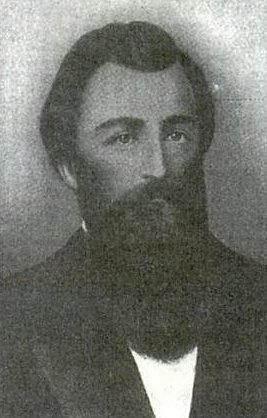
On this date in 1987, Jimmy L. Glass died in Louisiana’s electric chair — having come one vote short of having the device declared unconstitutional by the Supreme Court.

The 20-year-old Glass escaped from a parish jail with fellow inmate Jimmy Wingo on Christmas Eve, 1982, robbing and murdering an elderly couple in the process. Each blamed the other; both got the chair.*

But should they have?

Glass would lend his name to a landmark 1985 Supreme Court decision contesting Louisiana’s method of execution.

By a 5-4 decision, the high court held that electrocution, still at that point the country’s prevailing method of execution despite its medieval reputation for grisly botches, remained a constitutional method of inflicting death.

Liberal Justice William Brennan‘s vigorous dissent from that judgment is not for the squeamish. (For readability, I’ve added emphasis and removed the many citations in the original.)

[E]vidence suggests that death by electrical current is extremely violent and inflicts pain and indignities far beyond the “mere extinguishment of life.” Witnesses routinely report that, when the switch is thrown, the condemned prisoner “cringes,” “leaps,” and ” ‘fights the straps with amazing strength.’ ” “The hands turn red, then white, and the cords of the neck stand out like steel bands.” The prisoner’s limbs, fingers, toes, and face are severely contorted. The force of the electrical current is so powerful that the prisoner’s eyeballs sometimes pop out and “rest on [his] cheeks.” The prisoner often defecates, urinates, and vomits blood and drool.

“The body turns bright red as its temperature rises,” and the prisoner’s “flesh swells and his skin stretches to the point of breaking.” Sometimes the prisoner catches on fire, particularly “if [he] perspires excessively.” Witnesses hear a loud and sustained sound ” like bacon frying,” and “the sickly sweet smell of burning flesh” permeates the chamber. This “smell of frying human flesh in the immediate neighbourhood of the chair is sometimes bad enough to nauseate even the Press representatives who are present.” In the meantime, the prisoner almost literally boils: “the temperature in the brain itself approaches the boiling point of water,” and when the postelectrocution autopsy is performed “the liver is so hot that doctors have said that it cannot be touched by the human hand.” The body frequently is badly burned and disfigured.

The violence of killing prisoners through electrical current is frequently explained away by the assumption that death in these circumstances is instantaneous and painless. This assumption, however, in fact “is open to serious question” and is “a matter of sharp conflict of expert opinion.” Throughout the 20th century a number of distinguished electrical scientists and medical doctors have argued that the available evidence strongly suggests that electrocution causes unspeakable pain and suffering. Because ” ‘[t]he current flows along a restricted path into the body, and destroys all the tissue confronted in this path . . . [i]n the meantime the vital organs may be preserved; and pain, too great for us to imagine, is induced. . . . For the sufferer, time stands still; and this excruciating torture seems to last for an eternity.‘ ” L.G.V. Rota, a renowned French electrical scientist, concluded after extensive research that

“[i]n every case of electrocution, . . . death inevitably supervenes but it may be very long, and above all, excruciatingly painful . . . . [T]he space of time before death supervenes varies according to the subject. Some have a greater physiological resistance than others. I do not believe that anyone killed by electrocution dies instantly, no matter how weak the subject may be. In certain cases death will not have come about even though the point of contact of the electrode with the body shows distinct burns. Thus, in particular cases, the condemned person may be alive and even conscious for several minutes without it being possible for a doctor to say whether the victim is dead or not. . . . This method of execution is a form of torture.”

At least neither the juridical near miss nor Brennan’s graphic description of his impending manner of death dented Jimmy’s sense of humor. Asked for his last words, the “swaggering” inmate, already strapped in the chair, replied

Yeah, I think I’d rather be fishing.

Luckily for Carlisle United, he’s not the same guy as journeyman goaltender Jimmy Glass, who in 1999 improbably struck home one of the greatest goals in English football history.

* Wingo was put to death four days after Glass.

On this day..

1725: John Gow and his pirate crew

On this date in 1725, John Gow and seven comrade raiders hanged for piracy.

Having mutinied to commandeer a merchant vessel in November 1724, Gow managed merely a three-month career of seaboard outlawry* in European waters before an ill-fated landward raid in his native Scotland saw the ship run aground.

Captured, Gow and confederates were hailed to London to stand trial, the captain delaying matters by refusing to plead before the threat of being pressed forced his hand. The inevitable sentence came off a little … unevenly. During the hanging,

[Gow’s] friends, anxious to put him out of his pain, pulled his legs so forcibly that the rope broke and he dropped down; on which he was again taken up to the gibbet, and when he was dead was hanged in chains on the banks of the Thames.

Scottish scribbler Sir Walter Scott mined the local lore of “the Orkney pirate” heavily for his novel The Pirate.

* Exhaustingly catalogued in the Newgate calendar.

On this day..

1942: The village of Lidice, for the assassination of Reinhard Heydrich

On this date in 1942, the Germans visited upon the Czechoslovakian village of Lidice one of the most notorious butcheries of World War II: the physical destruction of the town, and the execution of most of the adult population, in revenge for the assassination of Reichsprotektor Reinhard Heydrich.

Heydrich had power of life and death in Nazi-occupied Bohemia and Moravia, and did not scruple to use it.

“The Hangman of Prague” was no mere functionary, but a Nazi grand wizard from way back, who’d had a hand in the Third Reich’s most terrifying greatest hits — the Night of the Long Knives, Kristallnacht. Just four months before this date, Heydrich had chaired the Wannsee Conference.* (Watch Kenneth Branagh as Heydrich ride herd over a gaggle of bureaucrats to get the Final Solution up and running in Conspiracy.) Hitler called him his “man with the iron heart.”

So he was a natural target for the Czechoslovakian army-in-exile and their British handlers, made more so by his lordly disdain for common-sense security safeguards.

Zipping along a predictable route in an open car, he was a sitting duck for a hit squad, who gave the Nazi bastard a mortal shrapnel wound from a grenade that had him lingering painfully at death’s door for several days before he finally died of blood poisoning.

The 1964 Czechoslovakian film Atentat (“Assassination”) chronicles the plot to kill Heydrich and its aftermath.

For this effrontery, Czechoslovakians would pay a dreadful price.

Naturally, the Nazis mercilessly hunted down and slaughtered those with any connection to the plot.

But the Reich also exacted collective reprisals to make plain that the entire “protectorate” could be considered hostage against such plots in the future.

Special transports of Jews marked “Attentat auf Heydrich” were shipped to the camps, and 152 were executed on the day Heydrich succumbed. But then, the Nazis were brutalizing Jews anyway. Something more headline-grabbing would be needed.

Enter Lidice.

After gaudy funerals for the slain Reichsprotektor, the Reich settled upon the small town of Lidice north of Prague — trumping up a few connections to resistance to “justify” collective punishment.

On this date, German troops stormed it, summarily executed all the men and boys** old enough to bear arms and a fair number of women, deported the others, and then physically destroyed and buried the town.

Lidice was intended as a demonstration — boldly published to the world as proof against a repeat,† it became the byword of Nazi cruelty towards subject nations. Though not by quantitative standards the greatest crime of the occupation, not even the greatest crime in reprisal for Heydrich, its three syllables distill all the evil of Hitler’s conquest for Czechoslovakia.

Lidice did live, and does yet, as an emblem par excellence those terrible years.

Less alive: Heydrich’s right-hand man Karl Hermann Frank, who was hanged in Prague after the war for engineering this monstrous crime. Those survivors of Lidice able to make the trip enjoyed priority seating.

* Heydrich’s aide at the Wannsee Conference, and taker of cleaned-up minutes, was Mr. Banality of Evil himself, Adolf Eichmann.

** Only three men of Lidice survived the destruction: two who were in England at that time, and one who was imprisoned in Prague for killing his son. The sentence for this crime, it turned out, was life.

† An effective proof — the calculated wholesale slaughter apparently did cool both the conquered populace and the enemies of Germany on enthusiasm for further assassinations.

On this day..

1864: Doctor Edmond-Désiré Couty de la Pommerais, poisoner

At dawn this morning before the walls of La Roquette, a homeopath convicted of poisoning his mistress was beheaded for one of Paris’s most sensational crime dramas of the 1860’s.

The ill-fated Madame de Pauw had fallen suddenly ill and expired in the doctor’s care; means and opportunity were obvious, and motive readily adduced from the handsome life insurance policies of the expired woman.

La Pommerais was convicted on this basis of killing his paramour in the midst of a farcical insurance scam, with noted forensic scientist Ambroise Tardieu establishing to the court’s satisfaction the presence of the poison digitalin.

(One can read a detailed 1865 critique of Tardieu’s conclusions and testimony, a reminder that the criminal justice system’s struggles with the uses and limitations of forensic science are a longstanding concern. This (if one takes it as such) murder, which reads in retrospection like a classic in the genre of comedic criminality, might have been the perfect crime absent an obvious pecuniary design: the death was put down to a routine cause and only scrutinized when an anonymous tip and/or the suspicious insurance adjusters led the authorities to exhume the body 13 days after burial.)

American newsman George Alfred Townsend chanced to be abroad in Paris on this occasion, and recorded the scene as “thousands of Parisians bent their steps the night before the execution” in Campaigns of a Non-combatant — excerpted at length here for its topicality to this blog.

The news had gone abroad that la Pommerais would not be pardoned. It was also generally credited that this would be the last execution ever held in Paris, since there is a general desire for the abolition of capital punishment in France, and a conviction that the Legislature, at its next session, will substitute life-imprisonment.* This, with the rarity of the event, and that terrible allurement of blood which distinguishes all populaces, brought out all the excitable folk of the town; and at dusk, on the night before the expiation, the whole neighborhood of La Roquette was crowded with men and women. All classes of Parisians were there, — the blouses, or workingmen, standing first in number; the students from the Latin Quartier being well represented, and idlers, and well-dressed nondescripts without enumeration, — distributing themselves among women, dogs, and babies.

Venders of galeaux, muscles, and fruit were out in force. The “Savage of Paris,” clothed in his war plumes, paint, greaves, armlets, and moccasins, was selling razors by gaslight; here and there ballad-mongers were singing the latest songs, and boys, with chairs to let, elbowed into the intricacies of the crowd, which amused itself all the night long by smoking, drinking, and hallooing. At last, the mass became formidable in numbers, covering every inch of ground within sight of the prison, and many soldiers and sergeants de ville, mounted and on foot, pushed through the dense mass to restore order.

At midnight, a body of cavalry forced back the people from the square of La Roquette. A number of workmen, issuing from the prison-gates, proceeded to set up the instrument of death by the light of blazing torches. The flame lit up the dark jail walls, and shone on the helmets and cuirasses of the sabre-men, and flared upon spots of the upturned faces, now bringing them into strong, ruddy relief, now plunging them into shadow. When the several pieces had been framed together, we had a real guillotine in view, — the same spectre at which thousands of good and bad men had shuddered; and the folks around it, peering up so eagerly, were descendants of those who stood on the Place de la Concorde to witness the head of a king roll into the common basket. Imagine two tall, straight timbers, a foot apart, rising fifteen feet from the ground. They are grooved, and spring from a wide platform, approached by a flight of steps. At the base, rests a spring-plank or bascule, to which leather thongs are attached to buckle down the victim, and a basket or pannier filled with sawdust to receive the severed head. Between these, at their summit, hangs the shining knife in its appointed grooves, and a cord, which may be disconnected by a jerk, holds it to its position. Two men will be required to work the instrument promptly, — the one to bind the condemned, the other to drop the axe. The bascule is so arranged that the whole weight and length of the trunk will rest upon it, leaving the head and neck free, and when prone it will reach to the grooves, leaving space for the knife to pass below it. The knife itself is short and wide, with a bright concave edge, and a rim of heavy steel ridges it at the top; it moves easily in the greased grooves, and may weigh forty pounds. It has a terrible fascination, hanging so high and so lightly in the blaze of the torches, which play and glitter upon it, and cast stains of red lights along its keen blade, as if by their brilliance all its past blood-marks had become visible again. A child may send it shimmering and crashing to the scaffold, but only God can fasten together the warm and throbbing parts which it shall soon dissever. And now that the terrible creature has been recreated, the workmen slink away, as if afraid of it, and a body of soldiers stand guard upon it, as if they fear that it might grow thirsty and insatiate as in the days of its youth. The multitude press up again, reinforced every hour, and at last the pale day climbs over the jail-walls, and waiting people see each other by its glimmer. The bells of Notre Dame peal out; a hundred towers fall into the march of the music; the early journals are shrieked by French newsboys, and folks begin to count the minutes on their watches. There are men on the ground who saw the first guillotine at work. They describe the click of the cleaver, the steady march of victims upon the scaffold-stairs, the rattle of the death-cart turning out of the rue Saint Honore, the painted executioners, with their dripping hands, wiping away the jets of blood from the hard, rough faces; nay! the step of the young queen, white-haired with care, but very beautiful, who bent her body as she had never bent her knee and paid the penalty of her pride with the neck which a king had fondled.

At four minutes to six o’clock on Thursday morning, the wicket in the prison-gate swung open; the condemned appeared, with his hands tied behind his back, and his knees bound together. He walked with difficulty, so fettered; but other than the artificial restraints, there was no hesitation nor terror in his movements. His hair, which had been long, dark, and wavy, was severed close to his scalp; his beard had likewise been clipped, and the fine moustache and goatee, which had set off his most interesting face, no longer appeared to enhance his romantic, expressive physiognomy. Yet his black eyes and cleanly cut mouth, nostrils, and eyebrows, demonstrated that Couty de la Pommerais was not a beauty dependent upon small accessories. There was a dignity even in his painful gait; the coarse prison-shirt, scissored low in the neck, exhibited the straight columnar throat and swelling chest; for the rest, he wore only a pair of black pantaloons and his own shapely boots. As he emerged from the wicket, the chill morning air, laden with the dew of the truck gardens near at hand, blew across the open spaces of the suburbs, and smote him with a cold chill. He was plainly seen to tremble; but in an instant, as if by the mere force of his will, he stood motionless, and cast a first and only glance at the guillotine straight before him. It was the glance of a man who meets an enemy’s eye, not shrinkingly, but half-defiant, as if even the bitter retribution could not abash his strong courage … he seemed to feel that forty thousand men and women, and young children were looking upon him to see how he dared to die, and that for a generation his bearing should go into fireside descriptions. Then he moved on between the files of soldiers at his shuffling pace, and before him went the aumonier or chaplain, swaying the crucifix, behind him the executioner of Versailles — a rough and bearded man — to assist in the final horror.

It was at this intense moment a most wonderful spectacle. As the prisoner had first appeared, a single great shout had shaken the multitude. It was the French word “Voila!” which means “Behold!” “See!” Then every spectator stood on tiptoe; the silence of death succeeded;** all the close street was undulant with human emotion; a few house roofs near by were dizzy with folks who gazed down from the tiles; all the way up the heights of Pere la Chaise, among the pale chapels and monuments of the dead, the thousands of stirred beings swung and shook like so many drowned corpses floating on the sea. Every eye and mind turned to the little structure raised among the trees, on the space before La Roquette, and there they saw a dark, shaven, disrobed young man, going quietly toward his grave.

He mounted the steps deliberately, looking towards his feet; the priest held up the crucifix, and he felt it was there, but did not see it; his lips one moment touched the image of Christ, but he did not look up nor speak; then, as he gained the last step, the bascule or swingboard sprang up before him; the executioner gave him a single push, and he fell prone upon the plank, with his face downward; it gave way before him, bearing him into the space between the upright beams, and he lay horizontally beneath the knife, presenting the back of his neck to it. Thus resting, he could look into the pannier or basket, into whose sawdust lining his head was to drop in a moment. And in that awful space, while all the people gazed with their fingers tingling, the legitimate Parisian executioner gave a jerk at the cord which held the fatal knife. With a quick, keen sound, the steel became detached; it fell hurtling through the grooves; it struck something with a dead, dumb thump; a jet of bright blood spurted into the light, and dyed the face of an attendant horribly read; and Couty de la Pommerais’s head lay in the sawdust of the pannier, while every vein in the lopped trunk trickled upon the scaffold-floor! They threw a cloth upon the carcass and carried away the pannier; the guillotine disappeared beneath the surrounding heads; loud exclamations and acclaims burst from the multitude; the venders of trash and edibles resumed their cheerful cries, and a hearse dashed through the mass, carrying the warm body of the guillotined to the cemetery of Mt. Parnasse. In thirty minutes, newsboys were hawking the scene of the execution upon all the quays and bridges. In every cafe of Paris some witness was telling the incidents of the show to breathless listeners, and the crowds which stopped to see the funeral procession of the great Marshal Pelissier divided their attention between the warrior and the poisoner, — the latter obtaining the preponderance of fame.

(This attention-getting execution attracted an apocryphal story† (pdf) that the severed head of La Pommerais was subject to a “wink test” to determine whether consciousness survived the fall of the blade.)

The doctor bequeathed the world a book on homeopathic medicine, which the discerning reader of French can peruse free.

* Actually, the last execution in France was still 113 years away.

** Rashomon-like, not all observers concurred as to the event’s quiet solemnity. The New York Times reported that

[t]he language of those non-official persons who assembled to witness this expiation of a great crime was brutal to the last decree. They hissed and hooted as the convict was about to mount the ladder, and were loudest in their brutal demonstrations when the crucifix was pressed to his lips. The blade had scarcely severed his head from his body, when a rush was made to do violence to the trunk. The troops were obliged to interfere, and had some difficulty in repelling the crowd, which was excited by the sight of a ‘gentleman criminal’ to a pitch of savage ferocity … The Pays, in noticing this expiation of a great crime, states that the crowd retired in silence. But I am in a position to affirm that the contrary was the cxase.

† Put about — as a hoax? — by Auguste Villiers de l’Isle-Adam.

On this day..

1405: Richard le Scrope and Thomas de Mowbray, without color of law

On this date in 1405, Henry IV had two rebellious peers beheaded on his authority at York.


The lower panels of this stained glass in St. Andrew’s Church, Bishopthorpe, depict the trial of Archbishop Scrope. Image (c) Roger Walton and used with permission.

Richard le Scrope, Archbishop of York, and Thomas de Mowbray, Earl of Norfolk, had both become estranged from Henry Bolingbroke, the noble who had wrested control of the English crown as Henry IV.

Since Henry’s legitimacy was dubious, he faced even more than a monarch’s usual ration of plots and rebellions — most famously that of young Sir Henry Percy, remembered as “Hotspur” in Shakespeare’s Henry IV part 1.

That particular enemy met his end in 1403, but old man Percy was soon back to fomenting from his expansive holdings in the north.

Mowbray, a disaffected teenager, and Scrope, a seasoned prelate who should have known better, were drawn into the next intrigue — by “the odor of French promises or rewards,” their enemies charged. A noble loyal to Henry intercepted their modest force and (so the story goes*) by representing to accept Scrope’s offer to parley induced the rebels to disband, whereupon the ringleaders were arrested.

Henry demanded their immediate condemnation; Chief Justice William Gascoigne insisted upon their right to be judged by other peers of the realm (and upon the inviolability of the archbishop**). The hot-blooded† Henry was inclined not to bother, and simply had their heads lopped off on his own authority.

Shakespeare treats this episode in Henry IV, part 2:

HASTINGS [another rebellious lord, who shared the same fate]

Our Army is dispers’d:
Like youthfull Steeres, unyoak’d, they tooke their course
East, West, North, South: or like a Schoole, broke up,
Each hurryes towards his home, and sporting place

WESTMORLAND

Good tidings (my Lord Hastings) for the which,
I doe arrest thee (Traytor) of high Treason:
And you Lord Arch-bishop, and you Lord Mowbray,
Of Capitall Treason, I attach you both

MOWBRAY

Is this proceeding just, and honorable?

WESTMORLAND

Is your Assembly so?

BISHOP SCROPE

Will you thus breake your faith?

JOHN

I pawn’d thee none:
I promis’d you redresse of these same Grievances
Whereof you did complaine; which, by mine Honor,
I will performe, with a most Christian care.
But for you (Rebels) looke to taste the due
Meet for Rebellion, and such Acts as yours.
Most shallowly did you these Armes commence,
Fondly brought here, and foolishly sent hence.
Strike up our Drummes, pursue the scatter’d stray,
Heaven, and not wee, have safely fought to day.
Some guard these Traitors to the Block of Death,
Treasons true Bed, and yeelder up of breath.

(See this scene played here.)

Scrope’s execution in particular played very badly as an arrogation of secular power over the ecclesiastical authorities. The pope was persuaded not to excommunicate Henry — that step would be reserved a later King Henry — but many contemporaries viewed the monarch’s subsequent (and ultimately fatal) bouts with disfiguring “leprosy” as a judgment from above St. Peter’s throne.

This Google books freebie has much more on the cast of characters at the center of this day’s action.

* This popular version has its opponents; the rebels may have simply surrendered when they recognized their hopeless military disadvantage.

** Interestingly, the very uncle of the noble who effected the arrest of Scrope and Mowbray had been implicated a traitor a generation before by the Merciless Parliament. Unlike many, Alexander Neville was spared a death sentence for his perceived proximity to Richard II … because he was, as Scrope would become, the Archbishop of York.

† Henry was making noises about destroying York altogether as punishment for its disloyalty as he rode there following the “Battle” of Shipton Moor. Residents of that northern city met him in poses of desperate submission — dressed in sackcloth, ropes about their necks, offering up their weapons.

On this day..

1862: William B. Mumford, flag desecrator

On this date in 1862, a 42-year-old gambler hanged at the New Orleans mint where, six weeks before, he had pulled down the Stars and Stripes of the arriving Union occupiers to the delight of a Confederate mob.

Moving to secure the Mississippi, Northern forces had the Big Easy encircled and about to surrender when, an advance team landed in the undefended city and pulled down the Stars and Bars over the mint on Esplanade Avenue.

William Bruce Mumford was among the Confederate loyalists who took exception to the Yankee flag, so he chopped it down and dragged it through the street (provoking a cannonade from a Union warship). The flag was little but tatters by the time he had through with it.

Although the city was not officially occupied at the time of this incident, the mint was a federal building. Army General Benjamin Butler resolved to make a salutary example out of the incident to quell any possible civil unrest.

I find the city under the dominion of a mob. They have insulted our flag — torn it down with indignity. This outrage will be punished in such a manner as in my judgment will caution both the perpetrators and abettors of the act, so that they will fear the stripes, if they do not reverence the stars of our banner.

Butler, it should be allowed, had some reason for this conclusion. The Picayune exulted the act as, well, a call to resistance.

The names of the party that distinguished themselves by gallantly tearing down the flag that had been surreptitiously hoisted, we learn, are W. B. Mumford, who cut it loose from the flag-staff amid the shower of grape. Lieutenant N. Holmes, Sergeant Burns and James Reed. They deserve great credit for their patriotic act. New Orleans, in this hour of adversity, by the calm dignity she displays in the presence of the enemy, by the proof she gives of her unflinching determination to sustain to the uttermost the righteous cause for which she has done so much and made such great sacrifices, by her serene endurance undismayed of the evil which afllicts her, and her abiding confidence in the not distant coming of better and brighter days — of speedy deliverance from the enemy’s toils — is showing a bright example to her sister cities, and proving herself, in all respects, worthy of the proud position she has achieved. We glory in being a citizen of this great metropolis.

This free book argues that Butler’s clemency a few days before to a group of condemned southern enlisted men made mercy politically impossible in the Mumford case, lest the citizenry interpret executive weakness as an invitation to lawlessness.

If that was Butler’s calculus, Confederate die-hards did not appreciate it.

Accordingly, when Mumford was “hung … from a flag-staff projecting from one of the windows under the front portico” of the mint, he won promotion into the pantheon of southern martyrs.

Confederate President Jefferson Davis issued an order condemning General Butler, and even his officers, to death, along with some outsized bluster about embargoing prisoner exchanges that the Confederacy had not the manpower to seriously intend:

William B. Mumford, a citizen of this Confederacy, was actually and publicly executed in cold blood by hanging alter the occupation of the city of New Orleans by the forces under the command of General Benjamin F. Butler when said Mumford was an unresisting and non-combatant captive, and for no offense even alleged to have been committed by him subsequent to the date of the capture of the said city …

the silence of the Government of the United States and its maintaining of said Butler in high office under its authority for many months after his commission of an act that can be viewed in no other light than as a deliberate murder, as well as of numerous other outrages and atrocities hereafter to be mentioned, afford evidence only too conclusive that the said Government sanctions the conduct of said Butler and is determined that he shall remain unpunished for his crimes:

Now therefore I, Jefferson Davis, President of the Confederate States of America, and in their name do pronounce and declare the said Benjamin F. Butler to be a felon deserving of capital punishment. I do order that he be no longer considered or treated simply as a public enemy of the Confederate States of America but as an outlaw and common enemy of mankind, and that in the event of his capture the officer in command of the capturing force do cause him to be immediately executed by hanging; and I do further order that no commissioned officer of the United States taken captive shall be released on parole before exchange until the said Butler shall have met with due punishment for his crimes.

And whereas the hostilities waged against this Confederacy by the forces of the United States under the command of said Benjamin F. Butler have borne no resemblance to such warfare as is alone permissible by the rules of international law or the usages of civilization but have been characterized by repeated atrocities and outrages

… (examples of atrocities omitted) …

I, Jefferson Davis, President of the Confederate States of America and acting by their authority, appealing to the Divine Judge in attestation that their conduct is not guided by the passion of revenge but that they reluctantly yield to the solemn duty of repressing by necessary severity crimes of which their citizens are the victims, do issue this my proclamation, and by virtue of my authority as Commander-in-Chief of the Armies of the Confederate States do order-

1. That all commissioned officers in the command of said Benjamin F. Butler be declared not entitled to be considered as soldiers engaged in honorable warfare but as robbers and criminals deserving death, and that they and each of them be whenever captured reserved for execution.

2. That the private soldiers and non-commissioned officers in the army of said Butler be considered as only the instruments used for the commission of the crimes perpetrated by his orders and not as free agents; that they therefore be treated when captured as prisoners of war with kindness and humanity and be sent home on the usual parole that they will in no manner aid or serve the United States in any capacity during the continuance of this war unless duly exchanged.

3. That all negro slaves captured in arms be at once delivered over to the executive authorities of the respective States to which they belong to be dealt with according to the laws of said States.

4. That the like orders be executed in all cases with respect to all commissioned officers of the United States when found serving in company with armed slaves in insurrection against the authorities of the different States of this Confederacy.

The Confederates never got a chance to enforce the order; he resumed his colorful political career and died in 1893 hailed as Massachusetts’ greatest citizen-soldier. Complain (pdf) as they might of his iron-heeled rule, the residents of New Orleans had good cause to appreciate the relatively early and orderly occupation of their city, which spared it the flames visited on more recalcitrant rebel strongholds.

For the South, the loss of its largest city and the gateway to the Mississippi was a severe blow. As the rebel position crumbled in the months to come, Jefferson Davis must have had a worry for his own neck.

Somehow, he and every other Southerner escaped execution for their treasonable design, which leaves William Bruce Mumford, the riverboat gambler who tore down Old Glory, as the only American since at least the War of 1812 to be put to death for treason against the United States.*

* Anti-slavery rebel John Brown was hanged for treason in 1859, but it was treason against the state of Virginia — not against the U.S. Julius and Ethel Rosenberg were electrocuted for espionage, not treason.

On this day..

1935: Pat Griffin and Elmer Brewer

On this date in 1935, the first double hanging* in the state of Iowa took place at Fort Madison.

Waterloo, Iowa, police heading out to query Elmer Brewer “in connection with alleged misconduct of Brewer with juvenile girls” alarmed Brewer and his friend Patrick Griffin, who assumed they were coming to arrest them for a robbery.

The two killed Deputy Sheriff William Fay Dilworth in a shootout.

Long forgotten, Griffin’s rodeo avocation, his friendship with the classmate who was to be his Catholic confessor, his offer to give all his earnings to the victim’s family were his sentence commuted to hard labor.

Just a lost file from the police blotter, moldering in a musty corner of a local archives. Although the glacial progress of the legal proceedings will look more familiar to modern eyes.

Thus closes a case which has been more or less in the courts since December 16, 1932. Attorney James Fay of Emmetsburg and Attorney John McCartney of Waterloo made valiant efforts to save the lives of the two men, but to no avail. Following their conviction of the murder in the district court in Waterloo on January 5, 1933, they were sentenced to be hanged on January 26, 1934. In May, 1933, an appeal was filed with the state supreme court, thus automatically staying the execution. The supreme court denied the appeal. On June 24, 1934, Attorneys Fay and McCartney petitioned the supreme court for a rehearing. This was denied January 10, 1935. A plea for commutation of the sentences to life imprisonment was denied by Governor Clyde Herring on February 1 and the chief executive set April 5, 1935, as the execution date. Continuing farther with their efforts the attorneys sought a writ of habeas corpus from District Judge John Craig of Fort Madison, but their request was denied. The refusal opened another loophole for the attorneys to ask a review of Judge Craig’s action. Again refused, the lawyers announced that they would go to the United States supreme court where they would ask the court for a writ of habeas corpus. In order to allow time for this step Governor Herring granted the convicted slayers a 60-day stay of execution but at the same time he announced that it was the last reprieve that could be expected from him. Illness of defense attorneys, it was said, prevented them from prosecuting their appeal to the supreme court. Monday Mr. Fay appealed to Federal District Court Judge Charles A. Dewey for a stay order and a writ of habeas corpus, but Judge Dewey refused to interfere. In Des Moines Tuesday a last minute effort to save the men was made in an appeal to Governor Herring, but the appeal for a commutation of sentence was denied.

A family member has compiled old clippings about this case — from which, both the excerpt above and the illustration — here.

* According to Iowans Against the Death Penalty. There had been a previous double execution when Iowa was a territory, and a triple execution in 1918.

On this day..

1814: Four of five deserters, in Buffalo

On this date* in 1814, an American army in Buffalo, N.Y., shaken by desertions lined up five absconding soldiers for execution.

The memoirs of one Jarvis Hanks, a drummer, recalled the singular scene that ensued.

In this alternative history of the war of 1812, the sergeant commanding the firing party and the soldier not executed make their way down the continent as an odd couple and fight in the Battle of New Orleans.

During the time we remained at Buffalo, five men were sentenced to be publicly shot for the offence of desertion. They were dressed in white robes with white caps upon their heads, and a red target fastened over the heart. The army was drawn up into a hollow square to witness the example that was about to be made of their comrades who had proved recreant to the regulations of the service. Five graves were dug in a row, five coffins placed near them, also in a line, with distance between coffins and graves to enable the criminals to kneel between them. About twelve men were assigned to the execution of each offender. Their guns were loaded by officers, and they were not permitted to examine them afterwards until they had fired.

All things being in readiness, the chaplain made a prayer, the caps were pulled down over the eyes of the poor culprits, and the word of command given: “Ready! Aim! Fire!” They all fell! Some into their graves, some over their coffins. One struggled faintly and the commanding officer ordered a sergeant to approach and end his misery. He obeyed by putting the muzzle of his piece within a yard of his head, and discharging it. This quieted him perfectly!

At this time one of the condemned slowly arose from his recumbent position to his knees and was assisted to his feet. His first remark was, “By God, I thought I was dead”. In consequence of his youth and the peculiar circumstances of his case, he had been reprieved, but the fact was not communicated to him until this moment. He had anticipated execution with his comrades, and when the report of the guns took place, he fell with them, though not a ball touched him. The platoon assigned to him had guns given to them which were not charged, or at least had nothing but powder in them.

Even Dostoyevsky didn’t get to the point where the mock executioners actually “fired”.

These executions took place during the Niagara campaign in the latter stages of the war — the Americans’ last push in their unsuccessful bid to conquer Canada.

* This execution, which obviously has a folklorish quality, has somewhat slippery particulars. The not-necessarily-dependable dating of the Espy file (pdf) places it on this date, as does The Rivers of War, which squares with the quoted soldier’s account of timing and the known troop movements. Hanks’ writings (and that of two other War of 1812 soldiers) is published in Soldiers of 1814: American Enlisted Men’s Memoirs of the Niagara Campaign. (Review.)

Espy names the executed soldiers as John Black, Mahlon Christie, George Orcote, and Isaac Kent.

On this day..

1989: Sandra Smith and Yassiem Harris

(Thanks to Richard Clark of Capital Punishment U.K. for the guest post, a reprint of an article originally published on that site. The images accompanying this post are also provided by Mr. Clark. -ed.)

Sandra Smith was the last woman to be hanged in South Africa (with her boyfriend Yassiem Harris).

Background.

Sandra Smith was a 22-year-old coloured woman (official South African designation during the apartheid era) who was married to a trawlerman called Philip and had two small children. Philip spent long periods at sea and sent money back for Sandra and the children. She began having an affair with Yassiem Harris, who was 3 years her junior, in the autumn of 1983 and soon they were deeply in love. Harris had been involved in crime since the age of 13 and had convictions for theft and fraud and was also a drug user. Philip found out about the affair from his neighbours and in March of 1986, he finally threw Sandra out. She and Harris now began living together in a rented apartment but soon the money that Philip used to give her ran out and their finances became tight.

The crime.

To make ends meet, they tried renting video recorders from shops and then selling them but this didn’t net them any real money. Harris, who was unemployed, also spent time hanging about outside a girl’s school and got to know some of the girls, including Jermaine Abrahams. He soon found out where she lived and from his conversations with Jermaine, he concluded that her family were quite wealthy.

They hatched a plan to break into the Abrahams’ family home and steal her mother’s jewelry and anything else of value. Harris had also found out that her parents left for work at 7.00 a.m. in the morning and she left for school about 7.40 a.m.

The victim, Jermaine Abrahams.

Smith and Harris arrived at the house about 7.30 a.m. on September the 1st, 1986, and Harris was let in by Jermaine on the pretext of him wanting to use the telephone. They tied Jermaine up but were disturbed by someone knocking at the door. She started to shout for help and struggle so they then tried to strangle her with a dish cloth. Harris now fetched a knife from the kitchen and repeatedly stabbed Jermaine in the neck. Amazingly, she didn’t die from her injuries and managed to get to her feet and stagger a few paces before collapsing. Harris carried Jermaine to her parents bedroom and made her show him where the jewelry and valuables were kept. He wrapped the poor girl in a duvet and then cut her throat, leaving her to bleed to death. He and Smith collected up what they wanted and then left the house.

Two weeks later, while Smith was being questioned by the police regarding the video scam, she surprised the interviewing officer by confessing to the killing of Jermaine. “I wouldn’t have been able to live with it,” she said. In her statement she told the police, “He pulled the scarf tight across her mouth and then cut her throat.”

On the 15th of September 1986, Sandra Smith was formally charged with the murder and 5 days later Harris was arrested and also charged with it.

Trial.

At their committal hearing at the Mitchell’s Plain Magistrates’ Court on the 23rd of September, they pleaded guilty to murder, alternatively to culpable homicide, and to stealing R2,000 worth of jewelry.

They were tried together at the Cape Town Supreme Court on December the 1st, 1986, before Mr. Justice Munnik, the Judge-President of the Cape Court, and two assessors. South Africa did not use the jury system, although its court proceedings were based upon British law, but instead a system of a judge and assessors. Both were represented by counsel and both attempted to shift the blame on to the other. Smith maintained that Harris had done the actual killing and Harris claimed to have been dominated by Smith, although they both admitted being present during the murder.

Sandra Smith was embarrassed by the revelations of her sex life with Harris in court and seemed at times more concerned with these than the fact that she was on trial for her life.

Having heard all the evidence, Mr. Justice Munnik gave a full reasoned judgement in which he described Harris as “an appalling witness.” He said it was clear that it was Harris who had stabbed the girl and slit her throat to prevent her identifying them. He also rejected Harris’ defence claim that he been dominated by Smith which had been refuted by the psychiatrist giving evidence for the prosecution. He accepted that Smith was demanding but not dominant, and there was no evidence to indicate that she forced Harris to kill Jermaine, nor that she had done anything to prevent the murder. He thus concluded that they were both equally responsible for the crime under the doctrine of “common purpose.” Thus on the 11th of December 1986, they were both formally convicted of the murder of Jermaine Abrahams and with robbery with aggravating circumstances and remanded for sentence.

Eleven days later they were brought back to the court and received the mandatory sentence for murder — that they be hanged by the neck until they were dead. Additionally, Harris received a 10-year prison sentence for robbery and Smith was given seven years for it. Sandra Smith became hysterical when she was sentenced to death and had to be taken struggling and screaming to the cells.

They were transferred to the country’s only death row, at Pretoria Central Prison, a modern facility on the outskirts of the capital where all South African executions were carried out. Their appeals were turned down and the review of the trial transcripts to determine whether to recommend that the state president grant clemency carried out by the Ministry of Justice failed to find any mitigating circumstances. As clemency was not forthcoming, their execution date was set for the 2nd of June 1989. Apparently, only around one in 50 people convicted of homicide were actually hanged at this time, the majority serving a prison sentence.

Execution.

At 6.50 a.m. on that morning, Smith was taken to meet Harris for the first time in over two and a half years. Together with two other men who had been convicted of murder, they were led the 52 steps to the pre-execution room next to the gallows. The death warrants were read to them and they were given the opportunity to say their last words. Their hands were handcuffed behind them and white hoods placed over their heads, these having a flap at the front which was left up until the last moment.

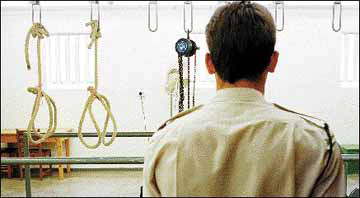
They were now led forward by warders into the large and brightly lit execution room. It was some 40 feet long with white painted walls. They would have seen the gallows beam running the length of the room and the 7 large metal eyes from which the four nooses dangled. (Seven prisoners could and often were hanged at once on this gallows.) The picture shows very much what Smith and Harris would have seen as they were led to the gallows. The chain hoist on the middle metal eye is used for raising the trapdoors after an execution.

They were positioned side by side, on painted footprints over the divide of the trap and held by warders while the hangman placed the nooses around their necks. He then turned down the hood flaps and when all was ready, pulled the lever plummeting them through the huge trapdoors.

They were left to hang for 15 minutes before being stripped and examined by a doctor in the room below. Once death had been certified, the bodies were washed off with a hose and the water allowed to drain into a large gully in the floor. A warder put a rope around each of their bodies and with a pulley lifted them to allow the rope to be taken off. They were then lowered onto a stretcher and placed directly into their coffins before taken to a public cemetery for burial.

Although executions in South Africa were held in private, the procedure was described in detail by the then hangman, Chris Barnard, in an interview before he died. He officiated at over 1,500 hangings there.

South Africa hanged 1,123 people at Pretoria Central prison between 1980 and 1989, Solomon Ngobeni being the last on November 14th, 1989. Surprisingly perhaps, almost all of these were for “ordinary” murders rather than politically motivated crimes and most attracted very little publicity.

According to the South African Department of Correctional Services, two other coloured women were hanged for murder in the years 1969 to 1989, Gertie Fourie, on the 20th of May 1969 and Roos de Vos, on the 12th of December 1986. A total of 14 women were executed between 1959 & 1989, out of a total of 2,949 hangings.

President De Klerk ordered a moratorium on executions in 1990 and capital punishment was abolished altogether by the incoming black government of Nelson Mandela on the 7th of June 1995.

Comment.

We cannot know why Smith and Harris went to the Abrahams’ home while they knew Jermaine would still be there or whether they had actually formed any intention to kill her. Neither of them had any record of violence prior to the murder. My guess is that they panicked when she started to call for help from the person who knocked on the door and they tried to silence her. However, it seems hard to believe that Harris really thought she wouldn’t identify him to the police as soon as they had left and he may well have decided to kill her for this reason. It is claimed that Smith wanted Jermaine dead as she was jealous of her having some sort of relationship with Harris. In any event, Jermaine suffered a horrible and agonising death at their hands.

We cannot know, either, which one of them did the actual killing or whether they both took equal part in it. But there was clear “common purpose” established under law, and there were no obvious mitigating circumstances to allow the state to reduce the sentence on either of them. South Africa had the highest rate of judicial execution in the world during the 80’s so they would surely have known the penalty for murder but like so many people, gave no thought to it until it was too late.

Sadly, it is so typical of the kind of brutal and senseless murder that happens all too frequently and one that led to cruel deaths for three young people.

On this day..

1453: Çandarli Halil Pasha, after the fall of Constantinople

On this date in 1453, Ottoman Grand Vizier Çandarli Halil Pasha (or Chandarly) was put to death, the first time anyone holding that office had suffered such a fate.

In Istanbul, Halil Pasha tower — part of the siegeworks used to take Constantinople — overlooks Fatih Sultan Mehmet Bridge, named for the man who ordered Halil Pasha’s death.

It was a stunning fall for the man who had presented himself in the sultan’s council just six days before to argue for discontinuing the seven-week-old Ottoman siege of Byzantine Constantinople.

This siege would succeed, on May 29, in conquering the second Rome, and it may have been Halil Pasha‘s longstanding opposition to this project so glorious for the rising Ottomans that cost him his life.

Or, something else; we are obliged to speculate. Other possible factors include:

  • Halil Pasha’s enormous personal wealth, which made his family both a potential rival and a source of confiscated revenues badly needed by the state.
  • Personal rivalry with the sultan now known as Mehmed the Conqueror, whom Halil Pasha had deposed in the former’s childhood in favor of his retired father when exigencies of state required a more experienced hand.
  • A generation gap with the sultan’s younger advisors. Both Ottoman and Christian sources recorded charges that he was in league with Byzantium’s defenders; even if not true in a literally treasonous sense, the veteran statesman had relationships with Christians through Constantinople and (as evidenced by his opposition to the siege) likely had more to lose than to gain from Mehmed’s aggressive foreign policy.

Especially in the last respect, Chandarly Halil Pasha’s death turned over a leaf in Europe’s complex relationship with the rising Turks. And among those inclined to view a clash of civilizations between the Christian and Muslim worlds, the May 29, 1453 Ottoman conquest of Constantinople rates as a day just as weighty for the fate of the world as for that of Halil Pasha himself.

A highly recommended digression: Lars Brownworth’s coverage in the 12 Byzantine Rulers podcast of that empire’s last ruler, Constantine XI — who died with his boots on the day Constantinople fell, “the empire as his winding-cloth.”

[audio:http://download.12byzantinerulers.com/16-Constantine-XI.mp3]

On this day..