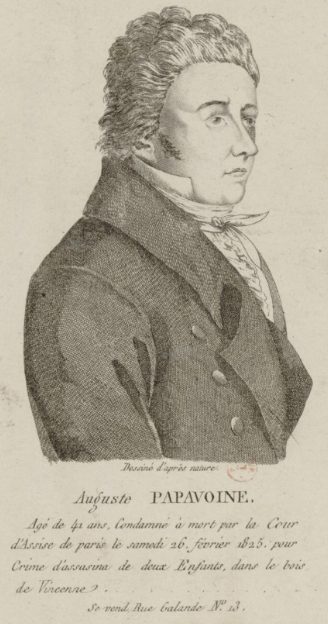
1825: Louis August Papavoine, An Execution in Paris

(Thanks to Dr. Robert Macnish, a young Scottish surgeon, writer, and polymath whose wide-roaming intellect earned him the nickname of “the Modern Pythagorean.” While resident in Paris, Macnish witnessed the public beheading of a French murderer on March 24, 1825 … an experience he rendered into the essay below. The crime which occasioned this spectacle was notorious in his brief day; Victor Hugo refers to Papavoine by name as “the horrible madman who killed the children with a knife to the head!” in The Last Day of a Condemned Man. -ed.)

AN EXECUTION IN PARIS.

In the month of March 1825, Louis Auguste Papavoine lost his head. He was guillotined at the Place de Greve for the murder of two children in the Bois de Vincennes. The man was mad, beyond all doubt, and in Great Britain would have been sentenced to perpetual confinement as a lunatic; but the French criminal court refused to admit the plea of insanity, and he was given over to the executioner: the Cour de Cassation having rejected his appeal from the decision of that which tried him.

To my shame be it spoken, I wished to see an execution by the guillotine. There was a sort of sanguinary spell attached to this instrument, which irresistibly impelled me to witness one of its horrid triumphs. When I thought of it, the overwhelming tragedy of the Revolution was brought before my eyes — that Revolution which plunged Europe in seas of blood, and stamped an indelible impression upon the whole fabric of modern society. There was something appalling in the very name of this terrific engine. M. Guillotine, its inventor, was also one of its victims — he perished by his own contrivance. [this popular legend is untrue -ed.] Let no man hereafter invent an instrument of punishment. Perillus contrived the brazen bull, and was among the first to perish by it. Earl Morton, who brought the “Maiden” to Scotland, underwent a like fate; and Deacon Brodie was hanged upon his own drop.

The day on which Papavoine suffered was beautifully fair; and, profiting by this circumstance, the idle population of the French capital flocked in myriads to witness his exit. It was calculated that there were not fewer than eighty thousand spectators. The Place de Greve was literally paved with human beings. A person might have walked upon their heads without difficulty; and so closely were they wedged together, that had any object larger than an apple been thrown among them, it could not have found its way to the ground. Men, women, and children, were clumped into one dense aggregate of living matter; and as the huge multitude moved itself to and fro, it was as the incipient stirring of an earthquake, or as the lazy floundering of the sea, when its waves, exhausted by a recent storm, tumble their huge sides about, like the indolent leviathan which floats upon their surface. There was no spot of the Place unoccupied save immediately around the scaffold, where a portion was squared off, and kept clear by a strong body of mounted gendarmerie, who kept back with their horses the living wall, which was every moment threatening to break asunder by the pressure behind, and intrude its animated materials into the proscribed area. Nor was the Place de Greve the only spot so crowded. The quays along the Seine were equally peopled, and even the opposite banks of that broad stream were filled with multitudes. Notre Dame shone with spectators, who had mounted its beetling towers to catch a dim prospect of the sacrifice; and every window and height, which afforded the most distant view, were similarly occupied.

In Paris, as in London, it is customary to let out those windows where a good view can be obtained; and on any occasion of particular interest — as the present happened to be — considerable sums are asked, and given. Sometimes half a Napoleon is demanded for a single place; and the sum varies from that to half a franc, according to the eligibility of the situation. Many of the windows are so near to the guillotine, that a very favourable prospect of the painful spectacle can be obtained; and these, of course, are crowded with persons who can afford to pay well for the gratification of their curiosity — if there be, indeed, any gratification in witnessing the instantaneous and sanguinary death of a fellow creature. Yet the view, even from the best windows, is not equal to that from within the open area. But into this space, it is no easy matter to get a footing; the few who are admitted being military men, and such of their friends as they choose to bring along with them. Indeed, at this time, there were few or no officers of any rank within the opening. It was mostly occupied by the gendarmes, who were there upon duty; and by a few dozens of common soldiers, whom curiosity or idleness had brought together. This, however, was the spot to which my wishes led me; and under the guidance of a young French officer of hussars, I was led into the area, and placed in front of the guillotine, not ten feet from its dreadful presence. But dreadful as it is from association, and from its destructive rapidity, this machine is by no means so appalling to look at as the gallows. The same feeling of horror does not attach to it; nor is the mind filled with the same blank dismay, or the same overpowering disgust, which are universally felt on beholding the gibbet, with its looped rope, its horrid beam, and its deceitful platform, which, slipping from beneath the feet of its victim, leaves him dangling and gasping in the winds of heaven. Somehow the same strong idea of disgrace is not connected with the axe as with the gibbet; but this may be from the thought that the noble and the good have shed their blood in torrents beneath its edge, thus giving it a sort of factitious interest, and deadening even with the most criminal the ignominy of its punishment. Nor is it coupled with such inveterate disgust, and such decided outrage to the feelings of humanity. Prolonged physical suffering is at all times revolting; and to see a human being struggling with a violent death — writhing in agony, and perishing like a dog — is the most detestable sight in existence. The guillotine distracts the fancy with no such sickening imagery. Whatever agony is sustained, is the more noble and enduring agony of the spirit, previous to the fatal hour. There is no struggle here with the grim tyrant — no painful encounter between life and death — no tortures like those which wrung Laocoön and his miserable offspring. From perfect life, the individual is transported to as perfect annihilation. He does not enter eternity by slow, unwilling steps: the spirit does not quit its fleshly mansion painfully and tardily, but leaves it with a sudden bound, and plunges at once into a new existence, there to be saved or lost, as its fate chances to be decreed in the Book of Life.

At the period of my admission, it was two o’clock — one hour exactly from the time of execution; and I had, therefore, abundant leisure to contemplate the engine of death, and to witness the behaviour of the vast multitude around it. Things were as quiet as could well be expected in so great an assemblage. There was plenty of talking, but much less disturbance than would have occurred in England upon any similar occasion. In truth, the only quarter which manifested tumult, was in the immediate neighbourhood of the area, which threatened every moment to be broken in, not so much by the fault of those directly in front of it, as by the immense pressure of those in the back-ground. Every now and then its square proportions were destroyed by a portion of the crowd which bulged inwards in a solid mass; and almost at the same moment, this violation of the straight line was repaired by the gendarmes, who kept riding along the square, and pressing back the intruding body into its proper place. The recklessness and fierce temper of the French soldiery were manifest, and formed a strong contrast to the good-humoured forbearance of our own troops. No ceremony was used towards intruders. Whoever came, or was forced into the square by his rearward companions, was thrust back with wanton violence. Where the pressure of the horses was resisted, the gendarmes made use of the flat sides of their sabres, and belaboured the crowd without mercy. The whole scene presented a strange picture of the fearful and the ludicrous. While it was distressing to witness the terrified crowd recoiling before the soldiers, it was amusing to witness the dexterity with which the latter treated the refractory — sometimes pushing them back with their steeds, sometimes beating them with their swords, and sometimes dexterously pitching off their hats into the assemblage. When any unfortunate fellow lost his chapeau in this manner, or received a salutary blow from the weapon of a gendarme, a loud shout of laughter was set up among the spectators. In fact, the whole, except thosewithin reach of punishment, were in excellent humour, and seemed to have come together more to enjoy a farce than witness the horrors of a public execution. Things continued in this state till the hour of three, which, pealing from the clock of the Hotel de Ville, announced the approach of the criminal. Scarcely had the fatal sounds swung upon the air, than the whole host was hushed into silence. They knew that the destined time was at hand, and that Papavoine was on his way to the scaffold; — and every man held his breath with deep interest, and felt, in spite of himself, a solemn awe fall over his spirit. But this dreadful silence did not continue long — for far off, in the direction of the bridge over which the criminal must pass, there was seen a heaving among the assemblage, which moved as if borne on the bosom of a vast wave; and murmurs like the half-suppressed voice of a remote volcano, were heard to proceed from this moving multitude. It was now evident that the procession approached; and every eye was turned towards that direction, and every ear wrought to its keenest pitch to catch the strange sounds which denoted its coming. Each moment the noise became louder, and the motion of the crowd more general. At last the trampling of horses was heard, and a troop of gendarmes, forcing a path through the recoiling people, were seen to approach. Behind them came a cart drawn by two horses; and in this cart sat Papavoine and an old Catholic priest. To the rear of this a second body of gendarmes brought up the procession. The criminal was a small, thin man, of about five feet six. He was dressed in a shabby blue surtout, and brown trowsers, and wore a fur cap upon his head. His arms were pinioned behind him, not by the elbows as with us, but by the wrists. He had no neckcloth on, nor shirt; and the collar of his surtout was drawn some way over his shoulders, so as to leave the neck quite bare and ready for the axe. Though pale and death-like, and seemingly impressed with the marks of sorrow and bad health, he exhibited no signs of terror or dismay. His demeanour was quiet and composed; and to the exhortations of his spiritual adviser he appeared to pay deep attention.
Now, here a scene took place which baffles description. No sooner had the wretch entered the area appropriated for his fate, than a shout of deafening execration arose from the hitherto silent multitude. No preparatory murmurs of hatred and revenge preceded this ebullition of feeling. It sprung up simultaneously, and as if those from whom it proceeded were animated with one soul, and felt one pervading vengeance thrilling through their hearts. “Wretch!” “Villain!” “Miscreant!” “Assassin!” arose in a wild swell from the crowd; and above the deeper voices of the men were heard the shrill imprecations of females, denouncing, with even more bitter wrath, the murderer. Had it been for almost any other crime, the women would have felt towards him more kindly than his own sex; but that for which he was to suffer was one of all others the most heinous to a maternal heart — and the natural fountains of woman’s tears were no longer free to flow in their wonted channel.

But Papavoine did not seem to hear the imprecations which were poured like vials of wrath upon his head — nor did he even appear sensible of the presence of those who so bitterly reviled him in his last moments. The cart stopped at the foot of the scaffold, and descending firmly, he conversed for one moment with the old priest, previous to mounting the fatal steps. I was at this time only a few yards from him, and marked him most distinctly. His look was perfectly calm and composed, and, had he died in a better cause, it would have been impossible not to admire his steady heroism. He said a single word in the ear of the priest who kissed him on the cheek, and left him, apparently much affected. Papavoine now ascended the guillotine rapidly and firmly, and committed himself to the hands of the executioner and his assistant satellite. At this part of the scene the loud execrations of the people had melted into breathless awe. Not a whisper was heard, nor even a movement among the vast and silent assemblage. The whole spectacle was dreadful — the very stillness of the crowd had something appalling in it; and the systematic dispatch with which the executioners proceeded among such universal silence, was sickening to the last degree. While gazing upon the victim, my respiration was almost totally suspended — my heart beat violently, and a feeling of intense anxiety and suffocation pervaded my frame.

The process was incredibly short. In a few seconds Papavoine was bound to a board which stood upright, and reached to the middle of his breast. The board moved on a pivot, and as soon as the malefactor was buckled to it, it was depressed, and shoved with its burden towards the groove of the guillotine, at the top of which hung the axe, ready to descend, on the pulling out of a small peg which kept it in its situation. A moveable piece of wood being now drawn down upon the root of the neck, to prevent all attempt at motion, and everything being ready, the executioner pulled a cord, and with the impetuosity of lightning, down came the axe upon its victim. Papavoine was annihilated in a moment. I saw his head slip from the body and tumble into a basket ready to receive it, while the blood spouted forth in little cataracts from the severed trunk, and dyed the scaffold with a purple tide. From the time when he appeared upon the guillotine till the head was severed, only twenty-five seconds elapsed — such is the appalling, yet humane rapidity of a French execution.

I looked attentively to observe if there was any motion in the trunk — any convulsive start at the instant of decapitation, but there was none. It lay from the first perfectly motionless, nor exhibited the slightest shudder — the least quivering — or the faintest indication that, the moment before, it was part of a sentient being, instinct with all the energies of life. This I did not expect. I conceived that a strong muscular spasm would have convulsed it at the fatal instant: and such, I am told, was the case with Brochetti, an Italian, executed some time before, and whose trunk sprung violently from its situation, and shook with universal tremor.

The momentary silence which pervaded the crowd previous to the axe’s descent was now broken, and an instantaneous movement ensued among its before tranquil numbers. The windows were deserted by their occupants; the doors poured their population into the streets; and the house-tops and black Gothic towers of Notre Dame were rid of the crowds which sat perched like eagles upon their lofty summits. But long ere this assembly had melted away, the guillotine had disappeared from the Place de Greve. Two minutes were allowed to elapse, that the head and body of the criminal might part with their blood.

They were then thrown into a long basket, and sent in the cart — which brought them alive — to the Ecole de Medecine for dissection. And the scaffold, after being cleansed of the gore, by having several buckets of water dashed over it, was taken to pieces, and deposited in the Hotel de Ville, till its sanguinary services were again required. The execution, together with the process of cleansing and dismantling the guillotine, did not occupy above seven minutes.

Next morning, the same curiosity which led me to witness this revolting sight took me to the Ecole de Medecine, to witness the remains of Papavoine. There were a number of scientific men present — among others, the celebrated Doctor Gall, who was employed in investigating the developements of the head, and pointing them out to several of his pupils. [A topic of great interest to Macnish, who also wrote a book about phrenology. -ed.] There was no portion whatever of the neck remaining attached to the trunk. It, as well as the head, had been severed from the body. The axe had struck at its very root, and even grazed the collar bone where it is fixed to the sternum. This is not in general the case, the neck being in most instances pretty accurately cut through the middle — one half of it adhering to the head, the other to the trunk.

I am not sure that I had done right in making such a scene as the above the subject of an article. There is something in the minute details of an execution, at which the mind shudders; and it is probable the reader may think that my impressions of the spectacle just related, should have been confined to my own bosom instead of being made public.

(For writerly firsthand accounts of the guillotine in action in the 19th century, compare to Tolstoy or Turgenev. -ed.)

On this day..

1823: John Newton, wife-beater

From the Hampshire Telegraph and Sussex Chronicle, March 31, 1823.

SHOCKING MURDER — At Shrewsbury Assizes, on Saturday, John Newton, a Farmer, living at Severn-Hall, near Bridgenorth, was tried for the Wilful Murder of his wife, Sarah Newton, by violently beating and striking her, by throwing her down on a sledge, and by kicking her, (she being five months gone with child), in consequence of which she languished three hours and then expired.

The provocation on her part was — having misapplied the trifling sum of three shillings.

Her children stood by at the time (the eldest not more than eight years of age) and exclaimed — “O dear! do not dad!”

The evidence clearly proved the initial act of the prisoner.

Mr. Justice Best, in passing sentence, spoke to the following effect: —

John Newton, you have been convicted, upon the clearest and most satisfactory evidence, of the dreadful crime of murder — a crime upon which Heaven has imposed a sentence. It was recorded in Holy Writ, that, “Whosoever shed a man’s blood, by man his blood should be shed.” You have deprived of life one whom it was your duty to protect and cherish: and for what cause? Why, because your wife had misapplied the trifling sum of three shillings.

Your humane and kind-hearted creditor had endeavoured to prevent you exercising your brutal chastisement upon your wife, and he told you he would rather lose this trifling sum than you should punish your wife. You promised him that you would not beat her. Notwithstanding this promise, notwithstanding she was in a state that not even a monster would have laid violent hands upon her, the dreadful threat you had uttered four hours before was put into execution.

You beat her to the ground; you kicked her on a part of her body which might almost in all cases have caused death, but especially in the state she was in. You acted as a most inhuman father, destroying that life which owed its origin to you; and you killed your wife at a time when it might be thought that the most savage, the most ferocious of mankind would be disarmed.

When she was lying in an alarming state from the bruises she had received at your hands, you refused to send for medical advice, and when she was lying on the floor you abused her in addition to your cruel conduct.

After thirty years’ experience in Courts of Justice, I confess I have never witnessed such savage conduct as yours. I hope to God you will obtain that mercy you were not disposed to show here. May you apply to him with a contrite and repentant heart, who is the distributor of all mercy, during the very short time you have to live; for no mercy can you obtain on this side the grave. You will have the assistance of a clergyman, who is better qualified than I am to teach you true repentance: and may God of his infinite mercy, so dispose your heart that it may be better fitted for another world.

There now remains for me only the painful duty of passing the sentence of the law — which is, that you be taken hence to the place whence you came, and thence to the place of execution, on Monday next, where you shall be hanged by the neck until you are dead, and your body shall then be given to the surgeons for dissection, and may God have mercy on your soul!

The prisoner, who is a robust-looking man of forty, showed little emotion during the trial, or when the verdict was given: but while the Judge was addressing him he seemed bewildered — looking wildly about him — moved, as if involuntarily, up and down as sick and once or twice attempted to turn away. He once put his handkerchief to his face, but did not want to shed tears.

On this day..

1768: James Gibson and Benjamin Payne, impressing James Boswell

(Thanks to James Boswell for the guest post. The Dr. Johnson biographer was a ravenous gallows-haunt whom we have encountered repeatedly in these pages; even in his guise as a barrister, Boswell personally lost a client to the hangman. No fool when it came to content repurposing, Boswell in 1768 wrote the Publick Advertiser about the March 23, 1768 double hanging of John Gibson and Benjamin Payne; then, in 1783, he recycled the entirety of this bygone letter to extend his musings on the spectacle of public executions, for the occasion of Tyburn’s abolition. We reprint here the 1783 article, a comment within a comment, within the very comment that is this dreary site. -ed.)

LONDON MAGAZINE,
FOR MAY, 1783.
THE HYPOCHONDRIACK. No. LXVIII.
Mitiores Poena nobis semper placuere. Justinian., 
'We have always preferred mild punishments.'

THE question, Whether society has a right to punish individuals, especially to the extent of death, which is well denominated in Latin “ultimum supplicium — the last or utmost punishment,” has been treated with great attention and ingenuity by a number of casuists in law and in morals. And of late it has been discussed with elegant ability by the Marquis di Marco, an Italian nobleman of Mantua, whose performance well becomes that celebrated city, while it shews that in modern times the descendants of those whom we are taught from our early years to admire, are yet worthy of admiration. So that we may quote from Addison‘s beautiful letter from Italy,

And still I seem to tread on classick ground.

It is indeed a question which resolves into the powerful and irresistible plea of necessity; since we are sure society could not exist without such a right. But the exercise of it, no doubt, admits of much modification, in which the wisdom and humanity of legislators has a wide field. Another Italian nobleman has done himself great honour by his admirable work “Delle de litte e delle pene,” which Voltaire has illuminated with some additional rays; and I can with pleasure mention, to the credit of our own nation, Mr. Eden‘s Principles of Penal Law.

These cursory remarks are only meant to serve the purpose of introducing into the collection of my Hypochondriack Essays, another of my former writings, which is, I think, well suited to my present title.

April 25, 1768.

To the Printer of the Publick Advertiser

Sir,

THAT the people of England possess that quality called good-nature, will not be denied by any man whose mind is not fretted by some real ills, or clouded by some fanciful ones. But it must also be acknowledged that the people of England are, of all nations in the world, the most desirous of feeing spectacles of cruelty. Bull-baiting, cock-fighting, and even throwing at cocks, were for many and many a year the delight of the English; and it is not long since assemblies of good-natured people were deliberately held to see their fellow-creatures beat, bruise, and sometimes actually kill each other.

Though the desire of seeing spectacles of cruelty has peculiarly prevailed in England, it has more or less been the passion of mankind in all ages and countries. Hence the various satires against it by poets; hence the various attempts to account for it by philosophers. Lucretius, who was both a poet and a philosopher, refers it to self-love, as we may see from that celebrated passage,

Suave mari magno turbantibus aequora ventis.

He thinks that men love to behold scenes of distress, that they may hug themselves in security, and relish more their own safety and ease, by comparing themselves with those who are suffering. Though I, as well as every rational and virtuous man, must think that Lucretius is in general a very false and a very hurtful writer; yet I must candidly own that he is often ingenious and just in his observations. In the present case he certainly has a great deal of merit; though I would be for compounding his system with that of the Abbe du Bos, who accounts for our desire of seeing spectacles of cruelty from the universal wish that we all have to be moved; that is, to have our souls agitated; for to be sure there is nothing so irksome to a man of lively sensations, as to have his faculties thrown into a kind of torpor, so that in Shakespeare’s words,

They cream and mantle like a standing pool

This will more fully account for what I am endeavouring to explains and will make human nature appear not so grossly selfish as Lucretius paints it.

Of all publick spectacles, that of a capital execution draws the greatest number of spectators. And I must confess that I myself am never absent from any of them. Nor can I accuse myself of being more hard-hearted than other people. On the contrary, I am persuaded that nobody feels more sincerely for the distresses of his fellow-creatures than I do, yor would do more to relieve them. When I first attended executions, I was shocked to the greatest degree. I was in a manner convulsed with pity and terror, and for several days, but especially nights after, I was in a very dismal situation. Still, however, I persisted in attending them, and by degrees my sensibility abated; so that I can now see one with great composure, and my mind is not afterwards haunted with frightful thoughts: though for a while a certain degree of gloom remains upon it. I can account for this curiosity in a philosophical manner, when I consider that death is the most aweful object before every man, who ever directs his thoughts seriously towards futurity; and that it is very natural that we should be anxious to see people in that situation which affects us so much. It is true indeed that none of us, who go to see an execution have any idea that we are to be executed, and few of us need be under any apprehension whatever of meeting with that fate. But dying publickly at Tyburn, and dying privately in one’s bed, are only different modes of the fame thing. They are both death; they are both that wonderous, that alarming scene of quitting all that we have ever seen, heard, or known, and at once passing into a state of being totally unknown, to us, and in which we cannot tell what may be our situation. Therefore it is that I feel an irresistible impulse to be present at every execution, as I there behold, the various effects of the near approach of death, according to the various tempers of the unhappy sufferers, and by studying them I learn to quiet and fortify my own mind.

I shall never forget the last execution I saw at Tyburn, when Mr. Gibson, the attorney, for forgery, and Benjamin Payne, for an highway robbery, were executed. Poor Payne was a thin young lad of twenty, in a mean dress, and a red night-cap, with nothing to discriminate him from the many miserable beings who are penitent and half dead with fear. But Mr. Gibson was indeed an extraordinary man. He came from Newgate in a coach, with some friends attending him. I met the mournful procession in Oxford-road; and I declare that if I had not been told it, I should not have known which was Mr. Gibson. He was drawn backwards, and looked as calm and easy as ever I saw a man in my life. He was dressed in a full suit of black, wore his own hair round and in a natural curl, and a hat. When he came to the place of execution he was allowed to remain a little in the coach. A signal was then given him that it was time to approach the fatal tree. He took leave of his friends, stepped out of the coach, and walked firmly to the cart. He was helped up upon it, as he was pinioned and had not the free use of his arms. When he was upon the cart, he gave his hat to the executioner, who immediately took off Mr. Gibson’s cravat, unloosed his shirt neck, and fixed the rope. Mr. Gibson never once altered his countenance. He refreshed his mouth by sucking a sweet orange. He shewed no stupid insensibility; nor did he affect to brave it out like those hardened wretches who boast that they die hard. He appeared to all the spectators a man of sense and reflexion, of a mind naturally sedate and placid. He submitted with a manly and decent resolution to what he knew to be the just punishment of the law. Mr. Moore, the Ordinary of Newgate, discharged his duty with much earnestness, and a fervour for which I and all around me esteemed and loved him. Mr. Moore seems worthy of his office, which, when justly considered, is a very important one, if administering divine comfort to multitudes of miserable beings, be important. Poor Payne seemed to rely on that mercy which I trust has not been refused him — Mr. Gibson seemed truely devout; and, in short, from first to last, his behaviour was the most perfect that I ever saw, or indeed could conceive of one in his unhappy circumstances. — I wish, Sir, I may not have detained you too long with a letter on subjects of a serious but I will not fay of a gloomy cast, because from my manner of viewing them I do say that they become matters of curious speculation, and are relieved of their dreary ideas. I am, Sir,

Your constant reader,
MORTALIS.

After an interval of fifteen years, I have little to add to this occasional essay. But I cannot but mention in justification of myself, from a charge of cruelty in having gone so much formerly to see executions, that the curiosity which impels people to be present at such affecting scenes, is certainly a proof of sensibility not of callousness. For it is observed, that the greatest proportion of the spectators is composed of women; and I do not apprehend that my readers will impute a barbarous severity to the fair sex, though it is common for lovers to represent them as metaphorically cruel. But in the one case they are cruel to others to be kind to themselves, by avoiding what is disagreeable to them. Whereas in the other case the pleasure must be from the sufferings of others independent of any such reference. That there, however, is such a pleasure I am afraid is true; and in support of my opinion, I bring no less authority than Edmund Burke, who maintains it in his Treatise on the Sublime and Beautiful. Yet let it not be supposed that this pleasure arising from agitation, prevents the finest feelings and effects of compassion; I am sure it does not.

As the great Justinian nobly expressed himself, I should wish that as mild punishments as are consistent with terrour were always inflicted. It is indeed astonishing how men have been found willing and able to execute some of the horrible sentences which have been put in execution upon some criminals. One shudders to think of them; and I shall not wound the minds of my readers by reciting particulars. They who wish to be shocked, or to gratify a monstrous curiosity, may read the tortures of Ravaillac or Damiens. A mode of death which strikes terrour into spectators, without excruciating the unfortunate objects of legal vengeance, seems to be the most eligible. I, therefore, think that the faces of those who are hanged should not be covered, as in Britain, but exposed, as is the custom upon the continent, that the distortions may be seen, which covered or uncovered must take place. I also think that the punishment of throwing criminals from the Tarpeian rock in ancient Rome was a very judicious one. But the best I have ever discovered is one practised in Modern Rome, which is called Macellare — to butcher.” The criminal is placed upon a scaffold, and the executioner knocks him on the head with a great iron hammer, then cuts his throat with a large knife, and lastly, hews him in pieces with an ax; in short, treats him exactly like an ox in the shambles. The spectators are struck with prodigious terrour; yet the poor wretch who is stunned into insensibility by the blow, does not actually suffer much.

But, indeed, death, simple death, when slowly and solemnly inflicted, will be fully sufficient to answer the purposes of publick punishment, as is very well demonstrated by Dr. Mandeville, in An Essay upon the Increase of Robberies, in which he has written with a very different spirit from that which prompted his very shrewd, lively, and entertaining, but dangerous Fable of the Bees.

On this day..

1945: Eliyahu Bet-Zuri and Eliyahu Hakim, Lord Moyne’s assassins

British-occupied Egypt on this date in 1945 hanged two young Jewish assassins for slaying the British plenipotentiary to the Middle East.

Walter Edward Guinness was heir to the barley beer fortune and a Tory politician of near 40 years’ standing. “Lord Moyne”, to call him (as history does, and as we will henceforward) by his aristocratic honorific, allied with his former rival Winston Churchill in the 1930s as a staunch foe of placating Hitler, eventually serving several roles in Churchill’s wartime government.*

The last and perforce most famous was Resident Minister of State in Cairo from January 1944, where he directed British affairs in North Africa, Persia, and the Middle East, crucially including Mandatory Palestine.

Such a figure must necessarily represent many things to different subjects, but to Zionists he represented the hostility to their project of both his own person and (more importantly) of London. While there is endless nitpicking about the man’s precise degree of disfavor for Jewish people or interests, “Lord Moyne was the highest British official in the Middle East,” in the words of Yitzhak Shamir, the emigre terrorist who orchestrated the hit and would one day become Prime Minister of Israel. “Because we fought against the British in this area, we took him for a target. This was the main reason for his assassination.” Nothing personal. (Maybe a little personal.)

On November 6, 1944, two of Shamir’s young cadres in the late Avraham Stern‘s militantly anti-British Lehi network, Eliyahu Bet-Zuri (Ben Suri) and Eliyahu Hakim, ambushed Moyne as his limousine pulled up at his villa, and shot him dead with pistols. (They also killed Moyne’s driver, a Lance Corporal named Arthur Fuller.) Once their affiliations became apparent it was Jewry’s turn to bask in the collective censorious scowl that minorities everywhere can anticipate given any perceived ethnic affinity to the latest atrocity’s author. These sortings-out from the London Times would do almost word for word for whatever horror tomorrow’s news might bring.


London Times, Nov. 10, 1944


London Times, Jan. 29, 1945

Similarly, Lord Moyne’s killers took every pain to link their martyrdom to Jewish/Zionist patriotism, no matter any moderate rabbi’s attempt to wash his hands of it.

Raised in Mandatory Palestine, both Bet-Zuri and Hakim spoke Arabic but insisted on speaking only Hebrew in the Cairo court. They went to the gallows singing the hymn “Hatikvah” — later to become Israel’s national anthem.

In the near term, their deed hardened hearts: “If our dreams for Zionism are to end in the smoke of an assassin’s pistol, and the labors for its future produce a new set of gangsters worthy of Nazi Germany, then many like myself will have to reconsider the position we have maintained so consistently and so long in the past,” Churchill snarled to Parliament.

But in fact the British reconsideration was soon seen to run counter to the dangerous meddling policing these “gangsters” would have demanded. Within only a few years London struck its colors in the Levant. Bet-Zuri’s and Hakim’s cause triumphed, and they too with it: as Prime Minister, Yitzhak Shamir arranged for the hanged men’s remains to be repatriated from Egypt; today, both rest in honor at Mount Herzl.

* There was a personal side to Lord Moyne’s anti-Naziism: his son, Bryan, had been abandoned by his socialite wife Diana Mitford … who became Diana Mosley in 1936 when she married British Union of Fascists chief Oswald Mosley, in a ceremony held at Joseph Goebbels‘ home no less.

On this day..

1706: Mary Channing, at the Maumbury Rings

(Thanks to novelist and archaeology enthusiast Thomas Hardy for the guest post, which originally appeared in the October 9, 1908 issue of the London Times. The Tess of the d’Urbervilles author, a man we have met quite often in our pages, was a Dorset native who nursed a lifelong fascination with the noose, particularly when it was affixed to women. Mary Channing’s fate in particular haunted Hardy, and resurfaced a number of times in his work; his 1925 poem “The Mock Wife” is also based on Channing’s tragedy. -ed.)

MAUMBURY RING

By Thomas Hardy.

The present month sees the last shovelful filled in, the last sod replaced, of the excavations in the well-known amphitheatre at Dorchester, which have been undertaken at the instance of the Dorset Field and Antiquarian Club* and others, for the purpose of ascertaining the history and date of the ruins. The experts have scraped their spades and gone home to meditate on the results of their exploration, pending the resumption of the work next spring. Mr. St. George Gray, of Taunton, has superintended the labour, assisted by Mr. Charles Prideaux, an enthusiastic antiquary of the town, who, with disinterested devotion to discovery, has preferred to spend his annual holiday from his professional duties at the bottom of chalk trenches groping for fibulae or arrow-heads in a drizzling rain, to idling it away on any other spot in Europe.


The amphitheater today. (cc) image by Carron Brown.

As usual, revelations have been made of an unexpected kind. There was a moment when the blood of us onlookers ran cold, and we shivered a shiver that was not occasioned by our wet feet and dripping clothes. For centuries the town, the county, and England generally, novelists, poets, historians, guidebook writers, and what not, had been freely indulging their imaginations in picturing scenes that, they assumed, must have been enacted within those oval slopes; the feats, the contests, animal exhibitions, even gladiatorial combats, before throngs of people

Who loved the games men played with death,
Where death must win

— briefly, the Colosseum programme on a smaller scale. But up were thrown from one corner prehistoric implements, chipped flints, horns, and other remains, and a voice announced that the earthworks were of the paleolithic or neolithic age, and not Roman at all!

This, however, was but a temporary and, it is believed, unnecessary alarm. At other points in the structure, as has been already stated in The Times, the level floor of an arena, trodden smooth, and coated with traces of gravel, was discovered with Roman relics and coins on its surface: and at the entrance and in front of the podium, a row of post-holes, apparently for barriers, as square as when they were dug, together with other significant marks, which made it fairly probable that, whatever the place had been before Julius Caesar’s landing, it had been used as an amphitheatre at some time during the Roman occupation. The obvious explanation, to those who are not specialists, seems to be that here, as elsewhere, the colonists, to save labour, shaped and adapted to their own use some earthworks already on the spot. This was antecedently likely from the fact that the amphitheatre stands on an elevated site — or, in the enigmatic words of Hutchins, is “artfully set on the top of a plain,” — and that every similar spot in the neighbourhood has a tumulus or tumuli upon it; or had till some were carted away within living memory.

But this is a matter on which the professional investigators will have their conclusive say when funds are forthcoming to enable them to dig further. For some reason they have hitherto left undisturbed the ground about the southern end of the arena, underneath which the cavea or vault for animals is traditionally said to be situated, although it is doubtful if any such vault, supposing it ever to have existed, would have been suffered to remain there, stones being valuable in a chalk district. And if it had been built of chalk blocks the frost and rains of centuries would have pulvrized them by this time.

While the antiquaries are musing on the puzzling problems that arise from the confusion of dates in the remains, the mere observer who possesses a smattering of local history and remembers local traditions that have been recounted by people now dead and gone, must walk round the familiar arena, and consider. And he is not, like the archaists, compelled to restrict his thoughts to the early centuries of our era. The sun has gone down behind the avenue on the Roman Via and modern road that adjoins, and the October moon is rising on the south-east behind the parapet, the two terminations of which by the north entrance jut against the sky like knuckles. The place is now in its normal state of repose and silence, save for the occasional bray of a motorist passing along outside in sublime ignorance of amphitheatrical lore, or the clang of shunting at the nearest railroad station. The breeze is not strong enough to stir even the grass-bents with which the slopes are covered, and over which the loiterer’s footsteps are quite noiseless.

Like all such taciturn presences, Maumbury is less taciturn by night than by day, which simply means that the episodes and incidents associated therewith come back more readily in the mind in nocturnal hours. First, it recalls to us that, if probably Roman, it is a good deal more. Its history under the rule of the Romans would not extend to a longer period than 200 or 300 years, while it has had a history of 1,600 years since they abandoned this island, through which ages it may have been regarded as a handy place for early English council-gatherings, may have been the scene of many an exciting episode in the life of the Western kingdom. But for century after century it keeps itself closely curtained, except at some moments to be mentioned.

The civil wars of Charles I unscreen it a little, and we vaguely learn that it was used by the artillery when the struggle was in this district, and that certain irregularities in its summit were caused then. The next incident that flashes a light over its contours is Sir Christopher Wren‘s visit a quarter of a century later. Nobody knows what the inhabitants thought to be the origin of its elliptic banks — differing from others in the vicinity by having no trench around them — until the day came when, according to legend, Wren passed up the adjoining highway on his journey to Portland to select stone for St. Paul’s Cathedral, and was struck with the sight of the mounts. Possibly he asked some rustic at plough there for information. That all tradition of their use as an amphitheatre had been lost is to be inferred from the popular name, and one can quite undrstand how readily, as he entered and stood on the summit, a man whose studies had lain so largely in the direction of Roman architecture should have ascribed a Roman origin to the erection. That the offhand guess of a passing architect should have turned out to be true — and it does not at present seem possible to prove the whole construction to be prehistoric — is a remarkable tribute to his insight.

The Amphitheatre was a huge circular enclosure, with a notch at opposite extremities of its diameter north and south. From its sloping internal form it might have been called the spittoon of Jötuns … Melancholy, impressive, lonely, yet accessible from every part of the town, the historic circle was the frequent spot for appointments of a furtive kind. Intrigues were arranged there; tentative meetings were there experimented after divisions and feuds … its associations had about them something sinister … apart from the sanguinary nature of the games originally played therein, such incidents attached to its past as these: that for scores of years the town-gallows had stood at one corner; that in 1705 a woman who had murdered her husband was half-strangled and then burnt there in the presence of ten thousand spectators. Tradition reports that at a certain stage of the burning her heart burst and leapt ouf of her body, to the terror of them all, and that not one of those ten thousand people ever cared particularly for hot roast after that.

-Hardy, The Mayor of Casterbridge

The curtain drops for another 40 years, and then Maumbury was the scene of as sinister an event as any associated with it, because it was a definite event. It is one which darkens its concave to this day. This was the death suffered there on March 21, 1705-6,** of a girl who had not yet reached her nineteenth year. Here, at any rate, we touch real flesh and blood, and no longer uncertain visions of possible Romans at their games or barbarians at their sacrifices. The story is a ghastly one, but nevertheless very distinctly a chapter of Maumbury’s experiences. This girl was the wife of a grocer in the town, a handsome young woman “of good natural parts,” and educated “to a proficiency suitable enough to one of her sex, to which likewise was added dancing.” She was tried and condemned for poisoning her husband, a Mr. Thomas Channing, to whom she had been married against her wish by the compulsion of her parents. The present writer has examined more than once a report of her trial, and can find no distinct evidence that the thoughtless, pleasure-loving creature committed the crime, while it contains much to suggest that she did not. Nor is any motive discoverable for such an act. She was allowed to have her former lover or lovers about her by her indulgent and weak-minded husband, who permitted her to go her own ways, give parties, and supplied her with plenty of money. However, at the assizes at the end of July, she was found guilty, after a trial in which the testimony chiefly went to show her careless character before and after marriage. During the three sultry days of its continuance, she, who was soon to become a mother, stood at the bar — then, as may be known, an actual bar of iron — “by reason of which (runs the account) and her much talking, being quite spent, she moved the Court for the liberty of a glass of water.” She conducted her own defence with the greatest ability, and was complimented thereupon by Judge Price, who tried her, but did not extend his compliment to a merciful summing-up. Maybe that he, like Pontius Pilate, was influenced by the desire of the townsfolk to wreak vengeance on somebody, right or wrong. When sentence was about to be passed, she pleaded her condition; and execution was postponed. Whilst awaiting the birth of her child in the old damp gaol by the river at the bottom of the town, near the White Hart inn, which stands there still, she was placed in the common room for women prisoners and no bed provided for her, no special payment and no bed provided for her, no special payment having been made to her goaler, Mr. Knapton, for a separate cell. Someone obtained for her the old tilt of a wagon to screen her from surrounding eyes, and under this she was delivered of a son, in December. After her lying-in she was attacked with an intermittent fever of a violent and lasting kind, which preyed upon her until she was nearly wasted away. In this state, at the next assizes, on the 8th of March following, the unhappy woman, who now said that she longed for death, but still persisted in her innocence, was again brought to the bar, and her execution fixed for the 21st.

On that day two men were hanged before her turn came, and then, “the under-sheriff having taken some refreshment,” he proceeded to his biggest and last job with this girl not yet 19, now reduced to a skeleton by the long fever, and already more dead than alive. She was conveyed from the gaol in a cart “by her father’s and husband’s houses,” so that the course of the procession must have been up the High-East-street as far as the Bow, thence down South-street and up the straight old Roman road to the Ring beside it. “When fixed to the stake she justified her innocence to the very last, and left the world with a courage seldom found in her sex. She being first strangled, the fire was kindled about five in the afternoon, and in the sight of many thousands she was consumed to ashes.” There is nothing to show that she was dead before the burning began, and from the use of the word “strangled” and not “hanged,” it would seem that she was merely rendered insensible before the fire was lit. An ancestor of the present writer, who witnessed the scene, has handed down the information that “her heart leapt out” during the burning, and other curious details that cannot be printed here. Was man ever “slaughtered by his fellow man” during the Roman or barbarian use of this place of games or of sacrifice in circumstances of greater atrocity?

A melodramatic, though less gruesome, exhibition within the arena was that which occurred at the time of the “No Popery” riots, and was witnessed by this writer when a small child. Highly realistic effigies of the Pope and Cardinal Wiseman were borne in procession from Fordington Hill round the town, followed by a long train of mock priests, monks, and nuns, and preceded by a young man discharging Roman candles, till the same wicked old place was reached, in the centre of which there stood a huge rick of furze, with a gallows above. The figures were slung up, and the fire blazed till they were blown to pieces by fireworks contained within them.

Like its more famous prototype, the Colosseum, this spot of sombre records has also been the scene of Christian worship, but only on one occasion, so far as the writer of these columns is aware, that being the Thanksgiving service for Peace a few years ago. The surplices of the clergy and choristers, as seen against the green grass, the shining brass musical instruments, the enormous chorus of singing voices, formed not the least impressive of the congregated masses that Maumbury Ring has drawn into its midst during its existence of a probable eighteen hundred years in its present shape, and of some possible thousands of years in an earlier form.


So large was the quantity of material thrown up in the course of the excavations at Maumbury Ring, Dorchester, especially from the prehistoric pit which was unexpectedly struck, that the work of filling in, which has been in progress eight days, is likely to last nearly a week longer. The pit, situated at the base of the bank on the north-west side, between the bank and the arena, was found at the conclusion of the excavations to be 30ft. deep, and Mr. St. George Gray thinks it is the deepest archaeological excavation on record in Britain. Of irregular shape, and apparently excavated in the solid chalk subsoil, it diminished in size from a diameter of about 6ft. at the mouth to about 18in. by 15in. at the bottom. One of the three red-deer antler picks recovered from the deposit in the pit was found resting on the solid chalk floor of the bottom, and worked flint was found within a few feet of the bottom. The picks exactly resemble those which Mr. St. George Gray found in the great fosse at Avebury last May. Roman deposits and specimens were found in the upper part of the pit down to the level of the chalk floor of the arena, but not below it.

* Hardy was himself a member of this club for amateur enthusiasts. In his novelist’s guise, Hardy glossed this very real group as the fictional Wessex Field and Antiquarian Clubs, whose meeting scaffolds the collection of short stories in his A Group of Noble Dames.

** England was keeping its official start to the new year on “Lady Day” in late March, so the year of this execution would be 1706 as we reckon it retrospectively (using January 1 as New Year’s), but 1705 to the hangman. See the footnote in this post for more (and more Hardy commentary) on the date.

On this day..

1954: Ernst Jennrich, for 17 June 1953

On this date in 1954, East Germany beheaded Ernst Jennrich for the previous June’s short-lived popular protests.

A Magdeburg gardener of socialist proclivities, Jennrich was nothing more than an enthusiast who got swept up in events when metalworkers at the Ernst-Thälmann factory struck for better pay and lower food prices — a protest that quickly metastasized into what looked to the Communist authorities like a treasonable movement calling for liberalization, a release of political prisoners, and reunification with West Germany.

The movement was crushed within a day by Russian tanks — although some Soviet soldiers notably (and sacrificially) refused to fire on protesting workers. But before events played out, Jennrich had disarmed a guard at the prison in nearby Sudenburg. He fired the guard’s carbine twice, then destroyed the weapon.

It’s not certain how many people lost their lives in the suppression of this affair — hostile western estimates ran into the thousands — but two policemen were killed at Sudenburg prison, and in a cruel show of official impunity Jennrich got tapped to answer for their deaths. He said he’d just fired the carbine into a wall or the air in order to empty it … but the state said he’d emptied it into those two luckless officers.

On scant evidence, Jennrich harshly received a life sentence that August. But even this did not suffice for officials racing to manifest their righteous indignation against the late subversion. “The protection of our peaceful state requires the death penalty for the crimes committed by the defendant,” huffed the prosecutor, and appealed the sentence to Germany’s high court … which accordingly upgraded the sentence to “the extermination of the defendant from our society, and therefore the death penalty.”

Jennrich was beheaded on the fallbeil at Dresden still protesting his innocence. A post-unification court finally vindicated that protest in 1991, posthumously rehabilitating Jennrich as having been condemned without evidence even by the terms of East Germany’s 1950s laws.

On this day..

1824: David Howe, bitter debtor

On this date in 1824, David D. Howe (or “How”) was publicly executed at the upstate New York town of Angelica. Up to five or six thousand souls — several times the population of Angelica — were said to have turned out on a fair springtime morning for the hanging.

Howe’s fate could be read as a cautionary of life before the bankruptcy code. Financially ruined by an unsuccessful investment in a turnpike, Howe attempted to recover himself by farming only to sink ever deeper into debt. Creditors soon came to drag him cruelly under the water line, and in the summer of 1823 they repossessed much of what he owned — including “all my crops, my horses, cattle, and even my farming utensils,” which of course cratered the farming venture into the bargain.

“Had I had time to have turned my property, I would have been able to pay my honest debts,” Howe complained (somewhat optimistically, given his track record) from his dungeon a few days before he hanged.

And the worst of these oppressors in his mind was the victim, Othello Church — who seized “possession of much more than he was bound for, (in my opinion, and which he acknowledged to several persons before his death.)” From Howe’s desperate standpoint, Church “had taken advantage of my troubles, and taken property from me wrongfully, and several other persons seemed combined with him to work my destruction.” The two traded high words often and in public; Howe’s obvious motive would in time help to cinch the circumstantial case against him because he was sought so immediately after the man’s murder that his horse was discovered still damp from its evil ride, and the muzzle of his rifle not yet cooled from the assassination.

Still, Howe could justify the fancy of escaping detection: after all, motive had not been enough to convict him when he was arrested — correctly so, he would admit in gallows’ shadow — for vengefully torching the barn of another vulturous creditor.

And so on December 29, 1823, having observed that “the state of the snow [was such] that I might not be tracked,” Howe — after a couple of alibi-making calls at public houses — secreted his rifle under his coat and made the six-mile ride to the farm of his nemesis. Whatever the injustice of his provocation, it is obvious in his narration that he acted with sure deliberation:

I hitched my beast near Mr. Spear’s shop — took out my knife and rubbed the flint that it might not miss fire. — I took the mitten from off my right hand and put it in my pocket, and was careful not to drop any thing whereby I might be detected. I then stepped to his kitchen door, which opened near the head of his bed, and stood 5 or 6 minutes on his door stone. All creation seemed locked in slumber, and one dread silence reigned through all the works of God.

Now my bold heart even trembled at the thought of an act so desperate, and every vibration of my soul seemed shrinking beneath the horrors of the scene.

I rapped at his door, and shuddered and the very noise I made, and was on the point of retiring, when his wife, I think, awoke him, and he exclaimed, “Who is there?” I endeavored to alter my voice, and answered, “I have a letter for you;” he then said, “walk in;” I answered, “have the goodness to open the door and take it.” He arose, and as he opened the door, as soon as I saw the appearance of his white shirt, I shot at venture; I took no sight, and had the gun by my side, and I think the muzzle was not more than three or four feet from him. I then heard him exclaim, “Oh! my God, my God!!” I heard no more of him. I then returned to my beast; and every step was marked with care, lest I should fall or loose something, as it was slippery. The shocking cries and shrieks of the family broke the midnight silence, and rent the air with horror, which I heard considerable distance. I then rode with great speed home. I dismounted and loaded my gun in haste, and set into the window whence I had taken it; then put out my beast, went to bed, and went to sleep.

The quotes above all come from The Trial of David D. How for the murder of Othello Church at Angelica, which is freely available here; it contains the evidence given against How(e) at trial as well as the confession he dictated to Rev. Joseph Badger.

Badger, a traveling evangelist, would preach the sermon at Howe’s hanging; Badger left an ample journal of his 18-day ministry to the doomed Howe, and parts of that journal can be read in Badger’s memoir. (Unfortunately I have not been able to access the complete original which the memoir references.)

Howe seems by Badger’s account to have hurled himself sincerely, and almost voraciously, into the pious repentance expected of a condemned man. One might well imagine the grateful heart with which Howe, so lately picked into penury by stone-hearted foes, greeted the clergymen and neighbors who now took such an interest in his salvation.

March the 18th. He sent for me at daybreak. I found he had a restless night, and was in great distress. I made him several visits ; his family came to take their leave of him forever. At 3 o’clock P. M., the Rev. Mr. Boach, a Methodist minister, preached a short discourse in the dungeon from John 3:16. Five clergymen were present, and the scene was solemn. Mr. How took the lead in singing two hymns, and carried his part through in a graceful manner. In singing the first, he stood up and leaned partly on the stove; held his little girl by one hand, who sat in the lap of her mother, and with the other he took the hand of his affectionate brother, who stood by his side. At the close of the meeting, his wife gave him her hand for the last time. He embraced her with fondness, and when he pressed his little girl to his bosom (about four years of age) he wept aloud. He requested that several Christian friends should spend the night with him in prayer; thus his last night on earth was spent in imploring God for grace and mercy.

March the 19th. I entered the prison at break of day, found him much resigned. He observed, as I entered, that his last night on earth was gone, which he had spent in prayer. At 7 o’clock I visited him again with a company of ladies who had never seen him. Mrs. Richards, of Dansville, took him by the hand, both fell upon their knees, and she prayed for him in the most fervent manner. He then prayed for himself, for his family, for the family of Mrs. Church, who were afflicted by him, for his executioner, and all the world. As we came out, a gentleman remarked that he had never heard a man pray like him.

At 9 I entered his apartment for the last time, accompanied by his heloved daughter and a young man who was soon to become her husband. We entered with serious hearts; he received them very pleasantly, and made remarks to me on the fine weather, and the lady who had prayed with him. He asked of me the privilege of walking into the yard with the young man. They spent a short time together. He then asked me to wait on Harriet to the door. He placed her by the side of the young man, and delivered her to his charge, saying that she had long been deprived of the counsels of a mother, and would be in a few moments separated from her father forever. “I now commit her to you as a friend, protector,
and lover.”

On this day..

1563: Jean de Poltrot, assassin of the Duke of Guise

On this date in 1563, Jean de Poltrot de Méré was ripped apart in the streets of Paris for assassinating the Duke of Guise.

The opening act of the civil war between Catholics and Huguenots that would devour France in the late 16th century was but a year old at this moment, and Guise was the very man who had set off the powderkeg with a notorious massacre of Huguenots the previous March that had sent agitated confessional armies into the fields.

During the ensuing months, Guise stood at the fore of Catholic forces, opposite the Huguenot commander Conde.

Come early 1563, Guise was besieging the Huguenot-held city of Orleans when Poltrot (English Wikipedia page | French) contrived to ambush him on a nearby road. Poltrot shot Guise with a pistol* and fled; he’d be arrested a day later.

In the Wars of Religion, each previous atrocity justified the revenge that followed it; Guise’s death — and Poltrot’s confession under torture** that it was the Huguenot Admiral Coligny who directed his hand — would help to set the scene for the St. Bartholomew’s Day Massacre visited by Catholics on the Huguenots nine years later. (In fairness we ought also to add that this was not Guise’s first brush with Protestant assassins.) And heavily Catholic Paris was even before the Guise murder violently agitated against Huguenots. During the fighting in 1562,

Reputed Huguenots were struck down in the streets. Sometimes mock trials were held; the attackers grilled the captives on their religious beliefs and, when not satisfied with the answers, killed them on the spot. Officials who tried to intervene were themselves in danger, and edicts against violence were bitterly protested. As one anonymous memoirist described it, “The people wanted nothing less than permission to kill and exterminate the Huguenots without any form of trial; but the consequences were too dangerous.” He implied that permission might have been given, had it been possible to contain the violence.†

All this rage, when focused on the assassin of the Catholic party’s champion, was enough to tear a man limb from limb.

Poltrot’s sentence was to be publicly ripped apart by horses straining his limbs to the four points of the compass. It didn’t quite work: sinew and muscle is too dense and tough to shred by main force, even for a horse; it was only by dint of the the executioner’s helpful hacking that the beasts could dismember their prey.


Here’s a similar take in color.

Quartering by horses is a punishment so preposterously horrific that it could only belong to an age of intentional spectacle.

Indeed, Florike Egmond and Peter Mason argue‡ that until the 16th century such a theatrical execution “was a purely fictional punishment in Europe, which ever since Roman times emerged occasionally in literature, legend and folk-tales as an outrageous form of retribution for (high) treason and related offences” — such as Livy’s mythic rendering of the end given faithless ex-ally Mettius Fufetius, the supposed treatment of St. Hippolytus, and foggy distant Frankish legends

Although the concept might have existed in imaginations for centuries before, equine execution was at best a vanishingly rare event in reality; certainly when Poltrot was butchered, nobody present had ever before beheld such a sight. For Egmond and Mason, this was an innovation of his judges who “jumped the gap between fiction and historical records” in pursuit of ever “more expressive forms of punishment in order to emphasize the outrageousness of the offense.”

It was an outrage whose time had come, however, for quartering by horses was employed several times more for regicidal offenses in the ensuing decades — including for the Catholic militant who assassinated the Huguenot King Henri IV.

* This event would appear to dislodge the 1570 murder of Scotland’s Regent Moray from its popular acclamation as history’s earliest firearm assassination. As Guise lingered for six days and finally succumbed to effects of his doctor’s own bloodletting, perhaps the view is that Poltrot’s pistol only earned half-credit.

** Poltrot would later retract the claim, when not under torture.

† Barbara Diefendorf, “Prologue to a Massacre: Popular Unrest in Paris, 1557-1572,” The American Historical Review, Dec. 1985.

‡ “Domestic and Exotic Cruelties: Extravagance and Punishment,” The Irish Review, Autumn 1999

§ The chronicler Matthew Paris records a thirteenth century would-be regicide condemned “to be torn limb from limb by horses, at Coventry, a terrible example, and lamentable sight to all who dared to plot such crimes. In the first place, he was dragged asunder, then beheaded, and his body divided into three parts; each part was then dragged through one of the principal cities of England, and was afterwards hung on a gibbet used for robbers.”

On this day..

1784: Anne Castledine, infanticide

(Thanks to Meaghan Good of the Charley Project for the guest post. -ed.)

On this day in 1784, 28-year-old Anne Castledine was executed at Retford, Nottinghamshire for the murder of her newborn baby.

The unmarried Castledine had been obviously pregnant, “being much alter’d in the size and shape of her belly”, then suddenly she was not pregnant but there was no baby to show for it. Suspicious neighbors alerted the authorities.

Although she maintained her innocence, the circumstances were very much against her. Just two years previously, Castledine had been charged with murdering another newborn under identical circumstances. No medical evidence was offered at the trial and she was acquitted in spite of her confession — perhaps indicative of the discomfort European courts had about delivering infanticides to the executioner. But this second time, the judge ordered Castledine to a midwife’s examination.

Castledine then admitted to having strangled her baby after birth. She had sewed its body into her mattress and slept on it for several days before her arrest.

Castledine was hanged alongside Robert Rushton, who had murdered his daughter. As was the case with most murderers executed in England during this period, Anne Castledine’s corpse was dissected after her hanging. Elizabeth T. Hutton noted in her book, Dissecting the Criminal Corpse: Staging Post-Execution Punishment in Early Modern England:

Yet it was Anne’s body that aroused intense medico-legal interest in the Midlands. The General Evening Post recorded that both bodies were ‘taken to county hall in order to be publicly exposed and dissected’. Further source material uncovers however how gender dictated the precise medico-legal steps. Robert’s body was muscular and therefore valuable. He was opened up to be anatomically checked and later dissected in Nottingham town. Anne’s corpse was initially opened up with a ‘crucial incision’, the cross-like cut on her torso, to establish her medical death. Then it was ‘exposed on boards and tressels [sic] in front of County Hall for two days’ so that ordinary people could walk around it and see that a child killer was ‘truly dead’ … [T]he table was mobile, it could be levered up and down to take in and out of County Hall each night, and had to be erected twice on two separate days to satisfy the large crowds filing past over a forty-eight hour period. Meantime there was considerable local discussion about where to dissect such a ‘good body’. She was a fertile young woman and corpses like it attracted a lot of medical competition. In the end a decision was taken by a judge in consultation with the local medical fraternity to send her body to ‘a surgeon in Derby’.

That Derby surgeon, according to lore from the The Date-Book of Remarkable & Memorable Events Connected with Nottingham and Its Neighbourhood, 1750-1879, from Authentic Records, had a novelistic last encounter in the course of his autopsy.

The remains of the young woman were given to Mr. Fox, a surgeon, of Derby. While they lay in a barn near his residence, a strange gentleman came on horseback to view them. He took up the heart, kissed it, squeezed a drop of blood from it upon his handkerchief, and rode away. This gentleman was doubtless the seducer, who had come many miles to take a last look at the once beautiful object of his cruelty and lust.

On this day..

1946: Max Blokzijl, voice of Dutch fascism

On this date in 1946, the Dutch journalist/propagandist Max Blokzijl was shot at Scheveningen for wartime Nazi collaboration.

Blokzijl (English Wikipedia entry | Dutch), who had a Jewish grandmother, fought in World War I but had become a war correspondent at Berlin by the end of it, reprising his prewar career.*

From 1918 to 1940 he worked from Germany, and Germany worked on him; in 1935, with National Socialism ascending its zenith in Germany, Blokzijl joined Anton Mussert‘s Dutch knockoff, the Nationaal-Socialistische Beweging party. He also wrote anonymously for the fascist newspaper De Waag.

When Germany occupied the Netherlands in 1940, Blokzijl decloaked as a fascist and accepted a gig as Berlin’s hand for the Dutch press. He was noted for the wartime radio show Brandende kwesties (Burning Issues) which helped make his the calm and measured voice of Dutch national socialism — an identification which soon proved to be a great liability.

The last Nazi redoubts in the Netherlands didn’t surrender until the very end in May, 1945, and that’s when Blokzijl was arrested, too. He stood a half-day trial on September 11, 1945 for his media campaign “aimed at breaking the spiritual resistance of the Dutch people are against the enemy and infidelity of the people to his government and the Allied cause.”

One could argue that the firing squad was a harsh penalty for a guy who had no direct hand in any atrocities. As with the French propagandist Robert Brasillach, the circumstance of facing the nation’s judgment so directly after the war contributed to the severity of Blokzijl’s punishment: indeed, Blokzijl was the very first Dutchman tried for his World War II behavior, which made a death sentence virtually de rigueur. As he wrote to his lawyers in the end, “I fall as the first sacrifice for a political reckoning.”

* One of his prewar careers: he was also a professional singer.

On this day..