1989: Francis Minah, Vice President of Sierra Leone

On this date in 1989, Sierra Leone politician Francis Minah was hanged at Freetown’s Pademba Road Prison as a traitor.

He was a veteran minister of state under the country’s dictatorial first president Siaka Stevens — a reign recalled in Sierra Leone historiography as the “17-year plague of locusts” that looted the country and opened the path to its horrific civil war.

Nearing 80 years old in 1985, Stevens stepped down and handed power off to another officer as self-dealing and authoritarian as he, Joseph Saidu Momoh.

In early 1987, Momoh dramatically announced the discovery and defeat of an alleged coup attempt against him* and arrested his own Vice President Minah as its instigator. In a farcical trial — Minah denied his guilt to the last — Minah was convicted and death-sentenced with 15 other alleged participants. Most had their sentences commuted to prison terms, but Minah and five others all hanged on October 7, 1989.

* It was indeed Momoh’s fate to be deposed by his army: that happened in 1992.

On this day..

1893: Paulino Pallas, Spanish anarchist

Spanish anarchist Paulino Pallas was shot on this date in 1893 for attempting to assassinate the military chief of Catalonia.

A bricklayer’s son who had known starvation days, the politically radicalized Pallas returned from years abroad to his native Catalonia to discover a restive district nearing the brink of outright rebellion.

An 1892 uprising among the Jerez peasantry, a disturbance that ended with four anarchists publicly garroted, stirred Spanish anarchists to a wave of violent revenge. Pallas’s strike came on the September 24, 1893, when he hurled two bombs at a military parade on the Gran Via in Barcelona in an attempt to assassinate Gen. Arsenio Martinez-Campos.

The bombing killed a nearby policeman, but Gen. Martinez-Campos was only slightly injured.

Pallas was arrested on the spot and his lair yielded for the horror of the pro-Bourbon press “many anarchists proclamations, a photo of the anarchists who were executed in Chicago, and several letters from France containing instructions on making a revolution.” Within days, a court-martial condemned him.

The assassin justified his action in a letter published two days after his execution:

I have maintained throughout my life a titanic struggle for existence. I have felt in my own skin the effects of this society, constituted poorly and governed even worse. I observe that it is a gangrenous body, to which you can not place one finger without touching a festering sore. I thought it was necessary to destroy it and I wanted to offer my contribution that demolishing work in the form of another bomb. General Martinez Campos, as a soldier and a gentleman, I respect. But I wanted to hurt him to undo one of the many pillars on which rests the current state of affairs in Spain. […] I state the record that, in undertaking this act, I have not been compelled by any consideration other than to sacrifice my life for the benefit of my brothers in misfortune.

On this day..

1802: Sanite Belair, tigress

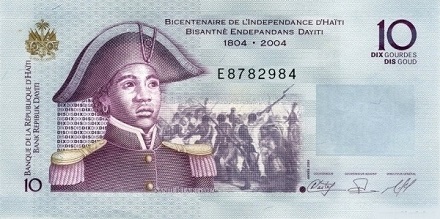
On October 5, 1802, Haitian soldier Suzanne Bélair, called Sanité Bélair, was shot with her husband by the French.

This “tigress” is the most famous of the Haitian Revolution’s numerous female protagonists. A free black woman, she married Charles Belair, the nephew and aide of the man who in the 1790s established pre-eminence on Saint-DomingueToussaint L’Ouverture.

L’Ouverture tragically vacillated when the French made their move in 1802 to reverse the revolution’s gains and re-establish slavery, but the tigress rallied General Belair to take the field in resistance — and not only rallied him, but fought alongside him as a regular in his army, attaining the rank of Lieutenant.

It’s said that at her capture, when threatened with beheading, she successfuly asserted the right to an honorable soldier’s death by musketry, and standing before their muzzles cried “Viv libète! Anba esclavaj!” (“Long live freedom! Down with slavery!”)

On this day..

1793: The slave Nell

Original from the Calendar of Virginia State Papers and Otner Manuscripts:

Champion Travis to the Governor

Sir:

Enclosed is a statement of the evidence which appeared against Daphne and Nell, two negroes convicted for the murder of Joel Garthright, which would have been sent sooner had the Attorney been in Town.

And am,
Your humble servant.


The evidence against Daphne and Nelly, two Slaves belonging to Col. Champion Travis, who were tried and convicted by the court of James City County in the month of June, for the murder of Joel Gathright, Col. Travis’s overseer, as well as my memory enables me to state it, was in substance follows:

It was proved in plain and positive terms by two negro boys, who were present and saw the greater part of the transaction, that Daphne and Nelly, the two criminals now under condemnation, were at work with ploughs on the day on which the overseer was killed, and the boys themselves leading the oxen to the ploughs.

Gathright, the overseer, came at his usual time to the field where these women were working, and blamed Nelly for suffering the fence to be left open, which had exposed the corn growing to be cropped by the sheep.

Nelly denied the charge and used some impertinent language, which provoked the overseer to strike her. This he did repeatedly with a small cane, till Nelly quitted her plough and ran; the overseer pursued and struck her on the ground after she had fallen.

Nelly recovered from her fall, and immediately engaged him. The woman Daphne, who was at a small distance off, as soon as she saw Nelly closely fighting with the overseer, ran to the place where they were engaged, and together they seized and threw him to the ground. They beat him on the ground with their fists and switches with great fury a considerable time.

The overseer made frequent efforts to raise himself up and get from them in vain, and demanded to know if they intended to kill him.

At length he ordered one of the boys, the witness, to go to a remote part of the field where the negro men were at work, and call one of them to his assistance; after some time, he sent the other boy.

The boys executed their orders, and soon returned to the place they had left; when they returned, the women, Daphne and Nelly, had fled, and an old negro man belonging to Col. Travis assisted to raise the overseer from the ground, who soon after expired.

It was proved by an old negro man, who kept a mill in the neighborhood of Col. Travis’s plantation, that these two women, Daphne and Nelly, in the afternoon of the same day on which they killed the overseer, passed the mill on their way to Williamsburg; and being asked by the old fellow where they were going, and what was the matter — seeing some disorder in their appearances, they replied that they had whipped their overseer, and were going to town to their master.

They were urged by the miller to go on, lest the overseer should overtake them; they observed that they had left him unable to move, and Daphne asked the old man if a woman could be hanged for killing a man.

Several white men who came to the place shortly after the scene was closed, and who were Jurors in the inquest held on his body, proved the violence committed on the body, and a fracture of the skull, which they imagined was made by a stone found a few feet from the head of the unfortunate man.

The Criminals, Daphne and Nelly, were tried separately, and the boys closely and rigidly examined; on each trial they delivered the same clear and unequivocal testimony. The criminals were undefended, but asked themselves many questions of the witnesses, which, as well as I remember, were answered strongly against them.

Ro. Sanders.
Attorney for James City County
July 26, 1793

Elsewhere in antebellum human chattelry: this from the Columbian Gazetteer, Oct. 28, 1793.

The full court record ensues in these same papers, demonstrating the same circumstances. Daphne was duly hanged on July 19, but “it being suggested to the court that the said Nelly is quick and big with child, it is commanded the Sheriff of this county that he cause execution of the above Judgement to be done on Friday the fourth day of October next. The Court also valued the said Nelly at fifty pounds Current money.”

(The timeline here implies that Nelly would have been about six to seven months pregnant when overseer Gathright began thrashing her for leaving the fence gate ajar.)

Nelly’s fate moved enough tender-hearted white neighbors to petition for her reprieve, a petition that was rebutted by a furious confutation with vastly more numerous signatories noting that “not a single circumstance appeared in alleviation of the horrid offence.” Can’t think of a one!

At any rate,

She has been delivered of her child some weeks, and now awaits the Execution of her sentence. We have heard with great emotion and concern that much Industry has been exerted to get signatures to a petition to your Excellency and the Hon’ble Board of Council to obtain a Pardon for the said negro woman, Nell; when we consider the alarming commotions which have lately existed among the negroes in this neighborhood, and the dangerous example of such a murder, we humbly conceive it necessary for the public peace that the course of the law should have its full effect in this instance.

And it did.

On this day..

1853: Three for the McIvor Gold Escort attack

On this date in 1853, three bushrangers hanged in Melbourne Gaol for the sensational (and very nearly successful) McIvor Gold Escort attack.

Our hanged trio’s crime traces to the mad 1850s gold rush to Victoria, mainland Australia’s southwesternmost province* and more specifically to the McIvor Creek diggings near Heathcote. Gold was struck there late in 1853; by the next year, the place was heavy with prospectors. And gold, why, we know what gold does to men’s souls.

The notes are eternal but gold sings her siren song in every major and minor key; where she calls men, haggard and desperate, bearing pickaxes and gilded dreams, she also beckons in another register to their counterparts bearing ready sidearms and black hearts. Miners after a different name.

On July 20, 1853, some 2,300 ounces of gold extracted from the McIvor diggings were dispatched with an armed guard from the Private Escort Cmpany on its regular run to Kyneton. Here was a mother lode for characters who could stake it.

The July 20 gold escort encountered a blocked road and six desperadoes waiting in a well-orchestrated ambush: without bothering to demand the escort stand and deliver, the robbers opened fire on their prey, wounding four of the troopers — non-fatally, but enough to compel submission — and killing the coach driver, William Flookes, ere they looted the dray of treasure worth near £10,000.


19th century illustration of the attak on the McIvor gold escort.

When news of the incident reached McIvor, 400 outraged miners formed up in posses and set off in pursuit — but the robbers had planned their strike cunningly and were well ahead of the chase. Racing away through wilderness, they paused to divide their spoils near Kilmore and proceeded to Melbourne, where they scattered themselves and were able to duck a sweeping but essentially blind manhunt for several weeks.

Joseph Grey, George and Joseph Francis, William Atkins, George Wilson, and George Melville were perhaps on the verge of completing the caper by August 13 when George Francis got cold feet and turned himself into the police — shopping all of his confederates into the bargain.

Joseph Grey, the wiliest of the bunch, was cautiously changing his address every single night — and so George Francis’s information did not nab him. Grey managed to stay ahead of the search and make good an escape with his share of the booty: he was never caught.

The remaining four — including Joseph Francis, George Francis’s own brother — were all speedily snapped up.

A twist in the plot occurred when star witness George Francis slashed his own throat, leaving the crown with a virtually empty case until brother Joseph fulfilled the informer’s place, piously declaiming against the shootings as more crime than either Francis had bargained for. This self-serving pap came in for uproarious pillory by the defense barristers when the surviving Francis took the witness stand — “with your own person in danger, you would sacrifice your mother and tell any lie you rpoor intelligence could invent!” — but the stool pigeon’s evidence stuck, corroborated by accounts from the troopers who survived the ambush.

Atkins, Wilson, and Melville hanged together at Melbourne Gaol sixteen days after their judge donned the black cap. Melville’s wife availed her right to claim her husband’s body and scandalized Melbourne’s authorities by cheekily garlanding the corpse in flowers and putting it on display in her oyster shop on Little Bourke Street, charging half a crown per gawk. Melbourne Gaol’s hanged thereafter were exclusively buried within the prison yards itself, and Parliament soon legislated this as a nationwide requirement.

* While the gold rush brought many boom towns that expired with their associated mineral veins, it boomed the frontier town of Melbourne right into the gigantic metropolis it remains today.

On this day..

2012: Moussa Agh Mohammed, by Ansar Dine in Timbuktu

On this date in 2012, northern Mali’s Islamist Ansar Dine movement, then in control of the city of Timbuktu, publicly executed Moussa Agh Mohammed there for murder.

Mohammed was one of Ansar Dine’s own fighters, but stringent consistency would oblige his fellows to put him to death under the sharia law Ansar Dine itself was enforcing in Timbuktu. Some days before he got into a fight with fishermen who reproached him for trampling their nets; as the confrontation escalated towards physical violence, Mohammed unslung his Kalashnikov and gunned one of them down. The fisherman’s family was offered, but refused, compensation in exchange for sparing the killer.

According to a correspondent, Mohammed “was a Tuareg cattle farmer from a major tribe [who] joined the Ansar Dine movement one month ago [before his execution]” having previously been affiliated with the Tuareg rebel army the National Movement for the Independence of Azawad. It was the third known execution in northern Mali under sharia: the previous two were an adulterous couple stoned to death in the town of Aguelhok.

“I didn’t feel a great deal of emotion from the crowd,” our observer reported. “People just stood there and watched as if it were a show. In contrast, the members of Ansar Dine looked moved by the event. Mohammed had close relationships with a number of his peers. But they explained that no one is exempt from Sharia law, and because of that they had no choice but kill him. It was a question of God’s will.”

On this day..

1822: Augustin Joseph Caron, entrapped

On this date in 1822, French Lt. Col. Augustin Joseph Caron was shot at Strasbourg as a rebel.

Little is known of his background, but Caron (English Wikipedia entry | French) enlisted in his army during the revolutionary year of 1791 and advanced into command positions under Napoleon. From his later conduct it’s apparent that these years shaped a political passion that would be starkly at odds with the post-Napoleon Bourbon restoration.

As we have noted elsewhere on this site France’s Liberal (often Bonapartist) opposition during these years was urged by the persecution of the monarchist party into conspiracy as the common coin of its politics.

Out of this mire grew both charbonnerie (France’s analogue to the carbonari terrorists who proliferated in Italy) and an overvigilant secret police whose campaigns of entrapment and threat exaggeration did nothing so well as to further obscure the line between mundane opposition and treason.

The strange interplay between these midnight foes would shape the fate of Col. Caron.

Caron’s path to execution begins with the thwarted rising of the Belfort garrison for New Year’s 1822 — a real plot that the government spies were able to squelch. This resulted in a number of executions, by dint of which it has featured in these very pages.

Caron enters this story in its second chapter: a pensioned former officer of known Bonapartist sympathies, Caron was (with another man named Roger) baited by police spies into mounting an attempted raid on Colmar prison where the arrested Belfort conspirators were being held. Officers chosen to play the part were detailed to meet him as “conspirators” and march with him to Colmar, allowing Caron to make compromising “Vive l’Empereur” exhortations along the way, before finally arresting him.

Though Caron himself had been a willing participant who most certainly did intend to raise a mutiny, the ridiculous spectacle of His Majesty’s warriors congratulating themselves for crushing a plot that they themselves controlled from the get-go came to crystallize the Liberal fulminations against abusive use of agents provocateur. As Alan Barrie Spitzer puts it in Old Hatreds and Young Hopes: The French Carbonari against the Bourbon Restoration,

the means employed to net such a minor, and such a vulnerable, agitator gave the critics of the regime and the defenders of other conspirators the opportunity to assimilate all the operations of the political police to this contemptible one. The government was placed on the defensive from the first. It proved difficult to demonstrate the Caron and Roger had initiated the seditious proposals … Two entire squadrons of chasseurs had conducted their brilliant operation to net only the two original suspects. And then there was the abrasive question of who, under what circumstances, shouted out “Vive l’Empereur!” — that is, tempted innocent passersby-into political crime. The original story … described the squadrons as riding through the countryside crying “Vive l’Empereur,” and innocently wondered whether these purveyors of seditious slogans would be arrested along with Caron, their alleged “leader.”

One Liberal deputy sneeringly pictured future French veterans boasting of their service, “I was in those squadrons that rode through the countryside of the Haut-Rhin shouting ‘Vive l’Empereur!’ in order to test the disposition of the inhabitants.” Indeed, what if the dispositions had been otherwise? It had been only a few years since the emperor really had returned from exile and raised a brief civil war; the idea that the military had risked triggering “the insurrection of a town and the massacre of its inhabitants” for no better reason than to compromise an utter nobody blossomed into a gigantic scandal. Caron became France’s metonym for a patsy;* demands to grant Caron leniency and turn the investigation against his persecutors multiplied discomfitingly.

But this was only one of several high-profile trials against anti-Bourbon plotters unfolding in 1822, and the Liberal denunciations against them practically staked the government’s credibility upon their outcome. So the government saw to the outcome it required — by invoking Caron’s military rank to have him transferred out of the civilian justice system and tried by a military tribunal that would be sure to convict him. Just to complete the shambles, the execution was then hurriedly conducted before Caron’s appeal could be brought before the Court of Cassation.

The Journal of the Lower Rhine gives the following details concerning the execution of Colonel Caron: —

Colonel Caron, who was unanimously condemned to death for the crime of embauchage [“hiring” -ed], by the first permanent council of war of this division, the judgment of which was likewise unanimously confirmed by the council of revision, was executed at two o’clock in the afternoon, in the presence of a small detachment of the garrison, and a numerous concourse of people who were attracted by curiosity. The Abbe Schittig zealously administered to him the consolations of religion, which he received with humility, and he died with the courage of a Christian and an old soldier. Caron was alone in a carriage, amidst the retinue which conducted him to the place of execution. At the entrance of the horn-work, called Finkmatt, where the execution took place, he alighted from the carriage without the assistance of the driver. On arriving in front of the 12 men who were to be his executioners, he refused to have his eyes bandaged. With his hat on, he himself gave the signal. Immediately the muskets were fired, and Caron was no more.

London Times, Oct. 10, 1822

He’s buried in Strasbourg, under a slab that reads MORT POUR LA LIBERTE.

* In The Red and The Black, the main character Julien Sorel at one point muses that, should a provocative letter be attributed to his hand, it could make him “the next Colonel Caron at Colmar.”

On this day..

1946: Takashi Sakai

On this date in 1946, Japan Gen. Takashi Sakai was shot by the World War II Allies at Nanking for war crimes.

Fifty-eight years old at his death, Sakai had built his career in the 1920s and 1930s manning various commands in the occupation of China.

Hours after Japan struck the U.S. at Pearl Harbor, Sakai commenced an attack on Hong Kong, then under British control but defended with only a token force that had no odds against the Japanese.

Sakai’s forces committed numerous summary executions and other cruelties on troops captured from the overwhelmed garrison before Hong Kong finally surrendered on Christmas Day.

The whole operation was much more protracted and difficult than Japan had anticipated and perhaps as a result Sakai was relieved of responsibility for the (similarly brutal) occupation of Hong Kong, and eased into retirement back on the mainland.

His next visit to China would occur under very different circumstances — where he would find himself obliged to dissociate himself from the atrocities that his men had authored in the capture of the city. His war crimes tribunal was not impressed.

The Tribunal dismissed the accused’s plea that he could not be held responsible for the above violations because they were perpetrated by his subordinates and he had no knowledge of them. The Tribunal’s findings were as follows:

That a field Commander must hold himself responsible for the discipline of his subordinates, is an accepted principle. It is inconceivable that he should not have been aware of the acts of atrocities committed by his subordinates … All the evidence goes to show that the defendant knew of the atrocities committed by his subordinates and deliberately let loose savagery upon civilians and prisoners of war.

The principle that a commander is responsible for the discipline of his subordinates, and that consequently he may be held responsible for their criminal acts if he neglects to undertake appropriate measures or knowingly tolerates the perpetration of offences on their part, is a rule generally accepted by nations and their courts of law in the sphere of the laws and customs of war.

(Conversely, Sakai’s attempt to cite superior orders as defense against charges for his part in initiating the war also got short shrift. So in terms of the chain of command, he got it coming and going.)

On this day..

1554: A false coiner and a masked dummy

From the diary of Felix Platter, a Swiss youth studying in Montpellier, France. It is not completely evident from context (“afterwards …”) whether the masked dummy was “executed” on the same occasion as the coiner, or whether that effigy was punished on a different day.

On the next day [after a September 28 execution] a false coiner was hanged in the same place. The gibbet was not vety high and had only one arm.

Afterwards a masked dummy was brought on a hurdle, and was laid on the cross and its limbs broken, as I have described. This dummy represented a Greek who had studied at Montpellier and had been accounted one of the keenest blades of the town. He had married Gillette d’Andrieu, a girl of doubtful reputation, who had neither beauty nor fortune. She had a very long nose, and her lover could scarcely manage to kiss her on the lips, especially since he too had a nose of respectable size.

The Greek was insulted by a canon, Pierre Saint-Ravy, who taunted him, at the moment when he was about to relieve himself, of having had intercourse with his wife. The husband at once stabbed the canon and fled; he could therefore be executed only in effigy. His wife continued to live in Montpellier, and was often in Rondelet’s house she was a relative of his.*

She often came there to dance, and one day I danced with her, all booted and spurred, on my return from Vendargues. As I turned, my spurs entangled themselves in her dress, and I fell full length on the floor. Some tablets I had in a breast pocket were broken into pieces, and I was so stunned that I had to be helped up.

* Guillaume Rondelet was one of Platter’s instructors, a professor of medicine. He had been friends with Rabelais and has the distinction of appearing in Gargantua and Pantagruel under the name Rondibilis.

Part of the Daily Double: Felix Platter’s Diary.

On this day..

1554: A handsome young man from Montpellier

From the diary of Felix Platter, a Swiss youth studying in Montpellier, France:

On the 28th [of September, 1554] the Provost came to Montpellier, and there were several executions.

On the first day he appeared on horseback, preceded by several horsemen and followed by the town trumpeter sounding his trumpet. Behind him walked a criminal, with some monks. He was a handsome young man and had been an accomplice in a murder He was brought to a scaffold that had been erected in front of the Hotel de Ville. There a Saint Andrew’s cross had been made with two hollowed-out balks of timber; in this his limbs were to be broken.

The condemned man stood and recounted in rhyme the crime he had committed, and at the end he added: ‘Pray to Holy Mary that she may intercede with her Son to take me into Paradise.’

The executioner then undressed him and tied him by the limbs to the cross, as those are tied, with us, who are to be broken on the wheel. Then he took a heavy bar of iron, called a massa, sharpened a little on one side, and broke the man’s limbs with it. This punishment resembles our punishment of the wheel, and is called here massarrer. The last blow was struck on the chest, and this killed the victim.

Part of the Daily Double: Felix Platter’s Diary.

On this day..