1952: George Muldowney, for loving and killing the original Bond girl

On this date in 1952, Irish steward George Muldowney was hanged at Pentonville Prison for the rather pathetic murder of a dashing Polish spy who had survived much greater villains.

Allowing that nobody ought to die on the floor of the Shelbourne Hotel with a sheath knife stuck in their chest, Christine Granville in particular really deserved a better exit.

Before the outbreak of World War II, she was Krystyna Skarbek, daughter of a Polish aristocrat sinking into poverty. After Germany overran Poland, she went off the marriage meatmarket and on Her Majesty’s Secret Service for a stunning career as a stunning spy that still has ’em sighing today.

Rechristened “Christine Granville” by Britain’s Special Operations Executive, she spent most of the war carrying out feats of cloak-and-dagger derring-do, with a Bond-like aplomb for extricating herself from tricky situations.

If only half the stories they tell about her are true …

  • Commuting between Hungary and Poland by skiing over the Tatra Mountains to gather intelligence and pull other agents out of harm’s way.
  • Getting herself and a fellow agent released from arrest by feigning tuberculosis by chewing her tongue until it bled.
  • Escaping capture at a checkpoint by pulling the pins on two grenades and daring the guards to shoot her.
  • Marching alone into a not-yet-liberated concentration camp to have POW’s reprieved from execution — by telling the Nazi commandante that he’d get the same treatment unless he spared them.
  • Snatching spymaster Francis Cammaerts from the Gestapo ahead of his execution.

And the love affairs! Or that’s what they say — including fellow agent Ian Fleming.

Granville earned the French Croix de Guerre, the George Medal for Special Services, the Order of the British Empire and other decorations, although merely surviving so much time in the field might have been her greatest achievement … but when the war ended, she was just another unwelcome Polish refugee, scrounging for service work in a recovering economy with no welcome waiting for her in her Soviet-dominated homeland.

From here on in, the trite and the tawdry eclipse the heroic.

A stewardess gig on a cruise ship attracted the attentions of her eventual murderer; his crush unreciprocated, and her companionship with another man jealously noticed, Muldowney stalked her and — on the very eve of Granville’s departure to reunite with a wartime confederate/lover — murdered her at her Kensington hotel.

To read the London Times‘ accounting the last moments of this woman so recently outfoxing the Nazis is to behold the face of banality triumphant.

Mr. Ian Smith, for the prosecution, said that, in a written statement at Kensington police station, Muldowney …

“describes how he waited outside the hotel and saw her go in. He went in after her and asked her for some letters he had exchanged with her. She said she had burned them. He did not believe her, and then says: ‘She told me she did not want anything to do with me and was off to the Continent and would see me in two years’ time.’

He then says: ‘Then I took the knife from the sheath which I had in my hip pocket and stabbed her in the chest, and then somebody came up.'” It was a deep stab wound up to the hilt of the knife, and penetrated the heart.

Muldowney didn’t fight the charge; he’d been planning to poison himself after the murder, and tried it when he was in custody. He declined legal aid and pleaded guilty at trial, seemingly eager to expiate his sin or join his would-be lover in death. It was less than 16 weeks after the crime that he stood on the gallows.

While Muldowney moulders in well-deserved obscurity, his victim reportedly inspired her former lover to create the character of Vesper Lynd — the original femme fatale secret agent in the original James Bond novel, Casino Royale. (And the smashing cocktail named for her in the same volume.)

She — Christine, not Vesper — is buried under a spadeful of symbolic Polish soil in St. Mary’s Roman Catholic Cemetery in London.

On this day..

1652: Captain James Hind, royalist highwayman

On this date in 1652, James Hind, a highwayman who preyed on Roundheads, was drawn and quartered for treason.

Famed throughout the realm for his dashing heists on the roads, Hind was the subject of no less than 16 printed pamphlets of the nascent popular press in the early 1650’s, which magnified brigand’s feats, oratory and persona into a sort of populist Cavalier superhero: Marvel Comics for the woodcut age.

The highlights of Hind’s adventures receive rapturous attention from the Newgate Chronicles:

  • Setting upon Oliver Cromwell shortly after the execution of Charles I, his partner Thomas Allen being taken in the affray;
  • An amusing duel of Biblical citations while robbing regicide Hugh Peters, resolved in the characteristic manner of such impasses by reference to which disputant holds the gun.

    “Pray, sir, make no reflections on my profession; for Solomon plainly says, ‘Do not despise a thief’; but it is to little purpose for us to dispute. The substance of what I have to say is this: deliver thy money presently, or else I shall send thee out of the world to thy master in an instant.”

  • Any number of pleasing episodes with lesser personages suitable for the gallant highwayman — ladies charmed but un-pillaged, paupers subsidized, and always, wicked Parliamentarians chastened. Several excellent Hind anecdotes are gathered by Gillian Spraggs here.

As to the veracity of this stuff, the Captain himself suggests a pinch of caution.

A Gentleman or two, desired so much favour of [the gaoler], as to aske Mr. Hind a civil question; which was granted. So pulling two books out of his pocket, the one entituled, Hind’s Ramble, The other Hind’s Exploits, asked him whether he had ever seen them or not: He answered, yes; And said upon the word of a Christian, they were fictions: But some merry Pranks and Revels I have plaid, that I deny not.

But Hind’s adherence to the Stuart cause was real enough, or at any rate something he had the 17th century media savvy to play up. At his execution, he professed pleasure in having targeted Roundheads for most of his crimes, and it was not theft that saw him to the scaffold, but treason. He made free royalist talk upon his arrest, proposing a toast to the exiled king that otherwise sympathetic guests were too cautious to take up.

Hind fits symbolically into the tradition of the romantic outlaw of Robin Hood stock, and anticipates the 18th century rogues’ gallery of noble brigands fighting a doomed rearguard against capitalism. Hind’s acts, criminal by any standard, are justified by the illegitimacy of the society he preys upon; he embodies at once a social and political rejection of the nascent mercantile England, and a biographical realization of its actuating mythos — personal aptitude and acquisition,* with a cover story for why his victims had it coming.

Neither did I ever wrong any poor man of the worth of a penny: but I must confess, I have (when I have been necessitated thereto) made bold with a rich Bompkin, or a lying Lawyer, whose full-fed fees from the rich Farmer, doth too too much impoverish the poor cottage-keeper: And truly I could wish, that thing were as little used in England amongst Lawyers, as the eating of Swines-flesh was amongst the Jews.

A dead-end position — just like James Hind himself.

* In a supposed rhapsody over gold forced from the hand of John Bradshaw — yet another regicide; Hind seemingly met them at every turn — our robber rather has his cake and eats it too in extolling and condemning lucre.

Ay, marry, sir, this is the metal that wins my heart for ever. Oh! precious gold, I admire thee as much as Bradshaw, Prynne or other such villains, who would for the sake of it sell our Redeemer again, were He now upon earth.

On this day..

1776: Nathan Hale, with regrets

On this date in 1776, Revolutionary spy Nathan Hale was hanged by the British in Manhattan — allegedly uttering the immortal last words, “I only regret that I have but one life to lose for my country.”

Nathan Hale statuary (with bound feet and hands) ironically stationed at Washington D.C.’s Department of Justice. Like statues are at the Chicago Tribune building and the Yale University campus; dueling plaques in New York contend to mark the execution spot.

Two years out of Yale when the Revolution broke out in 1775, the Connecticut-born Hale hitched onto the Continental Army and was directly promoted to captain.

When British Gen. William Howe landed at New York in the summer of 1776, Nathan Hale volunteered to slip behind enemy lines and reconnoiter enemy strength for George Washington. It turned out to be his mission into eternity.

As one might suspect, there’s a great deal more to Nathan Hale than his last words — and a fair bit of uncertainty about what his last words really were. Hale’s Wikipedia page retails many versions of the line from many sources.

The sentiment commonly attributed him (formulated in slight variations, e.g., “I only regret that I have but one life to give to my country”) was supposed to have been reported by a British officer attending him; it’s certainly a punchier version than, e.g., a Revolutionary War era report of “I am so satisfied with the cause in which I have engaged, that my only regret is, that I have not more lives than one to offer in its service.” Gah.

If all these presumably paraphrased reports have the gist right, it’s possible the 21-year-old recited an identical sentiment in the tragic play Cato:*

How beautiful is death, when earn’d by virtue!
Who would not be that youth? What pity is it
That we can die but once to serve our country.

There’s much more about this short-lived character and his larger-than-life transfiguration in mythologia Americana. The Library of Congress has a collection of links, and William Phelps recently penned this new (and surprisingly, first) biography of the revolutionary legend.

* The play was all the rage among patriots; Patrick Henry might have plucked his immortal “give me liberty or give me death” line from it, too. (“It is not now time to talk of aught/But chains or conquest, liberty or death.”)

Part of the Themed Set: Counterrevolution.

On this day..

1803: Robert Emmet, “let no man write my epitaph”

On this date in 1803, Irish nationalist Robert Emmet was hanged and posthumously beheaded, a day after his trial for treason against England.

The well-to-do scion of a Protestant family, Robert Emmet followed his older brother into the Republican ferment of the time and led an unavailing uprising in Dublin on July 23, 1803.

Captured a month later when he romantically recklessly moved his hideout closer to his beloved Sarah Curran.*

Emmet won his great laurels in the annals of Irish Republicanism with a stirring “Speech from the Dock” addressed to the courtroom the day before he died. Or better to say that it was addressed in a courtroom, for knowing that his death sentence was a foregone conclusion, the real audience was posterity and a wider world.

Emmet found that audience with one of the great orations of the 19th century.

This clip is a truncated version of a longer speech not set to paper by Emmet, so no single definitive version exists. Versions can be found at this Irish history site, and at SinnFein.ie.

I have but one request to ask at my departure from this world — it is the charity of its silence! Let no man write my epitaph: for as no man who knows my motives dare now vindicate them. let not prejudice or ignorance asperse them. Let them and me repose in obscurity and peace, and my tomb remain uninscribed, until other times, and other men, can do justice to my character; when my country takes her place among the nations of the earth, then, and not till then, let my epitaph be written. I have done.

On the strength of such sentiment — and the public’s learning of his love for Sarah Curran — the 25-year-old became iconic in death. Robert’s own death inspired the mandatory Irish patriotic ditty, “Bold Robert Emmet”:

But that sundered love between Emmet and Sarah Curran — who broken-heartedly accepted another proposal and moved to Sicily — was at least as stirring to the Romantic imagination. Washington Irving dedicated a short story to the lost romance; Emmet’s friend Thomas Moore made Curran the subject of a poem (beware: link opens an auto-playing audio file).


Anti-British terrorist Robert Emmet has a statue on Washington, D.C.’s Massachusetts Ave, and probably an entry on the no-fly list.

* 19th century Irish poet Thomas Moore paid her tribute in “She Is Far From the Land”:

She is far from the land where her young hero sleeps,
And lovers are round her, sighing:
But coldly she turns from their gaze, and weeps,
For her heart in his grave is lying.

She sings the wild song of her dear native plains,
Every note which he lov’d awaking; —
Ah! little they think who delight in her strains,
How the heart of the Minstrel is breaking.

He had liv’d for his love, for his country he died,
They were all that to life had entwin’d him;
Nor soon shall the tears of his country be dried,
Nor long will his love stay behind him.

Oh! make her a grave where the sunbeams rest,
When they promise a glorious morrow;
They’ll shine o’er his sleep, like a smile from the West,
From her ow lov’d island of sorrow.

Part of the Themed Set: Counterrevolution.

On this day..

1642: Thomas Granger and the beasts he lay with

On this date in 1642, a teenager was hanged in the Plymouth colony for bestiality — in accordance with the law of the Pentateuch.

William Bradford — we just met him, trying to keep things cool with the Indians — relates the “very sadde accidente of the like foule nature in this govermente”:

Ther was a youth whose name was Thomas Granger; he was servant to an honest man of Duxbery, being aboute 16 or 17 years of age. (His father and mother lived at the same time at Sityate.) He was this year detected of buggery (and indicted for the same) with a mare, a cowe, tow goats, five sheep, 2 calves, and a turkey. Horrible it is to mention, but the truth of the historie requires it. He was first discovered by one that accidentally saw his lewd practise towards the mare. (I forbear perticulers.) Being upon it examined and committed, in the end he not only confest the fact with that beast at that time, but sundrie times before, and at severall times with all the rest of the forenamed in his indictmente; and this his free-confession was not only in private to the magistrates, (though at first he strived to deney it,) but to sundrie, both ministers and others, and afterwards, upon his indictemente, to the whole court and jury; and confirmed it at his execution. And whereas some of the sheep could not so well be knowne by his description of them, others with them were brought before him, and he declared which were they, and which were not. And accordingly he was cast by the jury, and condemned, and after executed about the 8 of Sept 1642. A very sade spectakle it was; for first the mare, and then the cowe, and the rest of the lesser catle, were kild before his face, according to the law, Levit: 20.15 and then he him selfe was executed.* The catle were all cast into a great and large pitte that was digged of purposs for them, and no use made of any part of them.

So, pilgrims: weird about sex, a bit rough with the punishment. No wonder they got a rep.

Granger is the first juvenile known to be executed in the territory of the modern United States — if you like, you could read it as the start of a pattern, even though almost a century would pass before the next such execution. “Juvenile” is a relative term, of course, since we see our day’s victim across a historical redefinition (arguably, outright creation) of “childhood” in the centuries to come: Granger left a wife and daughter.

“Sodomy, rapes, buggery,” were one of the five classes of crimes punishable by death according to the Plymouth Colony’s 1636 statutes. Still, Granger’s is the only one of ten recorded Plymouth Colony executions not imposed for murder (Source, via.) — not that other hot-blooded Puritans, including later zoophiles, didn’t get themselves into hot water.

American poet Charles Olson reimagined Thomas Granger in the 1940’s by remixing William Bradford’s narrative into a startlingly poignant piece, “There was a Youth whose Name was Thomas Granger”:

From the beginning, SIN
and the reason, note, known from the start

says Mr. Bradford: As it is with waters when
their streames are stopped or damed up, wickednes

(Morton, Morton, Morton)
here by strict laws as in no more,
or so much, that I have known or heard of,
and ye same nerly looked unto
(Tom Granger)
so, as it cannot rune in a comone road of liberty
as it would, and is inclined,

it searches every wher (everywhere)
and breaks out wher it getts vente, says he

Rest, Tom, in your pit where they put you
a great & large pitte digged of purposs for them
of Duxbery, servant, being aboute 16. or 17. years of age
his father & mother living at the time at Sityate

espetially drunkennes & unclainnes
incontinencie betweene persons unmaried
but some maried persons allso
And that which is worse
(things fearfull to name)

HAVE BROAK FORTH OFTENER THAN ONCE
IN THIS LAND

2
indicated for ye same) with
a mare, a cowe, tow goats, five sheep, 2. calves
and a turkey (Plymouth Plantation)

Now follows ye ministers answers

3
Mr Charles Channcys a reverend, godly, very larned man
who shortly thereafter, due to a difference aboute baptising
he holding it ought only to be by diping
that sprinkling was unlawful, removed him selfe
to the same Sityate, a minister to ye church ther

in this case proved, by reference to ye judicials of Moyses
& see: Luther, Calvin, Hen: Bulin:. Theo: Beza. Zanch:
what greevous sin in ye sight of God,
by ye instigation of burning lusts, set on fire of hell,

to procede to contactum & fricationem ad emissionem seminis,
&c.,
& yt contra naturam, or to attempt ye grosse acts of

4

Mr Bradford: I forbear perticulers.
And accordingly he was cast by ye jury,
and condemned.

It being demanded of him
the youth confessed he had it of another
who had long used it in old England,
and they kept cattle together.

And after executed about ye 8. Of Septr, 1642.
A very sade spectakle it was; for first the mare,
and then ye cowe, and ye rest of ye lesser catle,

were kild before his face, according to ye law
Levit: 20.15.

and then he him selfe

and no use made of any part of them

* The hangman, John Holmes — no, not that one — claimed a fee “for x weeks dyett for Granger £1., and for executing Granger and viij beasts, £2.10.0.” His count of executed beasts falls short of the total (12) enumerated by Bradford, presumably accounted by the difficulty in identifying the sheep.

On this day..

1538: Cratwell, a hangman

This yere, the first daye of September, beinge Sondaye, at Clerkenwell, where the wrestlinge is kept, after the wrestlinge was done, there was hanged on a payre of gallowes, newe made, in the same place, the hangman of London and two more for robbinge a bouth in Bartlemewe fayre, which sayd hangman had done execution in London since the Holy Mayde of Kent was hanged, and was a conninge butcher in quarteringe of men.

A Chronicle of England During the Reigns of the Tudors, from A.D. 1485 to 1559

On this day..

1305: William Wallace, Braveheart

On this date in 1305, Scottish knight Mel Gibson — er, William Wallace — was hanged, drawn and quartered at Smithfield for treason to a British crown he refused to recognize.

Just like so:

Well, close enough. Some wags have alleged one or two historical liberties in Braveheart.

Among the lesser (but more pertinent here): that they weren’t — you knew this already — offering the former Guardian of Scotland the opportunity to reduce his suffering with a public submission, or use the stage for theatrical defiance. Hanging, drawing and quartering was a brand new execution Edward I was experimenting with for emasculating, disemboweling, and (so the idea went) utterly cowing the rebellious hinterlands of the British Isles. Wallace may have been just the second person to suffer it.

But only a pointy-headed blogger could possibly care when the main point is that back before Christendom succumbed to nancy decadences like Vatican II, men wore woad, defenestrated queers, and tapped top-shelf babes.


Among the few things known for certain about William Wallace is that he did not score with Isabella of France. Or with Sophie Marceau.

Facts? This is show business!

Mel’s bloodbath only riffs the already-fantastic 15th century epic of “the Wallace” by Scottish minstrel Blind Harry, which in turn got a lyrical call-out in Robert Burns’ 18th century Scottish patriotic tune Scots Wha Hae.

National martyrs — and, sure, it helps to die at the right time, as Wallace did just before Robert the Bruce secured Scottish independence — feed a train of hungry authors and ready audiences in every time, place and medium.

However genuinely flesh-and-blood the limbs that wrought his feats and were torn apart on this day, Wallace returns to his generations of interlocutors half-shrouded in mythology. Seven centuries on, his contested (and sometimes absurd) use as precedent or metaphor stakes a claim to his Truth at least as compelling as battlefield tactics at Stirling Bridge. What does he “really” have to tell us? No matter how grisly his end, William Wallace doesn’t get to decide: it’s between you, me, Mel, and a few billion other folks.

Only a character really worth remembering is worth that kind of fictionalizing.

On this day..

1191: Muslim prisoners at Acre

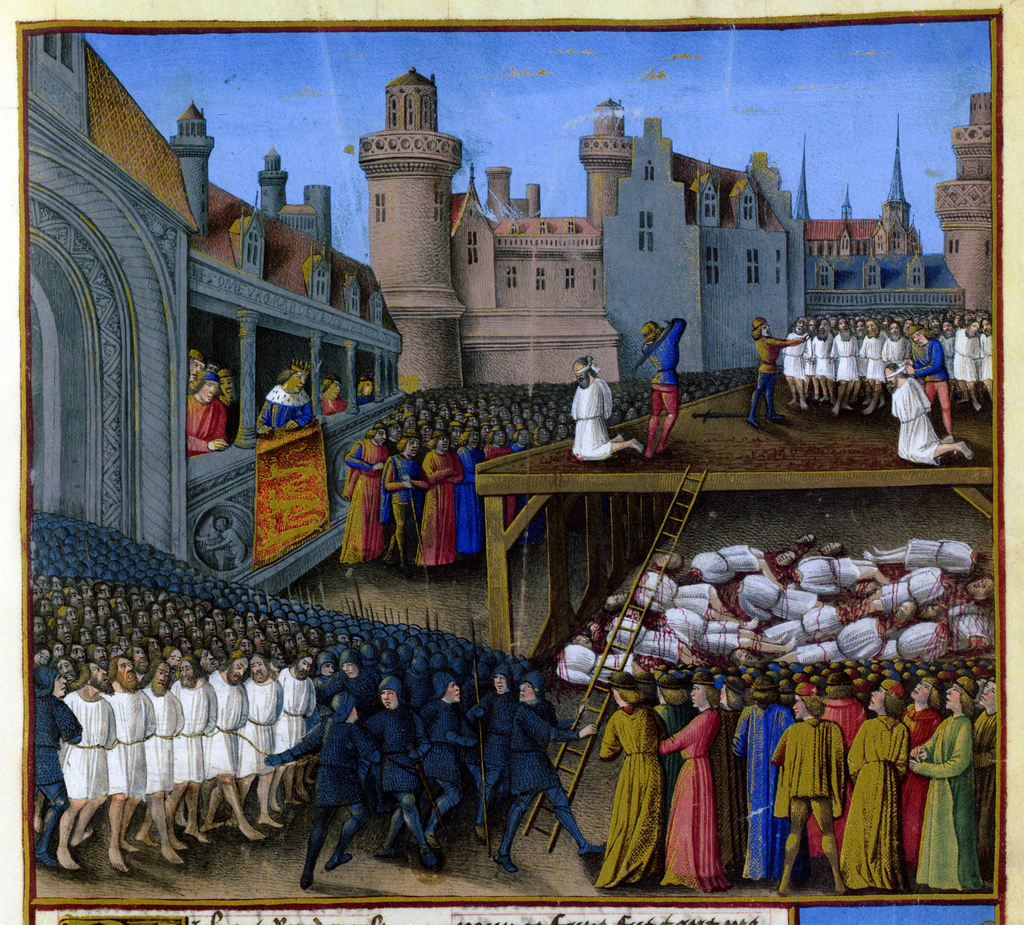
On this date in 1191, Richard the Lionheart had 2,700 Muslim prisoners of Acre demonstratively executed before his opposite number Saladin, when ransom arrangements dilated.

Courtesy of Project Gutenberg, here is Guizot on this ugly prod to action from the Third Crusade

From the 1st of August, 1191, to the 9th of October, 1192, King Richard remained alone in the East as chief of the crusade and defender of Christendom. He pertains, during that period, to the history of England, and no longer to that of France. We will, however, recall a few facts to show how fruitless, for the cause of Christendom in the East, was the prolongation of his stay and what strange deeds—at one time of savage barbarism, and at another of mad pride or fantastic knight-errantry—were united in him with noble instincts and the most heroic courage. On the 20th of August, 1191, five weeks after the surrender of St. Jean d’Acre, he found that Saladin was not fulfilling with sufficient promptitude the conditions of capitulation, and, to bring him up to time, he ordered the decapitation, before the walls of the place, of, according to some, twenty-five hundred, and, according to others, five thousand, Mussulman prisoners remaining in his hands.

The only effect of this massacre was, that during Richard’s first campaign after Philip’s departure for France, Saladin put to the sword all the Christians taken in battle or caught straggling, and ordered their bodies to be left without burial, as those of the garrison of St. Jean d’Acre had been. Some months afterwards Richard conceived the idea of putting an end to the struggle between Christendom and Islamry, which he was not succeeding in terminating by war, by a marriage. He had a sister, Joan of England, widow of William II., king of Sicily; and Saladin had a brother, Malek-Adhel, a valiant warrior, respected by the Christians. Richard had proposals made to Saladin to unite them in marriage and set them to reign together over the Christians and Mussulmans in the kingdom of Jerusalem. The only result of the negotiation was to give Saladin time for repairing the fortifications of Jerusalem, and to bring down upon King Richard and his sister, on the part of the Christian bishops, the fiercest threats of the fulminations of the Church. With the exception of this ridiculous incident, Richard’s life, during the whole course of this year, was nothing but a series of great or small battles, desperately contested, against Saladin. When Richard had obtained a success, he pursued it in a haughty, passionate spirit; when he suffered a check, he offered Saladin peace, but always on condition of surrendering Jerusalem to the Christians, and Saladin always answered, “Jerusalem never was yours, and we may not without sin give it up to you; for it is the place where the mysteries of our religion were accomplished, and the last one of my soldiers will perish before the Mussulmans renounce conquests made in the name of Mahomet.”

Good thing that Jerusalem issue has since been cleared up.

The BBC treated the scenario — complete with the resultant loss of the last chunk of the supposed True Cross — in a chunk of its 90-minute documentary on the Third Crusade:

On this day..

1963: Henry John Burnett, Scotland’s last hanging

On this date in 1963, the executioner paid his last call to Scotland with the hanging of Henry John Burnett for the murder of a rival-in-love seaman.

The type whom parents hope their daughter never dates, Burnett liked to keep his squeeze Margaret May Guyan under lock and key to keep her stepping out on him.

It’s an old, old tale. Boy meets girl, boy makes girl his prisoner, girl gets creeped out and returns to estranged hubby Thomas Guyan at 14 Jackson Terrace in Aberdeen, boy blasts Guyan in the face with a shotgun. How many times have we heard it told?

Even though the noose was on its way out — this is not only the last execution in Scotland, but the only hanging in Aberdeen in the past century and a half — there wasn’t much pussyfooting around when they’d made up their mind to use it: Burnett outlived his victim by only eleven weeks — notwithstanding an insanity plea and clemency petitions from both his own and the victim’s families — before hanging at Craiginches Prison, a facility that surely ought to be somebody’s porn name.

It’s got pride of place in a book about Aberdeen crime history, Blood and Granite. Because you can find anything on YouTube, there’s also this fine teaser for a forthcoming animation project of some kind:

Part of the Themed Set: At the End of the Rope.

On this day..

1964: Gwynne Owen Evans and Peter Anthony Allen, England’s last hangings

At 8 o’clock in the morning this date in 1964, two gallows traps 50 kilometers apart opened simultaneously — dropping the last two men England ever hanged.

Gwynne Owen Evans and Peter Anthony Allen couldn’t have been much smaller fare for a milestone as momentous as the last entry in England’s copious annals of execution.


Evans (left) and Allen.

The two twentysomethings had dropped by Evans’s former coworker’s place in the aptly-named port Workington to borrow money. Since the call was at 3 a.m. and the petitioners were armed, it might appear that they had in mind an offer that John Alan West couldn’t refuse. The reader is invited to fill in the rest: a quarrel, a murder, a stolen watch, a medallion dropped at the crime scene with one of the perps’ own names on it …

Three months later, they were on trial for their lives; a month after that, hanged by the neck until dead. If there is tragedy in these hapless thugs, it may be that either could possibly have saved the other by claiming sole responsibility for the murder; since each blamed the other, the jury ended up finding them equally culpable.

While the last hangings in Canada featured two unconnected men hanged together, the last in England had partners in crime hanged separately. Allen died at Liverpool’s Walton Prison; Evans was dropped at Manchester’s Strangeways Prison.*

And unlike the Canadian case, Evans and Allen didn’t die knowing they were likely the last.

Although hangings had slowed to a crawl in Britain — there were just two in 1963, and none in 1964 before this day — death sentences continued to be handed down. But the trend was toward abolition: the British Parliament suspended the death penalty for ordinary crimes late in 1965, and made the suspension permanent in 1969. The handful of exceptional crimes for which the gallows remained nominally available — treason, piracy, espionage — were never enforced as such before those statutes too were removed from the hangman’s jurisdiction by 1998.

* Evans’ executioner, Harry Allen — no relation to Peter Anthony Allen — also conducted the last hanging in Scotland.

Part of the Themed Set: At the End of the Rope.

On this day..