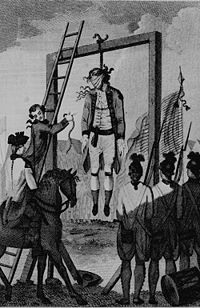
1780: David Dawson and Ralph Morden, Quaker “traitors”

On this date in 1780, two unconnected Quakers were hanged for two unconnected treason convictions in two different cities in Pennsylvania.

The public executions of Ralph Morden in Easton, Pa., and David Dawson in Philadelphia (in a double hanging along with counterfeiter Richard Chamberlain) had the unusual distinction of being treason convictions against the state of Pennsylvania during the Revolutionary War, rather than against any sort of federal entity.

According to the Espy File of American executions, there were only 15 people put to death for treason* during the Revolutionary War. It’s a remarkably low figure under the circumstances — separatist colonial conflict that often pitted revolutionary neighbor against loyalist neighbor.

Morden, a Quaker who kept his head down during the war, agreed to guide one Robert Land, a Tory who needed to slip past Continental sentries, and of course didn’t make it. His case is summarized here, here and here.**

Less is readily available about Dawson, but a fellow-prisoner (and fellow-Quaker) left an account remembering that he and the counterfeiter Chamberlain

were taken out amidst a crowd of spectators — they walked after a cart in which were two coffins and a ladder, etc., each had a rope about his neck and their arms tied behin [sic] them … they were both hanged in the commons of this city abt. 1 o’clock.

This prisoner, Samuel Rowland Fisher, kept a two-year journal (pdf) of his imprisonment in Philadelphia for Tory sympathies, and as one might imagine paints an unflattering picture of the revolutionary “State as they call it.” In his view, Dawson’s hanging was a

greater act of Cruelty in the present Rulers than anything they have heretofore done, for they never gave him even a shadow of a tryal in their own fashion & they have executed him merely as what they call a proscribed person because he came into the City while the Brittish Army lay here, the circumstances of which was, that he was coming from his abode with his Waggon, that being in danger of his life from some of Washington’s Men he fled into the City & left & lost his Wagon, Horses, provisions &c — He never acted in any manner under Brittish, nor had he taken the Test to the present Usurpers, he did not go with the Brittish Army to New York, but had secreted himself in various places till he was betrayed by Jamed Reed last Spring & taken prisoner

Quaker Notes

Quakers who stuck by the sect’s pacifist teachings had a tough go of the American Revolution, often lumped in as Tories by patriots and subject to spasms of popular abuse, official writs confiscating their property, and other indignities from those who considered them “the unfriendly Quakers … notoriously disaffected to the cause of American Liberty.”† That same prejudice occasionally exposed Quakers to the severest punishments for perceived crimes.

Thus Morden, who presumably helped the British agent as a personal gesture of assistance, an everyday “crime” for which hanging was an extreme stricture: one hundred Continental dollars from Chamberlain’s press to the reader who can demonstrate that this was one of the 15 most treasonable acts committed behind American lines. But confronted with the request in a time of war, what was the neutral, pacifist choice?

“A man was hanged this morning,” one British officer’s diary recorded, “for piloting some people through the back woods, to the Indians. He was very old and left a wife and 9 children. His death was chiefly owing to his being a noted friend of Government.” (Cited by John Coleman in “The Treason of Ralph Morden and Robert Land,” The Pennsylvania Magazine of History and Biography, Oct. 1955)

Dawson, meanwhile, had worked for the British during the city’s recent occupation by General William Howe and was one of many so-called Loyalists “attainted of High Treason” and stripped of property by the state. Still, the British had been gone more than two years by the time he hanged.

Egged by Benedict

What might have upgraded Dawson’s sentence to a capital one was having the bad sense to be apprehended around the same time news arrived that Benedict Arnold had betrayed the Revolutionary cause two months before this date.

Arnold had recently been stationed in Philadelphia, and there controversially married into a Tory family. The betrayal he wrought thereafter was keenly felt in the cradle of liberty, and Arnold’s

effigy was paraded through the streets and hanged, his wife was ordered to leave the city within fourteen days, and his estate was confiscated. Still more rigorous proceedings were instituted against the tories and Quakers, one of whom [Dawson -ed.] was convicted of high treason and hanged. (Source.)

Discipline and Punish

Since we are students of the morbid here, let us also pause to notice the strikingly throwback nature of the punishment — not merely the fact that the Dawson-Chamberlain hanging was public, but that they were so theatrically marched to it, with ropes drawn about necks like the false Martin Guerre.

Not only did the treason conviction belong to a pre-American jurisprudence — against the state, yes, but also of a broader British conception of treason that the still-to-come U.S. Constitution would sharply curtail — but the resulting sentence is sharply at odds with Pennsylvania’s historical image as a a haven of penal reform.

Before the decade was out, the Keystone State would establish itself as an international epicenter of the movement away from harsh and (to us) primitive-sounding judicial sanctions, reconceptualizing punishment into the ordered prison system still familiar today. Pennsylvania abolished the death penalty for all crimes but murder by the turn of the century (it had made liberal use of the rope to punish crimes like burglary before that), and even murder hangings were not frequent.

Quakers, and Quaker philosophy, were instrumental in the shift.

If the thought that led to that sea change came from a deeper place, it may yet have been informed by the episodic recent history of the revolution: according to Gail Stuart Rowe’s Embattled Bench, there were around 700 indictments and attainders for treason or misprision of treason in Pennsylvania throughout the American Revolution, and these resulted in only four hangings.

All four of the hanged were Quakers.

* The Espy file is an outstanding resource, with the intent to document every execution that took place in what is now the United States since its colonial antecedents. However, it is not necessarily reliable that it actually does this, so the precise figure of 15 should not be depended upon too greatly.

** Land himself managed to escape from the ambush, leaving only Morden to face the music. The interest in his fate seems to come from genealogists; according to this site, Charles Lindbergh numbered among his descendants — bringing us to another century’s death penalty.

† That was George Washington, cited in George Washington and Slavery. However, according to this listing of famous Quakers, other notable patriots like revolutionary Gen. Nathanael Greene, flag-stitcher Betsy Ross and polemicist Thomas Paine were Quakers, too.

On this day..

1922: Robert Erskine Childers, for carrying the gun of Michael Collins

On this date in 1922, Robert Erskine Childers was shot by the Irish Free State for carrying a gun its founding colossus had gifted him.

Many Irishmen were executed on either side in this terrible time, but Childers cuts a unique figure among them.

To begin with, he wasn’t all that Irish — “that damned Englishman,” fellow Republican turned Civil War enemy Arthur Griffith called him. The London-born son of a British scholar and an Irish mother, Childers was a lifelong Protestant, itself an anomaly since Irish nationalism mapped (and still maps) strongly to Catholicism.

You’d think he’d be a loyal man of the empire. Early on, that’s just what he was.

In his twenties, Childers volunteered for the Boer War, and he would later say the rank savagery and underlying injustice of England’s war “changed the whole current of my life and made me a Liberal and a Nationalist.” (Source.)

Laying down the sword, Childers took up the pen and wrote several books of military history. (Long since into the public domain, at least two can be read free online: War and the Arme Blanche, German Influence on British Cavalry.) He also wrote a novel, The Riddle of the Sands, that has a (debatable) claim as the first spy novel. Riddle has never gone out of print since it was published in 1903, though it is also available free online.

Both in fiction and nonfiction, Childers’ warnings against the German challenge to British hegemony were prophetic, but he was himself becoming a man divided. 1914 saw him running German guns to Irish nationalists aboard his yacht Asgard … and then signing up for the royal navy when World War I erupted.

The British crackdown on the Easter Rising during the war completed his radicalization; he moved to Dublin and turned his eloquence against the British.

Here, Childers was swept into the tragedy of the Irish War of Independence, and the civil war that followed it; though both were in the delegation that produced the contentious Anglo-Irish Treaty, Childers broke with Michael Collins over it and backed the IRA nationalists who fought the Irish Free State.

After Collins’s assassination, emergency laws promulgated the death sentence for anyone caught armed without authorization. Childers was a writer, not a partisan, but he was arrested in early November with a small sidearm — a gift Michael Collins had given him, back when they were on the same side. It was a time of bloody justice, and they threw the book at him.

Childers knew as well as Collins had that the internecine conflict would have to end. He checked out with awe-inspiring forgiveness; summoning his 16-year-old son to prison the night before his execution, Childers extracted a promise that the boy would find everyone who signed his death warrant … and shake their hands. (Young Erskine Hamilton Childers eventually became President of Ireland.)

Childers himself likewise shook the hands of his own firing squad, one by one. His last words (reported in a number of slightly different variations) were lightheartedly addressed to them:

Take a step or two forwards, lads. It will be easier that way.

On this day..

1538: John Lambert, “none but Christ”

On this date 470 years ago, John Lambert was burned to death at London’s Smithfield market for heresy.

One possible way to read the early progress of the English Reformation is as an initial flowering of Protestantism followed — after the execution of Anne Boleyn — by a reactionary crackdown by the monarch.

In this telling, John Lambert (born John Nicolson or Nicholson) marks the turning point, the man in whose blood Henry VIII etched his warning against doctrinal liberality.

John Lambert cooked his goose by picking a theological dispute with a pastor in London. He didn’t buy into transubstantiation, the Catholic doctrine (still extant today) that the bread blessed on the altar became the literal body of Christ.

Though the Anglican church would ditch this belief soon thereafter, it came down hard on Lambert in a show trial attended by Thomas Cromwell, Thomas Cranmer, and all the Tudor big wheels whose heads were at that point attached to their shoulders.

The king himself — who here reminds one of the the stout defense of the sacraments that in his early Catholic period had earned him the papal honorific “defender of the faith” — debated theology with the accused, though mostly he left it to his august councilors.


John Lambert disputing before Henry VIII. Early 19th c. illustration.

But the crowned head made his doctrine as plain to the audience as the consequences of crossing it.

The pro-Lambert account from which this extract is drawn is available free on Google books:

At length [Lambert] was worn out with fatigue, having been kept five hours standing …

Night coming on, the King being desirous to break up this pretended disputation, said to Lambert, “What sayest thou now, after all this pains taken with thee, and all the reasons and instructions of these learned men? Art thou not yet satisfied? Wilt thou live or die? What sayest thou? Thou has yet free choice.” Lambert answered, “I yield and submit myself wholly unto the will of your Majesty.” Then said the King, “Commit thyself into the hands of God, and not unto mine.” Lambert replied, “I commend my soul unto the hands of God, but my body I wholly yield and submit unto your clemency.” Then said the King, “If you do commit yourself unto my judgment, you must die, for I will not be a Patron unto heretics.” And then turning to Lord Cromwell he said, “Cromwell, read the sentence of condemnation against him:” which was accordingly done.

A few months later, Henry induced Parliament to pass the Act of the Six Articles, essentially establishing Catholic doctrine — sans Pope, obviously — as the basis for the Church of England and criminalizing dissent.

What to make of this trial and the policy it represented is open to dispute. In a simple telling, Henry realizes his Reformation is running away from him, or becomes wise to discomfiting reforms that Cranmer or Cromwell are pushing. Too, the ebb and flow of Henry’s “Reformation” has sometimes been seen as a product of the shifting balance between reformers and conservatives advising the crown; Protestant martyrologist John Foxe favored this approach since it enabled him to celebrate a John Lambert without indicting the monarch by blaming advisors.

Lambert’s death is also sometimes interpreted in light of the international situation, as the Catholic powers of France and the Holy Roman Empire had made peace, potentially (along with Scotland) encircling England with Popish foes who might conceivably be less belligerent with a move towards traditional doctrine.*

But maybe that’s all a good deal more explanation than is needed for the old defender of the faith. G.W. Bernard’s consideration of The King’s Reformation argues that Lambert isn’t so pivotal after all:

[H]istorians who see … the trial of Lambert as some sort of turning point are greatly mistaken. There was absolutely nothing new in Henry’s policy in November 1538. Ever since radical — Zwinglian — notions on the mass had come to influence some within England, Henry had reacted firmly and boldly. This was not something that only came late in the 1530s, when he supposedly woke up to what Cromwell and Cranmer had been doing in his name but without his knowledge. It was there from the start. As early as March 1535 a proclamation fiercely denounced strangers who had presumptuously rebaptised themselves and who denied that the blessed and most holy sacrament of the altar was really the body of Christ. If there was a novelty in autumn 1538, it was the perception that such heresies were spreading through the realm and that heretics with a high profile, such as Lambert, needed to be dealt with publicly so that others might learn from their unhappy example. … Henry surely blasted against sacramentarians for the straightforward reason that he sincerely believed them to be wicked.

As for Lambert himself, he met an especially cruel version of the none-too-pleasant sentence of burning alive, allegedly being lifted by pikestaffs from the flame when his legs were burned off to prolong his suffering. He is said to have continued to call out the inspirational last words, “None but Christ! None but Christ!”

* It was against this alliance that Cromwell would arrange the king’s ill-fated marriage to German princess Anne of Cleves, a debacle that helped Cromwell lose his own head.

On this day..

1869: Hamiora Pere, Maori “traitor” to the Queen

On this date in 1869, Hamiora Pere became the only New Zealander ever executed for treason.

Maurice Shadbolt’s Season of the Jew is a historical novel of the conflict that doomed Hamiora Pere. It’s told from the standpoint of Te Kooti, who liked to compare the Maori cause to that of the Israelites resisting Egypt, and founded a religious sect that still persists today.

Pere* came by the distinction quite accidentally — even setting aside the queer circumstance of his “betraying” a state on the opposite side of the globe by resisting its claim to his ancestral homeland.

Hamiora Pere was one of five Maori prisoners from the Siege of Ngatapa during Te Kooti’s War — an indigenous resistance against British colonization — to face the fatal charge.

The crown handled these cases carefully.

Though all five men drew death sentences (mandatory for treason), the government was evidently trying to stay out of the martyr-making business — as revealed by a judge’s comment during official deliberations.

I believe the result is the very best that could have been arrived at. I am glad to know that Mr McLean thinks that one execution will be useful as more would have been by way of example and caution.

Unfortunately for Hamiora Pere, the one of those five who was most likely set up to be the “example,” Wi Tamararo, committed suicide in prison shortly after his sentence.

Pere seemingly became the next in line for hanging because he was associated with murders in a noteworthy massacre at Matawhero that slew 33 Europeans and 37 of their Maori allies. Notably, however, the charge of murder actually filed against him was dropped prior to trial since he could be placed at the scene of the attack, but not directly shown to have killed anyone. Even off the indictment, it may have been the thing that doomed him.

Whatever the nature of the deliberations — and this report (pdf) of New Zealand’s Waitangi Tribunal inconclusively attempts to unpack the story with the patchy evidence available — the remaining convicts got clemency. Four years later, they were pardoned outright.

Pere got the noose at Wellington, and the accidental historical footnote. He would seem destined to maintain his unusual distinction indefinitely, since New Zealand has abolished the death penalty altogether.

Fear of Death

It is the circumstantial distinction of his case that earns Pere his place in this blog out of the numberless thousands to meet his same fate.

But in the end, he faced the gallows in that existential nakedness common to all us mortal wretches beholding death. Many in these pages meet their ceremonial end with with bravado; Hamiora Pere, by contrast, suffered all the pitiably human torments of fear, according to the report of the Daily Southern Cross:

He received the notice of his approaching death with calmness, and it was not until the morning before the execution that he gave any outward sign that he realised his terrible position. … [after his last farewell with his family he] became terribly distressed. He evidently fully recognised his position; he knew that he had looked for the last time on those from whom only he had any right to expect sympathy; every incident was reminding him how rapidly his term of life was decreasing, and it was not until his spiritual adviser … had been with him some time, that he became more composed.

…

[on the morning of the execution, Pere’s] responses [to his spiritual advisor] were accompanied by a peculiar moaning, and by convulsive sobbing. … the prisoner, quite a young man, and with nothing in his general appearance worthy of special remark, was sobbing bitterly, and was evidently suffering from intense mental agony; he looked anxiously around, yet stood firm and erect while he was being pinioned, repeating, as well as his trembling voice would allow, the prayers that were being offered on his behalf. … At the foot of the steps [to the gallows] the prisoner halted a moment, but, being led up, was quickly placed in the centre of the platform, under the noose, which was immediately fixed round his neck. From the time the prisoner left his room, until the rope was adjusted, he continued praying in a low moaning tone, interrupted frequently by violent sobbing …

* Also spelled “Peri” and, occasionally, “Pera”.

On this day..

1849: Frederick and Marie Manning, a Dickensian scene

On this date in 1849, husband-and-wife murderers Frederick and Marie Manning (or Maria Manning) were publicly hanged together outside Horsemonger Lane Gaol in London.

An image of Marie Manning (nee Marie de Roux) from the Victorian popular press — from this romantic biography of Tolstoyan length available free from Google books.

The felonious pair — she a Swiss-born domestic; he a shifty laborer with a penchant for the inside job — lured to dinner in their Bermondsey home a wealthy friend who had designs on the redheaded knockout, then murdered him for his loot and stuffed the limed body under the floorboards. They were apprehended separately on the lam.

As is typical when a heartthrob femme fatale stands in the dock, a sensational trial of the “here today, gone tomorrow” variety ensued. The crime, nicknamed “the Bermondsey Horror” (here (pdf) is a book chapter-scale recounting), had each accusing the other, with the outcome usual for this site.

A massive, jeering throng turned out to see the two off (Mrs. Manning’s choice of black satin for the occasion is said to have caused the look to go out of fashion).

Among that crowd was Charles Dickens,* who took a break from working on David Copperfield to write The Times a letter published Nov. 14 demanding that executions be removed within prison walls on account of the unedifying conduct of the spectators.

Sir — I was a witness of the execution at Horsemonger-lane this morning. I went there with the intention of observing the crowd gathered to behold it, and I had excellent opportunities of doing so, at intervals all through the night, and continuously from daybreak until after the spectacle was over.

…

I believe that a sight so inconceivably awful as the wickedness and levity of the immense crowd collected at that execution this morning could be imagined by no man, and could be presented in no heathen land under the sun. The horrors of the gibbet and of the crime which brought the wretched murderers to it, faded in my mind before the atrocious bearing, looks and language, of the assembled spectators. When I came upon the scene at midnight, the shrillness of the cries and howls that were raised from time to time, denoting that they came from a concourse of boys and girls already assembled in the best places, made my blood run cold. As the night went on, screeching, and laughing, and yelling in strong chorus of parodies on Negro melodies, with substitutions of “Mrs. Manning” for “Susannah,” and the like, were added to these. When the day dawned, thieves, low prostitutes, ruffians and vagabonds of every kind, flocked on to the ground, with every variety of offensive and foul behaviour. Fightings, faintings, whistlings, imitations of Punch, brutal jokes, tumultuous demonstrations of indecent delight when swooning women were dragged out of the crowd by the police with their dresses disordered, gave a new zest to the general entertainment. When the sun rose brightly — as it did — it gilded thousands upon thousands of upturned faces, so inexpressibly odious in their brutal mirth or callousness, that a man had cause to feel ashamed of the shape he wore, and to shrink from himself, as fashioned in the image of the Devil. When the two miserable creatures who attracted all this ghastly sight about them were turned quivering into the air, there was no more emotion, no more pity, no more thought that two immortal souls had gone to judgment, no more restraint in any of the previous obscenities, than if the name of Christ had never been heard in this world, and there were no belief among men but that they perished like the beasts.

… I am solemnly convinced that nothing that ingenuity could devise to be done in this city, in the same compass of time, could work such ruin as one public execution, and I stand astounded and appalled by the wickedness it exhibits. I do not believe that any community can prosper where such a scene of horror and demoralization as was enacted this morning outside Horsemonger-lane Gaol is presented at the very doors of good citizens, and is passed by, unknown or forgotten.

Dickens would base a French maid named Mademoiselle Hortense in his next novel, Bleak House on Marie Manning.

This question of public as opposed to private hangings was a lively debate at the time, and Dickens’s view was hardly uncontested. A letter in response from one F.B. Head of Oxenton countered thus:

The merciful object of every punishment which the law inflicts is not so much to revenge the past crime as to prevent its recurrence. Now, Mrs. Manning’s last moments clearly explain, or rather indisputably prove, the benefit which society practically derives from a public execution. … as for a few fleeting moments she stood, with bandaged eyes, beneath the gibbet, how unanswerably did the picture mutely expound the terror which the wicked very naturally have of being publicly hanged before the scum and refuse of society! “The whistlings — the imitations of Punch — the brutal jokes and indecent delight of the thieves, low prostitutes, ruffians and vagabonds,” so graphically described by Mr. Charles Dickens were — by her own showing — not only the most fearful portion of her sentence but, under Providence, these coarse ingredients may possibly have effected that momentary repentance which the mild but fervent exhortations of the chaplain had failed to produce.

But, besides the impolicy of divesting the death by law of a murderer of the most effective portion of its terrors, there are, Sir, I submit, higher and infinitely more important reasons, which make it our bounden duty to require that every criminal who suffers death should be executed in public.

So long as it shall be deemed advisable by us, by laws divine as well as human, to deprive the murderer of his life, the whole process of his trial, ending in an act of such awful responsiblity, ought to be performed in open day, in order that the community may at all events clearly see what it is they are doing — what it is they have done. The purple hands of the wretched sufferer sufficiently explain what the white nightcap hypocritically conceals, namely, the dreadful act that has been performed; and, although thieves and prostitutes may ridicule the convulsions they witness, there will, it is to be hoped, in a free country and with a free press, always be found among an English crowd some one fellow-creature possessing the kindly feelings of Mr. Charles Dickens, who, should he see sufficient reasons for doing so, will not only call upon the country most seriously to consider whether the punishment he delineates has not exceeded the offence, but, as an honest witness, will condemn and expose any unnecessary harshness or cruelty that may have accompanied it.”

Even the legendary British humor magazine Punch weighed in, with a famous cartoon skewering the mob who turned up for public hangings.**


“The Great Moral Lesson at Horsemonger Lane Gaol”, Punch magazine’s rendition of the Mannings’ execution — turning its gaze not on the scaffold but on the unruly crowd beneath it. It comes with a poem.

Public executions would continue in England until 1868.

* Not the only literary big wheel in the crowd: Herman Melville also checked it out. No indication they bumped into each other, and no surprise: the crowd was so huge that at least one spectator was crushed to death against a police barricade. (As reported by Hanging in the Balance: A History of the Abolition of Capital Punishment in Britain, which numbers the onlookers at 30,000 and claims 2.5 million execution broadsheets were sold.)

** According to Dickens and Crime, Dickens actually observed the hanging with the Punch cartoonist who sketched “The Great Moral Lesson” (the two went in together to rent out a well-placed roof “for the extremely moderate sum of Ten Guineas”). That artist, John Leech, had illustrated Dickens’ A Christmas Carol a few years before.

On this day..

1944: Hannah Szenes, who gambled on what mattered most

On this date in 1944, Hannah Szenes was shot by the Nazis in her native city of Budapest — a city she had left five years before, and to which she had returned as a British special operative.

Hannah Szenes (alternatively, “Chana Senesh” or “Hannah Senesh”) grew up in interwar Hungary.

Reaching adulthood in a period of rising anti-semitism in the late 1930’s, she became a Zionist and emigrated to British-controlled Palestine.

But with the onset of war, she signed up with the British Special Operations Executive and was parachuted behind German lines in March 1944.

Her brief: to save both Jews and downed Allied pilots. It is often described as the only military expedition to relieve European Jewry during World War II.

And it was as dangerous as it sounds.

[flv:http://www.blessedisthematch.com/BITMclip4.flv 425 344]

Hannah was nabbed crossing into Hungary on a mission that her colleagues (rightly, it seems) deemed too perilous to attempt, and withstood months of torture without divulging her codes.

By the time she went in the dock for treason, Nazi control of Hungary was collapsing and judicial administration itself was breaking down to the timpani of falling shells. Her sentencing November 4 was postponed; on November 7, an officer peremptorily informed her that she had been condemned to death. It’s believed that she was actually never formally sentenced, merely mopped up ahead of the unstoppable Red Army, which on this very day first entered Budapest’s suburbs.

A writer as well as a fighter, Szenes’ poetry survived as her monument to life — like the present-day Israeli standard “Blessed is the Match”, also the title of the documentary excerpted above; and, her “Halikha LeKesariya” (“A Walk to Caesarea”), also known as “Eli, Eli” (“My God, My God”). Here it is sung by Regina Spektor.

These lines were reportedly her last-known verses from prison:

One – two – three … eight feet long
Two strides across, the rest is dark …
Life is a fleeting question mark
One – two – three … maybe another week.
Or the next month may still find me here,
But death, I feel is very near.
I could have been 23 next July
I gambled on what mattered most, the dice were cast. I lost.

On this day..

1618: Walter Raleigh, age of exploration adventurer

On this date in 1618, schemer, explorer, and lover Walter Raleigh fell permanently out of favor.

One of the biggest wheels of Elizabethan England, Raleigh (who also rendered his name Rawleigh, Rawley, and most commonly, Ralegh) charmed his way into the Queen’s inner circle, and possibly her pants, and was even thought to be a contender for her hand.

In between gorging on royal monopolies, scribbling poetry, popularizing tobacco, and introducing the potato to Ireland [allegedly], Raleigh got his New World on by attempting to colonize Virginia,* helping fund it with privateering operations against England’s rivals in the land-grab game. The city of Raleigh, North Carolina — present-day North Carolina was part of the Virginia Colony back in the day — is named for him.

Proud, powerful, and the queenie’s pet. Just the sort of courtier other noble suckups loved to hate.

When the palace fave secretly dallied with one of the Queen’s ladies-in-waiting, he went on the royal outs and got real familiar with the Tower of London. Though he managed to patch up with Elizabeth, things were never quite the same for Sir Walter. Elizabeth’s successor James I put him back in prison (suspending a death sentence) for supposedly participating in the Main Plot.

Raleigh passed the time under lock and key burnishing his Renaissance man rep by writing various poetry and treatises, including an account of his voyage to Guyana. Convinced the legendary city of El Dorado was in the vicinity, Raleigh eventually prevailed upon James to release him to make another run at it.

But a dust-up with a Spanish outpost in South America left his son dead, and the Spanish ambassador hopping mad. Raleigh was arrested upon his return, and the death sentence reinstated.

At 66 years of age or so, Walter Raleigh had had a pretty good run.

He took his punishment with equanimity, writing tenderly to his wife, and examining the blade that would take off his head on the scaffold with the observation,

“This is a sharp Medicine, but it is a Physician for all Diseases.”

His wife creepily kept the severed head for the remaining 29 years of her life.

There’s a more detailed tour of Raleigh’s life here, and a site linking many works by and about Raleigh here.

* As Governor of Virginia, Raleigh forbade injuring Indians on pain of death, according to Giles Milton’s Big Chief Elizabeth. Raleigh’s “imperialism with a human face” policy had exchange programs of Indians visiting England, most notably Pocahontas.

On this day..

1660: Major-General Thomas Harrison, the first of the regicides

On this date in 1660, the restored House of Stuart began a week of bloody justice against Charles I‘s regicides by hanging, drawing and quartering Thomas Harrison at Charing Cross.

Stuart Little

Charles’ son and heir Charles II had been stuck on the continent during the 1650’s, until the Commonwealth came apart from its own internal contradictions after the death of Oliver Cromwell.

With anarchy looming, suddenly monarchy didn’t look so bad — and Charles II had a way back into the saddle.

Beheads I Win …

The first thing on everyone’s mind was what to do about the little matter of having lopped off his dad’s head.

Political reality drove the settlement: nearly everyone in the English gentry had in some manner acquiesced to the Commonwealth during its decade-plus turn steering the ship of state; an expansive line on treason would be a nonstarter. At the same time, His Soon-To-Be-Royal-Again Majesty expected a few examples made to do right by the old man and keep king-killing well off his future subjects’ agenda.

Result: the Indemnity and Oblivion Act, granting a free pardon to all supporters of the Commonwealth save a handful of those most directly implicated in Charles I’s execution.

Weeks of frantic negotiating between the parties and private settlements of borderline cases with the royalist camp preceded the action. But Thomas Harrison wasn’t part of any of it.

… Entrails you Lose.

The rigid Puritan, one of 59 who signed the last king’s death warrant and at one time the commander of England’s armies, had been on the outs with everyone since Cromwell set up the Protectorate in 1653. Godly Tom was a “Fifth Monarchist,” anticipating the imminent return of Christ perhaps in conjunction with the imminent year 1666 … and no government felt safe about these millenarians. He’d been imprisoned several times by the Protectorate, too.

Though many attainted regicides fled for Europe or America, Harrison (possibly motivated by age and infirmity) hung out, waited for arrest, and took his punishment stolidly.

God hath covered my head many times in the day of Battle. By God I have leaped over a wall, by God I have runned through a Troop, and by my God I will go through this death.

Specifically meaning, drawn on a hurdle from Newgate to Charing Cross (with a fine vantage for the doomed on Whitehall, where Charles I had met his end), hanged but revived, his genitalia cut off and bowels carved out and burned while still conscious, and finally beheaded and his body divided into quarters for gruesome public display around town.

You have selected regicide.

Harrison died on a Saturday, and his was the opening act of a busy week in the bowel-burning business; nine other fellow regicides condemned with him would share that fate during the week ahead:

  • John Carew, on Monday the 15th;
  • John Cook and Hugh Peters, on Tuesday the 16th;
  • Thomas Scot, Gregory Clemen, Adrian Scroop and John Jones, on Wednesday the 17th;
  • Francis Hacker and Daniel Axtel, on Friday the 19th.

Harrison was chosen as the first partly, perhaps, because the Fifth Monarchists were (justifiably) considered a still-extant menace, and partly because, as one account had it,

[h]e was a fierce and bloody enthusiast. And it was believed, that, while the army was in doubt, whether it was fitter to kill the king privately, or to bring him to an open trial, that he offered, if a private way was settled on, to be the man that should do it. So he was begun with. But, however reasonable this might be in itself, it had a very ill effect: for he was a man of great heat and resolution, fixed in his principles, and so persuaded of them, that he never looked after any interests of his own, but had opposed Cromwell when he set up for himself. He went through all the indignities and severities of his execution, in which the letter of the law in cases of treason was punctually observed, with a calmness or rather a cheerfulness that astonished the spectators.

“As cheerful as any man could do in that condition”

And this coda is attested by the age’s famous diarist, Samuel Pepys, whose neat and oft-quoted summation of Harrison’s fate runs thus:

I went out to Charing Cross, to see Major-General Harrison hanged, drawn, and quartered; which was done there, he looking as cheerful as any man could do in that condition … Thus it was my chance to see the King beheaded at White Hall, and to see the first blood shed in revenge for the blood of the King at Charing Cross.

Who overcomes by force hath overcome but half his foe

As might be expected, vindicated royalists sought more blood than the handful of exemplars could furnish. What compromise could expiate the sin of regicide?

Poet and polemicist John Milton, having been propagandist-in-chief for the now-abortive revolution, endured the jeers of his enemies for the conspicuously apolitical stuff (a grammar book!) by which he would set his table in the years ahead.

Upon John Milton’s not suffering for his traiterous Book when the Tryers were executed, 1660.

That thou escaped’st that vengeance, which o’ertook,
Milton, thy regicides, and thy own book,
Was clemency in Charles beyond compare:
And yet thy doom doth prove more grievous far.
Old, sickly, poor, stark blind, thou writest for bread:
So for to live thoud’st call Salmasius from the dead.

(Claudius Salmasius was a French intellectual whose defense of the Stuart royal rights had been savaged by Milton during the Protectorate.)

It’s thanks to the Indemnity and Oblivion Act’s not sending Milton the way of General Harrison that we have Paradise Lost.

On this day..

1915: Nurse Edith Cavell, “patriotism is not enough”

Early this morning in 1915, the German military occupying Belgium shot aid worker Edith Cavell at Brussels for aiding the British war effort.

The matronly nurse had been condemned only the day before by a German military court for helping Allied soldiers escape from behind German lines — charges Cavell readily admitted. The British chaplain who attended her the night before her death reported her saying (not actually her last words, but recalled as her parting sentiment, as it were):

But this I would say, standing as I do in view of God and eternity, I realize that patriotism is not enough. I must have no hatred or bitterness toward any one.

So naturally, she immediately became the Entente’s bloody banner of the barbarous Hun, helping dramatically ramp up recruitment for the other team’s set of moral cretins.

The thing is, the Germans actually had a point. Cavell ran a nursing school in Brussels, and courageously stuck around when the Germans smashed through Belgium as World War I opened. She’s sometimes remembered as getting in hot water for treating the wounded regardless of nationality, but she did a lot more than that: she got involved with an underground railroad funneling Allied soldiers back to enemy countries.

It was one of those impossible trials of conscience that wartime brings: Cavell, whose hospital was subsumed by the Red Cross during the war, should technically have remained neutral; her actions did bring material aid to Germany’s foes.

However, Belgian, French and English troops caught behind lines by the Germans’ lightning advance were in danger themselves of summary execution, as were civilians who harbored them. Neutrally treating them and handing them over as POWs might have been tantamount to killing many of them, especially in the first few months of the war. Though Edith Cavell said that “I am happy to die for my country,” her actions look more humanitarian than nationalistic — the best choice to be made when no good ones are available. Patriotism of a higher order, if you like.

Probably Cavell’s was a case tailor-made for executive clemency, but Germany was keen to send one of those proverbial messages: civilians in occupied countries had best stay out of the war. Despite the frantic lobbying of England’s ambassadors (and, ominously for Germany, those of the United States), the sentence was carried out on both Cavell and a fellow-traveler in her network, Belgian Philippe Baucq.

Clumsy propagandists, the Kaiser’s boys badly misjudged the message so sent.

In the face of intense international outcry, Germany soon found itself defending its actions (.pdf), and then commuting the sentences (.pdf again) of Cavell’s other collaborators.

None of this abated Cavell’s stupendous propaganda value to Germany’s enemies. And — holy wow, the graying 49-year-old gets made over into quite the heartbreaker in most of these.

The nurse’s repute — and she was said to have struck a Joan of Arc-like chord in those parts — caused a renaissance for the name “Edith” among French and Belgian newborns, most notably singer Edith Piaf (born in December 1915). While Cavell’s sacrifice did nothing to stem her name’s declining Anglo (or at least American) popularity, there is a Mount Edith Cavell named for her in Canada, and a plethora of monuments and public spaces dedicated to her throughout the Allied powers’ lands. (Here are just a handful.) And she still packs enough symbolic punch for the current British Prime Minister Gordon Brown to deploy her in the propagandist’s subtler modern arts.

There’s plenty more about her online, but world headquarters (with information about the Cavell Festival) is edithcavell.org.uk. There’s also a stupendous collection of text and images (several already used in this post) at the sometimes slow-loading but endlessly fascinating site The Great War in a Different Light.

Dutch speakers might enjoy this podcast:

[audio:http://veertienachttien.web-log.nl/mijn_weblog/files/068_va_edith_cavell.mp3]

On this day..

1780: Major John Andre, Benedict Arnold’s handler

On this date in 1780, the honorable British Major John Andre got what Benedict Arnold had coming to him.

Piqued that his (quite considerable) brilliance in the field did not earn honors he thought his due, General Benedict Arnold contrived to betray West Point to the British during the American Revolution — the plot that made his name a synonym for treachery.

As the scheme ripened, the turncoat asked Sir Henry Clinton for “a personal interview with an officer that you can confide in.”

Enter Clinton’s adjutant John Andre, head of British Special Intelligence.

The dashing officer, well-liked in society on either side of the permeable divide between Tories and Patriots on the continent, slipped into Haverstraw, N.Y. to make the arrangements. On his way back — when he already thought himself safely clear of American-held territory — he was nabbed with the incriminating documents.

The narrowly-averted betrayal was mirrored by the narrowest of escapes: luckily for Benedict Arnold, Andre was received in custody by a subordinate officer of his, whose initial report to Arnold alerted the general to his danger and enabled him to escape to the British a whisker ahead of the law.

Treason, of the blackest dye, was yesterday discovered. General Arnold, who commanded at West Point, lost to every sentiment of honor, of private and public obligation, was about to deliver up that important post into the hands of the enemy. Such an event must have given the American cause a dangerous, if not a fatal wound; happily the treason has been timely discovered, to prevent the fatal misfortune. The providential train of circumstances which led to it, afford the most convincing proofs that the liberties of America are the object of Divine protection.

It was a gentlemanly war, and Andre didn’t seem like the guy to hang in the whole exchange. But his argument before a court-martial that he was merely availing “an advantage taken in war” by agreeing to talk to an enemy general who wanted to hand them the keys to a fort didn’t fly: he’d been behind enemy lines, out of uniform, sneaking around. That made him a spy.

And the British refused to obtain Andre’s liberty by trading the man the Americans really wanted to execute.

Instead, by year’s end, the hero of Saratoga was commanding redcoats in the field — perhaps a little nervously; when he asked a captured American what might happen to him should he be taken, the reply was “Cut off your right leg, bury it with full military honors, and then hang the rest of you on a gibbet.”

John Andre was left holding the bag, to the dismay of just about everyone American and British alike. This extended account of the luckless major’s last moments* is from the pen of Continental Army surgeon James Thacher.

Major Andre is no more among the living. I have just witnessed his exit. It was a tragical scene of the deepest interest. During his confinement and trial, he exhibited those proud and elevated sensibilities which designate greatness and dignity of mind. Not a murmur or a sigh ever escaped him, and the civilities and attentions bestowed on him were politely acknowledged…

The fatal hour having arrived, a large detachment of troops was paraded, and an immense concourse of people assembled; almost all our general and field officers, excepting his excellency [George Washington] and his staff, were present on horseback; melancholy and gloom pervaded all ranks, and the scene was affectingly awful … Major Andre walked from the stone house, in which he had been confined, between two of our subaltern officers, arm in arm; the eyes of the immense multitude were fixed on him, who, rising superior to the fears of death, appeared as if conscious of the dignified deportment which he displayed. He betrayed no want of fortitude, but retained a complacent smile on his countenance, and politely bowed to several gentlemen whom he knew, which was respectfully returned. It was his earnest desire to be shot, as being the mode of death most comformable to the feelings of a military man, and he had indulged the hope that his request would be granted. At the moment, therefore, when suddenly he came in view of the gallows, he involuntarily started backward, and made a pause. “Why this emotion, sir?” said an officer by his side. Instantly recovering his composure, he said, “I am reconciled to my death, but I detest the mode.” While waiting and standing near the gallows, I observed some degree of trepidation; placing his foot on a stone, and rolling it over and choking in his throat, as if attempting to swallow. So soon, however, as he perceived that things were in readiness, he stepped quickly into the wagon, and at this moment he appeared to shrink, but instantly elevating his head with firmness, he said, “It will be but a momentary pang,” and taking from his pocket two white handkerchiefs, the provost-marshal, with one, loosely pinioned his arms, and with the other, the victim, after taking off his had and stock, bandaged his own eyes with perfect firmness, which melted the hearts and moistened the cheeks, not only of his servant, but of the throng of spectators. The rope being appended to the gallows, he slipped the noose over his head and adjusted it to his neck, without the assistance of the awkward executioner. Colonel Scammel now informed him that he had an opportunity to speak, if he desired it; he raised the handkerchief from his eyes, and said, “I pray you to bear me witness that I meet my fate like a brave man.” The wagon being now removed from under him, he was suspended, and instantly expired; it proved indeed “but a momentary pang.” He was dressed in his royal regimentals and boots, and his remains, in the same dress, were placed in an ordinary coffin, and interred at the foot of the gallows; and the spot was consecrated by the tears of thousands.

Thus died, in the bloom of life, the accomplished Major Andre, the pride of the royal army, and the valued friend of Sir Henry Clinton. He was about twenty-nine years of age, in his person well proportioned, tall, genteel and graceful. His mien respectable and dignified. His countenance mild, expressive and prepossessing, indicative of an intelligent and amiable mind. … considered as a skilful, brave and enterprising officer, and he is reported to have been benevolent and humane to our people who have been prisoners in New York. … The heart of sensibility mourns when a life of so much worth is sacrified on a gibbet. General Washington was called to discharge a duty from which his soul revolted; and it is asserted that his hand could scarcely command his pen, when signing the warrant for the execution of Major Andre. … Could Arnold have been suspended on the gibbet erected for Andre, not a tear or a sigh would have been produced, but exultation and joy would have been visible on every countenance.

Andre makes a sort of loyalist counterpart to Nathan Hale. Interestingly, Thacher’s account — in which he uses his old diaries for a book that was published in 1823 — footnotes an extended narration of Nathan Hale in a comparative vein, complaining that “whilst almost every historian of the American Revolution has celebrated the virtues and lamented the fate of Andre, Hale has remained unnoticed, and it is scarcely known that such a character ever existed.” Today, in terms of their public recognizability, the two are rather reversed.

* Andre was to have been hanged October 1, but the matter was stayed when a British deputation arrived under flag of truce to make one last parley for their man’s life.

On this day..