On this day in 1675, in the then-Puritan Massachusetts Bay Colony (now Essex County, Massachusetts), 27-year-old Samuel Guile was hanged for “violently and forcibly” raping Mary Ash on Christmas Day the previous year.
What little is known about the case comes from the Records of the Court of assistants of the colony of the Massachusetts bay, 1630-1692, which is available for free with Google Books.
Samuel Guile of Hauerill being Committed to Prison in order to his trial for Comitting a Rape was presented & Indicted by the Grand Jury, was brought from prison to the bar where holding up his hand was Indicted by the name of Samuel Guile for not hauving the feare of God before his eyes & being instigated by the divill did on or about the 25th day of December last in the woods violently and forcibly seize on & Comitt a rape on the body of Mary Ash the wife of John Ash of Amesbury Contrary to the peace of our Soueraigne Lord the King his Croune & dignity the lawes of God & of this jurisdiction — to which he pleaded not Guilty and put himself on God & country. After the Indictment and eudicenes were Read Comitted to the Jury & are on file with the Records of this Court the Jury brought in y’r verdict they found the prisoner at the barr Guilty & he accordingly had sentenc pronounct ag’ him yow Sam Guile are to Goe from hence to yo place from whence yo came & thence to yo place of execution & there be hang till yow be dead wch was accordingly donn 16 october 1675.
His estate paid six pounds, eighteen shillings in court costs and five pounds in damages to Mary.
Although rape was a capital crime, it was inconsistently punished in the Massachusetts Bay Colony. In 1680, five years after Guile swung, William Nelson was convicted of raping a girl under ten and he was only whipped.
Nearly forty years earlier, in 1642, Daniel Fairfield, John Hudson and Jenkin Davis were found guilty of gross immorality for molesting and raping two sisters over a period of years, starting when they weren’t even seven years old. The men confessed to everything but penetration, but the girls’ statements and a physical examination contradicted the suspects’ statements.
Governor John Winthrop was horrified and wrote at length about the case, calling it “a very foul sin.” Fairfield was whipped twice and had his nostrils slit, Hudson and Davis were also whipped and Davis had to wear a halter for life (like a scarlet letter, it would remind everyone of his crime), and all three men were fined heavily … but they were not executed.
One wonders, then, why Samuel Guile was. Did he have a bad reputation? Were Mary and John Ash prominent people? Or did the colonial court just decide they’d better exercise the law to its full extent for once?
On this date in 1767, a larcenous bank clerk was hanged at Tyburn for robbing the till.
Sleigh ride: Detail of a studious William Guest being drawn to Tyburn (click for full print).
In this case, it wasn’t anything so gross as grabbing the money and running. No, our malefactor William Guest — the “son of a clergyman of unblemished character” whose “constant handling of gold [for the Bank of England] shook his integrity” — started milling the edges of the guineas he handled and innocuously returning them to the bank’s stock whilst piling up his own supply of gold filings.
It’s sort of the pre-digital version of the Office Space scheme: “I’m just talking about fractions of a penny here, but we do it from a much bigger tray. A couple of million times. So what’s wrong with that?” Literal profit on the margin: perfect for the FIRE sector.
Though 18th century London’s perpetual necktie party was obviously focused on the lowest classes, its busy gallows had room enough for the occasional white-collar crime.
And by England’s lights, debasing the currency was as serious a crime as there was: Guest’s conviction wasn’t for larceny or fraud, but for treason.
Because of that, he didn’t get the plain-old cart ride to the gallows, but was drawn on a sledge — the “drawn” bit of “hanged, drawn, and quartered,” although for this penny-shaver the execution itself didn’t entail the horrible quartering.
After enduring this archaic ignominy, the minister’s son “was indulged to pray on his knees” before being noosed and “his whole deportment was so pious, grave, manly and solemn, as to draw tears from the greatest part of the numerous spectators.”
In honor of this impressive anniversary, we travel back in time and into the twilit frontier between fact and legend to another century’s intervention in that Graveyard of Empires — the Second Anglo-Afghan War, 1878-1880. Dr. Watson was there; maybe even his literary compatriot Sherlock Holmes, too.
It’s too bad we don’t have the services of those excellent detectives in this matter. We can’t date this particular method, or attribute any specific victim to it, or even substantiate the actuality of the practice to our liking (though there are several books by British soldiers of that war which traffick in the report). Frankly, everything about it smells. But we think you’ll agree that execution by urophagia is a story that needs to be told.
The following is an account from a biography of English officer and novelist John Masters. We’ll label it Mature Content both for what it describes and the manner of its description, just to make you really want to savor every word.
War for the Pathans [Pashtuns] was an honourable, exciting and manly exercise, in which each succeeding generation needed to prove itself, but war was also ruthless; no mercy was shown and none was expected. Neither side aimed to take prisoners. The Pathans customarily mutilated and then beheaded any wounded or dead who fell into their hands. Women often carried out these operations. A well-known torture was called the Thousand Cuts, whereby flesh woulds were newly made and grass and thorns pushed into them so that they would hurt horribly. A prisoner might be pegged out on the ground and his jaw forcibly opened with a stick so that he could not swallow, then women would urinate in his mouth until he drowned.Frank Baines, who served on the North-West Frontier and later with Masters in Burma, put it more crudely:* ‘If you got captured, you were not only killed in a lively and imaginative manner, you were carved up and quartered and had your cock cut off and stuffed in your mouth for good measure.’
On this date in 1675, an Indian (tribe uncertain insofar as I can ascertain) named Little John (or John Littlejohn) was publicly executed on Boston Common for murder.
Though the attributed crime was of a venial variety, the situation was conditioned by a dirty war of ethnic cleansing that had only just that summer erupted — King Philip’s War.
Strained by a series of Native American raids, Little John — lying in jail for murder — apparently became a popular target of Bostonian fury, which was a very bad place to be. Just a few days before this execution, two accredited Indian envoys in the city had been hailed as King Philip’s warriors by two whites, and upon that “recognition” put to death.
about the 10th of September, at nine O’clock at Night, there gathered together about forty Men (some of Note) and came to the House of Captain James Oliver; two or three of them went into the Entry to desire to speak with him, which was to desire him to be their Leader, and they should joyn together and go break open the Prison, and take one Indian out thence and Hang him: Captain Oliver hearing their Request, took his Cane and cudgelled them stoutly, and so for that Time dismist the Company; which had he but in the least countenanced, it might have been accompanied with ill Events in the End. Immediately Captain Oliver went and acquainted Mr. Ting his Neighbor, (a Justice of Peace) and they both went next Morning and acquainted the Governour, who thank’d Captain Oliver for what he had done last Night, but this rested not here; For the Commonalty were so enraged …
an Order was issued out for the Execution of that one (notorious above the rest) Indian, and accordingly he was led by a Rope about his Neck to the Gallows; when he came there, the Executioners (for there were many) flung one End over the Post, and so hoised him up like a Dog, three or four Times, he being yet half alive and half dead; then came an Indian, a Friend of his, and with his Knife made a Hole in his Breast to his Heart, and sucked out his Heart-Blood: Being asked his Reason therefore, his Answer, Umh, Umh nu, Me stronger as I was before, me be so strong as me and he too, he be ver strong Man fore he die.
Thus with the Dog-like Death (good enough) of one poor Heathen, was the Peoples Rage laid in some Measure, but in a short Time it began to work (not without Cause enough).
“I set off upon a very good Horse; it was then about 11 o’Clock, and very pleasant. After I had passed Charlestown Neck, and got nearly opposite where Mark was hung in chains, I saw two men on Horse back, under a Tree. When I got near them, I discovered they were British officers.”
This useful Cambridge landmark* so nearly catastrophic for the cause of American liberty had been supplied this date in 1755 by the fruit of American liberty’s original sin: slavery.
“Mark” was a Massachusetts slave who, for the crime of offing his master Captain John Codman — “willfully felloniously and Traiterously put a Deadly Poison called Arsenick into a Vial of Water” because Captain John had separated Mark from his family — was entombed in colonial cartography by means of hanging, tarring, and gibbeting in an iron cage.
This exceptional sentence was mirrored by the rare-for-North-America fate of burning alive meted out to Mark’s fellow-slave and co-conspirator, Phillis.
They were adjudged to have committed not merely murder, but that archaic offense of petty treason — betraying not their sovereign but their natural superior.
Besides Mark’s becoming a literal landmark, theirs was a landmark case: Mark and Phillis were the only people ever convicted (pdf) for petit treason in Massachusetts.
The records of this trial are preserved in a public domain volume available from Google books; we’re particularly drawn to a tangential mention in this tome of a British governor‘s defense of capital punishment as a specifically oligarchical strategy: “Whilst the people of this country lived from hand to mouth, and had very little wealth … capital punishment might in a great measure be avoided; but when by the acquisition, diffusion, and general intercourse of wealth, the temptations to fraud are abundantly increased, the terrors of it must be also proportionably enlarged; otherwise if, through a false tenderness for wicked men, the laws should not be sufficient to protect the property of the honest and industrious …”
borne on the night-wind of the Past,
Through all our history, to the last,
In the hour of darkness and peril and need,
The people will waken and listen to hear
The hurrying hoof-beats of that steed,
And the midnight message of Paul Revere.
* A nicely tarred corpse will really keep for you: one colonial doctor observing this gibbet in years past had noted that Mark’s “skin was but little broken altho’ he had been hanging there near three or four years.” This is the kind of Founding Fathers’ wisdom that latter-day America has so sadly turned its back on.
On this date in 1768, Isaac Frasier hanged at Fairfield, Connecticut for his career of (as the pamphlet told it) “Abominable Thefts”.
Frasier took to his larcenous ways from a very young age, and committed a host of thefts from the time of his minority apprenticed to a tightfisted shoemaker. For the volume and audacity of his thefts, Frasier was a sort of Charlie Peace of colonial New England with the significant difference that he was also extraordinarily bad about conducting his career in serial burglary without (repeated) detection.
And so Frasier was caught, over and over and over again: really, he might have thought about a different vocation. Eventually he ran afoul of an 18th-century three strikes law allowing the execution of repeat offenders. (And drawing in its case some lively public debate over the justice of hanging a man for a mere property crime under any circumstances whatsoever.
Anyway, thanks to his want of both restraint and wile, Frasier was clapped in irons, whipped, branded, sold to a privateer, had an ear cropped, whipped some more. He lost his wife after one arrest (that wasn’t juridical penalty, just a modicum of shame.)
He had a gift for escape which jibed well with his gift for arrest, but every time he busted out of stir he returned instantly to burglary with a positively alcoholic compulsion.
Even when he effected his last jailbreak while already under sentence of death for recidivism, he exercised not an iota of discretion but invited his swift recapture by frantically plundering every shopkeep he laid eyes on in a whirlwind tour of Connecticut and environs. Just one last fix for the road.
Last Wednesday evening the notorious FRASIER, who was under sentence of death for burglary, as has been mentioned, was brought from Worcester, (where he was taken up for theft, and whipt) and re-committed to the goal [sic] in this town, from whence he escaped about a month since, — in which time he has committed five or six burglaries and thefts, and traveled near 500 miles. The next night but one after his escape, he broke open no less than three shops in Middletown, from one of which he stole 70l. value in goods and cash. The Superior Court now sitting in Fairfield, have given strict orders, that he should be loaded with chains, and the goal guarded every night till the time of his execution …
“Excessive Wickedness, the Way to an untimely Death.” That was the title of the gallows sermon they gave for him. At least they couldn’t knock him for idleness.
This date in 1823 was that of the trial, conviction, and immediate execution of the first two men to suffer under color of law for the 1823 slave revolt in Demerara.
A sugar-producing colony recently ceded from the Netherlands to Britain (today, Demerara is part of Guyana), Demerara’s population was nearly 95% slaves. They would author one of the New World’s largest slave rebellions.
Ten thousand-plus are thought to have taken part in the rising — short-lived despite the numbers — starting on Aug. 18.
At the insistence of a well-regarded older slave named Quamina — nowadays honored as a Guyanese national hero — the rebels paradoxically committed themselves to nonviolence. Very few whites died; most plantation owners taken were simply tied up and held prisoner, to be rescued when government troops quelled the disturbance over the next few days.
This consideration was not reciprocated, including to Quamina himself: he was summarily executed upon capture, one of scores of rebels so treated.
But even while scattered mutineers still maintained themselves in the bush, “proper” judicial proceedings commenced on this date. (They’d been authorized just the day before. No time to stand on ceremony.)
Since these were the first public executions, they were carried out with great solemnity. A procession was formed to conduct the prisoners to the gallows that had been erected on the Parade Ground at Cumingsburg. First came an advance guard, followed by blacks beaing empty coffins. Then came the prisoners between guards, the garrison chaplain, and the band of the First Battalion, Demerara militia …
The procession moved slowly through the streets, the band playing a funeral march. As the procession passed up the main street of Cumingsburg, the whole of the Marine Battalion turned out and presented arms, until the procession had passed. When the prisoners were executed, a gun shot announced their deaths.
This author reports that, in contrast with the raucous scaffold support given popular “traitors” in the British homeland like Arthur Thistlewood, “in Demerara, silence and gloom surrounded the prisoners’ deaths. Those who dared to speak said they were dying for the sake of religion.”
Many would go to that silent gloom: two more the next day; four on the day after that; 47 judicially executed by the end of September. Different sources give different counts, so we’ll just say, look, it was more than a handful.
But in addition to whatever religious weight the condemned might have reckoned their sacrifice, they also died in the cause of slavery abolition. Alarmed by the scale of the uprising and not a little put off by the brutishness of its suppression, Parliament pressured on its overseas possessions to relieve the lot of the slave. Fewer beatings, a morsel of education, as a hedge against the danger of revolution. How about a bit of enlightened self-interest?
On this date in 1782, a crowd contemporaries pegged at 100,000 mobbed the gruesome public execution of David Tyrie — the last man hanged, drawn, and quartered in British history.
Tyrie was a Scotsman clerking at a Portsmouth naval office, who was caught in a treacherous correspondence with the French. He lacked political pull of his own and either the means or inclination to shop confederates, and therefore faced the full weight of the treason statute.
Tyrie might have been small time by those standards, but he wore it well this date — “played the man,” in the old parlance — before the throng on Southsea Common.
From the time he was put on the sledge, till be came to the gibbet, he continued in an unconcerned conversation with the gaoler, in which he expressed that he thought there were not three better, sounder, or honester hearts in the kingdom, than his own, which was just going to be burnt. That there was only one thing which gave him concern, which was, that his father was living, and he feared this misfortune would bring his grey hairs with sorrow to the grave. He declined saying a word to the populace, observing, that he knew not why he was to feed or gratify the idle curiosity of the multitude. He never hung his head the whole time. — When arrived at the place of execution, no halter was provided, upon which he smiled, and expressed astonishment as the inattention and neglect of his executioners; and indeed the business would have been retarded for some time, had not a rope and pulley been procured out of a lugger that lay under shore, during which time he read several passages in a bible he carried in his hand. – Before he was drawn up, he delivered a paper, setting forth, that he had authorised no person to publish any account of his life, nor was there any one who knew sufficiently of him to give any genuine particulars of his transactions in the world.
After hanging exactly twenty-two minutes, he was lowered upon the sledge, and the sentence literally put in execution. His head was severed from his body, his heart taken out and burnt, his privities cut off, and his body quartered. He was then put into a coffin, and buried among the pebbles by the sea-side; but no sooner had the officers retired, but the sailors dug up the coffin, took out the body, and cut it in a thousand pieces, every one carrying away a piece of his body to shew their messmates on board. — A more dreadful, affecting execution was perhaps never seen.
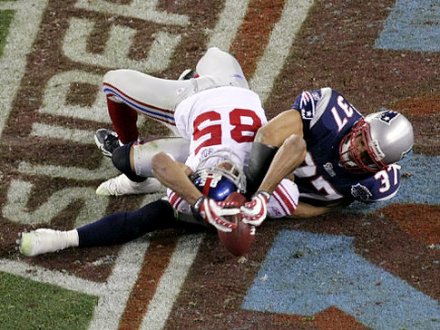
Before disemboweling, he was probably stretched out somewhat like David Tyree.
In fact, it was so dreadful (including many injuries in the distasteful rush for souvenirs) that they stopped doing it. Only gradually: Edward Marcus Despard, for instance, was sentenced to drawing and quartering, but they only hanged him to death and cut off his head posthumously. In 1814, that sentence — hanging plus posthumous beheading — formally replaced the old disemboweling-and-quartering bit as the penalty for treason.
This date in 1692 was the third of four execution dates during the notorious Salem witch trials.
Five souls were dispatched at Gallows Hill this date. With the executioner’s due respect to John Willard, George Burroughs, George Jacobs, Sr. and The Crucible main character John Proctor, we’re elated this date to focus on the only woman among them — Martha Carrier.
Carrier is the subject of the recent historical novel The Heretic’s Daughter by her tenth-generation descendant Kathleen Kent, whom we’re delighted to welcome for an interview on this anniversary.
How did you first learn of your connection to Martha Carrier, and how does your family feel about this link?
I was very fortunate to have heard stories of the colonial Carriers from the time I was a young child. My first memory of hearing about the Salem witch trials was when I was eight years old, visiting my maternal grandmother. She was the first one to tell me that my grandmother back nine generations, Martha Carrier, had been hanged as a witch in 1692. When I asked her if Martha was in fact a witch, my grandmother said, “Sweetheart, there are no such things as witches, just ferocious women.”
She, along with the rest of my family, had a great sense of pride over Martha’s courage in standing up to her accusers. She was one of the few people, out of the 150 New Englanders accused of practicing witchcraft, who not only refused to admit to being guilty, but also never accused anyone else of being a witch, which most people did to save themselves.
Your book tells the story of Martha Carrier from the perspective of her 10-year-old daughter. As an author, how did you approach the research, especially when it comes to Martha as an individual? Is that something you were able to source pretty strongly or did it require a lot of filling in the blanks?
The Heretic’s Daughter was my first novel, and it took five years of research and writing to complete it.
Fortunately, there is a wealth of historical information about the colonies during that time. The courts where the witch trials were conducted kept very meticulous records so I was able to gather a lot of facts regarding the magistrates and deponents, as well as the accused. There are so many wonderful fiction and non-fiction books alike that have been written about the Salem witch trials, but I wanted to write a very personal story about the Carrier family; how they lived day to day, how they survived disease, Indian raids, hostility from their neighbors, and ultimately the witch trials. I was able to weave in a lot of my family’s stories — the cow that gave golden milk, Andrew’s near death experience in the prison — that have been passed down through 10 generations.
When I first began working on the book, it was written from Martha’s point of view, but I decided it would make more compelling reading if the narrator was one of the Carrier children, Sarah, and it is through her eyes that we see the growing hysteria over witchcraft, and her struggle with Martha’s strong, unyielding character. This theme of mother-daughter conflict is central to the book’s development.
So, who was Martha Carrier and why did she become one of the people caught up in the Salem witch trials?
Martha Carrier had evidently long been resented by the community in Andover, where the Carrier family lived during the Salem witch trials, because of her forceful nature. She argued over boundary lines with several neighbors (which was a common occurrence amongst the settlers), telling one neighbor, “I will stick as close to you as bark on a tree.” (source: Salem witch trial deposition; see this document) She was also married to a man who had fought in the English Civil War, and was widely rumored to be one of the executioners of King Charles I of England. Martha fell outside of the Puritan ideal of what a woman was supposed to be and was so vocal in her own defense during the trials that when she was asked by her judges if she had ever seen the Devil, she responded by telling them that the only devils she had ever seen were the men sitting in judgment before her.
Her own children accused her of witchcraft. Are you descended through those kids as well? And do we know anything about how they later dealt with or rationalized that act?
My family is descended from Tom, Jr., and I learned the full genealogy at an early age from my grandparents. Four of Martha’s five children were arrested to compel her to admit to being guilty. Her two oldest sons were arrested first, and they were tortured until they agreed to testify against their mother. Tom and Sarah were then arrested — the real Sarah being only 7 years old at the time, and the second youngest child to be imprisoned during the trials — and they quickly admitted that they, too, were complicit in witchcraft.
During the research, I discovered how truly awful the conditions were in the Salem jail. Nearly half of the 150 people arrested from towns all over New England were under the age of 18. The surprising thing was not that people died, but that anyone survived at all. The four children were kept imprisoned for months after their mother was hanged and they were finally released in the fall of 1692. Within a few years, their father, Thomas, collected his children and grandchildren and moved to the wilds of Connecticut to start a new life.
How did she try to defend herself?
Martha Carrier was so vocal in her own defense during the trials that Cotton Mather, one of the most famous theologians of his day, named her the “Queen of Hell.”
This Rampant Hag, Martha Carrier, was the Person, of whom the Confessions of the Witches, and of her own Children among the rest, agreed, That the Devil had promised her, she should be Queen of Hell.
When she was confronted by the accusing girls, she turned to her judges and said, “It is a shameful thing that you should listen to these folks who are out of their wits.”
By the time of her arrest, several women had already been sentenced to be hanged, and she knew that her refusal to confess would mean death. She never wavered in her testimony and never accused another person to save herself, even when her four children were arrested and two of her sons were tortured.
Do you feel like she’s an overlooked figure in this affair? She’s not, for instance, even a character in The Crucible.
Arthur Miller did extensive research for The Crucible, but he did make changes to the historical facts for fictional purposes: for example John Proctor was in his seventies during the trials; hardly the strapping figure played by Daniel Day Lewis in the film adaptation.
There were so many remarkable people and events during the trials that he had to choose selectively in order to illustrate his primary motivation in writing the play which was to shed light on the McCarthy era communist “witch” trials.
Nathaniel Hawthorne wrote about Martha Carrier, as did Cotton Mather, but her forceful character made her a difficult subject, especially when there were more motherly figures like Rebecca Nurse, or titillating young characters like Abigail Williams to explore.
At this distance of time, Martha Carrier must have a great many descendants. Are you in touch with other branches of the family?
Soon after publishing The Heretic’s Daughter, I started getting emails and letters from fellow descendents of Thomas and Martha Carrier telling me that they, too, had heard many of the stories that I had grown up with.
For the release of my second novel, The Wolves of Andover, about Thomas Carrier’s life, I decided it would be fun to invite some of these extended family members to Salem for a book launch. On November 5th, 2010, nearly 250 Carrier descendents, some of them flying in from as far away as Washington State, California and Arizona, came to Salem for a weekend of author talks, receptions and story swapping. A video on my web site captured some of the highlights from that remarkable weekend.
We came as strangers and left Salem as family.
Ultimately, what’s changed about you yourself from your literary encounter with this famous ancestor?
The Salem witch trials were a dark period in American history, but from researching those events I discovered that positive changes occurred over time in the judicial system, the penal system, and for religious tolerance. I am awe-struck by the courage and fortitude of the settlers who sacrificed so much for their children and grandchildren.
And I am especially proud of my heritage: that my 9x great-grandmother defended her principles and conscience, even in the face of death. An interviewer once asked if, having written the novel, I felt I was speaking for Martha Carrier, and I said that I felt she had been speaking for me. A ferocious woman indeed!
With your second book, The Wolves of Andover, you’ve written two about the Carrier family. What’s your next project?
Wolves is a prequel to Heretic, as it explores the life of Thomas Carrier during the English Civil War and his journey to the new world from London.
I am about halfway through my third novel, but this one is quite different from the first two. It takes place during reconstruction era Texas in 1870, and chronicles a particularly chaotic, violent time in Texas history.
There’s another fine interview with Kathleen Kent here. -ed.
On this date in 1510, the new king Henry VIII had his dad’s most hated tax collectors beheaded on Tower Hill.
Better days: Empson (on the left) and Dudley (on the right) pal around with Henry VII.
When Henry Tudor conquered Bosworth Field to emerge from the War of the Roses as King Henry VII, he brought the baggage of being the son of some Welsh squire.
His shaky legitimacy exposed the newborn Tudor dynasty to existential threats from every quarter; even putative allies proved liable to turn against him.
Henry consequently looked for every opportunity to centralize power away from institutions that could check or threaten him and into his own hands — nowhere more notoriously so than in the realm of taxation.* Aggressive tax collection would not only regenerate the crown’s blasted treasury; it would widen his own scope of action.
Whether Henry’s historical repute for cupidity is well-deserved is a topic beyond the scope of this site, but the fact that he does have such a reputation can be attributed in no small degree to this date’s featured players.
These two persons, being lawyers in science, and privy councillors in authority, as the corruption of the best things is the worst, turned law and justice into wormwood and rapine. … Neither did they, toward the end, observe so much as the half-face of justice, in proceeding by indictment; but sent forth their precepts to attach men and convent them before themselves, and some others, at their private houses, in a court of commission; and there used to shuffle up a summary proceeding by examination, without trial of jury; assuming to themselves there to deal both in pleas of the crown and in controversies civil. Then did they also use to inthral and charge the subjects’ lands with tenure in capite, by finding false offices, and thereby to work upon them for wardships, liveries, premier seisin, and alienations … When men were outlawed in personal actions, they would not permit them to purchase their charters of pardon, except they paid great and intolerable sums; standing upon the strict point of law, which upon outlawries giveth forfeiture of goods; nay, contrary to all law and colour, they maintained the king ought to have the half of men’s lands and rents, during the space of full two years, for a pain in case of outlawry. They would also raffle with jurors, and enforce them to find as they would direct, and if they did not, convent [summon] them, imprison them, and fine them. These and many other courses, fitter to be buried than repeated, they had of preyig upon the people; both like tame hawks for their master, and like wild hawks for themselves; insomuch as they grew to great riches and substance.
–Francis Bacon‘s History of the Reign of King Henry the Seventh
Richard Empson and Edmund Dudley were two powerful parliamentarians of less than lordly stature who had been elevated to this bad-cop role for their loyalty and aptitude. There, they became lightning rods for public resentment. It’s a path that had once taken a French counterpart from the common stock to the robes of state to (once his patron monarch died) the scaffold. Empson and Dudley trod it exactly.
Even in Henry’s lifetime, his newly intrusive taxes risked fearful public reaction.
The pretender Perkin Warbeck knocked Henry for the “robberies, extortions, the daily pilling of the people by dismes [tithes], taskes [contributions], tallages [tolls], benevolences, and other unlawful impositions and grievous exactions” he imposed, “agreeable to the meanness of his birth.” Tax backlash helped generate at least some of Warbeck’s popular support.
By the twilight of Henry’s rule in the first decade of the 1500’s, he had mastered these threats and could take advantage of political tranquility to really focus on his accounting. And he’d figured out that by ratcheting up enforcement of already-existing levies, he could avoid the dangerous confrontations that might result from summoning Parliament to ask it for money. It’s from this period most of all that he gets his historical Ebenezer Scrooge image, and the tool he employed for it, the Council Learned in the Law, got its extreme unpopularity.
Henry died in April of 1509 at the age of 52, leaving his son Henry VIII an overflowing treasury and countless grievances against the tax collectors who made it happen.
As the Council Learned’s leading lights, Empson and Dudley — “the king’s long arms with which … he took what was his” — immediately became targets once their royal protector was in the ground. They were hailed before the greenhorn king and the Privy Council to justify themselves within days of Henry VII’s death.
Interestingly, because a royal pardon amnestied all crimes except “felony, murder, and treason,” the malfeasance of these two councilors — whose real offense was unimpeachable loyalty to the last sovereign — had to be exaggerated into rather fantastical charges of treason in order to satisfy petitioners against them while avoiding undue embarrassment for the late king or the other aides who had served him.
In the year or so he lay in the dungeon awaiting his fate, “a pson most ignorant, and being in wordlie vexacon and trowble, also wth the sorrowfull and bitter remembrance of death,” Edmund Dudley wrote a treatise on the right arrangement of a society dedicated to the young new master who held Dudley’s life in his hands. The Tree of Commonwealth can be read here.
Yale professor Keith Wrightson introduces an interesting lecture — “Early Modern England: Politics, Religion, and Society under the Tudors and Stuarts” — with Dudley’s Tree of Commonwealth social schema.
Remember both, since now each thrive,
on perquisite ill gotten,
Empson & Dudleys case survives,
when they’re hang’d, dead, & rotten;
-From an 18th century colonial Virginia ballad titled “Remonstrance”, comparing this date’s centuries-old executed to a contemporary politician (Richard Beale Davis, “The Colonial Virginia Satirist: Mid-Eighteenth-Century Commentaries on Politics, Religion, and Society,” Transactions of the American Philosophical Society, Vol. 57, No. 1 (1967))
Update: The History of England podcast covers these two blokes here.
* The phrase “Morton’s fork” comes from Henry’s extractive machinations. Named for his Lord Chancellor John Morton, the original dilemma was a “fork” the crown used to stick taxpayers: those living high on the hog were made to pay up, since they obviously had enough to spare … and those living modestly were also made to pay, since they perforce must have saved enough to spare.