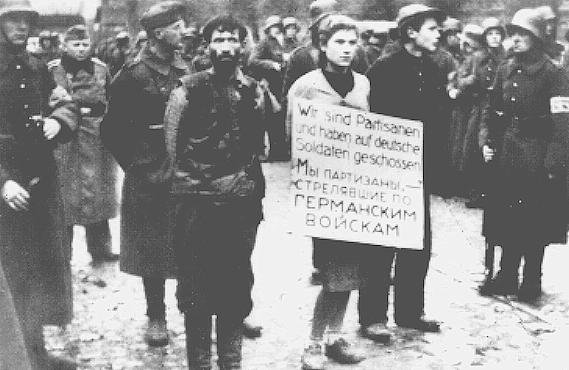
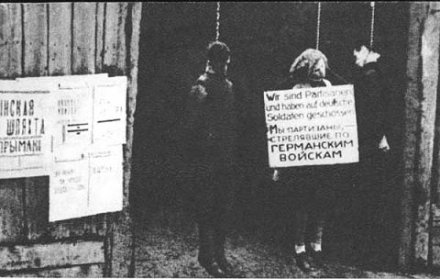
1941: Masha Bruskina, Kiril Trus, and Volodia Shcherbatsevich, partisans

On this date in 1941, the German occupiers of Minsk conducted an infamous public hanging of partisans — perhaps the first such salutary public execution of resistance members of the war.

Jewish* 17-year-old Maria (Masha) Bruskina was the central figure of the grim tableau, and wore the placard announcing “We are partisans and have shot at German soldiers.” Evidently, she also attracted the most attention** from the onlookers to whom the scene was addressed.

Before noon, I saw the armed German and Lithuanian soldiers appear on the street. From over the bridge they escorted three people with their arms tied behind their backs. In the middle there was a girl with a sign-board on her chest. They were led up to the yeast factory gate. I noticed how calmly these people walked. The girl did not look around … The first one led to the gallows was the girl.

She was hanged with bewhiskered World War I vet Kiril Trus and the 16-year-old Volodia Shcherbatsevich. The men were members of a partisan cell organizing anti-fascist resistance; Masha Bruskina was a nurse who had been caught aiding the partisans by providing civilian clothes and papers for wounded Red Army soldiers under her care to smuggle them back to the resistance.

The scene of their deaths was captured in a series of powerful photographs taken by one of the Lithuanian Wehrmacht collaborators.

(More images here and here.)

* Phototextualities: Intersections of Photography and Narrative claims that Bruskina lightened her hair and changed her name to prevent her Jewishness affecting her resistance work; even though she was a Minsk native, her initial identification didn’t happen until 1968. The men who suffered with her were named almost immediately after the war.

** Despite the eye-catching place of the girl, she was officially unidentified for decades even after the name Masha Bruskina surfaced. In “A Historical Injustice: The Case of Masha Bruskina,” (Holocaust Genocide Studies 1997, 11:3) Nechama Tec and Daniel Weiss argued that Soviet authorities, and later Belarusian ones, found her Jewishness problematic and resisted identifying her because of it — while an ethnically Russian female partisan like Zoya Kosmodemyanskaya could be more conveniently accepted as a heroine. Maybe, but bureaucratic inertia and simple precedence (since Zoya Kosmodemyanskaya was known immediately while Masha Bruskina was not) are also plausible contributing factors.

A plaque unveiled at the Minsk yeast factory in 2009 finally called her Maria Bruskina.

On this day..

1415: Bardolph, Hal’s friend

On this date in 1415, on the eve of the Battle of Agincourt, the young English King Henry V approved the execution of his onetime boon companion Bardolph in William Shakespeare’s Henry V.

The fictional Bardolph had been the ruddy-nosed friend of Henry’s in the Henry IV plays (Part 1, Part 2), where the hard-drinking, rabble-rousing young prince is a disappointment to the father who fears his heir will never merit the throne.

By Henry V, the boy has become the ruler, and launched an audacious incursion into France during the Hundred Years’ War.

Hal’s willingness to own the rough decisions of statecraft — in this case having his friend put to death further to his win-French-hearts-and-minds policy — is part of his coming of age as Henry V.

Whether that means Hal’s maturation into regal dignity or the corruption of his humanity by power is up to the reader.

KING

How now Fluellen, cam’st thou from the Bridge?

FLUELLEN

I, so please your Maiestie: The Duke of Exeter
ha’s very gallantly maintain’d the Pridge; the French is
gone off, looke you, and there is gallant and most praue
passages: marry, th’ athuersarie was haue possession of
the Pridge, but he is enforced to retyre, and the Duke of
Exeter is Master of the Pridge: I can tell your Maiestie,
the Duke is a praue man

KING

What men haue you lost, Fluellen?

FLUELLEN

The perdition of th’ athuersarie hath beene very
great, reasonnable great: marry for my part, I thinke the
Duke hath lost neuer a man, but one that is like to be executed
for robbing a Church, one Bardolph, if your Maiestie
know the man: his face is all bubukles and whelkes,
and knobs, and flames a fire, and his lippes blowes at his
nose, and it is like a coale of fire, sometimes plew, and
sometimes red, but his nose is executed, and his fire’s
out

KING

Wee would haue all such offendors so cut off:
and we giue expresse charge, that in our Marches through
the Countrey, there be nothing compell’d from the Villages;
nothing taken, but pay’d for: none of the French
vpbrayded or abused in disdainefull Language; for when
Leuitie and Crueltie play for a Kingdome, the gentler
Gamester is the soonest winner.

This is Laurence Olivier’s 1944 version of the scene, with the commoner Bardolph well off-camera:

… and Kenneth Branagh’s more pathos-laden 1989 interpretation, with the king wavering a moment as he locks eyes with his doomed subject, and flashing back to bygone scenes of conviviality before delivering his troop the stern lesson of his friend’s strangling:

Although Bardolph himself and his prior relationship with his sovereign are fiction, the action of the scene actually proceeds from reality. Shakespeare has (as is his wont) cribbed Holinshed, who relates that Henry’s army was under strict orders not to pillage the countryside, and observed that discipline to a man —

except one, which was, that a souldiour tooke a pix out of a church, for which he was apprehended, and the king not once remooved [i.e., he halted] till the box was restored, and the offendor strangled. The people of the countries thereabout, hearing of such zeale in him, to the maintenance of justice, ministered to his armie victuals, and other necessaries, although by open proclamation so to doo they were prohibited.*

* As quoted in the very apt 1992 “Shakespeare’s Henry the Fifth and the Law of War” by Theodor Meron, American Journal of International Law, vol. 86, no. 1.

Part of the Daily Double: Agincourt.

On this day..

1789: The murderers of the baker Francois

On this date in 1789, two working stiffs literally became stiffs for a noteworthy bread riot during the French Revolution’s early days.

Ah, 1789.

It was the best of times, it was the worst of times … it was the season of Light, it was the season of Darkness; it was the spring of hope, it was the winter of despair. And we know how all that ends.

Just three months after the Bastille was stormed, France was merely pregnant with its coming Terrors. The Revolution was in its “moderate stage”.

Some moderation.


“Events of the 22nd of October, 1789: The hanging of a man named Francois, a baker”. Despite the title, sources (like this French-language study in the Annales historiques de la Revolution francaise, overwhelmingly date the baker’s murder to the 21st.

The tumbrils may not have been running (actually, the Revolution’s iconic execution device had not yet even been created), but the “October Days” had enough to scare you, especially if you were a sensible constitutionalist type like the Marquis de Lafayette.*

Like a mob dragging the King back to Paris from Versailles, with the heads of his royal guards on pikestaffs.

A drought had created a calamitous bread shortage, which in turn helped stir the Revolutionary pot. The mob that invaded Louis XVI‘s palace a couple of weeks before had celebrated his return to Paris singing “We Have the Baker, the Baker’s Wife, and the Baker’s Son. We Shall Have Bread.” When the king’s presence failed to ease the shortage, fresh disturbances followed.

On October 21, 1789,** the baker Denis Francois became the unfortunate focus of one such, when a famished woman spuriously denounced him a monopolist. A frenzied crowd lynched the hapless boulanger before he could get a word in edgewise.

This event occasioned the Constituent Assembly to pass a martial law decree, permitting a municipality to signal martial law by raising a red flag, whereupon anyone failing to disperse made him- or herself liable to summary military execution.

According to Lafayette (cited in Revolutionary Justice in Paris: 1789-1790):

During the disturbance stirred up against the baker Francois, another one broke out in the Faubourg Saint-Antoine, the object of which was to unite with the Faubourg Saint-Marcel for purposes of reducing the price of bread, and for getting into the convents under the pretext of taking the muskets stored there. The National Guard, in breaking up these seditions, arrested the assassin of the baker [a dock porter named Blin] and the principal instigator of the faubourg [i.e., the Faubourg Saint-Antoine, namely a laborer named Michel Adrien†]. Both were judged and hanged the next day.

* We meet Lafayette here as captain of the National Guard; in a few years, the progress of the Revolution that he struggled to contain and direct will make him persona non grata in his country.

** Six Thousand Years of Bread: Its Holy and Unholy History gives the date as Oct. 20, though it’s not clear upon what authority. Archibald Alison placed it on the 19th. Whenever the murder of Francois occurred, the martial law decree’s passage on the 21st appears to be firmly dependable, which would mean the supposed malefactors’ deaths on this date should be as well.

† Revolutionary propagandist Camille Desmoulins later seized on the very skimpily justified Adrien execution — he “was judged and hanged in twenty-four hours for circulating a seditious flyer, although he didn’t know how to read” — to contrast with the outsized tenderheartedness shown for aristocrats who have “different weights on the scales of justice.” (Revolutionary Justice in Paris: 1789-1790)

On this day..

1928: William Edward Hickman, Randian superhero?

On this date in 1928, William Edward Hickman was hanged at California’s San Quentin prison for what the Los Angeles Times was still calling a decade later* “the most horrible crime of the 1920’s.”

Eighteen- or nineteen-year-old Hickman kidnapped the 12-year-old daughter of a Los Angeles banker, extracted a $1,500 ransom from said banker for her return, then delivered up the girl’s horribly mutilated corpse.

A nationwide manhunt immediately ensued, with Hickman soon captured in Oregon.

Pretty white girls abducted have been media catnip for many a livelong year. In this case, the dastardly deed induced the Los Angeles Times to editorially demand (Dec. 21, 1927) an automatic death penalty for murder in a manifesto that reads like it was written yesterday for whatever the outrageous crime du jour might be.

LET MURDERERS HANG

The sickly sentimentality which wars upon capital punishment for murder and insists upon the coddling of convicts will have a hard time to justify itself in the case of the slayer of Marian Parker, who, if police theories are correct, is William Edward Hickman, a criminal on probation. Had Hickman been serving the prison term which he deserved for his forgeries, he could not have committed the series of crimes which culminated in one of the most atrocious murders of which there is any record. He was free through the lenity of the California law to take his revenge in the most horrible fashion, against a man who had done him no injury that could be considered such by anyone with a spark of moral sense.

Not for vengeance, but for its own protection, both through example and through the eradication of a rotten and depraved individual, society should put the Parker case slayer out of life as quickly as the formalities of law permit. His continued existence is a reproach to all humanity.

A clash of conflicting theories of the best methods of dealing with criminals has brought society to a condition of hesitation. This condition is highly favorable to criminal operations of all sorts, while justice and the law seem to stand by, bewildered and helpless. The logical way to meet this situation is to take practical steps which society knows will protect it, and let penologists and psychiatrists conduct their debate over the ideal system, entirely to one side.

There can be no question that men in jail, while in jail, are no particular menace to society, and that men who have been hanged do not commit further murders. Upon these two solid facts let society base its actions, unless and until something better has been devised and proved. The semi-punishment, semi-reformatory scheme at present in force is obviously a failure.

Its greatest error is that it considers the interest of the criminal rather than those of his victim, or rather the interest of the class to which his victim belongs. This class is made up of the honest, the law-abiding, the God-fearing, the hard-working, the solid and substantial; in other words, of all individuals who are resolved to live in peace and harmony with their neighbors,. respecting others’ rights as courtesouly as they expect their own to be respected. Against this class, the great majority, another class, a minority, is waging war. It consists of the vicious, the depraved, the degenerate; nonproducers and parasites. At best this class is a drag upon progress, at worst it is a menace to civilization. Yet the law as it stands at present regards the rights of the individuals of the class as paramount. The machinery of the courts is strained at every point to aid them.

It is not necessary to inquire why a rattlesnake strikes, or if it is likely to strike again. His motives may be interesting, but they are not important. It is sufficient to recognize the danger and to deal with it appropriately.

It does not matter whether anti-social individuals are all insane, as some criminologists assert, whether they are economic misfits, as other theorists declare, or whether they are in the main ordinary persons gone wrong, as still another school insists. There has been too much consideration for them and not enough for those they prey upon and injure. It is time the emphasis was shifted.

It is time to face the facts, before the criminal class succeeds entirely in getting the upper hand. It is time to place every proved criminal where he can do no more harm. It is time for society to take the certainty of protection; it is time to stop giving the criminal “another chance.”

It is time to hang every murderer.

Lack of firmness in dealing with the criminal problem is due largely to the sob-sister and the sentimentalist. At the other extreme stands the mob spirit and lynch law, equally destructive of the foundations of society. Criminals should be judged without passion, bias or prejudice, and this is possible only in a court of law. No matter how heinous the crime, it is a matter for the courts to deal with. Good citizens will insist that proper punishment be dealt out in accordance with the provisions of law and order. For men to take the law into their own hands is to place themselves on a plane with the criminals, and to give away the immense moral advantage of being right.

Sensational crime + ill-considered policy response = a California tradition. (There wasn’t actually a change of the law in 1927-28, though.)

Perhaps recoiling from the self-righteous public baying after Hickman’s blood, a young Ayn Rand took such a shine to Hickman as to base upon him a murderous protagonist in a 1928 work, The Little Street. The budding apostle of selfishness decried in her journals

[a]verage, everyday, rather stupid looking citizens. Shabbily dressed, dried, worn looking little men. Fat, overdressed, very average, ‘dignified’ housewives … How can they decide the fate of that boy? Or anyone’s fate?

Though The Little Street never saw print, the hero disdainful of the petty bonds of moral hypocrisy is the go-to trope of Rand’s later novels. If you can bear them, you’ll find Rand speaking of “nonproducers and parasites” who are “a drag upon progress … a menace to civilization” in much the way the Times speaks of Hickman.

Rand wrote that “other people do not exist for [Hickman], and he does not see why they should … He has the true, innate psychology of a Superman. He can never realize and feel ‘other people.'” It’s a pretty near definition of sociopathy likewise imputed to the hero of her later novel The Fountainhead: “He was born without the ability to consider others.”

“She had a crush on him [Hickman],” says Lisa Duggan, author of a study of Rand’s thought, in this podcast.

Indeed, Hickman was a very strange choice for Rand’s affection, quite apart from the obvious: other than the derring-do to bluff school administrators into letting him take away a child on his own say-so, he didn’t really exhibit the magnificent contempt for his many lessers one would expect from a Howard Roark.


From the Los Angeles Times, Dec. 25, 1927.

Hickman broke down and confessed, not in pride but in panic, and signed a simpering “warning” to young men of the classic gallows-speech variety on Christmas Eve 1927:

Crime in its simplest definition is to have without work and enjoy the same place in society as other people and still show no honest effort or intention to go right.

Young men, when crime has once overcome your will power to be honest and straight you are a menace to society. …

Think it over, see my mistake. Be honest and upright. Respect the law. If you do these things you’ll be happier in the end. (Source: Los Angeles Times, Dec. 24, 1927)

Over the ten ensuing months, the teen had the opportunity to recover his wits and play a more manful part, but that didn’t happen either. A week before execution, when any hope of reprieve was gone and there was little percentage left in playing the supplicant, Hickman sent the Associated Press this bit of self-flagellation.

I know very well that I have been a most guilty sinner … I am sorry for having offended God and man … Please ask the people in the name of God to pray for us condemned men here at San Quentin prison.

(To top it off, he wilted climbing the scaffold and had to be helped up the last few steps.)

The miscreant unequal to the weight of his crime-slash-sin, thirsting for the redemptive chalice of heaven … as a criminals go, that’s more Dostoyevsky than Rand.

* Mar. 27, 1938. The context was a roundup of the gallows highlights of San Quentin’s history on the occasion of its switch from hanging to lethal gas.

On this day..

1672: Thomas Rood, the only incest execution in America

On this date in 1672, Thomas Rood (or Rhood, or Roode, or even Rude) achieved in Norwich, Conn., the distinction of being the only person executed in the future United States of America for incest.

The native of Glastonbury, England got in a bad way for, in the words of the indictment,

not haveing the feare of God before thine eyes thou hast committed that abominable sin of incest haveing carnall copulation with Sarah Rhood thy reputed daughter for which according to the law of God & the law of this colony thou deservest to dye …

Actually, the laws of the colony said nothing about incest, requiring the Hartford Court of Assistants to ask around the local clergy whether this sort of thing should be a hanging offense.

Hey, what do you think they’re going to say? Antonin Scalia would call this originalism.

Thomas Rhood thou art to goe from here to the place from whence thou camest & in due time to be carryed from thence to the place of execution & there to be hanged by the neck till thou art dead & then cut down & buried.

Of course, it takes two to make the beast with two backs; daughter/lover Sarah was in some fear for her neck as well, until the court took

notice of a great appearance of force layd up upon her spirit by her father overaweing & Tiranical abuse of his parentall authority besides his bodily striveings which not onely at first brought her into the snare but allso in after yeilding to his Temptation.

Having seemingly found her to be a rape victim, the court extended leniency.

[T]he sentence of the court is that shee be severly whipt on the naked body once at Hartford & once at Norwich that others may heare & fear & do no more such abominable wickednesse.

17th century texts from this pdf on a site selling an 820-page genealogy of the Rood lineage in America … to which the randy old man contributed to the tune of at least nine children.

On this day..

1946: The Nuremberg Trial War Criminals

Victor’s justice was never better served than this date in 1946, when the brass of Third Reich hung for crimes against humanity during the late World War II.

[audio:http://www.stelzriede.com/ms/mus/nuremexe.mp3]

(From this page of original period audio files.)

The landmark legal proceeding* is covered well enough in many other sources for this humble venue to break new ground.

Apart from trailblazing international law, the trial was notable for the gut-punching film of German atrocities; this relatively novel piece of evidence is available for perusal thanks to the magic of the Internet. Caution: Strong stuff. An hour’s worth of Nazi atrocities.The climactic hangings in the predawn hours this day in Nuremberg were conducted by an American hangman who used the American standard drop rather than the British table calibrated for efficacious neck-snapping. As a result, at least some hangings were botched strangulation jobs, a circumstance which has occasionally attracted charges of intentional barbarism.

Media eyewitness Kingsbury Smith’s taut report of the night’s executions (well worth the full read) described just such an ugly end for propagandist Julius Streicher.

At that instant the trap opened with a loud bang. He went down kicking. When the rope snapped taut with the body swinging wildly, groans could be heard from within the concealed interior of the scaffold. Finally, the hangman, who had descended from the gallows platform, lifted the black canvas curtain and went inside. Something happened that put a stop to the groans and brought the rope to a standstill. After it was over I was not in the mood to ask what he did, but I assume that he grabbed the swinging body of and pulled down on it. We were all of the opinion that Streicher had strangled.

There were in all 12 condemned to death at Nuremberg; all hanged this day except Martin Bormann (condemned in absentia; it was only years later that his death during the Nazi regime’s 1945 Gotterdammerung was established) and Hermann Goering (who cheated the executioner with a cyanide capsule two hours before hanging). The ten to die this day were:

* Its resultant Nuremberg Principles comprise a lofty articulation of principles whose actual application, as Noam Chomsky has observed, would have meant that “every post-war American president would have been hanged.”

On this day..

1888: Pauline McCoy

The Daily Picayune, October 13, 1888 (page 3).

ALABAMA.

MONTGOMERY.

Execution of Pauline McCoy, the First Woman Hanged in Alabama Since the War — She Murdered a Little Girl for Her Clothes.

MONTGOMERY, Oct. 12 — [Special.] — Pauline McCoy, colored, who was hanged at Union Springs at 1 o’clock for the murder of Annie Jordan, white, last February, was the third woman hanged in Alabama since its incorporation as a state and the first since the war.

On the scaffold the woman broke down completely and had to be supported on the trap by two deputy sheriffs. She had not eaten anything for a day or two and was kept up by the use of stimulants. She admitted having killed the girl in her last speech, but denied that her motive was robbery.

The crime for which the woman was hanged had not its equal in the whole criminal history of Alabama. Her victim had strayed away from her home in this city, being demented, and meeting Pauline down the railroad asked her to accompany her.

That was the last seen of Annie, the 14-year-old child, until her dead body was discovered in a plum thicket near the roadside several days after. Pauline was seen in Union Springs a few days later wearing the shoes, hat and jacket belonging to her victim. She was arrested and said under oath that her father, Jake McCoy, killed the girl and brought the clothes home. At the preliminary trial Jake was discharged and Pauline committed. On her third trial in August she was found guilty and sentenced to be hung, which sentence was faithfully carried out to-day.

Indefatigable crime blogger Laura James has some unanswered — unanswerable — questions about the case. The Daily Picayune had supplied a scanty few additional details from Pauline’s supposed jailhouse confession a few weeks before (September 5, 1888):

Pauline McCoy, the young negro woman who was recently convicted in the circuit court of Bullock county of the murder of Miss Annie Jordan, a demented young white woman who wandered from her home in Montgomery county last spring, has made a full confession of the crime to the jail physician at Union Springs. The murder was committed near [indistinguishable]. Pauline says she and Annie Jordan had a quarrel, and that she choked the young woman to death and concealed the dead body in the bushes. The murderess is sentenced to death on the scaffold on the 18th [sic?] of October.

According to the Espy file (pdf) of American historical executions, Alabama had last executed a woman in 1864 — she was a slave — and would not do so again until Silena Gilmore rode the lightning for murder on January 24, 1930. Over 250 men were put to death during the 41-year span between the two milestone murderesses.

(Only three additional women have been executed in the Yellowhammer State since Gilmore.)

On this day..

1870: Margaret Waters, baby farmer

On this date in 1870, Margaret Waters became the first woman in England to hang for baby-farming.

Waters was condemned for murdering an infant she had taken in as a contractual temporary adoption; there is the matter in the dry language of the law.

But Waters’ import — and in fact, since press outrage that her ward’s death had initially been ruled only manslaughter by the coroner, the extremity of her legal straits as well — derived from her milestone symbolism in a burgeoning Victorian-era moral panic.


Margaret Waters’ case dominates the cover of the Oct. 15, 1870 Illustrated Police News, with a central illustration of Margaret Waters hanged … surrounded, appropriately, by men.

“Baby farming” hit the papers in the 1860’s with sensational exposes of a gray market business whose model was:

  1. Relieve unwilling mother of her newborn infant for a fee
  2. ???
  3. Profit!

It’s the “???” that’s up for grabs.

To the newspapermen, and the day’s elite crusaders for reform, and especially to the nascent medical industry whose British Medical Journal was instrumental in fomenting public alarm,* it signified nothing short of infanticide, a sort of post-partum abortion.

Thus, the Times of London’s sermonizing post-hanging editorial (Oct. 12, 1870):

A most just sentence has thus been executed, and the law has conspicuously fulfilled its appointed office of being a terror to evil-doers. A more terrible case, with respect both to the heinousness of the offence and to the unexpected vengeance which has overtaken it, has never occurred … The wretched woman and her sister were proved to have systematically published advertisements offering to “adopt” children for a remuneration which no one in his senses could believe to be adequate. In other words, they offered to the parents of illegitimate children a means of getting rid of charges at once burdensome and shameful to them … For the sake of a paltry and precarious gain MARGARET WATERS and her sister had the heart to make away with the helpless little creatures … nothing can palliate the hideous spectacle thus brought to light. A murder in hot blood, the deliberate gratification of revenge, or even a premeditated act of violence in the pursuit of some selfish object, fall short in some respects to the heinousness of this offence. The deepest instincts of a woman’s heart must have been deadened, and the most ordinary feelings of human nature extinguished, before such slow murder could be perpetrated upon piteous little innocents.

… MARGARET WATERS confesses to receiving children for purposes of profit, whom she, at least, knew she could not support. She confesses to receiving them for 5 l. or 10 l., and finding other people who would receive them for a fortnight’s expenses paid in advance, and would then let her hear no more of them. She confesses to taking them into the streets, placing them in the hands of children, and then running away and leaving them to their fate. She confessed to all this, and yet she professed to see in it nothing but “falsehood and deceit.” It was not murder, and nothing seems to have astonished her so much as the sudden vengeance which overtook her … while admitting the most damning facts, she extenuates their criminality. It is well that the stern sentence of the law has pronounced a terrible condemnation of these heartless excuses. “Baby Farming” as practiced by MARGARET WATERS was ruthless and systematic murder, and her doom will indelibly stamp this brand upon her infamous trade.

We wish it could be thought this unhappy woman was a solitary instance of such wilful blindness. It is to be feared she has expiated the sins of others who have actually perpetrated similar crimes, and it is certain there are many who are direct accomplices in her guilt. When she says that “the parents of illegitimate children who seek to get rid of them are more culpable than persons like herself, and that if there were no such parents there would be no ‘Baby Farmers,'” she does but exaggerate a just charge. When MARGARET WATERS abandoned children in the streets to the casual care of passers-by, she did but repeat what had been done by those who had first abandoned them to her in the dark of the night at obscure railway stations. It cannot be too strongly asserted that this execution reflects more or less the brand of murder upon all who contributed to the offence — upon the parents who only sought to get rid of their children, and upon those who allowed their journals to be the instruments of what they might have known to be an infamous traffic. It must be acknowledged that the justice of the law is but brought justice, and spares many who deserve punishment. That is inevitable. But one of the great uses of the law is to depict in true colours the real meaning of common offences. Selfish and licentious men and women will know for the future what is the natural issue of the offences against morality and society which they lightly commit. It is murder, and nothing less, that is the ultimate meaning of these social evils, and this is the contamination incurred by those who facilitate such offences.

Sounds pretty bad.

But then … all those other “selfish and licentious men and women”: had Waters somehow been the bad apple to spoil an entire bushel? (Reformers of the time write often of illicit behavior as a contagion whose example inspires a wider moral deadening.) Or was there something else going on?

Even the Times agrees that our culprit “never entertained the intention of becoming a ‘Baby Farmer’ and a Murderess. She drifted into it under the pressure of want and temptation. … It is, according to her statement, only six years since she was a married woman in good circumstances.”

According to Waters’ own account, summarized third-hand in the Times a few days prior to the hanging, (Oct. 7, 1870) her fall from respectable wedlock to public enemy number one began with the 1864 death of her husband, leaving the woman

with 300 l. in her possession. Intending to turn her capital to account, she took a house in Addington-square, Camberwell, and put into it a number of sewing-machines. Her plan was to make collars and other such articles, and sell them to the city houses. She knew little or nothing of the business, however, and, partly owing to that circumstance and partly to the miserable prices which were paid for such goods, she was at the end of the year a loser of 250 l. She then resolved to save herself by letting lodgings, and that step led her imperceptibly into her career of baby farming. … she was steadily going down-hill, and she found herself obliged to leave Addington-square and go to Bournemouth-terrace, Peckham, where she commenced baby farming as a system. She advertised for children, and she had answers from persons in all stations … She drifted along in this course, getting from bad to worse. But she protested that she had no idea of injuring the children, though she did some things she was very sorry for, owing to the difficulties of her position … She took the Clerkenwell News, and there she used to find a whole string of advertisements — three of them were put in for a shilling — from women who wanted children to nurse. She advertised herself for children to adopt, and she generally got 10 l. with one. When she got the child and the money she went to one of the other advertisers in the Clerkenwell News and arranged to put the baby out to nurse. Upon paying two weeks in advance she was hardly ever asked even for her address, and when she went away of course she never heard anything more of the child. She gained the difference between the 10 l. given her for adopting the child and the fortnight’s payment for nursing it. This was, after all, a very precarious resource, and she fell into great distress … The time came soon when she was unable to pay the money-lender his instalments, and he threatened to strip her of everything under her bill of sale … When she went to Brixton five children died, some from diarrhoea and wasting, and others from convulsions. She was very poor, and determined to save the price of burial by leaving them about. She wrapped the bodies in brown paper and took them out at night, and left them where they were found by people afterwards. She maintains that she did what she could for these children, and attended to them to the best of her power. There were also four other children whom she got rid of in a way for which she is now very sorry. She took them, one at a time, into the streets, and when she saw little boys and girls at play she called one of them and said, “Oh, I am so tired! Here, hold my baby, and here is sixpence for you to go into the sweetstuff-shop and get something nice.” While the boy or girl went into the shop she made off. The babies, she believes, were generally taken to the workhouse.

The slide into the vast but shadow world of poverty, in short … a timeless story.

While intentional infanticide undoubtedly formed some part of the baby farming picture, its nature and extent is also nothing to presume. In an era of staggering child mortality, dead infants were a norm, sometimes the norm. In the context of desperate penury, it was all the more likely. Middle-class authorities who raided Waters’ “farm” saw (and testified to) a slum purposely structured to kill off children. They may simply have beheld indigence.

Waters herself always rejected any notion that she had intentionally killed any of her charges.

Summing up the doomed woman’s testimonial, the doctor who took it underscored the point with an entirely plausible counter-narrative.

Dr. Edmunds, in concluding the recital of the remarkable and instructive statement Margaret Waters made to him a few hours before, said that when children, even under the best conditions, were taken from the breast and brought up by hand, the chances were all against them. What, then, was the chance of infants taken out in the open air the moment they were born and brought up with only such appliances as Mrs. Waters, at her wits’ end for money, flying from money-lenders and dodging landlords, had at her disposal? From what he could judge she had no intention of murdering any of the children, but they died off, as they might have been expected to die off, from diarrhoea, thrush, and convulsions, and when they died she callously got rid of their bodies as best she could when she became poor.

If Waters’ story holds water, her fees so inadequate to the long-term maintenance of children represent much the same calculated gamble involved in insurance: foul play or no, she had no reason to expect to maintain children long-term.** Cold … but hardly incomprehensible.

(It should also be observed babies to adopt actually were in demand.)

Interestingly, one of the key antecedents of the baby farming scandals in the 1860s and 70s was the codification of prim sexual mores for which the Victorian era is a byword.

Earlier in the 19th century, financial responsibility for illegitimate children had shifted from the (putative) father to the mother, and government Poor Relief to single mothers had been slashed — a bit of abstinence-only social engineering meant to stigmatize single motherhood to the greater good of the softer sex: “We trust that as soon as it has become … burdensome and disgraceful, it will soon become … rare.”

Surprisingly, welfare reform did not stop Victorians having sex. Given a milieu where birth control and abortion are illicit and single motherhood severely stigmatized, the policy implied a swath of single mothers powerfully incentivized to have burdensome and death-prone children taken off their hands … and an industry of entrepreneurs ready to meet the demand.

Waters was the first of eight women in England, Scotland and Wales hanged as baby farmers from 1870 to 1909. Her execution would help lead to the 1872 adoption of the Infant Life Protection Act, which introduced a regimen of license and registration in the heretofore libertarian economy of freelance child-brokering.

Books about Baby Farming and its Context

* In “Wolves in Women’s Clothing: Baby-Farming and the British Medical Journal, 1860-1872” (Journal of Family History, vol. 26, no. 3, July 2001), Ruth Ellen Homrighaus argues that

[b]y using their ‘expertise’ to stake a claim on infanticide and to relegate female reformers to the ranks of amateurs, writers for the BMJ made one of many moves to professionalize medicine … [and] establish a monopoly over health care by improving and standardizing medical education and restricting competition from untrained ‘charlatans.’

Infanticide writ large being a complex social problem, it found in baby farming a specific target amenable to outraged public mobilization, with a “subtext … [that] denied that working-class women were fit to manage childbirth and infant care.”

Margaret Waters had the ill luck to be discovered just as this campaign was in need of a potent emblematic villain. Despite the pestering of the moralistic set, police interest in hounding the persons who attended England’s considerable produce of disposable children rapidly waned in the 1870’s.

** Reviewing the still-lively baby farming scene in early 20th century America, Lawrence Friedman notes that

baby farms made a profit from a “grisly calculus”: most babies, in the days before reliable bottle-feeding, simply died when separated from their mothers. Add to this filthy conditions and poor care, and it is no surprise that most babies in baby farms did not survive. Allegedly, up to 80 percent of all babies admitted to one Baltimore baby farm died within weeks.

Part of the Themed Set: Women Who Kill.

On this day..

1923: Susan Newell, the last woman hanged in Scotland

On this date in 1923, Susan Newell achieved footnote status by hanging for the murder of her 13-year-old paperboy … the last Scottish woman to die on the gallows, and the only one in the 20th century.

Newell was nabbed by nosy neighbors who noticed her dumping John Johnson’s body a few blocks away from prison* where she would ultimately expiate the crime.

Newell pointed the finger at her husband (she never admitted guilt), but John Newell produced a fistful of alibi witnesses to the effect that he was staying with relatives after a couple of nasty domestic fights.

Susan — so the jury believed — had worked off the stress solo by throttling the newsboy when he’d had the temerity to ask her to pay him. Paid content: the hidden killer.

Well, sometimes, you can only take so much.

Despite the guilty verdict, the jury entertained her insanity defense and plumped for mercy when it convicted her. But the crown was having none of it, in part because the murderess wouldn’t admit her crime in her clemency petitions, and perhaps also because “the application of the law in Scotland had to be seen to be in line with that in England where Edith Thompson had been hanged for what most of us would regard as a much less serious crime only 10 months earlier.”

Thompson’s same executioner, John Ellis, unhappily handled the Newell job just 20 days after her conviction. The condemned woman managed to wriggle her hands out of their bonds while her legs were being pinioned, and she ripped the hood off her face with the words “don’t put that thing over me!”

Wanting to get the distasteful procedure over with, Ellis obligingly dropped her barefaced.

* She was also the only woman ever executed at Glasgow’s Duke Street Prison.

Part of the Themed Set: Women Who Kill.

On this day..

2002: Aileen Wuornos, Monster

“Thanks a lot, society, for railroading my ass!”
-Aileen Wuornos

On this date in 2002, the tragically, horrifically iconic serial killer Aileen Wuornos checked out at Florida’s Starke Prison (and into an afterlife as an Academy Award-winning role) with the appropriately bizarre last words,

“I’d just like to say I’m sailing with the rock, and I’ll be back like Independence Day, with Jesus June 6. Like the movie, big mother ship and all, I’ll be back.”

Her sensational FBI-bestowed reputation as America’s “first” female serial killer rests on exaggeration,* but there’s something of the larger-than-life about prostitute/manslayer Aileen Carol Wuornos.

Heck, Aileen herself sold rights to her story within weeks of her arrest. So did investigators who worked the case. A year before our day’s perp faced lethal injection, her surname titled “the world’s first opera about a lesbian prostitute serial killer survivor of child abuse who is now on death row.” (Here’s the opera’s home page.)

That’s not the sort of legacy usual for a seven-time murderer. But there wasn’t much usual about Aileen Wuornos.

Wuornos — “Lee,” to her friends — projects for all her trail of bodies an irrepressibly humanity; Charlize Theron played her in Monster as the most sympathetic serial killer ever put to celluloid, her crime spree a desperate and impossible cry after human love that her life’s many travails had warped but never drained.

Still professing love for the lover who had sold her out and thereby ducked prosecution, Wuornos resigned her appeals and went her own way out this date in 2002.

Books and Films about Aileen Wuornos

* Or, if you like, a precision of definition not likely shared by the majority of her headline-reading public. What made Wuornos distinctive was killing strangers in a pattern over time; the stereotypical female multiple-murderer kills in a single spree, and/or for distinct pecuniary motives, and/or kills family members or other intimates.

Part of the Themed Set: Women Who Kill.

On this day..