1880: Prevost, predatory Parisian policeman

From a Paris Dispatch report via the New York Times. (Additional paragraph breaks have been added for readability.)

It is just 10 years ago, day for day, that the notorious Troppman, the murderer of the Kink family, was executed on the Place de la Roquette. This morning another convict of the same stamp underwent the penalty of death on the same spot.

Prevost, the policeman who murdered the woman Blondin and the jewelry-dealer, Lenoble, and afterward cut their bodies up and threw the pieces into the sewers, was guillotined there at daybreak.


Thwack: Prevost clobbers Lenoble.

It having become known last night that his appeal for mercy had been rejected by the President of the Republic, a large crowd began to assemble as early as 9 o’clock round the place of execution. To prevent a recurrence of the scenes of disorder which took place there when the young criminals Lebiez and Barre, the assassins of the woman Gilles, were put to death, a strong force of infantry and cavalry guarded the square and kept the people at a distance.

The crowd, in spite of the bitter cold and piercing north-east wind, grew more numerous toward midnight, and by the hour of execution all the thoroughfares leading to the spot were crammed with people.

The executioner arrived at 4 o’clock, and, aided by his assistants, erected the guillotine about 20 paces from the central door of the prison. The guillotine once in order, the headsman and his assistants entered the prison to arrange what is called the toilet of the culprit previous to his death.

The Abbe Crozes, the Chaplain of the jail, was the first to enter the prisoner’s cell. Prevost started up, gazed wildly at the reverend gentleman, and then buried his head in his hands, trembling and groaning.

“Alas!” said the Chaplain, “there is no hope now but in the mercy of God.”

Prevost had lured the jewel-trader Lenoble on the pretext of arranging a transaction, then for no reason save crass acquisition of his wares bludgeoned him to death with the iron rod-and-ball device used to link railroad cars.

It was a premeditated and gruesomely executed crime.

Using butchers’ knives he had pre-obtained for the purpose, Prevost spent the next several hours skinning Lenoble, dismembering Lenoble, and ultimately dicing Lenoble up into cutlets so that he could heap Lenoble in a basket and dispose of Lenoble’s bits in less-suspicious fragments in a variety of sewer grates and refuse heaps.

Such as was recovered was heaped together at the morgue, “a mass of quivering flesh, stripped of skin … bones covered with their tendons, sternum, ribs with fragments of the chest, bones of the shoulder blades and arms … the liver, heart and guts, and the fragments of skin torn off one by one from each severed part.”*

After his capture for this shocking crime, he admitted that he’d also been the author of the unsolved murder several years before of his lover, Adele Blondin — likewise for pecuniary gain, and likewise disposed of in pieces after Pevost’s ghoulish close work with corpse and saw.

The condemned man then left his bed, but he was too much overcome to dress himself. That task was done by the executioner and his assistants. He was then left alone with the Abbe Crozes to prepare his soul. He embraced the Chaplain several times and wept bitterly.

“Take courage, take courage,” said the reverend gentleman.

“Yes, yes,” replied Prevost, “I will take courage and try to meet my fate. I ask pardon of the Police administration, to which I belonged seven years.”

“If this … pawnbroker has been murdered by some one of a higher class in society,” Dostoyevsky had mused in Crime and Punishment in 1866, “how are we to explain this demoralisation of the civilised part of our society?”

Prevost’s demoralization afflicted his cognition as well as his conscience, because he had actually made previous chit-chat with fellow-officers to the effect that were he to commit the perfect crime he would surely go and butcher the body for no-fuss disposal.

The condemned man, after kissing the crucifix three or four times, marched out to the guillotine wit a firm step, and in an instant he was on the fatal bascule.

The spring was touched, a dull thud was heard, and the next second his head fell into the basket.

After the execution the body and head of the murderer were taken to the School of Medicine, and, having been sown together, electrical experiments were made on them, and in the opinion of all the doctors present death must have been instantaneous.

* This quote, and the other interspersed crime details, and the nice bashing illustration, are all via this French crime pamphlet.

Part of the Daily Triple: 1880 and Death.

On this day..

1902: Gideon Scheepers, Boer guerrilla

Scheepers lives because they shot him.”

-Hermi Baartman, Graaf-Reinet Museum

On this date in 1902, Kommandant Gideon Jacobus Scheepers was shot by the British for his exploits in the Boer War.

The young Dutch-descended Scheepers (here’s his Afrikaans Wikipedia page) was a soldier from the still-independent Boer states which were being reduced in this war to British dependencies.

In 1901, late in the proceedings, Scheepers took a column of irregulars into the British Eastern Cape Province and wrought havoc behind the lines. Some exploits are the stuff of legend, like the time he rode into a town, released all the Boer prisoners, locked up the British magistrate, and hauled down the Union Jack — to the delight of the Boer locals.

He would spend that year giving the British much better than he got, but the war was also infamously dirty.

According to David Harrison’s The White Tribe of Africa: South Africa in Perspective, “Scheeepers’ men also flogged and shot natives who helped the British, looted as well as burned farms, and executed Boer ‘traitors’.”

Was any of that criminal?

Since Scheepers was over enemy lines, the Boers who joined him could be held liable for treason … but that didn’t hold for Scheepers himself. His execution turned on holding these unsavory acts as war crimes: his 30-count charge sheet included seven arsons, seven murders, and various and sundry abuses of prisoners and blacks. Scheepers was really sore about the last; natives were supposed to be kept out of the fighting, but the prisoner very credibly insisted that the ones he “murdered” were under arms as scouts for the British.

“We Afrikaners will never find justice under the English,” Scheepers wrote as a prisoner. “Everything is for the kaffirs.”

(There’s a vociferous defense of Scheepers from a pro-Boer history here, and a more sober one by a London press correspondent here.)


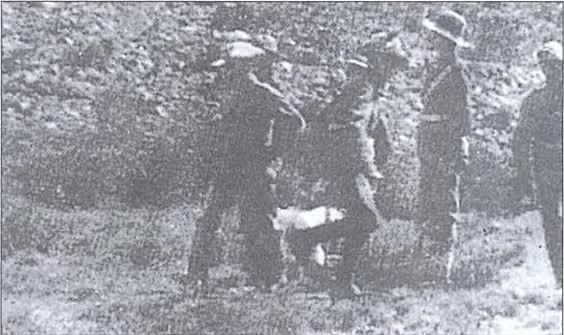
Scheepers is read the death warrant on January 17, 1902 — before Graaf-Reinet townspeople assembled by British orders.

For non-Loyalist Boers and for many throughout the world — the U.S. House of Representatives even moved a resolution calling for Scheepers to be accorded POW status according to the Geneva Convention — it smacked of a setup.


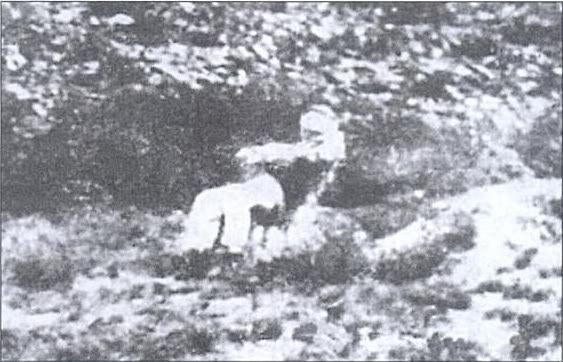
Gideon Scheepers (mostly obscured by his guards) tied to a chair for execution.


Just shot, Gideon Scheepers slumps backward in his chair.

While martyrdom guaranteed Scheepers a lasting legacy, bizarre posthumous turns helped elevate it into legend. When the dead man’s family turned up after hostilities to retrieve his bones, the grave turned out empty, leading to a years-long saga with colorful frauds presenting bogus remains, a mentally ill man doing the Grand Duchess Anastasia act and claiming to be Scheepers, and the actual corpse remaining stubbornly elusive.

The bereaved mother’s ultimately fruitless search for her son’s final resting place inspired the poem “Gebed om die Gebeente”(“Prayer for the Bones”), by D.J. Opperman. (Here’s a translated version.) That verse was recently set to music as a cantata by composer Hendrik Hofmeyr.

Scheepers’ allies, however, had simply been beaten in the field. On May 31, 1902 they capitulated to the British.

If we are asked why in 1978 a memorial should be erected for a man who died in 1902, then the answer is simple. The life and work of this man was such that history placed him in the heroes’ gallery and nothing and no one can deprive him of that place.

-Nationalist Prime Minister John Vorster upon the unveiling of a Scheepers monument

This interesting “On the Trail of Gideon Scheepers” series has a detailed and richly illustrated narrative of the man’s final year.

On this day..

1999: Recak Massacre

(Thanks to Meaghan Good of the Charley Project for the guest post. -ed.)

On this day in 1999, Serbian militants killed approximately 40 to 45 Kosovo Albanians near the village of Reçak in Kosovo. The victims allegedly included a twelve-year-old boy and at least one woman.

Depending on who you listened to, it was either a massacre against innocent civilians, or a military action against guerillas.

The New Kosova Report, adopting the former point of view, summarizes in a 2008 article:

In the early morning of 15 January, 1999, forces from Serbian Interior Ministry (MUP) and Yugoslav Army (VJ) moved into the village with tanks and began to shoot at houses sheltering civilians. After ransacking all the houses, they gathered 28 Albanian men and boys and ordered them to head towards a hill outside the village for questioning. There they were sprayed with machine guns and 23 of them died. Only five survived by pretending they were dead. Another 22 people were shot and/or decapitated at different places in the village. Some in a ravine behind the village, while others in front of their houses.

A local villager named Shefqet Avida gave photographer and BBC Radio reporter Melanie Friend an account which was later quoted in Friend’s book No Place Like Home: Echoes from Kosovo.

Policemen — Serbs — were hiding here, expecting them. I heard the Serbs saying, “Anyone under fifteen years old, don’t touch, but upwards of sixteen or seventeen years old, just kill them …” The people, when they were captured here, were made to stay in line, and every one of them was shot, and after that with a … very nice knife … they took eyes from the faces and hearts from the chest, and the Serbs later said, “That’s not true, we didn’t do that,” the mice, they’d eaten them. […]

Serbian police were shooting until four or five in the afternoon. When the observers arrived in the morning, we went with them to see the place where the people were murdered. Three of us stayed here all night to guard the bodies. […] Thirteen members of my family were killed there.

The Serbs denied having murdered civilians and claimed all those killed were all Kosovo Liberation Army fighters, shot during a skirmish with Serbian forces. To this day, many maintain the entire thing was staged, a hoax set up by the KLA in order to get support for their side.

Trying to sort the matter out, the European Union dispatched forensic experts to the scene from Finland. Helena Ranta, one of the experts, concluded that “There were no indications of the people being other than unarmed civilians.” When her opinion was broadcast in a press release, many mistook it for being the opinion of the entire group of scientists.

The Finns’ official report, however, has never been released. Dr. Ranta, a forensic dentist, later accused officials from the Ministry for Foreign Affairs of pressuring her to go against the Serbs.

Yugoslav and Belarusian scientists also examined the bodies and said they believed all the dead were KLA combatants. In response, critics blasted them for using allegedly out-of-date and unscientific testing methods.

News of the killings made headlines all over the world and incited NATO to finally get involved in the war. A couple of years later, Yugoslav dictator Slobodan Miloševic was brought up on war crimes charges; ordering the Reçak killings was one of them. It was later removed from the indictment for lack of evidence, however. (Miloševic died before his trial was concluded.)

In 2001, a Kosovo Serb police officer was sentenced to fifteen years in prison for participating in the killings. Outside observers, including the United Nations and Amnesty International, criticized the trial proceedings, accusing the Kosovo war crimes tribunal of ethnic bias and politically motivated decision-making. As of this writing, no one else has been called to account for what happened in Reçak.

On this day..

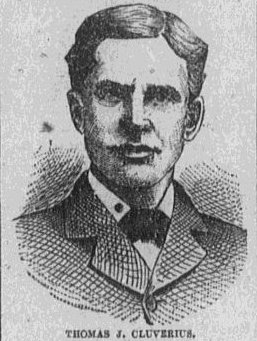
1887: Thomas Cluverius, Richmond murderer


Dallas Morning News, January 14, 1887.

On this date in 1887, a long-running (for the time) legal drama in Richmond ended with the hanging of Thomas Cluverius for murder.

On Friday the 13th — March 13, 1885 — Cluverius killed his cousin and lover Lillian Madison, who was eight months pregnant with his child, an act “as dark as any that can be found in all the calendar of crimes.” (Columbus Daily Enquirer, Jan. 15, 1887)

From the illicit affair to the shocking crime of passion and calculation to the damning lost watch key found at the site of the murder: everything conspired to spill newsprint, not only in Virginia but nationwide.

Nevertheless, by the time he hanged, the young lawyer was supported by at least a chunk of public opinion prepared to credit his dogged insistence on innocence.* He maintained it all the way to the scaffold. The drama of a potential gubernatorial reprieve, backed by hundreds of Old Dominion worthies, went to literally the very last hour of the condemned man.

The facts of this case now 125 years in the grave enjoy meticulous and evocative coverage at The Shockoe Examiner, a Richmond blog that we come to via Murder by Gaslight’s Cluverius post.

We’re very pleased on this occasion to interview a writer who has given “Tommie” and “Lillie” a more literary treatment. John Milliken Thompson‘s first novel The Reservoir (review), just published in the summer of 2011, illuminates the timeless conflicts between lust and propriety, in the very specific locale of post-Reconstruction Richmond.

ET: For you as a writer, how did you come by this story, and why did you decide to make it your first novel?

JMT: I came across a brief mention of the case in a book on Richmond history and made a mental note of it.

Sometime later I began looking into the case and, after finding all kinds of material on the trial and on Richmond in the 1880s, I became more and more intrigued. A failed attempt to turn the story into a nonfiction account led me to write it as a novel.

Book CoverWhat was the most challenging thing about approaching the story?

Creating believable, interesting characters within a compelling plot is THE challenge of writing any piece of fiction. This one was no different, though it helped to have a historical framework and tons of good material to turn to.

That said, one of the toughest things about telling this story was getting the voice right. My goal was to create a narrative that could get close in to Tommie’s head, without revealing too much (to the reader or himself), and then pull farther back.

I found it interesting that you said you “felt so connected to these long-dead people that [you] owed it to them to get it right,” because I have that sense myself sometimes. In the end, what are you hoping that 21st century readers take away from the story? What did you take away from it?

In the end, I think what I most want is for readers to feel moved by the plight of these young people, who made some crucial mistakes and paid dearly for them. We all make mistakes in our youth; sometimes we learn our lessons before we get in deeper, sometimes not.

The inference is that Tommie killed Lillian because she was pregnant. How damaging would Lillian’s giving birth really have been to Tommie socially, professionally, or otherwise? Do we need to look for more complex motivations?

That’s a good question, and Tommie even considers what his life would be like if he had “done the right thing” by Lillie and married her. Even if he had been able to live down the scandal of marrying a pregnant girl, which in those days and in their circle would’ve been significant, it would still not have been the life this ambitious young man had envisioned for himself.

And what about the world he lived in — 1880s Virginia, and the place of the crime, Richmond. What’s this place like a generation after the Civil War? And why did this crime in this place become national news?

Well, Richmond, the former Confederate capital, was making a comeback after being ravaged by the war. This event caught the interest of the general public because of the high standing of the families involved and because the lawyers trying the case were distinguished men and famous orators.

Despite maintaining innocence to the last, it seems pretty difficult to imagine that Thomas Cluverius was actually innocent. Still, at the time there were plenty of people who apparently thought he might be. Why on earth did he attract that level of support? If not for the watch-key, might he have avoided conviction altogether?

That’s the fickle nature of the public — once the scapegoat has been cast out, there is a lingering sense of doubt and guilt that causes many of us to look into our own hearts … let he who is without sin.

I think the watch-key did play a big role, but it wasn’t necessarily the sine qua non. I think the sheer volume of testimony offered by the prosecution overwhelmed any reserve the all-male jury might have felt. The burden of proof, in fact if not by law, lay with the defense, and the proof (of innocence) simply wasn’t there.

What are you working on next?

I’m finishing up a coming-of-age novel about a young woman who suffers a number of poignant losses in turn-of-the-century North Carolina. By the way, until “turn-of-the-century” means turn of the 21st (maybe in two decades?) I’m using that phrase to mean turn of the 20th.

Thanks for inviting me on your blog.

* Or empathize with the young lawyer’s lost-potential pathos.

On this day..

1629: Anna Gurren, in the Mergentheimer Hexenprozess

On this date in 1629, the German city of Mergentheim burned its late mayor’s widow for witchcraft.

Anna’s remains: the inventory of the late sorceress’s estate taken by its new owner, the city of Mergentheim.

Witch-hunting was a growth industry for Thirty Years’ War-torn Germany in the late 1620s.

Not long before, a Mergentheim Teutonic knight had been petitioned for help extracting a schoolboy from Wurzburg, where the absentee father feared he was running with a devilish crowd. Once the authorities heard that witchy stuff, all the inhuman gears came to life.

Instead of returning the tyke to his concerned dad, Wurzburg arrested the boy, strongarmed him into admitting his Satanic ties, and burned him at the stake. Nine years old.

That was Wurzburg. But back where the allegation originated, writes H.C. Erik Midelfort, “the discovery in Mergentheim that children might be guilty of witchcraft was to have serious consequences.”

Like a fresh plague outbreak, a witch persecution broke out in Mergentheim and neighboring Markelsheim, with some schoolchildren hounded by inquisitors within a few weeks of their compatriot’s execution over in Wurzburg. From there, it became epidemic all over town. By October 1628, the first witches were shrouded in flames for their neighbors’ edification. Over the course of 1629, the peak year for the Mergentheimer Hexenprozess, 91 humans were put to death as Satanic wizards — not counting those who were tortured to death.

Nor was this strictly confined to the weakest prey, your outcasts and servants.

Our victim today was big game, a wealthy city elite, and she wasn’t the only such. These must have made some kind of hedgerow gossip, but the general hysteria of the place made it dangerous to sustain any public controversy even about the downfall of the recently well-connected.

Midelfort, again, on the very relatable circumstance of a prosperous innkeeper who was a little too incensed for his own good at seeing Anna Gurren die.

Thomas Schreiber had a strong sense of justice. When the trials in Mergentheim had run only two months, he had already lost faith in the judicial procedure. On December 1, 1628 when Martha, wife of Burgermeister Hans Georg Braun, was executed, Schreiber was heard by many persons exclaiming that she had been done a gross injusice. Schreiber even let slip that “King Nero” had also conducted such bloodbaths. Six weeks later Schreiber was again appalled when the extremely wealthy widow of Lorenz Gurren was convicted of witchcraft and executed on January 12, 1629. When attending the execution of the lady, he had the temerity to express amazement over her confesion. The Amtmann Max Waltzen turned to him and said pointedly, “Ha, ha, those who know the devil should not be so amazed.” That kind of talk perturbed Schreiber, and when magistrates began avoiding him, he prepared to flee. During this time he repeatedly denounced the court for its unjust trials and declared that “if anything happens to me, let every pious Christian fear for himself.” He also prayed that “God might preserve everyone from Neuenhaus [the jail and torture chamber], for even the most pious if put in there would be found to be a witch.” The trials, he insisted, were bloodbaths, and the magistrates were out to “wash their hands in my blood.”

Schreiber fled town on February 1, having heard that people had started denouncing him. But he didn’t make it long.

He, too, was dead by the end of May — as a confessed (just like he predicted) witch.

On this day..

1801: Chevalier, bomb plot scapegoat

On this date in 1801, a Jacobin chemist was wrongly executed for Royalists’ plot against Napoleon.

Our scene is France, the year following Napoleon’s coup of 18th Brumaire (November 9, 1799 on the stodgy old Gregorian calendar). Marx’s “first time as tragedy”* saw the Corsican achieve monarch-esque power, and the months ensuing saw a plethora of plots against him.

The ranks of aggrieved potential assassins included both Jacobins, incensed at the military dictatorship, and Bourbons, incensed that it wasn’t their dictatorship — in both cases exacerbated by Napoleon’s decisive battlefield triumphs which consolidated his hold on power.

On Christmas Eve 1800, the man on horseback was a man in a carriage, careening through Paris to catch a performance of Haydn’s oratorio The Creation.

When, all of a sudden, a gigantic explosion on the Rue Saint-Nicaise attempted to un-create the First Consul. It failed, exploding after Napoleon had passed and before Josephine’s family followed, “merely” killing and maiming fifty-some miscellaneous Parisian bystanders instead.


Kablamo! The explosion of the Infernal Machine.

The Catherine Delors historical novel For the King (author’s teaser) is built around investigating the Plot of the Rue Saint-Nicaise.

“Every one,” wrote Sir Walter Scott,

shocked with the wild atrocity of such a reckless plot, became, while they execrated the perpetrators, attached in proportion to the object of their cruelty. A disappointed conspiracy always adds strength to the government against which it is directed; and Buonaparte did not fail to push this advantage to the uttermost.

This “Infernal Machine” had actually been built by disgruntled monarchists at the instigation of intriguer Georges Cadoudal, as was swiftly discerned by Napoleon’s Minister of Police, the ruthless ex-revolutionary Joseph Fouche.

Realpolitik exigencies — Napoleon was trying (unsuccessfully) to reach political terms with the royalist faction — instead drove a rush to pin the detonation on the Jacobins.

Who, it should be said, made themselves the primary suspects by virtue of the fact that they’d also been trying to blow up Napoleon. Chevalier had been arrested a couple of months before when a bomb of his, evidently an experiment for a similar Jacobin plot, loudly blew up near Salpetriere.

Four other Jacobins followed Chevalier to death later in January (and two royalists actually involved in the bomb got the same treatment). Some 130 other prominent Jacobins (French link) were expelled on Napoleon’s say-so — no legislative consultation — to the empire’s far-flung colonies, pretty much putting the remains of the long-supine revolutionary left permanently out of the picture as a political force.

* See the 18th Brumaire; the “second time as farce” also came with its own history-repeating-itself executions.

On this day..

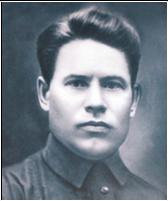
1937: Martemyan Ryutin, for his affair

On this date in 1937, Martemyan Ryutin was condemned to death and immediately executed in Stalinist USSR.

Ryutin (English Wikipedia entry | Russian | another Russian bio) was a revolutionary from the Far East who by the late 1920s was in the Bolsheviks’ heretical right wing; his affiliation with Bukharin and Rykov got him temporarily booted out of the Communist party in 1930.

Not content to keep his head safely down as Stalin’s star ascended, Ryutin typed out an anti-Stalin pamphlet and the 200-page “Ryutin Platform” denouncing Josef Djugashvili as “the gravedigger of the Revolution” and urging that he be removed — even by force.*

Weeks after Ryutin began circulating this incendiary samizdat the secret police busted him.

Though open discussion of the so-called Ryutin Affair was nonexistent in the Soviet Union until the Gorbachev era, it was a matter of dire importance for the Politburo in 1932; indeed, fleeting as it was, it’s one of the few organized elite attempts to thwart Stalin discernible during the 1930s. Stalin wanted Ryutin executed, but he was outvoted; this is a small milepost on the way to the Yezhovschina indicating that Stalin’s power still had its limits … and Bolsheviks still recoiled at the prospect of killing other party members.** These constraints were not very long for the scene.

Even so, Ryutin got a 10-year prison sentence and anyone else who had read the Ryutin platform without informing on it to the Party was in seriously hot water. Twenty-four were expelled from the party in October 1932 for this reason, including once-proud and soon-doomed Old Bolsheviks Zinoviev and Kamenev.

Ryutin, for his part, had only a few years to wait before the deteriorating political climate dispensed with those taboos about internecine bloodletting. The Supreme Court signed off on his execution this day with just a few minutes’ hearing, and it was immediately carried out.

Ryutin’s two sons were also executed in 1937, and his wife died in a labor camp. Only his daughter Lyubov survived the Ryutin Affair — which convictions were posthumously reversed in 1988.

* Bukharin’s widow later wrote that Stalin’s agents later added the most inflammatory material — like that violent overthrow stuff.

** Had Stalin had his way in 1932, Ryutin would have had the distinction of being the first Central Committee member to be executed, according to Suzi Weissman.

On this day..

1900: Louisa Josephine Jemima Masset

(Thanks to Meaghan Good of the Charley Project for the guest post. -ed.)

On this day in 1900, 36-year-old Louisa Josephine Jemima Masset (also called “Louise” in some accounts) was hung for the murder of her young son the previous year. She was the first woman, indeed the first person, to be executed in London in the brand spanking new 1900s.

Her crime, even by today’s standards, was shocking and there is little doubt that had it occurred today, Louisa would be featured on blogs with names like People You’ll See In Hell. (Actually, she got a TV miniseries in the early 1990s.)

The story of the murder and Louisa’s trial and death were recorded in detail in John J. Eddleston’s A Century of London Murders and Executions. Capital Punishment U.K. provides additional details, and the trial records can be seen here.

Our story begins a little after six on Friday, October 27, 1899, when a lady at the Dalston Junction train station in London found the body of a small boy shoved behind the door to the women’s lavatory. The child was naked, bloody and partially covered with a black shawl, and a bloodstained brick lay nearby.


Dalston Junction: Mind the gap. (cc) image from Matt From London

The post-mortem determined that the child had been beaten “with much violence” on the head and face, but the actual cause of death was suffocation. He probably died only about an hour or two before his body was found. There was no indication of his identity, so his description was published in the newspapers with hopes that someone would recognize him.

Someone did: the following Monday, a children’s nurse named Helen Eliza Gentle came forward and identified the murdered boy as Manfred Louis Masset, age three and a half, who had been in her charge until the previous Friday.

Manfred was illegitimate and had been in Helen Gentle’s care since shortly after birth. Louisa, his mother, doesn’t seem to have been the maternal type. She paid 37 shillings a month for his care and would visit him once every two weeks and take him to the park. The money supposedly came from Manfred’s father in France; Louisa herself earned a living as a day governess and gave piano lessons.

The arrangement with Helen Gentle ended when Louisa told Helen that she was sending Manfred to France to be with his father. Helen handed the child over to her at 12:45 p.m. on October 27, only hours before his death.


The day before giving him up, Helen Gentle took this picture of the tot to remember him by.

When she was tracked down at her brother-in-law’s house, Louisa denied having harmed her son and stated she didn’t even know he was dead until she read about it in the newspaper. She admitted the story about taking Manfred to France a lie and said she only wanted to transfer him to another carer, as she thought Nurse Gentle wasn’t educating him properly. Louisa claimed she had met two women, one of them a schoolmistress, in the park a few weeks earlier. She arranged to enroll Manfred for the price of £18 per annum, and handed the little boy over on October 27.

When pressed, however, Louisa couldn’t remember much about these women or their school. The police smelled a rat and took her into custody for murder.

At Louisa’s trial in December, she stuck to her story about giving Manfred to a schoolmistress. She said she’d handed him over at the train station at 4:00 p.m., along with a £12 deposit towards his school tuition, then took the 4:07 train to Brighton. No one at the station saw the two women Louisa described. However, three witnesses at the train station remembered seeing Louisa and Manfred, who was crying, hanging about the station for over an hour on the afternoon of Manfred’s death: one of those same witnesses saw and spoke to Louisa at the station at 6:50 p.m., nearly two hours after Louisa claimed to have left, and said her little boy wasn’t with her anymore.

The icing on the cake was when the brick used to batter Manfred was shown to be same kind as those in Louisa’s garden.

Louisa’s story was partially true; she did go to Brighton that day, hours later than she said, and Manfred’s clothes turned up in the waiting room of the train station there. Eudor Lucas, Louisa’s next-door neighbor, said they had spent the weekend together in Brighton, sleeping in the same bed, and he had “had connection” with her.

The jury must have been outraged by their blatantly immoral behavior, and in any case the evidence against Louisa was overwhelming. The jury got the case on December 18 and took thirty minutes to convict her. She was hung just three weeks later.

On this day..

1908: John Boyd, by John Radclive

On this date in 1908, John Boyd managed six fitful hours of sleep, had a breakfast of toast, poached eggs and tea, and then went to the Don Jail gallows for murdering his paramour’s rival suitor.

Canada had long before ceased public executions. Prior to Boyd’s execution, Don Jail hangings had occurred in a jail yard — technically behind prison walls, but easily peeped upon by curiosity-seekers willing to obtain higher ground. Boyd’s execution introduced a new privacy measure: it was the first of 26 hangings to occur in an interior chamber completely away from public eyes, the same place where Canada eventually held its last hangings in 1962.

But apart from this minor milestone, we notice on this date the hurried and disturbed departure of prolific hangman John Radclive. “Another poor soul gone,” he was overheard to say as he left.

Radclive is the subject of an empathetic Toronto Star profile that’s well worth the read.

He was Canada’s first professional hangman, with 69 recorded executions and perhaps just as many which the uneven documentation of the day failed to note. Predecessor of the better-known Arthur Ellis, Radclive learned his trade direct from William Marwood, and was put on the federal payroll as a full-time executioner in 1892.

He had a swagger in his ill-starred step back then: he once started a brawl boasting in a pub that he had “come to hang a Frenchman, and hoped it would not be the last.” By the time he got to Boyd and beyond, he was ready for the last. Alcoholism had wasted his nerves (and his liver: he died of cirrhosis in 1911). In 1910 Radclive told a psychiatrist,

“Now at night when I lie down, I start up with a roar as victim after victim comes up before me. I can see them on the trap, waiting a second before they meet their Maker. They haunt me and taunt me until I am nearly crazy with an unearthly fear.”

On this day..

1612: John Selman, Christmas cutpurse

400th death-day congratulations go to John Selman, a brass-balled nimblefingers who was hanged on this date in 1612 for stealing … at Whitehall … on Christmas … in the presence of the king. And, Selman himself added in his scaffold confessional, “in the time of divine Service, and the celebration of the Sacred Communion.” That’s like hitting for Stuart England’s malefaction cycle.

This common thief had tried to blend among the ermine-clad set at church with a black-velvet cloak getup, but drawn enough suspicion to be nabbed with a 40-shilling purse he’d brazenly boosted from a nobleman‘s retainer.

Francis Bacon, one of Selman’s judges, affected a suitably hyperbolic indignation at the effrontery of it all: “The first and greatest sinne that ever was committed was done in Heaven. The second was done in Paadise, being Heaven upon Earth, and truly I cannot chuse but place this in the third ranke.” Tens of thousands of human beings in the judge’s immediate ambit — England, Europe — had been slaughtering one another to the glory of God for the past century when Bacon said that. He’d surely give Nancy Grace a run for her money.

Then as now crime moved copy, and if the realm’s lord magistrates were ready to measure this guy up against Beelzebub, one can readily imagine the woodblock tweets he sent a-flying among the hoi polloi. Selman’s audacious escapade relieved his last days’ dread with the gift of celebrity. Writers scrambled to churn out Selman-tinged copy, like these inevitable ballads.

With hands and eyes to heaven,
all did in reverence stand:
While I in mischife used mine eye,
and my accursed hand,
Now was my mischiefe ripe.
my villanyes full growne,
And now the God in secret knew it.
did make it open knowne.

Hopefully God got a cut of the action from these writers. Talk about a Christmas gift for a scribe.

No less a personage than Ben Jonson hastily wrote Selman into his Twelfth Night masque Love Restored as “the Christmas Cutpurse”: this debuted the same night the real Selman made his last peace with God and man awaiting the next day’s hanging on the road to Charing Cross. (After all this Christmas reverence, they piously held off on the hanging until the full twelve days of Christmas had elapsed.)

Selman’s 15 minutes apparently took years to run, because Jonson went back to the same inspiration for 1614’s Bartholomew Fair — perhaps basing the character of Ezekiel Edgworth on Selman.

At playes and at sermons and at the Sessions,
‘Tis daily their practice such booty to make;
Yea under the gallows, at executions,
They stick not the stare-abouts’ purses to take;
Nay, one without grace, at a better place,
At Court, and in Christmas, before the Kings face.
Alack then for pitty! must I bear the curse,
That only belongs to the cunning Cut-purse?
Youth, youth you hadst better been starv’d by thy nurse,
Than live to be hang’d for cutting as purse.

“A Caveat for Cutpurses” from Bartholomew Fair

Jonson sure got that right: under Selman’s own gallows-tree this day, “one of his quality (a picke-pocket I meane) even at his execution, grew master of a true mans purse, who being presently taken, was imprisoned, and is like the next sessions to wander the long voiage after his grand Captaine Mounsier Iohn Selman.”

On this day..