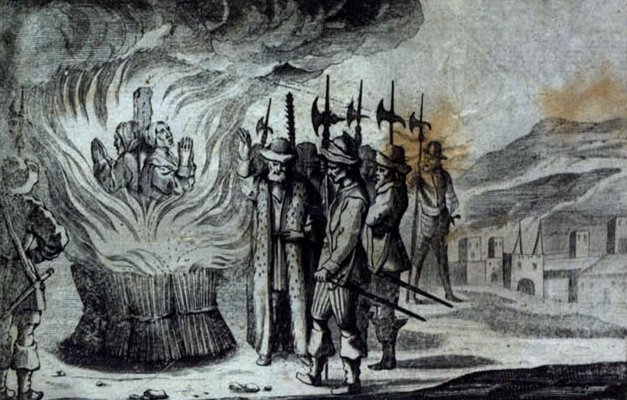
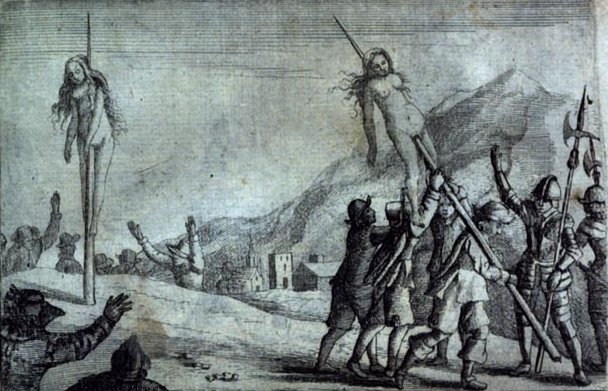
September 5 is International Indigenous Women’s Day, in honor of the torturous execution in Bolivia on this date in 1782 of the Aymara peasant rebel Bartolina Sisa.
Eighteen months before Bartolina’s execution, she and Tupac Katari — Julian Apasa, to use his given name before he staked out a nom de guerre claiming the inheritance of Tupac Amaru and Tomas Katari — laid La Paz* under siege with an army 40,000 strong. Over the course of that spring summer, the Bolivian capital lost 10,000 souls and teetered on the brink of collapse — actually in two separate three-month sieges with a brief interim between.
Bartolina Sisa was recognized by the rebels as the coequal of her husband; the two took command decisions together in consultation.
As such, when the siege was finally relieved and the natives defeated that October, Sisa was in line to share her husband’s fate. This was easy to effect because she had been betrayed into Spanish hands between the first and second sieges. Her enemies refused Tupac Katari’s every blandishment to exchange her, and in time had the cruel pleasure of forcing her to watch her defeated husband’s butchery. Nearly a year later Sisa tasted a like fate, and her body was thereafter chopped up to display as a warning in various towns to cow potential future native insurgents.
A present-day peasant women’s union bears Sisa’s name, the Bartolina Sisa Confederation; the president of Brazil’s 2006 Constituent Assembly that drafted the country’s current constitution was an indigenous Quechua woman named Silvia Lazarte, who was the Bartolina Sisa Confederation’s former executive secretary.
* The city‘s full original name was Nuestra Señora de La Paz, “Our Lady of Peace”. It was founded in 1548 at the site of a former indigenous village and the “peace” referred to is the restoration of calm after Gonzalo Pizarro‘s rising.
The English diplomat Sir Thomas Roe, envoy to the Mughal Empire from 1615 to 1619 during the reign of Jahangir, recorded in his journal* the unfortunate fate this date of a nameless woman for being caught rendezvousing with a palace eunuch.
This day a gentellwoeman of Normalls was taken in the kings house in some action with an Eunuch. Another Capon that loved her kylld him. The Poore Woeman was sett up to the Arme pitts in the Earth hard ramed, her feete tyde to a stake, to abyde 3 dayes and 2 nights without any sustenance, her head and armes bare, exposed to the sunns violence: if shee died not in that tyme she should bee pardoned. The Eunuch was Condemned to the Eliphantes. This damsell yeelded in Pearle, Jewelles, and ready mony 160,000 rupias.
That this bit character who does not even merit a name here left such a fortune surely testifies to the Mughal Empire’s famously astounding trade wealth.
Roe does not disclose how long the condemned woman managed to survive, but the separate memoir of Roe’s chaplain Edward Terry confirms that she succumbed to exposure well before the elapse of the pardonable three days. (The two seem to have received differing intelligence on the execution method of the eunuch, despite Terry’s indication that it transpired practically in the English mission’s backyard.)
Now for the disposition of that King, it ever seemed unto me to be composed of extremes; for sometimes he was barbarously cruel, and at other times he would seem to be exceedingly fair and gentle.
For his cruelties, he put one of his women to a miserable death; one of his women he had formerly touched and kept company with, but now she was superannuated; for neither himself nor nobles (as they say) come near their wives or women, after they exceed the age of thirty years. The fault of that woman was this; the Mogul upon a time found her and one of his eunuchs kissing one another; and for this very thing, the King presently gave command that a round hole should be made in the earth, and that her body should be put into that hole, where she should stnad with her head only above ground, and the earth to be put in again unto her close round about her, that so she might stand in the parching sun ’till the extreme hot beams thereof did kill her; in which torment she lived one whole day, and the night following, and almost ’till the next noon, crying out most lamentably, while she was able to speak, in her language, as the Shumanite’s child did in his, 2 King. 4. “Ah my head, my head!” which horrid execution, or rather murder, was acted near our house; where the eunuch, by the command of the said King, was brought very near the place where this poor creature was thus buried alive, and there in her sight cut all into pieces.
* Published as The embassy of Sir Thomas Roe to the court of the Great Mogul, 1615-1619, as narrated in his journal and correspondence. This vignette is from volume 1; there is also a volume 2
On this date in 1968,* Congolese revolutionary Pierre Mulele was shot by firing squad in Kinshasa.
The anti-colonialist (French link) Mulele served as Minister of Education in the leftist government of Patrice Lumumba, overturned by a western-backed coup in 1961.
Trained up in Maoist doctrine in China, Mulele took to the country to launch a strange insurrection from Kwilu, then fled to neighboring Republic of the Congo (aka Congo-Brazzaville, after its capital city) when that project collapsed.
Mulele was lured back to his home Congo in late September of 1968 under an amnesty extended by the Mobutu regime.
In retrospect, it might have been better not to trust Mobutu.
Foreign Minister Justin Bomboko … personally escorted the former rebel across the Congo River from the neighboring Congo Brazzaville, while Mobutu was on a private visit to Morocco. On his arrival, Mulele was feted over champagne and caviar. But Mobutu had hardly returned to Kinshasa when he announced that Mulele was not covered by the amnesty and that he would be tried as a war criminal.
tortured to death by soldiers. His eyes were pulled from their sockets, his genitals ripped off, his limbs amputated one by one as he slowly expired. What remained was dumped in the river.
That sounds … unsanitary.
As a result of this state perfidy — “an act of kidnapping and of international piracy” against an “authentic heir to the ideal which inspired Patrice Lumumba,” in the undiplomatic official statement† — Congo-Brazzaville broke off diplomatic relations with Congo-Kinshasa.
* Some sources have Mulele’s execution on Oct. 3, but the contemporary newspaper reports make clear that Mulele was tried on the 8th and shot on the 9th. Oct. 3 appears to be the date Mobutu publicly announced that Mulele would not be covered by amnesty.
On this date in 1536, Italian nobleman Sebastiano de Montecuccoli was torn apart at the Place de la Grenette in Lyons for poisoning the dauphinFrancis, heir to the French throne.
Sebastiano de Montecuccoli was a knight from Ferrara who had arrived in France in the train of the Catherine de’ Medici when she was married off to the no. 2 French prince Henri. He was fast friends with the royal princes, but his proximity to the family horribly turned against him when the 18-year-old Francis played a game of tennis, then caught ill and dropped dead. The last thing poor Francis had done was ask Montecuccoli for a glass of water.
In an era of forensics-by-guesswork, a sudden and unexplained death inevitably drew suspicions of poison — all the more so in a France gone security bonkers in the wake of the Affair of the Placards.
So just was in that glass of “water,” eh?
Sebastiano, upon his arrest, was found to possess a tome of poisons. This was a common enough interest among his class. (Catherine de’ Medici also had an interest in poison.) Nevertheless, it was great material for tunnel-vision investigators, and the young Italian soon provided a corroborating self-incrimination under torture: Sebastiano had offed the crown prince on orders from France’s longtime rival Charles V, who also just happened to be fighting a war with France over the duchy of Milan at that very moment.
Sebastiano attempted to recant this confession once he was off the rack, but to no avail. Many 16th century contemporaries could descry the eventual consensus of posterity that Sebastiano was a naif, and not an assassin. (Francis likely died from a disease.) Less generous by far was the judgment of the Lyonnaise citizenry who fell upon and ravaged Sebastiano’s body after it had been torn apart by horses.
Thanks to the unexpected death of the heir that triggered this horrible punishment, Francis’s brother Henri advanced to the crown prince seat and eventually became Henri II of France (until Henri’s own unfortunate sporting mishap) … and that Italian bride Catherine de’ Medici became Queen of France.
On this date in 1537, Jürgen Wullenwever was decapitated and quartered at Wolfenbüttel.
Photo by Agnete (Own work) [GFDL (http://www.gnu.org/copyleft/fdl.html) or CC-BY-SA-3.0 (http://creativecommons.org/licenses/by-sa/3.0)], via Wikimedia Commons
Wullenwever (English Wikipedia entry | German) was a merchant from Hamburg who came to the fore of a popular Lutheran movement in the Hanseatic port of Lübeck that claimed the power of its old aristocratic council for the city’s burghers.
In this capacity, Wullenwever maneuvered — vainly as it turned out — to arrest the century-long wane of the city’s influence. Lubeck in its day had been “the Queen of the Hanseatic League”. Come 16th century, it was struggling to maintain its trading preeminence against the inroads of Dutch merchants and the fragmentation of the once-mighty Hanse.
This project was doomed in its conception — there was nothing Lubeck could really have done to hold back the historical developments happening around it — and bungled in its execution. The merchant magnates of Wullenwever’s democratic coalition grew suspicious of (too-)popular religiosity.
And Wullenwever’s political high-wire act involved arrangements of convenience with the Anabaptist commune of Münster — spurring rumors of his own radical baptist conversion* — and fomenting Catholic peasant uprisings to meddle in the succession of the Danish-Swedish crown. Whatever else one could say of him, one can’t fault him for a want of daring, a quality that stood him in good stead with romantic era writers.
But Wullenwever’s allies lost their fights, and the political coalition that supported his municipal leadership soon broke up under the pressure of events.
The aristocratic party re-took power in 1535 and didn’t immediately persecute Wullenwever. But the hostile Archbishop of Bremen eventually seized the man on his territory and turned him over to a Catholic Saxon duke for punishment.
* I’m certainly not a specialist, but I’m skeptical of the claim in some sources that Wullenwever was an Anabaptist Manchurian candidate type. Wullenwever confessed to a great Anabaptist scheme … but that was under torture of enemies determined to do him to death, and it was retracted before his execution. The claim implies that all of northern Germany might have gone over to a radically democratic Anabaptism had not the ancien regime overthrown the Burgermeister, and for that reason it’s gained Wullenwever the surprising latter-day embrace of nationalists and revolutionaries.
On this date in 1567, Wilhelm von Grumbach was dismembered along with two of his followers in the marketplace of Gotha.
Grumbach (English Wikipedia entry | German) was the cantankerous German instigator of the aptly-named Grumbachsche Handel, a messy clash of rights and prerogatives at the hinge of the old feudal order and centralized princely authority.
Grumbach was a knight who’s invariably described as an “adventurer”. As a young man he fought in the Peasants War, but as he headed into middle age he became your basic penniless minor nobleman chafing at the failures and obstructed opportunities life threw at him.
The thing he could not abide losing was the disappearing right of the nobility to enter into a feud or vendetta. This scans to the modern like rank anarchy, but feuds were part of the tapestry of medieval German society, long codified in law — an obvious descendant of clan and tribal obligations out of which the muddle of feudal vassalage had formed. “The passion for liberty and rights,” says this volume, “ran amok in Germany. Churchmen, princes, burghers, and peasants all wanted their independence and readily resorted to declarations of feud to secure and defend their rights.”
The standing right for miscellaneous minor lords to start miscellaneous private wars was quite naturally one that princes were ever keen to restrict. After centuries of two-steps-forward, one-step-back efforts to deal with the feud, the 1495 Imperial Diet formally codified a ban on feuding known as the Ewiger Landfriede, or “perpetual peace”. In Poli Sci 101 terms, this is the state finally monopolizing legitimate violence.
As with dueling, however, official proscription did not end the practice. It was, indeed, Grumbach’s defeat and execution that would eventually be remembered as the decisive nail in the coffin for knightly feuds.
And so in Franconia where we lay our scene will civil blood make civil hands unclean …
Grumbach’s liege was Melchior Zobel von Giebelstadt, the Prince-Bishop of Wurzburg. (Still another confusing dimension of the political map, some princes of Germany’s many statelets were simultaneously ecclesiastical authorities. For purposes of this post, the “-Bishop” part doesn’t enter into it.)
Knights’ basic problem — the reason they were vulnerable to losing their wacky old-time rights — was poverty, and it was in money that Grumbach’s feud was rooted. Grumbach’s personal twist on this was being the sort of irascible coot who could carry a grudge so far as to get himself sawed into pieces over it.
Immediately upon assuming the Prince-Bishopric in 1544, Melchior Zobel von Giebelstadt forced Grumbach to return an unauthorized cash gift his predecessor had paid to the knight, and then stiffed said knight out of six villages whose revenues Grumbach sought by way of compensation.
He had to deal with Grumbach’s feud for the remainder of his term, which was also the remainder of his life … right up until Grumbach murdered him.
The disaffected knight hooked up with the margrave* Albert Alcibiades and started making a right mess in the middle of Europe with a 1552-54 mini-war. When Albert got thumped, Grumbach had to evacuate to France, and his holdings outside Wurzburg were plundered and/or destroyed by his foes.
So now the guy was even more aggrieved, and even more pfennigless.
He was downright vengeful about his feud at this point, although it’s noteworthy relative to that monopolization-of-violence trend that he was still the only one: in days of yore, intra-elite wars might have spawned multiple self-reproducing vendettas.
The grumpy Grumbach now gravitated to another patron,** the deposed elector of Saxony Johann Friedrich II — another dude who felt hard done by in the Holy Roman Empire.
Grumbach evened his score with Melchior von Zobel by having the Prince-Bishop killed in Wurzburg in April 1558. (In present-day Wurzburg, three Zobelsaulen markers commemorate the Prince-Bishop’s assassination, one on the very spot of the murder.)
But that still left the money, and we know Grumbach wasn’t the type to write off a debt. In 1563, he successfully invaded Wurzburg with 1,300 soldiers and at swordpoint forced from the city a concession restoring his property.
For Grumbach, it was to prove a Pyrrhic victory.
In principle, he had achieved a great vindication of the ancient right of the feud, and for the hard-pressed nobility against the realms’ many princes. If others of his station had rallied to that banner, what a whirlwind Germany would have reaped.
Grumbach was in fact hatching an extravagant scheme† to liberate the entire German nobility … from the yoke of the princes. It was a radical aristocratic utopia … nobles were not only to be protected by the [Holy Roman] emperor from the princes, but to help him subdue them once and for all and to establish an hereditary monarchy in Germany. But despite Grumbach’s best efforts to incite the Franconian nobility, they did not line up behind him. Guidied by the captain of the Franconian Circle (Kreis), Georg Ludwig von Seinsheim, who denounced Grumbach’s undertaking as ‘against God, law and the emperor’, they formally turned away from him in 1564. In the view of the majority of them, the Knighthood was to maintain its autonomy by respecting the equilibrium between emperor and princes, not by irresponsibly challenging the latter. And it was this view, reassuringly transmitted to the princes, which carried the day.
Grumbach was outlawed by the empire and in 1566-67 was overcome with his protector Johann Friedrich at Gotha. Both men spent he remainder of their lives as imperial prisoners, with the notable difference that Johann Friedrich had the pull to live out his natural ration of days while Grumbach went straight to the dungeon for torture and thence to the scaffold in the town that had lately been his last redoubt. There, Grumbach was ripped apart — his dying eyes beheld the executioner wrench the heart out of his very chest and taunt him: “Behold, Grumbach, thy false heart!” The late knight’s rotting quartered remains got nailed up around town to broadcast the unmistakable message:
The noble right to feud was dead.
* Hereditary military commander.
** Among their other capers, Grumbach and his patron Johann Friedrich conspired with Torben Oxe‘s nephew Peder Oxe to depose the Danish king Frederick II in favor of the king’s grand-niece, Christina. (Christina will be known to Tudor-philes as the young woman who scuttled Henry VIII’s post-Anne Boleyn suit with the sharp remark, “If I had two heads, one should be at the King of England’s disposal.”) Nothing came of the plot. (Source)
† Christian Wieland writes that Grumbach deployed — unsuccessfully but still impressively — a 16th century multimedia propaganda campaign to state his case to the “common nobleman”: woodblock-illustrated printed leaflets, songs valorizing the attack on Wurzburg (sample verse: “Violence may be averted by violence / According to natural law”).
When said heavy–handed monarch was deposed by his own uncle Frederick, Clement turned privateer … and when said deposing-uncle Frederick died in 1533, Clement entered the ensuing civil war between supporters of the still-imprisoned ex-king Christian II and those who backed Frederick’s own son Christian III. This was also a social and political war over the Reformation.
Clement went to war for his former boss, Christian II, instigating a 1534 North Jutland uprising of the Catholic peasantry that in October of that year trounced the Protestant noble army sent to suppress it at the Battle of Svenstrope Mose (Svenstrop Bog or Moor).
That battle clinched Clement’s reputation as one of the great peasant-rising leaders, and also clinched for Clement the fatethatusuallybefalls such characters. Shortly after, Clement’s aristocratic ally cut his own deal with Christian III and abandoned the rabble to a vicious counterattack. In December 1534, General Johan Rantzau stormed the rebel strongholdof Aalborg, slaughtering two thousand peasants, reducing freeholding farmers to tenants, and bringing Clement home in chains for a grand finale.
The captured commander languished in his dungeon awaiting the conclusion of the civil war. It took a good year under siege for Rantzau to bring Copenhagen to heel, but once that city capitulated in August 1536, Clement was brought out of storage for use as a victory cigar. (Danish link)
On September 9, 1536, wearing a lead crown to mock his ambition, Clement had his head chopped off, and his remains were dismembered and set up for public display.
On or about this date in 1781,* the native Aymara revolutionary Tupac Katari (or Tupac Catari, or Tupaj Katari) was torn apart in the Bolivian village of Penas — a messianic warning on his lips of his Spanish captors’ future comeuppance.
Hard on the heels of Tupac Amaru‘s public dismembering in nearby Cuzco (present-day Peru), Julian Apasa Nina took up the name and mantle of recent Bolivian insurgent Tomas Katari.
Julian Apasa’s new name Tupac Katari was as ambitious as his plans, for he took the thousands of indigenous Americans who flocked to his banner and laid siege to La Paz from the adjacent El Alto.**
The object was not mere plunder, but rolling back Spanish domination full stop.
A friar who met Katari reported that the Spanish tongue was forbidden on pain of death, and the rebel leader aimed to “totally separate himself from all Customs of the Spanish.” (Source) He did not shrink from ferocity to achieve his ends, hanging captives outside the walls of the city, enforcing military discipline ruthlessly. (Source) The Aymara fought with “a spirit and pretentiousness so horrible that … it can serve as an example as the most valiant nation.” (Source)
Though the siege† reduced Spanish defenders to eating bark and horseflesh, and starved out thousands, the city held out and the siege was at length lifted and Tupac Katari betrayed into his enemies’ hands.
Condemned to death (a fate his wife Bartolina Sisa would share months later), Katari was lashed to four horses who strained until his body ripped into quarters suitable for placarding towns of the district. But before he went, Katari bequeathed posterity a legendary final sentiment.
* It appears that the primary sources themselves are unclear on the precise date, and there are citations for the execution taking place anywhere from Nov. 13 to Nov. 18. Nov. 15 appears to be the best-preferred by scholars, or the co-number one with Nov. 14, and we’re inclined to prefer this date because of the 20th century Indian social justice movement which explicitly cited Katari’s inspiration — the Movimiento 15 de Noviembre (more in Spanish). It’s part of an entire political tendency in Bolivia called Katarismo. If the date is good enough for the Aymara, it’s good enough for this blog.
That wasn’t the only 20th century movement to situate itself as Katari’s heirs. A set of Marxist indigenous guerrillas styled themselves the Tupac Katari Guerrilla Army, and a former member of this Che-inspired militia is currently Bolivia’s vice president.
** From the Aymara siege of La Paz developed the local tradition of Ekeko.
† Actually, two distinct sieges in 1781, one lasting just over three months and the next lasting just over two.
On this date in 1307, radical preacher Fra Dolcino was gruesomely put to death in a daylong public torture at the Piedmontese town of Vercelli.
Dolcino was the millenarian successor of Gerard Segarelli, whose itinerant commune of impoverished penitents — Apostles, they called themselves, to the chagrin of the Church hierarchy — had attracted followers for near half a century before the powers that be smashed it.
The shade of the burned firebrand (and the corporeality of his refugee onetime followers) haunt the murderous monastery of Umberto Eco’s The Name of the Rose. Here, the paternal Franciscan unraveling the novel’s mystery explains Fra Dolcino’s illicit movement to his naive protege.
We were talking about those excluded from the flock of sheep. For centuries, as pope and emperor tore each other apart in their quarrels over power, the excluded went on living on the fringe, like lepers … all of them were ready to hear, or to produce, every sermon that, harking back to the word of Christ, would condemn the behavior of the dogs and shepherds and would promise their punishment one day. The powerful always realized this. The recovery of the outcasts demanded reduction of the privileges of the powerful, so the excluded who became aware of their exclusion had to be branded as heretics, whatever their doctrine …
the movements of spiritual renewal were blocked; they were channeled within the bounds of an order recognized by the Pope. But what circulated underneath was not channeled. It flowed, on the one hand, into the movements of the flagellants, who endanger no one, or into the armed bands like Fra Dolcino’s …
From the cinematic adaptation of The Name of the Rose. The monk’s semi-coherent summons to “penitenziagite” is significant because it marks him as a former adherent of the penance-focused movement. An Italian metal band called Dolcinian had a song (and album) of that exact title.
But were they really an “armed band”?
Executed Today is pleased to mark this portentous anniversary in conversation with historian Dr. Jerry Pierce, currently working on a book about the outlaw movement.
JP: A lot of people get kind of caught up in the Dolcino part. It’s not about him until the very end.
The group itself originated in 1260, and it lasted 40-some years before it ran into any trouble. Their whole goal when they start is essentially, live a life of poverty like the original Apostles. And apparently that’s a problem for people later.
That’s really all it was about. It’s communal living, it’s not owning things at all, including houses. By 1260, they were better Franciscans than the Franciscans were.
And the Franciscans had a big presence in the city of Parma, where this thing got started, so they were slightly peeved.
So it’s a challenge to the Franciscans?
It’s not trying to show up the Franciscans, but it becomes a challenge.
The “Apostles” wander around, they beg for their food, they tell people to do penance.
The early Franciscans started off the same way, all about poverty, but once they became established, the order became all about money.
And the Apostles are not the only ones mounting this challenge.
Right. Waldensians in France predate the Franciscans by about 30 years or so.* You just have a guy in France who’s a businessman who hears a reading of the gospel saying to give up your possessions and follow Christ. And that’s what he does. He even pays someone to translate the Bible into vernacular French, which is a big no-no.
His group and Segarelli’s group are not an issue as long as they don’t say anything about the doctrine. So long as they don’t say anything about the Trinity or the Eucharist, they’re just calling people to penance — they’re okay.
But the reason these groups come along is that in that period, around 1150 — Europe is experiencing a big economic change. The haves are on the side of the church. This is the core of all of them, and it’s the core of the Dolcino philosophy as well — the church is preaching poverty, but it’s living wealthy.
So they were doing something within the practice of the Church’s community for decades. How did they get so dangerously on the outs?
The bishop of Parma actually patronizes the Apostles and grants indulgences to people who give money to them. They’re not just some kooky group that’s out there even though the main writings about them are by their opponents.**
But what happens is they become really, really popular, and people start following them, and the Franciscans get the hierarchy involved.
There’s nothing doctrinal about them until Dolcino that becomes heresy.
And what specifically is that?
You take Segarelli’s stuff about poverty and radical egalitarianism, and you have Dolcino either witness or know about the execution of Segarelli, and that sort of crystallizes for him that members of the Church are forces of evil.
Basically, Dolcino says that if they would kill this guy for preaching nothing other than poverty, which is their own message, then there’s something wrong.
Because of the persecution — Segarelli’s execution, the Inquisition moving in and questioning people — that kind of pressure is what spurs Dolcino to take off to the northern mountains. That’s sort of the catalyst for him to become apocalyptic.
But even suppressing that takes the Church years.
The chronology is muddy because we only have about three sources, but we think he joined the order before Segarelli was executed. And between 1300 and 1302 or 1303, he’s off in the northeast of Italy near Trento.
He’s from Valsesia, a river valley in the Piedmont, and he eventually returns with a bunch of followers across the mountains — between Novara and Vercelli. It’s an important area because the bishops of the two cities have been fighting each other for access to the valleys, and fighting the local feudal lords, the Biandrate.
This family that’s been controlling the region, they’ve been extending their influence far up the river valley and the farther you go up the valley, the more independent the people are up there; they hate people who encroach on their autonomy and they’ve recently rebelled and kicked them out.
Essentially, Dolcino enters this sovereign territory, and he’s saying to the inhabitants, the wealthy church and the people who live down on the plain are wicked and they’re going to assault you, and sure enough …
And that’s the rebellion that takes place, it’s these farmers and families who live up there against the Crusader army.
A Crusade?
The Pope† allowed a papal indulgence for people going on Crusade up there. They essentially recruit a mercenary army.
The irony of it is that the things that Dolcino and his followers are accused of is raiding people’s houses and stealing all their stuff, and raiding churches and stealing all the gold. Well, guess who actually did that? And all the mercenaries needed to say when they plundered was, “uh, yeah, Dolcino did that.”
You have these non-Valsesian Crusaders and mercenaries who sort of move into these territories and basically get beat by the locals several times.
We know there was this final pitched battle. The Dolcinians flee to a mountaintop awaiting the End Times. Essentially what the Crusader army did was they starved them into submission, basically just blockaded the whole area, and then overran a bunch of starving women and children.
“On that day more than a thousand of the heretics perished in the flames, or in the river, or by the sword, in the cruellest of deaths. Thus they who made sport of God the Eternal Father and of the Catholic faith came, on the day of the Last Supper, through hunger, steel, fire, pestilence, and all wretchedness, to shame and disgraceful death, as they deserved.” (Source)
Dolcino also had a female opposite number, and the sect preached egalitarianism. Did they have an egalitarian gender politics as well?
The woman, Margaret or Margherita, it’s hard to tell exactly who she is — there’s all this embellishment. She’s sometimes called the “wife” of Dolcino, or sources call her the “mistress”, which makes it sound seedier. But we don’t actually know if they were involved or not involved. She was a former nun, and we know a little bit about her family, but there’s just not much about her.†
As to gender generally, the sources will say, these Apostles believed that nobody should own any property so they shared all their things and even their women.
So you’re meant to think that they just pass them around, but that wasn’t the case at all; there weren’t orgies and such. In this case, they did stress radical egalitarianism.
This is actually the ideology of the Christians in the first century: they also say, the world we live in is wrong, and it’s about to end — one of the things about the world they live in is, it’s patriarchal, and they come up with radical egalitarianism because there’s not supposed to be any distinctions in heaven and they’re looking forward to that.
We don’t exactly know if, in the end, it was the Dolcinians themselves fighting or the inhabitants of the area who protected them. But whoever it was, the [anti-Dolcino] sources on the battles also say, basically, “oh my God, the women are wearing pants and fighting next to the men.”
What’s the legacy of this whole movement?
In its own time, there were remnants of the Order of the Apostles still in Parma and the area for the next 20 or 30 years. It’s not heresy to be part of the group per se. There are references to sort of straggler parts of the group in France, in Spain, for the next 100 to 200 years, but it’s really hard to tell.
We do know they spread out pretty far. At one point under Segarelli they sent people to Jerusalem.
The people who live in Valsesia still today totally revere Dolcino. You can go on Dolcino hiking tours!
And there’s been this long history of appropriating his meaning.
“Thou, who perchance
Shalt shortly view the sun, this warning thou
Bear to Dolcino: bid him, if he wish not
Here soon to follow me, that with good store
Of food he arm him, lest impris’ning snows
Yield him a victim to Novara’s power,
No easy conquest else.”
-Mohammed, in Dante’s Inferno (He sounds prophetic, but Dante wrote after Dolcino’s death, with the action set while the heresiarch was still alive.)
In 1407, members of the Church went out and built a church consecrated to the fight aganist the heretics near the site where the Dolcinians were wiped out, and the local populace was outraged.
In 1907, Dolcino was appropriated by the Italian socialists. There was a workers’ group that planted a big red flag, and then they built a monument to him, with a plaque on it with the lines from Dante‘s Inferno.
There’s pictures of this monument, with tons of people up on the mountainside and they’re all dressed in their best.
And the monument lasted until the mid-1920s when the fascists blew it up with pro-fascist clerics. It was rebuilt in 1974, and you can see the old Catholic church from it — two opposing claims on Fra Dolcino.
Obviously you’re pretty sympathetic to this movement. What do you think we ought to make of them?
I think for me the key to understanding the whole order is not just to say, “well, everyone understands it wrong.” There’s a sort of willful wrongness to it, that whenever you put apocalypticism in it, it immediately puts people in the crazy category.
But in this period, when people talked about the end of the world, it didn’t necessarily mean they were nuts.
And then the other thing is, they’re not as violent and threatening as they appear on first read. I’m not even sure that they ever lifted a finger against the Crusaders, they may have just fled. Which in a sense means that they hold true to their values to the end.
‡ Margaret was also executed — allegedly turning down several smitten suitors’ offers to marry her if she would abjure. (Margaret was rich.) Although she’s most picturesquely shown burnt to death in front of Fra Dolcino during or before the latter’s torture, the sources seem to be unreliable as to whether she was in fact also executed on June 1, or on some other date.
On this date in 1655, Catholic forces under the Duke of Savoy carried out a notorious massacre of Waldensians* in the Piedmont.
This interesting, excommunicate sect had persisted for centuries in those hard-to-reach places in Alpine foothills, intermittently ignored and hunted. After Martin Luther, many Protestants inclined to see them as a proto-Reformation movement, or even a counter-papal apostolic succession reaching back to ancient Christianity.
At any rate, they sure weren’t Catholic.
And our friend the Duke decided — perhaps piqued by the murder of a missionary Catholic priest, or for whatever other reason — to mount one of those heresy-extirpating sorties and make them Catholic in 1655.
On April 17, the Marquis of Pianezza appeared with an overwhelming force of mixed Piedmontese, French, and Irish** troops. They conducted a few skirmishes, then made nice with the Waldensian civic leaders and induced them to quartering their troops temporarily further to some expedient pretext.
Alas! alas! these poor people were undone. They had received under their roof the executioners of themselves and their families. The first two days, the 22d and 23d of April, passed in peace, the soldiers sitting at the same table, sleeping under the same roof, and conversing freely with their destined victims …
At last the blow fell like a thunderbolt. At four of the clock on the morning of the 24th April the signal was given from the Castle of La Torre. But who shall describe the scenes that followed? On the instant a thousand assassins began the work of death …
Little children were torn from the arms of their mothers, and dashed against the rocks; or, more horrible still, they were held betwixt two soldiers, who, unmoved by their piteous cries and the sight of their quivering limbs, tore them up into two halves. Their bodies were then thrown on the highways and the fields. Sick persons and old people, men and women, were burned alive in their own houses; some were hacked in pieces; some were bound up in the form of a ball, and precipitated over the rocks or rolled down the mountains … Some were slowly dismembered, and fire applied to the wounds to staunch the bleeding and prolong their sufferings; some were flayed alive; some roasted alive; others were disembowelled; some were horribly and shamefully mutilated, and of others the flesh and brains were boiled and actually eaten by these cannibals.
Without doubting the capacity of man’s inhumanity to man, the cannibalism charge reminds that we’re dealing with propaganda alongside historiography. And what great propaganda — like, babies-torn-from-incubators great.
Thumbnails (click for a larger, disturbing view) of selected images of this date’s atrocities from Samuel Morland’s The History of the Evangelical Churches of the Valleys of Piedmont
And there’s little doubt as to the overall savagery of the affair, which could well have become the opening salvo in a full-scale sectarian cleansing campaign. (A later addendum to Foxe’s Book of Martyrsnarrates the ensuing Piedmontese armed struggle, petering out before any definitive resolution in the field.)
Outrage at this hecatomb spread in Protestant Europe — which would also refer to the day’s doings as the “Bloody Easter,” since it corresponded with the eve of that celebration as reckoned by the Julian Calendar (source).
It was felt especially in Protectorate England, which intervened diplomatically.
A “day of solemn fasting and humiliation” was promulgated in Albion, along with collections for the relief of the survivors. Oliver Cromwell personally put £2,000 into the kitty.
More importantly, he dispatched diplomat Samuel Morland† to force the House of Savoy to lay off the persecution; in fact, he threatened to disrupt high statecraft between England and France unless the French twisted arms on behalf of the Waldensians.
Written correspondence for Morland’s diplomatic tour addressed to Louis XIV of France and various other continental potentates, as well as a fiery bit of oratory that Morland delivered to Savoy, all seem to have originated from the pen of Republican scribbler John Milton — the future author of Paradise Lost.‡
Milton, for whom the whole thing was more than just a day job, was further moved to put his umbrage at the slaughter into sonnet form:
Avenge O Lord thy slaughter’d Saints, whose bones
Lie scatter’d on the Alpine mountains cold,
Ev’n them who kept thy truth so pure of old
When all our Fathers worship’t Stocks and Stones,
Forget not: in thy book record their groanes
Who were thy Sheep and in their antient Fold
Slayn by the bloody Piemontese that roll’d
Mother with Infant down the Rocks. Their moans
The Vales redoubl’d to the Hills, and they
To Heav’n. Their martyr’d blood and ashes sow
O’re all th’ Italian fields where still doth sway
The triple Tyrant: that from these may grow
A hunder’d-fold, who having learnt thy way
Early may fly the Babylonian wo.
* The Waldensians in question here are interchangeably known as the Vaudois for their geographic region, actually above the Piedmont and abutting the Swiss region also known as Vaud. (These pages have visited the latter.)

 Sisa (English Wikipedia entry | Spanish) shared with her husband Tupac Katari leadership of a huge indigenous uprising against the Spanish.
 The
The 


 Clement (
 Hard on the heels of