(Thanks to Jonathan Shipley of A Writer’s Desk for the guest post. -ed.)
It was on this day that a Welsh squire, Llywelyn ap Gruffydd Fychan, was gruesomely executed for thwarting the efforts of King Henry IV’s forces to squelch Welsh resistance to English rule.
First, the man’s stomach was cut out and cooked in front of him. Then, he was hanged, drawn and quartered.
The torturous execution took several hours before he succumbed to death. Then, a grisly postscript: his salted remains were sent to other Welsh towns to deter Welshmen from opposing the king.
Rewind to October, 1399.
Henry IV has been crowned King of England after overcoming the unpopularRichard II. Henry had his predecessor imprisoned and killed, then displayed at St. Paul’s Cathedral to prove to his supporters that he was gone.
Little surprise much of Henry’s reign was spent defending himself against plots, rebellions and assassination attempts. One rebellion? That of Owain Glydwr, who declared himself Prince of Wales in 1400.
This didn’t sit well with the new king. Armed men were sent out to find this treasonous Welshman. Found them they did, though perhaps they wished they hadn’t. In the summer of 1401, on the slopes of Pumlumon, Owain Glydwr crushed Henry’s army. This, too, did not sit well with the king.
Give me leave
To tell you once again that at my birth
The front of heaven was full of fiery shapes,
The goats ran from the mountains, and the herds
Were strangely clamorous to the frighted fields.
These signs have mark’d me extraordinary;
And all the courses of my life do show
I am not in the roll of common men.
Where is he living, clipp’d in with the sea
That chides the banks of England, Scotland, Wales,
Which calls me pupil, or hath read to me?
Henry then led a huge army, arriving in Llandovery, to capture this meddling countryman prince.
It was here that the English military met a 60-year-old man. A land owner from Caeo, his name was Llywelyn ap Gruffydd Fychan and the English army strongly suggested he assist them in helping locate Owain Glydwr. Llywelyn agreed.
Little did the English know, as they chased Glyndwr, that Llywelyn was taking them in the wrong direction.
He had two sons, did this Llywelyn, in Owain’s army. Though he knew he’d undoubtedly pay the ultimate sacrifice, he would not betray the Welsh people and his own family but leading the English king to the insurrectionists.
And so he led the English army on a wild goose chase.
For weeks Llywelyn lead the king and his forces through the uplands of Deheubarth. All the while Owain and his men made their escape the opposite direction to consolidate, grow, and fortify.
The king’s patience became taxed. He began to see that Llywelyn was not taking them to their man.
Angrily, the king drug Llywelyn to the town of Llandovery. In front of the castle gates, there in the town square, he was disemboweled and dismembered. Though Glyndwr’s war of liberation fizzled out, Owain was never captured nor betrayed.
Fast forward to the year 2001.
600 years after Llywelyn’s execution, a sculpture is erected. Standing 16 feet tall, erected by the castle he died in front of, is a statue of a cloaked figure, spear and shield in hand, atop a stone base inscribed with Welsh verse.
It is he, Llywelyn, commemorating his ultimate sacrifice.
Llywelyn’s striking steel statue stands watch over Llandovery. Images (c) Canis Major and stused with permission.
On the 20th of August, 1672, the city of the Hague, always so lively, so neat, and so trim that one might believe every day to be Sunday, with its shady park, with its tall trees, spreading over its Gothic houses, with its canals like large mirrors, in which its steeples and its almost Eastern cupolas are reflected,–the city of the Hague, the capital of the Seven United Provinces, was swelling in all its arteries with a black and red stream of hurried, panting, and restless citizens, who, with their knives in their girdles, muskets on their shoulders, or sticks in their hands, were pushing on to the Buytenhof, a terrible prison, the grated windows of which are still shown, where, on the charge of attempted murder preferred against him by the surgeon Tyckelaer, Cornelius de Witt, the brother of the Grand Pensionary of Holland was confined.
…
the whole town was crowding towards the Buytenhof, to witness the departure of Cornelius de Witt from prison, as he was going to exile; and to see what traces the torture of the rack had left on the noble frame of the man who knew his Horace so well.
Yet all this multitude was not crowding to the Buytenhof with the innocent view of merely feasting their eyes with the spectacle; there were many who went there to play an active part in it, and to take upon themselves an office which they conceived had been badly filled,–that of the executioner.
There were, indeed, others with less hostile intentions. All that they cared for was the spectacle, always so attractive to the mob, whose instinctive pride is flattered by it,–the sight of greatness hurled down into the dust.
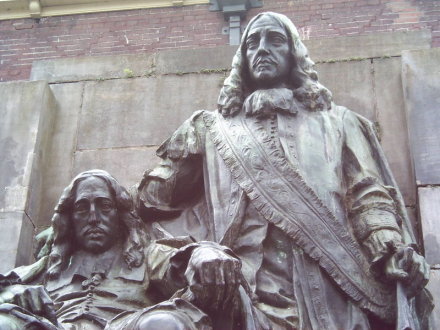
That ominous mob got its spectacle this date in 1672, lynching the Dutch Republic’s longtime de facto head of state, Johan de Witt along with his brother Cornelis/Cornelius.
A statue of Johan (standing) and Cornelis de Witt in their native Dordrecht.
The mercantile powerhouse that was the 17th century Dutch Republic was the stage for a long-running conflict between the Orange monarchists (hence the soccer uniforms) and the Republican merchant class.
With the sudden death of the young William II, Prince of Orange in 1650, leaving the (non-hereditary) executive office of stadtholder vacant, the Republicans became ascendant.
And the outstanding figure of the First Stadtholderless Period was Johan de Witt, scion of a Dordrecht merchant family powerful enough that William II had imprisoned de Witt’s own father during a power struggle.
While all these guys were landing themselves in their respective canons, Johan de Witt was trying to keep the age Golden.
Having only relatively recently broken free of Spain, the small country was an up-and-comer on the horns of a serious security dilemma: its leading commercial position put it into maritime competition with England, while its continental location made it vulnerable to the enormous army of the neighboring continental hegemon, France. Ultimately, even with its trade wealth, it did not have the resources to keep up with both of western Europe’s leading powers.
For a generation, de Witt’s statecraft kept the men of the Low Countries out of that predicament, while his brother Cornelis chipped in with a couple of timely naval victories. (Actually authored by Michiel de Ruyter, but Cornelis rode shotgun.)
In 1654, Johan brought the First Anglo-Dutch War to a close, making with Oliver Cromwell a secret pact he was only too happy to enforce never to allow William II’s son, the eventual William III, to be named stadtholder. Reason being: William III was the grandson of the Stuart king Cromwell beheaded, Charles I, and thus a potential claimant to the English throne. Both Protestant Republics had a distinct interest in keeping this monarchist well away from power. (Both would be sorely disappointed.)
A decade and a Stuart Restoration later, de Witt maintained (mostly) Dutch dominance of the seas in the Second Anglo-Dutch War, then held off France (with the help of a timely alliance with the recent adversary, England) in the War of Devolution.
In each case, he kept at least one of England or France on the sideline, or in his own camp.
But the Third Anglo-Dutch War was the charm — as it was also the Franco-Dutch War, and therefore 1672 was Rampjaar: disaster year. While the Dutch were aces on the waves, a massive French invasion easily overwhelmed them on terra firma.
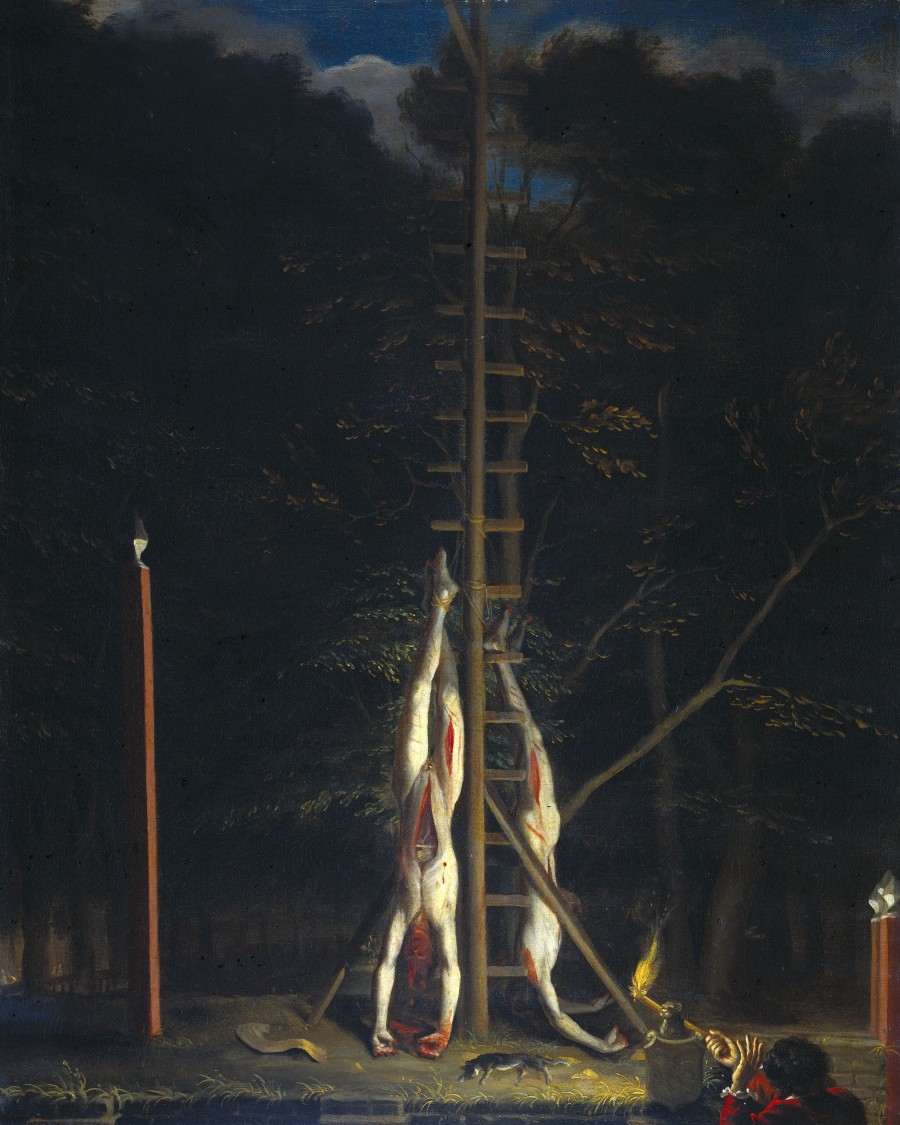
Detail view (click for the full image) of a grisly painting of the mutilated de Witt brothers strung up at The Hague. It’s attributed to Jan de Baen, who in better times took Johan de Witt’s portrait.
De Witt’s never-beloved mercantile oligarchy speedily collapsed with the military reverses, and the now all-grown-up William III was there to pick up the pieces to popular acclaim. Arrested for treason, Cornelis sustained torture without confessing, but when Johan visited him in prison — and William III incriminatingly withdrew the cavalry protecting the brothers — the mob quenched its fury with the de Witts’ blood.
every one of the miscreants, emboldened by his [Johan’s] fall, wanted to fire his gun at him, or strike him with blows of the sledge-hammer, or stab him with a knife or swords, every one wanted to draw a drop of blood from the fallen hero, and tear off a shred from his garments.
And after having mangled, and torn, and completely stripped the two brothers, the mob dragged their naked and bloody bodies to an extemporised gibbet, where amateur executioners hung them up by the feet.
Then came the most dastardly scoundrels of all, who not having dared to strike the living flesh, cut the dead in pieces, and then went about the town selling small slices of the bodies of John and Cornelius at ten sous a piece.
-Dumas
The word “ungrateful” comes to mind.
De Witt stood altogether on a lower plane than Cromwell. We regard him rather as a man of rare and singular talent, than as one of the chosen great ones of the earth, which Cromwell was. He stands far above the common run of men; and he was head and shoulders above nearly all the notable men of his time. He would have been greater if the movement of his limbs had been less burdened with the Dutch governing apparatus … He is not one whom the world can ever greatly admire or love.
(Here’s another, and here’s a 17th century volume de Witt himself coauthored.)
The rise of William III came with the decline of that Dutch Golden Age: the country fended off the immediate military threat, but it increasingly slipped behind its larger neighbors. Costly as was the Franco-Dutch War, it is a step on the path towards the present-day Europe, and this gives us enough excuse to notice that the Eurovision lead-in tune is actually from a Te Deum composed to mark its end.
But William’s own ascent to this wealthy sovereignty was just the beginning for him. Sixteen years later, the House of Orange’s champion vindicated Cromwell’s trepidation about him and gained a far more satisfactory position from which to do battle with his Gallic rival Louis XIV by stunningly overthrowing the Stuart dynasty and becoming King of England in the Glorious Revolution.**
* The Dutch remained the sole western contact of closed Japan until 1854, which is why Japan’s eventual period of scientific advancement became known as ‘Dutch Learning’.
** Albion did not forget the de Witts, either: according to this 1785 cant dictionary, the term “dewitted” had a 17th-18th century run in English to denote — well, exactly what happened to Cornelis and Johan.
This is the feast date, in both the Orthodox and Catholic traditions, of the Woman with Seven Sons — each of whom is supposed to have been put to death for refusing to break the Mosaic law by eating pork.
Although they are Jewish martyrs more than a century before Christ, they are revered most especially by the Christian faith that elbowed Judaism aside. Their story comes from 2 Maccabees, a “deuterocanonical” text that is part of the Old Testament but not part of the Hebrew Bible — for reasons having to do with the contingent process of formulating the canon.* (Short explanation | Long explanation)
Whether sent from the Lord or not, this story features the righteous resistance of the faithful family against Antiochus IV Epiphanes, ruler of the Seleucid Empire, which was one of the successor Hellenistic states to Alexander the Great’s conquests.
In 2 Maccabees (and also in 1 Maccabees, which covers the same period, though not this specific martyrdom), Antiochus IV is making an unwelcome pro-heathen intervention in a Jewish civil war on the side of the hellenizers as against the hidebound traditionalists. This comes to attempting “to compel the Jews to depart from the laws of their fathers, and not to live after the laws of God: And to pollute also the temple in Jerusalem, and to call it the temple of Jupiter Olympius.” (2 Maccabees 6:1-2; this chapter features a Whitman’s sampler of other faithful traditionalists slaughtered for various forms of adherence to the Law.)
Same deal with the dietary laws, whose countermanding edict Antiochus (being a wicked heathen king) is pleased to enforce by the most ghastly tortures.
Das Martyrium der sieben Makkabaer, by Antonio Ciseri, in an aptly classical setting.
1: It came to pass also, that seven brethren with their mother were taken, and compelled by the king against the law to taste swine’s flesh, and were tormented with scourges and whips.
2: But one of them that spake first said thus, What wouldest thou ask or learn of us? we are ready to die, rather than to transgress the laws of our fathers.
3: Then the king, being in a rage, commanded pans and caldrons to be made hot:
4: Which forthwith being heated, he commanded to cut out the tongue of him that spake first, and to cut off the utmost parts of his body, the rest of his brethren and his mother looking on.
5: Now when he was thus maimed in all his members, he commanded him being yet alive to be brought to the fire, and to be fried in the pan: and as the vapour of the pan was for a good space dispersed, they exhorted one another with the mother to die manfully, saying thus,
6: The Lord God looketh upon us, and in truth hath comfort in us, as Moses in his song, which witnessed to their faces, declared, saying, And he shall be comforted in his servants.
7: So when the first was dead after this number, they brought the second to make him a mocking stock: and when they had pulled off the skin of his head with the hair, they asked him, Wilt thou eat, before thou be punished throughout every member of thy body?
8: But he answered in his own language, and said, No. Wherefore he also received the next torment in order, as the former did.
9: And when he was at the last gasp, he said, Thou like a fury takest us out of this present life, but the King of the world shall raise us up, who have died for his laws, unto everlasting life.
10: After him was the third made a mocking stock: and when he was required, he put out his tongue, and that right soon, holding forth his hands manfully.
11: And said courageously, These I had from heaven; and for his laws I despise them; and from him I hope to receive them again.
12: Insomuch that the king, and they that were with him, marvelled at the young man’s courage, for that he nothing regarded the pains.
13: Now when this man was dead also, they tormented and mangled the fourth in like manner.
14: So when he was ready to die he said thus, It is good, being put to death by men, to look for hope from God to be raised up again by him: as for thee, thou shalt have no resurrection to life.
15: Afterward they brought the fifth also, and mangled him.
16: Then looked he unto the king, and said, Thou hast power over men, thou art corruptible, thou doest what thou wilt; yet think not that our nation is forsaken of God;
17: But abide a while, and behold his great power, how he will torment thee and thy seed.
18: After him also they brought the sixth, who being ready to die said, Be not deceived without cause: for we suffer these things for ourselves, having sinned against our God: therefore marvellous things are done unto us.
19: But think not thou, that takest in hand to strive against God, that thou shalt escape unpunished.
20: But the mother was marvellous above all, and worthy of honourable memory: for when she saw her seven sons slain within the space of one day, she bare it with a good courage, because of the hope that she had in the Lord.
21: Yea, she exhorted every one of them in her own language, filled with courageous spirits; and stirring up her womanish thoughts with a manly stomach, she said unto them,
22: I cannot tell how ye came into my womb: for I neither gave you breath nor life, neither was it I that formed the members of every one of you;
23: But doubtless the Creator of the world, who formed the generation of man, and found out the beginning of all things, will also of his own mercy give you breath and life again, as ye now regard not your own selves for his laws’ sake.
24: Now Antiochus, thinking himself despised, and suspecting it to be a reproachful speech, whilst the youngest was yet alive, did not only exhort him by words, but also assured him with oaths, that he would make him both a rich and a happy man, if he would turn from the laws of his fathers; and that also he would take him for his friend, and trust him with affairs.
25: But when the young man would in no case hearken unto him, the king called his mother, and exhorted her that she would counsel the young man to save his life.
26: And when he had exhorted her with many words, she promised him that she would counsel her son.
27: But she bowing herself toward him, laughing the cruel tyrant to scorn, spake in her country language on this manner; O my son, have pity upon me that bare thee nine months in my womb, and gave thee such three years, and nourished thee, and brought thee up unto this age, and endured the troubles of education.
28: I beseech thee, my son, look upon the heaven and the earth, and all that is therein, and consider that God made them of things that were not; and so was mankind made likewise.
29: Fear not this tormentor, but, being worthy of thy brethren, take thy death that I may receive thee again in mercy with thy brethren.
30: Whiles she was yet speaking these words, the young man said, Whom wait ye for? I will not obey the king’s commandment: but I will obey the commandment of the law that was given unto our fathers by Moses.
31: And thou, that hast been the author of all mischief against the Hebrews, shalt not escape the hands of God.
32: For we suffer because of our sins.
33: And though the living Lord be angry with us a little while for our chastening and correction, yet shall he be at one again with his servants.
34: But thou, O godless man, and of all other most wicked, be not lifted up without a cause, nor puffed up with uncertain hopes, lifting up thy hand against the servants of God:
35: For thou hast not yet escaped the judgment of Almighty God, who seeth all things.
36: For our brethren, who now have suffered a short pain, are dead under God’s covenant of everlasting life: but thou, through the judgment of God, shalt receive just punishment for thy pride.
37: But I, as my brethren, offer up my body and life for the laws of our fathers, beseeching God that he would speedily be merciful unto our nation; and that thou by torments and plagues mayest confess, that he alone is God;
38: And that in me and my brethren the wrath of the Almighty, which is justly brought upon our nation, may cease.
39: Than the king’ being in a rage, handed him worse than all the rest, and took it grievously that he was mocked.
40: So this man died undefiled, and put his whole trust in the Lord.
41: Last of all after the sons the mother died.
42: Let this be enough now to have spoken concerning the idolatrous feasts, and the extreme tortures.
The upshot of the Maccabees texts is the revolt of Judas Maccabeus against the Seleucids, the episode that gives us Hanukkah, when that “temple of Jupiter Olympius” was rededicated back to YHWH.
And though not specifically because of the Holy Maccabees, the start of that revolt is the very next thing to occur in the text,** at the start of chapter 8:
1: Then Judas Maccabeus, and they that were with him, went privily into the towns, and called their kinsfolks together, and took unto them all such as continued in the Jews’ religion, and assembled about six thousand men.
2: And they called upon the Lord, that he would look upon the people that was trodden down of all; and also pity the temple profaned of ungodly men.
3: And that he would have compassion upon the city, sore defaced, and ready to be made even with the ground; and hear the blood that cried unto him,
4: And remember the wicked slaughter of harmless infants, and the blasphemies committed against his name; and that he would shew his hatred against the wicked.
And then, of course, it’s the good guys’ turn to start killing.
* It is worth noting that deuterocanonical books aren’t part of the Old Testament for most Protestants; Martin Luther declared himself “so great an enemy to the second book of the Maccabees, and to Esther, that I wish they had not come to us at all, for they have too many heathen unnaturalities.”
** The book’s chronology is scarcely rigorous, but if the episode is considered historical, it would have occurred in 167 B.C.E. (the year the Maccabean revolt began) or the few years before, reaching back to Antiochus’s anti-Mosaic injunctions c. 175 B.C.E.
On this date in 1570, Russian tsar Ivan IV Grozny — Ivan the Terrible — carried out one of his most infamous and horrible atrocities with hundreds executed on Red Square.
Ivan the Terrible, by Viktor Vasnetsov. (Cropped image; click for the full painting.)
We find ourselves in 1570 almost a quarter-century into the reign of this complicated, frightening figure. It is the oprichnina, the bloodiest spell of Ivan’s authority: years of torture, purges, and political violence vividly symbolized by the tsar’s black-clad personal Gestapo, the oprichniki.
“Children of darkness,” the exiled noble Kurbsky called these dreadful Praetorians. “Hundreds and thousands of times worse than hangmen.”
A dangerous time to draw breath, but a particularly dangerous time for any boyar, men of the feudal nobility whom Ivan set his iron hand to mastering. This, after all, was the historical task of monarchs at this time, and it was everywhere accomplished with bloodshed.
Already stung by the defection — and subsequent nasty correspondence — of one such noble, Andrei Kurbsky, Ivan was downright paranoid about disloyalty during the long-running Livonian War against Muscovy’s western neighbors, Poland, Lithuania and Sweden.
Ivan became ever readier to equate dissent with treason and to ascribe his military reverses to conspiracies on the part of his aristocratic commanders, rather than to the shortcomings of his war-machine in general. A vicious circle thus emerged – of military failures; suspected treachery; the suspects’ fear of condemnation and liquidation, and flight abroad.*
The innocent have nothing to fear!
Taking it into his head that the ancient, rival city of Novgorod — one of the cradles of Russian civilization — was scheming to deliver itself to the newly-formed Polish-Lithuanian Commonwealth, Ivan led an army there that in early 1570 massacred thousands of Novgorodians.**
He wasn’t done yet.
Returning to Moscow with his blood up, Ivan subjected his numerous Novgorodian prisoners to a savage regimen meant to uncover the extent of their nefarious doings. And it wasn’t long before the locals (who were, after all, just as suspect in Ivan’s eyes) got swept up in it, too. Politically-motivated magistrates with torture-induced confessions and denunciations did the dreadful things they always do.
This date in 1570 turned out to be the affair’s crowning carnival of barbarism.
“The Russian capital had seen many horrors in its time,” wrote Soviet-era historian A.A. Zimin (cited in this biography of Ivan IV). “But what happened in Moscow on 25 July, in all its cruelty and sadistic refinement, outdid all that had gone before and can perhaps be explained only by the cruel temperament and the sick imagination of Ivan the Terrible.”
Ivan Viskovaty (English Wikipedia link | French) had been one of Russia’s leading men on foreign affairs for a generation, as well as a longstanding ally of the tsar.
Nevertheless, he would be the first and most prominent victim on Red Square this date. Viskovaty’s rival Andrei Shchelkalov, who succeeded Viskovaty as the foreign affairs minister, neatly stitched up the senior diplomat for being in on the Novgorod “plot” as well as more exotic schemes to hand over southern cities to Turkey and the Khanate.
On July 25, in the middle of the market-place, eighteen scaffolds were erected, a number of instruments of torture were fixed in position, a large stack of wood was lighted, and over it an enormous cauldron of water was placed. Seeing these terrible preparations, the people hurried away and hid themselves wherever they could, abandoning their opened shops, their goods and their money. Soon the place was void but for the band of opritchniks gathered round the gibbets, and the blazing fire. Then was heard the sound of drums: the Tsar appeared on horseback, accompanied by his dutiful son, the boyards, some princes, and quite a legion of hangmen. Behind these came some hundreds of the condemned, many like spectres; others torn, bleeding, and so feeble they scarce could walk. Ivan halted near the scaffolds and looked around, then at once commanded the opritchniks to find where the people were and drag them into the light of day. In his impatience he even himself ran about here and there, calling the Muscovites to come forward and see the spectacle he had prepared for them, promising all who came safety and pardon. The inhabitants, fearing to disobey, crept out of their hiding-place, and, trembling with fright, stood round the scaffold. Some having climbed on to the walls, and even showing themselves on the roofs, Ivan shouted: “People, ye are about to witness executions and a massacre, but these are traitors whom I thus punish. Answer me: Is this just?” And on all sides the people shouted approval. “Long live our glorious King! Down with traitors! Goiesi, Goida!”
Ivan separated 180 of the prisoners from the crowd and pardoned them. Then the first Clerk of the Council unrolled a scroll and called upon the condemned to answer. The first to be brought before him was Viskovati, and to him he read out: “Ivan Mikhailovich, formerly a Counsellor of State, thou hast been found faithless to his Imperial Highness. Thou has written to the King Sigismund offering him Novgorod; there thy first crime!” He paused to strike Viskovati on the head, then continued reading: “And this thy second crime, not less heinous than thy first, O ungrateful and perfidious one! Thou hast written to the Sultan of Turkey, that he may take Astrakhan and Kazan,” whereupon he struck the condemned wretch twice, and continued: “Also thou hast called upon the Khan of the Krim Tartars to enter and devastate Russia:† this thy third crime.” Viskovati called God to witness that he was innocent, that he had always served faithfully his Tsar and his country: “My earthly judges will not recognize the truth; but the Heavenly Judge knows my innocence! Thou also, O Prince, thou wilt recognise it before that tribunal on high!” Here the executioners interrupted, gagging him. He was then suspended, head downwards, his clothes torn off, and, Maluta Skutarov, the first to dismount from his horse and lead the attack, cut off an ear, then, little by little, his body was hacked to pieces.
The next victim was the treasurer, Funikov-Kartsef, a friend of Viskovati, accused with him of the same treason, and as unjustly. He in his turn said to Ivan, “I pray God will give thee in eternity a fitting reward for thy actions here!” He was drenched with boiling and cold water alternately, until he expired after enduring the most horrible torments. Then others were hanged, strangled, tortured, cut to pieces, killed slowly, quickly, by whatever means fancy suggested. Ivan himself took a part, stabbing and slaying without dismounting from his horse. In four hours two hundred and been put to death, and then, the carnage over, the hangmen, their clothes covered with blood, and their gory, steaming knives in their hands, surrounded the Tsar and shouted huzzah. “Goida! Goida! Long live the Tsar! Ivan for ever! Goida! Goida!” and so shouting they went round the market-place that Ivan might examine the mutilated remains, the piled-up corpses, the actual evidences of the slaughter. Enough of bloodshed for the one day? Not a bit of it. Ivan, satiated for the moment with the slaughter, would gloat over the grief of the survivors. Wishing to see the unhapy wives of Funikov-Kartsef and of Viskovati, he forced a way into their apartments and made merry over their grief! The wife of Funikov-Kartsef he put to the torture, that he might have from her whatever treasures she possessed. Equally he wished to torture her fifteen-year-old daughter, who was groaning and lamenting at their ill fortune, but contented himself with handing her over to the by no means tender mercies of the Tsarevich Ivan. Taken afterwards to a convent, these unhappy beings shortly died of grief — it is said.
Thanks to this sort of wholesale purging, Ivan the Terrible became in the 20th century something of an allegorical shorthand for Joseph Stalin, whose ownreignofterror was a touchier subject for direct commentary. By that same token, and capturing the multifaceted meaning of the word Grozny, (both awful and awe-inspiring) Soviet patriotic mythology co-opted Ivan and his allegedly farsighted cruelty as a state- and nation-builder.
Sergei Eisenstein’s Ivan the Terrible — a planned trilogy of films of which only two were completed, due to Stalin’s distaste for his greatest director’s interpretation — captures a view of Ivan IV Grozny from the shadow of wartime Stalinist Russia. (The two extant films can be seen in their entirety on YouTube, and are well worth the watching.)
The more conventional take is that, especially by his later years, the guy’s tyrannical paranoia had metastasized enough to send him plum off his rocker. In 1581, that favorite son who had accompanied Tsar Ivan to Novgorod, and to Red Square on this date, piqued his father’s rage during an argument — and in a fury, Ivan struck him dead.
Detail view (click for the full, gorgeous canvas) of Ilya Repin‘s emotional painting of Ivan the moment after he has mortally wounded his son. Incited to his own act of lunacy by the tsar’s riveting madman expression, iconographer and Old Believer Abram Balashov slashed these faces with a knife (image) in the Tretyakov Gallery in 1913.
The capable young heir’s senseless death effectively spelled the end for Russia’s Rurikid Dynasty descended from the half-mythical Norse founder of Rus’, Rurik. That argument from order and progress in favor of Ivan’s ferocity inconveniently runs up against the fact that what he actually bequeathed to the next generations of Russians was the rudderless, war-tornTime of Troubles, when rival claimants struggled for the throne.
Ivan IV is sure to remain a controversial, compelling figure for many a year to come. Released just a few months ago as of this writing, and in a time when Ivan comparisons are coming back into vogue for the ominous contemporary Russian state, Pavel Lungin’s Tsar (review) mounts a gory critique of its subject.
* Jonathan Shepard, book review in The Historical Journal, vol. 25, no. 2 (June 1982).
** Novgorod by 1570 was not as important as it had once been, but Ivan’s sack massively depopulated the city, essentially destroying its remaining strength as an independent commercial center.
† The allied Ottoman Turks and Crimean Khanate did in fact devastate Russia (and pillage Moscow) the very next year.
En celuy an, le samedi premier jour de juillet, fu fait à Paris une horrible justice, — né onques mais n’avoit esté faite semblable au royaume de France. Combien que nous lisons que l’empereur Henri en fist une autèle, et en Angleterre aussi, une autre fois en avint une autre semblable, toutes voies à Paris onques mais n’avoit esté telle , — d’un bourgois de Compiègne appellé Symon Pouilliet, assez riche, qui fu jugié à mort et mené aux halles de Paris; et fu estendu et lié sur un estal de bois, ainsi comme la char en la boucherie, et fu ylec copé et desmembré, premièrement les bras, puis les cuisses et après le chief ; et après pendu au gibet commun où l’en pent les larrons. Et tout pour ce qu’il avoit dit, si comme l’en luy imposoit, que le droit du royaume de France appartenoit mieux à Edouart, roy d’Angleterre, que à Phelippe de Valois. De laquelle mort tout honteuse, France pot bien dire la parole de Jhésucrist qui disoit : « Ci sont les commencemens des douleurs, » si comme il sera monstré par après.
The gist of the bolded bit:
a wealthy Compiègne bourgeois called Simon Pouilliet was broken and dismembered in Paris, and gibbeted on the common gallows. And all for saying that the right of the kingdom of France belonged more to Edward, king of England, that to Philippe of Valois.*
Come and see the violence inherent in the system!
There was cause, however, for the House of Valois to be oversensitive to Pouillet’s treasonable take on royal genealogy: it was at least plausibly true.
Edward’s interest in actualizing his nominal claim to the French throne had by this point precipitated the opening dynastic skirmishes of what would eventually (a hundred-plus years later) become remembered as the Hundred Years’ War.
And as the chronicle concludes on a note of melancholy, Simon Pouillet’s horrific butchery would be an omen of his realm’s coming sorrows.
Eight weeks later, the English sowed the battlefield of Crecy with the flower of French chivalry and established a foothold at Calais that would help sustain generations of bloodily inconclusive combat.
Then, from 1348, the Black Death ravaged Europe, bringing for its survivors the economic shock of a labor shortage, weird social movements like the flagellants, and a pervasive sense of fatalism that ate at humanity’s social bonds.
There’s no record whether the wind whistling through the remains of Simon Pouillet dangling on Montfaucon whispered “I told you so.”
* Pouillet had not acted on this notion — he’d merely been popping off, possibly while sauced. The absence of any actual intent on the speaker’s part, however, did not lessen the treason, as explained in The Law of Treason and Treason Trials in Later Medieval France:
The general royal position on treason by words was summed up in 1432 by Jean Barbin, king’s proctor in the Parlement of Poitiers, in the prosecution of the Fleming Hennequin Bize. ‘By word and by deed’, he began, ‘one commits the crime of lese-majesty: by deed when one makes an attempt on the person of the princeps; and by word when one speaks sinisterly of him or his acts.’ Barbin asserted furthermore that it was worse ‘to disparage by word than to injure by deed’, but he neglected to explain why.
On this date in 1716, legendary Sikh warrior Banda Singh Bahadur attained his martyrdom.
Born Lakshman Dev, the man who would become Banda Bahadur went on a spiritual wandering jag as a young man and chanced to be plucked out of hermitage by Sikh guru Gobind Singh.
When this guru’s efforts to make inroads for Sikh interests with the new Mughal Emperor Bahadur Shah foundered, the converted hermit (now returned to the martial exercises of his caste) was tasked with a punitive expedition against one of the more obnoxious governors.
The zealous general did his mentor one better, attracting thousands of sympathetic followers and carving out a Sikh kingdom in Punjab in the early 1710s.
This proto-state (forerunner of an actual state in the next century) was in due time outmuscled by the Mughals, capturing the rebels’ last redoubt by means of a perfidious assurance of leniency that would not be forthcoming. Not at all.
The captured were marched back to Delhi, along with the pike-mounted heads of their fallen comrades, and there subjected to grisly mass executions.
British diplomats making nice with the Mughal court at the time recorded the scene.
The great rebel Guru (Bandu, the Sikh) who has been for these twenty years so troublesome in the province of Lahore, is at length taken with all his family and attendance by the Subahdar, or Viceroy, of that province. Some days ago they entered the city laden with fetters, his whole attendants which were left alive being about 780,* all severally mounted on camels, which were sent out of the city for that purpose, besides about 2,000 heads stuck upon poles, being those who died by the sword inb attle. He was carried into the presence of the King, and from thence to a close prison. He at present has his life prolonged with most of his officers, in hopes to get an account of his treasure in several parts of his kingdom, and of those that assisted him, when afterwards he will be executed for the rest. There are one hundred each day beheaded. It is not a little remarkable with what patience they undergo their fate, and to the last it has not been found that one has apostatised from the new formed religion.
Their captain’s turn finally came this date when — spurning conversion to Islam, as had his fellows — he saw his son slaughtered before his eyes, then was hacked limb from limb.
On that day, following four days of torture, he was led to an executioner’s scaffold in Red Square in the company of his younger brother, Frol. The list of Razin’s crimes and then his sentence were read out to him. The punishment was to be “an evil death befitting the wicked — by quartering.” According to eyewitness accounts, Razin then crossed himself and submitted to the executioner. Normally, death by quartering requires that the executioner first chop off the right arm of the convicted man at the elbow, then his left leg at the knee, then the left arm at the elbow, then the right leg at the knee, ending the whole gruesome process by decapitation. In the case of Razin, the executioner made only the first two cuts when, for some reason — perhaps for fear of Razin’s power over the assembled multitude — he was told to end it all and chop off the head. To complete the sentence, the executioner then went back and severed the remaining limbs of the already headless Razin. The limbs and the severed head were taken to Bolotnaia ploshchad’ across the Moscow River and displayed on spikes. The body was thrown to the dogs. Frol, who was supposed to be executed in a similar manner, began screaming his willingness to cooperate with the authorities midway through his brother’s execution. He was led back to prison, interrogated further, and executed on 26 May 1676.
Marshaling the underclasses (literally, the “naked ones”: the Cossacks had class issues) in the semi-lawless southern reaches of the realm, Razin segued smoothly from from a career of brigandage into suzerainty over a quasi-state around the Volga with the help of a sympathetic peasant uprising.
Razin’s revolt had scope and duration enough to trounce a Persian expedition against him. He bestrode the Volga — sailed the Caspian — raided foreign lands — established a Cossack republic.
It was an impressive run while it lasted. But like most peasant revolts, it was ultimately on the receiving end of the trouncing.
Captured and hailed to Moscow for his demonstrative end, Razin’s story lives strong in Russian culture and folklore even though his body ended up in bits and pieces.
Best-recognized and most universally beloved is the folk tune “Ponizovaya Volnitsa”, which celebrates Stenka and the mighty waterway that bore him to posterity, the Volga.
* June 6, 1671 per the Julian calendar. It was June 16 in those countries that had already adopted the Gregorian calendar.
On this date in 1597, Cossack Severyn Nalyvaiko was publicly quartered in Warsaw.
Nalyvaiko organized “unregistered” Cossacks in Poland’s eastern realms, modern-day Belarus and Ukraine, into what became a significant rebellion. (Poland’s efforts to “register” and thereby control Cossacks would continue to cause tension in the years ahead.)
The Poles outmuscled him, and here he is.
However, because longer-term historical trends were not so favorable to the Polish-Lithuanian Commonwealth, Nalyvaiko rates a place as an early independence martyr for (east) Slavic resistance to Warsaw’s Polish imperialism.
Not only does he get a spot on present-day Ukrainian coinage (as pictured); 19th century Russian poet Kondraty Ryleyev, who would himself be executed for his part in the Decembrist plot, lyricized Nalyvaiko’s death as heroic national sacrifice … and simultaneously elevated the poet’s own prophesied fate for himself.
“In Ryleyev’s poetry, fate — romantic fate — is not simply personal and individual,” writes Lauren Leighton. “The fate of his heroes, and so his own fate, is raised to the level of national-historical tragedy. By welcoming his fate and dying for his land, Nalivayko ennobles his people.”
Say not, thou holy man, again
That this is sin, thy words are vain,
Be it a fearful mortal sin
Worse than all crimes that e’er have been,
I care not — for could I but see
My native land at liberty,
Could I but see my race restored
To freedom from the foreign horde,
All sins would I upon me take
Without one sigh for Russia’s sake. —
The crimes of all the Tartar race,
The apostates Uniates‘ treason base,
The sins of every Jew and Pole —
All would I take upon my soul.
Try not with threats my mind to shake,
Persuasive words no change can make,
For hell to me is to have viewed
My loved Ukraine in servitude;
To see my fatherland set free,
This, this alone, is heaven for me!
E’en from the cradle was my breast
With love of liberty possessed;
My mother sang me glorious lays
Of those long-past historic days,
Whose memory yet lives ‘mongst men,
For no fear seized on Russians then,
None cringed before the haughty Pole;
The iron of a foreign yoke
Weighed upon no free Russian’s soul,
None cowered beneath a stranger’s stroke;
Cossacks were then the Pole’s allies,
Bound each to each in equal ties,
Such as free men would well beseem —
Now all is vanished like a dream.
Cossacks long since had learned to know
How into tyrants friends may grow;
The Lithuanian, and the Jew,
The Pole, and all the Uniate crew,
Like ravening crows around their prey
Seize us, and tear our limbs away.
The voice of law no more is heard
In Warsaw’s city, none are stirred
At hearing all a nation’s wail,
Our mourning voices nought avail,
And now within me burns a flame
Of hatred for the Polish name —
A fierce hot flame of raging fire —
My look is wild with passion dire
And frenzied wrath; the soul in me
Sickens for love of liberty.
One thought have I by night and day,
Which like a shadow haunts my way,
E’en where the steppes lie silent, bare,
Unresting it pursues me there;
E’en in the soldier’s camp, and when
The battle’s whirl, and tramp of men,
Around me roar with maddening rush,
I hear it still, and in the hush
Of the still church’s vaulted gloom,
Sound in my ears the words of doom
“‘Tis time,” the holy accents say,
“‘Tis time to sweep the foes away,
“O’er the Ukraine who bear their sway.”
I know full well the direful fate
Which must upon the patriot wait
Who first dare rise against the foe
And at the tyrant aim the blow.
This is my destined fate — but say
When, when has freedom won her way
Without the blood of martyrs shed,
When none for liberty have bled?
My coming doom I feel and know
And bless the stroke which lays me low
And, father, now with joy I meet
My death, to me such end is sweet.
On this date* in 1520, on his famous voyage of circumnavigation, explorer Ferdinand Magellan ordered the immediate execution of a mutinous captain.
Not to be trifled with.
Having alit just days before at the natural harbor of Puerto San Julien on the Brazilian Argentine coast (Magellan named it) with plans to winter there, the overweening Portuguese explorer faced an uprising of grumpy Spanish officers.
Gaspar Quesada, captain of the Concepcion, along with Luis de Mendoza of the Victoria and recently displaced San Antonio skipper Juan de Cartagena, seized some of the expedition’s ships during the night of April 1-2.
Since you know Magellan’s name five centuries later, you already know he quashed it.
As the sovereign of this fragile floating world, Magellan had little choice but to treat a challenge to his authority mercilessly.**
Though accounts are inconsistent, it seems Mendoza was boldly slain by one of Magellan’s men meeting him under color of “negotiation”.
Mendoza was then posthumously beheaded and quartered along with Gaspar Quesada. Juan de Cartagena was either executed as well, or else caught a “break”: some sources relate that, instead of executing Cartagena, Magellan had him marooned.
the twentieth of June [1578], wee harboured ourselues againe in a very good harborough, called by Magellan Port S. Julian, where we found a gibbet standing upon the maine, which we supposed to be the place where Magellan did execution upon some of his disobedient and rebellious company.
–From a member of the Francis Drake expedition. Just 12 days later and at the very same place, Drake visited a similar penalty for a similar offense upon one of his own crew.
* “‘The authorities’ are divertingly divergent on the precise date of these events,” says O.H.K. Spate in The Spanish Lake, referring specifically to the dates of the mutiny. “Denucé puts them on Easter Sunday and Monday, 1–2 April; Merriman on Easter Sunday and Monday, 8–9 April; Nowell on Palm Sunday and the next day, with the trial verdict on 7 April. By the Julian calendar, in use until 1582, the dates would be 1–2 April; by the Gregorian, ten days later. Pigafetta and Maximilian, who slur over the whole affair, give no dates at all. It is not of vast moment.” Clearly, O.H.K. Spate never had to write an almanac blog.
Anyway, there’s some primary sourcing on this affair here.
** Though Magellan made an example of the leaders, he pragmatically spared about 40 others after keeping them in chains and working the pumps for three months. After all, the man still needed to crew his ships.
On this date in 1781, the last name in Incan rebellion met a horrible end in the ancient Incan capital of Cusco.
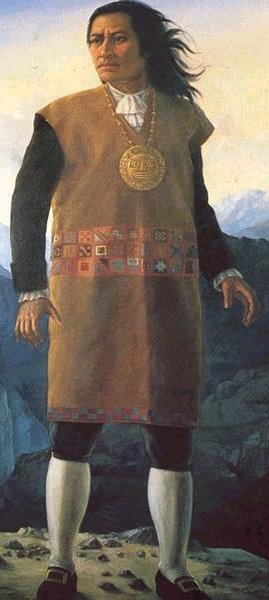
José Gabriel Condorcanqui — rechristened Tupac Amaru II, as he was a distant descendant of the last Incan king — was a member of the privileged indigenous population depended upon by the Spanish to administer the forced and extorted labor that made its New World empire worth having.
“From this day, no longer shall the Spanish feast on your poverty!”
This attention-grabbing entry onto the political chessboard was followed with an exemplary victory over Spanish forces. His revolt rapidly metastasized into an ethno-religious crusade, with all the accumulated bitterness of the Indians’ two-plus centuries maltreatment ferociously visited upon the Spanish.
It was a heady moment — but only a moment; within a few months, the Spanish had rallied and Tupac Amaru was betrayed into their hands.
The rebel had seized Incan symbology for his own purposes — speaking at ancient shrines, for instance — and the Spanish sentence against him included not only the inevitably horrific execution (of both Tupac Amaru and his wife and family) but a comprehensive and explicit programme of cultural annihilation to consign the Incan identity to the past. This lengthy sentence is well worth the read. (Sourced here, a pdf file; the bolded sections are my highlights.)
I must and do condemn José G. Túpac Amaru to be taken out to the main public square of [Cuzco], dragged out to the place of execution, where he shall witness the execution of the sentences imposed on his wife, Micaela Bastidas [Spanish link]; his two sons, Hipólito and Fernando Túpac Amaru; his uncle, Francisco Túpac Amaru; and his brother-in-law, Antonio Bastidas, as well as some of the principal captains and aides in his iniquitous and perverse intent or project, all of whom must die on the same day.
And once these sentences have been carried out, the executioner will cut out his tongue, and he will then be tied or bound by strong cords on each one of his arms and feet in such a way that each rope can be easily tied or fastened to others hanging from t he saddle straps of four horses, so that, in this position, each one of these horses, facing opposite corners of the square, will pull toward his own direction; and let the horses be urged or jolted into motion at the same time so that his body be divided into as many parts and then, once it is done, the parts should be carried to the hill or high ground known as “Picchu,” which is where he came to intimidate, lay siege to, and demand the surrender of this city; and let there be lit a fire which shall be prepared in advance and then let ashes be thrown into the air and a stone tablet placed there detailing his main crimes and manner of his death as the only record and statement of his loathsome action.
His head will be sent to the town of Tinta where, after being three days on the gallows, it shall be placed on a stake at the most public entrance to the town, one of his arms will go to the town of Tungasuca, where he was chief, where it will be treated in like manner, and the other in the capital of the province of Carabaya; one of the legs shall likewise be sent for the same kind of demonstration to the town of Libitaca in the province of Chumbilcas, while the remaining one shall go to Santa Rosa in the province of Lampa along with the affidavit and order to the respective chief magistrates, or territorial judges that this sentence be proclaimed publicly with the greatest solemnity as soon as it arrives in their hands, and on the same day every year thereafter; and they will give notice in writing of this to their superiors in government who are familiar with the said territories.
Since this traitor managed to arm himself and form an army and forces against the royal arms by making use of or seducing and leading with his falsehood the chiefs who are the second in command in the villages, since these villages, being of Indians, are not governed by such chiefs but rather by mayors who are elected annually by the vote or nomination of the chiefs: let these same electoral communities and the chief magistrates that care to give preference to candidates who know Spanish, and who are of the best behavior, reputation, and customs so that they will treat their subjects well and lovingly, honoring only those who have demonstrated honestly their inclination and faithfulness, eagerness, respect, obedience, submission, and gratitude to the greater glory of our great Monarch through the sacrificed of their lives, properties, or ranches in deference of their country or religion, receiving with brave disdain the threats and offers of the aforesaid reel leader and his military chiefs, yet taking care that these elected leaders are the only ones with the right to the title of chief or governor of their ayllus [communities] or towns, and that they cannot transmit their position to their children or other family members.
To this same end, it is prohibited that the Indians wear heathen clothes, especially those who belong to the nobility, since it only serves to symbolize those worn by their Inca ancestors, reminding them of memories which serve no other end than to increase their hatred toward the dominant nation; not to mention that their appear is ridiculous and very little in accordance with the purity of our relics, since they place in different parts images of the sun, which was their primary deity; and this prohibition is to be extended to all the provinces of this southern America, in order to completely eliminate such clothing, especially those items which represent the bestialities of their heathen kings through emblems such and the unco, which is a kind of vest; yacollas, which are very rich blankets or shawls of black velvet or taffeta; the macapaycha, which is a circle in the shape of a crown from which they hand a certain emblem of ancient nobility signified by a tuft or tassel of red-colored alpaca wool, as well as many other things of this kind and symbolism. All of this shall be proclaimed in writing in each province, that they dispose of or surrender to the magistrates whatever clothing of this kind exists in the province, as well as all the paintings or likenesses of their Incas which are extremely abundant in the houses of the Indians who consider themselves to be nobles and who use them to prove their claim or boast of their lineage.
These latter shall be erased without fail since they do not merit the dignity of being painted in such places, and with the same end in mind there shall also be erased, so that no sign remains, any portraits that might be found on walls or other solid objects; in churches, monasteries, hospitals, holy places or private homes, such duties fall under the jurisdiction of the reverend archbishops or bishops of both viceroyalties in those areas pertaining to the churches; and in their place it would be best to replace such adornments with images of the King and our other Catholic sovereigns should that be necessary. Also, the ministers and chief magistrates should ensure that in no town of their respective provinces be performed plays or other public functions of the kind that the Indians are accustomed to put on to commemorate their former Incas; and having carried out the order, these ministers shall give a certified account to the secretaries of the respective governments. In like manner shall be prohibited and confiscated the trumpets or bugles that the Indians use for their ceremonies and which they call pututos, being seashells with a strange and mournful sound that celebrate the mourning and pitiful memorial they make for their antiquity; and there shall also be prohibited the custom of using or wearing black clothing as a sign of mourning, a custom that drags on in some provinces in memory of their deceased monarchs and also of the day or time of the conquest which they consider disastrous and we consider fortunate since it brought them into the company of the Catholic Church and the very loving and gentle domination of our Kings.
With the same goal it is absolutely forbidden that the Indians sign themselves as “Incas,” since it is a title that anyone can assume but which makes a lasting impression on those of their class; and it is ordered, as is required of all those who have genealogical trees or documents that prove in some way their descent, that they produce them or send them certified and without cost by mail to the respective secretaries of both viceroyalties so that the formalities may be observed by those persons responsible to their excellencies the viceroys, consulting His Majesty where necessary according to each case; and the chief magistrates are charged to oversee the fulfillment of such requirements, to seek out and discover anyone who does not observe them correctly, in order to have it done to collect the documents with the aim of sending them to the proper authorities after giving their owners a receipt.
And so that these Indians renounce the hatred that they have conceived against the Spaniards, and that they adhere to the dress which the laws indicate, adopting our Spanish customs and speaking Castilian [Spanish], we shall introduce more vigorously than we have done up to now the use of schools, imposing the most rigorous and fair penalties on those who do not attend once enough time has passed for them to have learned the language; the duties and responsibilities involved in this plan going to the very reverend ecclesiastical prelates so that, in the opposition between parishes and doctrinas, they take care that those candidates bring affidavits from the provincial judges as to the numbers of people who speak the Said Castilian in those provinces … it being left up to the sovereign discretion of His Majesty to reward and honor those towns whose inhabitants have rendered, under the present circumstances, their due loyalty and faithfulness.
Finally, the manufacture of cannons of all kinds shall be prohibited under the penalty that any noble found manufacturing such items will be sentenced to ten years of prison in one of the presidios in Africa and any commoner will receive two hundred lashes as well as the same penalty for the same time period; reserving for a future time a similar resolution with regards to the manufacture of powder. And since there cannons of almost every caliber in the many ore-crushing mills and timber yards in these provinces, they will be gathered up by the magistrates once of the pacification of this uprising has been completely terminated in order to give account of them to the respective captaincy general so that he may determine whatever use he deems proper for them. Thus have I visualized, ordered, and signed: this is my final judgment.
José Antonio de Areche.
Tupac Lives.
The Spanish campaign to eradicate his name and identity didn’t exactly have legs.
The savagery of the crackdown helped generate Incan support for the rebellions that would shake off Spanish authority in the generations to come. He entered the official iconography of the post-colonial state, and can be found on Peruvian currency.




 Nalyvaiko organized “unregistered” Cossacks in Poland’s eastern realms, modern-day Belarus and Ukraine, into what became a significant rebellion. (Poland’s efforts to “register” and thereby control Cossacks would


 José Gabriel Condorcanqui — rechristened