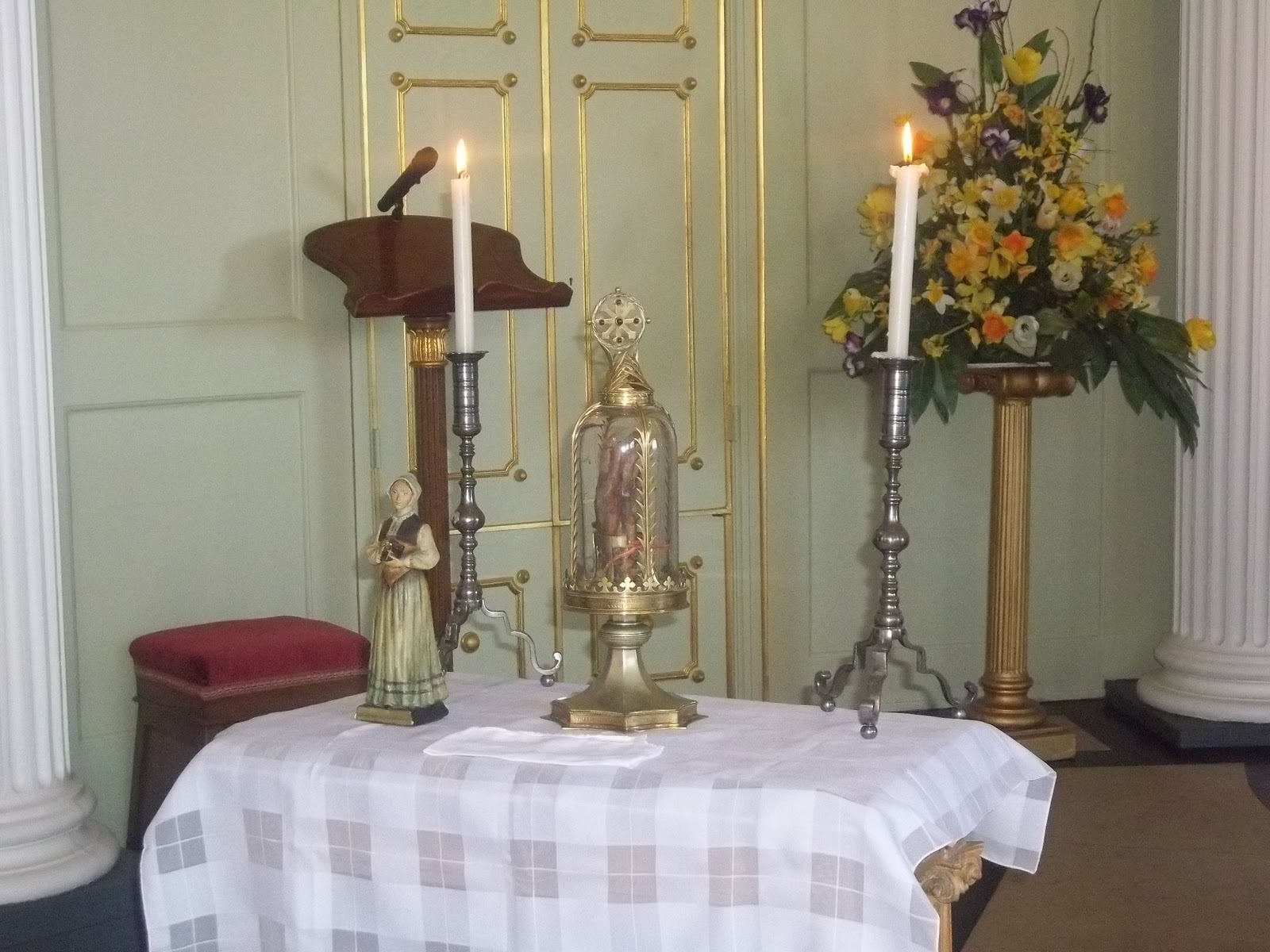
1537: Jurgen Wullenwever, Burgermeister of Lubeck

On this date in 1537, Jürgen Wullenwever was decapitated and quartered at Wolfenbüttel.

Photo by Agnete (Own work) [GFDL (http://www.gnu.org/copyleft/fdl.html) or CC-BY-SA-3.0 (http://creativecommons.org/licenses/by-sa/3.0)], via Wikimedia Commons

Wullenwever (English Wikipedia entry | German) was a merchant from Hamburg who came to the fore of a popular Lutheran movement in the Hanseatic port of Lübeck that claimed the power of its old aristocratic council for the city’s burghers.

In this capacity, Wullenwever maneuvered — vainly as it turned out — to arrest the century-long wane of the city’s influence. Lubeck in its day had been “the Queen of the Hanseatic League”. Come 16th century, it was struggling to maintain its trading preeminence against the inroads of Dutch merchants and the fragmentation of the once-mighty Hanse.

This project was doomed in its conception — there was nothing Lubeck could really have done to hold back the historical developments happening around it — and bungled in its execution. The merchant magnates of Wullenwever’s democratic coalition grew suspicious of (too-)popular religiosity.

And Wullenwever’s political high-wire act involved arrangements of convenience with the Anabaptist commune of Münster — spurring rumors of his own radical baptist conversion* — and fomenting Catholic peasant uprisings to meddle in the succession of the Danish-Swedish crown. Whatever else one could say of him, one can’t fault him for a want of daring, a quality that stood him in good stead with romantic era writers.

But Wullenwever’s allies lost their fights, and the political coalition that supported his municipal leadership soon broke up under the pressure of events.

The aristocratic party re-took power in 1535 and didn’t immediately persecute Wullenwever. But the hostile Archbishop of Bremen eventually seized the man on his territory and turned him over to a Catholic Saxon duke for punishment.

* I’m certainly not a specialist, but I’m skeptical of the claim in some sources that Wullenwever was an Anabaptist Manchurian candidate type. Wullenwever confessed to a great Anabaptist scheme … but that was under torture of enemies determined to do him to death, and it was retracted before his execution. The claim implies that all of northern Germany might have gone over to a radically democratic Anabaptism had not the ancien regime overthrown the Burgermeister, and for that reason it’s gained Wullenwever the surprising latter-day embrace of nationalists and revolutionaries.

On this day..

1459: Pietro di Campofregoso, former Doge of Genoa, stoned to death

On this date in 1459, the former Doge of Genoa Pietro di Campfregoso was stoned to death by his city’s enraged populace.

This Pietro (English Wikipedia entry | Italian) succeeded his cousin to the merchant oligarchy’s head in 1450. Genoa resided in a crab-bucket of rival peninsular and Mediterranean powers, and Pietro was distinctly out-scuttled in the 1450s.

Genoa unsuccessfully supported the Byzantine Empire when it was decisively conquered by the rising Ottomans in 1453, and the Genoans found themselves consequently rousted from a number of Aegean and Black Sea possessions. Meanwhile, fickle Italian fortune brought Neapolitan troops to the walls of Genoa and eventually forced Pietro to submit to a humiliating French protectorate under Charles VII.*

By this point, Genoa was also in the sights of Francesco Sforza, and when Pietro had to abdicate and blow town he went to the protection of the the great condottiero in Milan. There he joined a Sforza-backed plot to pull Genoa out of the French orbit and into that of the Duke of Milan, which coup utterly failed and got Pietro di Campofregoso lynched/murdered/summarily put to death near the Porta Soprana.

If only he’d been able to avoid that fate, he would have seen the plot come to fruition: when the French-supported Duke of Calabria left Genoa to attempt to re-establish his family’s foothold in Naples, Sforza’s agents got hold of the city and installed yet another Fregoso cousin, Spinetta, as the Milanese puppet.

The Campofregosos (or simply Fregosos) were far from finished with their misadventures in power. Pietro’s predecessor and kinsman Lodovico found his way back into office after Spinetta, but in 1462 the Genoan archbishop Paolo Fregoso (also kin!) arrested the sitting doge, and replaced him in office with his own self. Paolo was doge briefly in 1462, and again 1463-64, and then once again in the 1480s, being repeatedly deposed and exiled in between shifts.

* That’s the king at the end of his life whom Joan of Arc rallied to when he was a mere dauphin.

On this day..

1781: Francois Henri de la Motte, French spy

On this date in history, the French spy Francois Henri de la Motte was hanged at Tyburn — and, only after hanging, his head was cut off and his heart carved out. Old Blighty was going a bit soft: it didn’t do actual drawings and quarterings at this late enlightened date. (Well, just one.)

Those old enemies Britain and France had renewed hostilities over the American Revolution, which France backed to twist the neighboring lion’s tail.
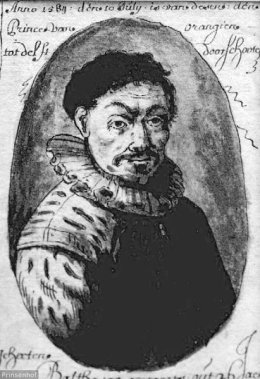
De la Motte was a French expat living in England, in which capacity he supported the statecraft of his native realm by coyly picking up British army and naval dispositions and sending word home of who was going where, when. His intelligence allegedly enabled the French navy to turn an unusually aggressive gambit against the British in an engagement in the East Indies, with the loss of 207 souls.

“In the whole history of mankind, an instance was not to be produced of a more ingenious, able, and industrious spy than Mr. De La Motte,” his prosecutors charged. (There’s an account of the trial here.)

Perhaps this was flattery, since the operation was not defeated by counterintelligence except de la Motte’s own counter-intelligence. The guy dropped a bunch of incriminating notes he had taken on naval movements in a staircase, and they were there snatched up by King George’s true subjects and forthwith sent their owner to Newgate. His English accomplice quickly turned Crown’s evidence

Days after the spy’s ignominious end, General Cornwallis’s army in the American south arrived from Charleston at Yorktown, Va., a deep-water port from which he meant to command the Chesapeake. There, Cornwallis was surrounded by an overwhelming force of both American rebels and their French armies. The British defeat at Yorktown that October clinched independence for the colonies.


De la Motte’s trial — accused perfidious Frenchman in danger of barbaric old-timey punishment — appears to be the model for the London trial against Charles Darnay depicted at the start of A Tale of Two Cities. See if this sketch by noted death penalty skeptic (but also death penalty obsessive) Charles Dickens doesn’t essentially depict Francois de la Motte’s situation:

“What’s coming on?”

“The Treason case.”

“The quartering one, eh?”

“Ah!” returned the man, with a relish; “he’ll be drawn on a hurdle to be half hanged, and then he’ll be taken down and sliced before his own face, and then his inside will be taken out and burnt while he looks on, and then his head will be chopped off, and he’ll be cut into quarters. That’s the sentence.”

“If he’s found Guilty, you mean to say?” Jerry added, by way of proviso.

“Oh! they’ll find him guilty,” said the other.

Charles Darnay had yesterday pleaded Not Guilty to an indictment denouncing him (with infinite jingle and jangle) for that he was a false traitor to our serene, illustrious, excellent, and so forth, prince, our Lord the King, by reason of his having, on divers occasions, and by divers means and ways, assisted Lewis, the French King, in his wars against our said serene, illustrious, excellent, and so forth; that was to say, by coming and going, between the dominions of our said serene, illustrious, excellent, and so forth, and those of the said French Lewis, and wickedly, falsely, traitorously, and otherwise evil-adverbiously, revealing to the said French Lewis what forces our said serene, illustrious, excellent, and so forth, had in preparation to send to Canada and North America.

Darnay is acquitted, obviously, as Dickens was only three chapters in and being paid for a novel-length serial.

On this day..

1584: Balthasar Gerard, assassin of William the Silent

“If you succeed in your enterprise, the King will fulfill all his promises, and you will gain an immortal name besides.”

Christoffel d’Assonleville, to Balthasar Gérard

After 4 days of torture, on this date in 1584, Balthasar Gérard (Geeraerts) finally met his end by beheading on the wheel.

Gérard managed to be both historically important and wholly forgettable: an assassin working for Spain against the Netherlands, his regicide was met with a predictably stiff punishment. Then, no fault of his own, the subsequent course of history** pushed the assassin into obscurity while elevating his prey.
A lawyer by trade, Gérard was a fervent Catholic and supporter of the Spanish crown, which controlled the territory up the coast through the present-day Netherlands. At the peak of its power, Spain’s monarchy — led by King Philip II — had significant cause for concern at the rise in Protestantism.

The Spanish were Europe’s paladins of staunch Catholicism, and the sight of her troops did little to endear Spain to her colonized neighbors to the North.

For both religious reasons and political ones, the Dutch were looking for a way out from under the Spanish thumb, and a former noble named William, Duke of Orange, was a major instigator in the struggle. In his collected letters and addresses from the period, An apology or defence of William the First of Nassau, William states that, starting in 1559, he became increasingly concerned with plans against Protestants by the Spanish monarchy.

That also happens to be the year William was bestowed with stadtholdership of Holland, Zeeland, and Utrecht; in effect, he controlled the Dutch coast.

Though he was known as William the Silent, the Duke was endowed with both financial resources and widespread popularity, and he didn’t keep his mouth shut when it came to Inquisition courts in his realms.†

When the head enforcer of that policy, Cardinal Antoine Perrenot de Granvelle, left town, William got even noisier — declaring before the Council of State that Spanish policies were squelching religious freedom.

In 1566, the nobleman signed onto the Compromise of Nobles and began funding insurgencies across the northern provinces. As religious unrest grew, Calvinists and Protestants in the French and Germanic portions of Spain’s holdings quickly formed up behind William. An early attempt in 1568 to invade the Netherlands using German mercenaries and French Huguenots failed, but the resultant executions of Egmont and Hoorn put Spain on a long and winding road toward defeat.

The Dutch War was afoot, with William leading the way.

It would take and dozens of small-scale military victories over the next 15 years (during which William declared himself a Calvinist and fully broke his Spanish ties) for the Dutch to move to independence. The 1580 Union of Utrecht and 1581 Act of Abjuration officially ousted King Phillip II from the Netherlands and installed a new government.

Needless to say, Phillip reciprocated William’s love.

In 1580, Spain’s top man put a price on William’s head. Juan de Jáuregui tried to collect two years later by shooting the stadtholder, but the man holding the new title of Prince William I of Nassau recovered, while de Jáuregui was killed on the spot.

With 25,000 crowns at stake, there were bound to be other takers.

Our man Balthasar Gérard started looking for a close encounter with William the Target. At first, he joined the army in Luxembourg, which didn’t get him very far. It was time to gin up a real plot, which Gérard shopped to the Duke of Parma, Alessandro Farnese, in April 1584. Though the Duke offered no funding for the operation — Gérard ponied up the startup money he needed for the trip — and held out little hope that the lawyer would be successful, he gave Gérard assurances that his family would be taken care of in case of disaster.

Gérard first presented himself to William in June as the son of a martyred Calvinist from France. On 8 July, he returned and, badly in need of new clothes, managed to beg 50 crowns for a new set.

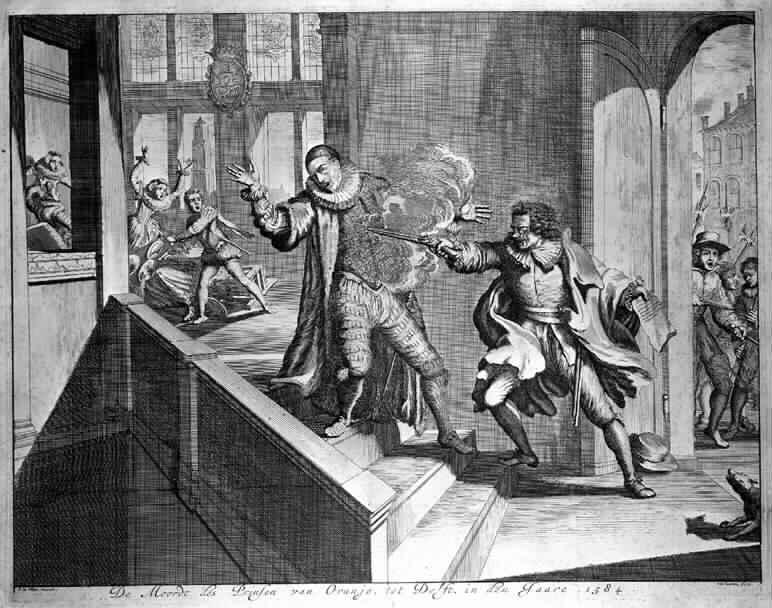
Instead, he bought a pair of pistols and, on 10 July, made history with a point-blank shot to William’s chest.


Detail view (click for the full image) of William the Silent’s 1585 assassination at the hands of Balthasar Gerard.

This assassination attempt didn’t fail. William became the second head of state to be killed by an assassin’s bullet,† — and his shooter the first such man to be juridically punished for the deed.

And, oh, how he was punished.

The regicide was beaten immediately after his capture, then subjected to a variety of cruelties, from wet leather boots which, when heated, both crushed and burned the feet, to daily floggings while hanging on a post outside the jail.

But on this day, his time of torture was up, and Gérard was finally put to death. You know, the usual:

It was decreed the right hand of Gerard should be burned off with a red-hot iron, that his flesh should be torn from his bones with pincers in six different places, that he should be quartered and disembowelled alive, that his heart should be torn from his bosom and flung in his face, and that, finally, his head should be taken off.


Gerard’s execution.

For all that he suffered as a regicide, Gérard left his family an impressive inheritance. Making good Parma’s assurances, King Phillip II gave them William’s former lands in three French provinces and took his siblings and their issue into his peerage.

Gérard’s cause carried on for another 60 years, until it was finally extinguished by the signing of the Peace of Münster by the Republic of the Seven United Netherlands and Spain.

* Foucault mistakenly identifies the torture as lasting 18 days, and the additional details he lays down for Gérard’s time on death row may be less-than-believable. However, all sources indicate that the tortures Gérard endured were quite spectacular, even by the standards of the day.

** See Dissident identities in the early modern Low Countries for a complete treatment of this period in The Netherlands and Belgium.

† For example, the city of Antwerp (Belgium), then under possession of the Spanish crown and considered the mercantile center of Europe for its vast sugar trade, featured over 100 executions for heresy from 1557-1562, twice as many as in all of Spain during that time.

‡ The first was James Stewart, 1st Earl of Moray, then Regent of Scotland. Stewart’s shooter, James Hamilton, escaped into exile, though others of the Hamilton clan answered for the murder.

On this day..

1608: St. Thomas Garnet, protomartyr of Stonyhurst

June 23, alas, was the end of the line for Jesuit Thomas Garnet, martyred on that date in 1608 for Catholic proselytizing in England.

Now accounted a saint and one of the Forty Martyrs of England and Wales, Garnet was the nephew of Henry Garnet, a priest executed in 1606 for complicity in the November 5, 1605 Gunpowder Plot.

Thomas, too — then about 30 years old — was arrested during this same backlash, and put to torture for evidence against uncle Henry. Thomas had been exercising his covert ministry in England since 1599, after slipping English custody once before.

As a result of the Gunpowder Plot hubbub, Thomas Garnet was among 47 Catholic clerics shipped across the English Channel to Flanders in July 1606, where they were warned that they faced execution should they ever again be caught in England.

Thomas Garnet returned, of course. He was betrayed within weeks by another priest named Rouse — whom Garnet publicly forgave while being drawn, hanged, and quartered on this date in 1608. (His faith was treasonable because he refused to swear an oath of allegiance demanded of Catholics post-5.11.)

Garnet’s remains were translated back to his Catholic school on the continent. In more tolerant times, long after Garnet’s death, this English Jesuit school finally had liberty to relocate back to England proper. While Garnet’s relics were destroyed in the French Revolution, he remains the protomartyr (the first martyr associated with a place) of the venerable Stonyhurst College, now in Lancashire.

On this day..

2001: An adult actress stoned to death in Evin prison


(From the May 22, 2001 Eugene Register-Guard, which is also the source of the quoted text below.)

Sex workers face a struggle worldwide for labor rights and human rights. At the extreme end of the criminalization spectrum was the fate of the unidentified 35-year-old woman who, according to the Iranian newspaper Entekhab, “was partially buried in a hole at Tehran’s Evin prison and stoned to death Sunday.”

She had been arrested eight years before for acting in “obscene sex films,” which of course are as prevalent in Iran as everywhere else.

On this day..

1705: The Camisards Catinat and Ravanel

On this date in 1705, two men were burned at the stake and two others broken on the wheel — Camisards all, put to death in Nimes, France.

The Camisards* were French Protestants of the mountainous southern Cevennes region who make their entry into these pages because the crown in 1685 revoked the Edict of Nantes, France’s guarantee of multiconfessional toleration.

Protestants were going to be bullied into conversion — or, in many cases, flight. (London’s Spitalfields textile industry, for instance, got a welcome shot in the arm from refugee Huguenot weavers.)

In 1702, the Cevennes Protestants pushed back.

“A persecution unsurpassed in violence had lasted near a score of years,” Robert Louis Stevenson wrote in his 19th century travelogue of the region. “This was the result upon the persecuted; hanging, burning, breaking on the wheel, had been in vain; the dragoons had left their hoof-marks over all the countryside; there were men rowing in the galleys, and women pining in the prisons of the Church; and not a thought was changed in the heart of any upright Protestant.”

On July 24, 1702, the Catholic torturer-priest running this show was assassinated, and the Camisard revolt was on.

Two years of dirty neighbor-on-neighbor violence mostly petered out in 1704 with the loss of the Camisards’ two main leaders — Jean Cavalier, the brilliant peasant-turned-commander who was bought off by an army commission and a royal pension, and Roland Laporte, who was betrayed as by Judas for 200 pieces of gold.

Catinat and Ravanel were Cavalier’s lieutenants; according to Alexandre Dumas, Catinat was a peasant named Abdias Maurel who picked up his nickname after serving under Marshal Catinat in the War of Spanish Succession.

The prospect of a renewed rising drew them back — a bold and terrible stroke to mount a surprise massacre and kidnap the exiled English Duke of Berwick. Catinat returned from his hidey-hole in Geneva; Ravanel came the bush where he was the last notable Camisard commander in the field.

An informer spilled the secret and the conspirators were busted in Nimes before they could spring their trap.

They faced immediate trial and condemnation — Catinat and Ravanel, along with two younger fighters named Jonquet and Villas.

After a long bout of pre-execution torture on April 21 to reveal their conspirators,**

The next day, the 22nd April, 1705, they were taken from the prison and drawn to the place of execution in two carts, being unable to walk, on account of the severe torture to which they had been subjected, and which had crushed the bones of their legs. A single pile of wood had been prepared for Catinat and Ravanel, who were to be burnt together; they were in one cart, and Villas and Jonquet, for whom two wheels had been prepared, were in the other.

The first operation was to bind Catinat and Ravanel back to back to the same stake, care being taken to place Catinat with his face to windward, so that his agony might last longer, and then the pile was lit under Ravanel.

As had been foreseen, this precaution gave great pleasure to those people who took delight in witnessing executions. The wind being rather high, blew the flames away from Catinat, so that at first the fire burnt his legs only — a circumstance which, the author of the History of the Camisards tells us, aroused Catinat’s impatience. Ravanel, however, bore everything to the end with the greatest heroism, only pausing in his singing to address words of encouragement to his companion in suffering, whom he could not see, but whose groans and curses he could hear; he would then return to his psalms, which he continued to sing until his voice was stifled in the flames. Just as he expired, Jonquet was removed from the wheel, and carried, his broken limbs dangling, to the burning pile, on which he was thrown. From the midst of the flames his voice was heard saying, “Courage, Catinat; we shall soon meet in heaven.” A few moments later, the stake, being burnt through at the base, broke, and Catinat falling into the flames, was quickly suffocated. That this accident had not been forseen and prevented by proper precautions caused great displeasure to spectators who found that the three-quarter of an hour which the spectacle had lasted was much too brief a time.

Villas lived three hours longer on his wheel, and expired without having uttered a single complaint.

A hecatomb of Camisard executions followed, fed by the denunciations of frightened or avaricious people; still others were “merely” condemned to the galleys … bringing at last a sullen peace of arms to the turbulent province.

* Here’s a 19th century public domain novel about the whole Camisard business.

** While three bore the torture quietly, Villas coughed up the name Boeton de Saint-Laurent-d’Aigozre. This man, too, was arrested and executed.

On this day..

1567: Wilhelm von Grumbach, Landfrieden-breaker

On this date in 1567, Wilhelm von Grumbach was dismembered along with two of his followers in the marketplace of Gotha.

Grumbach (English Wikipedia entry | German) was the cantankerous German instigator of the aptly-named Grumbachsche Handel, a messy clash of rights and prerogatives at the hinge of the old feudal order and centralized princely authority.

Grumbach was a knight who’s invariably described as an “adventurer”. As a young man he fought in the Peasants War, but as he headed into middle age he became your basic penniless minor nobleman chafing at the failures and obstructed opportunities life threw at him.

The thing he could not abide losing was the disappearing right of the nobility to enter into a feud or vendetta. This scans to the modern like rank anarchy, but feuds were part of the tapestry of medieval German society, long codified in law — an obvious descendant of clan and tribal obligations out of which the muddle of feudal vassalage had formed. “The passion for liberty and rights,” says this volume, “ran amok in Germany. Churchmen, princes, burghers, and peasants all wanted their independence and readily resorted to declarations of feud to secure and defend their rights.”

The standing right for miscellaneous minor lords to start miscellaneous private wars was quite naturally one that princes were ever keen to restrict. After centuries of two-steps-forward, one-step-back efforts to deal with the feud, the 1495 Imperial Diet formally codified a ban on feuding known as the Ewiger Landfriede, or “perpetual peace”. In Poli Sci 101 terms, this is the state finally monopolizing legitimate violence.

As with dueling, however, official proscription did not end the practice. It was, indeed, Grumbach’s defeat and execution that would eventually be remembered as the decisive nail in the coffin for knightly feuds.

And so in Franconia where we lay our scene will civil blood make civil hands unclean …

Grumbach’s liege was Melchior Zobel von Giebelstadt, the Prince-Bishop of Wurzburg. (Still another confusing dimension of the political map, some princes of Germany’s many statelets were simultaneously ecclesiastical authorities. For purposes of this post, the “-Bishop” part doesn’t enter into it.)

Knights’ basic problem — the reason they were vulnerable to losing their wacky old-time rights — was poverty, and it was in money that Grumbach’s feud was rooted. Grumbach’s personal twist on this was being the sort of irascible coot who could carry a grudge so far as to get himself sawed into pieces over it.

Immediately upon assuming the Prince-Bishopric in 1544, Melchior Zobel von Giebelstadt forced Grumbach to return an unauthorized cash gift his predecessor had paid to the knight, and then stiffed said knight out of six villages whose revenues Grumbach sought by way of compensation.

He had to deal with Grumbach’s feud for the remainder of his term, which was also the remainder of his life … right up until Grumbach murdered him.

The disaffected knight hooked up with the margrave* Albert Alcibiades and started making a right mess in the middle of Europe with a 1552-54 mini-war. When Albert got thumped, Grumbach had to evacuate to France, and his holdings outside Wurzburg were plundered and/or destroyed by his foes.

So now the guy was even more aggrieved, and even more pfennigless.

He was downright vengeful about his feud at this point, although it’s noteworthy relative to that monopolization-of-violence trend that he was still the only one: in days of yore, intra-elite wars might have spawned multiple self-reproducing vendettas.

The grumpy Grumbach now gravitated to another patron,** the deposed elector of Saxony Johann Friedrich II — another dude who felt hard done by in the Holy Roman Empire.

Grumbach evened his score with Melchior von Zobel by having the Prince-Bishop killed in Wurzburg in April 1558. (In present-day Wurzburg, three Zobelsaulen markers commemorate the Prince-Bishop’s assassination, one on the very spot of the murder.)

But that still left the money, and we know Grumbach wasn’t the type to write off a debt. In 1563, he successfully invaded Wurzburg with 1,300 soldiers and at swordpoint forced from the city a concession restoring his property.

For Grumbach, it was to prove a Pyrrhic victory.

In principle, he had achieved a great vindication of the ancient right of the feud, and for the hard-pressed nobility against the realms’ many princes. If others of his station had rallied to that banner, what a whirlwind Germany would have reaped.

According to Hillay Zmora’s State and Nobility in Early Modern Germany: The Knightly Feud in Franconia, 1440-1567, however, Grumbach’s fellow-knights looked into this particular abyss and said “nein, danke.”

Grumbach was in fact hatching an extravagant scheme† to liberate the entire German nobility … from the yoke of the princes. It was a radical aristocratic utopia … nobles were not only to be protected by the [Holy Roman] emperor from the princes, but to help him subdue them once and for all and to establish an hereditary monarchy in Germany. But despite Grumbach’s best efforts to incite the Franconian nobility, they did not line up behind him. Guidied by the captain of the Franconian Circle (Kreis), Georg Ludwig von Seinsheim, who denounced Grumbach’s undertaking as ‘against God, law and the emperor’, they formally turned away from him in 1564. In the view of the majority of them, the Knighthood was to maintain its autonomy by respecting the equilibrium between emperor and princes, not by irresponsibly challenging the latter. And it was this view, reassuringly transmitted to the princes, which carried the day.

Grumbach was outlawed by the empire and in 1566-67 was overcome with his protector Johann Friedrich at Gotha. Both men spent he remainder of their lives as imperial prisoners, with the notable difference that Johann Friedrich had the pull to live out his natural ration of days while Grumbach went straight to the dungeon for torture and thence to the scaffold in the town that had lately been his last redoubt. There, Grumbach was ripped apart — his dying eyes beheld the executioner wrench the heart out of his very chest and taunt him: “Behold, Grumbach, thy false heart!” The late knight’s rotting quartered remains got nailed up around town to broadcast the unmistakable message:

The noble right to feud was dead.

* Hereditary military commander.

** Among their other capers, Grumbach and his patron Johann Friedrich conspired with Torben Oxe‘s nephew Peder Oxe to depose the Danish king Frederick II in favor of the king’s grand-niece, Christina. (Christina will be known to Tudor-philes as the young woman who scuttled Henry VIII’s post-Anne Boleyn suit with the sharp remark, “If I had two heads, one should be at the King of England’s disposal.”) Nothing came of the plot. (Source)

† Christian Wieland writes that Grumbach deployed — unsuccessfully but still impressively — a 16th century multimedia propaganda campaign to state his case to the “common nobleman”: woodblock-illustrated printed leaflets, songs valorizing the attack on Wurzburg (sample verse: “Violence may be averted by violence / According to natural law”).

On this day..

1586: Saint Margaret Clitherow, pressed Catholic

(Thanks to historian Courtney Thomas for the guest post. -ed.)

On March 25, 1586 Margaret Clitherow, the wife of a York-based butcher, was subjected to one of the more obscure forms of capital punishment in early modern England: she was pressed to death, the mandated form of punishment for those who refused to enter a plea to a legal charge.*

Margaret was a victim of increasingly stringent attitudes toward recusants in the second half of Elizabeth I’s reign (1558-1603): Margaret was pressed to death just a year before the execution of Mary Queen of Scots for her role in a Catholic plot to overthrow the Elizabethan regime and two years before the 1588 Spanish Armada.

The two officials who were tasked with carrying out the sentence allegedly employed several beggars to perform the job instead and Margaret was taken to the toll-both on the bridge that straddles the river Ouse where she was stripped and had a handkerchief tied over her eyes as a blindfold. She was then placed upon a rock roughly the size of a baseball or an adult’s fist and a large panel of wood (roughly the size of a door) was put on top of her and slowly loaded with 700-800 pounds of rocks and stones.

In theory the smaller rock beneath her would break her back when the heavy rocks were piled on.

Witnesses report that she expired within about fifteen minutes. Other victims of this punishment were not typically so lucky. For example, Giles Corey, executed in Salem in 1692, had weights slowly piled on him for a period of several days (being asked daily before more weight was added if he wished to enter a plea to the charge that he was a warlock) before he expired.

Margaret was born Margaret Middleton in 1552/3, the daughter of a wax-chandler named Thomas and his wife Jane, the daughter of Richard Turner, an innkeeper. One of four children, she was born during the reign of Mary I (who has gone down in history with the unfortunate (but not entirely undeserved) appellation “Bloody” attached to her).

A bit of background on the process of the various reformations in England is necessary to understand why Margaret’s Catholic beliefs were treated so harshly.

Having broken with the Roman Catholic Church and founded the Anglican Church in the 1530s through a legislative reformation designed to assist him in securing the dissolution of his marriage to Catherine of Aragon so that he could wed Anne Boleyn, Henry VIII saw many of his religious policies undone by his heirs.

He was succeeded on the throne in 1547 by his son (with his third wife, Jane Seymour), Edward VI, who made England into a more recognizably Protestant state than Henry appears to have intended (while Henry was interested in reforming stances, he appears to have identified most strongly with Catholic principles and geared his reformation toward abolishing the authority of the Pope in English ecclesiastical affairs, rather than changing beliefs and practices).

Edward was, however, a short-lived king, having died in 1553 after but six years on the throne. He was succeeded by his half-sister Mary (daughter of Henry’s first wife Catherine of Aragon) who was a devout Catholic and spent much of her reign steering England back into the port of Catholicism — a task which involved martyring approximately three hundred of her subjects for their Protestant sympathies.

Mary, in turn, was succeeded by Elizabeth, the daughter of Henry’s second wife, Anne Boleyn. Elizabeth was of a Protestant mindset and reinstituted the Anglican Church. Though initially reluctant to persecute people for their beliefs (she expressed herself as having no desire to “make windows into men’s souls”), political circumstances involving a plethora of plots on the part of Catholics (both real and perceived) against the Queen resulted in a hardening of attitudes.

While fines and penalties were in place for non-attendance at Church of England services, the regime also began to enforce strict penalties against those found guilty of sheltering priests and Jesuits. And it was to these laws that Margaret fell victim.


On July 1, 1571, when she was about eighteen years old, Margaret wed John Clitherow, a local York butcher and a widower with two sons. The number of children borne by Margaret to her husband is unknown; in addition to her stepsons William (1563-1636) and Thomas (d. 1604), she bore Henry (b. 1572) and Anne (1574-1622) and there is mention of other pregnancies but the details do not survive.

In 1574, when she was twenty one, Margaret experienced a spiritual awakening and converted to Catholicism.

While her husband did not join her in converting, members of his family also held Catholic sympathies and he was not unsupportive of her conversion, with the exception of one recorded incident when he railed against Catholics while drunk at a banquet.

Margaret soon became highly involved in northern England’s underground Catholic community. She regularly held masses in her home in the Shambles (where she assisted her husband with his business) and her son, Henry, traveled to Rheims (a Jesuit centre) to train for the priesthood. Inside her home, Margaret created a series of architectural features to facilitate the concealing of priests, including a priest hole and a hole which was cut between the attics of her house and the adjoining house which could be used by a priest to escape in the event that the house was searched.

Inevitably Margaret’s involvement with the local Catholic community drew official censure, and from 1576 onwards, John Clitherow incurred regular fines for her refusal to attend Church of England services with him. She was also imprisoned several times for her refusal to conform, serving three separate terms in York Castle as a recusant (August 1577 – February 1578; October 1580 – April 1581; March 1583 – winter 1584).

Once released, despite her efforts at concealment, on March 10, 1586 Margaret was arrested for harbouring priests (which, in 1585 had been made a capital offense). In a search of her house, a frightened child had revealed the location of a secret room containing Catholic paraphernalia and designed to shelter a priest.

After her arrest, Margaret was jailed and on March 14 she appeared at the assizes. Although she was repeatedly asked to plead, she refused a trial by jury and thereby incurred the penalty of peine forte et dure: being crushed or pressed to death. Margaret maintained that her refusal to plead was a measure to prevent her children and servants having to testify against her and also served to protect the souls of the jury which would find her guilty. It is very likely that she also wanted to protect other local recusants who had assisted her and desired to prevent the revealing of their identity, which a trial would have uncovered. However, many contemporaries simply thought her mad and wondered at her seeming indifference to her husband and children — and Margaret’s willingness to abandon them for martyrdom.

Yet, despite her imminent death, Margaret allegedly did not forget her family in her final days and reportedly sent her hat to her husband and her hose and shoes to her daughter, Anne. Some people, including her father-in-law, engaged in scurrilous mongering and postulated that Margaret’s willingness to die stemmed from guilt over an illicit encounter with her confessor, whose child she now carried. Such views, however, did not attain much popularity.

After her sentencing, she was visited by several local Protestant preachers and kin, who endeavoured in vain to persuade her to plead guilty and throw herself on the mercy of the assize justices. She also appears to have been pregnant at the time as many people urged her to publicly admit her condition and thereby obtain a stay of execution.

Margaret steadfastly refused to consider any of these things; she had embraced martyrdom. After her death, local family and friends (one of whom, John Mush, later authored a biography that remains the primary source for her life) found her corpse (buried anonymously as a criminal) and reinterred her in an unknown location in accordance with Catholic rites.

After his wife’s death, John Clitherow married for a third time and remained a convinced Protestant until his own death. The couple’s children, however, embraced their mother’s Catholic faith. Anne Clitherow was briefly imprisoned in 1593 for her refusal to attend Church of England services and eventually became a nun at the convent of St. Ursula’s in Louvain in 1598. Henry (the son who had traveled to Rheims) studied first to be a Capuchin (he joined that order in 1592) and then to become a Dominican. He died, possibly insane, without having firmly settled on an order. Margaret’s stepson, William, became a priest in 1608, and her other stepson, Thomas, a draper, was imprisoned for his recusancy. He died in Hull prison in 1604.

Margaret’s work for the English Catholic community and her martyrdom resulted in her canonization in the twentieth century. She was beatified in 1929 and canonized in October of 1970 — one of the Forty Martyrs of England and Wales. After her execution, somebody apparently chopped off her hand to preserve as a relic at the Bar Convent in York. Margaret’s feast day in the current Roman Catholic calendar, together with that of the other thirty-nine English martyrs, is May 4 — although in England it is celebrated on August 30.

A few books about Margaret Clitherow

* Editor’s note: the trial could not begin without a guilty/not-guilty plea, so pressing was a means of forcing a mum defendant to the bar. Brute force often succeeded in extracting the necessary plea; however, because death by pressing preceded trial or conviction, a defendant hardy enough to undergo that fate could use it as a means to skip to the “execution” without suffering the other pains of criminal conviction. In Margaret’s case, she avoided the potential implication of other furtive Catholics at trial; in Giles Corey’s case, he avoided forfeiting his property upon the inevitable witchcraft conviction, and passed his estate to his heirs instead.

On this day..

1649: Saint Jean de Brébeuf, missionary to the Huron

It was on this date that the Jesuit missionary Saint Jean de Brébeuf was martyred by indigenous Iroquois near present-day Midland, Ontario.

(cc) image from Patrick Shanks

Brebeuf was of Norman stock, kin to poet Georges de Brebeuf.

Ordained in 1622, Brebeuf soon decamped to the New World to Christianize the natives.

There he teamed up with another Jesuit missionary named Gabriel Lalemant and established the Sainte-Marie among the Hurons mission.

As the name advertises, this outpost aimed to minister to the Hurons (Wyandot); to that end, Brebeuf — who learned the local tongue well enough to write a catechism and a dictionary — composed the still-beloved Christmas song “Huron Carol”.

Brebeuf’s own missives recording Huron established him an energetic chronicler who has been styled Canada’s first serious ethnographer. For instance, Brebeuf on the POW treatment he saw the Huron dish out:

when they seize some of their enemies, they treat them with all the cruelty they can devise. Five or six days will sometimes pass in assuaging their wrath, and in burning them at a slow fire; and they are not satisfied with seeing their skins entirely roasted, — they open the legs, the thighs, the arms, and the most fleshy parts, and thrust therein glowing brands, or red-hot hatchets … After having at last brained a victim, if he was a brave man, they tear out his heart, roast it on the coals, and distribute it in pieces to the young men; they think that this renders them courageous … we hope, with the assistance of Heaven, that the knowledge of the true God will entirely banish from this Country such barbarity. (From the Jesuit Relations, volume 10)

Well … not just yet.

Brebeuf regrettably foreshadowed his own ghastly fate, for during his ministry, the Huron and Iroquois went to war. No fewer than eight men posted to Brebeuf’s mission were martyred during 1640s Huron-Iroquois wars.

On March 16, 1649, Iroquois captured Brebeuf and Lalemant, and subjected them to a horrific death just like the sort of thing Brebeuf had seen inflicted by the Huron. Other Jesuit missionaries recorded the tortures from eyewitness accounts given in the subsequent weeks:

As soon as they were taken captive, they were stripped naked, and some of their nails were torn out; and the welcome which they received upon entering the village of St. Ignace was a hailstorm of blows with sticks upon their shoulders, their loins, their legs, their breasts, their bellies, and their faces, — there being no part of their bodies which did not then endure its torment.

Father Jean de Brebeuf, overwhelmed under the burden of these blows, did not on that account lose care for his flock; seeing himself surrounded with Christians whom he had instructed, and who were in captivity with him, he said to them: “My children, let us lift our eyes to Heaven at the height of our afflictions; let us remember that God is the witness of our sufferings, and will soon be our exceeding great reward. Let us die in this faith; and let us hope from his goodness the fulfillment of his promises. I have more pity for you than for myself; but sustain with courage the few remaining torments. They will end with our lives; the glory which follows them will never have an end.” “Echon,” they said to him (this is the name which the Hurons gave the Father), “our spirits will be in Heaven when our bodies shall be suffering on earth. Pray to God for us, that he may show us mercy; we will invoke him even until death.”

Some Huron Infidels — former captives of the Iroquois, naturalized among them, and former enemies of the Faith — were irritated by these words, and because our Fathers in their captivity had not their tongues captive. They cut off the hands of one, and pierce the other with sharp awls and iron points; they apply under their armpits and upon their loins hatchets heated red in the fire, and put a necklace of these about their necks in such a way that all the motions of their bodies gave them a new torture. For, if they attempted to lean forward, the red-hot hatchets which hung behind them burned the shoulders everywhere; and if they thought to avoid that pain, bending back a little, their stomachs and breasts experienced a similar torment; if they stood upright, without leaning to one side or the other, these glowing hatchets, touching them alike on all sides, were a double torture to them. They put about them belts of bark, filled with pitch and resin, to which they set fire, which scorched the whole of their bodies.

At the height of these torments, Father Gabriel Lallement lifted his eyes to Heaven, clasping his hands from time to time, and uttering sighs to God, whom he invoked to his aid. Father Jean de Brebeuf suffered like a rock, insensible to the fires and the flames, without uttering any cry, and keeping a profound silence, which astonished his executioners themselves: no doubt, his heart was then reposing in his God. Then, returning to himself, he preached to those Infidels, and still more to many good Christian captives, who had compassion on him.

Those butchers, indignant at his zeal, in order to hinder him from further speaking of God, girdled his mouth, cut off his nose, and tore off his lips; but his blood spoke much more loudly than his lips had done; and, his heart not being yet torn out, his tongue did not fail to render him service until the last sigh, for blessing God for these torments, and for animating the Christians more vigorously than he had ever done.

In derision of holy Baptism, — which these good Fathers had so charitably administered even at the breach, and in the hottest of the fight,—those wretches, enemies of the Faith, bethought themselves to baptize them with boiling water. Their bodies were entirely bathed with it, two or three times, and more, with biting gibes, which accompanied these torments. “We baptize thee,” said these wretches, “to the end that thou mayst be blessed in Heaven; for without proper Baptism one cannot be saved.” Others added, mocking, “we treat thee as a friend, since we shall be the cause of thy greatest happiness up in Heaven; thank us for so many good offices, — for, the more thou sufferest, the more thy God will reward thee.”

These were Infidel Hurons, former captives of the Iroquois, and, of old, enemies of the Faith, — who, having previously had sufficient instruction for their salvation, impiously abused it, — in reality, for the glory of the Fathers; but it is much to be feared that it was also for their own misfortune.

The more these torments were augmented, the more the Fathers entreated God that their sins should not be the cause of the reprobation of these poor blind ones, whom they pardoned with all their heart. It is surely now that they say in repose, Transivimus per ignem et aquam, et eduxisti nos in refrigerium.

When they were fastened to the post where they suffered these torments, and where they were to die, they knelt down, they embraced it with joy, and kissed it piously as the object of their desires and their love, and as a sure and final pledge of their salvation. They were there some time in prayers, and longer than those butchers were willing to permit them. They put out Father Gabriel Lallement’s eyes and applied burning coals in the hollows of the same.

Their tortures were not of the same duration. Father Jean de Brebeuf was at the height of his torments at about three o’clock on the same day of the capture, the 16th day of March, and rendered up his soul about four o ‘ clock in the evening. Father Gabriel Lallement endured longer, from six o’clock in the evening until about nine o’clock the next morning, the seventeenth of March.

Before their death, both their hearts were torn out, by means of an opening above the breast; and those Barbarians inhumanly feasted thereon, drinking their blood quite warm, which they drew from its source with sacrilegious hands. While still quite full of life, pieces of flesh were removed from their thighs, from the calves of the legs, and from their arms, — which those executioners placed on coals to roast, and ate in their sight.

They had slashed their bodies in various parts; and, in order to increase the feeling of pain, they had thrust into these wounds red-hot hatchets.

Father Jean de Brebeuf had had the skin which covered his skull torn away; they had cut off his feet and torn the flesh from his thighs, even to the bone, and had split, with the blow of a hatchet, one of his jaws in two.

Father Gabriel Lallement had received a hatchet- blow on the left ear, which they had driven into his brain, which appeared exposed; we saw no part of his body, from the feet even to the head, which had not been broiled, and in which he had not been burned alive,—even the eyes, into which those impious ones had thrust burning coals.

They had broiled their tongues, repeatedly putting into their mouths flaming brands, and burning pieces of bark, — not willing that they should invoke, in dying, him for whom they were suffering, and who could never die in their hearts. I have learned all this from persons worthy of credence, who have seen it, and reported it to me personally, and who were then captives with them, — but who having been reserved to be put to death at another time, found means to escape.

But let us leave these objects of horror, and these monsters of cruelty; since one day all those parts will be endowed with an immortal glory, the greatness of their torments will be the measure of their happiness, and, from now on, they live in the repose of the Saints, and will dwell in it forever.

Brebeuf’s intercultural legacy allegedly lives on in sport form. Though it’s unverifiable folklore, it is said that Brebeuf saw Iroquois tribesmen playing the game of baggataway and, reckoning the sticks used to manipulate the ball resembled bishops’ croziers, conferred upon the game the name lacrosse.

Europeanized versions of this game (“with a few genteel refinements”) remain wildly popular in Canada, and are growing throughout North America. Lax bros can be found especially in the environs of well-heeled private high schools … like Brebeuf Jesuit Prep School (Indianapolis, Indiana).

On this day..