1947: Karel Čurda and Viliam Gerik, Czechoslovakia resistance betrayers

Turncoat Czechoslovakian resistance fighters Karel Čurda and Viliam Gerik were hanged for traitors on this date in 1947.


Čurda (left) and Gerik

Both were special operatives trained in England and parachuted into Nazi-occupied Czechoslovakia. Gerik (Czech Wikipedia entry) became separated from his compatriots and couldn’t re-establish contact. Seemingly panicked as he contemplated his lonely situation in Prague, he turned himself in in early April 1942 and became a Gestapo collaborator, informing on his underground compatriots. Among other things, he identified the body of his onetime companion on his parachute jump, Arnošt Mikš — who had committed a well-timed suicide to avoid capture after killing a gendarme in a shootout. Gerik’s helpful ID enabled the Gestapo to shoot Mikš’s brothers by way of collective punishment.

This man did not greatly prosper by his betrayal even during the war years, for after later attempting to break free from his masters and re-establish contact with the resistance he was tossed in Dachau and only released when that camp was liberated by the U.S. Army, going in his case from frying pan to fire.

Far more notorious was the Judas act of Čurda (English Wikipedia entry | Czech), whose proximity to the operation that killed Reichsprotektor Reinhard Heydrich enabled him to give up the assassins hiding out in the basement of Prague’s St. Cyril and Methodius Cathedral.

Čurda’s reward was a half-million Reichsmarks and a German wife with whom he had a child, prior to his postwar arrest; such payoffs obviously make him a ready target of vilification, although more sympathetic interpretations exist suggesting that Čurda acted days after the demonstrative eradication of the village of Lidice because he feared that his own family or town might suffer the same fate.

On this day..

1877: James Singleton, Beeville character

James Edward Singleton caught a death sentence in Texas after setting out from Beeville with a business partner carrying a wad of cash with which they intended to set up a saloon in Rockport.

The business partner never made it there, and Singleton swung in Beeville on April 27, 1877, after having been arrested boarding a boat with all their saloon boodle in his pocket. He left this colorful last will and testament; the reader will not be surprised to learn that it was not honored. (The document survives in damaged condition; ellipses indicate lost text.)

In the Name of the Omnipotent, Omnipresent, Omnificient of science and common sense Amen. I, J.E. Singleton (cosmopolite) Now sojourning in Galveston Jail, State of Texas, And, being of sound mind. Do by these presents, Will, divise, and bequeath, (for the diffusion of anatomical knowledge among mankind) — my mortal remains to J.J. Swann, on the following conditions.

First, that my body — after the execution — be prepared in the most scientific & skillful manner known in anatomical art, and placed in his Office, in the Courthouse in Beeville … O … ter temple of Justice … may …

Second. It is my express desire — If [his prosecutor -ed.] Dave Walton has no objections — That two drumheads, be made of skin. On one of which shall be written in Indellible characters Popes universal prayer, & on the other the following Verdict, –

We, the Jury, find the defendant, Jas. E. Singleton, guilty of murder in the first degree, as charged in the Indictment, and assess the penalty of death.

The said drum heads to be presented to my distinguished friend and fellow citizen, Frank Boggus — drummer for Tom Holly’s division — On the following conditions that he, the aforesaid Frank Boggus, shall beat, or cause to be beaten on said drum heads the popular tune [Old Mollie Hare] … front on the 8th day of June Annually.

The viscera, and other parts of my body, useless for anatomical purposes, I wish composted for a fertilizer, and presented to Mr. Barclay, proprietor of the Grand Palace Hotel in Beeville, to be used by him for the purpose of nourishing the growth of cabbage, turnips, pertaters, and other garden sass, that the worthy people of Bee County — or at least the masculine portion thereof — may have something to relieve the monotony of hash & dried apples, during their brief sojourn at the aforesaid Hotel, while assembled at Beeville, for the purpose of dishing out Justice to Violators of the Law.

J.E. Singleton.

The foregoing is my last will and testement, and I wish J.J. Swann to act as Executor. I feel very grateful to the Citizens of Bee County in general, and to J.J. Swann in particular for the many favors conferred upon me by them. I also feel that I am indebted to them, to some extent pecuniarily, and being at present in Indigent circumstances, I write and leave this will, alike to liquidate my debts, and prove my gratitude.

Singleton really was quite a character. Newspapers around the Republic reported his pig-out last meal request of “one dish ham and eggs, one apple pie, one peach pie, one egg custard, one fruit pudding, one large pound cake, and two bottles of wine.” He also attempted to cheat the hangman by taking his own life, leaving a note for his mother that also hit the papers in which he confesses himself in very human terms not excluding his amusing disdain for the community that was preparing to take his life. (This from the Galveston Weekly News of May 7, 1877:)

Dear Mother — When you read this, I, your sinful, rebellious, neglectful son, will be no more on this earth. But, mother dear, I am not going to give these worthy people of Bee county the pleasure of publicly executing me. You will understand by this that I contemplate destroying my own life. And such is the case. I am aware that you look upon it as an unpardonable sin, or almost as such, but I can not bear the idea of being hanged in public, before a gaping multitude of fools, and especially Bee county fools. I am compelled to lose my life, mother dear; there is no other alternative, and you will pardon me, I’m sure, for this act, for it is only shortening my existence a few hours at most.

As for the justice of my conviction, I will not speak or write falsely to you at this time, and I reckon the verdict of the jury was a just one. I did the murder, but not with malice aforethought, as every one thinks, nor was I actuated by any hope of gain. It was for a quarrel about a trifle, and the provocation was not sufficient to warrant the killing; therefore, I don’t feel justified.

It’s hard, mother dear, for me to calmly contemplate death, and a great deal harder, when I think of your long suffering toll and privations for me. I know you are suffering and will suffer after my death. I would to God I could avert it from you, but I can not; but I think it’s better to take my life, than to be executed by the minions of the law in this place. I will not ask you not to grieve for me, mother, for I know that would be useless; but try and bear up the best you can. I trust that we may meet again in that better world beyond the grave. I do not feel capable of saying anything that will strengthen or comfort you at this time, when I know how much you need comfort and strength. But one thing, mother, please for my sake, and for the sake of Lee and Mamie, do not despair nor give up, if you can help it. Think how you, and none but you, can instruct them how to be great and good men. Some would think that my career was a contradiction of what I say, but God knows that the fact of my now being under sentence of death, and my name forever disgraced, is not the consequence of my home training. I was taught things that were right, but I was too weak and sinful to profit by your good teachings, but I do hope to God it will be different with the two younger ones. Teach them always to do right at all times, and for my sake teach them to think with pity and never with scorn of the disgraced and outcast murderer. For with all my faults, I always loved them; but I am not much afraid on that score, if they continue as they are now, as I do not in the least doubt their love for me. I saw Mamie this evening. I am thankful that I was permitted to see him once more. I regret not having seen Lee very much, but as I did not, you must convey my loving farewell to him. I must close this, mother, for writing here, solitary and alone as I am, of our loved ones causes such a rush of old half-forgotten memories that I am almost overpowered. I am not as near cast-iron as I thought. Well, dear, dear mother, farewell, and may God, in His infinite mercy, bless, comfort and console you is the prayer of your loving but unhappy son.

JAMES EDWARD SINGLETON

On this day..

1845: Sarah Freeman, Shapwick Murderess

Hanged April 23, 1845 for poisoning her brother Charles Dimond — and commonly suspected to have offed several other family members by means of arsenic — the “Shapwick Murderess” Sarah Freeman insisted her innocence to her very last breath. “I am as innocent as a lamb,” she said to the hangman William Calcraft as he noosed her.

Serial poisoner or wrongfully executed? Find out more at the Capital Punishment UK Facebook page

On this day..

1800: William M’Ilnea, true to the cause

The Caledonian Mercury of Edinburgh reported on April 26, 1800 news from across the Inner Seas at Carrickfergus, north of Belfast. (Line breaks have been added to the trial report for readability.)

CARRICKFERGUS ASSIZES

At an Assizes held at Carrickfergus the 14th April inst. the following persons were tried: —

William M’Ilnea, for the murder of Alexander M’Kelvey at Ballygoland, to be hanged on Saturday the 19th April, inst. which sentence has been put in execution.

James Parks, gent. for sending a challenge to Edm. Alex. M’Naghten, Esq. to be imprisoned one year, and until he pays a fine of 50 marks, and gives security before the Mayor of Carrickfergus to be of the peace and good behaviour for seven years.

Henry Wray, Esq. for delivering the challenge wrote by Mr Parks, to Edm. A. M’Naghten, Esq. to be imprisoned a fortnight, and until he pays a fine of one mark and gives like security.

TRIAL OF WILLIAM M’ILNEA.

It appeared in evidence, that the prisoner was a blacksmith by trade, that a person of credit and respectability, walked in company with the deceased and M’Ilnea, a few perches along the road, as conveying him towards home; it was nine o’clock at night on the 29th of July last, of course nearly dark; the witness returned home, and left the deceased and M’Ilnea still walking together, but in a few minutes was alarmed with the hue and cry of Alex. M’Kelvey being killed; witness went immediately to the house where the deceased lay and found him languishing in extreme pain under his mortal wound.

A woman of credit deposed, that she was returning from milking, and near her own house saw the deceased and M’Ilnea as in a struggle together, and heard from the deceased a lamentable cry of “Oh Billy, Billy!”

Witness ran up to them, and laying her hands on M’Ilnea’s shoulders, exclaimed, “what the devil are you doing?”

On this she received no answer, but looking at the deceased, she found, “he had his bowels in his hands,” and he cried out to witness, “observe that man, Billy M’Ilnea, my murderer!”

Deceased then ran into witness’s house, where he languished in great torture till the next day, when he was visited by two surgeons and two magistrates, before whom he gave a clear and circumstantial account of the murder, by the hand of the prisoner, declaring upon his oath, that while M’Ilnea and he were walking in apparent friendship, and mutual confidence, the former, taking him by one hand under a friendly mask, with the other treacherously drew out a concealed instrument called a butridge, used by smiths in shoeing horses, and therewith ripped open his belly and stomach, so that his bowels instantly fell out:

The examinations of the deceased to this effect were produced in court, and verified by the magistrates who took them.

M’Kelvey died in 30 hours after he was wounded. It appeared there had been a former dispute between the parties, which probably might produce a wish in M’Ilnea to be the instrument of vengeance, but there arose strong grounds to believe that the deceased owed his fate to an ill-founded suspicion that he was an informer; but even this most honourable and religious pretence for massacring him in cold blood was unfounded.

The fact being thus fully proved home, upon M’Ilnea, to the most perfect satisfaction of the whole Court — the prisoner, vainly attempted a ridiculous defence, by producing some of his near relations, to traduce the character of the deceased, and to prove that the prisoner had no weapon in his custody at the time of the murder. It was treated with the contempt it deserved, and the Jury without hesitation, returned a verdict of Guilty — when the learned Judge, after a short, but most pointed and pathetic address, instantly pronounced the awful sentence of the law, viz. “Execution at the common gallows, on the next day but one (Saturday) and subsequent dissection at the county Infirmary.”

He was accordingly hanged on the day appointed.

Such was the delusion of this unhappy man: that after the most solemn and public appeals to God of his innocence, he was privately heard to say to a near relation, “do not on any account acknowledge that I killed the man, for I must die true to the cause.”

On this day..

1802: John Beatson and William Whalley, mail robbers

From the Hampshire/Portsmouth Telegraph (Leeds, England), Monday, April 26, 1802:

On this day..

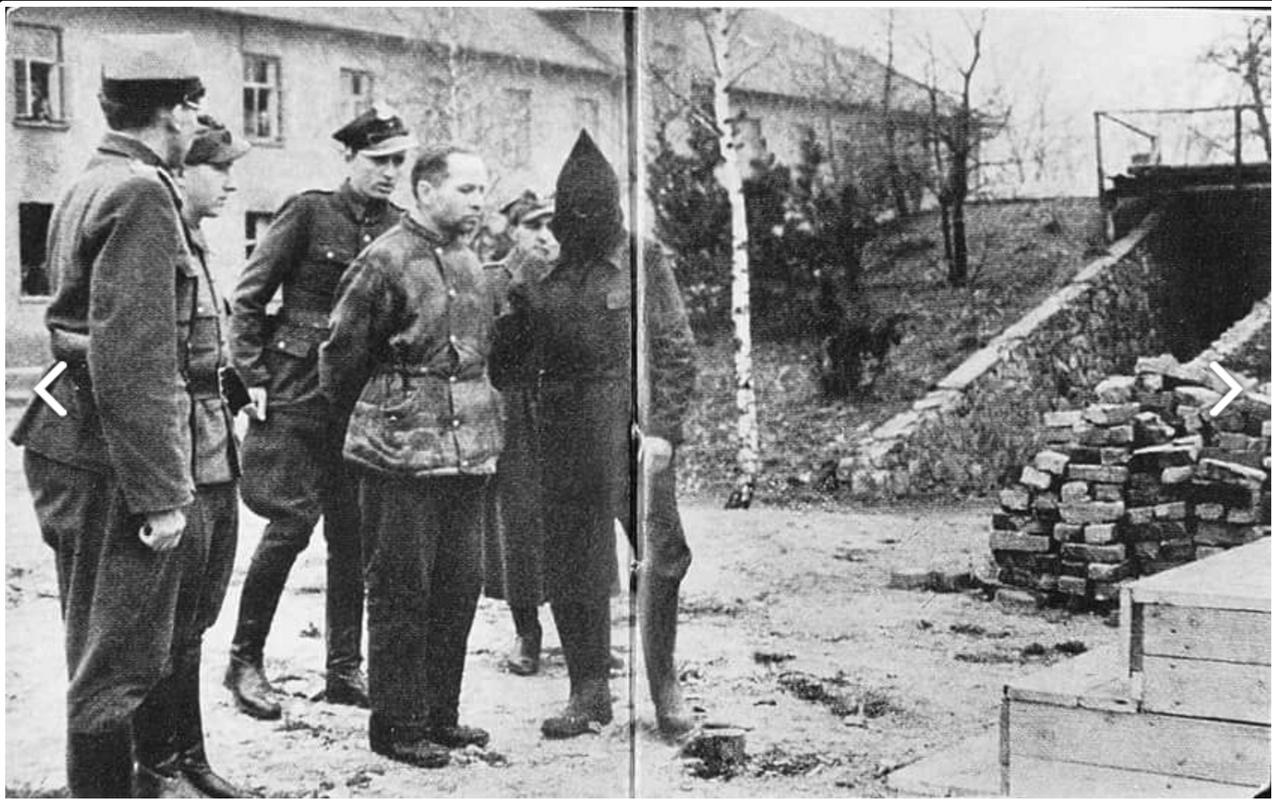
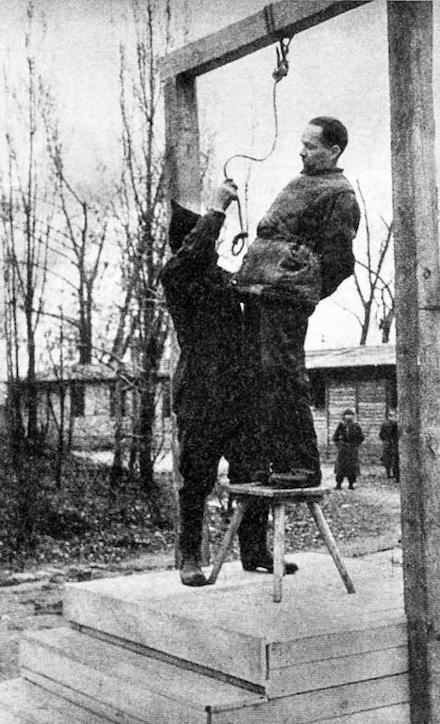
1947: Rudolf Höss, Auschwitz commandant

April 16, 1947, was the hanging-date of Auschwitz commandant Rudolf Höss.

Not to be confused with the Rudolf Hess, the Nazi party defector held by the British in lonely confinement in Spandau until 1987, Höss was true to the swastika from beginning to end.

A World War I survivor, our guy joined the right-wing Freikorps paramilitaries and scored NSDAP party number no. 3240 in 1922 — soon thereafter proving a willingness to shed blood for the cause by murdering a teacher suspected of betraying to the French the Nazi martyr figure Albert Leo Schlageter. Höss served only a year in prison for the crime.

Come the time of the Reich, he joined the SS and was “constantly associated” (his words) with the camp networks — beginning in the very first concentration camp, Dachau, followed by a two-year turn at Sachsenhausen.

In May 1940, he was appointed to direct the brand-new Auschwitz concentration camp in occupied Poland, a position that, excluding a few months when he was relieved of duties for having an affair with a camp inmate, he held until the Red Army liberated Auschwitz in January 1945.

Initially “just” a standard Reich prison camp with a mix of regular criminals, political prisoners, and Soviet POWs, Auschwitz earned its place as the Holocaust’s preeminent metonym in the subsequent years as it evolved into one of the primary killing sites of the Final Solution.

Höss himself is even “honored” as the namesake of Operation Höss, a deportation and extermination project targeting Hungarian Jewry that claimed 420,000 souls just in the last months of the war. It was one of the most efficient slaughters orchestrated by Nazi Germany, though even these were only a small portion of the crimes that stained Höss’s soul. In his postwar testimony at Nuremberg, Höss

estimate[d] that at least 2,500,000* victims were executed and exterminated there [at Auschwitz] by gassing and burning, and at least another half million succumbed to starvation and disease, making a total dead of about 3,000,000. This figure represents about 70% or 80% of all persons sent to Auschwitz as prisoners, the remainder having been selected and used for slave labor in the concentration camp industries. Included among the executed and burnt were approximately 20,000 Russian prisoners of war (previously screened out of Prisoner of War cages by the Gestapo) who were delivered at Auschwitz in Wehrmacht transports operated by regular Wehrmacht officers and men. The remainder of the total number of victims included about 100,000 German Jews, and great numbers of citizens (mostly Jewish) from Holland, France, Belgium, Poland, Hungary, Czechoslovakia, Greece, or other countries.

It wasn’t the Nuremberg court that noosed him, however; that duty fell to Poland’s Supreme National Tribunal. It had him executed on a gallows set up adjacent to Auschwitz’s Crematorium 1.

Höss’s grandson, Rainer Höss, has been an outspoken voice for atoning his family’s role in the Holocaust.

* Höss later revised this “2.5 million” estimate down, claiming that he had that figure from Adolf Eichmann but “I myself never knew the total number, and I have nothing to help me arrive at an estimate.” After tabulating the larger extermination actions that he could recall (including the 400,000+ from Hungary), Höss came up with the lower and still incredibly monstrous figure of 1.1 million: “Even Auschwitz had limits to its destructive capabilities.”

On this day..

1683: John Nisbet the Younger


Marker located at the entrance to the Burns Mall from Kilmarnock Cross. (cc) image from @mafleen.

John Nisbet was hanged on this date in 1683 for having participated four years prior in the Battle of Bothwell Bridge that shattered the Covenanter rebellion.

“Here lies John Nisbet, who was taken by Major Balfour’s party, and suffered at Kilmarnock, 14th April, 1683, for adhering to the word of God and our Covenants,” reads his grave.

Come, reader, see here pleasant Nisbet lies,
His blood doth pierce the high and lofty skies;
Kilmarnock did his latter hour perceive,
And Christ his soul to heaven did receive.
Yet bloody Torrence did his body raise,
And buried it in another place;
Saying, ‘Shall rebels lye in graves with me?
We’ll bury him where evil-doers be.’

Nisbet, we learn from Robert Wodrow, “sang the 16th Psalm, from the 5th verse to the close, with a great deal of affection and joy; and then read the 8th chapter to the Romans, and prayed again.”

When he had delivered his bible to his uncle, he made himself ready for the executioner, not expecting to get leave to say any thing to the specattors; but essaying to speak, and not being interrupted, he continued a good while in an extemporary discourse, pressing them to godliness, and recommending religion to them, from his own feeling and experience. He notices, that this is the first execution of this kind at that place, and is of the opinion, it is not like to be the last; he tells them, death is before them all, and if it were staring them in the face, as nearly as it was him at present, he doubts not there would be many awakened consciences among them; but as for himself, though death be naturally terrible, and a violent death yet more terrible, yet the sting of it is taken away, and he can say, he reckons every step of the ladder to be a step nearer heaven.

He’s not to be confused with his more famous uncle, John Nisbet of Hardhill, who suffered as a Covenanter martyr in 1685. (He surely cannot be the uncle referenced by Wodrow.) The Nesbitt Nisbet Society has more on this family’s role in the Covenanter movement.

On this day..

1726: Edward Burnworth and his gang, London Lives

Edward Burnworth and his gang — a group of villains who “seem to have risen to notoriety on the downfall of [Jonathan] Wild” by the estimation of the Newgate Calendar — were executed on this date in 1726, and thereafter hung in chains.

We endorse a bio of this coterie of thieves turned murderers on LondonLives.org. This wonderful site “makes available, in a fully digitised and searchable form, a wide range of primary sources about eighteenth-century London, with a particular focus on plebeian Londoners”; it’s in the same spirit as the oft-cited-by-Executed Today site Old Bailey Online site, and involves some of the very same principal authors.*

Their zoom-in on Burnworth et al finds the gang slaying one Thomas Hall, a gin shop owner who was attempting to set up as a thief-taker in the vacuum created by the hanging of the aforementioned Jonathan Wild — previously London’s preeminent thief-taker and (simultaneously) crime lord. Burnworth, William Blewitt, Thomas Berry, John Legee, John Higgs, and Emanuel Dickenson all suffered together and were gibbeted in chains thereafter, two apiece at St. George’s Fields, Putney Common and Kennington Common, although the last of these was given over to his friends for burial after just one day of exposure in consideration of his father’s honorable military service.

(Burnworth unsuccessfully attempted to exonerate of theft a man bound for the gallows a month before him, by confessing to the crime.)

* Tim Hitchcock, a historian now at the University of Sussex and a director instrumental to both sites, has previously provided some commentary directly to Executed Today as well, weighing in for example on the controversial identity of “Smugglerius” as well as OldBaileyOnline.org digitization practices. There are several other related “history from below” sites in his orbit: Locating London’s Past, Connected Histories, and The Digital Panopticon: The Global Impact of London Punishments, 1780-1925.

On this day..

1827: Sarah Jones, firm infanticide

From the Bristol Mercury of April 16, 1827:

EXECUTION OF SARAH JONES.

This unfortunate victim to seduction was 26 years of age, and lived with her father and mother, Thomas and Mary Jones, who resided in a small cottage, forming one of a row of houses, situated on the side of the Sirhowy tram-road, called Pye-corner, in the parish of Bassalleg, in the county of Monmouth.

On Tuesday morning she took a farewell leave of her wretched parents, which she bore with considerable firmness, being the least affected of the three. — A neighbor, who spoke to her character, was, at her desire, permitted to see her the same morning, and speak to her in the Welsh language. She was particularly communicative; detailing the circumstances most minutely, which led to her present situation. She said it was not her intention to have destroyed the hapless infant, until three months before her confinement, when she discovered her seducer, Flook, had married another woman; she then formed the diabolical plan of having her revenge in the murder of his infant.

On Monday, the 23d of October, at breakfast, she found herself ill, and went up stairs; about ten or eleven her mother came up, disturbed by her voice; she sent her down for some fresh linen; and whilst the mother was going down stairs, the child was born: — she immediately seized one of two pen-knives which were in her pocket by her bedside, and in a minute or two after the birth, gave it two gashes in the throat; the mother coming up with the linen, she hid the body between the sacking and the bed, on some straw lying between, and lay on it until the Friday night. On that night Flook came to see her, — she was then down stairs in the chair (her father asleep) — he immediately noticed the alteration in her size, on which she told him of the horrid deed she had committed, and entreated him to assist her, by burying the body; — he consented; and, having sewed it up in some spare sacking, she gave it him through the window.

She positively declares her father knew nothing of the transaction, till Potter, the game-keeper, brought the body to the house; that she had concealed her situation from her mother, denying her pregnancy, even the Sunday evening before her confinement; and that the mother believed the child to have been still-born, up to the time of the coroner’s inquisition.

Sarah Burley, a fellow prisoner, under sentence of imprisonment, for stealing money, at Newport, slept with her during the night; — she slept remarkably sound, being only disturbed by supposing she saw her coffin lying by her bedside: she asserts, she has felt ever since her sentence, the sensation of having a rope round her neck, and that she often lifted her hand to remove it. She spoke in the most flattering manner of the attentions of the keeper, Mr. T. Phillips, to whose humanity and instructions she was indebted for her firmness of mind; — she took a prison farewell of the friend to whom she revealed her mind, without tears, and viewed the prospect of the near approach of her death with the greatest resignation.

Additional Particulars. — This unfortunate woman was of short stature, stout made, with nothing in her countenance indicative of ferociousness, she stood during her trial without any perceptible emotion, but on receiving sentence was obliged to be supported by one of the officers in attendance, and was carried from the bar to the chaise which conducted her to the gaol; she has asserted that even then, she was as collected as she ever was in her life, and was only exhausted from the joy she felt that her mother was acquitted. She had made up her mind for the worst on first entering the gaol, and her whole anxiety was, lest her poor mother should be found guilty, and she should be thus accessory to another death.

She slept soundly the last night, awaking about 6 o’clock, and on viewing the fatal spot observed that every thing was ready and she was so herself. After divine service she received the sacrament with several other criminals, and was from thence ushered to the drop, walking with a steady step, on arriving at the lodge she took a last farewell of several around her, expressing her confidence of being in a few minutes happy, she then ascended the place where the executioner awaited her, in the performance of his painful duty, the only observation she made, was not to draw the rope too tight, and having kissed those around her, begged the cap might be then pulled over her face, she then stept on the platform with firmness, on the rope being adjusted, she begged the executioner to draw her clothes tight around her, which he did by tying a handkerchief, having retired, the drop fell, and in about a minute vitality ceased.

After hanging an hour her body was delivered to her friends, for interment in Bassalleg churchyard; on its being made known that the part of her sentence relating to her dissection was remitted, she felt much gratified and hoped they would let her body remain one night at her father’s house. Thus died this unhappy woman in her 26th year, her fate has excited much commiseration and miserable must be the recollections of her seducer; her resignation was praiseworthy, her repentance contrite, and her conduct firm and decided beyond precedent under such circumstances; endued with great strength and presence of mind, she only wanted the advantages of education, and to have been under the moral restrictions of the Christian code to have been an useful character in society, may her end be (in the impressive language of the Learned Judge who tried her) a warning to the unguarded of her age, and to those wretches unworthy the name of men who have, or who may seduce females to a similar state of degradation; throughout the trial the humanity of the Learned Sergeant was apparent, and the feeling manner in which he pronounced the dreadful fiat of the law drew tears from the eyes of a majority of the largest assemblage of spectators within that court. The crowd assembled at her execution was unusually large, and, as is customary, but no ways creditable to them, two thirds were females.

On this day..

1858: Alexander Anderson and Henry Richards

The story behind this stunning photograph of Alexander Anderson and Henry Richards on their Lancaster, Pa., gallows on April 9, 1858 we’re going to outsource to our friend (and occasional guest-blogger) Robert Wilhelm at Murder by Gaslight.

The only official witnesses were the twenty-four jurymen who convicted them, the sheriff, two deputies, two clergymen and state senator Cobb — a proponent of the death penalty who attended all Pennsylvania hangings.

Outside the prison walls, the public found other ways to witness the execution. People in surrounding houses could see inside the prison yard from their roofs. One entrepreneur erected a scaffolding on a hill outside the prison and charged a dollar a seat. Those without a view stood outside the prison walls waiting to cheer when the execution was confirmed.

Why were these men so hated? Read the whole thing at Murder by Gaslight.

On this day..