1818: Josiah Francis and Homathlemico, false flagged

On this date in 1818, Andrew Jackson had two Creek leaders summarily hanged in Florida.

The Creek in the American Southeast were a longtime thorn in the side of the young United States, and Andrew Jackson personally; Old Hickory was one of the chief American commanders in the Creek War several years before, a sort of subplot of the War of 1812 with Creek throughout the Gulf Coast aligning themselves with the British against American colonists.

One source of inspiration: the mighty Tecumseh, who assembled an ambitious native Confederacy to check Europeans’ advance. Although centered in the Great Lakes area, Tecumseh’s defeated vision was very broad, and he made a diplomatic visit to the American South seeking to bring the major tribes of that region into his alliance. Some Creeks saw a lot to like about Tecumseh’s line; they would become known as Red Sticks, for they raised the symbolic “red stick of war” against the whites, and announced it by massacring the entire population (about 500 souls) of Fort Mims, in Alabama.

Further south, in Florida, the Creek prophet Josiah Francis* was likewise stirred by Tecumseh; two days after Fort Mims, he led an attack on Fort Sinquefield that saw a dozen women and children killed and scalped. General Jackson suppressed that rising, forcing upon the Creek a victor’s peace that pushed that nation off 23 million acres in an L-shaped swath comprising much of Alabama and southern Georgia.** Jackson earned his nickname “Old Hickory” in this campaign, by conquering the Creek Hickory Ground.

Josiah Francis was among the many Red Sticks who took refuge in Spanish Florida after this defeat, but they could read a map like anyone else and understood that their respite from settlers would not last long here. Francis made a fascinating sojourn to England in 1815 where he vainly sought crown recognition of the Creek as British subjects, as a deterrent against Yankee aggression. Unsuccessful in his primary objective, Red Sticks returned carrying a ceremonial commission as a brigadier general. (The British Museum still has some of his kit in its possession to this day.) He did not have long to wait before tensions between whites and Creeks ignited the First Seminole War.†

As the clinching maneuver of this conflict — an act that would ultimately force Spain to cede Florida to the United States — the future U.S. president grossly exceeded the authority granted him by Washington to up and invade the Florida Panhandle with 3,000 men. They arrived at Fort St. Mark’s on April 6, there capturing two British subjects whom Jackson designated for an illegal court martial that would eventually hang them. But even this much due process was more than Creeks could expect.

An American warship had sauntered up to St. Mark’s ahead of its conflict, disguising its purpose by flying the British Union Jack and successfully extending the bluff to a Spanish officer who rowed out to greet them. Josiah Francis and another chieftain named Homathlemico or Homollimico, lurking in the bush nearby the conquered settlement, grabbed a canoe and rowed themselves out to these fortuitous allies only to find himself instantly made a prisoner. Jackson exulted in the duplicitous capture in an April 8 note to his wife: “Capt McKeever who coperated [sic] with me, was fortunate enough to capture on board his flotilla, the noted Francis the prophet, and Homollimicko, who visited him from St marks as a British vessell [sic] the Capt having the British colours flying, they supposed him part of Woodbines Fleet from new providence coming to their aid, these were hung this morning.”


An 1818 print depicts the captured natives.

* As he was known to whites. Hillis Hadjo (“crazy-brave medicine”) was his Creek name.

** And freeing Jackson to pivot to the defense of New Orleans.

† During this war, Josiah Francis’s daughter, Milly Francis, became famous throughout the continent as the “Creek Pocahontas” — literally doing what Pocahontas had done, talking her people off executing a captured white man named Duncan McCrimmon. Francis declined McCrimmon’s grateful offer of marriage, but let it not be said that an American soldier does not know how to return a boon: it was McCrimmon who set up the pivotal events of this post by tipping General Jackson to the presence somewhere nearby of his benefactress’s father. Milly presumably witnessed her father’s execution; she wound up deported to Oklahoma like much of the region’s Native American populace.

On this day..

1196: William FitzOsbert, medieval rebel

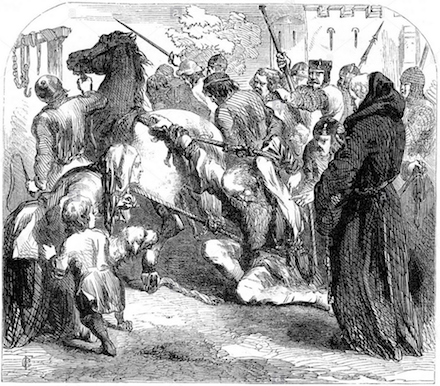
On this date in 1196, William FitzOsbert was torn from church sanctuary and hanged for one of medieval London’s most famous rebellions.

The setting is an England of King Richard I, meaning an England with an absentee king levying heavy taxes on his putative home realm to bankroll his foreign adventures. In reviewing the period’s Pipe Rolls, Doris Stenton remarked that they “give the impression of a country taxed to the limit.” Certainly the laboring classes believed themselves squeezed past dry, for “more frequently than usual,” in the words of the contemporary chronicler Roger of Hoveden, “aids to no small amount were imposed upon them, and the rich men, sparing their own purses, wanted the poor to pay everything.”

Our man FitzOsbert (or Fitz Osbert) was an educated lawyer who had been on Crusade with the occulted king, a fellow distinguished in appearance by his facial hair — “Longbeard” was his nickname — and in his manner by an evident grant of charisma. A later historian judges him “sharp of wit and some deal lettered; a bold man of speech, and sad of his countenance, and took upon him greater deeds than he could wield.”

As this interesting article on FitzOsbert notes, tax collection was a communal endeavor organized in local neighborhoods and wards, where neighbors assessed one another’s means: they naturally invited class friction. Longbeard apparently had a talent for catalyzing it; according to William of Newburgh — another contemporary, and a far more hostile witness than Roger of Hoveden —

At length, by his secret labors and poisoned whispers, he revealed, in its blackest colors to the common people, the insolence of the rich men and nobles by whom they were unworthily treated; for he inflamed the needy and moderately wealthy with a desire for unbounded liberty and happiness, and allured the many, and held them fascinated, as it were, by certain delusions, so closely bound to his cause, that they depended in all things upon his will, and were prepared unhesitatingly to obey him as their director in all things whatsoever he should command.

A powerful conspiracy was therefore organized in London, by the envy of the poor against the insolence of the powerful, The number of citizens engaged in this plot is reported to have been fifty-two thousand — the names of each being, as it afterwards appeared, written down and in the possession of the originator of this nefarious scheme. A large number of iron tools, for the purpose of breaking the more strongly defended houses, lay stored up in his possession, which being afterwards discovered, furnished proofs of a most malignant conspiracy. Relying on the large number who were implicated by zeal for the poorer classes of the people, while he still kept up the plea of studying the king’s profit, he began to beard the nobles in every public assembly, alleging with powerful eloquence that much loss was occasioned to the revenue through their dishonest practices …

this man, bent upon his object, and surrounded by his rabble, pompously held on his way, convoking public meetings by his own authority, in which he arrogantly proclaimed himself the king or savior of the poor, and in lofty phrase thundered out his intention of speedily curbing the perfidy of the traitors.

The pride of his discourses is plainly shown by what I have learned of a trustworthy man, who asserted that he himself had some days before been present at a meeting convened by him, and had heard him address the people. Having taken his text or theme from the Holy Scriptures, he thus began: “With joy shall ye draw water out of the wells of salvation” [Isaiah 12:3] — and applying this to himself, he continued, “I am the savior of the poor. Do ye, oh, poor! who have experienced the heaviness of rich men’s hands, drink from my wells the waters of the doctrine of salvation, and ye may do this joyfully; for the time of your visitation is at hand. For I will divide the waters from the waters. The people are the waters. I will divide the humble from the haughty and treacherous. I will separate the elect from the reprobate, as light from darkness.”

As FitzOsbert gained a wide following among commoners, the authorities — in this case led by the Archbishop of Canterbury/Crown Justiciar (same guy) Hubert Walter, since the vagabond king had returned to the continent and his beloved wars — feared an outbreak of civil war and moved to suppress the emerging rebel. When Hubert’s men attempted to arrest FitzOsbert, he escaped with his closest followers to St. Mary-le-Bow church. Fearing the consequences of a prolonged standoff that would permit this tribune of the people to rally an insurrectionary defense, the Archbishop gave no regard to sanctuary and “attacked with fire and smoke” this house of god until FitzOsbert was forced from its precincts. (And the steeple destroyed by fire.)

Yet even his death at Smithfield on April 6th — dragged “through the centre of the city to the elms, his flesh was demolished and spread all over the pavement and, fettered with a chain, he was hanged that same day on the elms with his associates and died” — was not his end, for the popular militant immediately ascended to the ranks of folk sainthood. William of Newburgh, again:

The extent to which this man had by his daring and mighty projects attached the minds of the wicked to himself, and how straitly he had bound the people to his interests as the pious and watchful champion of their cause, appeared even after his demise. For whereas they should have wiped out the disgrace of the conspiracy by the legal punishment of the conspirator, whom they stigmatized as impious and approved of his condemners, they sought by art to obtain for him the name and glory of a martyr. It is reported that a certain priest, his relative, had laid the chain by which be had been bound upon the person of one sick of a fever, and feigned with impudent vanity that a cure was the immediate result. This being spread abroad, the witless multitude believed that the man who had deservedly suffered had in reality died for the cause of justice and piety, and began to reverence him as a martyr: the gibbet upon which he had been hung was furtively removed by night from the place of punishment, in order that it might be honored in secret while the earth beneath it, as if consecrated by the blood of the executed man, was scraped away in handfuls by these infatuated creatures, as something consecrated to healing purposes, to the extent of a tolerably large ditch. And now the fame of this being circulated far and wide, large bands of fools, “whose number,” says Solomon, “is infinite,” and curious persons flocked to the place, to whom, doubtless, were added those who had come up out of the various provinces of England on their own proper business to London.

The idiot rabble, therefore, kept constant watch and ward over the spot; and the more honor they paid to the dead man, so much the greater crime did they impute to him by whom he had been put to death.

Hubert Walter was eventually obliged to set guards at this shrine to chase away its pilgrims and forcibly suppress the emerging cult.

On this day..

1913: A day in the death penalty around the U.S.

Alabama

From the Evening Star, April 4, 1913:

Florida

From the Tampa Tribune, April 5, 1913:

South Carolina

From the Charleston News and Courier, April 5, 1913:

West Virginia

From the Lexington Herald, April 5, 1913:

On this day..

2007: Six Bangladesh bombers

Bangladesh on this date in 2007 hanged six Islamic militants* for a terrorist bombing wave two years prior.

Several were agents of the terrorist organization Jamaat-ul-Mujahideen Bangladesh, notable for a headline-grabbing coordinated bombing on August 17, 2005 that saw hundreds of explosions throughout Bangladesh. That organization’s chief Shaykh Abdur Rahman was among those executed on March 30, 2007, as was “Bangla Bhai” (Siddique ul-Islam), the leader of the Al Qaeda-aligned Jagrata Muslim Janata Bangladesh (JMJB).

* Four different prisons were used for the executions.

On this day..

1713: Edward “Ned” Bonnet, the terror of Cambridge

(Thanks for the guest post to Charles Whitehead for the guest post — originally an entry in his true crime classic Lives and exploits of the most noted highwaymen, robbers and murderers, of all nations. This Bonnet biography’s mode of pithy episodic adventures cinched by a choice witticism or instructive event is highly characteristic of its genre. -ed.)

Edward Bonnet was born of respectable parents in the isle of Ely, in Cambridgeshire, received an education superior to many of his companions, and when he was only ten years old, gave the following proof of his promising genius. He was sent to the parson with the present of a sparerib of pork, wrapped up in a cloth in a basket. Ned knocked with some degree of importance at the door, which a servant answered, inquiring his business. “I want to speak with your master.” The master came. “Well, my dear, what is your business?” “Why, only my father has sent you this,” said young Ned; and gave him the basket, without moving his hat. “O fie! fie! child, have you no manners? you should pull off your hat, and say, — Sir, my father gives his service to you, and desires you to accept this small token. Come, go you out again with the basket, and knock at the door, and I ‘ll let you in, and see how prettily you can perform it.” The parson waited within until his impatience to receive and examine the contents of the basket incited him to open the door. But Ned was at a considerable distance, walking off with the present. “So ho! so ho, sirrah! where are you going?” “Home, sir,” replied Ned, in an equally loud voice. “Hey, but you must come back and do as I bade you first.” “Thank you for that, sir, I know better than that; and if you teach me manners, I ‘II teach you wit.” The father smiled at the story, and retained his sparerib.

At the age of fifteen, Bonnet was sent apprentice to a grocer, served his time with credit, was afterwards married to a young woman in the neighborhood, and continued in business until he had acquired about six hundred pounds. Unfortunately, however, he was reduced to poverty by an accidental fire. Unable to answer the pressing demands of his creditors, he left the place, and came up to London. Here he soon became acquainted with a band of highwaymen, and began with them to seek from the highway what had been lost by fire.

Nor did he long continue in the inferior walks of his new profession, but providing himself with a horse which he taught to leap over ditch, hedge, or toll-bar, and to know all the roads in the country, whether by day or by night, he quickly became the terror of Cambridgeshire.

Upon this horse, he one day met a Cantabrigian, who was possessed of more money than good sense, morality, or wit, in a calash with a dashing courtesan. Ned commanded the student to “stand and deliver.” Unwilling to show his cowardice before his companion, he refused. Without any respect for the venerable university to which he belonged, Ned by violence took from him about six pounds, and presenting a pair of pistols, constrained the hopeful pair to strip themselves, then bound them together, and giving the horse a lashing, the animal went off at full trot with them to the inn to which he belonged. But no sooner did these Adamites enter the town, than men, women, and children, came hallooing, shouting, and collecting the whole town to behold such an uncommon spectacle. The student was expelled for disgracing the university, and the courtesan was sent to the house of correction.

Humorous Ned next met with a tailor and his son, who had arrested him for five pounds. He commanded him to surrender, and received thirty-five in place of his five. “I wonder,” said the innocent son, “what these fellows think of themselves? Surely they must go to the place below for committing these notorious actions.” “God forbid,” replied the tailor, “for to have the conversation of such rogues there, would be worse than all the rest.”

Ned’s next adventure was with an anabaptist preacher, whom he commanded to deliver up his purse and scrip. The latter began by reasonings, ejaculations, and texts, to avert the impending evil. Ned instantly put himself in a great passion, and replied, “Pray, sir, keep your breath to cool your porridge, and don’t talk of religious matters to me, for I’ll have you to know, that, like all other true-bred gentlemen, I believe nothing at all of religion; therefore deliver me your money, and bestow your laborious cant upon your female auditors, who never scold with their maids without cudgelling them with broken pieces of scripture.” Whereupon, taking a watch and eight guineas, he tied his legs under his horse, and let him depart.

On another occasion, Bonnet and a few associates met a nobleman and four servants in a narrow pass, one side of which was enclosed by a craggy and shattered rock, and the other by an almost impenetrable wood, rising gradually considerably higher than the road, and accosted them in his usual style. The nobleman pretended that he supposed they were only in jest, and said, “that if they would accompany him to the next inn, he would give them a handsome treat.” He was soon informed that they preferred the present to the future. A sharp dispute ensued, but the nobleman and his men were conquered; and the lord was robbed of a purse of gold, a gold watch, a gold snuff-box, and a diamond ring.

Being conducted into the adjacent wood, and bound hand and foot, the robbers left them, saying, “that they would bring them more company presently.” Accordingly, they were as good as their word, for in less than two hours they contrived to increase the number to twelve, on which Ned cried, “There are now twelve of you, all good men and true; so bidding you farewell, you may give in your verdict against us as you please, when we are gone, though it will be none of the best; but to give us as little trouble as possible, we shall not now stay to challenge any of you. So, once more, farewell.”

Ned Bonnet and his comrades now going to the place of rendezvous, to make merry with what they had got, which was at a by sort of an inn standing somewhat out of the high-road between Stamford and Grantham, it happened at night to rain very hard, so that one Mr. Randal, a pewterer, living near Marygold alley in the Strand, before it was burnt down, was obliged to put in there for shelter. Calling for a pot of ale, on which was the innkeeper’s name, which was also Randal, the pewterer asked him, being his namesake, to sit and bear him company.

They had not been long chatting, before Ned and one of his comrades came down stairs and placed themselves at the same table; and understanding the name of the stranger, one of the rogues, fixing his eyes more intently than ordinary upon him, in a fit of seeming joy leaped over the table, and embracing the pewterer, exclaimed, “Dear Mr. Randal! who would have thought to have seen you here? it is ten years, I think, since I had the happiness to be acquainted with you.”

Whilst the pewterer was recollecting whether he could call this spark to mind or not, for it came not into his memory that he had ever seen him in his life, the highwayman again cried out, “Alas! Mr. Randal, I see now I am much altered, since you have forgotten me.” Here, being arrived at a ne plus ultra, up started Ned, and with as great apparent joy said to his companion, “Is this, Harry, the honest gentleman in London, whom you so often used to praise for his great civiIity and liberality to all people? Surely then we are very happy in meeting thus accidentally with him.”

By this discourse they would almost have persuaded Mr. Randal that they perfectly knew him; but being sensible of the contrary, he very seriously assured them that he could not remember that he had ever seen any of them in his life. “No!” said they, struck with seeming astonishment; “it is strange we should be altered so much within these few years.”

But to evade further ill-timed questions, the rogues insisted upon Mr: Randal’s supping with them, which invitation he was by no means permitted to decline.

By the time they had supped, in came four more of Ned’s comrades, who were invited also to sit down, and more provisions were called for, which were quickly brought, and as rapidly devoured.

When the fury of consuming half a dozen good fowls and other victuals was over, besides several flasks of wine, there was not less than three pounds odd money to pay. At this they stared on each other, and held a profound silence, whilst Mr. Randal was fumbling in his pocket. When they saw that he only brought forth a mouse from the mountain of money the thieves hoped to find piled in his pocket, which was only as much as his share, he that pretended to know him started up, and protested he should be excused for old acquaintance sake; but the pewterer, not willing to be beholden, as indeed they never intended he should, to such companions, lest for this civility they should expect greater obligations from him, pressed them to accept his dividend of the reckoning, saying, if they thought it equitable he would pay more.

At last one of them, tipping the wink, said, “Come, come, what needs all this ado? Let the gentleman, if he so pleases, present us with this small treat, and do you give him a larger at his taking his farewell in the morning.” Mr. Randal not liking this proposal, it was started that he and Ned should throw dice to end the controversy; and fearing he had got into ill company, to avoid mischief, Randal acquiesced to throw a main who should pay the whole shot, which was so managed that the lot fell upon Randal. By this means Randal, having the voice of the whole board against him, was deputed to pay the whole reckoning; though the dissembling villains vowed and protested they had rather it had fallen to any of them, that they might have had the honor of treating him.

Mr. Randal concealed his discontent at these shirking tricks as well as he could; and they perceiving he would not engage in gaming, but counterfeited drowsiness, and desired to be abed, the company broke up, and he was shown to his lodgings, which he barricadoed as well as he could, by putting old chairs, stools, and tables against the door. Going to bed and putting the candle out, he fell asleep; but was soon awaked by a strange walking up and down the room, and an outcry of murder and thieves.

At this surprising noise he leaped out of bed, and ran to the door, to see whether it was fast or not: and finding nothing removed, (for the highwaymen came into his chamber by a trap-door which was behind the hangings,) he wondered how the noise should be there in his apartment, unless it was enchanted; but as he was about to remove the barricade to run and raise the house, he was surrounded by a crew, who, tying and gagging him, took away all his clothes, and left him to shift for himself as well as he could.

One day having the misfortune to have his horse shot under him, Bonnet embraced the first opportunity to take a good gelding from the grounds of the man who kept the Red Lion inn. Being again equipped like a gentlemen, he rode into Cambridgeshire, and met with a gentleman, who informed him that he had well nigh been robbed, and requested him to ride along with him for protection. As a highwayman is never out of his way, he complied, and, at a convenient place, levied a contribution, as protector of the gentleman, by emptying his pockets of eighty guineas. He, however, had the generosity to give him half-a-crown to carry him to the next town.

After having, according to computation, committed three hundred robberies, another thief [Zachary Clare -ed.], being apprehended, in order to save his own life, informed against Bonnet, who was apprehended, not upon the highway, but in his own lodgings, and sent to Newgate, and at the next assizes carried down to Cambridge, sentenced and executed before the castle, on the 28th March, 1713, to the great joy of the county, which had suffered severely by his depredations.

On this day..

1907: Joseph Jones, no workhouse

Another great hang-day post today from the Facebook page of our friends at Capital Punishment UK, in which we discover one Joseph Jones, teetering on the edge of destitution,

hanged at Stafford on the morning of Tuesday the 26th of March 1907. Henry Pierrepoint and William Willis carried out the execution. Jones is reported to have told Pierrepoint “This is a damned sight better than the workhouse.”

On this day..

1752: James Lowry, despotical nautical

On this date in 1752 the tyrannous Scottish sea captain James Lowrey or Lowry was hanged at London’s execution dock for beating a crew member to death.

Lowr(e)y came to public notice in 1751 after the return to English shores of his merchantman, the Molly, from a run to Jamaica: ten of his ex-crew subscribed a public advertisement accusing him of murdering their mate on board, to which Lowry replied with advertisements accusing those accusers of mutiny.

Right away the British public knew it had a page-turner on its hands.

The captain had become unreasonably enraged with Kennith Hossack for lagging in his duties as he recovered from an illness, and upon a purported accusation of theft he had the mariner tied up and personally battered him about the head using a doubled-over rope as his cudgel, on Christmas Eve no less. Hossack at last dropped dead, at which point the heartless captain slapped his man and denounced him for “shamming Abraham” (i.e., feigning injury to skip work). Lowry evidently really had it in for Hossack, for the first mate explained that “I don’t know that he ever came upon deck twice in a week without beating him: my heart has bled for him many and many a time.” In the mate’s opinion, these beatings were always for no adequate reason.*

That’s a remark from the Admiralty Trial of Captain Lowry, where his former seamen developed the picture of an intolerably Queeg-like commander liable to take bitter umbrage if his men managed an illicit extra ration of sugar or rum, a guy who carried around a beating-cane with its own name (“the Royal Oak Foremast”) just in case he felt like doling out a disciplinary bludgeon. Three days after Hossack’s death, he came to blows with the second mate; two days after that, a fed-up crew “took the command from him” and ran the ship themselves, although they did not forcibly confine him.

Once the ship put in at Lisbon for repairs on the return journey, Lowry lodged a piracy complaint against his crew, but despite the incredibly serious charges and countercharges, everybody sailed on together for home thereafter, each party perhaps silently calculating the odds that the other would dare to press the case further as against getting on about their lives. Lowry does not appear to have made himself scarce until his former comrades went public with their claims, although once they did so he incriminatingly avoided the thief-takers and the small private reward set upon his capture for a few weeks.

On March 25, 1752, the brute was carried from Newgate Prison to the Execution Dock on the Thames, in a cart surmounted by a silver oar emblematic of the Admiralty. There he was hanged, and his body afterwards put in irons and displayed in infamy down the river at Blackwall.


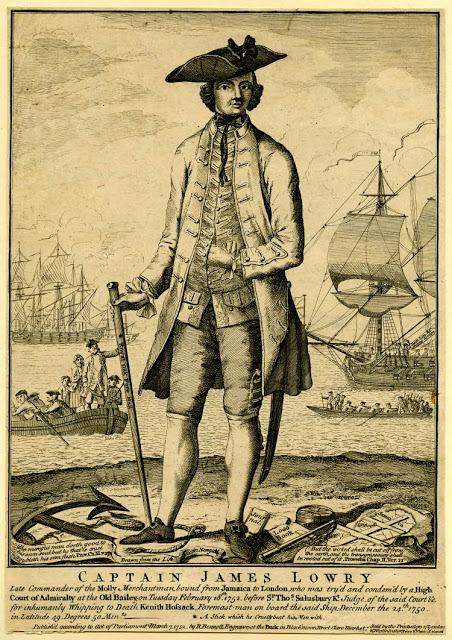
Lowry pictured as part of a “Scotch Triumvirate” of Caledonian evildoers, along with the Scottish officer William Cranstoun, blamed for seducing Mary Blandy to the gallows, and the more mysterious “Major James MacDonald” whose papers suggest involvement in the South Sea Bubble 32 years prior (?). I’m in good company with my confusion on this MacDonald fellow, as the British Museum can’t identify him either. Check out britishtars.com for a fascinating exposition on the iconographic detail of the Lowry images in this post; we have also featured in this narrative several additional links to that same site’s various posts about the events on the Molly.

We have revisited a few times in these pages the intense commercial bustle among publishers of crime ephemera — in England as well as Ireland. Naturally this headline-grabbing execution excited plenty of competitive hawking.

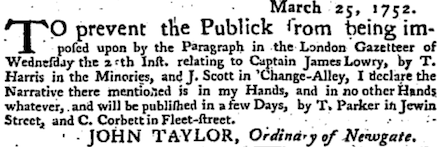
Two examples appear below; the first of them is by a pair of publishers named Harris and Scott; the second, by Parker and Corbett, who at this time had the deal to publish the Ordinary of Newgate’s accounts. Harris and Scott were first to the market here, in an environment where rapidity counted for a lot; the Ordinary wanted to be sure the public knew that his “official” (according to him) version would be soon forthcoming, so he burdened the pages of London newspapers and even his own Ordinary’s Account of ‘regular’ Tyburn criminals with adverts to that effect.


This image from the London General Advertiser of March 26, 1752, one of several papers to carry the notice. For more on the relationship between publishers and crime in this era, see Print Culture, Crime and Justice in 18th-Century London by Richard Ward

Read on below to enjoy both.

* In fact, one nugget from this case is that an adequate reason for corporal punishment at sea might sit at a much higher threshold than we commonly assume today. Although the Royal Navy was (in)famous for the discipline of the lash, multiple experienced sailors testified at this trial that they never knew floggings or beatings to occur on merchant vessels.

On this day..

1819: John Van Alstine

John Van Alstine was (incompetently) hanged two hundred years ago today for murdering Schoharie County, N.Y., deputy sheriff William Huddleston — whom he bludgeoned to death in a rage when Huddleston turned up to execute a civil judgment forcing the sale of Van Alstine’s property to service a debt. The man acknowledged having a ferocious temper.

“It is not a year since I stated in Judge Beekman’s presence, (and, I stated it as the firm conviction of my mind), that there were two things I should never come to — the state’s prison and the gallows,” the confessed murderer mused in his public reflections, below. “How often have these words occurred to me since the regretted 9th, and taught me the vanity of human boasting, and the weakness of human resolution, when opposed to long indulged passions.”


This document has also been transcribed here.

On this day..

1696: Charnock, King, and Keyes, frustrated of regicide

On this date in 1696, a trio of Jacobite conspirators were hanged for their failed assassination plot against King William.

An exiled loyalist to the deposed King James II, the onetime Oxford don Robert Charnock conceived what the propagandists would call “the late Hellish and Barbarous Plott” along with fellow Stuart loyalist George Barclay. Their mission in murdering William III was to catalyze a general Jacobite rising that would reverse the Glorious Revolution and restore James to the throne: it was a recurring campaign against the Dutch usurper throughout the 1690s.

Ambush was the gambit proposed by the worthies in this case, for William.

was in the habit of going every Saturday from Kensington to hunt in Richmond Park. There was then no bridge over the Thames between London and Kingston. The King therefore went, in a coach escorted by some of his body guards, through Turnham Green to the river. There he took boat, crossed the water, and found another coach and another set of guards ready to receive him on the Surrey side. The first coach and the first set of guards awaited his return on the northern bank. The conspirators ascertained with great precision the whole order of these journeys, and carefully examined the ground on both sides of the Thames. They thought that they should attack the King with more advantage on the Middlesex than on the Surrey bank, and when he was returning than when he was going … The place was to be a narrow and winding lane leading from the landing place on the north of the river to Turnham Green … a quagmire, through which the royal coach was with difficulty tugged at a foot’s pace. The time was to be the afternoon of Saturday the fifteenth of February. (Macaulay)

Some 40 assassins had been marshaled for the purpose of surprising the royal party on that occasion but as they nursed their cups in the vicinity’s public houses they received the disquieting intelligence that the king had skipped the hunt that day.

Although the inclement weather was the reason given out, the truth of the matter was that they were betrayed. In a week’s time, most of the conspirators would be in custody* and the country on a virtual war footing against prospective invasion by France. On March 11, the first three prospective assassins stood at the bar: Charnock, Edward King, and Thomas Keyes. They were plainly guilty and condemned accordingly.

King died firmly; Keyes, in “an agony of terror … [that] moved the pity of some of the spectators”; and Charnock, being repelled in his bid to turn songbird in exchange for his life, went out with a missive bitterly defending his project, for “if an army of twenty thousand men had suddenly landed in England and surprised the usurper, this would have been called legitimate war. Did the difference between war and assassination depend merely on the number of persons engaged?” (both quotes from Macaulay) Several additional conspirators would follow them to the scaffold in the weeks to come.


“The Triumphs of Providence over Hell, France & Rome”: Broadside celebrating and satirizing the deliverance of the realm from the Jacobite plot, via the British Museum.

* George Barclay, however, successfully escaped to the continent.

On this day..

1780: Elizabeth Butchill, Trinity College Cambridge bedding-girl

A Cambridge University servant was hanged on this date in 1780 for infanticide.

Elizabeth Butchill made her way turning down the beds for the boys attending Trinity College, work she had secured via her aunt who held the same position. She somehow got pregnant, an event which does not appear to have inordinately exercised her eventual judges perhaps by virtue of its very obviousness; as Frank McLynn wryly observes, “It does not need the imagination of a novelist to reconstruct the events that led her to the gallows.”

She was surely desperate to avoid social opprobrium and unemployment, so we find from the Newgate Calendar that “she confessed that she was delivered of a female child on Thursday morning [January 6, 1780], about half past six o’clock, by herself; that the child cried some little time after its birth; and that, in about twenty minutes after, she herself threw the said infant down one of the holes of the necessary into the river, and buried the placenta, &c. in the dunghill near the house.”

“Modest, patient, and penitent” during her confinement awaiting the noose, Butchill died

firm, resigned, and exemplary. She joined with the minister in prayer, and sung the lamentation of a sinner with marks of a sincere penitent, declaring she had made her peace with God, and was reconciled to her fate. Desiring her example might be a warning to all thoughtless young women, and calling on Jesus Christ for mercy, she was launched into eternity amidst thousands of commiserating spectators, who, though they abhorred the crime, shed tears of pity for the unhappy criminal.

Whether the nameless infant’s nameless father shared those tears is a matter for the novelist’s imagination.

On this day..