1941: Francisc Panet

On this date in 1941, “the Romanian Einstein” Francisc Panet was shot with his wife Lili and three other Communists at a forest near Jilava.

A chemical engineer by training, Panet or Paneth (English Wikipedia entry | Romanian) was fascinated by the theoretical research then revolutionizing physics.

While studying in Czechoslovakia, his work on elementary particles brought him to Einstein’s attention, and the two met in 1932 and corresponded thereafter. Panet’s advocates claim that Einstein foresaw for him a brilliant future.

But back in a Romania dominated by fascism, his scientific gifts would be required for more urgent and less exalted purposes: cooking homemade explosives in his bathroom for Communist saboteurs.

Eventually the secret police traced the munitions back to Panet, and he and his wife were arrested in a Halloween raid. Condemned to death in a two-hour court martial on November 5, they allegedly went before the fascists’ guns with the Internationale on their lips.

On this day..

1929: Habibullah Kalakani, Tajik bandit-king

Warlord Habibullah Kalakani, deposed after ten months styling himself King of Afghanistan, was publicly shot on this date in 1929.

An ethnic Tajik whose surname alludes to his native village north of Kabul, Kalakani served in the army of Emir Amanullah Khan.*

This Khan aspired to far-reaching reforms that would modernize his marchlands kingdom and not for the last time an Afghan ruler found this programme stoked a furious resistance among tribal grandees. Kalakani, though derisively nicknamed Bacha Seqao (son of a water-carrier) was just such a grandee, having pivoted profitably from regular military orders to highway robbery.

When Khan’s forces had vacated Kabul to manage a Pashtun rebellion in the south — only the latest of numerous tribal risings that plagued the Khan years — Kalakani in late 1928 sprang a surprise Tajik rebellion from the north and marched on the unprotected capital.

Amanullah evacuated Kabul with a quickness, personally behind the wheel as he blazed his Rolls Royce ahead of Kalakani’s cavalry all the way to India and eventual exile in Europe.


Kalakani

But the “bandit king” soon found his own government strained by the same tensions that had elevated him. Pashtun rebels who used to chafe under a western-oriented king now chafed under a Tajik one — in fact, the only Tajik to rule Afghanistan in its modern history — and their fresh rebellion soon toppled Kalakani in his own turn. He was shot with his brother and their aides, contentedly telling his firing squad, “I have nothing to ask God, he has given me everything I desired. God has made me King.”

Kalakani is still the third-last king of Afghanistan and is still bitterly — violently — controversial on his native soil, where whether you reckon him a hero or a thug depends upon your kinship. Just weeks ago as we write this, a reburial of Kalakani’s remains in Afghanistan provoked bloody ethnic melees on the streets.

* Although there is no specific connection here to Habibullah Kalakani, an execution blog would be remiss not to include a reference to this sadly undateable National Geographic photo tracing to Khan’s reign of one of those real-life dangling man-cages so beloved of the sword-and-sandals fantasy genre. Per NatGeo’s caption, an actual thief was “put in this iron cage, raised to the top of the pole, so that his friends could not pass food or poison to him, and here he was left to die.”

On this day..

1937: Panfiliya Tanailidi, Azerbaijani actress

On this date in 1937, Azerbaijani actress Panfiliya Tanailidi (various other transliterations are possible) was purged during Stalin’s terror.

Born in a tsarist governorate to Greek emigres, Tanailidi (English Wikipedia entry | Azerbaijani) was treading the Caucasus boards as a teenager in the pregnant century’s first decade.

She became an accomplished stage and screen actress, starring in 1930s silents Ismet and Almaz.

Come the Stalin years when any pretext was enough to destroy a body, the pretext against Tanailidi was apparently her affiliations with an Iran then taking a concerted anti-Soviet line: the actress had toured Iran in 1917 and had friends like Govhar Aliyeva who had fled the Soviet Union for Iran. This was more than enough to cast the pall of espionage about her.

On this day..

1914: Lt. Jean-Julien Chapelant, mort pour la France

On this date in 1914, the French army shot Lt. Jean-Julien Chapelant as a coward.

Most resources about Lt. Chapelant are in French, as are almost all the links in this post — but within France this case has been contested since the interwar years when his father fought in vain ferocity to reinstate the honor of his son.

Four days before his execution, Chapelant, commanding a machine gun section near a village in the Somme, was captured with four other gunners when the Germans overran their position. Though he’d been shot in the leg, Chapelant managed to escape his captors and return to French lines. (Three of the other gunners escaped, too.)

While the categorical rehabilitation of Great War soldiers “shot at dawn” as cowards or deserters has been a going concern in recent years, Chapelant also has a compelling individual argument that he ought not have been construed such even by the standards of his time.

The luckless lieutenant was shot for “capitulating in open country”. This was at best an extremely prejudicial interpretation of the facts, seemingly one that commanding officers themselves still adjusting to the unexpected prowess of German arms had already settled upon before any proper investigation, out of their pique at losing the position. The verdict was so certain that Chapelant’s commanding officer gave him his revolver back urging him to “burn out his own brains” and save everyone the trouble.

Chapelant refused, insisting that he had done his proper duty, and military justice was edified by the spectacle of a crippled man who could not stand propped up in his stretcher against an apple tree for the tender ministry of his firing squad.

“I die innocent. You will all know it later,” he told his executioners — then added, futile wish, “do not tell my parents.”

Although we have been treated in these pages to the heartbreaking scene of an officer comforting a man about to be shot with the remark that “yours also is a way of dying for France,” the idea has until very recently been confined to the precincts of personal sentiment and certainly not to the institutions responsible for the dying.

On November 11, 2012the centennary of Lt. Chapelant’s execution* — he was ceremonially rehabilitated and his death officially ascribed to that same cause that laid so many of his comrades low: “mort pour la France.”

* Adding round numbers is hard, apparently.

On this day..

1926: The Lowman lynchings

Aiken, South Carolina disgraced October 8, 1926 with the lynching of three members of the Lowman family.

American lynch law come 1926 was into its decline phase; the 30 lynchings in that year across the country have never been equalled in the nine decades since, but were also 50% below the rates at the beginning of the 1920s, and very far from the peak 1890s where triple-digit counts of mob murder were the perennial norm.

One might say that both the phenomenon and its pracitioners had matured. If exhortations to better refer justice to the law were the authorities’ running strategy for quelling lynch mobs, then the mobs themselves became complicit with the barristers — and could reserve recourse to extrajudicial means for occasions when the courts failed to work Judge Lynch’s will. Leo Frank’s case a decade prior to this is an excellent example: though there was a virtual lynch atmosphere at his trial, it was only after the man’s death sentence had been commuted by the governor that a lynch gang systematically extracted the man from prison to slay him.

Something like this pattern appears to distinguish the Lowman lynchings.

This dreadful case began with an exercise in that other grand tradition of racialized justice, the drug war — Prohibition-style. On April 25, 1925, the Lowmans’ tenant farm near Monetta was raided by police on a bootlegging tip.* The Lowmans resisted and a firefight broke out, leaving two dead: Annie Lowman, and Sheriff Henry Hampton “Bud” Howard.

Annie’s killing would of course never be punished. But inside of three weeks, fourteen-year-old Clarence Lowman was death-sentenced as Sheriff Howard’s killer, along with his cousin and “conspirator” 21-year-old Demmon Lowman. Bertha Lowman, Demmon’s older sister, received a life sentence.

And so Judge Lynch might rest easy.

Except that one year later, the South Carolina Supreme Court surprisingly threw out the Lowmans’ sentences as prejudicially obtained. The second trial began in October and right away the state suffered a setback when Judge Samuel Lanham threw out the murder case against Demmon Lowman.

Judge Lynch was wide awake now.

That very night — October 7 — white vigilantes organized a new verdict. According to the NAACP’s investigation, “within one hour of [Lanham’s] decision, news had been sent to as distant a point as Columbia that the three Lowmans were to be lynched that night.”

At 3 o’clock in the morning of October 8, and aided by the local constabulary, the mob stormed the jail and dragged Clarence, Demmon and Bertha Lowman away to a pine thicket outside of town where they were gunned down.

“On the way Clarence Lowman jumped from the car in which he was held,” the NAACP investigator would later report in the summation of his interviews.

He was shot down and recaptured, in order to prevent telltale blood marks, a rope was tied to the back of the car and the other end of it around Clarence’s body. In this manner he was dragged about a mile to the place of execution. The members of the mob sated that Bertha was the hardest one to kill. She was shot but not killed instantly. She dragged herself over the ground and as one member of the mob put it, ‘bleated like a goat.’ Another member of the mob, slightly more decent, said that she begged so piteously for her life and squirmed about so that a number of shots had to be fired before one found a vital spot and ended her agony.

Although the NAACP supplied South Carolina’s governor with the identities of 22 alleged members of the lynch mobs (including the sheriff himself) and 11 other witnesses to its actions, no man was ever sanctioned for this event, and an all-white grand jury declined to forward any indictments.

A distant Lowman relative was quoted in the Augusta Chronicle recollecting the stories his grandmother told about that horrible night, and the impression those stories had in his own life.

“She [grandma] talked about it all the time,” William Cue said. “Took them out of jail — drug them out like dead mules. When I drive past, I think about it — it happened in that house. … I learned something from that. … There was a lot of times where a man mistreated me and it kept me from doing anything.”

* It’s been argued by latter-day researchers that the tip itself was bogus, and supplied to police further to a personal vendetta — which, if true, would make the Lowmans victims of the 1920s version of SWATting.

On this day..

1893: Paulino Pallas, Spanish anarchist

Spanish anarchist Paulino Pallas was shot on this date in 1893 for attempting to assassinate the military chief of Catalonia.

A bricklayer’s son who had known starvation days, the politically radicalized Pallas returned from years abroad to his native Catalonia to discover a restive district nearing the brink of outright rebellion.

An 1892 uprising among the Jerez peasantry, a disturbance that ended with four anarchists publicly garroted, stirred Spanish anarchists to a wave of violent revenge. Pallas’s strike came on the September 24, 1893, when he hurled two bombs at a military parade on the Gran Via in Barcelona in an attempt to assassinate Gen. Arsenio Martinez-Campos.

The bombing killed a nearby policeman, but Gen. Martinez-Campos was only slightly injured.

Pallas was arrested on the spot and his lair yielded for the horror of the pro-Bourbon press “many anarchists proclamations, a photo of the anarchists who were executed in Chicago, and several letters from France containing instructions on making a revolution.” Within days, a court-martial condemned him.

The assassin justified his action in a letter published two days after his execution:

I have maintained throughout my life a titanic struggle for existence. I have felt in my own skin the effects of this society, constituted poorly and governed even worse. I observe that it is a gangrenous body, to which you can not place one finger without touching a festering sore. I thought it was necessary to destroy it and I wanted to offer my contribution that demolishing work in the form of another bomb. General Martinez Campos, as a soldier and a gentleman, I respect. But I wanted to hurt him to undo one of the many pillars on which rests the current state of affairs in Spain. […] I state the record that, in undertaking this act, I have not been compelled by any consideration other than to sacrifice my life for the benefit of my brothers in misfortune.

On this day..

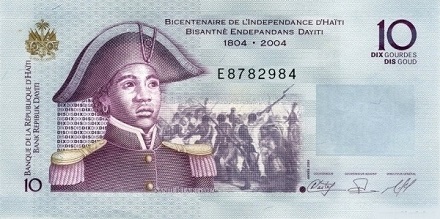
1802: Sanite Belair, tigress

On October 5, 1802, Haitian soldier Suzanne Bélair, called Sanité Bélair, was shot with her husband by the French.

This “tigress” is the most famous of the Haitian Revolution’s numerous female protagonists. A free black woman, she married Charles Belair, the nephew and aide of the man who in the 1790s established pre-eminence on Saint-DomingueToussaint L’Ouverture.

L’Ouverture tragically vacillated when the French made their move in 1802 to reverse the revolution’s gains and re-establish slavery, but the tigress rallied General Belair to take the field in resistance — and not only rallied him, but fought alongside him as a regular in his army, attaining the rank of Lieutenant.

It’s said that at her capture, when threatened with beheading, she successfuly asserted the right to an honorable soldier’s death by musketry, and standing before their muzzles cried “Viv libète! Anba esclavaj!” (“Long live freedom! Down with slavery!”)

On this day..

2012: Moussa Agh Mohammed, by Ansar Dine in Timbuktu

On this date in 2012, northern Mali’s Islamist Ansar Dine movement, then in control of the city of Timbuktu, publicly executed Moussa Agh Mohammed there for murder.

Mohammed was one of Ansar Dine’s own fighters, but stringent consistency would oblige his fellows to put him to death under the sharia law Ansar Dine itself was enforcing in Timbuktu. Some days before he got into a fight with fishermen who reproached him for trampling their nets; as the confrontation escalated towards physical violence, Mohammed unslung his Kalashnikov and gunned one of them down. The fisherman’s family was offered, but refused, compensation in exchange for sparing the killer.

According to a correspondent, Mohammed “was a Tuareg cattle farmer from a major tribe [who] joined the Ansar Dine movement one month ago [before his execution]” having previously been affiliated with the Tuareg rebel army the National Movement for the Independence of Azawad. It was the third known execution in northern Mali under sharia: the previous two were an adulterous couple stoned to death in the town of Aguelhok.

“I didn’t feel a great deal of emotion from the crowd,” our observer reported. “People just stood there and watched as if it were a show. In contrast, the members of Ansar Dine looked moved by the event. Mohammed had close relationships with a number of his peers. But they explained that no one is exempt from Sharia law, and because of that they had no choice but kill him. It was a question of God’s will.”

On this day..

1822: Augustin Joseph Caron, entrapped

On this date in 1822, French Lt. Col. Augustin Joseph Caron was shot at Strasbourg as a rebel.

Little is known of his background, but Caron (English Wikipedia entry | French) enlisted in his army during the revolutionary year of 1791 and advanced into command positions under Napoleon. From his later conduct it’s apparent that these years shaped a political passion that would be starkly at odds with the post-Napoleon Bourbon restoration.

As we have noted elsewhere on this site France’s Liberal (often Bonapartist) opposition during these years was urged by the persecution of the monarchist party into conspiracy as the common coin of its politics.

Out of this mire grew both charbonnerie (France’s analogue to the carbonari terrorists who proliferated in Italy) and an overvigilant secret police whose campaigns of entrapment and threat exaggeration did nothing so well as to further obscure the line between mundane opposition and treason.

The strange interplay between these midnight foes would shape the fate of Col. Caron.

Caron’s path to execution begins with the thwarted rising of the Belfort garrison for New Year’s 1822 — a real plot that the government spies were able to squelch. This resulted in a number of executions, by dint of which it has featured in these very pages.

Caron enters this story in its second chapter: a pensioned former officer of known Bonapartist sympathies, Caron was (with another man named Roger) baited by police spies into mounting an attempted raid on Colmar prison where the arrested Belfort conspirators were being held. Officers chosen to play the part were detailed to meet him as “conspirators” and march with him to Colmar, allowing Caron to make compromising “Vive l’Empereur” exhortations along the way, before finally arresting him.

Though Caron himself had been a willing participant who most certainly did intend to raise a mutiny, the ridiculous spectacle of His Majesty’s warriors congratulating themselves for crushing a plot that they themselves controlled from the get-go came to crystallize the Liberal fulminations against abusive use of agents provocateur. As Alan Barrie Spitzer puts it in Old Hatreds and Young Hopes: The French Carbonari against the Bourbon Restoration,

the means employed to net such a minor, and such a vulnerable, agitator gave the critics of the regime and the defenders of other conspirators the opportunity to assimilate all the operations of the political police to this contemptible one. The government was placed on the defensive from the first. It proved difficult to demonstrate the Caron and Roger had initiated the seditious proposals … Two entire squadrons of chasseurs had conducted their brilliant operation to net only the two original suspects. And then there was the abrasive question of who, under what circumstances, shouted out “Vive l’Empereur!” — that is, tempted innocent passersby-into political crime. The original story … described the squadrons as riding through the countryside crying “Vive l’Empereur,” and innocently wondered whether these purveyors of seditious slogans would be arrested along with Caron, their alleged “leader.”

One Liberal deputy sneeringly pictured future French veterans boasting of their service, “I was in those squadrons that rode through the countryside of the Haut-Rhin shouting ‘Vive l’Empereur!’ in order to test the disposition of the inhabitants.” Indeed, what if the dispositions had been otherwise? It had been only a few years since the emperor really had returned from exile and raised a brief civil war; the idea that the military had risked triggering “the insurrection of a town and the massacre of its inhabitants” for no better reason than to compromise an utter nobody blossomed into a gigantic scandal. Caron became France’s metonym for a patsy;* demands to grant Caron leniency and turn the investigation against his persecutors multiplied discomfitingly.

But this was only one of several high-profile trials against anti-Bourbon plotters unfolding in 1822, and the Liberal denunciations against them practically staked the government’s credibility upon their outcome. So the government saw to the outcome it required — by invoking Caron’s military rank to have him transferred out of the civilian justice system and tried by a military tribunal that would be sure to convict him. Just to complete the shambles, the execution was then hurriedly conducted before Caron’s appeal could be brought before the Court of Cassation.

The Journal of the Lower Rhine gives the following details concerning the execution of Colonel Caron: —

Colonel Caron, who was unanimously condemned to death for the crime of embauchage [“hiring” -ed], by the first permanent council of war of this division, the judgment of which was likewise unanimously confirmed by the council of revision, was executed at two o’clock in the afternoon, in the presence of a small detachment of the garrison, and a numerous concourse of people who were attracted by curiosity. The Abbe Schittig zealously administered to him the consolations of religion, which he received with humility, and he died with the courage of a Christian and an old soldier. Caron was alone in a carriage, amidst the retinue which conducted him to the place of execution. At the entrance of the horn-work, called Finkmatt, where the execution took place, he alighted from the carriage without the assistance of the driver. On arriving in front of the 12 men who were to be his executioners, he refused to have his eyes bandaged. With his hat on, he himself gave the signal. Immediately the muskets were fired, and Caron was no more.

London Times, Oct. 10, 1822

He’s buried in Strasbourg, under a slab that reads MORT POUR LA LIBERTE.

* In The Red and The Black, the main character Julien Sorel at one point muses that, should a provocative letter be attributed to his hand, it could make him “the next Colonel Caron at Colmar.”

On this day..

1946: Takashi Sakai

On this date in 1946, Japan Gen. Takashi Sakai was shot by the World War II Allies at Nanking for war crimes.

Fifty-eight years old at his death, Sakai had built his career in the 1920s and 1930s manning various commands in the occupation of China.

Hours after Japan struck the U.S. at Pearl Harbor, Sakai commenced an attack on Hong Kong, then under British control but defended with only a token force that had no odds against the Japanese.

Sakai’s forces committed numerous summary executions and other cruelties on troops captured from the overwhelmed garrison before Hong Kong finally surrendered on Christmas Day.

The whole operation was much more protracted and difficult than Japan had anticipated and perhaps as a result Sakai was relieved of responsibility for the (similarly brutal) occupation of Hong Kong, and eased into retirement back on the mainland.

His next visit to China would occur under very different circumstances — where he would find himself obliged to dissociate himself from the atrocities that his men had authored in the capture of the city. His war crimes tribunal was not impressed.

The Tribunal dismissed the accused’s plea that he could not be held responsible for the above violations because they were perpetrated by his subordinates and he had no knowledge of them. The Tribunal’s findings were as follows:

That a field Commander must hold himself responsible for the discipline of his subordinates, is an accepted principle. It is inconceivable that he should not have been aware of the acts of atrocities committed by his subordinates … All the evidence goes to show that the defendant knew of the atrocities committed by his subordinates and deliberately let loose savagery upon civilians and prisoners of war.

The principle that a commander is responsible for the discipline of his subordinates, and that consequently he may be held responsible for their criminal acts if he neglects to undertake appropriate measures or knowingly tolerates the perpetration of offences on their part, is a rule generally accepted by nations and their courts of law in the sphere of the laws and customs of war.

(Conversely, Sakai’s attempt to cite superior orders as defense against charges for his part in initiating the war also got short shrift. So in terms of the chain of command, he got it coming and going.)

On this day..