1294: Rane Jonsen, Marsk Stig conspirator

On an unknown date in 1294, the former page of the late Danish King Eric V was put to death for regicide outside Roskilde.

Rane Jonsen or Jonsson (here’s his short Danish Wikipedia page) had been present at the hunt during which the former monarch, more popularly known as “Erik Glipping”, was murdered by unknown assailants in 1286.

The convention — and the official verdict of state — have it that Jonsen contrived to admit marsk Stig Andersen Hvide and fellow conspirators to the vulnerable king’s presence for the purpose of murdering him, possibly revenging the king’s rape of Andersen’s wife. “Marsk Stig” and Rane both fled, and were condemned along with seven other men by the Danish Assembly in the spring of 1287.

Although there is little remaining primary documentation, it does seem that the guilt of these people was decided above all by political expedience. It was Stig Anderson’s opponents who got control of the government (and the regency of 12-year-old Erik Menved), conveniently declaring the guilty parties to be their own rivals, who had formerly been close to Erik Glipping.*

Our page, himself a noble, got the short end of the stick in all this; he energetically denied the story that he had stood aside to permit the murder of his liege, claiming that he fought back albeit unarmed and outnumbered.

But as an emblem of the perfidy of the king’s inner circle, you couldn’t do much better than Rane theatrically planting his sword into a table and standing aside to signify the king’s vulnerability. You can just picture that story being retold with a meaningful ahem to the boy-king Eric VI.

In fact, it was retold: wrongful conviction or no, this episode (in its official version, with Rane and Stig as evildoers) was the basis for a number of entries in the rich Danish ballad genre.

Though popularly cited as medieval ballads, disputed dating places different verses anywhere from Rane Jonsen’s own time to three centuries later.** In any era, they offer some lovely exemplars of the art.

This book reproduces several; topical for this entry is an imagining of the fugitive regicide’s plight, both sad (for his hopelessness) and menacing (for his violent seizure of a bride) — disconcertingly delivered in a repetitious lullaby singsong.

Ranild bade saddle his charger gray,
‘Twas told me oft before,
“I’ll be the Algrave’s guest today,
“Tho’ friends I have no more.”

Ranild rode up to his castle gate
‘Twas told him oft before
Where ermine-clad the Algrave sate,
Tho’ friends he had no more.

“Hail noble Algrave, here I come,
‘Twas told thee oft before
“To fetch my trothplight Kirstin home,
“Tho’ friends I have no more.”

Then up and spake her mother dear,
“‘Twas told thee oft before,
“For thee is bride no longer here,
“For friends thou hast no more.”

“I’ll either with the maid return,
“‘Twas told you oft before
“Or else your house and chattels burn,
“Tho’ friends I have no more.”

“Nay set not thou the house on flame,
“‘Twas told thee oft before,
“E’en take the bride thou ‘rt come to claim,
“Tho’ friends thou hast no more.”

In mantle wrapt the gentle maid,
‘Twas told her oft before,
On Ranild’s good gray horse was laid,
Tho’ friends he had no more.

No other bridal bed had they,
‘Twas told her oft before,
Than bush, and field, and new made hay,
For friends he had no more.

“The wood has ears, the mead can see,
“‘Twas told thee oft before,
“A wretched outlaw’d pair are we,
“For friends I have no more.”

“And had you not King Erick slain,
“‘Twas told you oft before,
“We still might in the land remain,
“But friends we have no more.”

“Stay, Kirstin, stay, such words forbear,
“‘Twas told thee oft before,
“Where strangers are, take greater care,
“For friends we have no ore.”

With that he slapp’d her cheek so red,
“‘Twas told thee oft before,
“It was not I, smote Erick dead,
“Tho’ friends I have no more.”

From the same source, our day’s principal meets his end:

Report is rife in all the land
Ranild at last is caught;
He surely had never gone from Hielm,
His doom had he bethought;
A death of torture he must die,
As he has long been taught.

Ranild he stepp’d within the door,
‘Good evening’ bade the king,
And all the guard of gentlemen,
Who round him stood in ring;
“Christ! may no son of loyal Dane
“Such trouble on him bring!

“But, O King Erick, noble liege,
“Remember you no more;
“The best was I of all the swains
“Your father’s livery wore;
“And you through wood and flowery mead
“In arms so often bore?”

“Full well I know thou servedst here
“For clothes and food and pay;
“And, like a vile and treacherous knave,
“My father didst betray;
“For which the stake thy carcase bears,
“If I but reign a day.”

“My hands and feet hack from my limbs,
“Tear from my head these eyes;
“With racking tortures martyr me,
“The worst you can devise;
“So much the wrong I’ve done your house
“For vengeance on me cries.”

“Thine eyes put out, that will we not,
“Nor lop thy hands or feet;
“But with a traitor’s hardest death
“The worst of traitors treat;
“And on our father’s murderer take
“Such vengeance as is meet.”

As forth from Roskilde he was led,
He wrung his hands anew,
And tears to see him go to die
Wept ladies not a few;
He turn’d him round, and bade them all
A thousand times Adieu.

They led him forth to where the rack
Stood ghastly on the plain;
“O Christ, from such a martyring death
“Protect each honest Dane!
“Had I but stay’d at Hielm this year,
“And there in safety lain!

“Now were there here one faithful friend,
“Who home for me would go,
“And would my sorrowing wife Christine,
“Her path of duty show!
“O Christ, look on my children dear!
“O comfort thou their woe!

“And you, I pray, good Christian folk,
“Who here are standing round,
“A pater noster read for me,
“That grace for me be found;
“And that this night I reach the land,
“Where heavenly joys abound.”

Marsk Stig, however, is the primary focus of these dramas; he raided shipping from his island base on Hielm (Hjelm), dying of natural causes in 1293. Some additional translated ballads about this character are available here.

But since this is poetry, take a moment to dig the original Danish,† which should be at least partially comprehensible to any English- or German-speaker.

Marsti ind aff dorren tren
med suerd i hoyre hend:
kongen sidder hannem op igien,
saa giorlig han hannem kende

>>Hor du, Ranil Ienssen!
oc vilt du verie mit liff:
jeg giffuer dig min soster
oc halff min rige in min tid.<< Det vor Ranil Iensson, han hug i borde oc balck; det vil ieg for sanden sige: hand veriet sin herre som en skalck De stack ham ind at skulder-bende, oc det stod ud aff halss; det vil ieg for sandingen sige: det vaar alt giort med falsk. De stack hannem ind at skulder oc ud aff venster side: >>Nu haffuer wi giort den gierning i dag,
all Danmarck baer for stor quide<<.

Stig burst through the door,
his sword in his right hand;
the king sat upright
and recognized him.

“Hear me, Rane Jonson!
If you defend my life
I will give you my sister
and half of my kingdom.”

Rane Jonson swung his sword
and stuck it in the table and in the wall;
in truth,
he betrayed his lord shamefully.

They stabbed him in the shoulderbone
and out through the neck;
in truth,
they did it all deceitfully.

They stabbed him in the shoulder
and out through the left side.
“Now we have done the deed today,
all Denmark bears too heavy a load”

* Discussed at length in “Killing Erik Glipping. On the Early Days of a Danish Historical Ballad” by William Layher in Song and Popular Culture, 45, 2000. Layher reports that the Norwegian government (which received the fugitives) and the Danish were still trading nastygrams over the propriety of the convictions in the early 1300s. On the instigation of the Archbishop of Lund, who supported the exiles, the Church interdicted sacraments to Denmark for several years around the turn of the century.

** See Layher again. At least one contemporaneous bard, minnesinger Meister Rumelant, is known to have composed on the famous murder.

† Extract and translation from Layher, once again.

Part of the Themed Set: The Ballad.

On this day..

1980: Kim Jaegyu, intelligence chief

On this date in 1980, the former intelligence chief of South Korea was hanged for assassinating President Park Chung-hee.*

In this surreal affair — known after its date as the “10.26 incident” in South Korea — the head of the Korean Central Intelligence Agency popped the autocratic head of state during a private dinner party at a secret KCIA compound.

He then returned to another dinner party at the compound and, without disclosing what he had done, reported an “accident” and started dropping suggestions to a general that this might be an opportune moment to arrange martial law. Instead, the two repaired to a bunker. There, several hours’ confused wind-gauging by a hastily assembled cross-section of the country’s power brokers (not knowing their own chief spook had pulled the trigger) gave illustration to the Ovid maxim that “treason doth never prosper: what’s the reason? If it prosper, none dare call it treason.”

Only two participants, Kim Chae Kyu and Kim Kye Won, had witnessed the assassination, and neither disclosed the killer … Without an explanation from these two, the others present were left to speculate whether the killings were truly accidental, organized by North Koreans, or perpetrated as part of a South Korean conspiracy, large or small. They could not rule out the possibility that some among them … were part of a plot. Without knowing the balance of power, both civilian ministers and military officers worried about making a wrong move … (Source)

The truth, eventually, would out. But the reason for this shocking internecine turn by a supposed confidante of the president? The murder was too well-planned to square with initial reports of an argument gone out of control. It seems a coup, but if so, our assassin disastrously — almost delusionally — miscalculated the post-Park lay of the land. Maybe we have to entertain the defendant’s own far-out claim to have struck against the authoritarian concentration of presidential power.

I shot the heart of Yusin Constitution like a beast. I did that for democracy of this country. Nothing more nothing less.

The controversial 2005 flick The President’s Last Bang offers a darkly comic look at the twisted mise en scene in the intelligence compound that fateful 10.26 … and doesn’t find a lot of participants worth admiring.

Whatever its cause, South Korea’s unanticipated transition was a wobbly one. Even as the spymaster who had set it in motion was hanged this date with some of his conspiring security men, successor dictator Chun Dwoo-hwan was crushing a student uprising in Gwangju.**

* Park had survived previous assassination attempts, often authored by North Korea — including one that slew his wife in 1974.

** This uprising resulted in a death sentence against future South Korean president Kim Dae-jung — obviously not carried out. Under Kim’s administration years later, Chun was himself condemned to die for the massacre; Kim returned the gesture of clemency.

On this day..

1946: Karl Hermann Frank

On this date in 1946, the Sudeten German whose fifth column had paved the way for the Nazi conquest of Czechoslovakia expiated his war crimes at Prague’s Pankrac Prison.

Karl Hermann Frank (English Wikipedia page | German) had been a prewar mover and shaker in the Sudeten German Party, increasingly the Reich’s stalking-horse as it bluffed European rivals into acceding to Czechoslovakia’s dismemberment.

The onetime Czechoslovakian MP did well by the Anschluss, gaining the rank of Obergruppenführer and becoming one of Bohemia and Moravia’s top evildoers.

Notably, he helped orchestrate (though the orders for it came from above) the notorious massacre of Lidice in revenge for the assassination of Reich Protector Reinhard Heydrich.

The Lidice operation formed a war crimes charge against Herr Frank after the war, and Frank’s own lasting badge of infamy: the systematic destruction of the entire male population of an arbitrarily chosen village remains the emblematic crime of the Nazi occupation to this day.

(Source of the video)

Thousands of spectators came to see the former “Protector of Bohemia and Moravia” executed in Prague’s Pankrac Prison by the Austro-Hungarian “pole hanging” method, as depicted in the film above.

Those of Lidice’s widows who were able to come — and widows of some of the 30,000 other Czechs for whose executions Frank had been adjudged indirectly responsible — occupied the second row of seats. …

Not the slightest gleam of compassion could be seen in that long row of unforgiving eyes as Frank, garbed in a ragged Nazi Elite Guard uniform, walked quietly between two guards. …

As the noose was adjusted about his neck, Frank muttered: “Deutschland wird leben auch wenn wir nicht leben” (“Germany will live even if we do not live.”)

The spectators, admitted by special cards, watched quietly in the bright sunshine. (New York Times)

On this day..

1894: Emile Henry, because there are no innocent bourgeois

On this date in 1894, Emile Henry was guillotined in Paris for bombing the Cafe Terminus three months before.

Yale history professor John Merriman (see him lecturing on the Paris Commune) explores how Henry’s bombing “ignited the age of modern terror.” (Review.) (Another.)

A bourgeois youth who, disgusted at the gross economic exploitation of the Gilded Age, had turned against his class with the fury only the apostate can command, Émile Henry had chucked a bomb into the chic cafe of the Parisian Gare Saint-Lazare a week after the execution of Auguste Vaillant.

Henry’s act killed only one, but electrified the country.

The Terminus bombing stood out in an era of violent anarchist ferment for its target selection: not a prince or president or parliamentarian, but the faceless multitudes of the bourgeoisie (formerly) secure in their metropolitan repose — who, in their indifference to the misery of workers assented to and profited from the more infamous repressions wrought by their plenipotentiaries.

Henry was completely explicit about his intent: “there are no innocent bourgeois.”

Recognizing the hopelessness of his legal position, he proudly admitted the charges against him and mounted an eloquent defense for the wider world of his version of anarchist terror.

I had returned to Paris at the time of the Vaillant affair, and I witnessed the frightful repression that followed the explosion at the Palais Bourbon. I saw the draconian measures which the government decided to take against the anarchists. Everywhere there were spies, and searches, and arrests. A crowd of individuals were indiscriminately rounded up, torn from their families, and thrown into prison. Nobody was concerned about what happened to the wives and children of these comrades while they remained in jail.

The anarchist was no longer regarded as a man, but as a wild beast to be hunted everywhere while the bourgeois Press, which is the vile slave of authority, loudly demands his extermination.

But, gentlemen of the bourgeoisie, you have reckoned a little too much without your host. You arrested hundreds of men and women, you violated scores of homes, but still outside the prison walls there were men unknown to you who watched from the shadows as you hunted the anarchists, and waited only for the moment that would be favourable for them in their turn to hunt the hunters.

… The bomb in the Cafe Terminus is the answer to all your violations of freedom, to your arrests, to your searches, to your laws against the Press, to your mass transportations, to your guillotinings. But why, you ask, attack these peaceful cafe guests, who sat listening to music and who, no doubt, were neither judges nor deputies nor bureaucrats? Why? It is very simple. The bourgeoisie did not distinguish among the anarchists. Vaillant, a man on his own, threw a bomb; nine-tenths of the comrades did not even know him. But that meant nothing; the persecution was a mass one, and anyone with the slightest anarchist links was hunted down. And since you hold a whole party responsible for the actions of a single man, and strike indiscriminately, we also strike indiscriminately.

Perhaps we should attack only the deputies who make laws against us, the judges who apply those laws, the police who arrest us? I do not agree. These men are only instruments. They do not act in their own name. Their functions were instituted by the bourgeoisie for its own defence. They are no more guilty than the rest of you. Those good bourgeois who hold no office but who reap their dividends and live idly on the profits of the workers’ toil, they also must take their share in the reprisals. And not only they, but all those who are satisfied with the existing order, who applaud the acts of the government and so become its accomplices, those clerks earning three or five hundred francs a month who hate the people even more violently than the rich, that stupid and pretentious mass of folk who always choose the strongest side — in other words, the daily clientele of Terminus and the other great cafés.

That is why I struck at random and did not choose my victims! The bourgeoisie must be brought to understand that those who have suffered are tired at last of their sufferings; they are showing their teeth and they will strike all the more brutally if you are brutal with them. …

We will not spare the women and children of the bourgeois, for the women and children of those we love have not been spared. Must we not count among the innocent victims those children who die slowly of anaemia in the slums because bread is scarce in their houses; those women who grow pale in your workshops, working to earn forty sous a day and fortunate when poverty does not force them into prostitution; those old men whom you have made production machines all their lives and whom you cast on to the waste heap or into the workhouse when their strength has worn away?

At least have the courage of your crimes, gentlemen of the bourgeoisie, and grant that our reprisals are completely legitimate.

In that pitiless war which we have declared on the bourgeoisie, we ask for no pity. We give death, and we know how to endure it. So it is with indifference that I await your verdict. I know that my head is not the last you will cut off; yet others will fall, for the starving are beginning to know the way to your great cafes and restaurants, to the Terminus and Foyot. You will add other names to the bloody list of our dead.

You have hanged in Chicago, decapitated in Germany, garotted in Jerez, shot in Barcelona, guillotined in Montbrison and Paris, but what you will never destroy is anarchy. Its roots are too deep. It is born in the heart of a society that is rotting and falling apart. It is a violent reaction against the established order. It represents all the egalitarian and libertarian aspirations that strike out against authority. It is everywhere, which makes it impossible to contain. It will end by killing you.

Clemenceau, who witnessed the beheading at the Place de la Roquette, saw in the ghastly white 21-year-old crying “long live anarchy!” in the predawn gloom this morning in 1894 “the face of a tormented Christ, terribly pale, implacable in expression, trying to impose his intellectual pride upon his child’s body … let those for the death penalty go, if they dare, to smell the blood of La Roquette.”

Five weeks later, the French president who had refused to spare Henry was himself assassinated by another anarchist.

The clip above uses an actual 1893 anarchist hymn to dynamite, that fruit of the chemical science whose pyrotechnics were held to catalyze social change. Henry, who probably hummed the song a few times in his life, must have approved the songwriter’s philosophy.

Tant mieux s’il éclate parfois en faisant beaucoup de victimes
Chez nos ennemis les bourgeois cela nous venge de leurs crimes

For more on Henry’s place in the era’s revolutionary ferment, enjoy this lecture by Dynamite Club author John Merriman as part of his course European Civilization, 1648-1945.

[audio:http://openmedia.yale.edu/projects/courses/fall08/hist202/mp3/hist202_14_102208.mp3]

On this day..

2001: Zhang Jun and his gang

On this date in 2001, an infamous crime lord and 13 members of his gang were put to death in two Hunan Province cities.

Suave serial bank robber Zhang Jun had a reported 28 deaths on his conscience, including such underworld classics as forcing a lover to execute someone in order to prove her loyalty, in a years-long spree of robbery and mayhem. He was a major catch early in China’s execution-rich “strike hard” crime crackdown.

Despite-slash-because of the body trail, the cool Zhang — who appeared in court dressed modishly and flaunting such indifference to death that he disdained to defend himself — attracted a strain of fandom for his “gangland chic”.

He’s kind of like the gangsters in the movies, really likable.

The authorities, and his many victims, liked him less.


A still shot from the broadcast of Zhang Jun’s trial.

According to Courts and Criminal Justice in Contemporary China, the gang’s trial had the distinction of being the first ever broadcast live in China.

Zhang Jun’s trial was notable for its ripples in other media as well. The Committee to Protect Journalists reported that several writers and editors were demoted or fired after publishing a story in Nanfang Zhoumo (Southern Weekend) exploring the gang’s roots in poverty and inequality … a take deemed inimical to the dialectical historical march of the Peoples’ Republic. (See here for some of the more approved commentary angles.)

On this day..

1948: U Saw and the assassins of Aung San

On this date in 1948, Burma hanged six for a shocking assassination that haunts the country to this day.

The previous summer — specifically, at 10:37 a.m. on July 19th — independence hero/proto-head of state Aung San and six members of his cabinet had been massacred by gunmen

The trail quickly led back to rival pol U Saw, himself a former Prime Minister of under British colonial rule.

U Saw had once defended in court the hero of a peasant revolt that the British had quelled with some difficulty. His own maneuverings were heretofore of a more slippery character, having negotiated with the British government early in World War II for independent dominion status — and then turned around and negotiated with the Japanese for consideration in their occupation government.

(The British caught him at his act, and locked him up for the rest of the war. Aung San — “hands … dyed in British and loyal Burmese blood,” Winston Churchill charged* — had also collaborated with the Japanese, who were viewed as liberators by many who had struggled against British domination.)

U Saw was executed with three collaborators in this plot this day at Insein prison, while two others were hanged at Rangoon prison.

But were the British the unindicted co-conspirators?

The damage done by the assassination, in any event, could not be undone with the noose. Aung San appeared to be the only person with sufficient stature to govern Burma effectively. After his death, the newly independent country suffered impotent governments, ethnic conflict, and eventually coups that have today brought to power one of the more repugnant military dictatorships in the world.

The current Burmese junta has for a generation held under house arrest the most recent person to democratically win (but not assume) the office of Prime Minister: Aung San’s daughter, Nobel laureate Aung San Suu Kyi.

* Churchill said this after Aung San’s assassination. See London Times, Nov. 6, 1947, p. 4.

On this day..

1795: Antoine Quentin Fouquier-Tinville, Robespierre’s prosecutor

On this date in 1795, the attorney who had engineered the Terror was guillotined for engineering the Terror.

Antoine Quentin Fouquier de Tinville (English Wikipedia page | French), or just plain Fouquier-Tinville, had emerged during the Revolution from penurious obscurity to wrangle a jury foreman’s position courtesy of his connection to Camille Desmoulins. When Desmoulins ally Georges Danton spearheaded creation of a Revolutionary Tribunal (French link), Fouquier-Tinville drew the choice gig of Public Prosecutor.

From that perch, he would supply the arbitrary exercises of the Committee of Public Safety their (increasingly scanty) scaffolding of formal legality in Paris’s greatest show trials.

Charlotte Corday.

The Girondists.

Marie Antoinette.

Fouquier-Tinville’s own onetime benefactors, Danton and Desmoulins. (He struggled to contain Danton’s rhetorical fireworks, as depicted in the 1983 film Danton — we see him plying his trade from about 3:29 of this clip.)

Heck … when the Terror ended, our good state’s attorney even signed off on the execution of Robespierre, with what must have been a lump in his throat. He was himself denounced within days, and narrowly preserved from the summary justice of his fellow-prisoners upon incarceration.

Naturally, like every criminal barrister since, Fouquier-Tinville’s defense was, hey, don’t blame me: the law made me do it. “I had only acted in the spirit of the laws passed by a Convention invested with all powers. Through the absence of its members [on trial], I find myself the head of a conspiracy I have never been aware of.”

Pity the lawyers.

This varietal of the only-following-orders defense did not impress in Fouquier-Tinville’s case; the Public Prosecutor had made the role too much his own.

I have been told by a gentleman who was at school with Fouquier, and has had frequent occasions of observing him at different periods since, that he always appeared to him to be a man of mild manners, and by no means likely to become the instrument of these atrocities; but a strong addiction to gaming having involved him in embarrassments, he was induced to accept the office of Public Accuser to the Tribunal, and was progressively led on from administering to the iniquity of his employers, to find a gratification in it himself.

And, indeed, he was condemned by his own hand. His lawyerly letter to the Convention during Danton’s trial — “the accused are behaving like madmen and demand the summoning of their witnesses … our judicial powers do not furnish us with any means of refusing” — duly elicited those heretofore absent powers, which the prosecutor immediately deployed to gag the defense.

Antoine Quentin Fouquier de Tinville, the sinister mediocrity who gave villainy the cover of law, was guillotined this morning in 1795 to the delight of the Paris mob: the last head to roll in a batch of 16.

On this day..

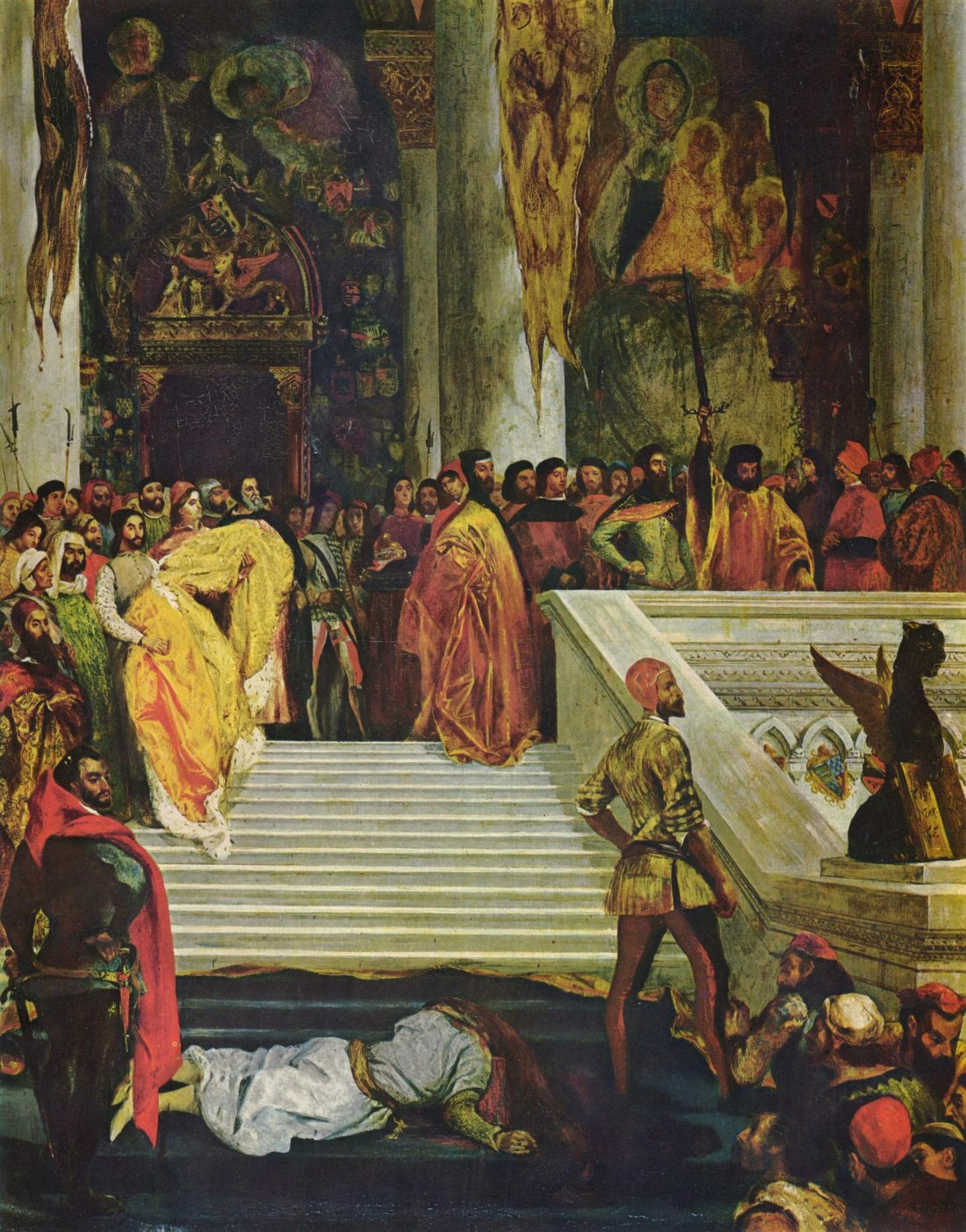
1355: Marino Faliero, Doge of Venice

On this date in 1355, Marino Faliero* was escorted to the spot where he had been crowned Doge of Venice scant months before. There, he was ceremoniously relieved of his robes of state … and then his head.


The Execution of Marino Faliero, by Eugene Delacroix (1827).

Some fog surrounds the day’s proceedings, product not only of time but of the Doge’s executioners’ damnatio memoriae upon their victim. What was written was circumspect; even Faliero‘s portrait in the great hall of the Doge’s Palace was veiled.

What is known — or at any rate, was admitted by the elderly first citizen — is that the ruler attempted a coup against the overweening power of Venice’s great families.

The putsch was supposed to occur on April 15, with the bell of St. Mark’s Cathedral tolling on a fabricated hue and cry. In the tumult, the Doge’s supporters meant to cut down the nobles who flexed the real political muscle in the maritime republic and consolidate ducal power.

Why?

The salacious version has the old goat in a tiff with a noble, who made fun of his May-December marriage —

Marino Faliero of the beautiful wife,
Others enjoy her while he maintains her

A tribunal of fellow-nobles let the rascal off with a slap on the wrist.

Power being what it is, and princes and nobilities being born for conflict with one another across the centuries in Europe, one may as well discern a straightforward political intent — heightened, perhaps, by the then-dire state of Venice’s naval contest with Genoa.

Downright Byronic under either scenario … and Byron wrote a play about Faliero. The doomed ruler gives throat to quite a magnificent curse upon his city, with all the foresight of Byron’s half-millennium of hindsight:

I perish, but not unavenged; far ages
Float up from the abyss of time to be,
And show these eyes, before they close, the doom
Of this proud city, and I leave my curse
On her and hers for ever! —

          — She shall be bought
And sold, and be an appanage to those
Who shall despise her! — She shall stoop to be
A province for an empire, petty town
In lieu of capital, with slaves for senates,
Beggars for nobles, panders for a people!

Amidst thy many murders, think of mine!
Thou den of drunkards with the blood of princes!
Gehenna of the waters! thou sea Sodom!
Thus I devote thee to the infernal gods!
Thee and thy serpent seed!
[Here the Doge turns, and addresses the executioner.]
          Slave, do thine office!
Strike as I struck the foe! Strike as I would
Have struck those tyrants! Strike deep as my curse!
Strike — and but once!

This sort of thing knocking about among litterateurs in the 19th century practically guarantees an opera.

* Or simply “Marin Falier”, in the Venetian dialect.

On this day..

1548: Gonzalo Pizarro and Francisco de Carvajal

On this date in 1548, the Spanish crown cemented its authority over the territory of the former Incan Empire by beheading its rebellious conquistador authorities.

Gonzalo Pizarro (English Wikipedia entry | Spanish) had served in the force that late elder half-brother Francisco used to destroy the Incas. The poor bloke was always second banana in the conquistador game; when he wasn’t being one-upped by his flesh and blood, he was bailing on the expedition that “discovered” and navigated the Amazon River. (Francisco de Orellana earned those honors instead.)

No, Gonzalo had a more prosaic specialty: killing.

While big bro went off to pacify more territory, Gonzalo along with siblings Hernando and Juan, the Baldwin brothers of New World conquest, chilled in the former Incan capital Cusco and sparked a rebellion in the 1530’s with their iron-fisted rule.

Appointed Governor of Quito in 1541 — he forced the appointment with some exemplary hangings — Gonzalo was just the sort to get a burr in his saddle when the Emperor Charles V promulgated the New Laws requiring slightly less crappy treatment of the natives.

And that was a low bar to clear indeed.

Although the following passage is not particular to Gonzalo Pizarro, gadfly monk Bartolome de las Casas described (perhaps exaggeratedly, but still) the previous Spanish depredations in “Perusia”:

[T]he Spaniards, without the least provocation on their part, as soon as they entred [sic] upon these Territories, did burn at the Stake their most Potent Caciq Ataliba, Prince of the whole Country, after they had extorted from him above Two Millions of Gold, and possessed themselves of his Province, without the least Opposition … As also some few days after, the Ruler of the Province of Quitonia, who was burnt, without any Cause given, or Crime laid to his Charge … and in like manner, burnt the Feet of Alvidis, the greatest of all the Quitonian Lords, and rackt him with other Torments to Extract from him a discovery of Ataliba’s Treasure, whereof as appear’d after, he was totally ignorant …

[T]hese Eyes of mine the Spaniards for no other reason, but only to gratifie their bloody mindedness, cut off the Hands, Noses, and Ears, both of Indians and Indianesses, and that in so many places and parts, that it would be too prolix and tedious to relate them. Nay, I have seen the Spaniards let loose their Dogs upon the Indians to bait and tear them in pieces, and such a Number of Villages burnt by them as cannot well be discover’d: Farther this is a certain Truth, that they snatched Babes from the Mothers Embraces, and taking hold of their Arms threw them away as far as they would from them: (a pretty kind of barr-tossing Recreation.) They committed many other Cruelties, which shook me with Terror at the very sight of them, and would take up too much time in the Relation …

More urgent than “recreation,” Pizarro (and many of the New World’s new landholding elite) were miffed that meddlesome European bleeding hearts types were going to cut into their profit margins.

Pizarro revolted, enlisting the brilliant officer Francisco de Carvajal, a longtime fixture of the Old World battlefield. Now an octogenarian, he had lost neither vigor in command, nor cruelty in conquest. (He played bad cop to Gonzalo’s good cop.) The two killed the guy sent to impose the emperor’s decree.

This uprising forced the next Spanish viceroy to repeal the hated New Laws in order to win political support against Pizarro and Carvajal — a happy outcome for Pizarro’s base, but not for the conquistador himself.

Pedro de la Gasca’s adroit diplomacy caused the entire rebel force to desert before the fight at the “Battle” of Jaquijahuana in Sacsayhuaman.

The two principals were quickly arraigned. Carvajal, at his age, could be wry about being singled out for punishment: “very merciful is the Lord President; for, if the victory had been ours, there would have fallen on this spot nine hundred men.”

Carvajal was hanged and Pizarro beheaded, both of them winding up on pikestaffs at the gates of the city Francisco Pizarro had founded — Lima.

Their partnership — and the arc of Spanish exploits in the New World — is covered in this Google Books freebie.

On this day..

1877: John D. Lee, for the Mountain Meadows Massacre

On this date in 1877, Mormon leader John D. Lee was shot at the site of (and for the crime of instigating) the Mountain Meadows Massacre 20 years before.

As the only person ever prosecuted for this dreadful affair, which saw 120 California-bound settlers slaughtered by a Mormon militia, Lee “was allowed … to carry to his grave Mormondom’s guilt for this horrible and barbaric act.” (Jan Shipps)

On this anniversary of Lee’s death, Executed Today interviews author Judith Freeman, whose historical novel Red Water tells Lee’s story through the eyes of three of his 19 wives.

You grew up Mormon — what brought you to this story? I gather that it wasn’t exactly daily discourse in your youth.

I found a copy of Juanita Brooks‘ book The Mountain Meadows Massacre in a used bookstore in Port Townsend, Washington, read it and was captivated by this story.

Growing up in northern Utah, I’d only heard vague, shadowy references to the massacre. It was the dirty little secret buried in the Mormon past — except for those people in Southern Utah who lived with that story as part of every generation’s experience and shame. I felt I had to write a novel about it, in part to try and understand this question: How do you get basically good people, like those Mormon settlers, to commit such evil?

You paint a picture of John Lee through the eyes of three of his wives. What kind of man was he — and how representative of the Mormon hierarchy would that be?

I think Lee was first and foremost a brilliant pioneer and survivalist and also a big blowhard, the kind of guy who would talk your head off — affable and a bit boring when it came to promoting his own virtues and experiences. He was self-aggrandizing, he’d do anything to make a buck, he had problems with the truth. He was a suck-up to Brigham Young who became his substitute father and then betrayed him.

He wasn’t entirely trustworthy because he put his own interests before all else. He could also be incredibly generous and kind, helpful to others. He wanted people to like him though they often didn’t, and he had an ingratiating quality. He was an orphan, with an orphan’s life-long neediness. In many ways I think he was good to his wives and cared deeply about his family — all sixty something kids and 19 wives. He was an amazingly talented man, skilled at many trades and businesses.

Was he representative of the Mormon Hierarchy? I don’t know. In some ways yes but I sense he was more sycophantic than some, and had a more amusing character than others, but what they all had in common was an absolute deference to church authority. I think I might have enjoyed meeting John D. Lee, he might have been more lively and fun than Brigham Young who strikes me as a misogynist and a brittle, cold man.

What about the women — three very different characters. What’s the sense you got of life for these women as pioneers, living in a polygamous family? How did they relate to one another, and how did the massacre and the execution of John Lee change their situation?

The women were also amazingly inventive as pioneers, strong, tough, formidable women though how can you generalize about 19 different personalities? Some liked each other and some couldn’t stand each other and the good thing was that Lee was a small industry and many of his wives had their own farms so they weren’t required to live on top of each other. He understood the “kitchen thing” when it comes to women, and said he wanted every one of his wives to have her own stove. The Lee family/families were devastated by his execution. His families were left penniless and destroyed, treated very cruelly, the women dispersed and shunned, the children shamed, and this shame was carried for generations.

To what extent is polygamy in the back story of the Mountain Meadows Massacre? What, for that matter, was the massacre really “about” in your judgment?

Polygamy had a small role to play in the massacre. The practice of polygamy, outlawed by the United States, was a part of what disturbed Washington and caused the federal government to send troops to Utah, which scared the Mormon populace into committing violent acts. One must remember that they had been the victims of violence and massacre, and fear turned in their minds.

What the massacre was really about, in my judgment, was the struggle for power in Utah. Would Brigham Young and the Mormon hierarchy control the territory and be masters of their own destiny, or would the federal government impose control of the “fiefdom”? The massacre came out of the idea the Indians could be made to carry out an attack and then the government would be forced to realize that if the Mormons were not allowed to control the territory and “their” natives, terrible things could happen. But the whole thing got out of control and took on a terrible life of its own.

A large party of Mormons, painted and tricked out as Indians, overtook the train of emigrant wagons some three hundred miles south of Salt Lake City, and made an attack. But the emigrants threw up earthworks, made fortresses of their wagons and defended themselves gallantly and successfully for five days! Your Missouri or Arkansas gentleman is not much afraid of the sort of scurvy apologies for “Indians” which the southern part of Utah affords. He would stand up and fight five hundred of them.

At the end of the five days the Mormons tried military strategy. They retired to the upper end of the “Meadows,” resumed civilized apparel, washed off their paint, and then, heavily armed, drove down in wagons to the beleaguered emigrants, bearing a flag of truce! When the emigrants saw white men coming they threw down their guns and welcomed them with cheer after cheer! And, all unconscious of the poetry of it, no doubt, they lifted a little child aloft, dressed in white, in answer to the flag of truce!

The leaders of the timely white “deliverers” were President Haight and Bishop John D. Lee, of the Mormon Church. Mr. Cradlebaugh, who served a term as a Federal Judge in Utah and afterward was sent to Congress from Nevada, tells in a speech delivered in Congress how these leaders next proceeded:

They professed to be on good terms with the Indians, and represented them as being very mad. They also proposed to intercede and settle the matter with the Indians. After several hours parley they, having (apparently) visited the Indians, gave the ultimatum of the savages; which was, that the emigrants should march out of their camp, leaving everything behind them, even their guns. It was promised by the Mormon bishops that they would bring a force and guard the emigrants back to the settlements. The terms were agreed to, the emigrants being desirous of saving the lives of their families. The Mormons retired, and subsequently appeared with thirty or forty armed men. The emigrants were marched out, the women and children in front and the men behind, the Mormon guard being in the rear. When they had marched in this way about a mile, at a given signal the slaughter commenced. The men were almost all shot down at the first fire from the guard. Two only escaped, who fled to the desert, and were followed one hundred and fifty miles before they were overtaken and slaughtered. The women and children ran on, two or three hundred yards further, when they were overtaken and with the aid of the Indians they were slaughtered. Seventeen individuals only, of all the emigrant party, were spared, and they were little children, the eldest of them being only seven years old. Thus, on the 10th day of September, 1857, was consummated one of the most cruel, cowardly and bloody murders known in our history.

Mark Twain, Roughing It

John Lee: murderer, scapegoat, or both? How did he come to be prosecuted at all, and how to be the only one prosecuted?

John D. Lee was both murderer and scapegoat. He was bold and careless enough to hang around the area after the massacre, and to prosper from his various businesses and appear almost indifferent to what had happened — perhaps he thought he had the protection of the church authorities who continued to insist the Indians had committed this atrocity. A lot of others who’d participated in the massacre left the area, driven out by fear and shame. But Lee hung on.

John D. Lee, seated beside his coffin just before his execution.

How he was thrown to the wolves by the church authorities is a long story, as is the story of his two trials. He was the easiest person to scapegoat. He took the bullet for his church, and I think the authorities felt that they could put the affair behind them once he was dead, and they did for a very long time, until brave little Juanita Brooks wrote her book in the 1950s and was the first to tell the truth: the Mormons did it.

Does the Mormon church have some unfinished reckoning here? If so — why, after all these years?

Who cares what I think? But in my opinion, of course they do. They need to stop saying it was a “local” affair, carried out by some “local” renegade fanatics in southern Utah. The whole situation that led to the massacre was put into motion by people high up in the church, but I doubt very much they’ll ever go there and admit that. Too many lawyers, too much money, too impossible to admit culpability of prophets, seers, revelators.

Finally, I just want to say that after writing Red Water and thinking about this massacre for the five years it took to research and write the book, this is what I came to believe about how you get good people to do bad things.

You need to get three things going: First, you have to make people afraid and use that fear to manipulate them (think of 9/11). Second, you need get people to obey some greater force or consciousness other than their own — the Mormons had a principle of Perfect Obedience where you were required to subject yourself to the authority of the priesthood and church elders, but this idea could as well be inculcated in the concept of patriotism, or military duty. The point is, you subdue your own conscience in favor of deferment to an outside force. Third, you make people think their system is better than the other guy’s, that you’re doing God’s will, that your sense of right is greater than theirs. If you can make people think they are doing God’s will, you can get them to do anything. Get these three things going, and you can get good people to commit great evil.

On this day..