2007: Not Earl Wesley Berry … for the time being

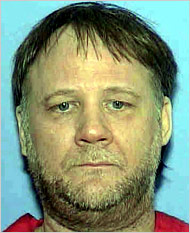
Minutes before he was to die this day last year, the lethal injection of Mississippi murderer Earl Wesley Berry was stayed by the Supreme Court — the signal that it had imposed a de facto moratorium on executions while it considered the constitutionality of lethal injection.

Condemned to die for kidnapping and beating to death Mary Bounds in 1987, Berry was your basic unappealing death row case with no particular issue either substantive or technical likely to help him out in the courts.

Luckily for Berry, the fundamental issue of whether whether the lethal injection regime used in Mississippi and in most of the United States was cruel and unusual punishment had reached the high court at just time time.

Also luckily, the phone lines were open: Berry got his reprieve with about 15 or 20 minutes to spare.

Berry’s stay finally clarified a few weeks of uncertainty that prevailed after the Court took last year’s lethal injection challenge, Baze v. Rees.

Could executions still go forward while lethal injection was under review? Would the holdup be limited to Kentucky, where the appeal originated? Was there any manner of case-by-case flexibility?

Berry was the bellwether. The execution-friendly Fifth Circuit Court let Berry’s scheduled date go ahead, making the hapless killer “the last best chance for prosecutors to restart executions this year [2007].”

But Earl Wesley Berry’s luck was only about seven months long: he was executed on May 21, 2008, the second prisoner put to death after the moratorium expired upon the Court’s rejection of Baze.

On this day..

1997: Ricky Lee Green

On this date in 1997, serial killer Ricky Lee Green died by lethal injection in Texas.

The radiator repairman was executed specifically for castrating and stabbing to death Steven Fefferman in 1986, but he killed at least three other people — two women and a 16-year-old boy — and investigators associated his m.o. with up to eight other unsolved murders. (Green also copped to another murder after his conviction, possibly to help another man, William Chappell, avoid execution. It didn’t work; Chappell was executed for that crime in 2002.)

“They all deserved it. They were kind of the dregs of society.”

“A Jekyll and Hyde thing” is how Green’s true-crime biographer characterized him — a lifetime of physical and sexual abuse and a drug habit dating to childhood had seriously warped the dude.

And the most famous serial killer from tiny Boyd, Texas might’ve kept getting away with it if wasn’t for his darn estranged wife.

Someone sure was grateful for Sharon Dollar Green’s help: even though she’d participated in some of the murders, she shopped hubby and skated with ten years’ probation as more Green’s victim than his accomplice.

Green went the popular “death row conversion” route while awaiting the inevitable, or so — atheists in foxholes and all — maintained his last statement.

I want to thank the Lord for giving me this opportunity to get to know Him. He has shown me a lot and He has changed me in the past two months.

I have been in prison 8 1/2 years and on death row for 7, and I have not gotten into any trouble. I feel like I am not a threat to society anymore. I feel like my punishment is over, but my friends are now being punished.

I thank the Lord for all He has done for me.

I do want to tell the …

But the lethal cocktail had begun, and the sentiment went to the grave with Ricky Lee Green.

On this day..

2003: Paul Hill, anti-abortion martyr

Five years ago today, minister Paul Hill was put to death by lethal injection for murdering an abortion provider and a clinic escort nine years before.

Hill rose to prominence in the early 1990’s as a fire-eating abortion foe, who openly preached the righteousness of defending unborn life by force — a divisive position among anti-abortion activists that got him excommunicated from the Presbyterian church.

On July 29, 1994, in the abortion conflict’s ground-zero of Pensacola, Fla., Hill put his theology into action by gunning down Dr. John Britton and his septuagenarian escort, along with Britton’s wife (who survived the shooting).

Creepy. It sure looks like the song and image pairings were done in earnest, not in irony.

He never betrayed the least scruple about his act, hoping only to use his trial to present a “justifiable homicide” defense; the judge’s suppression of this line was and remains a grievance of Hill’s fellow-travelers against the judiciary.

Nor did Hill betray the least concern to die for his beliefs; if anything, in dropping appeals that would at the least have prolonged his life, he cut a figure thirsty for the martyrdom he attained this day.

To what end?

Hill left a plentiful documentary record — like this manifesto, among the pro-Hill documents collected on the Army of God website:

I knew that [killing an abortion provider] would uphold the truths of the gospel at the precise point of Satan’s current attack (the abortionist’s knife). While most Christians firmly profess the duty to defend born children with force (which is not yet being disputed by the government) most of these professors have neglected the duty to similarly defend the unborn. They are steady all along the battleline except at the point where the enemy has broken through. I was certain that if I took my stand at this point, others would join with me, and the Lord would eventually bring about a great victory.

One can question whether this proved to be the case or not. The infamy (in most circles) of the killing arguably dampened enthusiasm for the cause, at least as measured by the sulfur level on clinic sidewalks. At the same time, Hill’s was only the most spectacular instance of a campaign to terrorize abortion providers that drove many out of business and made some areas of the country virtual abortion-free zones.

Whatever may have surprised him about the way the issue played out over the 1990’s, he was serene about his choices when interviewed the day before his execution.

To some in the movement, he’s a holy martyr, the John Brown of slavery’s modern-day parallel.

And even if Paul Hill’s name is taboo in the respectable public discourse of abortion today, with four relatively young rock-ribbed anti-Roe v. Wade votes now entrenched at the Supreme Court, it’s far from obvious that Hill won’t get what he was after all along … even if he didn’t live to see it.

Part of the Themed Set: Judging Abortion.

On this day..

1993: Ruben Cantu, an innocent child?

On this date in 1993, Texas gave a lethal injection to a young man for murder — a crime many involved in the case no longer believe he committed, since the sole witness against him has recanted.

Ruben Cantu was only 17 years old at the time of the crime, and for that reason would not be eligible for execution today. But according to a Houston Chronicle investigation (the story is also mirrored here) 12 years after his death, he shouldn’t have been eligible then because he might not have done it. Cantu himself may have kept a street code of silence to his death.

Lise Olsen — interviewed by NPR here — blew up the case; Cantu’s jury forewoman and the district attorney who tried him for his life are among those who have publicly regretted their roles in what has emerged one of the most compelling cases of an executed innocent in the modern American death penalty era. Nobody could possibly have predicted that pitiable public defender resources and an extremely aggressive capital punishment regime could result in such a thing.

The subsequent (and still current) Bexar County District Attorney checked it out (threatening to prosecute the recanting witness) and declared everything proper. So don’t worry about it. What could she possibly have to gain from a whitewash?

On this day..

2007: Frank Duane Welch, a cold case CSI caught

One year ago today, justice was served better late than never, courtesy of the crime lab.

The 1987 rape and murder of Jo Talley Cooper, a pregnant 28-year-old Norman woman killed while her infant son lay unharmed in the next room, had stood unsolved for a decade.

Coincidentally — unluckily for Frank Duane Welch — forensic DNA testing was just coming online during that decade. A match in another case led the database to its culprit, in the Cooper murder and a similar crime around the same time.

Apart from the manner of his capture — and the incidental minor distinction of being the last person killed in Oklahoma’s busy death chamber before the 2007-2008 execution moratorium due to court challenges to lethal injection — Welch is an almost wholly unremarkable character, central casting for the modern American death row, a paragon of the banality undergirding appalling, life-shattering crimes.

The penpal site of the Canadian Coalition to Abolish the Death Penalty still preserves Welch’s c. 1999 appeal for correspondence:

My name is Frank Duane Welch, I am a 38 yr. old white male who is confined on Death Row within the Oklahoma Department of Corrections. I enjoy watching numerous sporting events, such as football, baseball, tennis and rodeo. Here on Death Row we have only two options of exercise, basketball or handball. I try and take advantage of both in order to stay in shape. Besides sports, I enjoy a good book, novels mostly. My tastes in music are first country and then some light rock, no heavy metal. My educational background consists of a bachelors degree in Animal Science. Now as for what I am looking for in a pen pal. I am looking for a friend, age not important. One who is willing to be straight forward with me, no games. For I will be straightforward with them. I need someone who is willing to help me both emotionally and financially. Someone who, when I am having a bad day, is willing to listen and give support. I am a proud man, but it is hard being alone in this place, no one to share your thoughts and feelings with. For this is the reason I have written this letter. If you are willing to accept me as I am and not hold my faults against me, I would love to hear from you.

According to the macabre* blog Dead Man Eating, Welch checked out with a belly full of pizza and a two-liter Coke, tritely last-wording:

There is nothing that can change the horrible thing I done. There is nothing that can change that. I take full responsibility for what I done. I am truly, truly sorry for all the hurt and pain I have caused you. I take full responsibility for what I’ve done. There’s no excuse for it. There never was. It was just me.

I love y’all. God bless y’all. I’m ready.

Maybe that’s as much closure as one can have in this world. That infant child who survived the horror had grown into a 20-year-old man who had never known his mother. Travis Cooper’s testimony at the clemency board hearing helped seal Welch’s fate.

It would be different if my mother would have died of natural causes. It would be different if it was God’s will, but the truth is that an evil man named Frank Welch took her life … And the unspeakable things he did to her, my mother, is what fills me with anger, the pain, and the loneliness that I feel to this day.

“None of this will ever bring my mom back,” Cooper told reporters after the execution. “I miss my mom.”

* Pot. Kettle. Black.

On this day..

2007: Zheng Xiaoyu, former Director of the State Food and Drug Administration

One year ago today, China made to clean up its image — with public health advocates, if not with human rights advocates — by executing* its former Food and Drugs minister for economic crimes.

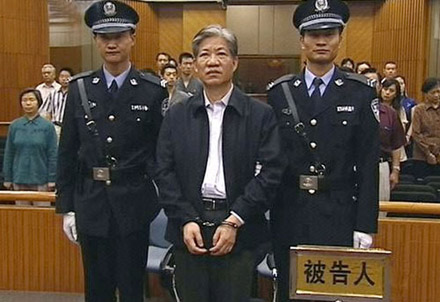
Zheng Xiaoyu, China’s drug regulation capo from 1994 to 2005 and only (“only”?) the fourth minister-level official to be put to death in China since the immediate aftermath of Mao Zedong’s reign, was sentenced for extracting bribes from pharmaceutical companies he nominally regulated in exchange for approving their worthless and/or unsafe products.

One bogus antibiotic he rubber-stamped killed ten in China before it was pulled from the market, but it was dangerous Chinese products exported abroad — including lethal pet food ingredients to the United States and a cough syrup that killed dozens in Panama — that lit a fire under the export-driven colossus. The court that rejected his appeal explicitly referenced Zheng’s danger to China’s international reputation — simultaneously shifting focus from structural weaknesses by individualizing them to Zheng’s personal failings.

Zheng Xiaoyu hears his death sentence.

On this same day it announced Zheng’s death, China anxiously unveiled plans to safeguard the food supply for its upcoming turn under the Olympic klieg lights. That acid test is now upon it: opening ceremonies are mere weeks away as of this writing.

It may have been a politically-driven execution and an unusually heavy sentence, but Zheng’s passing was exulted in China. Someone even tried to put his name on a rat poison — rejected for that most distinguished reason of modern capitalism, Zheng’s own intellectual property in his name.

For an interesting dive into the social and legal currents surrounding this case, check out this .pdf edition of Criminal Bar Quarterly.

* The method of execution was not announced, and to my knowledge has not been conclusively documented. Gunshot was the longtime standby for Chinese executions, but China has shifted heavily towards lethal injection in recent years; it’s generally assumed that Zheng suffered the latter fate.

On this day..

2000: Two kidnappers, televised by Guatemala

On this date in 2000, Amilcar Cetino Perez and Tomas Cerrate Hernandez were executed on live television in Guatemala for kidnapping and murdering a liquor heiress.

The televised Perez execution began at 6:05 a.m., with Hernandez (reportedly “shaking badly”) following at 7:15. Both took some minutes; Amnesty International has charged that they were botched and the prisoners suffered prolonged suffering. The macabre spectacle was replayed on Guatemalan TV throughout the day.

So daunting (or puffed-up) was the menace posed by the Los Posaco kidnapping-and-extortion gang they belonged to, the president sent his family to Canada to shield them from reprisals.

Today’s casualties were the second and third persons to die by lethal injection in Guatemala,* and remain to this date the last.

They might not retain that distinction long, however. Legislation earlier this year filled a legal gap that had caused a five-year moratorium on executions — ironically, by restoring the president’s power to pardon and commute death sentences.

* Lethal injection was introduced after a televised execution by firing squad came off most un-telegenically.

On this day..

2001: Timothy McVeigh, Oklahoma City bomber

At 7:14 a.m. on this date in 2001, Oklahoma City bomber Timothy McVeigh was executed at the federal penitentiary in Terre Haute, Ind.

More ink has been spilled about the 33-year-old Gulf War veteran and his infamous crime than this space can possibly hope to summarize. Books can be — and have been — written debating whence McVeigh sprang and whether he was rightly convicted.

McVeigh tended to keep coy about his version of his activities on April 19, 1995,* but he was never less than frank about his philosophy.

Though his avowed motive, the Waco slaughter that occurred two years to the day before Oklahoma City, has never exactly been secret, the way he’s connected those events has also never been particularly welcome. And McVeigh would say that the fact that he suffered execution while the only parties punished in the Waco siege were the survivors makes his point.

For all its moral monstrosity, the Gulf War veteran’s critique of his violent actions vis-a-vis those the state claims legitimacy for makes discomfiting reading, and is not always so easy to answer. From our distance of time, knowing that three months after McVeigh’s execution another terrorist act to beggar Oklahoma City would propel the United States back into Iraq, it strikes eerily prescient notes.

In a 1998 essay, McVeigh savaged the government for its hypocritical posture towards the country he had once fought, Iraq:

The administration has said that Iraq has no right to stockpile chemical or biological weapons (“weapons of mass destruction”) — mainly because they have used them in the past.

Well, if that’s the standard by which these matters are decided, then the U.S. is the nation that set the precedent. The U.S. has stockpiled these same weapons (and more) for over 40 years. The U.S. claims that this was done for deterrent purposes during the “Cold War” with the Soviet Union. Why, then is it invalid for Iraq to claim the same reason (deterrence) — with respect to Iraq’s (real) war with, and the continued threat of, its neighbor Iran?

If Saddam is such a demon, and people are calling for war crimes charges and trials against him and his nation, why do we not hear the same cry for blood directed at those responsible for even greater amounts of “mass destruction” — like those responsible and involved in dropping bombs on [Dresden, Hanoi, Tripoli, Baghdad, Hiroshima and Nagasaki]?

The truth is, the use of a truck, a plane, or a missile for the delivery of a weapon of mass destruction does not alter the nature of the act itself.

These are weapons of mass destruction — and the method of delivery matters little to those on the receiving end of such weapons.

Whether you wish to admit it or not, when you approve, morally, of the bombing of foreign targets by the U.S. military, you are approving of acts morally equivalent to the bombing in Oklahoma City. The only difference is that this nation is not going to see any foreign casualties appear on the cover of Newsweek magazine.

It seems ironic and hypocritical that an act viciously condemned in Oklahoma City is now a “justified” response to a problem in a foreign land.

Another note sent shortly before his execution to author Gore Vidal travestied government warmaking talking points:

[T]his bombing was also meant as a pre-emptive (or pro-active) strike against those forces and their command and control centers within the federal building. When an aggressor force continually launches attacks from a particular base of operations, it is sound military strategy to take the fight to the enemy. Additionally, borrowing a page from U.S. foreign policy, I decided to send a message to a government that was becoming increasingly hostile, by bombing a government building and the government employees within that building who represent that government. Bombing the Murrah Federal Building was morally and strategically equivalent to the U.S. hitting a government building in Serbia, Iraq, or other nations. Based on observations of the policies of my own government, I viewed this action as an acceptable option. From this perspective what occurred in Oklahoma City was no different than what Americans rain on the heads of others all the time, and, subsequently, my mindset was and is one of clinical detachment.

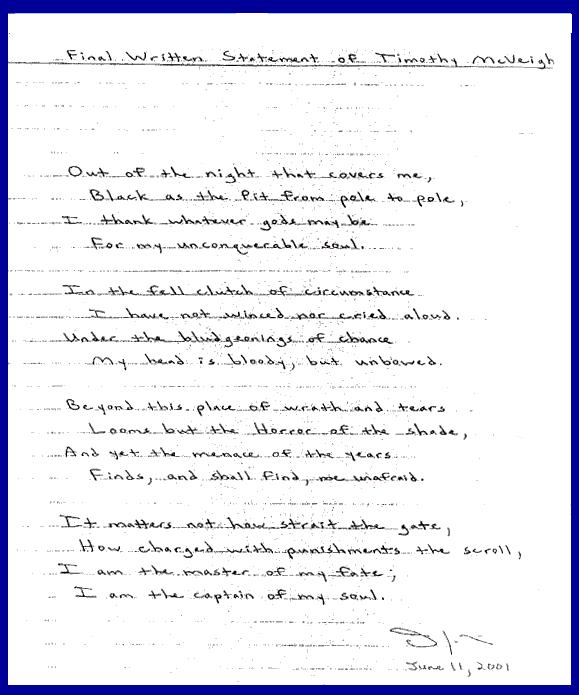
He broadcast clinical detachment in the execution itself — the first conducted by the federal government since 1963, technically imposed for the eight federal employees among his 168 victims — from his waiver of appeals to his unnervingly unblinking death mask to the stoic 19th century poem “Invictus” that formed his written (and only) final statement.

* Also — coincidentally or not — the execution date of Richard Snell in Arkansas, a militia man (and white supremacist, which McVeigh was not) who had once tried to blow up the Murrah building himself.

On this day..

2004: Case Study: Kelsey Patterson

The case of Kelsey Patterson, who was executed in 2004, is one of the most compelling examples of what can happen when the mental health system fails to provide adequate care and in doing so, puts the public at risk. For more than two decades, Patterson struggled with paranoid schizophrenia. His severe delusions and elaborate conspiracy theories led him to commit several irrational and motiveless assaults. Yet instead of investing resources in a long-term treatment plan, the state of Texas largely left Patterson to his own devices, until one day his mental illness pushed him to the point of no return.

A Cycle of Illness, Violence, and Neglect

Kelsey Patterson spent much of the 1980s in and out of two state mental hospitals. His condition would be stabilized, but would deteriorate once he was removed from psychiatric care. According to a Houston Chronicle from 11 August 2002 (“Mentally Ill Killer’s Life on the Line”), when he stopped taking his medication, he would become belligerent. An earlier article in the same newspaper (“Is Mentally Ill Death Row Inmate Sane Enough to Die?”, Houston Chronicle, 14 November 1999) noted he was “left half-treated and unsupervised by the state for years despite a history of psychotically inspired, near-fatal assaults.”

Kelsey Patterson: Not all there.

In 1980, Patterson shot and wounded Richard Lane, a Dallas co-worker who he believed was conspiring against him and attempting to poison his food (it was Lane’s first day on the job). Lane survived and Patterson was sent to the maximum security unit at Rusk State Hospital, where he was found incompetent to stand trial and diagnosed with schizophrenia. Although restored to competency through treatment, doctors determined that he had been unable to conform his conduct to the law, a key provision of Texas’ insanity statute at the time. Prosecutors dismissed the charges, deeming him insane at the time of the crime.

In 1983, Patterson shot and wounded a co-worker in his hometown of Palestine in another motiveless, delusional assault. Again he spent months at Rusk State Hospital before being restored to competency. Once again he was found unable to conform his behavior to the law, and the attempted murder charge was dismissed.

Back in Dallas in 1986, he assaulted yet another co-worker and was sent to Terrell State Hospital. As with the previous incidents, no charges were filed because of his mental health status. He was hospitalized once more in 1988 after reportedly threatening family members and complaining that people were trying to poison him. That hospital stay lasted only 34 days.

Throughout this period, Patterson denied that he was mentally ill, would stop taking his medications, and refused to comply with treatment plans. His delusions continued to worsen, and he believed that everyone was out to get him, particularly “the authorities.” According to his brother, he sometimes would tape the edges of his windows and doors to determine if anyone had come in the room. He also heard voices talking to him through the walls and over the loudspeakers during his time in jail.

On September 25, 1992, just days after his brother once again tried to have him committed to a psychiatric facility, Patterson walked a short distance from his home to a local oil supply business in Palestine, where he shot and killed both the owner, Louis Oates, and his secretary, Dorothy Kay Harris, at whom he screamed “You ain’t going to get away with it.” After the shooting, he put down the gun, stripped to his socks, and paced, shouting incomprehensibly until the police arrived. As with his previous assaults, there seemed to be no real motive or explanation for the crime – Patterson had only a casual acquaintance with the victims. Yet in this instance, the state not only decided to pursue charges but also to seek the death penalty, arguing that Patterson met the new legal standard of sanity, which merely required the defendant to know that his conduct was wrong. The ability to conform one’s conduct to the law was no longer part of the insanity defense in Texas. By all accounts, however, Patterson’s delusional beliefs were the same as always.

Excerpt from a 13-page letter from Kelsey Patterson to the Texas Court of Criminal Appeals. (Image owned by author.)


Patterson’s Competency Hearing and Capital Trial

At his competency hearing, two physicians did not dispute his mental illness but declared Patterson to be competent to stand trial. Dr. James Grigson – who had diagnosed Patterson with schizophrenia 12 years earlier – reversed course and testified that in this latest assault, Patterson had been sane at the time of the crime. He had spoken with Patterson for less than five minutes and had not conducted a comprehensive evaluation, yet was absolutely confident in his assessment.*

Against the advice of his attorneys, Patterson took the witness stand during the hearing and rambled about the conspiracies against him. He offered this explanation for his behavior:

They have some type of implant devices that they used on me in the military, which I receive. Like the device that they put in the inner ear in which they can send subliminal message and make a person act beyond their controllability to know you have taken an action.”

The jury found him competent to stand trial, in spite of the clear evidence that he did not possess a rational or factual understanding of the proceedings against him and was unable to consult with his attorneys, whom he believed were plotting against him. Patterson was constantly removed from the courtroom during his trial because of his disruptive behavior and outbursts about the devices implanted in his body. The jury rejected his insanity defense, found him guilty of capital murder, and sentenced him to death.

A Permanent Stay of Execution

During his time on death row, Patterson consistently maintained that he was the victim of an elaborate conspiracy, and he wrote rambling, incoherent letters to court officials, his family, politicians, and others. He refused to meet with mental health professionals or his lawyers, which made it impossible to formally assess his competence. Both state and federal courts upheld his conviction and found him competent to be executed. In November 2003, the U.S. Supreme Court refused to hear his appeal and the state set his execution for the following May.

Upon learning of his execution date, Patterson’s letters referred to a “permanent stay of execution” that he said he had received on grounds of innocence. Competency for execution requires an inmate to be aware of the impending execution and the reason for it.

On May 17, 2004, the Texas Board of Pardons and Paroles issued an extremely rare recommendation of clemency for Kelsey Patterson because of his mental illness; the vote was 5-1 and was only the second such recommendation in the board’s history. Governor Rick Perry rejected the recommendation, however, “in the interests of justice and public safety.” Kelsey Patterson was executed on May 18, 2004, delusional until the very end, as evidenced by his incoherent last statement:

Statement to what? State what? I am not guilty of the charge of capital murder. Steal me and my family’s money. My truth will always be my truth. There is no kin and no friend; no fear what you do to me. No kin to you undertaker. Murderer. … Get my money. Give me my rights. Give me my rights. Give me my rights. Give me my life back.

For more information on death penalty cases involving mental illness, go to http://www.tcadp.org/index.php?page=mental-illness or visit http://preventionnotpunishment.blogspot.com

* Dr. Grigson was known as “Dr. Death” because his testimony was instrumental in sending so many people to death row. He later was expelled from the American Psychiatric Association and Texas Society of Psychiatric Physicians because of his unethical, unscientific testimony in such cases.

Kristin Houle is a 2007 Soros Justice Fellow based in Austin, Texas.

On this day..

1995: Richard Snell – did he go out with a bang?

At 9 p.m. this evening on this date, white supremacist Richard Snell was executed for murder in Arkansas.

He went out full of venom and smugness, his last words menacing the state’s governor:

Governor Tucker, look over your shoulder; justice is coming. I wouldn’t trade places with you or any of your cronies. Hell has victories. I am at peace.

(Source — but possibly erroneous; note the comments to this post)

It had been as satisfying* for Snell as last days on earth come: the very morning of his execution, militia fellow-traveler Timothy McVeigh blew up Oklahoma City’s Murrah Federal Building.

It is not for this venue to attempt any definitive judgment on the connections and cul-de-sacs of the much-scribbled-about white supremacist labyrinth. It is enough for our purposes to note several items which may be coincidence and have sometimes been reckoned rather more.

  • April 19 had already become the militia movement’s holy day: April 19, 1775, had sparked the American Revolution; more to the point, it had been the date in 1993 of the slaughterous Waco siege. Snell’s execution was slated for that date intentionally, much to the outrage of his sympathizers: so was McVeigh’s plot.
  • Twelve years before his death, Snell himself had schemed to blow up the very same building.
  • Snell has been reported to have predicted that there would be a bombing on his execution date.

After his execution, Snell was returned to Oklahoma Christian Identity mecca (and possible McVeigh haunt) Elohim City, where he lay three days in an open casket before being interred in the community’s cemetery under a headstone marked “Rev Richard Wayne Snell. Patriot.”

* Snell was “smiling and chuckling and nodding” on his last day as he watched coverage of the bombing.

On this day..