On February 27,* 1623, the Dutch East India Company beheaded twenty who had been waterboarded into confessing to a terrorist plot.
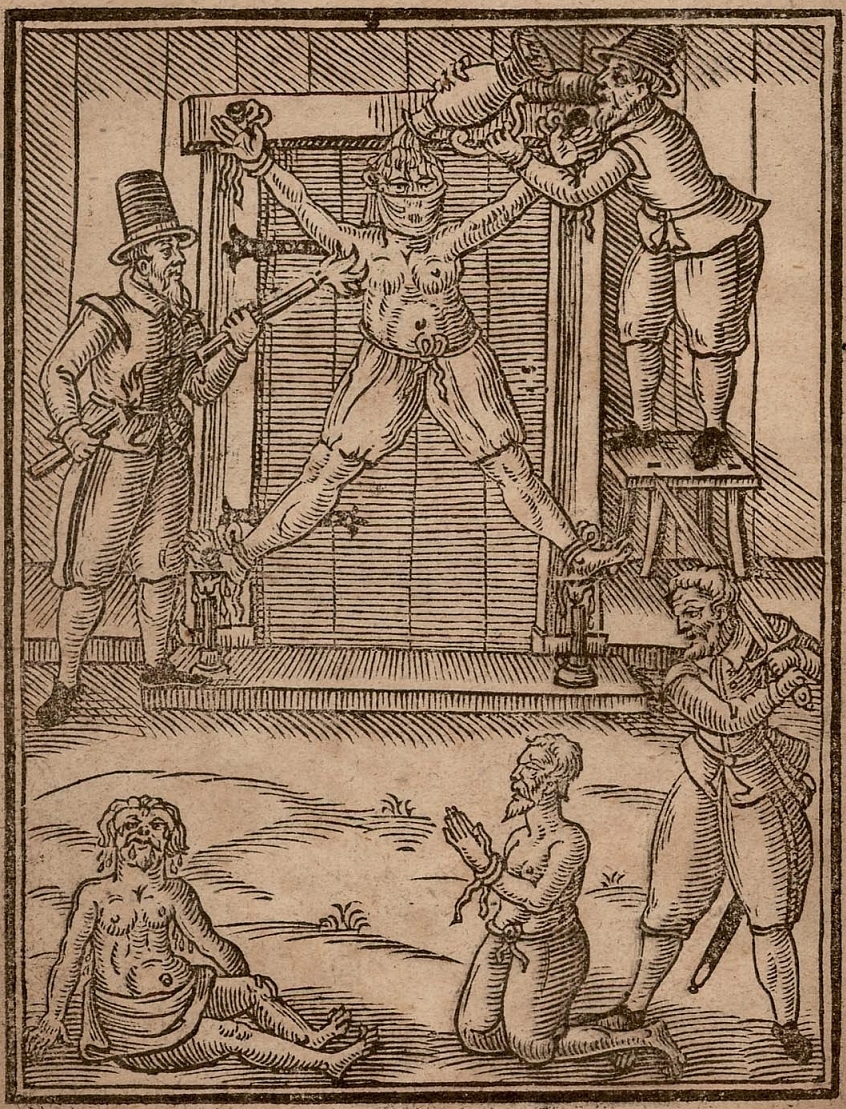
English prisoner suffering “waterboarding” faux-drowning torture, published under the name “A true relation of the unjust, cruell, and barbarous proceedings against the English at Amboyna in the East-Indies 1624”.
The torturers “poured the water softly upon his head until the cloth [wrapping his head] was full, up to the mouth and nostrils, and somewhat higher, so that he could not draw breath but he must suck in all the water.” More nasty description.
As in modern times, this scenario originated with resource competition in the Muslim world … in this case, competition for spice, in Indonesia.
European colonialism had pitted the Dutch East India Company against its British counterpart on the archipelago, both scrabbling after the lucrative trade in cloves and pepper, with garnishes of nutmeg, cinnamon, mace, and ginger.
The two rival powers had, as we lay our story, recently come to a tense truce, dividing the commerce between them — and swapping mutual accusations of violating that pact. The arrangement basically gave the Dutch a bigger slice of the pie, so we’ll find them when the cloves hit the fan having the balance of power on their side.
Terrorists
We’re going to oversimplify to set the scene.
On Ambon Island, one of the very “Spice Islands” (i.e., the Moluccas) — at the Dutch-controlled fortification of a trading post also shared by the English — the Dutch merchant-governor Herman van Speult heard that a Japanese mercenary had asked about the Dutch fortifications.
The security-conscious van Speult ordered that unfortunate soldier interrogated under torture.
As tends to happen when the interrogators in such a case are convinced of a ticking time bomb situation, the torture uncovered a ticking time bomb situation.
The mercenary got the Dutch to stop burning and drowning him by “revealing” a highly implausible** English plot to seize the Dutch fort, with 20 guys or so and no prospect of imminent outside aid. Wouldn’t you know it: when the supposed confederates named by the mercenary were similarly tortured, they too admitted the plot. Van Speult’s English opposite number, Gabriel Towerson, was one of them.
The Amboyna Massacre followed anon, with Towerson and nine other British East India Company employees beheaded, along with nine Japanese mercenaries and one Portuguese. (The latter ten worked for the Dutch East India Company, not the British. A fifth column!)
They went to their deaths protesting their innocence, and many smuggled out written recantations to that same effect: “tortured … with that extream Torment of Fire and water, that Flesh and Blood could not endure it, and we take it upon our Salvation, that they have put us to Death Guiltless.”
Anger in the English Street
That last quote comes from Karen Chance, “The Amboyna Massacre in English Politics, 1624-1632,” in Albion: A Quarterly Journal Concerned with British Studies (Winter 1998).
As the title of that piece suggests, the Amboyna Massacre outraged Towerson’s countrymen and -women once word finally made it back to the mothership. (In addition to the torture/wrongful execution dimension, the legal authority of the Dutch trading concern to impose judicial punishment on their English counterparts was questionable at best.)
English demands for satisfaction against the perpetrators continued to complicate Dutch-English relations into the reign of Charles I and beyond. Even Oliver Cromwell required, as the price of peace for the First Anglo-Dutch War in the 1650s, punishment of any surviving offenders. (Which was apparently nobody at all.)
And still later, the burgeoning British Empire’s propaganda arm reached for the Amboyna narrative to justify seizing New Amsterdam on the grounds that the Dutch had attempted to spring a massacre on English settlers — “their Amboyna treacherous Cruelty extended itself from the East to the West Indies, and pursued thus the straight channel of Dutch blood”.
As for the trade-jockeying: the Netherlands’ commanding position in Indonesia ultimately squeezed the English out.** But don’t fret for Old Blighty: she turned attention to gobbling up India, and made a lot more bank than did the Dutch spice racket.
* February 27 was the date according to the Julian calendar in use at this time by the British. By the Gregorian calendar the Dutch were using, the massacre took place on March 9.
** For more on both the fanciful nature of the supposed plot, and the economics of the East Indies trade as it unfolded in the 17th century, see D.K. Bassett, “The ‘Amboyna Massacre’ of 1623”, Journal of Southeast Asian History, September 1960.
On this date in 1865, Confederate John Yates Beall was hanged at Governors Island, New York, as a spy and saboteur.
This Virginian was knocked out of regular service through injuries early in the Civil War, but proceeded to a privateering career harassing Union shipping.
The pinpricks inflicted by Beall’s couple of ships was hardly calamitous for the North, but what he lacked in resources he made up in persistence.
Captured and exchanged midway through the war, he returned to his swashbuckling ways. But sneaking into New York from Canada in a bid to free rebel prisoners, Beall was caught again trying to derail trains — and secretly condemned by a military tribunal.
When the news of his impending execution got out, six Senators and 85 other members of Congress* appealed for leniency.
“For days before the execution,” it was said, “the President closed the doors of the executive palace against all suppliants, male or female, and his ears against all appeals, whether with the tongue of men or angels in behalf of the unfortunate prisoner. From the first Mr. Lincoln had responded to all applications for his interposition — ‘Gen. Dix may dispose of the case as he pleases — I will not interfere.’ Gen. Dix on his part replied, ‘All now rests with the President — as far as my action rests there is not a gleam of hope.’ Thus they stood as the pillars of the gallows, on which Beall’s fate was suspended and between them he died.” (Source)
Here’s the capture-trial-and-execution portions of a homemade documentary on Beall (also check the preceding parts 1, 2, and 3)
On this date in 1942, Estonian linguist and ethnographer Boris Vilde was shot with his French Resistance circle at Fort Mont-Valerien.
St. Petersburg-born, Estonian-raised, the young scientist came to Paris at age 25 (French link) with his life in a backpack.
In the eight short years remaining to him before he gave his life for his adopted land’s anti-Nazi resistance, Vilde cofounded the Paris Musee de l’Homme. (When visiting, be sure to look for the skull of Suleiman al-Halabi, a Syrian executed for assassinating one of Napoleon’s Egyptian officers in 1800.)
It says here that Vilde even imported the French word “resistance” into Estonian.
Boris knew whereof he spoke.
His Musee de l’Homme group recruited scientists and intellectuals and published anti-fascist propaganda.
When the Vichy government infiltrated it and had its principals condemned, one of Vilde’s compatriots is said to have bellowed at the firing squad at the last moment,
One day after Nicholas Brembre’s treason trial was interrupted for the sudden capture and summary execution of his political ally Robert Tresilian, the former Mayor of London was back in the dock of the Merciless Parliament this day to receive (and immediately suffer) the Lords’ judgment that he be hanged.
Like Robert Tresilian, Brembre had backed the young Richard II’s bid to throw off the influence of a circle of advisors during the dangerous 1380s.
Brembre spent the early part of the decade bursting his ample coffers with a plum customs-collection gig (in which capacity he employed Geoffrey Chaucer), with a couple of stints as London mayor mixed in.
He earned a reputation for corruption and election-rigging (“on the day of the election … Sir Nicholas and others of his faction ordered to the Guildhall of London certain persons, ‘foreigns’ and others in great numbers, who were armed, to make the election”).
A wiser fellow than myself once said, sometimes you eat the bear and sometimes the bear, well, he eats you.
A rough customer to the last, Brembre tried (pdf) to mount a defense by right of single combat. It was not taken up.
He was drawn from the Tower through the city on a hurdle to Tyburn, resting at furlong intervals he gave great penance, beseeching mercy from God and men against whom he had sinned in past times, and many commiserating prayed for him. And when the noose was put on him so that he might be hanged, the son of Northampton* asked him whether the aforesaid things done elsewhere to his father by Brembre were legally done. For Northampton was formerly a mayor of the city of London, a richer and more powerful citizen among all those who were in the city, and through certain ones, associates who were death-bearing plagues, namely Brembre, Tresilian and others, was enormously vexed by certain nefarious conspiracies and confederacies then condemned to death, and with all his goods stripped hardly escaped alive. And concerning those things Brembre confessed that neither piously nor justly but with a violent heart for the sake of destroying Northampton he had infelicitously committed those things. And seeking forgiveness, hanging by the rope, he died when his throat was cut. Behold how good and pleasant it is to be raised up to honors! It seems to me better to carry out business at home among paupers than be thus lordly among kings, and at the end climb the ladder among thieves; since it is more a matter of onerousness than honor to assume the name of honor. You who are reading, look down to regard him, and you might be able to consider by their ends how their works receive results. For in every work be mindful of the end. (Source)
Richard II subsequently outmaneuvered the foes whose ascendance in 1388 forced Brembre’s execution; in 1399, the attainder was posthumously reversed … just before his royal patron Richard II was overthrown by Henry IV.
* “Northampton” here refers to former London Mayor John of Northampton, not to be confused with the ennobled Earl of Northampton — which latter title was actually held at this time by Henry Bolingbroke, the future King Henry IV and a member of the anti-Ricardian Lords Appellant party that engineered Brembre’s downfall. (Got all that?)
On this date in 1388, England’s former Chief Justice was executed for his executive-friendly jurisprudence.
For some reason, this illustration of Tresilian’s execution from Froissart‘s chronicles shows him receiving a dignified beheading, rather than a nude hanging.
The ambitious Robert Tresilian (or Tresillian) had shimmied his way up the 14th century legal ranks for his dutiful service to the monarch, including presiding over a “bloody assize” after Wat Tyler’s revolt.
Despite stringing up 500 rebels, Tresilian couldn’t have been too upset about the disturbance: it also killed off the sitting Chief Justice and opened the seat for a man of Tresilian’s talents and loyalty.
A few years later, Richard would require of this position a legal opinion vindicating his personal authority as against the council his rivals had foisted upon him. Tresilian duly produced a writ affirming the unitary executive authority.
The upshot of this opinion was to put that council at risk of life and limb. It turned out to be more dangerous to its author.
The lords thereupon announced that in matters of such high concern the rules of civil law oculd not be observed; the parliament was itself the supreme judge; it was not to be bound by the forms which guided inferior courts, that were merely the executors of the ancient laws and customs of the realm, and of the ordinances and establishments of parliament.
In a characteristically judge-like juxtaposition of wit, naivete and arrogance, Tresilian was somehow smart enough to go into hiding but dumb enough to hide by disguising himself and hanging around the parliament where his associate, London Mayor Nicholas Brembre, was putting on a theatrically futile defense. Since Tresilian had absconded, he was already judged guilty in absentia and liable to suffer execution immediately upon capture.
This date in 1388, that’s exactly what happened: capture, and summary hanging.
Before they had argued to the finish the end of the trial against Nicholas Brembre, the hapless Tresilian occupied their attention. He had been located above the gutter of a certain house annexed to the wall of the palace, hiding among the roofs the sake of watching the lords coming and going from parliament. However, when resolute soldiers had entered that house and looking around found no one, a certain knight with intent expression strode to the father of the house and pulled his head up by the hair, drawing his dagger, saying, “Show us where Tresilian is or your days are numbered.” Immediately, the terrified father of the household said, “Behold the place where that man is positioned at this moment,” and under a certain round table which was covered for deception with a tablecloth, the unfortunate Tresilian, disguised as usual, was miraculously discovered. His tunic was made out of old russet, extending down to mid-shin, as if he were an old man, and he had a wiry and thick beard, and wore red boots with the soles of Joseph, looking more like a pilgrim or beggar than a king’s justice. This event was immediately made clear to the lords’ ears, and when, quicker than a word, the aforesaid five appellants under a hasty pretext left the parliament without explaining the reason for their departure, all who remain in parliament were stunned, and many others followed them with passionate zeal. And when at the palace gate they had seized Tresilian, leading him toward the parliament, they proclaimed in a universal voice, “We havet hym! We havet hym!” Meanwhile, interrogated in the parliament how he would excuse himself concerning the false treachery of this kind and other things done by him, he remained nonetheless stock-still and mute, his heart hardened even in the face of death, and he would not confess to the things committed. Immediately parliament was broken for the sake of this matter, and on the grounds of dealing with Tresilian they sent away for the day Brembre, who had remained present. And at once Tresilian was led to the Tower of London so that execution of his sentence might be carried out on his person. His wife and daughters, moaning and imploring weepingly, were present at hand there in that place, and with voiceless requests, kissing him first from one side then the other, they forgave him for one or another of the crimes he had committed. But she, overwhelmed with sorrow in her heart, fell to the ground as if dead. At length Tresilian was bound hand and foot to a hurdle, and along with a vast multitude of lords and commoners, horsemen and pedestrians, he was dragged from the back of horses through the city squares, resting at intervals of about the length of a furlong out of considerations of charity, to see if he wanted to repent anything. But alas, he did not publicly confess, and indeed it is not known what he would say to his friar confessor, nor has it been ours to discover: the friars well treated Tresilian, preserving him from his transgression. And when he had come to the place of Calvary that he might be made defunct, he did not want to climb the stairs but goaded by sticks and whips that he might ascend, he said, “While I carry a certain something around me, I am not able to die.” Immediately they stripped him and found particular instructions with particular signs depicted in them, in the manner of astronomical characters; and one depicted a demon’s head, many others were inscribed with demons’ names. With these taken away, he was hanged nude, and for greater certainty of his death his throat was cut.
“His fate,” wrote Baron John Campbell, “seems to have excited little compassion, for he had shown himself ready to mete out like injustice to others, and he had extra-judicially pronounced opinions which, if acted upon, would have been for ever fatal to public liberty.”
On this date in 1960, Romanian anti-communist Oliviu Beldeanu was executed at Jilava prison for a headline-grabbing protest he’d orchestrated in Switzerland five years before.
Beldeanu (here‘s his Romanian Wikipedia page) was the ringleader of a group of Romanian exiles who’d commandeered the Romanian embassy in Bern(e) in February 1955.
The aptly-named Berne Incident was meant to be a symbolic protest — Communist symbols smashed, damaging secret correspondence released, that sort of thing — but it did also result in an embassy driver being shot to death.
These “legionary fascist groups”* and “traitors abroad,” (pdf) (in the official lexicology of Bucharest) were handled fairly gently by Switzerland, predictably keen to stay clear of diplomatic incidents.
And that would have been the end of it … but a Communist cloak-and-dagger operation after the ex-cons were freed lured Beldeanu to Berlin. He was kidnapped by the East German Stasi and flown to Romania, there to be subject to a perfunctory trial and speedy execution.
* “Legionary fascist” denunciations — associating the Switzerland activists with Romania’s notorious Iron Guard — cited by Paul Nistor, “The five who scared … America, too. The immediate effects of the attempt in Bern (1955) over the Romanian diplomacy”, Valahian Journal of Historical Studies, Dec. 2009.
Shortly before midnight this date in 1979, Iranian royalist Generals Mehdi Rahimi, Reza Naji, Manuchehr Khosrodad, and Nematollah Nassiri were shot in a Tehran school courtyard after a snap trial by the newborn Iranian revolutionary regime.
General Mehdi Rahimi.
The Iranian Revolution had only just overthrown the remains of the absconded Shah’s regime; the country observes the “Decade of Fajr” over the first 11 days of February, commemorating the “Dawn” of the Islamic Republic from the return of Ayatollah Khomeini to the fall of the luckless loyalists installed by Pahlavi on his way out the door.
In this uncertain situation, the new regime seized its newfound authority … violently.
General Rahimi — probably the most voluptuously eulogized of the bunch — still pulls tribute for his loyalty to the collapsing monarchy, and his salute to the Shah even when in revolutionary custody.
Lower-profile to posterity, Naji had once governed Isfahan under martial law; Khosrodad was a general of the air force; and Nassiri headed the hated secret police SAVAK.
All were convicted of the catch-all charge of “corruption on earth” (just imagine what they’d do with the banksters!), and upon a quick confirmation of sentence from Khomeini, immediately shot. (Their property was also confiscated.)
The first people I tried and punished for their deeds were Nematollah Nasiri, head of SAVAK, and Khosrodad, air force commander; Naji, martial law administrator of Esfahan, and Rahimi, martial law administrator of Tehran and head of police force. … All the people who were sentenced to death by the Revolutionary Tribunals were the best examples of ‘corruptor on earth’ and they were executed as such.
A Corruptor on earth is a person who contributes to spreading and expanding corruption on earth. Corruption is what leads to the decline, destruction and the deviation of society from its nature. People who were executed had strived in spreading corruption and prostitution, circulating heroin, opium and licentious behavior, atheism, murder, betrayal, flattery, and, in sum, all these vile qualities. These people’s problems were aggravated by the fact that they did not repent once they saw the people’s revolution.
I believed at the time, and I still believe, that all the parliamentarians and senators, all governors, heads of SAVAK and police, who held office after 1963 and the Imam’s boycott, should be sentenced to death. High-ranking ministry officials who were instrumental in the survival of the [Shah’s] apparatus and who, for getting close to the Shah and his family, would accept any humiliation are all convicted (condemned).
To sum up, all the people that I condemned and who were executed in the early days of the establishment of the Revolutionary Tribunals and later in the Qasr prison were all corruptors on earth and, based on the Quran, their blood was a waste.
(The executions were announced on February 16, and that date is sometimes cited as the execution date. Feb. 15 appears to be more strongly attested to me. Whatever the clock said, these men’s deaths marked the start of a juridical bloodbath.)
February 12 is the anniversary of Lady Jane Grey‘s beheading at the Tower of London. The Protestant teenager was the designated successor of sickly boy-king Edward VI, but popular and aristocratic support went for Mary Tudor in a landslide.
The Nine Days’ Queen landed in the Tower and copped to a treason charge on a tenuous deal for mercy (not applicable to her sponsors and allies, many of whom went to the block). But a January 1554 Protestant rebellion that had Protestant restoration as part of its programme made it a dangerous indulgence for Mary to keep her cousin’s neck attached to its shoulders.
On this auspicious anniversary, Executed Today is pleased to welcome Jane Grey expert J. Stephan Edwards, Ph.D. Dr. Edwards runs the Some Grey Matter site, and is working on a forthcoming book about our day’s famous beheadee.
ET: The conventional wisdom on Jane Grey is that she was basically destroyed by the machinations of the men around her. Is that a misapprehension? Was she more involved in events than she’s given credit for? Can one take seriously the notion that she didn’t want to be queen?
JSE: Having spent almost ten years researching the life of Lady Jane Grey Dudley and her very brief reign as Queen of England in July 1553, I am confident that she was not directly involved in the plans to make her Edward VI’s successor to the throne. At the same time, however, I am completely convinced that she was well aware of those plans at least six weeks before she actually became queen. And it is beyond question that she knew of the plan at least a week before her accession. Thus the standard mythology that portrays Jane as utterly unaware and totally innocent until the last possible second is just that … a myth.
I am similarly convinced that Jane accepted the crown after offering little more than perfunctory resistance. The crown offered a degree of personal independence that would otherwise have been unavailable to her. It also offered power. Despite Victorian-era storytelling to the contrary, Jane Grey Dudley was very much a product of her own age, and that was an age of widespread personal ambition, of duty to both family and God to advance one’s self and one’s family. It would have been a deep betrayal of her family and of social norms actually to refuse such an exalted position.
In the act of accepting, she is recorded to have asked God for some sign that she should refuse, paused for a moment, and receiving no such sign, she accepted. Further, Jane was apparently an adherent to the Calvinist doctrine of predestination, the idea that all things, including our daily lives, are preordained and known to God, and as humans we are powerless to alter God’s plan. Having prayed to God for a sign that she should refuse the crown and receiving none was no doubt to her an indication that her God’s preordained plan was for her to be Queen of England. She therefore accepted without offering further resistance of any kind.
Further, there is ample evidence to show that Jane fully embraced her new status. She signed dozens, perhaps hundreds, of documents with her own hand rather than relying on a privy secretary to sign in her stead (common practice in the reigns of Henry VIII and Edward VI before her). This indicates active and positive involvement in affairs. And on more than one occasion, she countermanded the orders of her council, imposing her own will upon them, again evidence of an intent to rule.
Was she “destroyed by the machinations of the men around her”? I think perhaps there is a better way to phrase it. Jane Grey Dudley lived in an era when women were second class citizens with few legal rights and virtually barred from public affairs. Yet the circumstances of July 1553 mandated that a woman must assume the throne, however much that contradicted 400 years of established English practice. If anything, Jane Grey Dudley was a pawn in a political chess game in which the players, all male, searched desperately for a male king, yet all they had at hand were potential queens. The male players at the chess board were simply struggling with the pieces they had available and trying to make the best of an unfamiliar and even frightening situation. They failed, and Queen Jane was one of the unfortunate pieces swept from the board.
Jane is obviously a romantic figure — small r, big R — in part because she didn’t ever have the chance to start doing the un-romantic things that rulers have to do. How has her image changed over the years? What about her would most surprise people today?
Actually, Jane did “do some of the unromantic things that rulers have to do.” She sat in daily on meetings of the Privy Council. She helped to plan military maneuvers against her cousin, the future Queen Mary … maneuvers intended to bring about the latter’s death. She sent thousands of men off to die in battle. The nine short days of the reign of Queen Jane were packed with unromantic and burdensome activity unfamiliar to a woman of not quite eighteen years of age.
If anything, the years have served to erase much of that non-romantic material and replaced it with the image of an obedient girl-child secluded in study or prayer, uninvolved in the affairs of the world. Indeed, one biographer writing in the 19th century referred to her existence as one of “splendid isolation.”
Yet she was anything but isolated. The historical evidence makes it clear that she was socially active, participating in many of the public celebrations held by her kingly cousin’s court. She traveled a great deal, visiting with relatives and friends of the family scattered across the entire realm. And she had a love of music that was intense enough to give her tutor concern that she was becoming too distracted from her intellectual studies. The picture that has emerged from my own research is of a girl who was quite “normal” for those of her social and economic status in that era, with the possible exception of a gift for languages.
Had Jane, in fact, ruled, how different might events in England been? (and elsewhere, since this was also a key period of imperial competition?)
I am not myself a huge fan of “counterfactual history,” of speculating about “what might have been.” But since a lot of people do ask this question, I will say this: Had Jane remained queen, and had Mary remained on the political periphery (or been executed), it seems to me that the British Isles would be a very different place today. Just in basic political terms, Elizabeth also would likely not have become queen, so the great Elizabethan “Golden Age” would never have happened. Also, Jane would likely have had children, so there would not have been any need to reach outside the realm in 1603 to find an heir. James VI of Scotland would never have become James I of England, and Scotland may have remained forever a separate kingdom and nation. Without a King James of England, there would not have been a Charles I of England, and thus perhaps no religious civil wars in the mid 17th century. Carried still further, James II would never have become king, and no Act of Settlement would have been necessary. The Hanoverians would never have succeeded to the English throne … no George III and perhaps no American revolution. Certainly no Queen Victoria. And the current queen would instead be a German housewife.
All of this would likely have left England as a relatively small nation. It probably would never have become “Great Britain,” either geo-politically or symbolically. It might well have remained a minor actor on the international political stage. The great “British Empire” and the modern Commonwealth might never have existed.
Religiously, England might also have been very different. The more radical strain of evangelical reformism (later called “Puritanism”) espoused by Edward VI and Jane may well have prevailed. The moderate Elizabethan religious settlement of the 1560s likely would not have happened. Thus the Church of England might have looked today more like a Presbyterian or Lutheran church, both doctrinally and physically. Anglicanism today would have been based on simple preaching, with most ritual and liturgy pared down to a bare minimum. No vestments, no decorated churches, and perhaps no bishops and archbishops. All of that would, in turn, have had a huge impact on English culture, art, literature, etc.
In short, had Jane reigned long, the world would be a very different place today, in ways that we probably cannot even begin to imagine.
How did Jane herself change over the course of her experiences in proximity to power, and then as the queen, and then in the Tower?
This is a very difficult question to answer, if not an impossible one, because we have so very little evidence about Jane herself, her character, and her personality. We know next to nothing of her innermost thoughts and attitudes during this period, especially the period during her imprisonment in the Tower. The one thing that we can perhaps say is that religion became Jane’s chief comfort during the last six months of her life, and she clung to her faith with tenacity. The evidence suggests that she was accepting of her death in the belief that she was serving her God and her faith. In fact, she seems to have carried out the activities of her last days with great care and deliberateness so as to leave a carefully constructed final impression on others. She wrote a judiciously worded letter to her sister and penned a brief note to her father, almost certainly conscious that both would be published after her death. She engaged in a semi-public theological debate with Queen Mary’s own Roman Catholic chaplain and hand signed a transcript of that debate in order to authenticate her words. And lastly, she delivered an ambiguously worded speech from the execution scaffold that declared herself simultaneously innocent and guilty. Jane was a relatively unknown private figure when she became queen, and a very public one by the time she died, well aware that she would soon be known across Europe. That transformation from private to public figure must surely have changed her profoundly, in ways we can only guess.
As a researcher, how do you deal with the sketchy documentary trail on Lady Jane?
Historians and researchers deal every day with people and groups of people for whom few written records or other evidence exists. To compensate, many modern historians take pieces of evidence from here and bits of data from there and compile them, then use that compilation to construct snapshots of groups rather than of individuals. For example, we can reconstruct from written records the amount of charity that was dispensed in certain specific regions (e.g., a single parish in London). From that amount, we can gain some idea of how extensive poverty may have been in that region. And from the list of names and ages of those to whom charity was dispensed, we can deduce what percentage of the poor were male or female, young or old … even if we know nothing more than their names and ages.
With Jane, I have reversed the process. Historians have done a great deal of work to describe aristocratic young women in England in the sixteenth century … their education, their religious beliefs and practices, their domestic lives, etc. If that group composite picture is valid, we should also be able to say that if a certain person is a member of that group of young female aristocrats, she is likely to have had similar characteristics. Thus I have proposed that in the absence of any written evidence to the contrary, Jane was probably very much like her social and economic peers in many ways. She was different only in those ways for which we have clear evidence, such as her proficiency in as many as five to seven languages.
How was her execution carried out? Was it typical for its time, place, and circumstances?
Dying was an active process in the Tudor era. It was something a person did, not something that happened to a person. Those facing death were expected to carry out certain predetermined actions and to behave in certain specific ways as demonstrations that they were destined to go to heaven. Dying was to be done with dignity, with a measure of planning (if the death was anticipated far enough in advance), and with particular tasks to be performed by the dying before they took their leave of the earthly world and moved on to the spiritual world. A large body of literature and advice books on how to die, or “the art of dying” (ars moriendi in Latin), emerged during the period. Jane Grey Dudley played her part so well that she was held up as an example to all in later years of “how to die well.”
The condemned were always afforded the opportunity to prepare themselves spiritually, with the method of preparation dependent upon the form of religion then in place. Jane was executed after Roman Catholicism had been re-instituted in England, so she was given the opportunity to confess to a Catholic priest, to be absolved, and to take final communion. Holding firm to her Protestant beliefs that confession was a private matter between penitent and God alone and not necessitating a priest’s hearing, that absolution was given only by God and not mediated by priests, and that the Roman Catholic Mass was erroneous, she instead engaged in a public theological debate with John de Feckenham. During this debate, Jane professed her faith to a sizable audience, outlining its central tenets, an action that itself served as a kind of “Protestant confession” without directly involving a priest in the process.
She then wrote letters to her sister and father bidding them farewell and offering spiritual counsel to them as well. She probably wrote letters to others, especially her mother, but they have not survived. Taking leave of the world and offering consolation to those to be left behind was part of the ars moriendi. Jane’s letter to her sister, in particular, was reproduced repeatedly over the next century as a near-perfect example of how to bid farewell to loved ones. [Available here, the last of several Jane Grey letters reproduced in this public-domain book.]
On the morning of the execution, she would have dressed appropriately in a simple gown of somber color, usually gray or black (certainly not the angelically virginal white depicted in Paul Delaroche’s famous histrionic painting of her execution). Many carried some type of religious text with them to the place of execution, often a Missal or Book of Hours (for Catholics) or a New Testament or copies of the Four Gospels (for Protestants). Jane carried a book of prayers copied from the works of St Jerome, St Ambrose, and St Austin, each a father of the early Christian church of the fourth century (Tudor-era Protestants recognized the value of the writings of these men though they denied their status as saints and intercessors in heaven). That morning, she carefully inscribed the book to her jailer in preparation for presenting it to him in her last moments. Small gifts to jailers, and even to executioners, were considered signs of humility and Christian forgiveness.
Jane was to be executed within the relatively private walls of the Tower of London rather than in the full glare of the crowds outside the walls on Tower Hill. Executions were large public spectacles that often drew huge audiences, so a private execution was considered a great favor to the condemned.
There was no permanent execution scaffold within the Tower. Scaffolds were built specifically for each execution, then immediately dismantled. The eye-witness accounts indicate that the scaffold for Jane’s execution was built against the wall of the central White Tower, at its northwest corner … the corner closest to the Chapel of St Peter-ad-Vincula. Since Jane was housed in the upper storey of the Gentleman Gaoler’s (Jailer’s) quarters, which still stands today, she would have seen the scaffold being built just a few yards across Tower Green. She would also have had a very short walk from her quarters to the scaffold, though she would have been in full view of the many permanent residents, workers, and official visitors within the Tower that busy Monday morning. She is said by eyewitnesses to have made the walk with great dignity and without any outward signs of distress.
Jane was accompanied to the scaffold by at least two of her ladies-in-waiting and by John de Feckenham, her debate opponent of the previous days. Feckenham served two purposes. Firstly, he was available should Jane wish to convert to Roman Catholicism in her final moments, and to offer whatever spiritual comfort he could should she chose not to convert. No Protestant preacher or pastor was allowed. Secondly, Feckenham served as the personal representative of Queen Mary, ready to witness the proceedings and to recount them to his mistress.
Upon reaching the scaffold, Jane, like all those condemned to die, was allowed to make a final speech. Such speeches were customarily written and memorized in advance with great care, as it was common practice for the witnesses present to write down the dying person’s last words. Scaffold speeches were often published within days of the execution and circulated widely, sometimes as political propaganda, sometimes as educational tools or warnings to others, and sometimes simply as “news of the day.” Jane would have been well aware of this practice, and her final speech, as it was published barely more than a month later, reflects a careful choice of words. She stated that she was guilty of having broken the law by accepting the crown, but that she was innocent of having sought it. She acknowledged the justice of her execution, as all condemned were expected to do. Protestations of innocence at the moment of execution were paradoxically considered signs of guilt, of lack of humility, and transgressions of God’s will.
Jane also asked those in the small audience to pray for her soul “while yet I live.” Her choice of words reflected her disagreement with the Catholic practice of saying masses for the dead. She then kneeled and asked the audience to recite along with her as she spoke the words of Psalm 51, the Miserere, which begins, “Have mercy upon me, O God.”
Those of noble or royal status who were convicted of treason were often beheaded, whereas men of lower birth were hung, drawn and quartered and women of lower birth were often burned at the stake (considered more “humane” for the “weaker sex” than hanging, drawing and quartering). The monarch’s consent was required for beheading, but it was seldom withheld. Thus Mary consented to Jane being executed by beheading with an axe. Therefore, following her recitation of Psalm 51, Jane stood again to make final preparations to meet the axe. She handed her gloves and handkerchief to one of her ladies, and gave her small prayer-book to Thomas Bridges, the brother of the Lieutenant of the Tower. The prayerbook has survived and is sometimes displayed as part of the permanent “Treasures of the Library” exhibition at the British Library in London.
After her attendants assisted her to loosen the neck of her gown, the executioner knelt in the customary request for forgiveness from the condemned. The executioner then asked her to stand upon the straw spread around the block to soak up the blood. As she began to kneel, she asked the executioner whether he would take her by surprise and strike before she was ready. Assured that he would not, she tied a cloth around her head to block her eyesight. Then, in one of the most poignant of scenes, she felt blindly for the block, and not finding it because of the cloth over her eyes, she asked, “What shall I do? Where is it?” It was against custom to assist the condemned to find the block, lest the person offering aid be accused of having an unjust part in a death. However, someone -– usually reported as Feckenham –- apparently did reach down and guide her hands to the block. (This instant is the scene depicted in Delaroche’s near-life-sized painting, though most of the details of that painting are quite inaccurate.)
Detail view of Hippolyte (Paul) Delaroche’s The Execution of Lady Jane Grey. (Click for full-size image.)
According to the gallery’s advance publicity, “For the first time, Painting History examines this iconic masterpiece in the context of Delaroche’s great historical paintings, particularly the poignant scenes from English history which made his reputation. The exhibition features seven major international loans of paintings by Delaroche including The Princes in the Tower, 1830 and Young Christian Martyr, 1854–5 (both Louvre) and Strafford on his way to Execution, 1835 (private collection). Displayed alongside are Delaroche’s expressive preparatory drawings for Lady Jane and a selection of comparative paintings and prints by his contemporaries, including Eugène Lami, Claude Jacquand and François-Marius Granet.”
The guy sure had a thingforexecutions. If this blog had a patron artist, it would be Paul Delaroche.
Finally finding the block, she laid her neck upon it and repeated Jesus’s words on the cross, “Lord, into thy hands I commend my spirit.” At those words, the executioner swung his axe and she was dead.
There is a previously unchallenged tradition that Lady Jane Grey Dudley was buried in the Chapel of St Peter-ad-Vincula (St Peter-in-Chains) within the Tower, supposedly beneath the floor just in front of the left-hand side of the altar. A plaque to that effect was placed there in the 1870s, and the modern tour guides of the Tower usually regale tourists with heavily embellished stories of the events.
My own research, however, suggests that Jane may have been buried outside the Tower. Several circumstances of the day support my conclusion. First, the chapel had been restored to service in the Roman Catholic faith by mid-February 1554. The Roman Catholic Church explicitly prohibits the burial of heretics in consecrated ground, and Jane was considered a heretic by that Church. Additionally, there is a contemporary account that tells of the bodies of Jane and her husband Guildford, who was executed the same day on Tower Hill, lying in a cart outside the chapel for several hours. The reason for the delay is given as a need to seek special permission to bury them within. None of the eyewitness accounts of the day go on to speak of the burial itself. Whether this is because none of those eyewitnesses saw the burial take place or because it was considered by them to be not worth the mentioning is unclear. However, Jane’s father Henry Grey was executed on Tower Hill two weeks later for his part in a rebellion in late January 1554, and he is reported to have been buried in the Church of Holy Trinity Minories just yards from Tower Hill. That church was a former abbey of the Order of St Clare that had been closed by Henry VIII during the Dissolution of the 1530s. Henry Grey had purchased the former abbey, together with its church, from the crown in the 1540s. During renovation work in 1851, a workman discovered a carefully preserved severed head that was later identified as the head of Henry Grey. It therefore seems probable that Henry Grey was indeed buried inside Holy Trinity Minories, one of his own properties conveniently nearest the place of his execution. It is equally possible that his daughter Jane Grey Dudley and his son-in-law Guildford Dudley were buried at Holy Trinity just days before Henry.
Holy Trinity was closed as a place of worship in 1899 and merged with the nearby Church of St Botolph’s-without-Aldgate. Henry Grey’s preserved head is now kept in a secret location somewhere on the grounds of St Botolph’s, but the remains of the Church of Holy Trinity Minories were destroyed during the London Blitz of 1940. All that remains is a small public garden in Tower Hill Terrace over the road from the north outer curtain wall of the Tower, a mere 150 yards from the site of Jane’s execution.
At 8 a.m. in Melbourne this date in 1967, as a moment of silence was observed across Australia, Ronald Ryan was hanged in Pentridge Prison for killing a guard during a prison break. He would be the last man put to death Down Under.
Ryan, a small-time thief, broke out of that selfsame Pentridge Prison’s lower-security districts with fellow-prisoner Peter John Walker late in 1965, prompting a high-profile holiday season manhunt.
Still, with capital punishment fading in Australia — and especially in Victoria, where nobody had hanged since 1951 — even the jury that doomed Ryan thought its sentence was strictly pro forma. Eleven of them later joined nationwide petitions for clemency when Liberal Premier Henry Bolte made plain his intention to let the hanging go forward.
Though Bolte did in fact gain seats at the next polls, the anti-hanging campaign had a breadth hard to comprehend forty-plus years later.
A media witness recalled that he “came away from Pentridge Prison in 1967 firmly opposed to capital punishment,” and some form of that sentiment seemed to take throughout Australia. Its state and federal governments abolished their various death penalties over the ensuing generation.
Ryan’s hanging “ensured that no government anywhere in the country would politically risk imposing the death penalty again,” the criminal’s biographer said.
It also gave the man a lasting foothold in Aussie popular culture. Clips from a couple of subsequent films made about him can be seen online here and here.
A Welsh courtier with the boldness to bed the queen lost his head this date in 1461 … but his career in usurpation was just getting started.
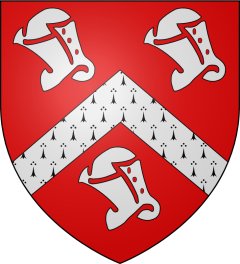
Owen Tudor’s coat of arms.
The House of Tudor that would come to rule England counted Owen its sire; the four-year-old grandson he left at his death grew up to become the first Tudor monarch, Henry VII.
That union was supposed to join the two great realms, but Henry V unexpectedly kicked the bucket in 1422, leaving an infant son who was not only unable to hold the French throne … he was too unstable to hold the English throne, either.
Unless he was a seer, suave Owen must not have been thinking dynasties when he took the Queen as his lover (and eventually his wife via a secret marriage in the early 1430s).
They produced six children, but it wasn’t the bedroom politics that did our prolific father in, at least not directly. Only decades later, when ownership of the crown was up for grabs in the War of the Roses and Owen loyally led Lancastrian forces at a battle he was unwise enough to lose, did he give up his head for the pedestrian crime of backing the wrong horse.
Owen reportedly thought he had stature enough to expect a reprieve until the very last moment, when the executioner’s ripping his collar caused him to sigh,
The head which used to lie in Queen Catherine’s lap, would now lie in the executioner’s basket.
In time, Owen’s descendants would get to pull the same trick, because the doomed cause in whose service Owen Tudor lost his life swept clear England’s political chessboard and made possible his own line’s accession.
Elizabethan poet Michael Drayton later versified Owen’s prodigious conquest in “Owen Tudor to Queen Catherine”.
When first mine eyes beheld your princely name,
And found from whence this friendly letter came;
Is in excess of joy, I bad forgot.
Whether I saw it, or I saw it not:
My panting heart doth bid mine eyes proceed,
My dazzled eyes invite my tongue to read,
Which wanting their direction, dully mist it:
My lips, which should have spoke, were dumb, and kist it,
And left the paper in my trembling hand,
When all my senses did amazed stand :
Even as a mother coming to her child,
Which from her presence hath been long exil’d,
With gentle arms his tender neck doth strain,
Now kissing it, now clipping it again;
And yet excessive joy deludes her so,
As still she doubts, if this be hers, or no.
At length, awaken’d from this pleasing dream,
When passion somewhat left to be extreme,
My longing eyes with their fair object meet,
Where ev’ry letter’s pleasing, each word sweet.
It was not Henry’s conquests, nor his court,
That had the power to win me by report;
Nor was his dreadful terrour-striking name,
The cause that I from Wales to England came:
For Christian Rhodes, and our religion’s truth,
To great achievement first had won my youth:
Th’ brave adventure did my valour prove,
Before I e’er knew what it was to love.
Nor came I hither by some poor event,
But by th’ eternal destinies’ consent;
Whose uncomprised wisdom did foresee,
That you in marriage should be link’d to me.
By our great Merlin was it not foretold,
(Amongst his holy prophesies enroll’d)
When first he did of Tndor’s name divine,
That kings and queens should follow in our line?
And that the helm (the Tudors ancient crest)
Should with the golden flow’r-de-luce be drest ?
As that the leek (our country’s! chief renown!)
Should grow with roses in the English crown –
As Charles his daughter, you the lilly wear;
As Henry’s queen, the blushing rose you bear;
By France’s conquest, and by England’s oath,
You are the true-made dowager of both :
Both in your crown, both in your cheek together,
Join Tether’s love to yours, and yours to Tether.
Then cast no future doubts, nor fear no hate,
When it so long hath been fore-told by fate ;
And by the all-disposing doom of Heav’n,
Before our births, we to one bed were giv’n.
No Pallas here, nor Juno is at all,
When I to Venus yield the golden ball:
Nor when the Grecians wonder I enjoy,
None in revenge to kindle fire in Troy.
And have not strange events divin’d to us,
That in our love we should be prosperous ?
When in your presence I was call’d to dance,
In lofty tricks whilst I myself advance,
And in a turn my footing fail’d by hap,
Was’t not my chance to light into your lap ?
Who would not judge it fortune’s greatest grace,
Sith he must fall, to fall in such a place ?
His birth from Heav’n, your Tudor not derives,
Nor stands on tip-toes in superlatives,
Although the envious English do devise
A thousand jests of our hyperbolies;
Nor do I claim that plot by ancient deeds,
Where Phoebus pasture his fire-breathing steeds:
Nor do I boast my god-made grandsire’s scars,
Nor giants trophies in the Titans wars:
Nor feign my birth (your princely ears to please)
By three nights getting, as was Hercules:
Nor do I forge my long descent to rim
From aged Neptune, or the glorious Sun:
And yet in Wales, with them that famous be,
Our learned bards do sing my pedigree
And boast my birth from great Cadwallader,
From old Caer-Septon, in mount Palador:
And from Eneon’s line, the South-Wales king,
By Theodor, the Tudors’ name do bring.
My royal mother’s princely stock began
From her great grandame, fair Gwenellian,
By true descent from Leolin the great,
As well from North-Wales, as fair Powsland’s seal.
Though for our princely genealogy
I do not stand to make apology:
Yet who with judgment’s true impartial eyes,
Shall look from whence our name at did first rise,
Shall find, that fortune is to us in debt And why not Tudor, as Plantagenet?
Nor that term Croggen, nick name of disgrace
Us’d as a by-word now in ev’ry place,
Shall blot our blood, or wrong a Welshman’s name,
Which was at first begot with England’s shame.
Our valiant swords our right did still maintain,
Against that cruel, proud, usurping Dane,
Buckling besides in many dang’rous fights,
With Norway, Swethens, and with Muscovites;
And kept our native language now thus long,
And to this day yet never chang’d our tungue:
When they which now our nation fain would tame,
Subdu’d, have lost their country and their name.
Nor ever could the Saxons’ swords provoke
Our British necks to hear their servile yoke:
Where Cambria’s pleasant countries bounded be
With swelling Severn, and the holy Dee:
And since great Brutus first arrived, have stood
The only remnant of the Trojan blood.
To every man is not allotted chance,
To boast with Henry, to have conquer’d France:
Yet if my fortune be thus rais’d by thee,
This may presage a further good to me;
And our Saint David, in the Britons’ right,
May join with George, the sainted English knight:
And old Caer-merdin, Merlin’s famous town,
Not scorn’d by London, though of such renown.
Ah, would to God that hour my hopes attend,
Were with my wish brought to desired end !
Blame me not, madam, though I thus desire,
Many there be, that after you inquire;
Till now your beauty in night’s bosom slept,
What eye durst stir, where awful Henry kept ?
Who durst attempt to sail but near the bay,
Where that all-conqu’ring great, Alcides lay ?
Your beauty now is set a royal prize,
And kings repair to cheapen merchandise.
If you but walk to take the breathing air,
Orithia makes me that I Boreas fear:
If to the fire, Jove once in light’ning came.
And fair Egina makes me fear the flame:
If in the Sun, then sad suspicion dreams
Phoebus should spread Lucothoe in his beams:
If in a fountain you do cool your blood,
Neptune, I fear, which once came in a flood:
If with your maids, I dread Apollo’s rape,
Who cous’ned Chion in an old wife’s shape :
If you do banquet, Bacchus makes me dread,
Who in a grape Erigone did feed :
And if myself your chamber-door should keep,
Yet fear I Hermes coming in a sleep.
Pardon (sweet queen) if I offend in this,
In these delays love most impatient is:
And youth wants pow’r his hot spleen to suppress,
When hope already banquets in excess.
Though Henry’d fame in me you shall not find,
Yet that which better shall content your mind;
But only in the title of a king
Was his advantage, in no other thing:
If in his love more pleasure you did take,
Never let queen trust Briton for my sake.
Yet judge me not from modesty exempt,
That I another Phaeton’s charge attempt;
My mind, that thus your favours dare aspire,
Shows, that ’tis touch’d with a celestial fire:
If I do fault, the more is beauty’s blame,
When she herself is author of the same;
“All men to some one quality incline,”
Only to love is naturally mine.
Thou art by beauty famous, as by birth,
Ordain’d by Heav’n to cheer the drooping Earth :
Add faithful love unto your greater state,
And be alike in all things fortunate.
A king might promise more, I not deny,
But yet (by Heav’n) he lov’d not more than I.
And thus I leave, till time my faith approve,
I cease to write, but never cease to love.


 St. Petersburg-born, Estonian-raised, the young scientist came to Paris
 Beldeanu (