Shortly after midnight this date* in 1935, the career of 71-year-old Canadian executioner Arthur Ellis came to an end with the botched hanging of Thomasina Sarao.
All a simple matter of physics.
When the old-school “drop ’em from a cart” method of strangulation hanging gave way to the “new drop”, the hangman’s art eventually came to encompass the scientific application of the humane level of force to the doomed person’s vertebrae.
Something in the neighborhood of 1,000 ft/lbs was about right. Too little, and the poor wretch strangles to death. Too much, and you rip the head right off.
Thomasina Sarao got too much, and it ripped her head right off.
They’d worked everything out to a handy table, see, where if you weighed this much, they knew to drop you this far, derived from the formula
1020/weight in pounds (less 14 lbs for the head) = drop in feet
Except in the widow Mrs. Sarao’s case — the Italian immigrant had offed her husband to collect the insurance** — Arthur Ellis was given the wrong weight for his client. He coiled a noose for a woman 32 pounds lighter than the person who actually mounted the scaffold, and he therefore made it more than a foot too long.
That whole “ripping off a woman’s head” thing really harshed everyone’s vibe. So, although hangings had long been moved behind prison walls, the Canadian government stopped the ongoing practice of allowing members of the general public to obtain tickets to witness them.
“Arthur Ellis” — it was actually a trade name he’d made up, and so dignified that one of his successors used the same alias — died three years after his grisly retirement party. He’s saluted by the Arthur Ellis Awards, the Crime Writers of Canada’s annual awards: a little trophy of a guy getting hanged.
Winners of the Arthur Ellis Award, like Robert J. Sawyer, get this trinket to commemorate. At least the little wooden fetish has his head attached to his shoulders. (Images (c) Robert J. Sawyer, and used with permission.)
* March 28 is sometimes reported, but the period press reports (like this wire story) seem to agree on the 29th, as does this index of Canadian executions.
** Two male co-conspirators, Leone Gagliardi and Angelo Donofrio, were also hanged for the same crime, a few minutes before Sarao on a different scaffold.
On this date in 1794, firebrand revolutionary pamphleteer Jacques Hebert and his eponymous party of Convention radicals mounted the scaffold during the Paris Terror.
As a 32-year-old, Hebert started putting out his foul-mouthed blog radical newspaper Le Pere Duchesne in the Revolution’s early months.
In this increasingly vituperative rag, Hebert — incongruously writing in the voice of “Old Man Duchesne” — savaged first the royal couple, and then (after that pair lost their well-coiffed heads) whatever the retrograde element of the unfolding Revolution happened to be on any given day: the constitutional monarchist Lafayette; the bourgeois liberal Girondists. His paper valorized the Parisian working-class sans-culottes, and lustily demanded heads for the satisfaction of their various grievances.
All of these thoughts trouble my brain, and the memory of Marat follows me without end. Last night I saw him in a dream: his wound was still bleeding, dammit. Upon seeing it I cried. Friend of the people, I shouted, is it you? Yes, good Père Duchesne, it’s Marat who comes from the dead to talk with you, because — dammit — the love of freedom pursues me even beyond the grave. Content to have lost my life for my republic, there only remains to me the regret of not having seen it delivered, before my death, from all the scoundrels who tear away at its breast. Père Duchesne, you must do what I couldn’t do. You closely followed me in the revolution; like me you consecrated you life to the defense of the rights of the people. You speak the language of the Sans Culottes, and your foul mouth, which makes little mistresses faint, sounds beautiful to free men, for free men shouldn’t be sought among the beautiful souls. Your joy and your anger have done more than all the dreams of statesmen. They know this well, the worthless fucks, and that’s why they’ve persecuted you like they did me. Courage, old man; don’t back off when you suffer the same trials as me, don’t be afraid: is there a more beautiful death than mine? But since you’re useful to your fellow citizens, try to avoid the daggers of statesmen. Live a while longer in order to denounce them and to complete, if you can, the task I’d undertaken.
…
Yes, Père Duchesne, you have to go after them hammer and tong, and not take it easy on anyone. When three months ago I proposed planting three hundred nooses on the terrace of the Tuileries in order to hang there the perfidious representatives of the people, some took me for a madman, and others as someone thirsty for blood. But nevertheless, if I’d been believed how much bloodshed would have been avoided! More than a million fewer men would have perished! So when I made that proposition I wasn’t speaking as a bloody monster, on the contrary I spoke as a friend of humanity. The moderates have buried more victims than those that fell before the steel of our enemies. Nothing is more harmful in a revolution than half measures. We have finally arrived at the era when we must pare things right down to the bone. … No more quarter for the defeated party, because, dammit, if the statesmen had the upper hand for one moment there wouldn’t exist a single patriot in six months.*
Late in his run, Hebert was on to venting dissatisfaction with the party of Danton, who had followed the monarchists and the liberals off the starboard of acceptable revolutionary opinion. Sensible centrist Maximilien Robespierre would indeed strike that faction down — just two weeks after he’d purged the radical Hebertist gaggle itself.**
Eleven days afterLe Pere Duchesne last hit the streets, its author’s head hit the basket.
His printed editorials (like the one above) often assert a modish conviction in his own coming martyrdom, but as proof against a fatal political reversal, Hebert had trusted overmuch to his power base in the Paris commune. When he was carted out this morning, the mob whom his own paper once played to reveled in old Pere Duchesne’s fall just as readily as it had reveled in his enemies’.
some men carrying long sticks, at the end of which were suspended braziers of burning charcoal, symbolical of the “Charcoal-burners” of the “Pere Duchesne,” thrust them into the face of Hebert, insulting him with the same bitter railleries with which he tormented so many other victims (Alphonse de Lamartine)
Hebert was executed at the Place de la Revolution in a batch of 20 fellow-radicals, among whom we also find the eloquent “orator of mankind,” anticlerical† wordsmith Anacharsis Cloots. (Victor Hugo on his revolutionary leader in Les Miserables: “he had too much of Saint-Just about him, and not enough of Anacharsis Cloots.”)
The original La Pere Duchesne was dead, but just as the hot-selling mag had attracted ripoffs in its original run, the name lived on as a symbol of popular revolutionary menace — to be reclaimed by later generations in print and song.
Everywhere and at all times men of commerce have had neither heart nor soul: their cash-box is their God; they only know how to thieve and deceive; they would shave an egg, they would kidnap their own fathers; they traffic in all things, even human flesh; theirs are the ships which sail to the African coasts to capture negroes whom they then treat as worthless cattle.
** These rival factions linked as fellow-victims of Robespierre’s Terror are neatly symbolized by the spouses of their respective antipathetic scribblers: Jacques Hebert’s wife Marie, and Lucile Duplessis, wife of the Dantonist journalist Camille Desmoulins. Marie and Lucile were guillotined together that April, having forged a friendship while awaiting the chop.
† “The personal enemy of Jesus Christ,” Cloots called himself. He also remarked, “What is man’s chief enemy? Each man is his own.” A lot of enemies, this one had.
On this date in 1526, Spanish bishop Antonio Osorio de Acuña was beheaded in Simancas for supporting the revolt of the comuneros.
Acuna was in his sixties when the popular revolt rose in Castile.
Given his age and station, he might have been expected to exercise the bishopric of Zamora in the interests of the powers that be. Instead, he threw in with the rebels, even fearlessly leading men into battle.
If that sounds (rightly or wrongly) principled to you, you might be surprised that Acuna has generally been tarred as an opportunist.
Was it “opportunistic” to seize the vacant bishopric of Toledo when that city was under attack by royalists? Or was it a courageous and needful stroke to take the ecclesiastical power in hand and direct the church’s material resources to the cause?
It’s really all in how you look at it. Surely throwing dissenting priests into the dungeon was a little harsh, but then, it was wartime.
Acuna was caught fleeing for France after the revolt broke down, but his execution took four-plus years to arrange through the sluggardly church courts.
Still, he was executed — a fact which underscores the stakes he was playing for, and insured that he would never get the benefit of historiographic doubt.
This Spanish-language page summarizes Acuna’s pre-comuneros career of graft and careerism. This Castilian nationalist page likes him quite a lot better.
This position provided access to the Fuhrer for Fromm — and for his chief of staff, Col. Claus von Stauffenberg. And it gave his office the authority to issue the “Valkyrie” orders for quelling civil unrest that Stauffenberg’s circle would use to attempt to seize Berlin.
Fromm realized that his underling was involved in a plot against the Nazi dictator, but neither joined it nor smashed it.
This play-it-safe approach turned out not to be safe at all. When Stauffenberg’s attempt to assassinate Hitler failed, Fromm hastily attempted to cover his tracks by summarily executing Stauffenberg and co-conspirators.
Not all that subtle, really. “You’ve been in a damned hurry to get your witnesses below ground,” Joseph Goebbels sneered.
Heinrich Himmler quickly had Fromm arrested. “Fate does not spare the man whose convictions are not matched by his readiness to give them effect,” wrote July 20th conspirator Hans Speidel. (As cited by Shirer.)
Although in Friedrich Fromm’s case, that wasn’t entirely true.
In recognition of the general’s calculated but not-unhelpful show of loyalty on the decisive date (enacted when Fromm realized the plotters had made a dog’s breakfast of everything) Hitler generously permitted the general to be “honorably” shot … rather than strangled from a meathook.
* Some sources give March 12, rather than March 19. I have been unable to establish primary documentation, but the sites for March 19 are far more numerous. (Years-later update: I probably got this wrong. I’d be better inclined to believe March 12.)
On this date in 1314, the last Grand Master of the Knights Templar was burned in Paris.
Illustration of Jacques de Molay and Geoffroi de Charney burning on Paris’s Île de la Cité.
In a boring materialist history, Jacques de Molay was simply the head of an overrich military order whose crusading raison d’etre had become passe* with the Templars’ expulsion from the Holy Land.
Scores of trumped-up heresy charges did the work of ecclesiastical assassination for this renowned brotherhood originally founded to safeguard pilgrims in the Holy Land. (There’s a fine podcast episode on the Templars’ history here.)
This appears to be some sort of legitimate history. How droll!
Ruthless French King Philip the Fair, who owed the Templar banks a ton of cash, mounted in 1307 a, um, surprise nationalization — with the magnificently coordinated arrest of hundreds of members of the order on Friday, Oct. 13, 1307.**
This was, on the face of it, quite an infringement by the secular power upon the Church, but since Pope Clement V was Philip’s very own sock puppet — to the extent of relocating the papacy to Avignon the better to attend to his master — it was all good. Plus, of course, everyone made out with a big pile of loot.
As the interested parties jockeyed over those confiscated estates, there ensued for the once-powerful, now-proscribed order a years-long saga of torture, burnings (of lower-ranking Templars), salacious Baphomet-worship revelations, juridical maneuvering, and, finally, a compromise life-saving confession which Molay and his associate Geoffroi de Charney dramatically spurned.
The cardinals dallied with their duty until March 1314, when, on a scaffold in front of Notre Dame, Jacques de Molay, Templar Grand Master, Geoffroi de Charney, Master of Normandy, Ilugues de Peraud, Visitor of France, and Godefroi de Gonneville, Master of Aquitaine, were brought forth from the jail in which for nearly seven years they had lain, to receive the sentence agreed upon by the cardinals, in conjunction with the Archbishop of Sens and some other prelates whom they had called in. Considering the offences which the culprits had confessed and confirmed, the penance imposed was in accordance with rule—that of perpetual imprisonment. The affair was supposed to be concluded when, to the dismay of the prelates and wonderment of the assembled crowd, de Molay and Geoffroi de Charney arose. They had been guilty, they said, not of the crimes imputed to them, but of basely betraying their Order to save their own lives. It was pure and holy; the charges were fictitious and the confessions false. Hastily the cardinals delivered them to the Prevot of Paris, and retired to deliberate on this unexpected contingency, but they were saved all trouble. ‘When the news was carried to Philippe he was furious. A short consultation with his council only was required. The canons pronounced that a relapsed heretic was to be burned without a hearing; the facts were notorious and no formal judgment by the papal commission need be waited for. That same day, by sunset, a pile was erected on a small island in the Seine, the Isle des Juifs, near the palace garden. There de Molay and de Charney were slowly burned to death, refusing all offers of pardon for retraction, and bearing their torment with a composure which won for them the reputation of martyrs among the people, who reverently collected their ashes as relics.’
–A History of the Inquisition of the Middle Ages, Vol III
Not bad, but the for a real plot twist, check the Templars’ turn — most famously in Dan Brown’s leaden bestseller The Da Vinci Code, but more entertainingly rendered as nonfiction “speculative history” in Holy Blood, Holy Grail — as mystic guardians of Christological secrets.†
Their most sensational secret: the Holy Grail.
In this reworking, the Cup of Christ is not the San Greal but the Sang Real, God’s own royal bloodline, by way (for some reason) of the French Merovingian dynasty.
Thither this blog dares not venture, but those with the requisite inclination towards the occult will find limitless explorations of the theme for ready sale. All we ask, gentle reader, is that you kindly cut us in on the action by using our handy affiliate links.
In what may be yet another mystical just-so story, Molay is said to have foretold, as the flames consumed him, the deaths of his persecutors.
Pope Clement, Chevalier Guillaume de Nogaret [the prosecuting inquisitor], King Philip! I summon you to the Tribunal of Heaven before the year is out!
The curse worked: none of those gentlemen lived to see 1315. Someone, somewhere, has also attributed every bum turn for the French crown since then to Molay’s anathema. There’s a legend that an onlooker at Louis XVI‘s execution dipped his handkerchief in Citizen Capet’s Sang Real and cried out, “Jacques de Molay, tu es vengé!”
* Other expeditions called “Crusades” did continue after the Templars, but Christendom’s occupation of the Holy Land was toast until Lawrence of Arabia days.
† It is a fact that these guys liked sweeping their crusading conquests for supposed holy relics, like this Roman nail recently unveiled from a Templar fort that was reverentially “handled by a lot of people over a long period of time.”
The Roman Emperor Tiberius expired at Misenum on this date in 37 A.D.
The Death of Tiberius, by Jean-Paul Laurens. Tacitus records that the aged princeps was thought to have expired, to the great relief of all, when word came that he was reviving. “[Praetorian prefect] Macro, nothing daunted, ordered the old emperor to be smothered under a huge heap of clothes.”
As Tiberius had been spending his last years terrifyingly purging Rome of alleged “traitors,” his death was met with some considerable relief. Great news: charismatic young prince Caligula is in charge now!
Anyway, despite the old man’s unpopularity and the manifest injustice of his treason trials, Tiberius’s death did not quite halt momentum of political butchery. Ever thus with bureaucracies.
The people were so glad of his death, that at the first news of it some ran about shouting, “Tiberius to the Tiber,” while others prayed to Mother Earth and the Manes to allow the dead man no abode except among the damned. Still others threatened his body with the hook and the Stairs of Mourning, especially embittered by a recent outrage, added to the memory of his former cruelty. It had been provided by decree of the senate that the execution of the condemned should in all cases be put off for ten days, and it chanced that the punishment of some fell due on the day when the news came about Tiberius. The poor wretches begged the public for protection; but since in the continued absence of Gaius [Caligula] there was no one who could be approached and appealed to, the jailers, fearing to act contrary to the law, strangled them and cast out their bodies on the Stairs of Mourning. Therefore hatred of the tyrant waxed greater, since his cruelty endured even after his death.
But Tiberius’s cruelty didn’t endure too long after his death. Pretty soon, Caligula’s cruelty would have the stage all to itself and Tiberius survivors would be yearning for the good old days.
The History of Rome podcast covers Tiberius’s crazy years and the transition to Caligula here.
* It’s not completely explicit that it was on this same March 16 that news of the emperor’s death hit Rome; therefore, it’s conceivable that the drama described here played out on a subsequent date.
Every Person in the Fleet, who through Cowardice, Negligence, or Disaffection, shall in Time of Action withdraw or keep, or not come into the Fight or Engagement, or shall not to do his utmost to take or destroy every Ship which it shall be his Duty to engage, and to assist and relieve all and every of his Majesty’s Ships, or those of his Allies, which it shall be his Duty to assist and relieve, every such Person so offending, and being convicted thereof the Sentence of a Court-martial, shall suffer Death.
On this date in 1757, English Admiral John Byng was shot to death by musketry on the quarterdeck of the HMS Monarque for failing to “do his utmost” to defend Minorca against the French.
The first and last man of that rank executed by the Royal Navy, Byng was one of 15 (!) children of an ennobled admiral. He’d been 40 years at sea himself, a competent, forgettable senior officer unburdened by genius.
The 1750s found him in service of a listless British Empire sliding towards war with France.
In 1756, the Brits belatedly realized the French were about to grab the Mediterranean island/naval base of Minorca (Menorca) from them, and dispatched a too-little, too-late expedition under Admiral Byng.
By the time he got there, the French already had Minorca in hand, save the last, besieged garrison. Byng attempted to land reinforcements for the garrison — without enthusiasm, since he perceived the inadequacy of his force — and was repelled in an inconclusive naval engagement.
The loss of Minorca raised the curtain on the Seven Years War: the first “world war,” in Winston Churchill’s reckoning, in which European alliances would duke it out for continent and colonies.
But it dropped the curtain on the ill-starred Admiral Byng.
Popular outrage at the military setback had the Duke of Newcastle‘s government scrambling to find a scapegoat, and the commander on the scene fit the bill exactly.
A gloating French account of the engagement — “the English had the advantage of the wind, but still seemed unwilling to fight” — reached Albion’s shores ahead of the admiral’s dispatch; when the latter arrived, it was publicly leaked in unflatteringly redacted form that generally made Byng look like a big fraidy-cat.
Having been thus attainted in the court of public opinion, the admiral was hailed before a court martial and convicted of not doing enough to relieve the English garrison and generally not fighting a very good fight.
Only one penalty was prescribed for this offense: death.
“The officers who composed this tribunal” themselves had such misgivings about shooting an officer for an on-the-scene tactical miscalculation “unanimously subscribed a letter to the board of admiralty [reading] ‘for our own consciences sake, as well as in justice to the prisoner, we pray your lordships, in the most earnest manner, to recommend him to his majesty’s clemency.'”
But Hanoverian George II had no upside in getting involved. He faced complaints enough wringing the revenue out of Englanders to defend a hereditary German electorate of no consequence to British security; what sense could there be in antagonizing the irritated masses by going to bat for the official fall guy in the realm’s scandalous military reversal?
On the day fixed for his execution [relates the Newgate Calendar] the boats belonging to the squadron at Spithead being manned and armed, containing their captains and officers, with a detachment of marines, attended this solemnity in the harbour, which was also crowded with an infinite number of other boats and vessels filled with spectators. About noon, the Admiral having taken leave of a clergyman, and two friends who accompanied him, walked out of the great cabin to the quarter-deck, where two files of marines were ready to execute the sentence. He advanced with a firm deliberate step, a composed and resolute countenance, and resolved to suffer with his face uncovered, until his friends, representing that his looks would possibly intimidate the soldiers, and prevent their taking aim properly, he submitted to their request, threw his hat on the deck, kneeled on a cushion, tied one white handkerchief over his eyes, and dropped the other as a signal for his executioners, who fired a volley so decisive, that five balls passed through his body, and he dropped down dead in an instant. The time in which this tragedy was acted, from his walking out of the cabin to his being deposited in the coffin, did not exceed three minutes.
Thus fell, to the astonishment of all Europe, Admiral John Byng; who, whatever his errors and indiscretions might have been, was at least rashly condemned, meanly given up, and cruelly sacrificed to vile political intrigues.
A school of thought does exist that the empire reaped from its rash, mean, and cruel example a generation of aggressive captains and commodores — or, as Voltaire put it shortly afterwards in Candide, “it is thought good to kill an admiral from time to time to encourage the others.” (“pour encourager les autres”)
Whatever the morale effects, the British soon rallied from their early setbacks in the Seven Years’ War and emerged from the conflict undisputed masters of North America and India.
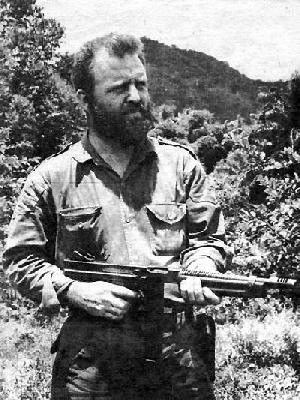
On this date in 1961, American William Morgan — once an anti-Batista rebel — was shot in Havana’s La Cabana fortress for counter-revolutionary activity against the Castro government.
He’d had an unsettled life, this Morgan. He’d been a convict, a circus sideshow, a wanderer. But he was about to make his name.
This strange gringo soon to be nicknamed “El Americano” walked into the Escambray Mountains and joined a group of anti-Batista rebels that was unaffiliated with Castro’s 26th of July Movement. Morgan won the respect of Cubans for his courage and his evidently un-mercenary commitment to the cause.
Fatally for him, that cause was a constitutional-democracy take on opposing the Batista dictatorship.
Those two men’s columns nearly exchanged shots when Guevara was dispatched by Castro to reach an understanding with Morgan. Morgan and Guevara came to terms that day — there was a revolution to be won, after all — but animosity would remain between these two impassioned freedom-fighters whose visions of freedom could never be reconciled.
They personify the competing choices before post-Batista Cuba, in those first years when Cuba kept to a tenuous hold on non-alignment.
Morgan supported that revolution; he even made the headlines for dramatically foiling a Dominican-backed plot to topple Castro in 1959.
But it was Guevara who was the future. More radical July 26th members won senior spots in the new administration, while outsiders like Morgan got assignments like frog-farming. Geopolitical events saw Cuba sliding into the Soviet camp.
He was caught in late 1960, held incommunicado for a period, then tried, convicted and condemned two days before his execution (along with fellow-traveler and -plotter Jesus Carreras Zayas (Spanish link)) after nightfall March 11, 1961.
Morgan’s execution was carried out by a fellow Yanqui, Herman Marks — himself destined to run afoul of the Castro regime down the road. (Marks fled back to the U.S.) The sympathetic account of el Americano‘s death is quite the flowery affair, with the Cubans kneecapping Morgan when he defiantly refuses to kneel.
Castro himself is sometimes said to be present, the shadowy observer issuing the fatal commands to which Morgan will not bow, like the insouciant silhouette of Stalin behind a screen at trials where his former henchmen were purged.
A poetic touch, though one would think a head of state might have more pressing business than personally orchestrating executions: and indeed, it seems that Fidel actually spent that evening at a diplomatic reception with Soviet and Chinese ambassadors. Two months later, Castro officially declared Cuba a socialist state.
And as with Morgan, so with many of his brethren-in-arms from the Escambray Mountains. It took Havana the better part of the 1960s to suppress anti-communist “bandits” in Morgan’s old stomping-grounds — Cuba’s (successful) War Against the Bandits.
* There’s more skullduggery in Morgan’s shadowy life than this post has space for, but theories exist that the Dominican plot he “foiled” was actually one he had been an earnest participant in before it was sniffed out by Cuban security, with the war hero Morgan forced to betray it.
On this date in 1986,* Nigerian Major-General Mamman Jiya Vatsa was shot (along with nine others) by command of his childhood friend — the dictator Ibrahim Babangida, whom Vatsa was allegedly plotting to overthrow.
A gifted writer since youth, Vatsa was just a nameless twenty-something junior officer in the early 1970s when he emerged onto the national literary scene.
In the 15 years before his death, Vatsa churned out 20-plus volumes, mostly poetry. He had a special inclination for writing for children.
Simultaneously, his star ascended in his professional sphere.
Testimony against them — much of it of the speculative or torture-induced variety — described a ring of officers piqued at the Babangida coup (Vatsa was out of the country when it occurred) and keen to undo it. The scheme would have been only one of many such hatched or imagined in an unstable political situation that surely made the new big man nervous.
In the end, “only” ten (the nine others are named here) were stood up against the wall for the alleged plot. Many others, however, were imprisoned or purged, a lasting injury to the Nigerian brass that particularly crippled its air force.
Babangida, of course, rejected clemency appeals from the Vatsa family he knew well. He has since justified his harshness by arguing that Vatsa would have continued plotting against him in prison or in forced retirement. “Rawlings did it in Ghana,” Babangida said. “And you know Vatsa was very stubborn.”
I don’t know, nobody ever asked.
That was how some heroes died.
They died.
-Vatsa, “They Died” (Voices from the Trench)
* Some sources give March 6 as the execution date, but contemporaneous western press reports (admittedly an impeachable source) prefer the 5th. For instance, the March 6 Chicago Tribune says the executions occurred on “Wednesday” (the 5th).
** Ironically, Vatsa himself had once sat on a tribunal for another group of failed putschists, the 1976 Dimka coup.
On an uncertain date in March 1289, fallen nobleman Ugolino della Gherardesca was immured in a Pisan tower with two sons and two grandsons — all doomed to starve to death and land in the Inferno.
Hungry? Ugolino with his starving whelps, as chiseled by Jean-Baptiste Carpeaux. (Ugolino was around 70 at his death, so his sons and grandsons were actually quite a bit older than these tots.) Auguste Rodin also sculpted Ugolino, more literally following Dante’s narrative.
In the dangerous Guelph vs. Ghibelline political landscape, Gherardesca had a knack for switching sides.
Originally a Ghibelline, he was banished once for plotting but returned with the support of Guelphs, and was made podesta to negotiate with Pisa’s Guelph enemies, Florence and Lucca.
Having made the unpopular but perhaps politically necessary decision to buy peace with Florence at the expense of territory and castles, Ugolino schemed to extend his own authority in Pisa, only to find himself hoisted on his own petard when onetime plotting-partner Archbishop Ruggieri Ubaldini had Ugolino and descendants seized for (wait for it) … treachery.
Months later, Archbishop Ruggieri ordered the keys to their dungeon thrown into the Arno and left them to starve to death.
Ugolino’s fate is mostly remembered by way of Dante, who places both Ugolino and Ruggieri deep in hell — where the treacherous noble has at least the satisfaction of gnawing vengefully on the treacherous cleric, but detaches his maw long enough to deliver himself the poem’s longest speech by any of the damned.
I beheld two spirits by the ice
Pent in one hollow, that the head of one
Was cowl unto the other; and as bread
Is raven’d up through hunger, th’ uppermost
Did so apply his fangs to th’ other’s brain,
Where the spine joins it. Not more furiously
On Menalippus’ temples Tydeus gnaw’d,
Than on that skull and on its garbage he.
“O thou who show’st so beastly sign of hate
‘Gainst him thou prey’st on, let me hear,” said I
“The cause, on such condition, that if right
Warrant thy grievance, knowing who ye are,
And what the colour of his sinning was,
I may repay thee in the world above,
If that, wherewith I speak be moist so long.”
HIS jaws uplifting from their fell repast,
That sinner wip’d them on the hairs o’ th’ head,
Which he behind had mangled, then began:
“Thy will obeying, I call up afresh
Sorrow past cure, which but to think of wrings
My heart, or ere I tell on’t. But if words,
That I may utter, shall prove seed to bear
Fruit of eternal infamy to him,
The traitor whom I gnaw at, thou at once
Shalt see me speak and weep. Who thou mayst be
I know not, nor how here below art come:
But Florentine thou seemest of a truth,
When I do hear thee. Know I was on earth
Count Ugolino, and th’ Archbishop he
Ruggieri. Why I neighbour him so close,
Now list. That through effect of his ill thoughts
In him my trust reposing, I was ta’en
And after murder’d, need is not I tell.
What therefore thou canst not have heard, that is,
How cruel was the murder, shalt thou hear,
And know if he have wrong’d me. A small grate
Within that mew, which for my sake the name
Of famine bears, where others yet must pine,
Already through its opening sev’ral moons
Had shown me, when I slept the evil sleep,
That from the future tore the curtain off.
This one, methought, as master of the sport,
Rode forth to chase the gaunt wolf and his whelps
Unto the mountain, which forbids the sight
Of Lucca to the Pisan. With lean brachs
Inquisitive and keen, before him rang’d
Lanfranchi with Sismondi and Gualandi.
After short course the father and the sons
Seem’d tir’d and lagging, and methought I saw
The sharp tusks gore their sides. When I awoke
Before the dawn, amid their sleep I heard
My sons (for they were with me) weep and ask
For bread. Right cruel art thou, if no pang
Thou feel at thinking what my heart foretold;
And if not now, why use thy tears to flow?
Now had they waken’d; and the hour drew near
When they were wont to bring us food; the mind
Of each misgave him through his dream, and I
Heard, at its outlet underneath lock’d up
The’ horrible tower: whence uttering not a word
I look’d upon the visage of my sons.
I wept not: so all stone I felt within.
They wept: and one, my little Anslem, cried:
“Thou lookest so! Father what ails thee?” Yet
I shed no tear, nor answer’d all that day
Nor the next night, until another sun
Came out upon the world. When a faint beam
Had to our doleful prison made its way,
And in four countenances I descry’d
The image of my own, on either hand
Through agony I bit, and they who thought
I did it through desire of feeding, rose
O’ th’ sudden, and cried, ‘Father, we should grieve
Far less, if thou wouldst eat of us: thou gav’st
These weeds of miserable flesh we wear,
‘And do thou strip them off from us again.’
Then, not to make them sadder, I kept down
My spirit in stillness. That day and the next
We all were silent. Ah, obdurate earth!
Why open’dst not upon us? When we came
To the fourth day, then Geddo at my feet
Outstretch’d did fling him, crying, ‘Hast no help
For me, my father!’ There he died, and e’en
Plainly as thou seest me, saw I the three
Fall one by one ‘twixt the fifth day and sixth:
“Whence I betook me now grown blind to grope
Over them all, and for three days aloud
Call’d on them who were dead. Then fasting got
The mastery of grief.” Thus having spoke,
Once more upon the wretched skull his teeth
He fasten’d, like a mastiff’s ‘gainst the bone
Firm and unyielding. Oh thou Pisa! shame
Of all the people, who their dwelling make
In that fair region, where th’ Italian voice
Is heard, since that thy neighbours are so slack
To punish, from their deep foundations rise
Capraia and Gorgona, and dam up
The mouth of Arno, that each soul in thee
May perish in the waters! What if fame
Reported that thy castles were betray’d
By Ugolino, yet no right hadst thou
To stretch his children on the rack. For them,
Brigata, Ugaccione, and the pair
Of gentle ones, of whom my song hath told,
Their tender years, thou modern Thebes! did make
Uncapable of guilt.
(According to Dante, the Wayfarer, Ugolino’s daughter married Guido Novello, and the couple actually hosted Dante at one point in his long exile.)
Dante’s quite understandable speculation that Ugolino might have been driven to cannibalize children has been recently disputed by scientists examining the apparent remains of this unfortunate bunch. But it hardly matters now … and Dante was sure right about the cannibalism scene’s dramatic potential.

![[Ellis Trophy]](https://www.executedtoday.com/images/Arthur_Ellis_Award_1.jpg)
![[Ellis Trophy]](https://www.executedtoday.com/images/Arthur_Ellis_Award_2.jpg)
 As a 32-year-old,


 On this date in 1757, English Admiral
 A gifted writer since youth, Vatsa was just a nameless twenty-something junior officer in the early 1970s when he emerged onto the national literary scene.