1314: Tour de Nesle Affair adulterers

Think you want to fall in love with a princess?

On this date in 1314, the French crown dissuaded the fantasy by butchering two Norman knights who had sheathed their swords where they oughtn’t.

In the Tour de Nesle affair (English Wikipedia page | French), French princess Isabella — then Queen of England, where she is known as Isabella of France or any number of less-flattering sobriquets — noticed that some purses she had once given her brothers’ wives as gifts were being sported by a couple of (evidently metrosexual) dudes in the court.

Let their fate be a warning against regifting.

In short order, the purse-toting knights Philippe and Gauthier d’Aunay or d’Aulnay (both links are in French) were arrested for tapping, respectively: Margaret of Burgundy (the wife of the king’s eldest son, Louis, soon to become Louis X); and, Blanche of Burgundy (the wife of the king’s third son, Charles, the future king Charles IV).*

“The pious confidence of the middle age, which did not mistrust the immuring of a great lady along with her knights in the precincts of a castle, of a narrow tower — the vassalage which imposed on young men as a feudal duty the sweetest cares, was a dangerous trial for human nature, when the ties of religion were weakened.”

Jules Michelet

Under torture, the knights copped to the cuckoldry, supposed to have been conducted in the Tour de Nesle, a since-destroyed guard tower on the Seine.**


Detail view (click to see larger image) of the dilapidated Tour de Nesle, as sketched in the 17th century by Jacques Callot. The tower was destroyed in 1665.

The knights suffered horrific deaths:

“deux jeunes et biaux chevaliers furents roués vifs, écorchés vifs , émasculés, épendus de plomb soufré en ébullition, puis décapités, traînés à travers rues, et pendus au gibet y pourrissant durant des semaines. Leurs sexes, instruments du crime, sont jetés aux chiens. Jamais corps n’auront autant souffert.”

In fine: flayed, broken on the wheel, burned with hot lead and sulfur, genitals thrown to the dogs, and then decapitated for ignominious gibbeting on Montfaucon.

The women fared only a little better. Neither faced execution, and in fact both would technically become Queens of France. But they “reigned” as such from prison.

Margaret of Burgundy was clapped in a tower in a room exposed to the elements while her estranged husband became king. She succumbed (or possibly was murdered outright to clear the way for a new wife) in 1315.

Blanche of Burgundy was still in wedlock and still locked up in Chateau-Gaillard when her husband ascended the throne early in 1322; the marriage was annulled a few months later, and Blanche lived out her last few years at a nunnery.

Isabella’s role in all of this as the goody-two-shoes informer upon the adulterers looks particularly ironic with benefit of hindsight. In another 12 years’ time, this Queen of England and an adulterous lover combined to overthrow the King of England.

But maybe not so ironic after all, if one takes her for a power-thirsty “she-wolf”.

This Tour de Nesle scandal also happened to cast doubt on the paternity of Margaret’s only daughter Joan, which mitigated against Joan (and potentially in favor of Isabella’s new son, Edward) for eventual claim to the throne of France. Since this potential succession was not evidently imminent, and Isabella had three brothers in the prime of life, this seems a farfetched motivation for tattling. But one is drawn to the question of inheritance since happenstance soon put the royal succession into dispute — a misfortune that helped lead to the Hundred Years’ War when that son, grown up to be Edward III of England, did indeed press his French claims at swordpoint.

(The Tour de Nesle scandal is generally thought now to have been legitimate, on the grounds that the ruling family would not have inflicted such an injury to its own legitimacy without very good cause. However, according to Alison Weir, at least one chronicle blamed the affair on a frame-up by hated royal advisor — and eventual Executed Today client — Enguerrand de Marigny.)

Neither Isabella nor Joan ever ruled France. Joan, however, was an ancestor of Henri IV.

* The wife of the middle son, Philip, was also accused of knowing about the affairs, but her strong defense and her husband’s backing got her off.

** Spectacular embroideries enhanced the legend in later generations, into tales of a royal succubus making her rendezvous in the tower by night, then having her lovers hurled off it at dawn. Alexandre Dumas spun a melodrama from this material, though Frederic Gaillardet accused him of plagiarism. (Dumas gives his side of the story at excrutiating length in his memoirs.) La Tour de Nesle was later made into a movie.

On this day..

1860: General Jaime Ortega y Olleta, for a Carlist uprising

This date marks 150 years since the admittedly little distinguished execution of turncoat General Jaime Ortega y Olleta for attempting to aid a Carlist uprising in Spain.

Hoping to exploit the Spanish military’s preoccupation with a conflict in Morocco, the Carlist pretender Infante Carlos and his brother Don Fernando attempted to topple their cousin Queen Isabella II.

They landed at San Carlos de la Rapita (Spanish link) bound for death or glory … or maybe just an “absurd fiasco”.

Ortega (Spanish Wikipedia link), dignified in the Encyclopedia Britannica‘s estimation as a “featherheaded officer”, turned coat to support this ill-fated adventure. Alas for him, none of the men under his command did likewise, nor did the populace.

The rising (more Spanish) collapsed immediately; Ortega was captured, court-martialed on April 17, and shot the following morning. (The New York Times recounts the story of his last hours from the Barcelona papers here.)

General Featherhead was the only casualty.

The would-be monarchs for whom he threw away his life were spared at the price of renouncing their claims, which renunciation they then attempted to renounce once back in exile. For some reason, nobody took them seriously; they died under suspicious circumstances the following year. Their nephew would later lead the last (likewise unsuccessful, but at least less embarrassing) Carlist war in Spain.

On this day..

1525: Count Ludwig von Helfenstein

At the end of the fifteenth and beginning of the sixteenth centuries, conditions for peasants in what is now southern and central Germany were in decline. The cost of goods continued to increase while the ruling aristocracy, who owned the land rented by peasants to grow crops, declined to reduce rents or raise wages

In addition, the territorial sovereigns attempted to increase their income to accommodate the increase in prices by levying additional taxes and tithes on, and increase other obligations owed by, the peasants and serfs under their control.

Simultaneously, changes in the economic market due to increased international trade and industry affected the structure of society, putting into conflict the interests of the aristocracy and the growing merchant class, and giving rise to burghers and industrial workers. Growing awareness of the Reformation and changes in commerce and the social structure also put ecclesiastical society and its lifestyle into conflict with secular interests.

In 1524, a petition known as the Twelve Articles of the Black Forest was presented to the Holy Roman Emperor.

The majority of the Twelve Articles asked for relief from economic hardships, such as the cattle tithes and death tax, and for the preservation of “common” land for use by the peasants. The Emperor ignored the petition, which then became the definitive set of grievances of the lower class. The movement quickly splintered into three factions: Catholics who resisted any challenge to the Church’s supremacy; burghers and princes seeking autonomy from the Church through reforms proposed by Luther; and the lower classes.

Violence soon errupted, as these factions took up arms to preserve, or better, their way of life in an uprising known as the Peasant’s War (1524-1525).

Not surprisingly, sources differ on why the conflict came to a head when it did: the Catholic church blamed the revolting Lutherans; the peasants blamed the aristocracy; and the aristocrats blamed the church. Regardless of the reason, Count von Helfenstein was not in a favorable position.

Count Ludwig von Helfenstein fought against the peasants during this conflict. Occupying the town of Weinsberg on the orders of the Archduke, von Helfenstein freely slew peasants either when discovered in small bands or when they sought admission to the town.

On April 16, in revenge for these killings, an attack led by Florian Geyer and Jacklein Rohrbach (German link) and under the command of George Metzler captured the town and von Helfenstein.

Many aristocrats and knights were killed outright during the fight. Von Helfenstein, however, was forced by vengeful peasants to run (while his wife and child watched) a double gantlet of men with spears drawn.


Helfenstein is led to his messy fate, while his kneeling wife entreats in vain, in this 1844 painting by Gustav Metz. (More, in German.)

Like most peasant revolts, however, it got its licks in and then got crushed. The princes, connected to the Empire, were able to amass greater control over other nobility, while feudalism’s decline was accelerated in favor of commercialism and trade.

(See The Peasants War in Germany, 1525-152, by Ernest Belfort Bax for a florid description of Helfenstein’s end.)

On this day..

1554: Thomas Wyatt the Younger, with the Queen’s life in his hands

On this date in 1554, rebel leader Thomas Wyatt the Younger tied on his own blindfold and laid his head on the block, having declared that not “any other now in your durance [i.e., the Tower] was privy to my rising”.

That remark exculpated the Princess Elizabeth, who just days before had been ominously rowed to the Tower on suspicion of having known of or involved herself in Wyatt‘s abortive revolt.

And Wyatt had had to do more than talk the talk to keep the future Queen Elizabeth I out of the executioner’s way.

Sore afraid that Wyatt’s rebellion had been engineered with the connivance of her Protestant half-sister, the Catholic Queen Mary Tudor had had Wyatt tortured to implicate her.

Wyatt held firm to Elizabeth’s innocence.

Had he not, the princess might have followed her mother to the scaffold, instead of becoming one of the realm’s most illustrious monarchs* — a fraught situation aptly portrayed at the outset of the 1998 Cate Blanchett flick Elizabeth.

It wasn’t only religion that made the political situation in 1550s England so perilous.

Mary Tudor’s marriage to Philip of Spain had roused fears of Spanish political domination. This, much more than theology, triggered the plot that took Thomas Wyatt’s head off his shoulders.

Against this specter of Iberian influence, Wyatt and some fellow-nobles attempted to raise coordinated insurrections in early 1554. Most fizzled or were busted by authorities before they could get going. Wyatt’s alone, in quarrelsome Kent, ignited: he marched 4,000 men on the city of London and for a moment seemed to have a real prospect of capturing it before the crown rallied the city.

A paroxysm of vengeful executions in February 1554 claimed nearly 100 participants in the rebellion, their mutilated bodies demonstratively hung up around town. (It also claimed Lady Jane Grey, the lately defeated rival contender for Mary’s throne, whom the latter now realized was too dangerous to be left alive.)

It could have been uglier, though.

Despite her “Bloody Mary” reputation, the Queen went fairly easy on this dangerous challenge to her authority, making some high-profile examples but paroling most of the rank-and-file traitors in a hearts-and-minds clemency campaign.

The namesake rebel, however, was never going to be in that bunch. He was kept on a bit in the Tower while Mary’s goons “laboured to make Sir Thomas Wyatt confess concerning the Lady Elizabeth … but unsuccessfully, though torture had been applied.”

“Much suspected by me, nothing proved can be, Quoth Elizabeth prisoner”

Having kept his head under torture, Wyatt lost it on this date — and readied Elizabeth’s to wear the crown.


If you find the Elizabethan age worth celebrating, spare an extra thought this date for Thomas Wyatt the Younger’s eponymous old man.**

This Henrician poet is supposed to have been Anne Boleyn‘s last lover before Henry VIII.

In Henry’s snakepit, youthful frolics could come back to bite you; Wyatt the elder was actually imprisoned for adultery with the queen, only ducking the fatal charge thanks to some pull with Thomas Cromwell.

Wyatt pere wrote a melancholy poem about this depressing turn of his fortunes, but considering his times, you’d have to say he was born under a good sign.

A few years later, he was again on the hook for treason, and (Cromwell having been beheaded in the interim) saved by the fortuitous influence of Queen Catherine Howard, who was herself not long before a fall and a chop. (After that, Lady Wyatt, famous for her gallantries, was supposed to be in the running to become King Henry’s sixth wife even though she was still married to Thomas.)

The elder Wyatt managed to die naturally before trying his luck with a third treason charge.

* Many a slip ‘twixt a cup and a lip, but that turn of ill fate for Elizabeth could have set Mary, Queen of Scots on her way to becoming one of England’s most illustrious monarchs, instead of going to the scaffold.

** The illustrious family ties go the other direction, too. Thomas Wyatt the Younger was the grandfather of Francis Wyatt, the first English royal governor of the New World territory named for Queen Elizabeth: Virginia.

On this day..

1919: Mehmed Kemal, for the Armenian genocide

Ninety-one years ago today,* the tottering Ottoman Empire hanged one of its officials in Istanbul for his role in the mass slaughter of its Armenian minority during the First World War.

Kemal Bey’s hanging in Bayezid Square occurred in the immediate aftermath of the Great War. Here, on its last legs, the remains of a sultanate splintered apart in the war instituted tribunals for wartime offenses by the Young Turks who had run the government during the war — a sop to the British occupying forces making worrying noises about international trials for much bigger fish.

Much testimony at the trial pointed to the governor’s fervor for massacres; an Armenian priest who survived the slaughter later wrote that a Turkish officer had told him that Kemal “made a vow on the honor of the Prophet: I shall not leave a single Armenian alive in the sanjak of Yozgat.”

A response to the New York Timesreport of the hanging noted that “his part was that of an executioner. The originators of the plan to exterminate the Armenians were primarily Enver, Tallat, and Djemal.”

These “Three Pashas” who had driven Ottoman policy during the war had fled abroad. They would be condemned to death in absentia, and though none would hang, neither would they outlive Mehmed Kemal by as much as four years.

They were among the many unpunished perpetrators of the slaughter hunted down by Armenian assassins. The latter two were avenged by Operation Nemesis; Enver Pasha died in battle in Tajikistan during the Russian Civil War.

Though overshadowed in historical import by those three, our day’s principal is distinguished as the first person executed for “crimes against humanity.”

This novelty, combined with the trial’s victor’s-justice character, were immediately controversial, and remain so in the fraught politicking around the genocide. (This genocide-denialist paper describes, on page 13, the rowdy funeral scene that erupted the next day, also attested** by annoyed British officials.)

Events would soon outstrip these tribunals and lay waste to all parties’ plans for the Ottoman carcass, incidentally leaving the Armenian issue permanently unresolved.

The month after Mehmed Kemal swung, western allies went one dismemberment too far by backing the irredentist Greek state’s landing at Smyrna — an intervention that was to backfire catastrophically for the Greeks, and help birth the Turkish Republic.

* A few secondary sources say April 12 rather than April 10, but the earlier date appears much better attested.

** e.g., a diplomatic note cited in The Burning Tigris, p. 337: “Not one Turk in a thousand will think that any other Turk deserves to be hanged for massacring Christians.”

On this day..

1747: Simon Fraser, Lord Lovat

Unprincipled, octogenarian Scottish noble Simon Fraser,* Lord Lovat was on this date in 1747 the last to lose his head on Tower Hill.

The Clan Fraser patriarch was an expert double-dealer from his youth in Restoration England — when he recruited a small regiment in nominal service to William and Mary but allegedly plotting to desert to the Stuarts at the opportune moment.

That moment never came … and the Stuarts’ fruitless quest for it in the decades to come would eventually claim the Lord Lovat.

But first up: a long life of opportunistic, frequently reprehensible political maneuvering.

  • He kidnapped, raped, and forcibly married a woman from a rival clan in order to gain claim on a contested succession (Lovat had to flee the country, a death sentence in absentia at his heels)
  • He expediently converted to Catholicism to get in with the exiled Stuarts and their continental allies
  • He forged incriminating documents in an unsuccessful bid to undermine rival nobles
  • He played both sides of the Hanover-Stuart intrigue, ingratiating himself with both Jacobites and London during the 1715 rising. He did this so adeptly that George I served as Lovat’s son’s godfather

When the Jacobites decided to double down on doomed risings in 1745,** this wily knave finally managed to commit himself to the wrong team at the wrong time. Hey, everyone should be allowed one fatal mistake every 80 years or so. (Read all about those years in this public-domain biography.)

Though Lovat was so infirm he had to be borne on a litter, his military acumen would have been worth the rebels’ while had they possessed the muscle to get into a fair fight.

But they didn’t, and Lord Lovat was captured in the undignified circumstance of being stashed in a tree, and at length fitted for a no less undignified trial.

He could neither walk nor ride, as he was almost helpless; he was deaf, purblind, eighty years of age, ignorant of English law, and it was therefore not a matter of surprise that the high-born tribes, who thronged to his trial, were disappointed in the brilliancy of his parts, and in the readiness of his wit. “I see little of parts in him,” observes Walpole, “nor attributed much to that cunning for which he is so famous; it might catch wild Highlanders.” … It appeared, indeed, doubtful in what form death would seize him first, and whether disease and age might not cheat the scaffold of its victim.

Oh, well.

Only the good die young.

By his public life, he has left an indelible stain upon the honour of the Highland character, upon his party, upon his country.

* Not to be confused with the Canadian explorer for whom British Columbia’s Simon Fraser University is named.

** The 1745 rebellion spawned a popular patriotic song that became the national anthem: “God Save the King/Queen”.

One of the tune’s impolitic verses you won’t hear performed at glitzy official ceremonies (or much of anywhere at all) is this nationalist blast at the Jacobite party:

Lord grant that Marshal Wade
Shall by thy mighty aid
Victory bring
May he sedition hush,
And like a torrent rush
Rebellious Scots to crush
God save the King.

All of which, one supposes, gives Simon Fraser claim to a spot in the fine print of the credits for the song, and for that matter, for the Sex Pistols’ riposte.

Nothing new, this scandalous punk riff: English radicals were travestying the nationalist anthem within the lifetime of many who personally saw the rebellious Scot Lord Lovat crushed.

On this day..

2007: Ajmal Naqshbandi, Fixer

On this date in 2007, the Taliban beheaded hostage Ajmal Naqshbandi, an Afghan “fixer” who arranged local contacts for foreign journalists.

Naqshbandi had been pinched on March 6 with La Repubblica writer Daniele Mastrogiacomo while both were out on a story together, even though Naqshbandi himself had set up Taliban interviews before.*

Quiet negotiations over several weeks produced a swap that would free the scribes, but a last-minute breach by the authorities — who decided not to return one of the agreed-upon prisoners — caused the Taliban to hang onto the Fixer. (Mastrogiacomo was set free. The man who was driving these two had been beheaded at the outset to prove the captors meant business.)

The story wasn’t quiet any longer, and as it mushroomed into a worldwide cause celebre with a scramble to save Ajmal, the Taliban evidently perceived a political advantage in butchering its hostage.

Success! Afghan President Hamid Karzai looked like a total stooge, willing to ransom a foreigner but not an Afghan.

So, for that matter, did the Italian government, which got it from both sides for being abject enough to deal with terrorists in the first place, and then ignoble enough once it did so to bail out its own national while letting his local partner die.

Naqshbandi is the subject of the (aptly titled) documentary Fixer: The Taking of Ajmal Naqshbandi (review).

Fellow-hostage Daniele Mastrogiacomo wrote this book about the ordeal.

The film follows Ajmal’s work with journalist Christian Parenti.

Doug Henwood of Left Business Observer interviewed Christian Parenti in the second half of this August 2009 episode from his (highly recommended, though rarely death penalty-related) WBAI radio program/podcast Behind the News, with intriguing coverage of the political context and the role of Pakistani intelligence:

[audio:http://shout.lbo-talk.org/lbo/RadioArchive/2009/09_08_15.mp3]

(Another leftist outlet, Democracy Now!, interviewed Parenti here.)

Pretty brutal.

But then, war is hell for journalists.

* “This work is very dangerous,” Naqshbandi said a few months before his death. “I bring one enemy to meet another.”

On this day..

1520: Gaspar Quesada, Magellan’s expedition mutineer

On this date* in 1520, on his famous voyage of circumnavigation, explorer Ferdinand Magellan ordered the immediate execution of a mutinous captain.

Not to be trifled with.

Having alit just days before at the natural harbor of Puerto San Julien on the Brazilian Argentine coast (Magellan named it) with plans to winter there, the overweening Portuguese explorer faced an uprising of grumpy Spanish officers.

Gaspar Quesada, captain of the Concepcion, along with Luis de Mendoza of the Victoria and recently displaced San Antonio skipper Juan de Cartagena, seized some of the expedition’s ships during the night of April 1-2.

Since you know Magellan’s name five centuries later, you already know he quashed it.

As the sovereign of this fragile floating world, Magellan had little choice but to treat a challenge to his authority mercilessly.**

Though accounts are inconsistent, it seems Mendoza was boldly slain by one of Magellan’s men meeting him under color of “negotiation”.


Mendoza’s assassination. From this site.

Mendoza was then posthumously beheaded and quartered along with Gaspar Quesada. Juan de Cartagena was either executed as well, or else caught a “break”: some sources relate that, instead of executing Cartagena, Magellan had him marooned.

the twentieth of June [1578], wee harboured ourselues againe in a very good harborough, called by Magellan Port S. Julian, where we found a gibbet standing upon the maine, which we supposed to be the place where Magellan did execution upon some of his disobedient and rebellious company.

From a member of the Francis Drake expedition. Just 12 days later and at the very same place, Drake visited a similar penalty for a similar offense upon one of his own crew.

* “‘The authorities’ are divertingly divergent on the precise date of these events,” says O.H.K. Spate in The Spanish Lake, referring specifically to the dates of the mutiny. “Denucé puts them on Easter Sunday and Monday, 1–2 April; Merriman on Easter Sunday and Monday, 8–9 April; Nowell on Palm Sunday and the next day, with the trial verdict on 7 April. By the Julian calendar, in use until 1582, the dates would be 1–2 April; by the Gregorian, ten days later. Pigafetta and Maximilian, who slur over the whole affair, give no dates at all. It is not of vast moment.” Clearly, O.H.K. Spate never had to write an almanac blog.

Anyway, there’s some primary sourcing on this affair here.

** Though Magellan made an example of the leaders, he pragmatically spared about 40 others after keeping them in chains and working the pumps for three months. After all, the man still needed to crew his ships.

On this day..

1199: Pierre Basile, marksman

(Thanks to Jonathan Shipley of A Writer’s Desk for the guest post. -ed.)

If you kill a king, expect swift retribution.

Expect avengers.

Expect to not live long after you deal the final fatal blow to a royal personage.

A boy, Pierre Basile, was executed on this date in 1199 for shooting King Richard the Lionhearted* with an arrow expelled from his crossbow.

The wound wasn’t fatal to Richard I; the gangrene was. (French page) Although the king pardoned the boy for the shot before dying, Richard’s right hand man, French Provencal warrior Mercadier, would hear none of it. After the king’s death, Mercadier stormed Chateau de Chalus-Chabrol, defended weakly by Basile, then flayed him alive before hanging him.

Little is known of the boy defender. Also known as Bertran de Gurdun and John Sabroz (the various names suggest we’ll never know his real name), Basile was one of only two knights defending the castle against the king’s siege.

This castle protected the southern approach to Limoges and was betwixt routes from Paris and Spain and the Mediterranean Sea and the Atlantic Ocean. The English army openly mocked its defenses as the siege continued. The ramparts were cobbled together with makeshift armor. A shield was constructed out of a frying pan.

Knowing the castle would fall sooner than later, the English were lax in their siege, though eager for the riches inside. (Supposedly within the castle walls was a treasure trove of Roman gold.)

Richard I, as feudal overlord, claimed it for himself and no boy knights were going to get in his way. The king had been in the area suppressing a revolt by Viscount Aimar V of Limoges. The viscount’s forces had been decimated by the king’s army. The riches for the win lay in the castle and Basile stood atop it.

It was early evening, March 25, 1199, when Richard walked around the castle perimeter without his chainmail on. Arrows had been shot from the ramparts by Basile but were paid little attention. The king applauded when one arrow was aimed at him. The next arrow fired struck the king in the left shoulder near the neck.


Richard the Lionhearted, mortally wounded.

The king returned to the privacy of his tent to pull it out. He couldn’t. The surgeon Hoveden, Mercadier’s personal physician, was summoned. He removed the arrow, but not swiftly, or cleanly. Gangrene quickly set in. The king asked for the crossbowman. The boy, Basile, appeared before the stricken king, expecting to be executed on the spot. The boy spoke first, saying he had tried to kill Richard because the king had killed the boy’s father and two brothers.

“Live on,” the king replied, “and by my bounty behold the light of day.”

He ordered the boy set free and, further, sent him away with 100 shillings. Deliriously jubilant at the king’s decision, the boy quickly returned to the castle.

On April 6, in the arms of his mother, Richard I died. His remains were buried at the foot of the tower from which Basile shot the arrow.

And with the king died his chivalry towards Basile.

Mercadier, who had entered the king’s service in 1184 and fought in battles in Berry and Brittany, Flanders and Normandy, brought the castle’s defenders to a swift and punishing death.

Hanging the defenders, he took the boy and flayed him first — that is, he removed the boy’s skin while he was still alive. Then Pierre Basile was hung, and his body consigned in an unmarked grave.

* Last seen in these parts slaughtering Muslims on Crusade.

On this day..

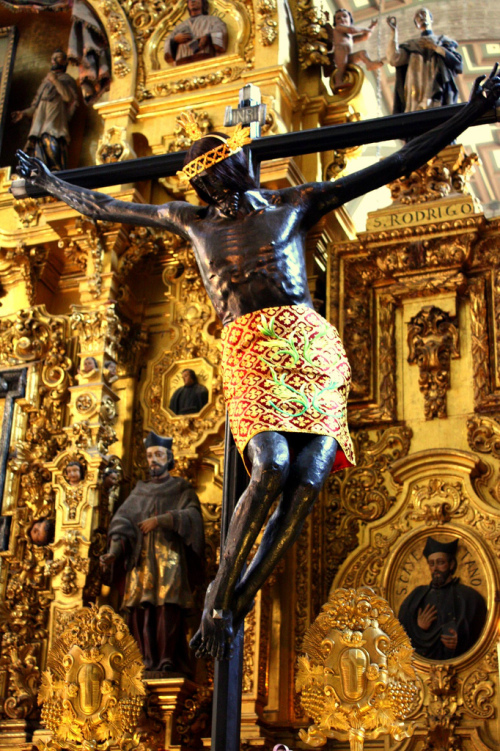
Jesus of Nazareth, King of the Jews

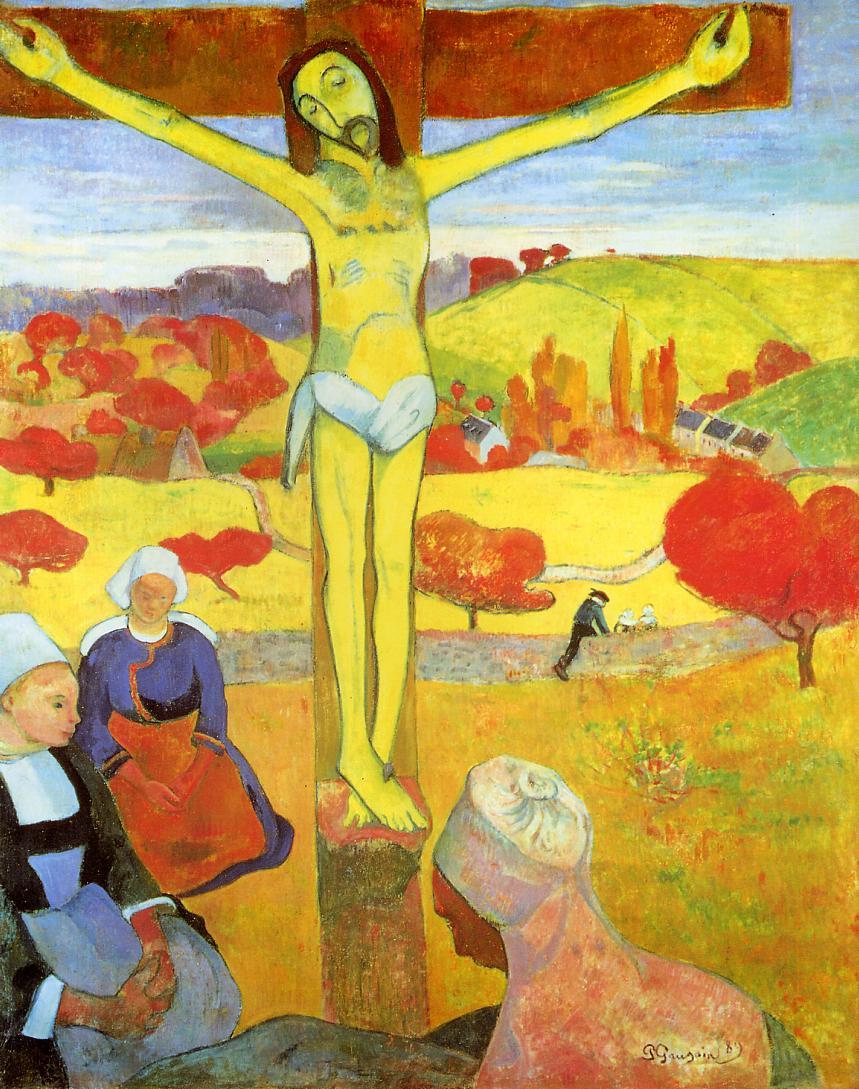
Images of the Crucifixion


(Thanks to Jeffrey Fisher [jeffreyfisher at me.com] for the guest post.)

On Good Friday every year,* Christians around the world commemorate the death by crucifixion of Jesus of Nazareth, rabbi, prophet, Son of God, Son of Man, messiah, and all-around trouble-maker.

The truth is that very little is known of Jesus’ life and teachings from verifiable accounts, but this has not stopped generation after generation of Christians from telling his story, beginning with Jesus’ semi-official biographers, the evangelists of the New Testament. Almost everything we know about the life and teachings of the physical human being Jesus are in those writings, which do not portray him always in compatible ways, and which are almost entirely unconfirmed by any external source. The Roman historian Tacitus mentions (with disdain if not disgust) Jesus’ cult following, as does the Jewish historian and philosopher Josephus, but neither gives us anything to work with as historians (or, for that matter, as theologians). For the record, Suetonius and Pliny also talk about Christians, but these piecemeal sources tell us much more about Roman perceptions of Christians than about Christ and his teachings, or even necessarily Christian beliefs and practices.

What, then, can we reasonably say about Jesus?

It is almost impossible to find universal agreement around anything more than a few basics, including most importantly Jesus’ crucifixion. The Gospels narrate it; Paul the Apostle (who never met Jesus in the flesh, as it were) hangs his theology on it, together with the equally important resurrection; and no contemporary sources (Christian or otherwise) dispute it.

But it’s when we ask why Jesus was crucified that things start to get interesting.

What did he do? The two men he is traditionally said to have been crucified with are commonly understood to be “robbers,” but that they were common criminals is highly unlikely. Crucifixion is a horrible death designed to make a very public statement about the crucified, the sort of thing you use on gladiator-slave rebels like Spartacus, not on pickpockets and roustabouts. The Greek term used for these two men (lestai) is consistent with the description of the released Barabbas as one who had participated in rebellious activities, whose “criminality” was related to his revolutionary business. Moreover, the name “Barabbas” means literally “son of the father,” a purely symbolic and surely entirely fictional name, and that the people choose to have him released indicates their affinity for him as a thorn in the side of the Romans. He is thus contrasted with Jesus, the other son of the father, the peaceful (apocalyptic) revolutionary.

So Jesus would have been crucified as a political criminal, a rebel. This would make sense of accounts of his having been identified by the Romans as “Iesus Nazarenus Rex Iudaeorum”: “Jesus of Nazareth, King of the Jews.” Anyone claiming to be king (and “son of God” was a Jewish way of talking about the king of Israel recorded clearly in Psalm 2), would, if taken seriously, be understood as challenging Roman authority.

Insofar as Jesus seems to have been deliberately poking the Romans’ local running dogs, the Sadducees and the Temple priests, his seizure and termination were surely inevitable. If his teaching is as opposed to violence and unconcerned with “politics” as it seems to have been, it’s hard to believe the Romans would have noticed him without some prodding, this coming not from the “crowd,” but from the leadership (who in Mark and Matthew incite the crowd). Indeed, the priests and scribes look for ways to arrest him when the crowds are not around, because they fear a riot.

If we take the Gospel of Mark at all seriously, Jesus was preaching a new kingdom of God, an apocalyptic redemption of the people of the earth by God’s direct intervention (and with Jesus as the sacrificial pesach lamb). If we take the Gospel of Luke seriously, Jesus spoke in a classic prophetic mode, calling people — Jew and Gentile both — to care for the oppressed of the earth, the poor and the hungry and the helpless. Both Jesuses called for people to be better to each other, to love each other, and indeed to love each other when love was, according to common sense, the foolish thing.

Why would this get you executed?

Well, in itself, it wouldn’t. But the Gospel of Mark tells us of Jesus speaking with a man who realizes that all the animal sacrifices in the world don’t amount to a hill of beans (in that crazy world). When love counts more than sacrifice, we are undermining the Temple. When we go into the Temple, start knocking things over, and say it’s become about robbing the poor and not about loving God and one’s neighbor, we are undermining the Temple. And to undermine the Temple’s authority is also to undermine Rome’s authority, and Rome’s cash flow.

Jesus, like the Essenes he may or may not have associated with, was a purist.

The Temple was full of collaborators and exploiters, the kind seen before in the history of Israel (and berated by prophets like Isaiah and Amos), the kind hated also by the Dead Sea community of apocalyptic purists awaiting a final showdown between God and evil (i.e., the Roman Empire and their local potentates, the Temple authorities).

Jesus, like other Jewish prophets before him, thought that Judaism was about something. That it was somehow about justice and not just about following rules or waiting around for things to get better: that it was about our making the world a better place, and not just making our own lives better.

Start talking that way and get people on your side, and you’re fairly likely to get killed, even twenty centuries later.

* Though the actual date (even the year) of the execution marked by the movable feast of Good Friday is fundamentally unknowable, there are some present-day astronomer types who’d like to sell you April 3, 33 A.D.

On this day..