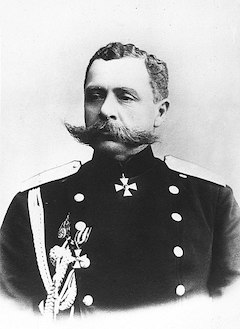
1892: Louis Anastay, “I wish to mount the scaffold”

Louis Anastay was guillotined on this date in 1892.

The young army lieutenant, catching word of a windfall coming to a wealthy benefactress of his named baroness Dellard, assailed and left for dead both the lady and her servant in December 1891. (The servant survived; Dellard did not.) As the accused described it to a courtroom all aghast:

Yes, I entered; — I chatted with her; — and then I struck, –. Ah! you do not know what it is to have struck your fellow creature with a knife. I have always Madame Dellard before my eyes. I have committed a crime; — not only as an officer have I committed faults, but I have committed a crime against society; — I demand to expiate it; — I accept the responsibility; — I wish to mount the scaffold.

Sensational enough in its time that “the scum of Parisians” were jostling for sightlines to the guillotine for full two days before the blade fell, Anastay rates a passing reference in the anarchist Ravachol‘s secret courtroom address among several criminals notorious for their cupidity. (“We will no longer see men like Pranzini, Prado, Berland, Anastay and others who kill in order to have [gold].”)

According to medical historian Lindsey Fitzharris, Anastay invited his brother to attend his beheading and attempt to interact with his severed head as part of the age-old quest to prove that life subsists a few moments after decapitation. There’s no indication that any such experiment actually took place, however.

As a strange coda of compounded tragedy, that very brother, Leon Anastay by name, was himself murdered in a lovers’ quarrel in 1907.

On this day..

1799: Francesco Antonio Lucifero, mayor of Crotone

On this date in 1799, the Jacobin mayor of the Calabrian city of Crotone was shot by counterrevolutionists with three comrades.

Francesco Antonio Lucifero hailed from a devilishly powerful family that had produced several prior mayors who weren’t left-wing radicals. Our Lucifero cleaved to the Parthenopean Republic, the Neapolitan revolutionary state that from the first days of 1799 displaced the Kingdom of Naples.

The Republic was short-lived, and so was Lucifero.

Southerly Crotone was one of the first targets of the Catholic and monarchist Sanfedismo militia led by Calabrian Cardinal Fabrizio Ruffo, which counterattacked the Republic with fury and alacrity. Ruffo overcame that city in March; Lucifero was condemned to death along with three other leading nobleman-revolutionaries Bartolo Villaroja and Giuseppe Suriano, and a Captain Giuseppe Ducarne — the leaders of the holdout republican resistance whom Ruffo besieged in Crotone’s fortress.

On this day..

1918: Paul von Rennenkampf, tsarist general

On this date in 1918, General Paul von Rennenkampf dug his own grave by the side of the railway tracks near Taganrog, then was shot by the Bolsheviks for declining a promotion.

The Baltic German with the glorious Hungarian had spent a career in the tsarist officer corps; he took part in the multinational suppression of China’s Boxer Rebellion, and then the entirely domestic suppression of the abortive 1905 revolution.

Less well did the motherland fare against the Japanese in 1904 (where Rennenkampf’s shin and Russia’s infantry were both shattered) or against history in the Great War (which saw Rennenkampf sacked for command failures in the Battle of Lodz).

Although it seems that the latter result was the consequence of political infighting moreso than verifiable incompetence, the man was still cooling his heels in forced retirement when the revolutions of 1917 arrived. Both the February and the October revolutionaries detained him for a time and then released him, finding insufficient interest in those weighty days in a cashiered sexagenarian no matter how backwards his political priors.

But the Bolsheviks found him interesting when they took over Taganrog, where Rennenkampf was parked. This was his wife’s home town, near the southern industrial center Rostov-on-Don — a place that would be intensely contested in the unfolding civil war between communist Red and tsarist White armies. Such moments entail a choice of sides, so when the Bolsheviks offered this veteran senior commander a role in the Red Army, it was understood to be an offer he couldn’t refuse. He refused it, with bold words that were patriotic but not prophetic.

I’m old. I have not much left to live, for the salvation of my life, I will not become a traitor and will not go against my own. Give me a well-armed army, and I will go against the Germans, but you have no army; to lead this army would mean leading people to slaughter, I will not take this responsibility on myself.

On this day..

1871: Generals Lecomte and Thomas, at the birth of the Paris Commune

On this date in 1871, the Paris Commune was born, with the execution of Generals Lecomte and Thomas.

Paris had come to the brink of revolution by dint of the country’s humiliating defeat in the Franco-Prussian War. After a monthslong Prussian siege of the capital, Paris had become thoroughly radicalized and stood at tense loggerheads with the newly elected conservative national government of Adolphe Thiers. A militant National Guard swelled by the city’s large proletariat had defended Paris during its late privations, only to see a government of national humiliation accept punishing peace terms from Bismarck and submit to a Prussian victory parade on the Champs d’Elysees.

Now, it blanched at the national government’s intention to reassert its own long-absent authority in Paris.

These sovereigns’ rivalries chanced to focus in the critical moment upon 400 bronze cannon in Paris, which the National Guard had used in the city’s defense and deployed to working-class neighborhoods with the intention of keeping them out of the government’s hands.

On March 18, upon an order by Thiers which some of his ministers opposed, the army moved upon these guns, intending to seize weapons and authority together. General Claude Lecomte (English Wikipedia entry | French), a rock-ribbed career officer of 63, had charge of this operation so offensive to the Parisian populace.

Lecomte was able to deploy his men at Montmarte where a great portion of the guns would come into his possession, but well did the master observe that “The line between disorder and order lies in logistics” — for a delay in the arrival of the horses and tumbrils by which the artillery would be hauled away gave time for word to spread in the city and an angry crowd assemble to oppose this outrage. Thiers had overruled objections that his soldiery was itself sympathetic to the radicals and would not be reliable in the breach; now, those warnings were vindicated as the soldiery declined to fire on Parisians and instead fraternized as the people took back Montmarte.

Although Lecomte was “merely” seized for the Central Committee of the National Guard, Paris’s blood was up; “the mob wanted to tear their victims to pieces, and it is my opinion they are the culpable judges,” writes John Leighton in Paris Under the Commune.

The first to lay hands on General Lecomte were linesmen and Mobiles, one of the latter observing, as he made a gesture, “Formerly you punished me with thirty days in prison, now I will be the first to fire at you.” Whilst this was going on a new movement was observed in the crowd. It was the arrival of another prisoner, a venerable gentleman, with a white beard, in plain clothes. It was General Clement Thomas, who had been arrested in the Place Pigalle by the National Guards. The General had been advised to run away, but he would remain, saying, “I will walk, it is my right.” This brought about a mob, who conducted him to the Rue des Rosiers, making it still worse for the prisoner Lecomte, for it was well known that Clement Thomas had been pretty severe at the Hotel de Ville and elsewhere, on the battalions of Montmartre and Belleville.

Once in the Rue des Rosiers, General Thomas felt he was lost, but as he would not die without knowing the cause, he mounted some steps and in a loud voice demanded, “What do you reproach me with?” “To death!” replied the crowd. “You are too great cowards to shoot me,” said the General. With these words he was driven into the garden, whilst General Lecomte in the scuffle attempted to escape by the back door, though unfortunately without success. Once in the garden, the old vine-covered walls and chestnut trees became crowded with miserable spectators ready to see the horrible deed perpetrated by a peloton of soldiers of the line and two francs-tireurs. In falling, poor General Lecomte exclaimed, “Oh my poor children! my —-” As he sunk mortally wounded, a villain of the group stepped forward and slapped him in the face. Clement Thomas was shot by National Guards. At first only wounded, he afterwards fell pierced in fourteen places. A National Guard pulled him over by the beard, that his face might be seen, and for two hours afterwards the bodies afforded a ghastly spectacle that was enjoyed by an ignoble procession of spectators.

Outside the garden, with the city in an uproar, the proletarian organs that had grown over the long siege took Paris firmly in hand while national government officials fled as they could — or were rounded up as hostages if they could not. The Commune would be master of Paris for ten tense weeks, until Thiers’s republic drowned it in blood.

For Leighton, no friend of the Commune, all the woe in its suppression could be traced to the ham-handed cannon debacle of March 18, 1871:

One thing appears certain — that General Lecomte did not take prompt measures and proper precautions, and that the Government, which sent him to remove 171 guns, without teams, and so small a force, acted inconsiderately, and must be held morally responsible for the disasters which ensued — disasters that, terrible as they are, might have been worse and have led to the total ruin of France.

On this day..

1979: Gen. Nader Jahanbani and eleven others

Wire report via the Baltimore Sun, March 14, 1979:

12 shot by firing squads in Iran

Tehran, Iran (AP) — Firing quads executed two generals, a legislator, the former head of the national news agency and eight other men yesterday, continuing the purge that has killed dozens of former supporters of Shah Mohammad Reza Pahlavi.

Eleven men were executed in Tehran and one in the holy city of Qom, 100 miles to the south, after secret trials without the aid of defense attorneys.

Since the shah’s government fell February 12, Islamic revolutionary courts are known to have ordered the execution of 57 persons, including 12 generals, for alleged political and sex crimes. The shah is in exile in Morocco.

Meanwhile, there were indications yesterday that the new government is having success in bringing the economy back to life. The National Iranian Oil Company announced that production in the country’s oilfields had reached 2.5 million barrels a day, up from 1.6 million barrels a day last week.

The company said all but 700,000 barrels a day was marked for foreign consumption. Before anti-shah strikes paralyzed the economy, Iran exported about 6 million barrels of oil a day.

The company said it will resume selling Iranian crude on a contract basis to American, European and Japanese companies April 1. In recent weeks, oil has been sold on a spot basis to the highest bidder. Spot prices are in the range of $20 a barrel, compared to the OPEC price of $13.55.

At Tehran University, 40,000 young Iranians rallied to condemn Mideast peace efforts by President Carter and Egyptian President Anwar el Sadat.

Iran’s Islamic Revolutionary Council announced the 12 executions on radio.

Among those shot were Air Force Gen. Nader Jahan-Bani, former director of the National Iranian Sports Organization; Army Gen. Vali Mohammad Zandkarimi, former director of prisons, and Gholam Hussein Daneshi, a Muslim clergyman and former member of parliament who supported the shah.

Also executed were Mahmoud Jaafariian, former head of the official Pars news agency and former deputy director of the national radio and television service, and Parviz Nik-Khah, also a former deputy director of the radio-TV service. Both were former Communists who were sentenced to death by the shah in 1967, but who were pardoned and later went to the shah’s side.

Firing squads in Tehran also executed a corporal in the shah’s Imperial Guard and in Qom a former police officer was shot. Also executed were five members of the shah’s former secret police, SAVAK.

On this day..

1653: Felim O’Neill

Irish rebel Felim (or Phelim) O’Neill of Kinard was executed on this date in 1653.

“A well-bred gentleman, three years at court, as free and generous as could be desired, and very complaisant; stout in his person, but, not being bred anything of a soldier, wanted the main art, that is, policy in war and good conduct” by a contemporary assessment, O’Neill numbered among the leaders of the 1641 Irish Rebellion against English governance. He issued a noteworthy manifesto of the affair known as the Proclamation of Dungannon.

The attempted coup helped to launch the English Civil War,* whose local-to-Ireland theater was known as the Irish Confederate Wars — Irish Catholics versus Protestant English and Scottish colonists. Felim O’Neill passed these years as a parliamentarian of the rebel (to English eyes) Confederate Ireland whose destruction required the bloody intervention of Oliver Cromwell.

O’Neill officered troops in this conflict, to no stirring victories. Although far from Confederate Ireland’s most important player, he was significant enough to merit an exception to the 1652 Act for the Settlement of Ireland — which made him an outlaw with a price on his head. He was captured in February 1653 and tried for treason in Dublin, refusing the court’s blandishments to abate the horrible drawing-and-quartering sentence by shifting any blame for the rising to the lately beheaded King Charles I.

* Or for a somewhat broader periodization, the rebellion fit into the Britain-wide breakdown that delivered the Wars of the Three Kingdoms.

On this day..

1916: Benjamin Argumedo

On this date in 1916, Mexican Revolution commander Benjamin Argumedo was shot at Durango.

Every revolution has its opportunists and this cavalryman swerved wildly between the infighting factions — deserting the general and president overthrown by the revolution, Porfirio Diaz, in favor of Francisco Madero (president from 1911 to 1913), then switching to rebel Pascual Orozco, and then to El Usurpador Victoriano Huerta (president from 1913 to 1914 via a coup), and last a swing to the left-wing revolutionary Emiliano Zapata.

This man waged a running guerrilla battle against the government until his own death in 1919 … by which time Argumedo was long done for, having been run to ground by Constitutionalist general Francisco Murguia. (Murguia extended him the courtesy of a drumhead tribunal the day before execution.)

Argumedo was reportedly refused a plea to be shot in the public plaza for maximum spectacle, and died with a wish upon his lips that posterity forego noxious flourishes of rank because “we are all equal material for the grave.” (Executed Today endorses this sentiment.)


The corrido “Las Mananitas de Benjamin Argumedo” — “So much fighting and fighting, / so much fighting and fighting, / with my Mauser in my hands. I came to be shot, / I came to be shot / in the cemetery of Durango.” (Full lyrics and even sheet music to be found in Hispano Folk Music of the Rio Grande Del Norte.

On this day..

2016: Mumtaz Qadri, assassin of Salman Taseer

On Leap Day in 2016, the bodyguard-turned-assassin of Punjab governor Salman Taseer was hanged for murder.

A longtime activist of the center-left Pakistan Peoples Party, Taseer was a prominent public figure for thirty-plus years and wrote a biography of hanged PPP Prime Minister Zulfikar Ali Bhutto in 1980.

A millionaire through financial services businesses and a minister in the federal government from 2007, Taseer became governor of the Punjab region in 2010. But as a secular- and liberal-minded elite, he was already becoming an artifact from a different Pakistan, and indeed his party was routed at the 2013 election.

The specific grievance nursed by our date’s principal Mumtaz Qadri, a former police commando recruited in 2010 to the personal security detail of the businessman/politician, was Taseer’s support for reversing the high-profile death sentence for blasphemy against a Pakistani Christian woman.* On January 4, 2011, Qadri opened up on his protective charge in an Islamabad marketplace, shooting him 28 times.

As a legal matter, this was all open and shut — but Qadri’s strike on behalf of Islamic militancy earned him wide admiration that reminded some observers of the Raj-era Punjabi assassin Ilm Deen. Hundreds of lawyers clamored to represent him pro bono while “cheering supporters clapped Qadri as he was bundled into court. ‘Death is acceptable for Muhammad’s slave,’ they chanted.” (Guardian)

Death is what he got, of course, although thousands subsequently marched in mourning and staged a parliament sit-in to demand sharia law. On the same day as that march, a suicide bomber attacked a Christian Easter gathering in a Lahore public park, killing 75 or more.

* After a yearslong legal odyssey, Asia Bibi’s conviction was vacated by the Pakistani Supreme Court only in 2018. She was allowed to emigrate to Canada in 2019. (Here’s a short interview with her Incidentally, a second politician, Federal Minister for Minorities Affairs Shahbaz Bhatti, was also assassinated in 2011 for advocating her position.

On this day..

1947: Jonas Noreika, “General Storm”

On this date in 1947, Lithuanian anti-Soviet partisan Jonas Noreika was executed in Moscow.

Memorial plaque honoring Jonas Noreika in Vilnius; it was destroyed in 2019 by an anti-fascist politician. (cc) image from Alma Pater.

Long held as a hero of Lithuanian patriots, “General Storm”* has been headline news in recent years having his legacy complicated.

It all started when author Silvia Foti, Noreika’s granddaughter, took up her late mother’s unfinished project to write a biography of their famous kinsman. At the time, she accepted the received lore that Jonas Noreika had been an anti-Nazi resister during the Second World War, prior to being an anti-Communist resister afterwards — a story facilitated by Noreika’s 1943 arrest and detention in the Stutthof concentration camp among dozens of other high-profile Lithuanians taken as hostages.

But Foti’s understanding of events evolved painfully, as she described in a wrenching 2018 Salon article with the spoiler-alert title “My grandfather wasn’t a Nazi-fighting war hero — he was a brutal collaborator”.

According to Foti’s research in conjunction with the (since-deceased) director of Vilnius’s Sugihara House and Holocaust researcher Grant Gochin, Noreika was a principal of the anti-Soviet June Uprising sparked by the Nazi invasion of the USSR, but preceding the Wehrmacht’s actual arrival; in those days, Lithuanian militia seized control of towns, often massacring Jews (or, which was tantamount to the same thing, preventing their escape to the Soviet Union). Foti believes that Noreika did exactly this in his town of Plungė in the Samogitia region where he was later appointed as a county administrator during the German occupation.

[Sugihara House director Simon] Dovidavičius; was the first to suggest that my grandfather conducted the initial akcija (action) during World War II before the Germans arrived. It coincided with Operation Barbarossa on June 22, 1941, when Hitler invaded Russia, the same day Lithuania began its uprising with the Germans against the Soviets, marking the start of a Holocaust there, where 95 percent of its 200,000 Jews were murdered, the highest percentage of any country in Europe. (About 3,000 Jews remain in Lithuania today.)

Within three weeks, 2,000 Jew had been killed in Plungė, half the town’s population, and where my grandfather led the uprising. This preceded the January 1942 Wannsee Conference, when Nazi Germany decided to make mass-murder its state policy. Put in more chilling terms, Dovidavičius claimed that my grandfather, as captain, taught his Lithuanian soldiers how to exterminate Jews efficiently: how to sequester them, march them into the woods, force them to dig their own graves and shove them into pits after shooting them. My grandfather was a master educator …

By the end of the trip [to Lithuania] I came to believe that my grandfather must have sanctioned the murders of 2,000 Jews in Plungė, 5,500 Jews in Šiauliai and 7,000 in Telšiai.

Foti’s revelations have been roughly received in a country where the Holocaust complicity of anti-Soviet national heroes remains a very sore subject; there are still monuments to and streets named after her grandfather in Lithuania, and apparently a military academy there even published a prewar antisemitic essay by Noreika in 2016 in a wholly uncritical light.

* Not to be confused with a Philadelphia property repair contractor.

On this day..

1918: Victor Manson Spencer, Otago Regiment deserter

Text from New Zealand’s Pardon for Soldiers of the Great War Act of 2000. Spencer was one of four New Zealand enlistees shot for cowardice during World War I,* all of whom were posthumously exonerated by this legislation.

Pardon of Private Spencer

Private Victor Manson Spencer, regimental number 8/2733, a member of the 1st Battalion, Otago Regiment, —

  1. who was charged with having committed on 13 August 1917 the offence of desertion; and
  2. who was, by a Field General Court Martial held on 17 January 1918, convicted of that offence and sentenced to death; and
  3. who was again sentenced to death on 29 January 1918 after the Field General Court Martial had revised its finding and had convicted him of having committed the offence of desertion not on 13 August 1917 but on 25 August 1917; and
  4. who was, after the sentence of death imposed on him on 29 January 1918 had been confirmed, executed by firing squad in accordance with that sentence on 24 February 1918, —

is, by this Act, granted a pardon for that offence of desertion.

He’s buried in Belgium. Spencer was also covered by the UK’s 2006 Armed Forces Act, pardoning 306 British and Commonwealth soldiers executed during the Great War.

Spencer’s pardon cleared the way for his family to receive several decorations that had been deprived him: the 1914-15 Star, British War Medal, Victory Medal, New Zealand Certificate of Honour and Anzac Commemorative. These items were recently in the news when the family accidentally sold and then successfully retrieved them.

* Another Kiwi, Jack Braithwaite, was executed for mutiny in 1916. He was also included in Wellington’s posthumous pardon bill.

On this day..