1943: Amos Pampaloni, Captain Corelli’s Mandolin inspiration

Italian artillerist Amos Pampaloni, the real-life model for the title character of the novel and film Captain Corelli’s Mandolin, miraculously survived execution on this date in 1943.

It occurred at the outset of the Cephalonia Massacre on September 21, 1943, which began a dayslong slaughter on that Greek island by German soldiers of their former Italian comrades. With some 5,000 victims, it’s one of the largest POW massacres of the Second World War.

Captain Pampaloni was among 500-odd officers deployed with the 12,000-strong Acqui Infantry Division. This formation had been part of fascist Italy’s invasion of Greece in 1940-41; after victory in that campaign, the Acqui Division occupied several Greek islands over the succeeding years, where German troops were also stationed.

The Pact of Steel uniting these powers melted abruptly in early September of 1943, when the Allies forced Italy into an armistice. For Italian forces standing in the field cheek-by-fascist epaulette, this forced a sudden and dangerous reckoning. Some units had barely even heard of the new situation before they were under German guns; in a best-case scenario, they had to decide within a few hours or days between radically different attitudes towards their up-to-now comrades-in-arms.

The Acqui on the Ionian island of Cephalonia (Kefalonia) was a case in point. In the days following the Italian armistice, the much larger German force presented its commanders an ultimatum to decide among three alternatives:

  1. Continue fighting alongside the Germans
  2. Fight against the Germans
  3. Surrender, disarm, and repatriate

While the last of these might seem the obvious course, disarming was contrary to the Italian high command’s ambiguous order neither to initiate hostilities with Germans, nor to cooperate with them. Moreover, the Cephalonia division got some reports in those confused days that the Germans weren’t always repatriating units that surrendered. The soldiery was polled on the options, and went for resistance.

Unfortunately the Italians were thoroughly outgunned in this fight, and the Allies refused to permit dispatching reinforcements from Italy that might easily be captured by the Germans. Within days the Acqui had been roughly brought to heel.

Outnumbered and suffering under accurate mortar fire, Pampaloni decided to surrender. The captain protested that it was against the rules of war when his men were systematically robbed of their wallets and watches, only to be told by the German commanding officer that those rules applied to prisoners, not to traitors.

The officer then shot the captain through the back of the neck, and the rest of his men, including the wounded, were mown down with machine gun fire. Miraculously still alive, Pampaloni remained conscious as a German soldier removed his own watch from his apparently lifeless body.

Captain Pampaloni was not, in fact, the only soldier from his company to survive. “The mule handlers were spared, because every mule responds best to his own master,” he said. “Ten minutes after the massacre the German soldiers left, singing.”

Captain Pampaloni went on to fight for a year with the Greek resistance on the mainland. Having witnessed the brutality of the conflict on Cephalonia, he was still shocked by the sight of partisans slitting the throats of German prisoners with their daggers — ammunition was too precious to be wasted on executions.

Cefalonia – crimine di guerra 1 from Va.Le. Cinematografica 78 on Vimeo.

Cefalonia – crimine di guerra 2 from Va.Le. Cinematografica 78 on Vimeo.

Numerous summary executions disgraced the German victory. (There’s a monument to the victims in Verona.) Our man Amos Pampaloni faced his on the first day of the general massacre; according to a 2001 profile in the Guardian,

Outnumbered and suffering under accurate mortar fire, Pampaloni decided to surrender. The captain protested that it was against the rules of war when his men were systematically robbed of their wallets and watches, only to be told by the German commanding officer that those rules applied to prisoners, not to traitors.*

The officer then shot the captain through the back of the neck, and the rest of his men, including the wounded, were mown down with machine gun fire. Miraculously still alive, Pampaloni remained conscious as a German soldier removed his own watch from his apparently lifeless body.

Captain Pampaloni was not, in fact, the only soldier from his company to survive. “The mule handlers were spared, because every mule responds best to his own master,” he said. “Ten minutes after the massacre the German soldiers left, singing.”

Captain Pampaloni went on to fight for a year with the Greek resistance on the mainland. Having witnessed the brutality of the conflict on Cephalonia, he was still shocked by the sight of partisans slitting the throats of German prisoners with their daggers — ammunition was too precious to be wasted on executions.

In the novel Captain Corelli’s Mandolin, Pampaloni’s fictional imitator survives thanks to a noble comrade who hurls his body in front of the fusillade.

Pampaloni didn’t appreciate Mandolin all that much, owing to its hostile depiction of the Communist partisan movement that he joined after surviving his execution. For those seeking alternative literatures, there’s also a 1960s novelization of the Greek resistance on Cephalonia by Marcello Venturi; written in Italian (as Bandiera bianca a Cefalonia), it’s long out of print in English as The White Flag.

* Prior to the Italian armistice, the Italian forces on the island were working on an arrangement to obey German command structures; hence, the brutal treatment of Italian prisoners who could be conceived as not merely prisoners of war, but traitors or rebels unprotected by any law of war. A German directive had explicitly demanded as much: “because of the perfidious and treacherous behaviour on Kefalonia, no prisoners are to be taken.”

On this day..

2014: Darfur rebels for killing Chinese oil workers

From news reports:

The management of the federal Kober Prison in Khartoum North on Sunday [September 14, 2014] carried out the death penalty against two men accused of having killed Chinese workers in West Kordofan several years ago.

The members of the Darfur rebel Justice and Equality Movement (JEM) were sentenced to death on charges of murdering the five Chinese who were working at the Abu Dafra oil field in West Kordofan in 2008. 17 others were acquitted.

On 18 October 2008, a group of 35 JEM rebels kidnapped nine Chinese oil workers and a Sudanese driver at the Abu Dafra oil field. The bodies of five workers were found a few days later.

JEM strongly condemned the execution of the “freedom fighters” in Kober prison, stressing that “no JEM combatant had anything to do with the assassination of the Chinese in Abu Dafra.”

Jibril Adam Bilal, the spokesman for the movement, told Radio Dabanga that the trial, in which the two were convicted, was politically motivated. “It was directed by the National Intelligence and Security Service (NISS), and has nothing to do with the judiciary in the country.”

He urged human rights organizations to investigate and document “this crime committed against innocent people.”

On this day..

1917: Private John Abigail

Private John Abigail of the Royal Norfolk Regiment was shot on this date in 1917 for World War I desertion, at the village of Esquelbecq on the French-Belgian border.

He was a four-time offender, the last occasion judiciously ditching his post just before he was ordered over the top into the Passchendaele bloodbath.

Abigail’s name surprisingly appears carved on a war memorial plaque at St. Augustine’s Church in Norwich that long predates the humane 21st century rehabilitation of those shot at dawn. (See it here, at the very top of the right panel.)

The BBC has a short program about him available here.

On this day..

1916: Yakub Cemil, Ottoman putschist

Ottoman officer Yakub Cemil was executed on this date in 1916 as an aspiring putschist.

A Circassian infantryman who served under Enver Pasha in the 1900s, Cemil was an early and ardent supporter of the Committee of Union and Progress. This onetime underground party ascended to national preeminence in 1908, after which Cemil became a sturdy “weapon of the organization”.
He did not shrink to imbrue his hands with blood; allegedly, he assassinated journalist Ahmet Samin Bey in 1910, and on campaign in Libya against the Italian invasion he privately murdered a black lieutenant out of some combination of suspected espionage and racial animus. His implacability was his great asset and his great liability; the eventual father of post-Ottoman Turkeuy, Ataturk is perhaps apocryphally supposed to have mused, “If I one day mount a revolution, Cemil is the first man I want by my side, and Cemil is the first man I will hang afterwards.”

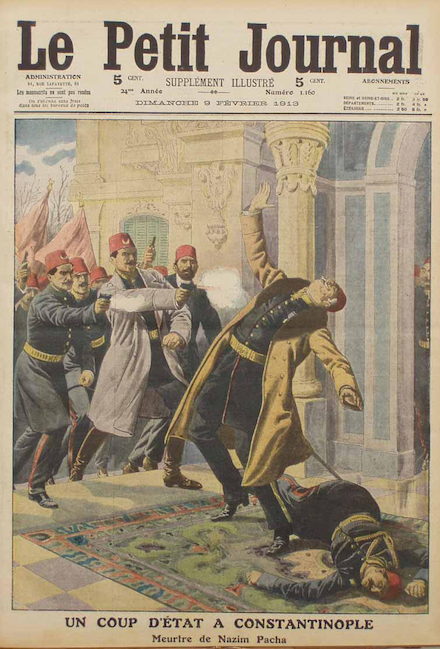
Such provincial homicides were but studies for the main deed of his days when in the 1913 Ottoman coup d’etat when he gunned down War Minister Nazim Pasha on the steps of the Sublime Porte as his CUP comrades barged in to force the resignation of the aging Grand Vizier and take the state firmly in hand.

It was an act that shook capitals around the world.


9 February 1913 edition of Le Petit Journal with a cover depiction of “un coup d’etat a Constantinople: muertre de Nazim Pacha”.

Ironically it was a desire for peace that brought his end. A couple of years deep into the catastrophe of World War I, Cemil rightly perceived the need to extricate his state from the conflict, and began making plans to topple the “Three Pashas” of the CUP whom he had helped to bring to power. His old friend Enver Pasha had no intention of approving the resulting death sentence — indeed, he had caught wind of it and tried persuasion to bring Cemil back onside — but when Enver Pasha was summoned to Berlin for a war council the fellow triumvir Talaat Pasha signed off on the execution with dispatch.

Rumors and legends abound concerning his death, such as shouting “Long live the Committee for Union and Progress!” before the firing squad opened up on him, and an agonizing half-hour bleed-out during which the expiring Cemil scrawled a patriotic slogan in the dirt with his own blood.

On this day..

1964: Mohamed Chabani

On this date in 1964 — one day shy of his 30th birthday — Algerian officer Mohamed Chabani was executed as a traitor.

It’s a verdict that posterity has washed its hands of; Chabani (other transliterations include Shabani and Chaabani) was officially rehabilitated in 1984 and his name decorates public spaces in Algeria.

But in 1964, when Algeria was but two years into her post-France independence, this former FLN fighter become Algeria’s youngest colonel was governor of the fourth military district in Biskra when he fell foul of the Defence Minister Houari Boumediene.

Boumediene was in the process in this interim of consolidating power to his own circle; the following year he would overthrow President Ahmed Ben Bella and rule Algeria until his death in 1978. Boumediene allegedly feared that Chabani would form an independent bloc that could oppose him, and attempted to have the young commander assassinated.

“How long is it since you began to travel by short stages and side-tracks?” the Marquise de Merteuil demanded of Valmont in a different context. “My friend, when you want to get somewhere — post horses and the main road!”

Boumediene’s main road was to arrest Chabani for a supposed separatist plot to break away oil-rich southern Algeria and have him shot in Oran.

On this day..

1853: Gasparich Mark Kilit

On this date in 1853, Hungarian patriot-priest Gasparich Mark Kilit was executed by the Austrian empire for his part in the failed revolutions of 1848-1849.

Gasparich — it’s a Hungarian link, as are most sources about the man — was a Franciscan who served as a camp priest to the nationalist insurgents under Perczel, who made him a Major.

After the revolutions were defeated and suppressed, he managed to live a couple of years under a pseudonym. But, writing for a Hungarian newspaper and dabbling with new radical movements, he was hardly keeping his head down. He’d even become a socialist on top of everything else. Captured late in 1852, Gasparich’s fate might have been sealed by the early 1853 attempted assassination of Emperor Franz Joseph and the resulting pall of state security.

Gasparich was hanged at a pig field outside Bratislava in the early hours of September 2, 1853.

A street and a monument in Zalaegerszeg, the capital of the man’s native haunts, preserve Gasparich’s name for the ages.

On this day..

1217: Eustace the Monk, turncoat outlaw

On this date in 1217, the pirate Eustace the Monk was defeated in battle and summarily beheaded, scuppering an ongoing invasion that nearly seated a French dauphin on the English throne.

This colorful outlaw commenced life as the younger son of a Boulogne lord, but his conventional path into the Abbey Saint-Wulms was aborted by the murder of his father — leading Eustace to abandon his cowl for a vain attempt at vengeance.

“From a black monk becoming demoniac” — in the words of one chronicle — the man’s career thence proceeded, first rejoining the secular economy as a seneschal and then pivoting to outlawry when his former master turned against him.

His exploits in banditry are greatly embellished and romanticized in the medieval French verse titled Eustache the Monk (peruse in full here; helpful introduction here), including a number of charming and imaginary vignettes that double as moral parables and medieval slices-of-life.

Eustache spotted the Abbot of Jumièges as he was coming down the road. “Sir Abbot,” he said, “stop where you are! What are you carrying? Come now, don’t hide it.” The Abbot answered: “What’s it to you?” At this, Eustache was ready to hit him, but instead replied: “What’s it to me, fat-ass? Upon my word, I’ll make it my business. Get down, fast, and not another word out of you, or I’ll let you have it. You’ll be beaten up so badly you won’t be worth a hundred pounds.” The Abbot thought the man was drunk, and said, more politely this time: “Go away. You won’t find what you are looking for here.” Eustache responded: “Cut the bullshit and get off your horse fast, or you’ll be in for a lot of trouble.” The Abbot got down, frightened now. Eustache asked how much money he had with him. “Four marks,” said the Abbot, “in truth I only have four marks silver.” Eustache searched him immediately and found thirty marks or more. He gave back to the Abbot the four marks he claimed to have. The Abbot became duly furious; for, had he told the truth, he would have got back all his money. The Abbot lost his money only because he told a lie.

Around this time Eustace set up as a freelance English Channel pirate and was regularly employed by the English King John from about 1205 until 1212, when he switched his allegiance back to Philip II of France. Eustace tormented his former English patrons during the civil war in that country that led to the Magna Carta; the rebel barons in this war offered the English throne to the French heir Louis, and Louis invaded and held London and about half the realm, merrily aided by Eustace’s channel buccaneers.

Things went sideways for Louis and for Eustace in 1217; the former suffered a devastating reversal at the Battle of Lincoln.* Our man Eustace, attempting to reinforce Louis’s camp, was intercepted at sea and trounced at the Battle of Sandwich.**

Run-of-the-mill French knights were captured for ransom as per usual;

With Eustance, however, the case was different. When the ship was captured, the English instituted a search for him, and he was at length discovered down in the hold (Matthew Paris says in the bilge-water) by ‘Richard Sorale and Wudecoc’. Then Eustace offered a large sum of money for a ransom, ten thousand marks, as the writer of the Guillaume le Marechal puts it; ‘but it could not be.’ His addition offer (so Wendover) to serve the king of the English faithfully thereafter, if actually made, would have been only a reminder of his previous injuries. It was Stephen Trabe (or Crave) [or Crabbe -ed.], one of the mariners, ‘who had long been with him,’ that executed him, so the Histoire des Ducs de Normandie tells us; or as the poem of Guillaume le Marechal narrates it: ‘There was one there named Stephen of Winchelsea, who recalled to him the hardships which he had caused them both upon land and sea and who gave him the choice of having his head cut off either upon the trebuchet or upon the rail of the ship. Then he cut off his head.’ The head was subsequently fixed upon a lance and borne to Canterbury and about the country for a spectacle. The Romance concludes with the sentiment: ‘Nor can one live long who is intent always upon doing evil.’ (Henry Lewis Cannon


13th century illustration: Eustace gets the chop over the side of the boat.

Eustace’s defeat completely undermined Louis’s position, and the chancer was obliged to retreat to his homeland — where he’d become king in 1223. He’s known as Louis the Lion, which is pretty good, but he was rather convincingly surpassed by his son Saint Louis.

* Known to history as the “Lincoln Fair” for all the looting that occurred afterwards.

** The English maneuver on this occasion was to use an advantageous wind to hurl lime onto the French ships, blinding the enemy crews.

On this day..

1848: Puran Appu, Kandy rebel

Weera Sanadhdhana Weera Balasooriya Kuru Uthumpala Arthadewa Gunaratne Nanayakkara Lakshapathi Maha Widanelage Fransisco Fernando — who is thankfully better known simply as Veera Puran Appu — was executed on this date in 1848 as one of the principals in a Ceylon rebellion against the British.

For several years he had been a famed and colorful bandit in the central highlands around Kandy, and his name bore the romance of the road and the weight of a £10 price. He was “light, well looking, well made, stout, marks of punishment on the back and 4 vaccination marks” in the words of the Brits’ wanted-man bulletin. They forgot to add: political.

In July of 1848, Puran Appu emerged at the head of a popular uprising sparked by land seizures and taxes upon an irate peasantry that every day became more inextricably entangled in the empire’s economic circuitry. It’s known as the Matale rebellion after the central city which Puran Appu briefly held, ransacking government buildings before the disciplined British army was able to rally and put down the rising and stood the rebel in front of a firing squad.

“He died exclaiming, if the king [meaning the self-proclaimed rebel king, in whose name Puran Appu acted] had three men about him as bold and determined as myself he would have been master of Kandy,” the British Governor Torrington* recorded.

He’s honored in Sri Lanka (and Kandy in particular) every year on this anniversary of his death, but fine for any occasion is a 1978 Sri Lankan biopic about, and titled, Veera Puran Appu.

* George Byng was his name, the 7th Viscount Torrington. He’s in the same family tree as the 18th century British admiral infamously executed pour encourager les autres, John Byng: Admiral John was a younger son of the 1st Viscount Torrington.

On this day..

1819: Antonia Santos, Bolivarian revolutionary

Today is the bicentennial of the July 28, 1819 execution by firing squad of Bolivarian independence heroine Maria Antonia Santos Plata.

Monument to Antonia Santos in Socorro, Colombia.

This New Grenada peasant (English Wikipedia entry | the more extensive Spanish) led Bolivar-aligned guerrillas resisting the Spanish reconquest in her home Province of Socorro.

She was captured during the last months of Spanish hegemony, but even as she awaited execution of her sentence her comrades in arms continuing in the field played a part in the crucial Bolivarian victory at the Battle of Pantano de Vargas.

She was shot at 10:30 in the morning on the main square of Socorro, along with Pascual Becerra and Isidro Bravo.

A battalion of the Colombian army’s Seventh Brigade is named for Antonia Santos.

On this day..

1833: Anastasio Aquino, Nonualco rebel

On this date in 1833, the Federal Republic of Central America executed Salvadoran indigenous rebel Anastasio Aquino.

Monument to Anastasio Aquino in Santiago Nonualco, the place where both man and rising originated (it’s sometimes called the Nonualco Rebellion). (cc) image from AlfredoMercurio-503.

This interesting post-Spanish polity lasted until the Central American federation splintered in 1841 into the modern-day independent states of Nicaragua, Guatemala, El Salvador, Honduras, Costa Rica, and a bit of Mexico.

Not for the first time, New World indigenes found the breakaway settler state a less congenial authority than the former colonial overlord — in this case cumbering them with new taxes, with laws facilitating the private takeover of their “uncultivated” lands. and with conscriptions onto exploitive hacienda estates.*

This soon catalyzed a rebellion; its leader, our day’s principal “Aquino the Indian”, was a hacienda laborer aggrieved by the unjust arrest of his brother and for the first months of 1833 he set the state of El Salvador on the brink of revolution, winning several battles as the General Commandant of the Liberation Army and issuing edicts in his own name.

His rebel army was defeated at the end of February and its fugitive general finally captured weeks later — destined for the scaffold and for the literary tribute of subsequent Salvadoran writers who have often styled him a national hero.

On this day..