1638: Stepan Ostryanin, Cossack hetman

(Thanks to friend of the blog Sonechka for research, translation, and background information touching this post. -ed.)

October 14 (October 1 O.S.) is a liturgical feast celebrating the protective intercession of the Virgin Mary, a date of particular significance in Russia and Ukraine. Indeed, Red Square’s St. Basil’s Cathedral is actually the Cathedral of the Intercession of the Most Holy Theotokos [i.e., Mary] on the Moat, just one of many Orthodox churches so named.

Also known as Pokrov — a quaint Slavic term for covering, denoting safeguarding — the holiday celebrates an incident from 10th century Byzantium when a saint beheld Mary descend through the dome of the church, then spread her garment protectively over the entire congregation.

It is of special significance in Ukraine where the ecclesiastical celebration pulls double duty as the Day of the Ukrainian Cossacks. And it is in honor of Pokrov that we dedicate this post.


17th century icon of the Madonna’s broad cloak protecting Ukrainians.

On an unspecified date in 1638, a Cossack named Ostryanin was broken on the wheel in Warsaw … maybe.

The Ostryanin Uprising of 1638 was one of the ongoing cycle of Cossack disturbances in the southern reaches of the Polish-Lithuanian Empire — modern-day Ukraine. Like many of these, it was a short-lived affair considered on its own, but the pattern of disaffected Cossacks struggling against the Polish crown for some combination of recognition, largesse, and autonomy was an ongoing pattern in the 17th century — and by the 1650s it would begin tearing apart the formerly mighty Polish-Lithuanian realm and transferring Ukrainian territory from Polish to Russian domination.

Tradition held that after the rising was stamped out in the summer of 1638, Stepan Ostryanin himself was treacherously seized and taken to Warsaw for execution. A late 18th century chronicle* of a distinctly patriotic bent called Istoriya Russov embroiders upon that death by breaking-wheel with racist gusto:

in accord with their treachery, insidious and duplicitous, having learned through their Jew spies that hetman Ostryanin’s would travel unguarded … the Lyakhs [term for “Poles”; it’s derogatory in present-day Russian but may have been less so at the time -ed.] surrounded him in Kanev monastery with a host of men. They, having tied the hetman and his men, altogether thirty seven people, … prepared an execution for them in Warsaw unprecedented in its cruelty, which posterity will scarcely believe to be true, because it would not occur to even the most barbarous and ferocious Japanese (!) and the reality of which would terrify the very beasts and monsters.

On the other hand, a Cossack named Yakiv Ostryanin was to be found on Russian soil in the subsequent years, until he was murdered in 1641. Some historians think that he was the very same namesake Cossack rebel escaped from Polish vengeance, and the story about him being broken on the wheel in Poland is pure sentimental folklore; alternatively, Stepan and Yakiv might have just been two different Cossacks named Ostryanin who met two different fates.

Quite a difference for our supposed Stepan Ostryanin, but a minor mystery from this distance in time. Nevertheless, our man, whoever he was, had a posthumous contribution yet to make to the letters of his Slavic brethren.

Polish historian Szymon Okolski rode along with the Polish commander Mikolaj Potocki in Potocki’s successful campaign of the spring-summer 1638 to suppress this rebellion. Okolski’s field diaries of the campaign are a key historical source on the Cossacks and are thought to have been used extensively by the Cossack-descended writer Nikolai Gogol in composing his short story Taras Bulba.

A product of Gogol’s youth, Taras Bulba has a rough romanticism — and a romanticism for the Cossack (read: national Ukrainian) cause specifically that nonplussed Russian authorities at the time. (And probably now, too.)

Taras Bulba‘s title character is a mature Cossack patriot who with his two sons joins the Cossack risings against Poland. Its location in time is indeterminate, not unlike the unending cycle of risings themselves. Taras Bulba is a nearly eternal character, almost a fixture of nature, because his war seemed eternal too.

And of course it contains some cracking execution scenes. The execution by breaking-wheel of Taras Bulba’s son might have been inspired by the Istoriya Russov‘s outraged account of that full Japanese barbarism. The excerpt below hails from this public-domain English translation.


Ostap had been seized and bound before his very eyes, and that he was now in the hands of the Lyakhs. Grief overpowered him. He pulled off and tore in pieces the bandages from his wounds, and threw them far from him; he tried to say something, but only articulated some incoherent words. Fever and delirium seized upon him afresh, and he uttered wild and incoherent speeches. Meanwhile his faithful comrade stood beside him, scolding and showering harsh, reproachful words upon him without stint. Finally, he seized him by the arms and legs, wrapped him up like a child, arranged all his bandages, rolled him in an ox-hide, bound him with bast, and, fastening him with ropes to his saddle, rode with him again at full speed along the road.

“I’ll get you there, even if it be not alive! I will not abandon your body for the Lyakhs to make merry over you, and cut your body in twain and fling it into the water. Let the eagle tear out your eyes if it must be so; but let it be our eagle of the steppe and not a Polish eagle, not one which has flown hither from Polish soil. I will bring you, though it be a corpse, to the Ukraine!”

Thus spoke his faithful companion. He rode without drawing rein, day and night, and brought Taras still insensible into the Zaporozhian Setch itself. There he undertook to cure him, with unswerving care, by the aid of herbs and liniments. He sought out a skilled Jewess, who made Taras drink various potions for a whole month, and at length he improved. Whether it was owing to the medicine or to his iron constitution gaining the upper hand, at all events, in six weeks he was on his feet. His wounds had closed, and only the scars of the sabre-cuts showed how deeply injured the old Cossack had been. But he was markedly sad and morose. Three deep wrinkles engraved themselves upon his brow and never more departed thence. Then he looked around him. All was new in the Setch; all his old companions were dead. Not one was left of those who had stood up for the right, for faith and brotherhood. And those who had gone forth with the Koschevoi in pursuit of the Tatars, they also had long since disappeared. All had perished. One had lost his head in battle; another had died for lack of food, amid the salt marshes of the Crimea; another had fallen in captivity and been unable to survive the disgrace. Their former Koschevoi was no longer living, nor any of his old companions, and the grass was growing over those once alert with power. He felt as one who had given a feast, a great noisy feast. All the dishes had been smashed in pieces; not a drop of wine was left anywhere; the guests and servants had all stolen valuable cups and platters; and he, like the master of the house, stood sadly thinking that it would have been no feast. In vain did they try to cheer Taras and to divert his mind; in vain did the long-bearded, grey-haired guitar-players come by twos and threes to glorify his Cossack deeds. He gazed grimly and indifferently at everything, with inappeasable grief printed on his stolid face; and said softly, as he drooped his head, “My son, my Ostap!”

…

The square on which the execution was to take place was not hard to find: for the people were thronging thither from all quarters. In that savage age such a thing constituted one of the most noteworthy spectacles, not only for the common people, but among the higher classes. A number of the most pious old men, a throng of young girls, and the most cowardly women, who dreamed the whole night afterwards of their bloody corpses, and shrieked as loudly in their sleep as a drunken hussar, missed, nevertheless, no opportunity of gratifying their curiosity. “Ah, what tortures!” many of them would cry, hysterically, covering their eyes and turning away; but they stood their ground for a good while, all the same. Many a one, with gaping mouth and outstretched hands, would have liked to jump upon other folk’s heads, to get a better view. Above the crowd towered a bulky butcher, admiring the whole process with the air of a connoisseur, and exchanging brief remarks with a gunsmith, whom he addressed as “Gossip,” because he got drunk in the same alehouse with him on holidays. Some entered into warm discussions, others even laid wagers. But the majority were of the species who, all the world over, look on at the world and at everything that goes on in it and merely scratch their noses. In the front ranks, close to the bearded civic-guards, stood a young noble, in warlike array, who had certainly put his whole wardrobe on his back, leaving only his torn shirt and old shoes at his quarters. Two chains, one above the other, hung around his neck. He stood beside his mistress, Usisya, and glanced about incessantly to see that no one soiled her silk gown. He explained everything to her so perfectly that no one could have added a word. “All these people whom you see, my dear Usisya,” he said, “have come to see the criminals executed; and that man, my love, yonder, holding the axe and other instruments in his hands, is the executioner, who will despatch them. When he begins to break them on the wheel, and torture them in other ways, the criminals will still be alive; but when he cuts off their heads, then, my love, they will die at once. Before that, they will cry and move; but as soon as their heads are cut off, it will be impossible for them to cry, or to eat or drink, because, my dear, they will no longer have any head.” Usisya listened to all this with terror and curiosity.

The upper stories of the houses were filled with people. From the windows in the roof peered strange faces with beards and something resembling caps. Upon the balconies, beneath shady awnings, sat the aristocracy. The hands of smiling young ladies, brilliant as white sugar, rested on the railings. Portly nobles looked on with dignity. Servants in rich garb, with flowing sleeves, handed round various refreshments. Sometimes a black-eyed young rogue would take her cake or fruit and fling it among the crowd with her own noble little hand. The crowd of hungry gentles held up their caps to receive it; and some tall noble, whose head rose amid the throng, with his faded red jacket and discoloured gold braid, and who was the first to catch it with the aid of his long arms, would kiss his booty, press it to his heart, and finally put it in his mouth. The hawk, suspended beneath the balcony in a golden cage, was also a spectator; with beak inclined to one side, and with one foot raised, he, too, watched the people attentively. But suddenly a murmur ran through the crowd, and a rumour spread, “They are coming! they are coming! the Cossacks!”

They were bare-headed, with their long locks floating in the air. Their beards had grown, and their once handsome garments were worn out, and hung about them in tatters. They walked neither timidly nor surlily, but with a certain pride, neither looking at nor bowing to the people. At the head of all came Ostap.

What were old Taras’s feelings when thus he beheld his Ostap? What filled his heart then? He gazed at him from amid the crowd, and lost not a single movement of his. They reached the place of execution. Ostap stopped. He was to be the first to drink the bitter cup. He glanced at his comrades, raised his hand, and said in a loud voice: “God grant that none of the heretics who stand here may hear, the unclean dogs, how Christians suffer! Let none of us utter a single word.” After this he ascended the scaffold.

“Well done, son! well done!” said Bulba, softly, and bent his grey head.

The executioner tore off his old rags; they fastened his hands and feet in stocks prepared expressly, and—We will not pain the reader with a picture of the hellish tortures which would make his hair rise upright on his head. They were the outcome of that coarse, wild age, when men still led a life of warfare which hardened their souls until no sense of humanity was left in them. In vain did some, not many, in that age make a stand against such terrible measures. In vain did the king and many nobles, enlightened in mind and spirit, demonstrate that such severity of punishment could but fan the flame of vengeance in the Cossack nation. But the power of the king, and the opinion of the wise, was as nothing before the savage will of the magnates of the kingdom, who, by their thoughtlessness and unconquerable lack of all far-sighted policy, their childish self-love and miserable pride, converted the Diet into the mockery of a government. Ostap endured the torture like a giant. Not a cry, not a groan, was heard. Even when they began to break the bones in his hands and feet, when, amid the death-like stillness of the crowd, the horrible cracking was audible to the most distant spectators; when even his tormentors turned aside their eyes, nothing like a groan escaped his lips, nor did his face quiver. Taras stood in the crowd with bowed head; and, raising his eyes proudly at that moment, he said, approvingly, “Well done, boy! well done!”

But when they took him to the last deadly tortures, it seemed as though his strength were failing. He cast his eyes around.

O God! all strangers, all unknown faces! If only some of his relatives had been present at his death! He would not have cared to hear the sobs and anguish of his poor, weak mother, nor the unreasoning cries of a wife, tearing her hair and beating her white breast; but he would have liked to see a strong man who might refresh him with a word of wisdom, and cheer his end. And his strength failed him, and he cried in the weakness of his soul, “Father! where are you? do you hear?”

“I hear!” rang through the universal silence, and those thousands of people shuddered in concert. A detachment of cavalry hastened to search through the throng of people. Yankel turned pale as death, and when the horsemen had got within a short distance of him, turned round in terror to look for Taras; but Taras was no longer beside him; every trace of him was lost.


Despite his cunning escape on this occasion, Taras Bulba himself is also in the end put to death: the story ends with him going to the stake as his soul summons the brethren he can still see in the distance to resume the fight, again and again.


[A] band of Lyakhs suddenly rushed up, and seized him by the shoulders. He struggled with all might; but he could not scatter on the earth, as he had been wont to do, the heydukes who had seized him. “Oh, old age, old age!” he exclaimed: and the stout old Cossack wept. But his age was not to blame: nearly thirty men were clinging to his arms and legs.

“The raven is caught!” yelled the Lyakhs. “We must think how we can show him the most honour, the dog!” They decided, with the permission of the hetman, to burn him alive in the sight of all. There stood hard by a leafless tree, the summit of which had been struck by lightning. They fastened him with iron chains and nails driven through his hands high up on the trunk of the tree, so that he might be seen from all sides; and began at once to place fagots at its foot. But Taras did not look at the wood, nor did he think of the fire with which they were preparing to roast him: he gazed anxiously in the direction whence his Cossacks were firing. From his high point of observation he could see everything as in the palm of his hand.

…

“Farewell, comrades!” he shouted to them from above; “remember me, and come hither again next spring and make merry in the same fashion! What! cursed Lyakhs, have ye caught me? Think ye there is anything in the world that a Cossack fears? Wait; the time will come when ye shall learn what the orthodox Russian faith is! Already the people scent it far and near. A czar shall arise from Russian soil, and there shall not be a power in the world which shall not submit to him!” But fire had already risen from the fagots; it lapped his feet, and the flame spread to the tree…. But can any fire, flames, or power be found on earth which are capable of overpowering Russian strength?

Broad is the river Dniester, and in it are many deep pools, dense reed-beds, clear shallows and little bays; its watery mirror gleams, filled with the melodious plaint of the swan, the proud wild goose glides swiftly over it; and snipe, red-throated ruffs, and other birds are to be found among the reeds and along the banks. The Cossacks rowed swiftly on in the narrow double-ruddered boats—rowed stoutly, carefully shunning the sand bars, and cleaving the ranks of the birds, which took wing—rowed, and talked of their hetman.

* The Istoriya Russov had a great influence on young writers in the early 19th century. The text can be read as advancing a nationalism of all the Russias, or as speaking in a more specifically Ukrainian voice. See The Cossack Myth: History and Nationhood in the Age of Empires.

On this day..

1567: The Michelade of Nimes

On this date in 1567, Huguenots in revolt in Nimes put to death dozens of Catholics in a courtyard butchery to climax a massacre remembered as La Michelade (English Wikipedia entry | the much more detailed French)

This name of sinister memory derives from one of the church calendar’s great autumnal feast, Michaelmas — and the sword-arm of its titular archangel would have been required to keep the peace between the rival religionists in the Languedoc.

Nimes went heavily for the Protestants, with the region’s royal governors unable to restrain the conquest of Catholic neighborhoods and churches by the predominant Huguenots through the 1560s: “the very wind which blew upon Nimes breathed heresy,” in the words of Dumas.

The years running up to our events of 1567 feature one of the numerous rancorous truces pocking France’s intractable Wars of Religion: this one is known as the “Armed Peace”, which gives you an idea where everyone’s heads were at. And in Nimes, the heresy in the wind was not such as to prevent the restoration of Catholic authorities to control of the civic institutions — to the undoubted irritation of the Huguenot grandees who endured the indignity of displacement alongside the sure knowledge of the popular weight that supported them.

This ripening conflict appropriately came to fruition via a vegetable market at a city fair on Michaelmas — September 29, 1567 — where an altercation turned into a sectarian riot and soon transformed into a municipal Protestant insurrection.

Huguenots still maintaining the preponderance of force in Nimes, they perpetrated the expected outrages during the excitement: sacking the cathedral, murdering some particularly hated Catholics. But the overall organization of the Huguenots and the organized participation of the city’s Huguenot elites suggests a good deal of advance orchestration, and perhaps coordination with the Huguenot attempt to kidnap the king just days before.

In the disturbance, Nimes’s first consul Guy Rochette — Catholic, naturally — sought refuge in the palace of Bishop Bernard d’Elbene; a Huguenot captain forced the door and arrested them, confiscating from Rochette the keys to the city. Though the bishop managed to escape, other prominent Catholics were systematically detained, too. According to Allan Tulchin’s That Men Would Praise the Lord: The Triumph of Protestantism in Nimes, 1530-1570, “[i]t seems clear that the Protestant leadership intended to conduct a general roundup of Catholic lay and clerical leadership. Protestant forces targeted at least half of the sixteen men who had served as consul between 1564 and 1567 … of the nine Catholic members of the presidial, only two did not appear among the victims.”

Captive Catholics were detained in several buildings around the city, notably in the city hall. It is not known to what extent the kill lists to cull from these unfortunates were preordained and to what extent they were improvised in the moment, but on the night of September 30, summons for specific victims went out, and Protestant squads complied by dragging them out of the city hall basement or wherever else they were held to the courtyard of the bishop’s palace. This would be the makeshift abattoir.

In the narration of Dumas,

when night came the large number of prisoners so imprudently taken began to be felt as an encumbrance by the insurgent chiefs, who therefore resolved to take advantage of the darkness to get rid of them without causing too much excitement in the city. They were therefore gathered together from the various houses in which they had been confined, and were brought to a large hall in the Hotel de Ville, capable of containing from four to five hundred persons, and which was soon full. An irregular tribunal arrogating to itself powers of life and death was formed, and a clerk was appointed to register its decrees. A list of all the prisoners was given him, a cross placed before a name indicating that its bearer was condemned to death, and, list in hand, he went from group to group calling out the names distinguished by the fatal sign. Those thus sorted out were then conducted to a spot which had been chosen beforehand as the place of execution.

This was the palace courtyard in the middle of which yawned a well twenty-four feet in circumference and fifty deep. The fanatics thus found a grave ready-digged as it were to their hand, and to save time, made use of it.

The unfortunate Catholics, led thither in groups, were either stabbed with daggers or mutilated with axes, and the bodies thrown down the well. Guy-Rochette was one of the first to be dragged up. For himself he asked neither mercy nor favour, but he begged that the life of his young brother might be spared, whose only crime was the bond of blood which united them; but the assassins, paying no heed to his prayers, struck down both man and boy and flung them into the well. The corpse of the vicar-general, who had been killed the day before, was in its turn dragged thither by a rope and added to the others. All night the massacre went on, the crimsoned water rising in the well as corpse after corpse was thrown in, till, at break of day, it overflowed, one hundred and twenty bodies being then hidden in its depths.

Dumas is indulging poetic exaggeration of the scene, and later estimations of the number of victims range well below 120 — but Tulchin quotes a leather worker who saw the courtyard on the following day and described it as “all covered with blood and the water of the well all red.” Even “merely” twenty or thirty victims slashed to death would have been a gory work.

In the days following, Huguenots would cement their control of Nimes with the systematic pillage of churches and (after a six-week siege) the capture of the city’s royal garrison. There was no general massacre after the Michelade; in the main, Catholics were forced into submission or exile instead of the grave.

But the effusion, combined with Huguenot attacks further north, helped to trigger the (very brief) “Second War” within the Wars of Religion which gave way after a short truce to the much bloodier “Third War” of 1568-1570 … whose peace would be broken by a Catholic sectarian massacre much better remembered to history than the Michelade.

On this day..

1620: Sidonia von Borcke, the sorceress

On this date in 1620, Sidonia von Borcke was beheaded and then immolated in Stettin (Szczecin) — one of the most notorious witch executions in German history.

The Pre-Raphaelites quite fancied the Sidonia story: this is Edward Burne-Jones‘s 1860 watercolor Sidonia von Bork.

This Pomeranian noblewoman (English Wikipedia entry | German), aging and penniless, resided from 1604 in a Lutheran Stift, a secular convent for unmarried ladies. There she busied herself and the courts of the Holy Roman Empire with numerous lawsuits against the convent’s prioresses, other women in the cloister, and inheritance disputes with members of her family.

According to Gerda Riedl’s “‘Alles von rechts wegen!’ Frühneuzeitliches Hexenprozeß-(un-)wesen am Beispiel des Falles der Sidonia von Borcke” in Hexen: Historische Faktizität und fiktive Bildlichkeit, the frayed nerves around Sidonia finally snapped at a church service where she and the sub-prioress got into an altercation and were both arrested.

It was July of 1619. Sidonia von Borcke was a cranky 71-year-old spinster with a knack for making enemies. And then the sub-prioress accused her of witchcraft.

The ordeals of the next year occupy over a thousand pages in the archives. A wandering fortune-teller named Wolde Albrechts was slated with channeling the infernal powers for Sidonia: when put to torture, that poor creature soon admitted all, complete with the obliging accusation of Sidonia.

Wolde Albrechts went to the stake on October 9, 1619. By December, 72 impressive charges were preferred against Sidonia von Borcke, by now transferred from confinement in her abbey (where she had attempted suicide) to the public prison. These included the murder by sorcery of every consequential person who had died in her vicinity in recent memory, from the previous prioress all the way up to the Duke of Pomerania, whose childless death at the tender age of 44 the previous year had thrown the political situation in Pomerania into confusion.* (Not to mention sexual contact with her loyal kitty Chim, in the latter’s guise as demonic familiar.)

Her ashes were barely cold when Sidonia passed into folklore and thence to legend, eventually to be seized and considerably embellished by Gothic poets in the 18th century. Her countryman Wilhelm Meinhold‘s Sidonia von Bork, die Klosterhexe situates her as a beautiful young woman balked of her dynastic marriages who goes on a midlife jag as a picaresque outlaw before repairing in her dotage to the abbey heavy with grievances. English translations of it were wildly popular, including one rendered by Oscar Wilde‘s mum.

* Succession started passing to the late duke’s brothers, and the Harry Potter-esque House of Griffin which had ruled Pomerania back to the 12th century was done by 1637. Their destruction juxtaposed to Sidonia’s own would help cement the latter’s immortality.

On this day..

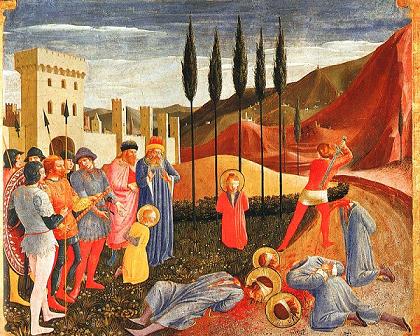
Feast Day of Saints Cosmas and Damian


The Martyrdom of Saints Cosmas and Damian, by Fra Angelico.

September 27 is the traditional* feast date of early Christian saints Cosmas and Damian.

Martyred in Syria during the Diocletian persecution, these Arabian brothers were reputedly physicians who did not charge their patients, even for premium services like transplanting an entire leg.


Cosmas and Damian graft an Ethiopian’s leg onto a white patient.

This has made them patron saints to doctors, surgeons, pharmacists, and dentists but decidedly not to insurers.

They were once much more widely known and revered than today, back when the mysteries of medicine and of faith intertwined with one another. The two are named in the Canon of the Mass, and multiple churches in Europe dubiously claim the honor the ancient doctors’ relics; their skulls alone reside simultaneously in Bremen, Vienna, and Madrid, while a church in Venice allegedly holds their non-cranial remains. Visitors to the Roman Forum will behold the beautifully preserved pagan Temple of Romulus, which was rededicated in 527 as the basilica of Santi Cosma de Damiano and still hosts weddings beneath its impressive Cosmas and Damian mosaic.

The saints’ day is observed in Brazil, where children on September 27 receive candies (Cosmas and Damian also count confectioners and children among their devotees). St. Anthony’s Church in Utica, New York, also hosts an annual Cosmas and Damian pilgrimage attracting thousands of people from across North America.

As two men intimate with one another who traveled and ministered together, they are sometimes speculatively ventured as early gay exemplars. (They’re traditionally accounted as brothers.)

* The Vatican’s 1969 calendar revision moved the feast to September 26, leaving September 27 to St. Vincent de Paul.

On this day..

1482: Richard Puller von Hohenburg and Anthony Mätzler


The Alsatian knight Richard Puller von Hohenburg and his servant, Anthony Mätzler, burned for sodomy at Zurich. From illustration in Die Grosse Burgunderchronik by Diebold Schilling de Altere, c. 1483.

On this day..

1589: Franz Seuboldt, broken parricide

We have had occasion to profile the famous Nuremberg executioner (and diarist) Franz Schmidt, who is the subject of a recent book on his life and times.

This date in 1589 marked one of executioner Schmidt’s more high-profile appearances. The occasion was the execution of parricide Franz Seuboldt, who killed his own father by ambush while dad was setting bird traps.

For this transgression, Seuboldt was condemned to be drawn through Nuremberg and “nipped” by the executioner’s red-hot tongs. With these, Franz Schmidt ripped bloody chunks of the murderer’s flesh. When at last they reached the “raven stone” execution platform outside Nuremberg’s sturdy walls, Schmidt stretched out his patient and set about methodically smashing his limbs with a heavy wooden “Catherine wheel”: “only” two limbs in Seuboldt’s case, before administering the coup de grace.

This broadsheet illustration traces the case in a U shape from crime (upper left) to tongs (foreground) to execution (right) and finally the mounted wheel.

Although reserved for more exceptional crimes than the everyday thefts that merited hanging, breaking on the wheel was a fairly common form of execution in Germany, France, and elsewhere in continental Europe for many, many years. Indeed, while the wheel would fade from the Nuremberg scene during the 17th century, the horrible device remained in (increasingly rare) use in France right up to the French Revolution.

On this day..

1774: John Reid, James Boswell’s first client

Though best known as the familiar and biographer of English writer Samuel Johnson,* James Boswell was educated as a lawyer.

His very first client was a fellow named John Reid, accused in 1766 of rustling 120 sheep from a Peebleshire farm. Boswell, clever lad, beat the charge,** and John Reid lived to shear again.

In 1774, Reid was accused again — and this time, all Boswell’s rhetorical genius could not save him: the Edinburgh Advertiser (Aug. 2, 1774) saluted the “masterly and pathetic manner” of Boswell’s summation, “which did him great honour both as a lawyer and as one who wished for a free and impartial trial by jury.”

It did not do John Reid the honour of an acquittal.

Even beaten in court, our libertine diarist went to extraordinary lengths to defend Reid; his personal passion for saving Reid’s life bleeds out of lengthy diary entries — 70-odd pages’ worth over the seven weeks from conviction to execution, quoted here from Boswell for the Defence. He strongly believed Reid innocent of the crime — that he had received the sheep apparently legitimately from a man named William Gardner, who was the real thief. (Gardner was transported for theft before Reid’s execution.)

Boswell worried at the Earl of Rochford, the Earl of Pembroke, the Earl of Suffolk, and the Duke of Queensberry with imprecations to intervene for a royal pardon. He found himself checked by the judge, equally determined to hang Reid: “The King was certainly disposed to transport, but the judge’s report was too strong,” Lord Pembroke wrote him afterwards. “Indeed, I never read anything more so, or so positive.”

Balked of royal mercy, Boswell even went so far as to lay plans to snatch Reid’s body immediately after hanging and have it whisked away for an attempted resuscitation. As a client, you can’t ask for more zealous representation than that. (Boswell was talked off the scheme only the day before the hanging.)

It is still true today that many death row attorneys give much more of themselves to their clients than mere legal scholarship, as they find themselves shepherding in the valley of death. Boswell met often with Reid, and Reid’s wife; he solicited family history, had Reid sit for a portrait, and bore the delicate burden of keeping Reid’s spirits up even while apprising him day by day of his ever darkening situation. When they spoke of making ready for death, Boswell found Reid much better possessed than was he himself.

The barrister’s diary entries for these days are among the longest and most anguished that Boswell ever wrote. (I have here elided from the September 20 entry a good deal of Boswell’s logistical preparations for, discussions with potential collaborators about, and grudging final resolution against, the mooted resurrection attempt.)

TUESDAY 20 SEPTEMBER. I was now more firmly impressed with a belief of John Reid’s innocence … I really believed he was condemned on insufficient evidence, and, from his solemn averments of his innocence, thought him not guilty of the crime for which he was condemned; such averments being in my opinion an overbalance not for positive, or even strong circumstantial, evidence, but for such evidence as was brought against him, which I thought could produce no more than suspicion.

When I came to the prison I found that John Reid’s wife and children were with him. The door of the iron room was now left open and they were allowed to go and come as they pleased. He was very composed. His daughter Janet was a girl about fifteen, his eldest son Benjamin about ten, his youngest son Daniel between two and three. It was a striking scene to see John on the last night of his life surrounded by his family. His wife and two eldest children behaved very quietly. It was really curious to see the young child Daniel, who knew nothing of the melancholy situation of his father, jumping upon him with great fondness, laughing and calling to him with vivacity. The contrast was remarkable between the father in chains and in gloom and the child quite free and frolicsome. John took him on his knee with affection.

WEDNESDAY 21 SEPTEMBER. John Reid’s wife called on me before breakfast and told me that Mrs. Walker said she was welcome to the best room in her house for the corpse; but that afterwards her landlord had sent to her that she must quit his house if she allowed such a thing. I said that there would be no occasion for any place. The mob would not trouble the corpse; and it might be put directly on the cart that she expected was to come for it. After breakfast Mr. Nasmith came, and was pleased to find that the scheme of recovery was given up … We walked backwards and forwards in the Grassmarket, looking at the gallows and talking of John Reid. Mr. Nasmith said he imagined he would yet confess; for his wife had said this morning that he had something to tell me which he had as yet told to no mortal.

We went to the prison about half an hour after twelve. He was now released from the iron about his leg. The Reverend Dr. Webster and Mr. Ritchie were with him. We waited in the hall along with his wife, who had white linen clothes with black ribbons in a bundle, ready to put on him before he should go out to execution. There was a deep settled grief in her countenance. She was resolved to attend him to the last; but Richard whispered me that the Magistrates had given orders that she should be detained in the prison till the execution was over. I dissuaded her from going and she agreed to take my advice; and then Richard told her the orders of the Magistrates. I said aloud I was glad to hear of it. The Reverend Dr. Macqueen, who afterwards came in, told her it would be a tempting of Providence to go; that it might affect her so as to render her incapable to take care of her fatherless children; and Mr. Ritchie said that the best thing she could do was to remain in the prison and pray for her husband. Dr. Macqueen said to me he was so much impressed with the poor man’s innocence that he had some difficulty whether he ought to attend the execution and authorize it by his presence. I said he certainly should attend, for it was legal; and, besides, supposing it ever so unjust, it was humane to attend an unhappy man in his last moments.

“But,” said Dr. Macqueen, “I will not pray for him as a guilty man.”

“You would be very much in the wrong to do so,” said I, “if you think him not guilty.” Dr. Webster and I had no conversation as he passed through the hall except inquiring at each other how we did.

John’s wife then went up to him for a little, having been told both by me and Mr. Nasmith that she could not hope for the blessing of Providence on her and her children if by her advice John went out of the world with a lie in his mouth. I followed in a little, and found him in his usual dress, standing at the window. I told him I understood he had something to mention to me. He said he would mention it. He had since his trial in 1766 stolen a few sheep (I think five), of which he never was suspected.

“John,” said I, “it gives me concern to find that even such a warning as you got then did not prevent you from stealing. I really imagine that if you had now got off you might again have been guilty, such influence has Satan over you.” He said he did not know but he might. Then I observed that his untimely death might be a mercy to him, as he had time for repentance. He seemed to admit that it might be so. He said that what he had now told me he had not mentioned even to his wife; and I might let it rest. I called up Mr. Nasmith, with whom came Mr. Ritchie. I said he might acknowledge this fact to them, which he did. I asked him, if I saw it proper to mention it as making his denial of the theft for which he was condemned more probable, I might be at liberty to do so? He said I might dispose of it as I thought proper. But he persisted in denying the theft for which he was condemned. He now began to put on his white dress, and we left him.

Some time after, his wife came down and begged that we would go up to him, that he might not be alone. Dress has a wonderful impression on the fancy. I was not much affected when I saw him this morning in his usual dress. But now he was all in white, with a high nightcap on, and he appeared much taller, and upon the whole struck me with a kind of tremor. He was praying; but stopped when we came in. I bid him not be disturbed, but go on with his devotions. He did so, and prayed with decent fervency, while his wife, Mr. Nasmith, and I stood close around him.

He prayed in particular, “Grant, Lord, through the merits of my Saviour, that this the day of my death may be the day of my birth unto life eternal.” Poor man, I felt now a kind of regard for him. He said calmly, “I think I’ll be in eternity in about an hour.” His wife said something from which he saw that she was not to attend him to his execution; and he said, “So you’re no to be wi’ me.” I satisfied him that it was right she should not go.

I said, “I suppose, John, you know that the executioner is down in the hall.” He said no. I told him that he was there and would tie his arms before he went out.

“Ay,” said his wife, “to keep him from catching at the tow [rope].”

“Yes,” said I, “that it may he easier for him.” John said he would submit to everything.

I once more conjured him to tell the truth. “John,” said I, “you must excuse me for still entertaining some doubt, as you know you have formerly deceived me in some particulars. I have done more for you in this world than ever was done for any man in your circumstances. I beseech you let me be of some use to you for the next world. Consider what a shocking thing it is to go out of the world with a lie in your mouth. How can you expect mercy, if you are in rebellion against the GOD of truth?” I thus pressed him; and while he stood in his dead clothes, on the very brink of the grave, with his knees knocking together, partly from the cold occasioned by his linen clothes, partly from an awful apprehension of death, he most solemnly averred that what he had told concerning the present alleged crime was the truth. Before this, I had at Mr. Ritchie’s desire read over his last speech to him, which was rather an irksome task as it was very long; and he said it was all right except some immaterial circumstance about his meeting Wilson with the six score of sheep. Vulgar minds, and indeed all minds, will be more struck with some unusual thought than with the most awful consideration which they have often heard.

I tried John thus: “We are all mortal. Our life is uncertain. I may perhaps die in a week hence. Now, John, consider how terrible it would be if I should come into the other world and find” (looking him steadfastly in the face) “that you have been imposing on me.” He was roused by this, but still persisted. “Then,” said I, “John, I shall trouble you no more upon this head. I believe you. GOD forbid that I should not believe the word of a fellow man in your awful situation, when there is no strong evidence against it, as I should hope to be believed myself in the same situation. But remember, John, it is trusting to you that I believe. It is between GOD and your own conscience if you have told the truth; and you should not allow me to believe if it is not true.” He adhered.

I asked him if he had anything more to tell. He said he had been guilty of one other act of sheep-stealing. I think he said of seven sheep; but I think he did not mention precisely when. As he shivered, his wife took off her green cloth cloak and threw it about his shoulders. It was curious to see such care taken to keep from a little cold one who was so soon to be violently put to death. He desired she might think no more of him, and let his children push their way in the world.

“The eldest boy,” said he, “is reading very well. Take care that he reads the word of GOD.” He desired her to keep a New Testament and a psalm-book which he had got in a present from Mr. Ritchie and which he was to take with him to the scaffold. He was quite sensible and judicious. He had written a kind of circular letter to all his friends on whom he could depend, begging them to be kind to his family.

Two o’clock struck.

I said, with a solemn tone, “There’s two o’clock.” In a little Richard came up. The sound of his feet on the stair struck me. He said calmly, “Will you come awa now?” This was a striking period. John said yes, and readily prepared to go down. Mr. Nasmith and I went down a little before him. A pretty, well-dressed young woman and her maid were in a small closet off the hall; and a number of prisoners formed a kind of audience, being placed as spectators in a sort of loft looking down to the hall.

There was a dead silence, all waiting to see the dying man appear. The sound of his steps coming down the stair affected me like what one fancies to be the impression of a supernatural grave noise before any solemn event.

When he stepped into the hall, it was quite the appearance of a ghost. The hangman, who was in a small room off the hall, then came forth. He took off his hat and made a low bow to the prisoner. John bowed his head towards him. They stood looking at each other with an awkward uneasy attention. I interfered, and said, “John, you are to have no resentment against this poor man. He only does his duty.” “I only do my duty,” repeated the hangman. “I have no resentment against him,” said John. “I desire to forgive all mankind.” “Well, John,” said I, “you are leaving the world with a very proper disposition: forgiving as you hope to be forgiven.” I forgot to mention that before he left the iron room Mr. Ritchie said to him, “Our merciful King was hindered from pardoning you by a representation against you; but you are going before the King of Heaven, who knows all things and whose mercy cannot be prevented by any representation.”

The hangman advanced and pinioned him, as the phrase is; that is, tied his arms with a small cord. John stood quiet and undisturbed. I said, “Richard, give him another glass of wine.” Captain Fraser, the gaoler, had sent him the night before a bottle of claret, part of which Richard had given him, warmed with sugar, early in the morning, two glasses of it in the forenoon, and now he gave him another. John drank to us.

He then paused a little, then kissed his wife with a sad adieu, then Mr. Ritchie kissed him. I then took him by the hand with both mine, saying, “John, it is not yet too late. If you have any thing to acknowledge, do it at the last to the reverend gentlemen, Dr. Macqueen and Dr. Dick, to whom you are much obliged. Farewell, and I pray GOD may be merciful to you.” He seemed faint and deep in thought. The prison door then opened and he stepped away with the hangman behind him, and the door was instantly shut His wife then cried, “O Richard, let me up,” and got to the window and looked earnestly out till he was out of sight. Mr. Nasmith and I went to a window more to the west, and saw him stalking forward in the gloomy procession.

I then desired his wife to retire and pray that he might be supported in this his hour of trial. Captain Fraser gave her four shillings. It was very agreeable to see such humanity in the gaoler, and indeed the tenderness with which the last hours of a convict were soothed pleased me much.

The mob were gone from the prison door in a moment. Mr. Nasmith and I walked through the Parliament Close, down the Back Stairs and up the Cowgate, both of us satisfied of John Reid’s innocence, and Mr. Nasmith observing the littleness of human justice, that could not reach a man for the crimes which he committed but punished him for what he did not commit.

We got to the place of execution about the time that the procession did. We would not go upon the scaffold nor be seen by John, lest it should be thought that we prevented him from confessing. It was a fine day. The sun shone bright. We stood close to the scaffold on the south side between two of the Town Guard. There were fewer people present than upon any such occasion that I ever saw. He behaved with great calmness and piety. Just as he was going to mount the ladder, he desired to see his wife and children; but was told they were taken care of. There was his sister and his daughter near to the gibbet, but they were removed. Dr. Dick asked him if what he had said was the truth. He said it was. Just as he was going off, he made an attempt to speak. Somebody on the scaffold called, “Pull up his cap.” The executioner did so. He then said, “Take warning. Mine is an unjust sentence.” Then his cap was pulled down and he went off. He catched the ladder; but soon quitted his hold. To me it sounded as if he said, “just sentence”; and the people were divided, some crying, “He says his sentence is just.” Some: “No. He says unjust.” Mr. Laing, clerk to Mr. Tait, one of the town clerks, put me out of doubt, by telling me he had asked the executioner, who said it was unjust. I was not at all shocked with this execution at the time. John died seemingly without much pain. He was effectually hanged, the rope having fixed upon his neck very firmly, and he was allowed to hang near three quarters of an hour; so that any attempt to recover him would have been in vain. I comforted myself in thinking that by giving up the scheme I had avoided much anxiety and uneasiness.

We waited till he was cut down; and then walked to the Greyfriars Churchyard, in the office of which his corpse was deposited by porters whom Mr. Nasmith and I paid, no cart having come for his body. A considerable mob gathered about the office. Mr. Nasmith went to Hutchinson’s to bespeak some dinner and write a note to The Courant that there would be a paragraph tonight giving an account of the execution; for we agreed that a recent account would make a strong impression.

I walked seriously backwards and forwards a considerable time in the churchyard waiting for John Reid’s wife coming, that I might resign the corpse to her charge. I at last wearied, and then went to the office of the prison. There I asked the executioner myself what had passed. He told me that John first spoke to him on the ladder and said he suffered wrongfully; and then called to the people that his sentence was unjust. John’s sister came here, and returned me many thanks for what I had done for her brother. She was for burying him in the Greyfriars Churchyard, since no cart had come. “No,” said I, “the will of the dead shall be fulfilled. He was anxious to be laid in his own burying-place, and it shall be done.”

I then desired Richard to see if he could get a cart to hire, and bid him bring John’s wife to Hutchinson’s. Mr. Nasmith and I eat some cold beef and cold fowl and drank some port, and then I wrote a paragraph to be inserted in the newspapers. Mr. Nasmith threw in a few words. I made two copies of it, and, both to the printer of The Courant and Mercury, subjoined my name to be kept as the authority. Richard brought John’s wife and daughter. “Well,” said I, “Mrs. Reid, I have the satisfaction to tell you that your husband behaved as well as we could wish.” “And that is a great satisfaction,” said she. We made her eat a little and take a glass, but she was, though not violently or very tenderly affected, in a kind of dull grief. The girl did not seem moved. She eat heartily.

I told Mrs. Reid that I insisted that John should be buried at home; and as I found that as yet no carter would undertake to go but at an extravagant price, the corpse might lie till tomorrow night, and then perhaps a reasonable carter might be had.

Mr. Nasmith went to The Courant with the paragraph, and I to The Mercury. I sat till it was printed. It was liberal in Robertson, who was himself one of the jury, to admit it; and he corrected the press.

It was now about eight in the evening, and gloom came upon me. I went home and found my wife no comforter, as she thought I had carried my zeal for John too far, might hurt my own character and interest by it, and as she thought him guilty.† I was so affrighted that I started every now and then and durst hardly rise from my chair at the fireside. I sent for Grange, but he was not at home. I however got Dr. Webster, who came and supped, and he and I drank a bottle of claret. But still I was quite dismal.

Boswell spent several days more in resolving affairs, both pragmatic and psychological. For his own part the latter entailed reconciling to the reality of what has occurred, and regaining an equilibrium with friends and colleagues who doubted Reid’s innocence (and/or played some part in Reid’s conviction).

Boswell was around the midpoint of his manhood at 33 years of age, with two more decades ahead to make a glorious mark. But on September 21, 1774, John Reid’s story was done.

“After this defeat, though he would labor at the law for many years more, Boswell made a critical emotional swerve,” writes Gordon Turnbull — away from law and towards the literary exertions that define him for posterity. “Part of Boswell died with Reid: it was defeat in this cause which, in Frank Brady’s words, ‘crystallized his distaste for the Scottish bar’ and ‘destroyed his momentum as a lawyer.'”

* Among other things, Dr. Johnson bequeathed us the aphorism that “when a man knows he is to be hanged in a fortnight, it concentrates his mind wonderfully.” When Johnson said it, it concerned a real person whose hanging was really imminent … and it was a 100% bullshit cover story for a faked enhancement of mental faculties said man had not, in fact, evinced.

** Boswell’s friend and fellow Scottish Enlightenment big wheel Andrew Crosbie helped in the 1766 Reid case … but not the 1774 one.

† With a defter feel for the diplomatic considerations Boswell had ignored in his exertions, the barrister’s wife reminded him a few days afterwards “that John Reid was now gone, but that his jury, fifteen men upon oath, were alive. By my speaking strongly of the injustice of the sentence, I did John no good and in some measure attacked them.” She quoted him a passage from John Home’s tragedy Douglas:

The living claim some duty; vainly thou
Bestow’st thy care upon the silent dead.

On this day..

1685: Krystof Alois Lautner, Witch Hammer victim

On this date in 1685, Catholic priest Kryštof* Alois Lautner was degraded from the clergy and burnt at the stake as a sorcer — but his real crime was standing athwart a witch hunt.

The term “witch craze” doesn’t quite seem the just one for the Northern Moravian witch trials since they spanned 18 terribly systematic years until the gouty main inquisitor mercifully retired in 1696, having put about 100 people to the sword and stake.

Generally understood in the context of Catholic hostility to reform denominations on the soil of the present-day Czech Republic, this dreadful affair started when a Vernirovice woman was caught sneaking the Host out of Easter Mass in 1678, intending to use it as a charm for a folk spell to enhance the fertility of her cows.

By 1679, that woman was burned at the stake — along with two others whom she was induced to accuse by the threat of torture.

These executions were the fruit of a witchcraft commission that had been empaneled to pursue the original desecration of the communion bread, but now that the witch team was an institution it began finding more and more necromancers, in a self-justifying spiral of accusations.

Lautner, a well-liked deacon of Sumperk, spoke against the witch hunt when it came to that city and for his pains he was arrested there in 1680 … then leisurely broken by torture over a period of four years until he was at last undone by accusations wrenched from the torture of the wealthy Sattler family. (Whose valuables the commission did not neglect to appropriate.) It was standard witchcraft fare: black sabbaths, incestuous orgies, pacts with Satan.

“Milder tortures were used against him initially” the records say. “But those he admirably resisted, and remained obdurate. Then came harsher steps. Lautner began to confess, but when he was removed from the devices he recanted his admissions. So he was put to torture again and again, to defeat the devil’s secrecy. He was interrogated in June 1684 — twelve days in a row, except Sunday.” The case progressed so deliberately in part because the prosecution of a clergyman required the signoff of church heirarchy** … and in part because Lautner’s own friends intervened to try to free him. (One such ally, the priest Tomáš König, wrote a letter to the bishop on Lautner’s behalf and thereby became an object for investigation himself; it’s thought that he was about to be arrested by the witchsmellers when he fortuitously died in 1682.)

In the end the cleric could not hope to withstand the pressure. 20,000 people are reported to have swelled Sumperk for his execution by fire.

His case — which has latterly been commemorated by public monuments celebrating Lautner as a hero of conscience — was dramatized in the historical novel Witch Hammer by Vaclav Kaplicki. Otakar Vavry adapted the story for the silver screen; Kladivo na Carodejnice is available online in its entirety, but you’ll need to be up on your Czech.

* Hacek courtesy of Jan Hus!

** Pope Innocent XI ultimately signed off on proceedings, on the sententious grounds that clergy can’t be above the law when they traffic with devils.

On this day..

1783: William Wynne Ryland, court engraver

On this date in 1783, British engraver William Wynne Ryland hanged at Tyburn* before a throng of gallows-voyeurs such as “had not been seen on a like occasion since the execution of Dr. Dodd.” (Morning Chronicle and London Advertiser, Aug. 30, 1783)

“[H]is evil genius prompted him, for gold, to debase his talents in engraving,” the Newgate Calendar opined. “By one fatal act, he entirely ruined his reputation as a man: but his name as an artist will ever stand in the highest estimation.”

French- and Italian-trained, Ryland was a premier court artist in his day, noted for importing stipple engraving from the continent to England. He earned a royal pension for his portraits of Hanoverian elites.


Some Ryland portraiture, from the National Portrait Gallery: King George III and his queen, Sophia Charlotte.

Although Ryland’s first attempt to parlay his draftsmanship into a print-selling business had gone bankrupt in 1771, he does not seem to have been entirely neglected by the muse of business acumen, either. Over the subsequent decade he had discharged all his previous debts and stockpiled assets to the amount of £10,000. “I am rich beyond temptation,” he protested to the jurors who tried him for his life. The Crown could produce little in the way of an immediate motive for the forgery. (“It is impossible for us to penetrate so far into the heart of man as to know what his inducements are.”)

But lucre is its own motivation, and the facts of the case weighed heavily against Ryland.

He had come into (legitimate) possession of £200 bill of exchange issued by the East India Company and dated October 5, 1780. Somehow it transpired that Ryland then exchanged two copies of this bill — one on September 19, 1782 with the banker Sir Charles Asgill, and then once again on November 4, 1782 to a banking firm with the Dickensian name of Ransom & Co.

Both bills were identical to every inspection, with the same amount, date, and cheque number, and Ryland the expert engraver could give no convincing account of the second note’s provenance. In the public’s mind, the fact that he had fled the indictment and then dramatically attempted suicide when his capture was imminent surely cinched the case.

Ryland’s attempts to inspire in the jurors a sufficient doubt as to whether the East India Company might not have accidentally circulated two identical bills was fatally undone when it turned out that a difference between the two bills could be found after all — by the paper manufacturer, who proved to the court that the second bill was inscribed on paper whose watermark established that did not exist on its purported date of issue.

this sheet of paper was made at the mill, on that particular mould, it has a defect on it; on the 21st of January, 1782, of the same mould of which this note is now shewn me, I made this sheet of paper; there is a defect of the mould, either by an injury it has received, or in consequence of the quantity of paper made on it, the bill has the same defect; and there is likewise a defect which the bill has not, so that the sheet of paper on which the bill was written, was made from that mould. This could not happen in the same places, and situations in any two moulds.

The jury needed only half an hour to convict him.

By the Morning Chronicle and London Advertiser‘s account, he was London’s star attraction on his hanging day.

At half past nine a man on the steps of newgate called out, “Mr. Ryland’s coach,” upon which a mourning-coach, that was standing opposite the Sessions-house, drew up to the door of the prison, and in about two minutes after the unhappy man walked down the steps at a brisk pace, and entered the vehicle; presently after which [fellow condemned prisoner John] Lloyd went into another mourning coach. The Ordinary of Newgate, another clergyman, a gentleman in mourning, (said to be a relation of he convict’s) and a sheriff’s Officer, went in the coach with Mr. Ryland …

These coaches, which immediately followed the Sheriffs’ carriages, having drawn a few yards from the door of the prison, two carts were drawn up; [James] Brown, [Thomas] Burgess, and [John] Edwards were tied in the first, as was [James] Rivers in the last cart …

The gallows was fixed about 50 yards nearer the park wall than usual. About five minutes before 11 o’clock, Ryland’s coach drew on the right of the gallows, as did Lloyd’s on the left; and between them the cart; soon after which a violent storm of thunder, lightning, and rain came on, when the Sheriffs gave orders for a delay of the execution. When the storm had subsided, and some time had been employed in prayer, Rivers was lifted from one into the other cart, which backing to Lloyd’s coach, he alighted therefrom, and entered the vehicle, and after the ropes had been fixed about the necks of these unfortunate men, Ryland stepped from the coach to join his unhappy fellow sufferers. After a conversation of at least ten minutes between Ryland and Mr. Villette, Ordinary of Newgate, and the same time employed in an earnest discourse between Lloyd and Burgess, all the malefactors joined in singing the hymn, called, “The Sinners Lamentation”


Editor’s note: I’m not certain whether this is the hymn alluded to.

Ryland was the object that attracted the general attention, from Newgate to Tyburn, the sound that reverberated from every quarter, amidst the immense multitude was, “Which is ryland? There, that is Ryland in the first coach!” Exclusive of the usual accommodations, a vast number of temporary stages were erected; and gentlemens and hired carriages were innumerable. Some rooms, for accommodating private companies, were actually let at the enormous rate of from six to ten guineas.

Notwithstanding the vast press of the crowd, amidst the astonishing number of horsemen, carriages, and people on foot, we have not heard that any body was materially hurt, though many were forced down and trod on.

Ryland was in mourning, and wore a tail wig … Through the whole of this trying scene [he] conducted himself with remarkable serenity and fortitude, strongly indicating that he was prepared for, and perfectly reconciled to his fate.

The wheel of fortune turning against the mighty — especially when they should hazard their lives for a needless pittance — being irresistible to other artists, Ryland is the title character of a a comedic play.

* One of the very last hangings at Tyburn.

On this day..

1648: Sir Charles Lucas and Sir George Lisle, royalists

The Death of Sir Charles Lucas and Sir George Lisle, Monday, Aug. 28, 1648

By the old wall at Colchester,
With moss and grass o’ergrown,
The curious, thoughtful wanderer
Will note a small, white stone.
Tis sunken now — yet slight it not;
That stone can speak, and tell
A tale of blood; it marks the spot
Where Lisle and Lucas fell.

On earth there is no abject thing
So abject as a fallen king.
And Charles, despoiled, cashiered, discrowned,
In his own halls a captive bound,
Spurned, crushed by countless ills forlorn,
Drinks to the dregs the cup of scorn.

Yet in that hour of blank despair,
Lisle, Lucas, Capel, Compton dare
Their wrecks of shattered strength to call
To Colchester’s beleaguered wall;
Round Charles, in hope ‘gainst hope to cling
Proclaim, e’en yet, that Charles is king;
And one more mighty effort try
For honour, love, and loyalty.

Vain all the dauntless venture — vain
Their valour, piety, and pain.
Who in the field the foe repels
Grim Famine in the city quells.
The soldier, gaunt and staggering, crawls
From post to post along the walls;
With leaden eyes the townsmen meet,
Like spectres, in the howling street.
No bread within — without, the foe —
No friend, no succour nigh —
The leaguer closer drawn — they know
They needs must yield, or die.

They yield — and Fairfax, bloody heart!
Ere yet the shades of evening part,
Dooms to a sudden, felon grave
Lisle, Lucas, bravest of the brave;
And Ireton, in exultant glee,
Hastes on the murderous tragedy.

“Haste on the murderous tragedy!
Nor let them live another night,
Nor mother, sister, brother see;
Nor give them space to order right
Their souls to meet their Maker’s sight!”

One hour — brief respite! So to prayer,
Last refuge of the soul, they went —
To prayer, and blessed Sacrament;
And then rose up, refreshed, to bear
Whate’er of added scorn or sting
The circumstance of death might bring.

“Lead Lucas forth!” Forth Lucas came,
And on the files of musqueteers
Smiled as in scorn; in step and frame
No trembling, and in soul no fears.
But, as from fields of carnage wet,
He oft had marched to victory,
Though vanquished, fettered, doomed to die,
He stands the victor-hero yet;
And cried, “In battle’s stern embrace
Oft I and death met face to face;
See now in death I death defy,
And mark how Lucas dares to die.”

He bowed his knees a little space,
With clasped hands, and eyes lift up;
And craved of Jesu parting grace
To sweeten pain’s last bitter cup;
Then laid his bosom bare, and cried,
“I’m ready: rebels, do your worst;”
Fell on his face, and groaned, and died,
Pierced with four savage wounds accurst.

“Haste on the murderous tragedy!
Yea, howl aloud for victims more;
And with remorseless butchery,
Let Lisle be bathed in Lucas’ gore.”

He treads the stage of death, his eye
Glancing defiance round —
He sees his brother’s body lie
Stretched on the bloody ground.
Tis more than e’en a Lisle can bear —
The mighty heart gives way;
He weeps amain, and kneeling there
Beside his dead, in love’s despair
Kisses the lifeless clay;
And sobs his requiem: “Oh, my friend,
My brother, thou hast reached thy goal!
Christ is thy rest — Christ me defend;
My spirit with thy spirit blend,
Thou peerless and unspotted soul!”

Then stands erect, the anguish past;
And marks in lines the levelled gun —
“Come nearer, men.” “Nay,” answered one,
“Fear not, good Sir, we’ll hit you fast.”
“Ah!” cried the warrior, “oft in fight
Nearer to me than now ye came;
In field and fort, by day and night
I met you, and ye missed your aim.
And oh, how oft as well ye know,
In hottest blood and deadliest strife,
I checked my hand, and spared the blow,
And sheathed my sword, and gave you life.
I die content; my God shall bring
Grace for my soul’s anneal;
I die for faith, for Charles my King,
And for my country’s weal.”

With invocations loud and deep
On Jesu’s blessed name.
E’en as he prayed, he fell asleep
When the death-volley came.
Where Lucas fell, there Lisle lay dead —
They slept on one same gory bed.
One in their common death; in life
One in the same dread, glorious strife;
As one to live in honour high,
So one in mighty heart to die.
One grave contains the sacred dead —
Go, ponder there awhile;
Then say with pride, “My country bred
A Lucas and a Lisle.”

On this day..