Johann Christian Woyzeck was publicly beheaded on this date in 1824 for fatally daggering his lover in a jealous wrath.
He was a rudderless orphan to whom the Napoleonic Wars gifted the stopgap profession of soldiering, but once the fighting stopped, Woyzeck wandered back to his native Leipzig and gave rein to his many vices.
Suicidal, drinking heavily, and unable to hold down steady work, Woyzeck frequently abused his special lady friend, the widow Johanna Christiane Woost. He would later say that he was often urged by voices in his mind to slay her — and on the night of June 21, 1821, after she canceled a rendezvous, he did so at last.
A pathetic exit from life turned out to be an entrance into judicial and literary history.
There was no question but that Woyzeck’s hand had taken Woost’s life, but proceedings against the killer dragged on for three years as courts vacillated on his mental competence. Woyzeck had been wildly depressed and owned to hallucinations and unbalanced moods that his contemporaries could readily recognize as falling near the pall of madness.
Nevertheless, Woyzeck had initially been slated for execution in November 1822 based on the evaluation of celebrated Leipzig physician Johann Christian August Clarus, but another doctor — academics will recognize the irksome intervention of reviewer no. 2 here — horned in with a missive questioning the conclusion.
That stay invited an 11th-hour stay and five more examinations worth of billable hours for Dr. Clarus, who studied up his man again and came to the same conclusion: that Woyzeck, though disturbed, was cogent enough to bear responsibility for his actions. It was in the end by this verdict that the executioner’s sword-arm swung.
The lost soul’s end on a Leipzig scaffold on this date would eventually inspire the writer Georg Buchner to pen the play Woyzeck. Though left unfinished when Buchner died young, the play has been frequently staged down to the present day, and even adapted for the silver screen by Werner Herzog:
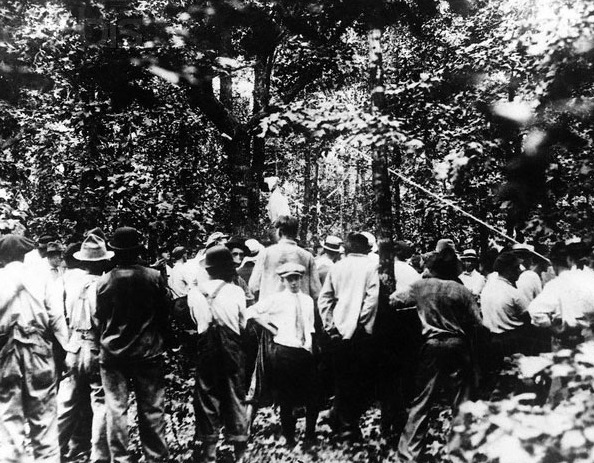
One hundred years ago today, Leo M. Frank was lynched to an oak tree at Marietta — one of the most notorious mob murders in American history.
Methodically extracted hours before from the Midgeville State Penitentiary by an Ocean’s Eleven-style team of coordinated professionals, Frank’s murder was as shocking in 1915 as it reads in retrospect.
The well-heeled Jewish Yankee was factory superintendent at the National Pencil Company in Atlanta when a 13-year-old girl in his employ was discovered in the factory’s basement — throttled and apparently raped. That was in 1913; for the ensuing two years, the prosecution of Mary Phagan’s boss as her murderer would play out in sensational press coverage.
Frank is today widely thought innocent of the crime, although the Georgia Board of Pardons and Paroles has balked at issuing an unconditional pardon since so little of the original evidence survives. (A 1986 pardon came down “without attempting to address the question of guilt or innocence” in recognition of the slanted trial and the failure to protect Frank from lynchers.) But this was much more than a courtroom drama; the Frank affair crackles with the social tensions of early 20th century America. Industry and labor; integration; sexual violation; sectional politics; race and class and power.
Populist Party politician Thomas E. Watson, whose magazines made a dishonorable intervention by openly agitating for (and then celebrating) Frank’s lynching, captures the Zeitgeist for us as he fulminates against the nationwide campaign to grant the convicted murderer a new trial: “Frank belongs to the Jewish aristocracy, and it was determined by the rich Jews that no aristocrat of their race should die for the death of a working-class Gentile.” Frank came to enjoy (if that’s the right word) the editorial support of most of the country’s major papers, but the meddling of northern publishers, and of fellow Jews in solidarity,* arguably led Georgians to circle wagons in response. Present-day Muslims called upon to disavow every bad act by every other Muslim would surely recognize this no-win position.
But then we must also add that Watson himself, a lawyer, had been approached by Frank’s defense team hoping to enlist his bombast to defend their man at trial. The white supremacist demagogue would have been perfect for the job, for the legal battle pitted the credibility of a black janitor named Jim Conley against that of Frank.
Here amid the nadir of American race relations Frank’s team made its own ugly and unsuccessful pitch for racial solidarity with his neighbors. When formulaically asked by the court that had convicted him for any statement to mitigate the impending sentence, Frank replied that
my execution will make the advent of a new era in Georgia, where a good name and stainless honor count for naught against the word of a vile criminal; where the testimony of Southern white women of unimpeachable character is branded as false by the prosecution, disregarded by the jury and the perjured vaporings of a black brute alone accepted as the whole truth.
This violent collision of two vulnerable minorities each with the keen sense that one or the other of them was being outfitted for WASP America’s nooses makes for riveting and sometimes bizarre reading. Newspapers could hardly fail to note that the all-white jury (Leo Frank’s defense team struck all the blacks) had, as Frank complained, privileged the account of just the sort of “black brute” that Southern courts were accustomed to scorn, or railroad. Thus we have the NAACP organ The Crisis taking umbrage that “Atlanta tried to lynch a Negro for the alleged murder of a young white girl” but “a white degenerate has now been indicted for the crime.” It was likewise reasoned by some that since Conley was a young black man with a criminal record who was a potential suspect in the Deep South in the murderous sexual assault of a little white girl, “the mere fact that Conley did not long ago make his exit from this terrestrial sphere, via a chariot of fire is convincing proof that he, at least, is not the man who committed the deed.”** (New York Age, Oct. 29, 1914.)
In the end it was a zero-sum game between Jim Conley and Leo Frank: one of them was the murderer; each accused the other. Their respective desperate interests permeated to their respective communities. After Frank’s lynching, hundreds of Jews left Georgia; many who remained took pains to downplay their Jewishness.
By whatever circumstance police zeroed on Frank and the white community’s passion followed — tunnel vision that would eventually manifest itself in a circus courtroom atmosphere where the prosecuting attorney was cheered and defense witnesses hooted at and the ultimate outcome more demanded than anticipated. The judge feared that an acquittal would result in the summary lynching of not only Frank but his defenders.
Unusually for the time, appeals on the case reached the U.S. Supreme Court which declined to intervene — although two justices filed a dissent citing the egregious trial atmosphere.
Mob law does not become due process of law by securing the assent of a terrorized jury …
This is not a matter for polite presumptions; we must look facts in the face. Any judge who has sat with juries knows that in spite of forms they are extremely likely to be impregnated by the environing atmosphere … we think the presumption overwhelming that the jury responded to the passions of the mob …
lynch law [is] as little valid when practiced by a regularly drawn jury as when administered by one elected by a mob intent on death.
But that mob would still have its say. On the eve of Frank’s scheduled June 22, 1915 hanging, outgoing governor John Slatoncommuted the sentence.
“Feeling as I do about this case, I would be a murderer if I allowed this man to hang,” the governor said. “It may mean that I must live in obscurity the rest of my days, but I would rather be plowing in a field than feel for the rest of my days that I had this man’s blood on my hands.”†
Frank was spirited away to the penitentiary under cover of darkness; it was hoped that the remote and reinforced edifice would deter any reprisal. It turned out that the furies who hunted Franks could not be dissuaded by mere inconvenience: a committee calling itself the Knights of Mary Phagan formed with the open object of organizing the intended mob vengeance — and indeed it was almost superseded in July of that year by a fellow-prisoner who slashed Frank’s throat as he slept.
Frank survived that murder attempt only to await the next one. Who knows what fancies frequented him in those weeks when he ducked from the shadow of the gallows to that of the lynching-tree, object of pity or hatred. He had time on the last day to savor his impending fate when the Knights methodically cut their way into the penitentiary — snipping the phone wires and disabling the vehicles — and marched their man out with nary a shot fired. Then, a convoy of automobiles “sped” (at 18 miles per hour) all the way back to a prepared execution-site at Marietta. The drive took seven or eight hours over unpaved country lanes, and for every moment of it Frank surely knew how it would end.
As a contrasting response, the American Jewish Committee declined to participate in the Frank campaign for fear of lending counterproductive credence to charges such as those voiced by the New York Sun (Oct. 12, 1913):
The anti-Semitic feeling was the natural result of the belief that the Jews had banded to free Frank, innocent or guilty. The supposed solidarity of the Jews for Frank, even if he was guilty, caused a Gentile solidarity against him.
** Maurianne Davis’s Strangers and Neighbors: Relations between Blacks and Jews in the United States has a trove of interesting editorial comment from Frank’s contemporaries in the black press, and the Jewish press. Conley was actually the confessed accessory, and served a year in prison for it: he said that he complied with Frank’s order to hide the body for fear that his “white” boss could easily get Conley lynched for the crime. Conley also wrote (under Frank’s directive, he said) the preposterous “murder notes” found with the body that purported to be Mary Phagan’s dying indictment of Newt Lee, the African-American night watchman.
† The allusion to political suicide suggests Slaton’s mind was on the precedent of Illinois Gov. John Altgeld, whose career was destroyed by pardoning some of the Haymarket anarchists. If so, Slaton was quite correct; he actually had to flee Georgia altogether and could not return to the state for more than a decade.
July 20, 1934 was the third and last of Walter Lett’s scheduled execution dates for raping a white woman in Monroeville, Alabama.
A thirty-something ex-convict, Lett’s protestations of innocence stood little chance against the word of a white woman named Naomi Lowery, herself a penniless drifter.
Lett was almost lynched but despite his certain condemnation there was something wrong about this case — something discomfiting even for Monroeville’s worthies. We have seen elsewhere in these pages that a rape accusation was a powerful weapon on the ambiguous fringes of the color line. Just three years before this story, nine black teens had been accused of a rape on an Alabama train, and the legal odyssey of these Scottsboro Boys would dominate headlines during the Depression.
“It may have been that [Lett] and Lowery were lovers, or that she was involved with another Negro man,” one author put it. “If a white woman became pregnant under those circumstances, it was not uncommon for her to claim rape, or accuse someone other than her lover.”
Records of this trial seem to have gone missing, but Lett’s claims had enough weight (and Lowery’s had little enough) to induce Monroeville’s elders to petition Gov. Benjamin Miller* against carrying out the electrocution. Miller reprieved Lett ahead of May 11 and June 20 execution dates: “I am of the opinion and conviction that there is much doubt as to the man being guilty,” Miller told the Montgomery Advertiser. Gov. Miller was so sure that Lett didn’t do it that before the man went to the chair on July 20, Miller decided instead to let him spend the rest of his life in prison for the thing he didn’t do.
We don’t have Walter Lett’s side of this story because the strain of his position drove him mad; when the sentence was commuted, he was transported from death row directly to a mental hospital, where he died of tuberculosis in 1937.
In his stead, we have a different voice: a Monroeville schoolgirl at the time of Lett’s trial named Harper Lee** would later channel the case’s undertones of racial injustice for her legendary (and, until recently, only) novel, To Kill a Mockingbird.
In one of the famously retiring Lee’s few public comments on the book, she cited the Lett case as her model for the book’s fictional, and manifestly unjust, rape trial.
Lee’s father, A.C. Lee was the editor-publisher of the Monroeville Journal at the time of l’affaire Lett. But as a young lawyer, before Harper’s birth, Lee himself had once defended in court two men who wound up being hanged. An idealized† version of this man is the clear foundation for the defense attorney Atticus Finch in Lee’s book.
Charles Shields, whose 2006 biography of Harper Lee is quoted above on the indeterminate reason for the rape allegation, writes that the author “had a free hand to retell this macabre episode in her father’s life, which he always referred to in vague terms, no doubt because of the pain it caused him. (He never accepted another criminal case.) This time, under his daughter’s sensitive hand, A. C. Lee, in the character of Atticus Finch, could be made to argue in defense of Walter Lett, and his virtues as a humane, fair minded man would be honored.”
* Miller was an anti-Ku Klux Klan politician, a fact of possible relevance to his actions.
** Harper Lee’s childhood friend was Truman Capote, future author of In Cold Blood. (Lee traveled to Kansas with Capote and helped him research the murder case in question.) Alabama’s legislature has recognized Monroeville as the state’s literary capital.
† According to Shields, the real A.C. Lee was more of a gentleman, establishment segregationist: more like the warts-and-all Atticus Finch of Lee’s Go Set a Watchman than the saintly character played by Gregory Peck. In 1952-53, A.C. Lee helped to force out the pastor of the local First Methodist church over controversial pro-integration remarks from the pulpit. Rev. Ray Whatley’s post-Monroeville assignment took him to Montgomery, where he was president of a chapter of the Alabama Council on Human Relations while the young Rev. Martin Luther King was vice-president. Whatley was forced out of his Montgomery congregation, too: called “a liar, a communist, and a few other things” (Whatley’s words) for supporting the Montgomery Bus Boycott. They tried to reassign him to tiny Linden, Alabama, but townspeople there immediately rejected him and many stopped paying church tithes until he was shipped onward to Mobile.
See When the Church Bell Rang Racist by Donald Collins, who notes that Whatley’s anathema had a chilling effect on other white Methodist clergy — now clearly given to understand that there would be “a great price to be paid if a minister chose to speak out for racial justice.”
On this date in 1865, the Japanese samurai Okada Izo was dispatched by crucifixion.
He was one of* the “Four Hitokiri“ — manslayers — whose legendary blades coruscated in the Bakumatsu era that marked Japan’s pivot from an isolationist feudal state, one where samurai were big men on prefectures, to a burgeoning modern power ruled by industry and mass conscription.
The irony was that dinosaurs like the Hitokiri helped bring the asteroid down on their own heads.
During the chaotic Bakumatsu period, triggered by Japan’s becoming involuntarily opened to the outside world, the emperor — long a figurehead marginalized by the shogun — entered the political fray under the xenophobic banner “revere the emperor, expel the barbarians.”
Warriors/assassins like the Hitokiri were wooed by the imperial camp and the promise of a policy that would maintain the purpose and privilege of elite swordsmen. But once power was conquered, the Meiji emperor repaid those knights’ exertions by doing the modernization thing that Hitokiri types had hoped to avoid.
Okada Izo was among the first barbarian-expellers to be caught up by the policy swing. After a couple of years running amok in Kyoto, the anti-foreigner movement was suppressed and its leader forced to commit seppuku, which was still more deference than Izo received.
* Along with fellow-execution victim Kawakami Gensai, and two otherguys who met violent deaths that were not (more’s the pity for this site) executions.
Before we dive into the grim stuff, here’s a hilariously campy pulp cover (mis)interpretation.
Less an “execution” than a human sacrifice — the village old feller’s folksy “Lottery in June, corn be heavy soon,” evokes a primal flash of blood trickling off the maize-god’s altar — the titular event is an annual tradition for a tiny American town. Though unnamed, the town and some of its denizens were patterned on North Bennington, Vermont, where Jackson was living as the wife of a professor at Bennington College.
The setting was entirely contemporary to the story’s publication, right down to the day: it hit print in the June 26, 1948 edition of The New Yorker magazine. And what took Jackson two hours to write has continued to disturb and perplex generations of readers.
In “The Lottery” (available online here (pdf)), friendly townsfolk gather “in the square, between the post office and the bank” to enact a curious civic ritual dating to a time and purpose they no longer even remember.
We see each household’s father draw a slip of paper from a battered old box and although we do not understand the reason we grasp from the dark atmosphere afoot in the crowd that something ominous is unfolding.
After the last slip is drawn,
there was a long pause, a breathless pause, until Mr. Summers. holding his slip of paper in the air, said, “All right, fellows.” For a minute, no one moved, and then all the slips of paper were opened. Suddenly, all the women began to speak at once, saving. “Who is it?,” “Who’s got it?,” “Is it the Dunbars?,” “Is it the Watsons?” Then the voices began to say, “It’s Hutchinson. It’s Bill,” “Bill Hutchinson’s got it.”
“Go tell your father,” Mrs. Dunbar said to her older son.
People began to look around to see the Hutchinsons. Bill Hutchinson was standing quiet, staring down at the paper in his hand. Suddenly. Tessie Hutchinson shouted to Mr. Summers. “You didn’t give him time enough to take any paper he wanted. I saw you. It wasn’t fair!”
“Be a good sport, Tessie.” Mrs. Delacroix called, and Mrs. Graves said, “All of us took the same chance.”
“Shut up, Tessie,” Bill Hutchinson said.
Tessie has good cause to fear. A second drawing now ensues among the five members of the Hutchinson family — Tessie and Bill, plus their three children.
And as soon as Tessie reveals the slip of paper with the black spot, her friends and even her family (“someone gave little Davy Hutchinson a few pebbles”) immediately turn on her and stone her to death.
“I hoped, by setting a particularly brutal ancient rite in the present and in my own village to shock the story’s readers with a graphic dramatization of the pointless violence and general inhumanity in their own lives,” Jackson explained.
These noble heads rolled a bare 10 weeks after the death of King Edward IV to whom Woodville was certainly quite loyal: the Earl’s sister, Elizabeth Woodville, was Edward’s queen Consort.
This marked the acme of the family’s meteoric, single-generation rise from gentleman nobodies. Anthony’s dad, Richard Woodville, vaulted the family into the nobility with an illicit marriage to the Duke of Bedford’s widow. Their pretty daughter Elizabeth scandalized Britain’s elite by conquering Edward’s heart and his hand in 1464 — though this was her second marriage: the first, to Sir John Grey of Groby, had produced two children, one of whom was the Richard Grey who went to the block with Sir Anthony Woodville.
But while heads were still attached to shoulders, Woodville employed his in literary pursuits: he’s credited with publishing (via the pioneering English printer William Caxton) some of the very first books in English: Earl Rivers’s own translation into “right good and fayr Englyssh” of Jean Mielot‘s Cordyale, or Four last thinges (image); and, the 1477 Dictes and Sayings of the Philosophers, another Rivers translation that he knocked out while on pilgrimage to Santiago de Compostela. It’s distinguished as the first English printed book that dates itself (November 18, 1477).
Earl Rivers presents Edward IV with the fruits of movable type.
But for sure, circa Regna tonat — especially here during the long-running War of the Roses for control of the English throne.
The reason that Anthony Woodville and not his father was the current Earl Rivers was because dad had his own head cut off when King Edward was temporarily deposed in 1469. (Exile to Bruges was also the reason that the second Earl Rivers met William Caxton.)
After Edward came roaring back at the Battle of Tewkesbury in 1471, the Woodville family would have been feeling pretty well set up: their Yorkist faction seemed to have won as decisive a victory as could be imagined over the Lancastrians.
But King Edward’s early death meant that Anthony’s nephew Edward V inherited all too early — which is to say that he did not truly inherit at all. The 12-year-old Edward and his younger brother Richard, Duke of York, both of them children of Elizabeth Woodville, were the boy-princes left to the care of Edward IV’s brother Richard, Duke of Gloucester.
Now, they believe it; and withal whet me
To be revenged on Rivers, Vaughan, Grey:
But then I sigh; and, with a piece of scripture,
Tell them that God bids us do good for evil:
And thus I clothe my naked villany
With old odd ends stolen out of holy writ;
And seem a saint, when most I play the devil.
The next part of the story is quite notorious, and it directly concerns the Woodvilles: the reason that Richard infamously disappeared those tragic princes into the Tower of London was because they were in Elizabeth Woodville’s own custody — and Richard, soon to seize power for himself as King Richard III, feared that if given the opportunity to gather themselves the Woodvilles and not he would dominate English politics.
Events could easily have turned out differently — even with Richard on the blade end of the Woodvilles’ executioner. In the chaotic days following Edward’s death, as news made its way ponderously around the realm, Richard raced to get ahead of the Woodvilles before they were secure in their patrimony. On April 30 of 1483, Richard intercepted the royal party traveling to London and took king into custody along with Rivers, Thomas Vaughan, and Richard Grey.
Gloucester-cum-Richard III acted with dispatch from that point. He had Elizabeth Woodville’s marriage to the late king invalidated, effectively disinheriting her children. While Gloucester made ready for his coronation, Anthony Woodville and his friends made sad poetry and last wills and testaments.
* There are some citations equivocating on Vaughan’s precise death-date. Yet another man, Sir Richard Haute (Hawte) is also sometimes numbered a fourth in the doomed party; however, a man of this name took part in Buckingham’s Rebellion against King Richard III, and received a pardon in 1485.
On this date in 1718,* Peter the Great’s hand-picked court condemned his son and onetime heir apparent Tsarevich Alexei to death for plotting treason.
Probably no single figure more strikingly underscored Peter’s violent rupture of the old Russia than Alexei: “timid, secretive and lacking in self-confidence,” he was Peter’s opposite in nearly every particular — his nemesis, literally from birth.
The product of Peter’s unsatisfactory first dynastic marriage to a conservative boyar princess, Alexei got abandoned along with his mother Eudoxia Lopukhina when Peter went on his years-long jag through western Europe.
Peter eventually forced the tsaritsa into a convent so he could take up with the ambitious emigre beauty Anna Mons, but the firstborn son was not so easily discarded.
Often malignantly ignored in his youth, Alexei spent his teen years being browbeaten by Peter who rightly despaired of ever making the boy into a king who could carry Peter’s legacy.
Where the father was preternaturally energetic, the son was feeble and reticent; Peter’s irritated letters to Alexei frequently complain of his laziness. (“I am incapable of exertion,” Alexei whinged.) Where the father had a curious mind for the Age of Enlightenment, the son was a dreamer who preferred the mysteries of the Orthodox religion. The boy showed little interest in politics or statecraft, but his position as the firstborn son meant that politics and statecraft were interested in him. Alexei just wanted to go to church and fool around with his Finnish mistress; he feigned or induced illness to avoid the instructional tasks his father appointed him, and once even tried to shoot himself in the hand to duck work.
The father called on all of his legendary severity fruitlessly trying to twist this malformed sapling into a sovereign when the boy’s every characteristic seemed to reproach Peter’s mission of a new and reborn Russia.
“How often have I scolded you for this, and not merely scolded but beaten you,” Peter wrote the boy when the latest assignment was not accomplished to his satisfaction. “Nothing has succeeded, nothing is any use, all is to no purpose, all is words spoken to the wind, and you want to do nothing but sit at home and enjoy yourself.” Start with scolding, proceed to beating — Peter’s philosophy of management as well as child-rearing.
Ever more fearful of his hated father, Alexei in 1716 gave Peter one final and greatest embarrassment by spurning his father’s last ultimatum to join the Russian army on campaign. Instead, the tsarevich fled to the protection of the Holy Roman Emperor Charles VI. Charles put him up in Naples for a year until Peter’s courtier Count Tolstoy** finally persuaded Alexei to return.
Alexei hoped he had arranged to get out of the royal-succession game and live as a private citizen, but where princes of the blood are concerned this option is more easily conceived than accomplished. Peter well knew that the Orthodox clergy and many aristocrats awaited his death as their opportunity to roll back his reforms; the pious Alexei was inevitably a focus of these hopes and the boy embraced rather than shunned the association. Moreover, the twerp had made Peter look the fool before all of Europe with his running-away act.
Instead, the prince — whose return to Russia under the circumstances really was quite naive — found himself faced with a cruel inquisition.
Detail view (click for the full image) of Nikolai Ge’s 1871 painting “Peter the Great Interrogating the Tsarevich Alexei Petrovich in Peterhof” (via Wikimedia Commons)
Gibbon wrote of Marcus Aurelius that in permitting his notorious son Commodus to become his heir, “he sacrificed the happiness of millions to a fond partiality for a worthless boy, [and] chose a successor in his own family, rather than in the republic.”
Peter the Great easily possessed the iron resolution that the ancient Stoic lacked.
The tsar had learned seamanship in his youth by working in European dockyards; had learned soldiery by enrolling himself in the ranks and working his way up from drummer-boy. In his childhood he had seen the palace guard run amok in the Kremlin slaughtering his own family, bided his time until he could topple the power of his half-sister and take Russia in hand, and then wrought on those mutinous soldiers a terrible revenge.
And he had set for his reign a self-consciously world-historic mission, to force an unwilling nation into the European family. This enterprise of relentless, exhausting hubris the tsar applied everywhere from the cut of his noblemen’s facial hair to the whole-cloth creation of the Westward-facing capital city St. Petersburg.
Just so did Peter address himself to his truculent son.
“I will deprive you of the succession, as one may cut off a useless member,” he threatened in a come-to-Jesus letter of 1715, when Alexei was already 25 years old.
Do not fancy that, because I have no other child but you, I only write this to terrify you. I will certainly put it in execution if it please God; for whereas I do not spare my own life for my country and the welfare of my people, why should I spare you who do not render yourself worthy of either? I would rather choose to transmit them to a worthy stranger than to my own unworthy son.
Peter, to borrow a phrase redolent in Russian historiography, mourned not the cracked eggs that made his omelette.
And sometime after Alexei’s flight to Naples, Peter had clearly come to the understanding that for the good of his nation that unworthy son must indeed be spattered.
This episode places Peter in a monstrous light, just as would Marcus Aurelius appear to us had he contrived to murder the future tyrant Commodus when the latter was a mere callow youth. We do not have the luxury of seeing the path not taken, but it ought be said in the towering tsar’s defense that his disdain for the crown prince’s ability is difficult not to share. Alexei’s character stacks flaw upon flaw; no doubt Peter’s upbringing, by turns distant and brutal, was stamped upon it. Let the father bear that failure, but it does not relieve the sovereign’s choice: was he to confide his country and his legacy to the hands of this goblin? Was it even tolerable to leave this firstborn cooling his heels in a monastery, waiting for Peter’s death to cast off cowl and abdication and be acclaimed king by Old Russia?
Peter’s own youth, when he was part of an unresolved dynastic rivalry awkwardly sharing power, had been mired in plots and counterplots. Now, he could scarcely help but suspect that Alexei was also a piece of some conspiracy intending to undo Peter — whether in life or in death.
He forced the son to name his confidantes, then put those confidantes to torture and followed their accusations. In March of 1718, several men were broken on the wheel in Red Square; Alexei’s mother, long ago exiled to a convent, was menaced through her brother who was beheaded and her lover who was publicly impaled. Others got off with whippings, brandings, beatings, exile.
Not long after, that Finnish mistress of Alexei returned to the rodina herself. During his mission to Italy, Count Tolstoy had compromised her, and now she willingly supplied Peter the evidence of his son’s treason: that he spoke often of the succession, and how he would abandon St. Petersburg, let the navy rot, and restore the rights of the church; that he thrilled to every rumor of Peter’s illness and even to a mutiny. (Alexei would later acknowledge to his father’s face that had the mutineers acclaimed him tsar, he would have answered the summons.)
Peter empowered a very reluctant secular court to examine Alexei as a traitor without deference to his royal person. In a word, this meant torture — and on June 19, the frail Alexei was lashed 25 times with the knout, a terrible whip reinforced with metal rings that flayed a man’s back into carrion-meat and could even break the spine. Alexei managed to endure it, so on June 24 his suppurating wounds were reopened with another 15 strokes of the cruel scourge.
Under this inhuman torment, Alexei admitted wishing his father’s death — not much of an admission since he had already said as much to dad in the weeks before. But this gave his magistrates enough to condemn the tsarevich to death later that same night, for compassing the death of the king. The reality was that Alexei, vapid and indolent, had only one design on the death of his father: to await it with hope.
What we do not quite know is whether or how this sentence was actually effected. Peter wavered and did not sign the sentence — but as contemporaries saw it, God signed it.
On the morning of June 26, Peter and a number of other court dignitaries went to Peter and Paul Fortress. The fortress’s logs do not specify whether this was yet another round of torture for Alexei; stories would later circulate that Peter or a subaltern murdered the boy here by crudely beating him to death or privately beheading him, sparing the realm the spectacle of the broken crown prince mounting the scaffold.
But the official story, that an already-faltering Alexei begged Peter’s forgiveness as he succumbed to the shock notice of his condemnation, could easily be true: 40 strokes of the knout were enough to take the life of a much firmer constitution than Alexei’s.
By any measure, Peter authored the death of his son under the pall of execution, if not its literal fact — and for all the instances of royal-on-royal violence supplied by the annals, this filicide is nearly unique: Peter the Great, Emperor of All Russia, tortured his disappointing son to death.
Peter the Great died in 1725 at age 52 — according to legend, catching his death by forging into the freezing Finnish Gulf to rescue some drowning soldiers. (“I do not spare my own life for my country and the welfare of my people …”) Peter’s wives had borne him eight legitimate sons over the years, but Alexander, Pavel, Peter, another Pavel, another Peter, yet another Pavel, and yet another Peter had all died in early childhood. This was to be (after the brief reign later in the 1720s of Alexei’s sickly son Peter II) the end of the direct male line of Romanovs.
Instead, Peter was succeeded by his remarkable wife Catherine, by origin a Latvian peasant — and the 18th century would be dominated by female monarchs, culminating with Catherine the Great.
* It was June 24 by the Julian calendar still in use in Russia at that time. By the modern Gregorian calendar, Alexei Petrovich was condemned on July 5, and died on July 7.
How happy is the blameless Vestal’s lot!
The world forgetting, by the world forgot:
Eternal sunshine of the spotless mind!
Each prayer accepted, and each wish resign’d.
June 9 in ancient Rome was the festival of the Vesta, the acme of the Vestalia festival extending until June 15.*
We hope this hearth-goddess will accept the homage Pluto‘s emissaries here propose to pay her most famous servants, the Vestal Virgins.
An ancient order of priestesses reaching back to Rome’s mythical founding period, perhaps even rooted in Rome’s matriarchal Etruscan predecessors, the Virgins by the time of the classical era numbered six — selected from among candidate girls aged 6 to 10 who would be whisked away from their families to serve for thirty years.
Vestal Virgins enjoyed great prestige and a number of social prerogatives (they had the power to pardon condemned prisoners, among other things). In exchange, they were tasked with maintaining Rome’s favor with her temperamental gods by tending diligently to the city’s most cherished religious observances.
The remains of the House of the Vestals on the Roman Forum ((cc) image from Milos Kravcik.) Here’s a reconstructed view of what the residence might have looked like in its glory.
From the moment of their selection, Vestal Virgins became a sort of personification of Rome itself — Rome’s civic virtue; Rome’s standing with the gods. Rome and the Vestals, joined by the sacred eternal hearth-flame whose perpetual kindling was the virgins’ chief ceremonial duty, drew succor from one another. Pliny wrote that they “have the power, by uttering a certain prayer, to arrest the flight of runaway slaves, and to rivet them to the spot, provided they have not gone beyond the precincts of the City” — but Rome’s greatness, too, was attributed to the citizenry’s dutiful maintenance of the Vestals through the centuries.
For such an empyreal creature to indulge the fleeting pleasures of the flesh was quite beyond question. Vesta, said Ovid,
was always unable to tolerate men.
What wonder if a virgin delights in virgin servants,
And only allows chaste hands to touch her sacred relics?
Realize that Vesta is nothing but living flame,
And you’ll see that no bodies are born from her.
She’s truly a virgin, who neither accepts seed
Nor yields it, and she loves virgin companions.
But over the centuries, not all of Vesta’s servants kept that same hard line on unchaste hands** — and in so doing risked punishment by an unusual execution of living burial. Even defiled Vestals were inviolate in their persons: their blood could not be shed, and the hands of the common executioner could not touch them. They had to be dispatched without direct violence, by immuring them alive under the earth. (Not so their seducers: getting busy with a Vestal Virgin would cost a man as many strokes of a scourge as required to kill him.)
Back to Ovid:
Now sacred flames you shine brightly under Caesar’s rule:
The fire on the Ilian hearths is there, and will remain,
It won’t be said that under him any priestess disgraced
Her office, nor that she was buried alive in the earth.
So the unchaste die, being entombed in what they
Have violated: since divine Earth and Vesta are one.
We have no specific calendar dates to go with any of these, but the British Museum antiquarian G.H. Noehdon compiled the available information about Vestals’ executions at some length in this public domain text:
a subterraneous chamber or cell of small dimension was formed, into which you descended from above. There were placed in it a couch or bed, a burning lamp, and a few necessaries of life, such as bread, water, milk, and oil. It would have been impious, according to Plutarch, to destroy by hunger, a life that had been consecrated by the most holy rites. The wretched victim, it is to be imagined, chiefly perished by suffocation. For the cell was closely shut, and overlaid with earth, as soon as she was descended.
The whole proceedings were terrific. The delinquent was conveyed to that place of horror in a litter, so fastened up and covered from without, that not even a sound or groan could escape from it. She was thus carried through the market-place, while the people, in fearful silence, made way, and followed speechless, impressed with the awe of this frightful ceremony. No sight, says Plutarch, could be more shocking, nor was there ever a day at Rome more gloomy and sorrowful.
Detail view (click for the full image) of Execution of a Vestal Virgin, by Heinrich Friedrich Fuger.
Per Noehdon, the oldest case on record was of one Pinaria, executed for impurity under Tarquin the Elder. A Vestal named Minucia suffered the same fate in the 4th century BCE; two more, Opimia and Floronia, were condemned in the 3rd century, though one committed suicide in preference to immurement. Dionysius of Halicarnassus attributes a plague to the incontinence of the Vestal Urbenia, and its abatement to her punishment. Cassius Dio credits no fewer than three Vestals with execution for unchastity in 114 BCE — but one can hardly fail to note that this is a period of deepening class tension in Rome in the aftermath of the Gracchi. One wonders if carnal indulgences were merely a pretext to purge Aemilia, Licinia, and Marcia for the wrong factional alignment.
Probably the best-attested and best-known Vestal Virgin executed was Cornelia, the Virgo Maxima (chief Vestal) entombed by order of the notorious tyrant Domitian. (Domitian had also executed three other Vestals some years prior.) Pliny the Younger recorded her going to her death effecting (as did her purported lover) a persuasive mien of indignant innocence.
Domitian generally raged most furiously where his evidence failed him most hopelessly. That emperor had determined that Cornelia, chief of the Vestal Virgins, should be buried alive, from an extravagant notion that exemplary severities of this kind conferred lustre upon his reign.
Accordingly, by virtue of his office as supreme pontiff, or, rather, in the exercise of a tyrant’s cruelty, a despot’s lawlessness, he convened the sacred college, not in the pontifical court where they usually assemble, but at his villa near Alba; and there, with a guilt no less heinous than that which he professed to be punishing, he condemned her, when she was not present to defend herself, on the charge of incest, while he himself had been guilty, not only of debauching his own brother’s daughter, but was also accessory to her death: for that lady, being a widow, in order to conceal her shame, endeavoured to procure an abortion, and by that means lost her life.
However, the priests were directed to see the sentence immediately executed upon Cornelia. As they were leading her to the place of execution, she called upon Vesta, and the rest of the gods, to attest her innocence; and, amongst other exclamations, frequently cried out, “Is it possible that Caesar can think me polluted, under the influence of whose sacred functions he has conquered and triumphed?” Whether she said this in flattery or derision; whether it proceeded from a consciousness of her innocence, or contempt of the emperor, is uncertain; but she continued exclaiming in this manner, til she came to the place of execution, to which she was led, whether innocent or guilty I cannot say, at all events with every appearance and demonstration of innocence. As she was being lowered down into the subterranean vault, her robe happening to catch upon something in the descent, she turned round and disengaged it, when, the executioner offering his assistance, she drew herself back with horror, refusing to be so much as touched by him, as though it were a defilement to her pure and unspotted chastity: still preserving the appearance of sanctity up to the last moment; and, among all the other instances of her modesty, “She took great care to fall with decency.”
Celer likewise, a Roman knight, who was accused of an intrigue with her, while they were scourging him with rods in the Forum, persisted in exclaiming, “What have I done? — I have done nothing.”
The Vestal Virgins were finally suppressed (and their eternal flame quenched) by the Christian emperor Theodosius, in 394.†
A few years later, Rome was sacked for the first time in 800 years.
* There are mixed accounts as to whether June 9 or June 7 was the first day of the Vestalia, but the 9th was unquestionably the most important.
** Legend has it that Rome’s founders, Romulus and Remus, were sons of a Vestal Virgin, Rhea Silvia: again, this tradition could well be the refracted memory of Etruscan priestesses, or princesses, or both. The man who was to kill these unholy offspring instead took pity on them and cast them adrift on the Tiber — and that’s how they ended up being famously suckled by wolves.
† Eliminating pagan holdovers was a great sport in this period for Rome’s now-Christian emperors. Theodosius also ended the Olympic Games; his son Honorius got rid of gladiatorial combat.
On this day in 1940, in the tiny village of Celiny in Nazi-occupied Poland, German soldiers and gendarmes stood 32 Polish citizens against the wall of a house and shot them all to death.
The victims of the shooting had, by the Germans’ own admission, done nothing to deserve their fate. They were killed in reprisal for crimes committed by others: namely, the murder of a German gendarme the previous day.
Two Poles had apparently become involved in a dispute with the gendarme, provoked by a disagreement over the legality of ordering a certain dish in a local hostelry: that particular cut of meat was not supposed to be available to Poles under the rationing system introduced by the German administration. The Poles initially succeeded in escaping from the fracas by bicycle, but were caught up by the gendarme, on a motorbike, in Celiny; here, a further scuffle had ensued, in the course of which the gendarme was fatally wounded.
In a slightly different version of the story, the German gendarme had not even been killed by the Poles but had died as a result of crashing when, somewhat inebriated as well as angry, he took a corner too fast in pursuit of the two Poles. Whatever the truth of the matter, the latter knew they were in for trouble and rapidly escaped; they were nowhere to be tracked down.
The Germans had previously registered prominent local citizens to serve as hostages for just this sort of situation. But everyone on the registration list was forewarned by their friends and family and went into hiding to avoid arrest.
The next morning, unable to find any of their hostages, the local German authorities got together and argued for a full three hours over what to do. In the end they settled on a plan: They went to the prison in the nearby city of Sosnowiec and grabbed 32 inmates who had been “incarcerated for all the manner of reasons, including minor infringements of the most trivial of the new rules imposed by the German occupation, political resistance, and sheer bad luck.”
The men’s bad luck got even worse: the 32 men (29 Catholics and three Jews) were trucked fifteen miles back to Celiny, taken to the scene of the fight from the night before, stood in a row against the wall and shot dead at point-blank range.
Nearly three-quarters of a century later, Fulbrook visited the site of the massacre:
The wall against which the thirty-two people were shot remains pockmarked by the bullet holes, daubed now with dashes of red paint to intimate their bloody origins; there is a memorial stone, for which money had arduously to be raised among the local community; and fresh flowers were often laid there, to keep the memory of former compatriots and relatives alive.
The memorial stone lists the names of the 29 Catholic victims, but not the names of the Jews, apparently because the townspeople didn’t know who they were.
Fulbrook notes that this incident seems insignificant when put into context of the “enormity of other crimes that were soon to engulf the area.” Indeed, she says, “This incident would scarcely bear mention in comparison with the crimes committed on an infinitely larger scale at Auschwitz.”
But to the tiny village it was devastating and not easily forgotten — a small emblem of the countless nameless Poles casually put to execution in those years.
The fourth and last of little King James‘s regents, Morton was arguably the most able of the bunch and distinguished his span of authority by winning the raging civil war against James’s mother Mary.
Regent Morton had a reputation for avarice during his run in the 1570s. However, deriving as it does from his executive impingement on the treasures of courtiers and clans no less grasping than himself, that reputation probably ought to be taken with a grain of salt.
Rimshot
If nothing else, Regent Morton had the excuse of king and country. Sir Walter Scott, for one, favored this Red Douglas with a much more charitably statesmanlike gloss in The Monastery and The Abbott.
As one example, Morton irked divines by enforcing with a minimum of pious exceptions a pre-existing statute requiring a one-third cut of ecclesiastical revenues.
In 1578, this Argyll kidnapped King James VI and induced the 12-year-old to declare his majority and dismiss the Earl of Morton. Argyll landed a Chancellorship out of the deal: Morton — well, you know. He would eventually be accused, 14 years’ belatedly but not inaccurately, of complicity in the 1567 murder of Lord Darnley.
Argyll in the end lost his head to that distinctive Scottish proto-guillotine known as the Maiden. Though the apparatus actually dates back to 1564,* a legend as moralistic as it is specious holds that the Regent Morton was himself the man who ordered construction of the device that would eventually end his own life. Sir Walter could hardly be asked to resist that kind of material:
“Look you, Adam, I were loth to terrify you, and you just come from a journey; but I promise you, Earl Morton hath brought you down a Maiden from Halifax, you never saw the like of her — and she’ll clasp you round the neck, and your head will remain in her arms.”
“Pshaw!” answered Adam, “I am too old to have my head turned by any maiden of them all. I know my Lord of Morton will go as far for a buxom lass as anyone; but what the devil took him to Halifax all the way? and if he has got a gamester there, what hath she to do with my head?”
“Much, much!” answered Michael. “Herod’s daughter, who did such execution with her foot and ankle, danced not men’s heads off more cleanly than this maiden of Morton. ‘Tis an axe, man, — an axe which falls of itself like a sash window, and never gives the headsmen the trouble to wield it.”
“By my faith, a shrewd device,” said Woodcock; “heaven keep us free on’t!”
-Sir Walter Scott, The Abbott
When next in Edinburgh, quaff Scots engineering acumen with the friendly backpackers crashing at the High Street Hostel — the glorious stone town house that was once Regent Morton’s very own crib.
By Kim Traynor (Own work) [CC BY-SA 3.0], via Wikimedia Commons.

 He was a rudderless orphan to whom the Napoleonic Wars gifted the stopgap profession of soldiering, but once the fighting stopped, Woyzeck wandered back to his native Leipzig and gave rein to his many vices.


 The well-heeled Jewish Yankee was factory superintendent at the National Pencil Company in Atlanta when a 13-year-old girl in his employ was discovered in the factory’s basement — throttled and apparently raped. That was in 1913; for the ensuing two years, the prosecution of Mary Phagan’s boss as her murderer would play out in sensational press coverage.



 These noble heads rolled a bare 10 weeks after the death of

 Probably no single figure more strikingly underscored Peter’s violent rupture of the old Russia than Alexei: “timid, secretive and lacking in self-confidence,” he was Peter’s opposite in nearly every particular — his nemesis, literally from birth.



 If nothing else, Regent Morton had the excuse of king and country.

