1778: James “Sandy Flash” Fitzpatrick

On this date in 1778, Revolutionary War-era bandit James Fitzpatrick was hanged — very badly — at Chester, Pennsylvania.

Fitzpatrick was then, and still is now, a legendary character in Chester County. He’s better known as “Captain Fitz” or, with a bit more flair, “Sandy Flash”.

Born to Irish immigrants in Chester, Fitzpatrick joined up with the Continental Army when the Revolutionary War broke out.

But after being subject to the commonplace but brutal punishment of flogging for some failure of military discipline, Fitzpatrick deserted, swimming off Long Island in the dead of night and eventually returning home. There, he was recognized as a deserter and clapped in jail until he agreed to fight again.

All this built up a terrific grudge in the young man’s heart, and he “agreed” just long enough to get out from behind bars and abscond again. After warding off yet another press gang sent to retrieve him, Fitzpatrick vengefully took to the road.

This was not necessarily out of bounds for Fitzpatrick’s milieu. As detailed by Rosemary Warden (“‘The Infamous Fitch’: The Tory Bandit, James Fitzpatrick of Chester County,” Pennsylvania History Summer 1995):

Fitzpatrick’s bold outlawry must be seen against the background of many Chester Countians’ lack ofsupport for the Revolution, ranging from passive neutrality to outright loyalism. Forty percent were Quaker, settled most heavily in the eastern township. Only a small number actively supported the Revolution or the British cause … Fitzpatrick’s two favorite targets, militia recruiters and tax collectors, often met violent opposition in Chester County during this period, and not always from loyalists …

It is not surprising that revolutionary General Anthony Wayne wrote to Council President Thomas Wharton in the spring of 1778, to suggest that he stop recruiting troops in Chester County, a wasted effort, and concentrate on raising men in Berks, Lancaster, York, or Cumberland Counties. Nor is it surprising that a loyalist bandit who particularly targeted militia officers would find clandestine support and safe hideouts in Cheser County.

Playing to the hilt the part of “Tory highwayman,” Captain Fitz targeted Chester County Whigs, and especially agents of the revolutionary government. And he did not neglect the opportunity to inflict with the flog the suffering he had once endured himself. Still,

Despite his many crimes, there was a rough chivalry in the character of the man which exhibited itself in his marked gallantry towards women, in his open, generous disposition to aid them on when ill fortune bore heavily; indeed, he was never known to rob a poor man or ill-treat a female. Many are the instances related when he bestowed upon the destitute that which he had taken from those in good circumstances, and the weak or defenseless never suffered at his hands. On one occasion an old woman, who made a meagre living by peddling from house to house odds and ends of female apparel, encountered Fitzpatrick in the neighborhood of Caln Friends’ meeting-house. She was at the time on her way to Philadelphia to buy goods, and all the money she possessed was on her person. She had never seen Capt. Fitzpatrick, and she informed, the tall, handsome stranger that she was told that the outlaw had made some demonstrations in that neighborhood a short time before, and she was afraid that she might fall in with him and be robbed of all her money. Fitzpatrick, by a few questions, drew from her the particulars of her business, and her difficulty in winning an honest livelihood. He then good naturedly told her she need be under no apprehension, Fitzpatrick never warred upon the weak or defenseless, that she was talking to that personage; and taking a purse from his pocket containing several gold pieces, he gave it to her to aid her in increasing her scanty stock of goods. Then, wishing her a safe journey, he turned into the woods and disappeared.

What a guy.

His prey among the Whig well-to-do not being constrained to treat Fitz with any similar measure of gallantry, the bandit was at length captured when, in the course of raiding a household, he briefly set down his weapons — and his hostages jumped him. (The hostages in question had an argument with each other afterwards over who should get the reward.)

“Sandy Flash” is a prominent character in Bayard Taylor‘s portrait of revolutionary Pennsylvania, The Story of Kennett, where, Turpin-like, he’s “transformed” (the author’s own words) “from a living terror into a romantic name.” Here, Bayard dramatizes an allegedly real exploit, in which Fitzpatrick boldly presents himself at a public inn* where a posse hunting him has holed up.

All eyes, turned towards the crossing of the roads, beheld, just rounding the corner-house, fifty paces distant, a short, broad-shouldered, determined figure, making directly for the tavern. His face was red and freckled, his thin lips half-parted with a grin which showed the flash of white teeth between them, and his eyes sparkled with the light of a cold, fierce courage. He had a double-barrelled musket on his shoulder, and there were four pistols in the tight leathern belt about his waist.

Barton turned deadly pale as he beheld this man. An astonished silence fell upon the group, but, the next moment, some voice exclaimed, in an undertone, which, nevertheless, every one heard,—

“By the living Lord! Sandy Flash himself!”

There was a general confused movement, of which Alfred Barton took advantage to partly cover his heavy body by one of the porch-pillars. Some of the volunteers started back, others pressed closer together. The pert youth, alone, who was to form the third party, brought his musket to his shoulder.

Quick as lightning Sandy Flash drew a pistol from his belt and levelled it at the young man’s breast.

“Ground arms!” he cried, “or you are a dead man.”

He was obeyed, although slowly and with grinding teeth.

“Stand aside!” he then commanded. “You have pluck, and I should hate to shoot you. Make way, the rest o’ ye! I’ve saved ye the trouble o’ ridin’ far to find me. Whoever puts finger to trigger, falls. Back, back, I say, and open the door for me!”

Still advancing as he spoke, and shifting his pistol so as to cover now one, now another of the group, he reached the tavern-porch. Some one opened the door of the barroom, which swung inwards. The highwayman strode directly to the bar, and there stood, facing the open door, while he cried to the trembling bar-keeper,—

“A glass o’ Rye, good and strong!”

It was set before him. Holding the musket in his arm, he took the glass, drank, wiped his mouth with the back of his hand, and then, spinning a silver dollar into the air, said, as it rang upon the floor,—

“I stand treat to-day; let the rest o’ the gentlemen drink at my expense!”

He then walked out, and slowly retreated backwards towards the corner-house, covering his retreat with the levelled pistol, and the flash of his dauntless eye.

* Specifically, the Unicorn, a patriotic tavern. Filed under “small world”: this pub was owned by Joseph Shippen, the uncle of the woman who would marry soon-to-be–turncoat Benedict Arnold.

On this day..

1916: Mary the Elephant

On this date in 1916 — true story — this happened.

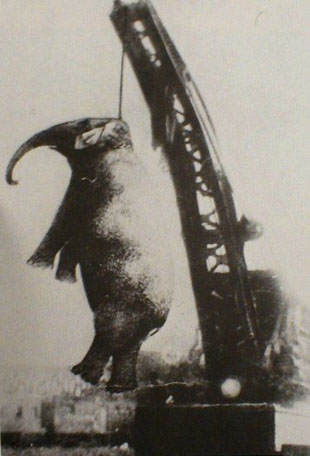
The circus elephant Mary hanged Sep. 13, 1913 in Erwin, Tennessee

Five-ton circus elephant Mary (yes, she has her own Wikipedia page) was in Kingsport, Tennessee on the chintzy fairgrounds touring circuit with Sparks World Famous Circus.

Billed as as “The Largest Living Land Animal on Earth,”* this exotic creature was a prime draw for the circus — and also a beloved pet of the Sparks family.

Unfortunately, this valuable asset was placed in the temporary stewardship of an inexperienced “under keeper” whom the circus had had to scoop up at a recent stop to cover staff turnover. Between shows on September 12, that fellow somehow (accounts conflict) enraged Mary, and (again according to one version among several) she

“collided its trunk vice-like [sic] about [the under keeper’s] body, lifted him 10 feet in the air, then dashed him with fury to the ground … and with the full force of her biestly [sic] fury is said to have sunk her giant tusks entirely through his body. The animal then trampled the dying form of Eldridge as if seeking a murderous triumph, then with a sudden … swing of her massive foot hurled his body into the crowd.”

It’s apparent in this report that the facts of an already-sensational event almost instantly began disappearing into its spectacle. See the largest land animal on earth! See it maul its handler to death! But what happened next lifted Mary all the way to legend.

The owners knew they had to euthanize the “mankiller,” or if they didn’t know they were soon persuaded by mushrooming press attention and towns threatening to ban the Sparks circus.

But how? They couldn’t shoot Mary to death — she apparently survived gunshots from the vengeful crowd in the immediate aftermath of the trampling; firearms just didn’t pack the wallop to put down a pachyderm in 1916. The area didn’t have the sort of electrical juice available that Thomas Edison had once used to drop a circus elephant during his weird campaign for the electric chair.

The choice for the baleful logistical task of killing a 10,000-pound evildoer was hanging, selected over “crushing it between railroad cars.”

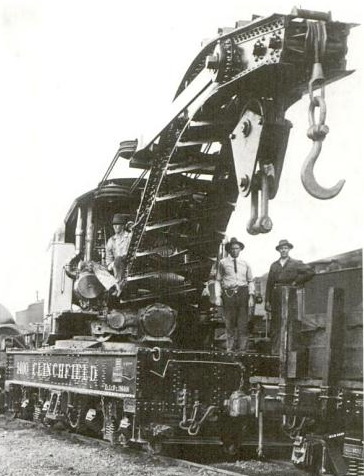
And for stringing up “Murderous Mary”, you need no ordinary gallows. No, for this job, you’re using the hoist on a train derrick and an industrial-strength chain for a noose.


The actual train derrick that hanged Mary the elephant. The leftmost man, seated on the machine, is the “executioner” who worked the controls, according toThe Day They Hung the Elephant.

The railroad was game for the operation, provided the circus would come to it. So on this date, the circus train cars loaded up for the nearest usable train derrickscaffold at Erwin, Tennessee.

There, a procession of all five Sparks elephants — the routine was supposed to keep Mary compliant, and it did the trick even though some observers later remembered the condemned creature behaving unusually skittishly — marched to the railyard.

There Mary was noosed with a 7/8″ chain and hoisted up. The chain broke, and the animal shattered its hip crashing to the ground; another, still larger, chain, did the trick on the second try.

Talk about a spectacle. Talk about scary clowns.

There’s something about this event abidingly piteous, even shameful. It may be for that reason that it’s also abidingly mysterious. The particulars about what happened on the day they hanged the elephant and what became of the body (a steamshovel dug a grave, but the exact location was never marked and there’s a wild story that it was dug up later for ivory) are the topics of conflicting, nth-hand rumors. Some in Erwin don’t to this day want to discuss the matter. Others, just the opposite.


Image (c) John Pugh of SourceToSea.net and used with permission.

* Sparks evidently kept the “largest living land animal” marquee in use for Mary’s successor, as indicated by this 1919 poster (pdf) for the show.

Part of the Themed Set: Americana.

On this day..

1875: Six in Fort Smith under Hanging Judge Isaac Parker

I have ever had the single aim of justice in view … ‘Do equal and exact justice,’ is my motto, and I have often said to the grand jury, ‘Permit no innocent man to be punished, but let no guilty man escape.’

–Judge Isaac Parker

On this date in 1875, the most famous — or infamous, depending on your perspective — “hanging judge” of the American West dropped the trap on his noosing career with his first six hangings at Fort Smith, Arkansas.

Isaac Parker, around the time he arrived at Fort Smith

Isaac Parker had parlayed a legal career in Missouri into a congressional seat, when the fall of the Arkansas Republican party’s fortunes late in Reconstruction swept him out of office in 1874.

No problem: his co-partisan president, Ulysses S. Grant, appointed Parker to a federal judgeship in neighboring Arkansas. It’s upon that renowned tenure that the man’s reputation, uh, hangs.

Parker arrived at Fort Smith on May 4, 1875, the youngest federal judge in the west and a man whose jurisdiction included the lawless Indian Territory (present-day Oklahoma).

This expanse of land, the final destination of the Trail of Tears, had once been preserved for tribes forcibly “removed” from eastern North America.

But by the post-Civil War years, the frontier was sweeping past on iron wheels … and as long as Indian Territory remained (mostly) protected from white settlement, it remained a sparsely-populated refuge for outlaws.

Pandemonium in the Territory was only exacerbated by the Fort Smith court’s reputation for corruption and inefficiency; the office was open for Parker’s appointment because his predecessor had resigned to avoid impeachment.

Judge Isaac Parker came to clean up the place.

Fort Smith was an unusual portfolio for a federal judge. While most of Parker’s colleagues were confined to the tedium of interstate civil litigation, Parker was the court of first call for many regular criminal cases in the Indian Territory which in other jurisdictions would have been a state matter. He estimated in 1885 Congressional testimony that seven-eighths of his caseload came from Indian Territory.*

And in those cases he quickly established himself a reputation for severity.

“I never hanged a man,” Parker said of himself later in life. “The law hanged him. I was only its instrument.”

But make yourself the law’s instrument to the tune of 79 hangings, and folks are bound to sit up and take notice.


“they nearly hung me for stealin’ a horse
in Fort Smith Arkansas.

Judge Parker said guilty and the gavel came down
just like a cannon shot …”

At his court’s very first sitting in May 1875, Parker death-sentenced a murderer — Daniel Evans, who came straight from frontier central casting and had murdered a man for his boots.

As that year unfolded, he added enough condemned men to the bowels of the miserable jail nicknamed “Hell on the Border” — for an eight-strong hanging date to christen September.

One of the eight had his sentence commuted due to youth.

One was shot trying to escape.

And the other six were the debut crop for the mass-occupancy gallows that Parker ordered constructed at Fort Smith. (Its capacity was a full dozen.)


Modern replica at Fort Smith — today a national historic site — of Judge Parker’s gallows. (cc) image from photoguyinmo.

The clientele was six unconnected murderers, committing various atrocities for various motives and aptly embodying the region’s ethnic diversity.

  • Evans, white
  • James Moore, white
  • Samuel Fooy, quarter Cherokee
  • Smoker Mankiller, Cherokee
  • Edmond Campbell, black
  • John Whittington, white

And the audience? Five thousand or so reportedly on hand in Fort Smith this date, plus a national media audience … and posterity deep into the second century since this sturdy magistrate donned his first black cap and set about putting chaos into order with a rope in his hand.


New York Tmes, September 4, 1875.

Whatever one might have to say about his methods, Parker presents a magnetic personality, a figure so truly of his own time and place that he obligingly died just weeks after his court was finally relieved of its Oklahoman jurisdiction in 1896. He’d never hang around to jolt our anachronism meter by weighing in on trench warfare or cubism.

Parker is undoubtedly a more layered figure than his “hanging judge” reputation would suggest, and even his life’s project to bring his unruly jurisdiction to heel was more complicated than just being a hardass. (He had a significant administrative challenge to manage his chronically underfunded court, and he needed to foster the sense of communal reciprocity and legal integrity that would encourage fellow-citizens to turn up for jury duty and witness testimony that make the law’s everyday business possible.) The judge was famous for the long hours he kept, and capital cases were never more than a tiny fraction of his work.

Parker was notorious (slash-beloved, again depending on perspective) for his prosecution-friendly courtrooms, but even the tough sentences he handed down came in his mind from a place of tough love. He wrote late in life that

not one of [those he suffered to long prison terms for violent crimes], no matter how depraved, had entirely lost that better part of human nature …

The object of punishment is to revive, that in some cases, almost extinct spark, to lift the man up, to stamp out his bad nature and wicked disposition, that his better and God given traits may assert themselves.*

Still, whether you prefer him as the stern avatar of law on an outlaw plain or bloodthirsty yahoo, Parker’s ready amenability to latter-day Hollywood tropes will surely maintain his popularity in the cultural rookery of wild west cutouts.

Among numerous other reference points, the novel True Grit, and the 1969 and 2010 films based on it, use Judge Parker’s Fort Smith as the heroine’s embarkation point — with her dangerous journey carrying her into the untamed Indian Territory on his doorstep.

Pat Hingle’s “Judge Fenton” (from “Fort Grant”) in the Clint Eastwood western Hang ‘Em High also shows an unmistakable debt to the Judge Parker persona.

A few books about Judge Parker


Spare a thought, too, for the man operating the ropes and levers this date.

George Maledon, named Fort Smith’s official hangman just a couple of years before Isaac Parker’s appointment, would enforce the Hanging Judge’s hanging sentences into the 1890s: 60-plus executions in all, plus five other escaping prisoners he gunned down, all in a day’s work for an Arkansas lawman.

Maledon has a sad coda to this story, which wasn’t so upbeat to begin with.

The year after the veteran hangman hung up his hood and opened a grocery store, Maledon’s daughter was murdered. The bereaved father’s friend Judge Parker, still on the bench at that time, condemned the killer to die in a case we’ll suggest might have warranted a recusal by present-day standards. Nevertheless, a successful appeal balked Maledon’s successor of the malefactor, and the disgusted ex-executioner got his species of payback by taking the accoutrement of his late profession on the road as a traveling act.

There, under the billing of “the Prince of Hangmen,” Maledon lectured and exhibited old hanging ropes and pictures of the outlaws they had choked.

People of all classes flocked to the show grounds, crowded about the lecturer and filled the tent, viewing the gruesome relics and listening to the old hangman’s recital of soul-stirring events as he pointed out the…instruments of his vocation. (Source)

* See Mary Stolerg, “Politician, Populist, Reformer: A Reesamination of ‘Hanging Judge’ Isaac C. Parker”, The Arkansas Historical Quarterly, Spring 1988

Part of the Themed Set: Americana.

On this day..

1772: Moses Paul

On this date in 1772, the town of New Haven, Connecticut hanged a Mohegan Indian named Moses Paul for a drunken homicide. He’d been kicked out of a tavern as an unruly sot, and vengefully beat to death outside it a (white) fellow-customer with whom he had quarreled.

Notable to the reported “concourse” of attendees as the first execution in those parts for more than twenty years, it comes to posterity as the occasion for an interesting milestone: the first known Native American publication in America was Samson Occom‘s “A Sermon Preached at the Execution of Moses Paul, an Indian”. (pdf)

Occom, himself a Mohegan, was a Presbyterian divine whom the condemned solicited to deliver the hanging sermon. So the multitudes assembled were also treated to the edification of seeing an Indian preach from the scaffold, which may have been yet another first.

Occom’s sermon went predictably long on the hark-ye-to-this-warning Christian boilerplate (as a convert from heathenism, Occom did not want for zeal). But the speaker was also plainly self-conscious of his racial position,and took pains to invoke the egalitarianism of the afterlife:* the same death and judgment awaiting “Negroes, Indians, English, or … what nations soever.”

Given the liquor-induced crime that was even then a stereotype of Indian susceptibilities, Occom concluded “address[ing] myself to the Indians, my bretheren and kindred according to the flesh” with a call to temperance in view of the waste he saw laid to his own communities:

My Poor Kindred,

You see the woeful consequences of sin, by seeing this our poor miserable countryman now before us, who is to die this day for his sins and great wickedness. And it was the sin of drunkenness that has brought this destruction and untimely death upon him … this abominable, this beastly and accursed sin of drunkenness, that has stript us of every desirable comfort in this life; by this we are poor miserable and wretched; by this sin we have no name nor credit in the world among polite nations, for this sin we are despised in the world … when we are intoxicated with strong drink we drown our rational powers, by which we are distinguished from the brutal creation we unman ourselves, and bring ourselves not only level with the beasts of the field, but seven degrees beneath them.

…

Drunkenness is so common amongst us, that even our young men, (and what is still more shocking) young women are not ashamed to get drunk.

…

break off from your drunkenness … O let us reform our lives, and live as becomes dying creatures, in time to come. Let us be persuaded that we are accountable creatures to God, and we must be called to an account in a few days … Fight against all sins, and especially the sin that easily besets you, and behave in time to come as becomes rational creatures.

Ava Chamberlain’s “The Execution of Moses Paul: A Story of Crime and Contact in Eighteenth-Century Connecticut”, published in The New England Quarterly (September 2004) has a detailed summary of this case, Paul’s unsuccessful efforts to appeal around the question of premeditation, and the historiographical riddle left by Occom’s voluble commentary vis-a-vis his subject’s near-total silence.

* Our colonial Calvinist anticipated Marxist aphorists with the remark, “whether we concern ourselves with death or not, it will concern itself with us.” The colonists present probably would have appreciated the occasion more had they known they were participating in an Internet meme.

Part of the Themed Set: Americana.

On this day..

1863: Peyton Farquhar, in An Occurrence at Owl Creek Bridge

It would perhaps be around this time in 1863 that a Southern planter is arrayed for hanging in An Occurrence at Owl Creek Bridge

This “greatest American short story … a flawless example of American genius” (according to Kurt Vonnegut) was 1890 product of puissant wordsmith Ambrose Bierce.

In this non-chronological story, Peyton Farquhar, “a well to do planter, of an old and highly respected Alabama family,” is entrapped by a Union spy purporting to be a Confederate agent to attempt an act of sabotage in the face of a hanging warning issued by the Union army.

It can be ballparked in late August or early September based on its location in northern Alabama, which essentially didn’t see Civil War activity until the very end of the war. Except, that is, for the maneuvering building up to the Battle of Chickamauga fought just over the border in southeastern Tennessee September 19-20, 1863.* That also squares with seasonal indicators in the text pointing to summer, e.g.: “the flood of last winter had lodged a great quantity of driftwood against the wooden pier at this end of the bridge. It is now dry and would burn like tinder.”

At any rate, the story begins with Farquhar stationed on Owl Creek Bridge awaiting execution … but the rope snaps as he falls, giving him a bid for freedom. As for what happens next: read the story, or take in this economical screen adaptation by French director Robert Enrico aired for American audiences on The Twilight Zone.

* Bierce fought at Chickamauga on the Union side; he wrote a non-fiction memoir and a short story titled “Chickamauga” about the experience.

Part of the Themed Set: Americana.

On this day..

1594: Ishikawa Goemon, bandit

On this date in 1594, legendary Japanese outlaw and folk hero Ishikawa Goemon was boiled to death in oil for attempting to assassinate Toyotomi Hideyoshi.

And he’s supposed to have had his son thrown into the kettle* with him, and, boiling to death himself, to have held the boy aloft out of harm’s way.

A 19th-century image painted by Toyokuni III of Goemon in one of the several kabuki plays he features in.

Ishikawa is a sort of Japanese Robin Hood figure, and the (very much) that isn’t offered by the documentary record is helpfully expanded in folklore.

Trained in forbidden ninja ways? Check.

Or maybe a samurai? Why not?

Henchman named “rat boy”? Oh, yes.

Just what his beef with national unifier Toyotomi Hideyoshi might have been is also subject to the exigencies of the story at hand. Let it be oppression or something, good enough for one of those classic outlaw-with-a-heart-of-gold retorts against condemnation for his thieving career.

It is you who are the robber who stole the whole country!

He gets to be the title character of the 2009 film Goemon:

Thanks to the inevitable marketing tie-ins, the world also has a Goemon action figure.

Personally, and especially because I would lose all these nifty accessories, I much prefer the adorable Goemon Cosbaby series.

* As a result of this famous exit, a Goeomon-buro (Goemon bath) in Japanese refers to a large iron kettle-shaped bathtub.

On this day..

1692: Martha Carrier, ferocious woman

This date in 1692 was the third of four execution dates during the notorious Salem witch trials.

Five souls were dispatched at Gallows Hill this date. With the executioner’s due respect to John Willard, George Burroughs, George Jacobs, Sr. and The Crucible main character John Proctor, we’re elated this date to focus on the only woman among them — Martha Carrier.

Carrier is the subject of the recent historical novel The Heretic’s Daughter by her tenth-generation descendant Kathleen Kent, whom we’re delighted to welcome for an interview on this anniversary.

How did you first learn of your connection to Martha Carrier, and how does your family feel about this link?

I was very fortunate to have heard stories of the colonial Carriers from the time I was a young child. My first memory of hearing about the Salem witch trials was when I was eight years old, visiting my maternal grandmother. She was the first one to tell me that my grandmother back nine generations, Martha Carrier, had been hanged as a witch in 1692. When I asked her if Martha was in fact a witch, my grandmother said, “Sweetheart, there are no such things as witches, just ferocious women.”

She, along with the rest of my family, had a great sense of pride over Martha’s courage in standing up to her accusers. She was one of the few people, out of the 150 New Englanders accused of practicing witchcraft, who not only refused to admit to being guilty, but also never accused anyone else of being a witch, which most people did to save themselves.

Your book tells the story of Martha Carrier from the perspective of her 10-year-old daughter. As an author, how did you approach the research, especially when it comes to Martha as an individual? Is that something you were able to source pretty strongly or did it require a lot of filling in the blanks?

The Heretic’s Daughter was my first novel, and it took five years of research and writing to complete it.

Fortunately, there is a wealth of historical information about the colonies during that time. The courts where the witch trials were conducted kept very meticulous records so I was able to gather a lot of facts regarding the magistrates and deponents, as well as the accused. There are so many wonderful fiction and non-fiction books alike that have been written about the Salem witch trials, but I wanted to write a very personal story about the Carrier family; how they lived day to day, how they survived disease, Indian raids, hostility from their neighbors, and ultimately the witch trials. I was able to weave in a lot of my family’s stories — the cow that gave golden milk, Andrew’s near death experience in the prison — that have been passed down through 10 generations.

When I first began working on the book, it was written from Martha’s point of view, but I decided it would make more compelling reading if the narrator was one of the Carrier children, Sarah, and it is through her eyes that we see the growing hysteria over witchcraft, and her struggle with Martha’s strong, unyielding character. This theme of mother-daughter conflict is central to the book’s development.

So, who was Martha Carrier and why did she become one of the people caught up in the Salem witch trials?

Martha Carrier had evidently long been resented by the community in Andover, where the Carrier family lived during the Salem witch trials, because of her forceful nature. She argued over boundary lines with several neighbors (which was a common occurrence amongst the settlers), telling one neighbor, “I will stick as close to you as bark on a tree.” (source: Salem witch trial deposition; see this document) She was also married to a man who had fought in the English Civil War, and was widely rumored to be one of the executioners of King Charles I of England. Martha fell outside of the Puritan ideal of what a woman was supposed to be and was so vocal in her own defense during the trials that when she was asked by her judges if she had ever seen the Devil, she responded by telling them that the only devils she had ever seen were the men sitting in judgment before her.


One of 20 granite benches commemorating the Salem witch trial victims at a memorial. (cc) image from Deaf RED Bear.

Her own children accused her of witchcraft. Are you descended through those kids as well? And do we know anything about how they later dealt with or rationalized that act?

My family is descended from Tom, Jr., and I learned the full genealogy at an early age from my grandparents. Four of Martha’s five children were arrested to compel her to admit to being guilty. Her two oldest sons were arrested first, and they were tortured until they agreed to testify against their mother. Tom and Sarah were then arrested — the real Sarah being only 7 years old at the time, and the second youngest child to be imprisoned during the trials — and they quickly admitted that they, too, were complicit in witchcraft.

During the research, I discovered how truly awful the conditions were in the Salem jail. Nearly half of the 150 people arrested from towns all over New England were under the age of 18. The surprising thing was not that people died, but that anyone survived at all. The four children were kept imprisoned for months after their mother was hanged and they were finally released in the fall of 1692. Within a few years, their father, Thomas, collected his children and grandchildren and moved to the wilds of Connecticut to start a new life.

How did she try to defend herself?

Martha Carrier was so vocal in her own defense during the trials that Cotton Mather, one of the most famous theologians of his day, named her the “Queen of Hell.”

This Rampant Hag, Martha Carrier, was the Person, of whom the Confessions of the Witches, and of her own Children among the rest, agreed, That the Devil had promised her, she should be Queen of Hell.

–Mather

When she was confronted by the accusing girls, she turned to her judges and said, “It is a shameful thing that you should listen to these folks who are out of their wits.”

By the time of her arrest, several women had already been sentenced to be hanged, and she knew that her refusal to confess would mean death. She never wavered in her testimony and never accused another person to save herself, even when her four children were arrested and two of her sons were tortured.

Do you feel like she’s an overlooked figure in this affair? She’s not, for instance, even a character in The Crucible.

Arthur Miller did extensive research for The Crucible, but he did make changes to the historical facts for fictional purposes: for example John Proctor was in his seventies during the trials; hardly the strapping figure played by Daniel Day Lewis in the film adaptation.

There were so many remarkable people and events during the trials that he had to choose selectively in order to illustrate his primary motivation in writing the play which was to shed light on the McCarthy era communist “witch” trials.

Nathaniel Hawthorne wrote about Martha Carrier, as did Cotton Mather, but her forceful character made her a difficult subject, especially when there were more motherly figures like Rebecca Nurse, or titillating young characters like Abigail Williams to explore.

At this distance of time, Martha Carrier must have a great many descendants. Are you in touch with other branches of the family?

Soon after publishing The Heretic’s Daughter, I started getting emails and letters from fellow descendents of Thomas and Martha Carrier telling me that they, too, had heard many of the stories that I had grown up with.

For the release of my second novel, The Wolves of Andover, about Thomas Carrier’s life, I decided it would be fun to invite some of these extended family members to Salem for a book launch. On November 5th, 2010, nearly 250 Carrier descendents, some of them flying in from as far away as Washington State, California and Arizona, came to Salem for a weekend of author talks, receptions and story swapping. A video on my web site captured some of the highlights from that remarkable weekend.

We came as strangers and left Salem as family.

Ultimately, what’s changed about you yourself from your literary encounter with this famous ancestor?

The Salem witch trials were a dark period in American history, but from researching those events I discovered that positive changes occurred over time in the judicial system, the penal system, and for religious tolerance. I am awe-struck by the courage and fortitude of the settlers who sacrificed so much for their children and grandchildren.

And I am especially proud of my heritage: that my 9x great-grandmother defended her principles and conscience, even in the face of death. An interviewer once asked if, having written the novel, I felt I was speaking for Martha Carrier, and I said that I felt she had been speaking for me. A ferocious woman indeed!

With your second book, The Wolves of Andover, you’ve written two about the Carrier family. What’s your next project?

Wolves is a prequel to Heretic, as it explores the life of Thomas Carrier during the English Civil War and his journey to the new world from London.

I am about halfway through my third novel, but this one is quite different from the first two. It takes place during reconstruction era Texas in 1870, and chronicles a particularly chaotic, violent time in Texas history.

There’s another fine interview with Kathleen Kent here. -ed.

On this day..

1634: Urbain Grandier, for the Loudon possessions

On this date in 1634, a Paris tribunal “declare[d] the said Urbain Grandier duly guilty of the crime of sorcery, evil spells, and the possession visited upon some Ursuline nuns of this town of Loudon and of other laywomen mentioned at the trial, together with other crimes resulting from the above. For redress of these, he has been condemned … to be taken to the Place of Saine-Croix of this said town, to be tied to a post on a pile of faggots that is to be built in the said Place. There his body is to be burned alive … and his ashes are to be scattered to the winds.”

The sentence was immediately enforced.

These Loudon possessions were a disgraceful carnival of simulated enspellment by the local Ursuline nuns engineered to destroy Grandier, a parish priest with a knack for acquiring enemies.

Alexandre Dumas, pere would write about Grandier in his Crimes Célèbres, and later in a stand-alone play. In Dumas’s rendering, Grandier arrived in Loudon as a handsome outsider, eloquent in the pulpit and doubly so in pursuit of a pretty girl,* as inexorable as Shylock in his victorious lawsuits against the local grandees.

Most recklessly of all, he made a foe of Cardinal Richelieu — snubbing him, opposing him politically, and (so it was alleged) authoring a scathing and anonymous lampoon of the Grey Eminence.

When Richelieu’s deputy came to town, the locals got the Ursuline nuns into their fits and got Grandier fast-tracked for hell.

The nuns put on a circus of frothing, profane, hip-thrusting demoniac possession accusing Grandier of bewitchment as they melodramatically underwent exorcism. (Fabulously attended, these public displays of possession and exorcism went on for several years after Grandier’s death as a perverse tourist attraction.)

Richelieu’s guy arranged to try Grandier in his own court (no appeal possible) and threatened to arrest for treason anyone who testified in his defense. In case that were insufficient advantage, a contract with Lucifer — a literal, signed document — was produced for the magistrates’ edification.


In fairness, this “contract” must have been a hell of a lot of fun to forge.

Heck, even nuns who tried to recant were turned away. Must be back under Lucifer’s influence!

Before proceeding to the stake, Grandier was subjected to one last “extraordinary” torture. His holy persecutors, “lest the Devils should have the power to resist the blows of a profane man, such as the hangman was, they themselves took the hammers and tortured the unhappy man” until the bone marrow leaked from his legs. Satan’s subcontractor suffered the blows without confessing or naming an accomplice.

In 1952, Aldous Huxley molded the horrible Grandier story into a non-fiction novel, The Devils of Loudun. Huxley’s take helped to popularize the tale — one that polemicists in the 17th century also recognized as an injustice — for the modern era of flesh minced by ideological madness.

From beginning to end, the trial proved a farce in which the condemnation of the accused was a foregone conclusion. By means of a series of trumped-up charges reinforced by an official philosophy and falsified theological dogmas, the resources of the state were mobilized to crush the offending individual. Huxley is not slow to point to the modern counterpart of such proceedings, notably in Fascist or Communist countries.

-Book review by S. van Dantzich, The Australian Quarterly, June 1954

Evidently, it struck a chord.

A 1971 cinematic adaptation of this book, The Devils, a captivating and sacrilegious tapestry of violent, sexual, and religious iconography, won critical praise and censor board bans, as well as an “X” rating in the United States. It’s hard to find, but worth the trouble.

Huxley’s book also formed the basis for an operatic interpretation, Die Teufel von Loudun (The Devils of Loudun)

* As we’ve seen, French priests making sexy time stood in danger from their game-less counterparts.

On this day..

1915: George Joseph Smith, Brides in the Bath murderer

(Thanks to Meaghan Good of the Charley Project for the guest post. -ed.)

On this day in 1915, serial uxoricide George Joseph Smith was hung by the capable John Ellis at Maidstone Prison in the UK.

Smith had committed three murders and various forms of larceny as well; he’d earned his noose several times over.

Two things tend to trip people up when they’ve seemingly committed the perfect crime: either they brag about it to impress others, or they repeat the crime using the same methodology as before, since it worked so well the first time. Either of those actions greatly increases the risk of the criminal’s getting caught.

Smith made the latter mistake. He was in a sense a victim of his own success.

Smith was born on January 11, 1872. His criminal record began when he was sent to a reformatory at nine and served a seven-year sentence. In young adulthood he was in and out of prison on theft- and fraud-related convictions.

His complicated marital career began when he married Caroline Beatrice Thornhill, a domestic servant, in 1898. Smith persuaded her to steal from her employers. Caroline served time in prison as a result, and implicated her husband, who got two years for his role in the thefts.

After George Smith’s release, Caroline thought it wise to put a few thousand miles between herself and her estranged husband, and so she left the UK for Canada. She never filed for divorce, however.

Smith remained legally married to her for the rest of his life, so none of his numerous other marriages were legal.

Unlawfully Wedded …

The guy wasn’t good-looking, but he could charm like any good con artist. A year after his marriage to Caroline, Smith bigamously married another woman. He cleaned out her saving account and then deserted her.

Between 1908 and 1914, he married no fewer than seven additional women, usually under an alias, and deserted most of them after a short time, sometimes only a matter of days — but not before he helped himself to their possessions and bank accounts.

As true crime writer Harold Schechter tells it in his book The Serial Killer Files: The Who, What, Where, How, and Why of the World’s Most Terrifying Murderers:

Smith initially limited himself to scamming gullible spinsters out of their life savings by luring them into bigamous marriages … The moment Smith had his hands on his new bride’s money, he would disappear. Usually telling her he was going out on an errand — to pick up a newspaper or buy a pack of cigarettes — he would never return. On one occasion, he brought his newlywed wife to the National Gallery of Art and, after viewing some paintings, excused himself to go to the bathroom. She never saw him — or her life savings — again.

That particular bride was named Sarah Faulkner. Smith had already plundered £350 in cash from her and her jewelry as well, and while she was waiting for him to return from the loo he was back at their hotel, swiping her clothing and the rest of her money.

The only wife that didn’t fit this pattern was Edith Pegler.

Smith was away from her side for months at a time on “business trips” and when he returned it was always to ask for money, but he never left her for good and they remained together for seven years. As to whether he actually harbored some form of affection for her or whether he just didn’t want to kill his cash cow while it was still milkable, we can only speculate.

Yet all these women were, in a sense, lucky.

Smith may have broken their hearts and taken their cash, but he left them their lives.

… ‘Til Death Do Us Part

The first unlucky wife was Bessie Mundy, whom Smith murdered on July 13, 1912.

They’d married in August 1910, but he left her after persuading her to give him £150 in cash. On the way out the door, he accused her of giving him a venereal disease.

Eighteen months later, Bessie ran into Smith on the street. Somehow, the charmer got his ex to forgive him and resume their relationship.

In fact, Smith wanted to get his hands on Bessie’s £2,500 inheritance, but it was in trust and he couldn’t touch it.

After their reunion, the couple drew up mutual wills, naming each other as beneficiaries. Bessie willed her husband £2,579. Less than a week later, she was mysteriously dead.

Smith rented a house for them in Herne Bay and had a new cast-iron bathtub installed. Tragically, Bessie drowned in the bath. Her husband said he’d been out buying dinner and returned to discover the body.

Since Smith claimed his bride suffered from epilepsy and that she’d had a seizure the day before she died, it was easy to believe she’d simply had an unfortunate accident.

In spite of his newfound wealth, Smith had Bessie consigned to a pauper’s grave and even returned the slightly-used bathtub to the ironmonger for a £1 17s. refund.

This, perhaps, is where Smith might have counted himself lucky and checked out of the homicide business — or at least thought about a different m.o. Instead, hubris and habit got him hanged.

The Brides of Bath murder victims: from left to right, Bessie Mundy, Alice Burnham, and Margaret Lofty.

Next to go was Alice Burnham, who was making a goodly living as a nurse. Smith married on November 4, 1913, and became her widower on December 13.

Alice and her new husband were honeymooning at a seaside boardinghouse in Blackpool when she drowned in the bathtub while he was supposedly out getting eggs.

Smith, who claimed she had a weak heart, had insured her life for £500. She too was buried on the cheap.

Margaret Elizabeth Lofty died in her London home a little over a year later, on December 18, 1914. Newspapers reported she had drowned in the bathtub while her husband — identified as Robert Lloyd — was out buying tomatoes. He and the landlady found the body. Lofty and “Lloyd” had married only the day before and, appropriately enough, the ceremony was performed in the city of Bath.

Although it was initially classified as death by misadventure, Margaret’s murder ultimately lead to Smith’s downfall.

Rotten luck, it was: Alice Burnham’s father read an account of her death in the newspaper and, even though the husband had a different name, he couldn’t help but notice that Margaret’s death was suspiciously similar to his daughter’s.

Joseph Crossley, who was the couple’s landlord at the time of Alice’s death, noticed the same thing. Since both the Burnhams and Crossleys had taken a dislike to Smith from the get-go, they both wrote the police, asking them to open an investigation.

Authorities quickly determined that George Joseph Smith and Robert Lloyd were the same man. They sure had the same playbook.

Margaret had made out a will just hours before she died, naming her husband the sole heir to her estate. She had also withdrawn her life savings from the bank the same day, and three days before she had taken out a £700 life insurance policy on herself, with her husband as the beneficiary. Ka-ching.

When the grieving widower showed up at the insurance office to collect on Margaret’s policy, he was arrested. Lloyd/Smith was initially charged with putting a false name on a marriage certificate, but bigamy and murder charges would follow fast.

When news of the arrest was published, a police chief from Kent read the story and told the London police about Bessie Mundy’s death, which was strikingly similar to the other two.

Forever Hold Your Peace

But how could he could have drowned the women in the tub, without leaving marks of violence on their body?

Margaret had only a small bruise on her elbow. For answers, the police turned to renowned pathologist Bernard Spilsbury. The first thing he did was exhume the bodies to determine whether the women had, in fact, drowned. They had.

After experimenting with the very same bathtub Margaret Lofty died in, he determined how it might have happened. John Brophy, a crime writer, describes it chillingly:

With honeymoon playfulness he would enter the room where his bride was already in the bath, admire her naked beauty, bend over her fondly, and, still murmuring endearments, hold her feet. Suddenly, he would tug her feet upward, jerking her head at the end of the bath, below the water, so that in a few moments she would be drowned with no bruises on the body or other signs of assault or resistance.

Effective. Actually, you can see why he stuck to his system.

When Smith went to trial, it was only for the murder of Bessie; British law didn’t permit him to be tried for multiple murders in one go. However, the prosecution wanted to bring evidence in the Lofty and Burham deaths into the trial, arguing that they indicated a criminal “system.”

The judge allowed it, setting a precedent that would be used in later criminal cases.

In pretrial investigations later described in court, Spilsbury demonstrated his murder theory using Bessie’s bathtub and a female police officer in a bathing suit. It worked all too well: she lost consciousness immediately and they had to drag her out of the tub and perform artificial respiration to revive her.

No wonder the jury was only out for twenty-two minutes before it delivered a guilty verdict.

Caroline Thornhill, Smith’s legal wife, returned to Britain for his trial. She married a Canadian soldier the day after his execution.

The “Brides in the Bath” case has remained vividly alive in British memory.

The historian Harold Nicholson compared Smith’s behavior to Adolf Hitler’s in his 1939 book, Why Britain is at War; Smith was mentioned in novels by Evelyn Waugh, Agatha Christie and Dorothy Sayers, and in 1952 the case was made into an episode for the true-crime radio show The Black Museum.

[audio:http://www.archive.org/download/OTRR_Black_Museum_Singles/BlackMuseum-03-TheBathTub.mp3]

More recently, in 2003 the murders were featured into made-for-TV movie called The Brides in the Bath.

Warning: Video contains NSFW naked ladyparts. Oh, and homicide.

At least two plays, Tryst and The Drowning Girls, are based on the story. In 2010, the author Jane Robins published a book about the case, called The Magnificent Spilsbury and the Case of the Brides in the Bath.

Part of the Themed Set: Branded.

On this day..

1930: Thomas Shipp and Abram Smith, strange fruit

On this date in 1930, two black youths were lynched in Marion, Indiana for murdering a white man and raping his girlfriend.

(The rape allegation — although it, and not the homicide, seems to have been the thing that triggered the lynching — was subsequently withdrawn, and there were even rumors that the white girlfriend was a lover and confederate of one of the lynched men. It’s just one strand in the very human tapestry around the “last classic lynching north of the Mason-Dixon line” explored by Cynthia Carr in Our Town: A Heartland Lynching, a Haunted Town, and the Hidden History of White America.)

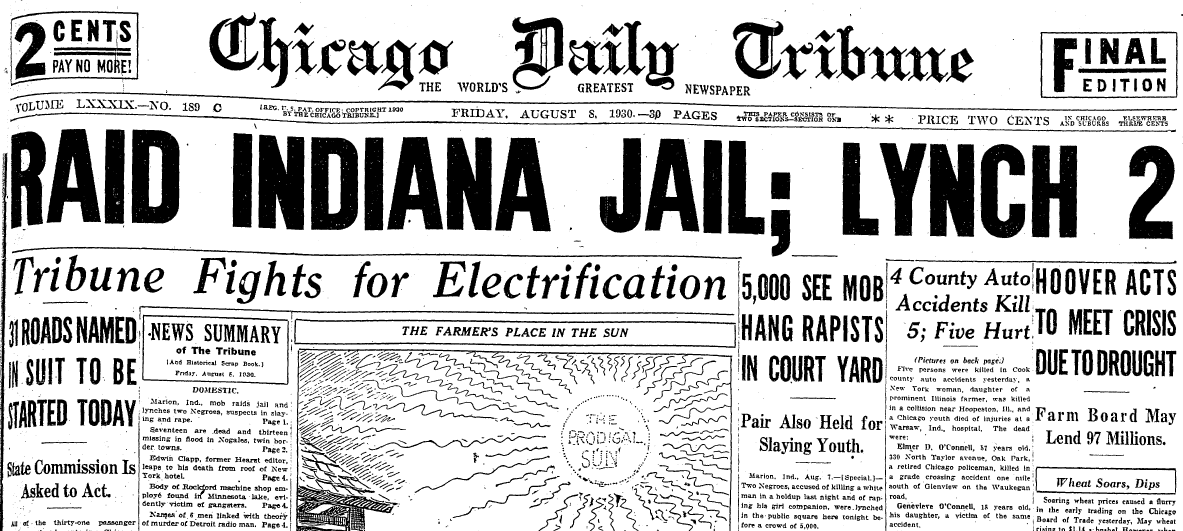
Thomas Shipp and Abram (or Abraham) Smith had been taken just the day before. The Chicago Daily Tribune (Aug. 8, 1930), for whom this event was banner news, reported that

Shipp, who is said to have confessed killing the white man, Claude Deeter, 23, of Fairmount, Ind., was hanged from an elm tree in the courthouse yard. Smith, whom the girl identified as her assailant, was thrown from a third floor window of the jail with a noose around his neck and strangled.

…

Reports of the crimes and confessions, published in Marion newspapers this afternoon, stirred this quiet community of 23,000 to intense excitement. There was no hint of the impending violence, however, until 8:30 p.m., when a motorcade of Deeter’s fellow townsmen arrived from Fairmount.

The Fairmount delegation, numbering about 100, gathered in the public square, openly displaying their guns and shouting for a lynching … The sheriff led his deputies to the front door, argued a moment with the leaders of the mob and then ordered the tear bombs thrown. Blinded, the lynchers fell back for a few minutes, but returned and began the sledge hammer siege which forced the jail doors within ten minutes. No shots were fired on either side.

Following the lynching the mob gathered in the square for an hour, some proposing to drive the 2,000 members of the Negro colony from the city and burn their dwellings. Peace officers from Indianapolis, Kokomo, Fort Wayne, and other towns were arriving however, and gradually the mob broke up.

The corpses hung in the square for hours, attracting throngs of gawkers — including a photographer able to snap this picture:


Teacher/poet Abel Meeropol ran across this photo of the Shipp-Smith lynching a few years later in a magazine, and it so “haunted” him — his word — that he penned the anti-lynching poem “Strange Fruit”. You know it from Billie Holiday‘s arresting vocal rendition.

Southern trees bear strange fruit
Blood on the leaves
Blood at the root
Black bodies swinging in the southern breeze
Strange fruit hanging from the poplar trees

Pastoral scene of the gallant south
The bulging eyes and the twisted mouth
The scent of magnolia sweet and fresh
Then the sudden smell of burning flesh

Here is a fruit for the crows to pluck
for the rain to gather
for the wind to suck
for the sun to rot
for the tree to drop
Here is a strange and bitter crop

Abel Meeropol was no passing sentimentalist himself, but a prolific left-wing activist. During the McCarthy years, he adopted the children of the Rosenbergs when the latter were electrocuted as Soviet spies. As faithfully as those two orphaned boys have carried the torch for their lost birth parents, they also still carry an adoptive surname: Michael Meeropol and Robert Meeropol.


A third person was almost lynched in the same Marion, Ind., incident, but 16-year-old James Cameron (sometimes called “Herbert” or “Robert” in the 1930 news reports) managed to convince the mob that he wasn’t involved. Just how he managed this feat and what he’d really been up to is another strand of Carr’s tapestry: many of the Marion blacks as well as whites she interviewed overtly mistrusted Cameron.

At any rate, the crowd let him off with a beating, and Cameron served time as an accessory to the crime.

After release, he became an anti-lynching activist in Indiana and, later, Wisconsin — where he founded a (since-shuttered) Black Holocaust Museum. He started several NAACP chapters.

Cameron was pardoned by Indiana Gov. Evan Bayh in 1993, and authored a memoir titled A Time of Terror: A Survivor’s Story.

In the more immediate aftermath, it was far from a given that this date’s effusion of summary justice wouldn’t cascade into a generalized racial pogrom.

As the Tribune article notes, the lynch mob mulled attacking the black community, ultimately dissuaded by the gradual arrival of lawmen. By the next day, the Indiana national guard had occupied Marion. The Tribune on Aug. 10 reported the town “peaceful to all outward appearances but acutely aware of an undercurrent of racial antagonism that it feared might flame into open warfare at any moment.”

Lest this seem a bit over-the-top, recall that all this went down just a few years since a lynch mob in Tulsa had metastasized into one of America’s most notorious race riots. The prospect of wholesale bloodletting was very real.

When the local attorney general and grand jury waved away the small matter of punishing mob leaders, several of whom were publicly known by name, Indianapolis attorney general (and Marion native) James M. Ogden drove up to town and personally filed indictments, to the fury of white residents.

“It was astonishing to see and feel the mob atmosphere that still prevailed nearly seven months after the murder,” wrote a correspondent for The Nation. Ogden’s deputies were “looked upon as enemies of the community, not only by the mob, but also by most of the court officials.” After all-white juries acquitted the first two people tried, the state dropped its remaining indictments.


The maelstrom of race and politics and history that emerged from that first fatal transaction — a brutal but banal Lover’s Lane heist — grew so far beyond the original cast of criminal and victim that they practically became secondary to the story.

On August 8, 1930, a wire story datelined Fairmount, Ind., ran in the Indianapolis Star (but not the Marion papers):

Deep regret that the negro slayers of their son Claude, were lynched in Marion last night by a mob, was expressed today by Mr. and Mrs. William Deeter, members of the Apostolic faith, a sect similar to the Quakers.

“God should have been the judge,” said the elderly Deeter. “They had no right to do it,” his wife assented.

Both are opposed to capital punishment and did not want to see the negroes put to death for their crime.

On this day..