1942: Janusz Korczak and his orphans

(Thanks to Meaghan Good of the Charley Project for the guest post. -ed.)

On August 6, 1942, in the Warsaw Ghetto, Polish/Jewish hero Janusz Korczak marched with his orphans to the death trains and into legend.

The man, his activities in the ghetto, and above all his famed final walk to the Umschlagplatz, are mentioned in many books and memoirs about the ghetto.

The story of his final days also has been told many times in books for children such as The Champion of Children: The Story of Janusz Korczak, A Hero and the Holocaust: The Story of Janusz Korczak and his Children, and Janusz Korczak’s Children.

However, one of the former residents of his orphanage said, “I don’t want to talk about the dead Korczak, but the living one.”

The living Korczak’s story is told in Betty Lifton’s award-winning biography The King of Children: The Life and Death of Janusz Korczak.

Korczak’s real name was Henryk Goldschmidt. He took the name Janusz Korczak (pronounced “ya-nish kor-chok”) for his writing and it wound up taking over his entire life, a la Mark Twain.

Born in an observant Jewish household in Warsaw (which was then Russian Territory) in either 1878 or 1879,* he became man of the house after his father suffered a nervous breakdown in 1889 and eventually had to be hospitalized.

By thirteen, bored by school, he was writing poetry and learning foreign languages by himself. He went to medical school and served as a military doctor with the Russian Army in the Sino-Japanese War of 1905-1906. Eventually he was promoted to the rank of major.

Korczak’s true calling wasn’t in medicine, however, but in writing and in working with children. He found himself drawn to neglected and abused youngsters, and believed in treating every child with honesty and respect.

While he was in China with the military, his first book, Child of the Drawing Room, became famous in Poland. He didn’t realize he was a celebrity until he returned home.

He tried to distance himself from his writing and his fame and be an ordinary pediatrician, but people wanted to see him, to the extent that they would pretend their children were sick in order to entice him to their homes.

Korczak wrote later that one woman claimed her sons had the flu and, when he made a house call, insisted on serving him tea.

“Have you been writing anything lately?” she asked.

“Prescriptions,” he replied, and left, realizing he’d been had.

In 1910, he gave up his medical practice to start an orphanage for Jewish children age seven to fourteen. His institution was very different from most of that time and place, for Korczak had very democratic ideas: the children wrote their own newspaper and had their own parliament and court system.

If one child had a falling-out with another, the urchin could “sue” and bring a case to be decided before the orphanage court, which met once a week. (Even teachers and other staff members could be sued.) The orphanage court also held trials for children accused of violating one of the home’s rules.

Children were rewarded for good behavior, and spanked only as a last resort. Every child had a private, lockable drawer to hold their most precious belongings. Korczak carefully monitored the children’s health and also acted as a sort of informal therapist, encouraging them — most of them orphans from backgrounds of desperate poverty and abuse — to talk about their feelings. The children called him Pan (“Mister”) Doctor.

When World War I broke out, Korczak left the orphanage to serve in the Army again. He left it in good hands, however, in the care of teachers and staff he had trained himself.

“All the world is submerged in blood and fire, in tears and mourning,” he wrote sadly of his war experiences.

It was while in the trenches on the Eastern Front that he began writing a book on child development, titled For The Love of a Child. In 1918, the war finally ended, Poland became a free and independent nation, and Korczak returned to his orphans in Warsaw.

He stayed busy, setting up a second orphanage in 1919, and afterwards writing King Matt the First. The novel, a children’s story about a young boy who becomes king and puts the country’s children in charge, became a bestseller throughout the country in the wake of the calamity lately unleashed by the grown-ups. The sequel, King Matt on the Desert Island, was also a commercial success.

Korczak continued to work for his children, however; he consulted at Warsaw’s juvenile court, and in 1928 founded third orphanage, called Our Home, which had attached dormitories for teachers-in-training and was intended for Catholic children.

In 1925, Korczak wrote another book called When I Am Little Again, told from the point of view of a middle-aged teacher and meant to be read by both children and adults.

He started a children’s newspaper, the Little Review, in 1926. Saying he wanted to “defend children” in his new paper, he invited children from all over Poland to write and tell him the stories of their lives. The newspaper lasted until 1939.

He also hosted a hugely popular radio show, using the name “Old Doctor.” The program was terminated in 1937, however, after only a couple of years; Korczak’s employers with the radio station were reluctant to keep a Jew on the air. When his identity became known, the right-wing press castigated him, saying that as Jew he could never be a real Pole and shouldn’t be allowed to educate Polish children.

Like any public figure, Korczak had his critics. Anti-Semites called Our Home “a new nest of Masonry and potential Communism erected in the heart of the capital.” Communists said his institutions weren’t Communist enough; Zionists criticized him for not directing the children towards a life in Palestine; religious Jews said there wasn’t enough religion in the orphanages while assimilationist Jews said there was too much.

Yet Korczak’s methods worked.

In a follow-up study he conducted of all the former residents 21 years after the first of his institutions was opened, he found that only a few had turned to crime or prostitution as adults. The same could not be said for children who graduated from other children’s homes in Poland.

During the 1930s, many of Korczak’s friends encouraged him to move to Palestine to escape the growing problems in Poland. He actually visited a kibbutz there, but he couldn’t make up his mind whether or to go; he had trouble leaning Hebrew and wasn’t sure a man of his age could start a whole new life.

“I don’t have forty years to spend in the desert,” he wrote to a friend.

Germany’s invasion of Poland in 1939 settled the question for him; leaving the country was no longer an option. Korczak volunteered for the Army again, but was turned down due to his age.

As the Nazis tightened their strangehold around Poland and Poland’s Jews, Korczak did the best he could to shied his orphans from the chaos, suffering and bigotry around them.

He turned his pen to appeals for funds for the children. As a protest against the occupation, he walked around the city openly in his old Polish Army uniform as well as the required Star of David armband.

The uniform proved surprisingly useful: he told a friend that when he went door to door asking for money for the children, “Some people are generous, but not everyone. If they’re difficult, I just undo my coat and reveal my Polish uniform. They get so nervous about having someone in uniform in their place that they give me something just to make me leave.”

The Warsaw Ghetto opened in 1940, and the orphanage was outside its boundaries, so they had to move. (Later, the Germans reduced the size of the ghetto, and Korczak’s orphanage had to relocate again.)

The Warsaw Ghetto was a kind of hell for Jews; allotted rations of only 800 calories a day — if they could get that — people died in droves of starvation and related diseases, including typhus and tuberculosis, as well as deliberate murder by the Nazis and their collaborators.

As recorded in Betty Lifton’s biography, a gentile friend, Igor Newerly, offered to help Korczak escape this fate:

“Everyone’s worried about your going into the ghetto with the children,” Newerly told him. “Just say the word and we’ll get you false identity papers to live on our side.”

“And the children?”

“We’ll try to hide as many as we can in monasteries and private homes.”

Korczak put down his cigarette, took off his glasses in their cheap round metal frames, and began wiping them with his handkerchief as he always did when he was stalling for time.

Finally, he asked: “Do you realize how difficult it would be to hide one hundred and seventy Jewish children — that’s that’s how many we have now.”

“We’d try,” Newerlv repeated.

“But can you guarantee me that every child will be safe?”

Newerly shook his head sadly: “I’m afraid that’s impossible. We can’t guarantee anything” — he
paused — “even for ourselves.”

Korczak thanked his friend, but turned him down. He would take his chances in the ghetto. His decision was sensible for the time — the “Final Solution” had not been conceived of, and no one knew what the eventual fate of the ghetto residents would be.

Lifton records:

On the day they were scheduled to depart, November 29, the children lined up in the courtyard as rehearsed, while Korczak made a final inspection of the wagons filled with the coal and potatoes that he had so arduously procured on his daily rounds. The children waved goodbye sadly to the Polish janitor, Piotr Zalewski, who was staying behind to care for the house. His face was swollen almost beyond recognition from the beating he had received the day before when he and the laundress had applied to the Nazi police for permission to go into the ghetto with the orphans. The Germans had thrown the laundress out, but detained Zalewski for questioning. Didn’t he know that Aryans were no longer allowed to work for Jews? When the janitor replied that after twenty years of service he considered the orphanage his home, the Germans thrashed him with whips and rifle butts.

[…]

The orphans tried to sing as they marched out of the courtyard and into the street, clutching their few possessions. The green flag of King Matt, with a Jewish star on one side, flew over the little parade as it made its way through the teeming streets the short distance to 33 Chlodna Street. When they reached the place where the wall cut along Chlodna, slicing its “Aryan” half off from the ghetto, they found German and Polish police at the gate demanding identification, as if they were crossing a foreign border.

Within the ghetto, Korczak continued his activities for children’s welfare.

He tirelessly solicited aid for the orphanage to keep the children clothed and fed. He and others held benefit concerts and poetry readings, and put posters all around the ghetto saying “OUR CHILDREN MUST LIVE” and “A CHILD IS THE HOLIEST OF BEINGS.”

He took the job as director of a hopelessly underfunded shelter that housed a thousand children; in spite of his efforts, the mortality rate there was sixty percent.

Everywhere children were dying of starvation and disease on the streets or in filthy, overcrowded hovels; Korczak lobbied for the creation of a sort of hospice where they could at least breathe their last in clean, quiet surroundings.

For himself he functioned mostly on pure willpower. It was hard for him to eat when he knew the children were hungry. Five shots of pure alcohol a day, mixed with water, provided precious calories.

Yet his health was failing. His friends noticed how emaciated he had become: “ill, wasted and stooped.” He had a persistent cough and a doctor who examined him diagnosed him with pulmonary edema. Nightmares interrupted his sleep. “How hard it is to live,” he wrote, “how easy to die!”

Yet he carried on.

In the summer of 1942, it became increasingly apparent that the ghetto would be liquidated. Igor Newerly approached Korczak again and offered to help save whoever he could.

Korczak declined his offer again, but gave him his diary for safekeeping — a sign that Korczak, too, knew the end was coming. He had decided to throw his lot in with the children.

In July, the Nazis announced that there were “too many Jews” and they were sending away the children, the old, the sick and anyone else who could not work. Orphans, of course, would be at the top of the list. Resettlement meant death, and many of the ghetto residents knew it, although a substantial number clung to the hope that they would be placed in work camps and find someway of surviving a little longer.

Adam Czerniaków, the Warsaw Ghetto Chairman and Korczak’s personal friend, took his own life rather than supervise the deportations.

For the next few weeks, people were marched or dragged to the death trains, packed inside and driven off to the Treblinka Extermination Camp for gassing.

Many people tried to hide, for the most part unsuccessfully, to escape being deported. Some of the ghetto residents were so hungry that they volunteered to go, because the Nazis promised bread and marmalade to anyone who reported of their own accord.

Korczak’s orphanage’s turn came on August 6. He and the staff had made up their minds earlier: all of them would go together. And they would go quietly, in an orderly fashion, so as not to frighten the children.

Their walk to the death trains, witnessed by thousands, has passed into Holocaust legend.

Lipton records:

The Germans had taken a roll call: one hundred and ninety-two children and ten adults. Korczak was at the head of this little army, the tattered remnants of the generations of moral soldiers he had raised in his children’s republic. He held five-year-old Romcia in one arm, and perhaps Szymonek Jakubowicz…

Stefa followed a little way back with the nine- to twelve year-olds. There were Giena, with sad, dark eyes like her mother’s; Eva Mandelblatt, whose brother had been in the orphanage before her. Halinka Pinchonson, who chose to go with Korczak rather than stay behind with her mother. There were Jakub, who wrote the poem about Moses; Leon with his polished box; Mietek with his dead brother’s prayer book; and Abus, who had stayed too long on the toilet.

There were Zygmus, Sami, Hanka, and Aronek, who had signed the petition to play in the church garden; Hella, who was always restless; big Hanna, who had asthma; and little Hanna with her pale, tubercular smile; Mendelek, who had the bad dream; and the agitated boy who had not wanted to leave his dying mother. There were Abrasha, who had played Amal, with his violin; Jerzyk, the fakir. Chaimek, the doctor; Adek, the lord mayor. , and the rest of the cast of The Post Office, all following their own Pan Doctor on their way to meet the Messiah King. One of the older boys carried the green flag of King Matt, the blue Star of David set against a field of white on one side. The older children took turns carrying the flag during the course of their two-mile walk…

The young protagonist of Jerry Spinelli’s novel Milkweed described it this way:

The orphans were going by. They were marching. Their heads were high and they were singing the song I had learned. I sang along with them. Not one was dressed in rags. Everyone wore shoes. Doctor Korczak lead the way…

“The very stones of the street,” wrote Yehoshue Perle, another chronicler, “wept at the sight of the procession.”

As the group waited for the trains to leave, Korczak’s many friends were seeking out anyone with influence, desperately trying to get them out of Umschlagplatz and back to the orphanage to die another day.

It was said that a German officer, who had been a fan Korczak’s King Matt books as a child, offered him the chance to leave — without the children. Korczak refused.

His presence kept the children calm; if he left them they might panic. He knew what was coming, and he knew he could not force the children to face death alone. The fact that he was in such poor health and probably would not have survived the war in any case does not make his sacrifice any less.

Eventually the orphans and the staff boarded the train and were hauled away. There were no survivors. His name is listed on a memorial stone at the site where Treblinka once stood — the only such stone with a name on it.

Korczak’s books were translated into many different languages, including English, and some are still in print: his children’s novel King Matt the First, which was a best-seller in Poland when it first came out; Loving Every Child: Wisdom for Parents; When I Am Little Again and The Child’s Right to Respect, two books in one; and his final piece of writing, his Ghetto Diary. The editor Sandra Josephs also put together the compilation of his works called A Voice for the Child: The Inspirational Words of Janusz Korczak.

Korczak’s legacy is not just in books; his name and image have been used in a lot of memorabilia over the years, and have appeared on stamps in Poland, Israel and Germany. In 1991, Polish filmmaker Andrzej Wajda made a film about Korczak and his last march. There are four statues of him in Warsaw, and a school for street children in Thailand is named after him.


From Andrzej Wajda’s Korczak.

* His year of birth is uncertain; Korczak himself may not have known it.

On this day..

Unspecified Year: Tess of the d’Urbervilles

On an unspecified July date in an unspecified late-19th century year, the title character of Thomas Hardy‘s Tess of the d’Urbervilles was hanged for murder.

Recent film adaptations of Tess of the D’Urbervilles. The book is available free from Gutenberg.org.

The heroine, “goodness made interesting” — or “A Pure Woman Faithfully Presented,” in the words of the subtitle — has been torn between the man she loves, Angel Clare, and one she loathes, Alec d’Urberville. Alec’s early, unwelcome attentions lead him to forcibly deflower young Tess, and the revelation that she is not a virgin ultimately shatters her prospectively happy marriage to Angel.

Years later, Angel returns from seeking his fortune in Brazil to find Tess miserably wed to her onetime rapist. But no sooner has Tess sent Angel away than she chases him down in the streets of Sandbourne.

“Angel,” she said, as if waiting for this, “do you know what I have been running after you for? To tell you that I have killed him!” A pitiful white smile lit her face as she spoke.

“What!” said he, thinking from the strangeness of her manner that she was in some delirium.

“I have done it — I don’t know how,” she continued. “Still, I owed it to you, and to myself, Angel. I feared long ago, when I struck him on the mouth with my glove, that I might do it some day for the trap he set for me in my simple youth, and his wrong to you through me. He has come between us and ruined us, and now he can never do it any more.”

The two flee together overland, intending to wait out the search that must pursue them and slip away to a ship. They have a few days’ idyllic refuge in an abandoned house, and at once blissful and tragic, Tess foreshadows her fate:

“I fear that what you think of me now may not last. I do not wish to outlive your present feeling for me. I would rather not. I would rather be dead and buried when the time comes for you to despise me, so that it may never be known to me that you despised me.”

Finally forced to move on, they cinematically take their rest at Stonehenge — Tess literally sleeping on an altar.


One of the illustrations of the original serialized version of Tess.

There they are captured — on a pagan shrine, their love long frustrated in its licit form, at last fulfilled on the lam. (“Fulfillment” is the title of the novel’s last section.)

Hardy wastes no words on his heroine’s travail with the judiciary, which is merely inexorable.

The city of Wintoncester, that fine old city, aforetime capital of Wessex, lay amidst its convex and concave downlands in all the brightness and warmth of a July morning. The gabled brick, tile, and freestone houses had almost dried off for the season their integument of lichen, the streams in the meadows were low, and in the sloping High Street, from the West Gateway to the mediæval cross, and from the mediæval cross to the bridge, that leisurely dusting and sweeping was in progress which usually ushers in an old-fashioned market-day.

From the western gate aforesaid the highway, as every Wintoncestrian knows, ascends a long and regular incline of the exact length of a measured mile, leaving the houses gradually behind. Up this road from the precincts of the city two persons were walking rapidly, as if unconscious of the trying ascent — unconscious through preoccupation and not through buoyancy. They had emerged upon this road through a narrow, barred wicket in a high wall a little lower down. They seemed anxious to get out of the sight of the houses and of their kind, and this road appeared to offer the quickest means of doing so. Though they were young, they walked with bowed heads, which gait of grief the sun’s rays smiled on pitilessly.

One of the pair was Angel Clare, the other a tall budding creature — half girl, half woman — a spiritualized image of Tess, slighter than she, but with the same beautiful eyes — Clare’s sister-in-law, ‘Liza-Lu. Their pale faces seemed to have shrunk to half their natural size. They moved on hand in hand, and never spoke a word, the drooping of their heads being that of Giotto’s “Two Apostles”.

When they had nearly reached the top of the great West Hill the clocks in the town struck eight. Each gave a start at the notes, and, walking onward yet a few steps, they reached the first milestone, standing whitely on the green margin of the grass, and backed by the down, which here was open to the road. They entered upon the turf, and, impelled by a force that seemed to overrule their will, suddenly stood still, turned, and waited in paralyzed suspense beside the stone.

The prospect from this summit was almost unlimited. In the valley beneath lay the city they had just left, its more prominent buildings showing as in an isometric drawing — among them the broad cathedral tower, with its Norman windows and immense length of aisle and nave, the spires of St Thomas’s, the pinnacled tower of the College, and, more to the right, the tower and gables of the ancient hospice, where to this day the pilgrim may receive his dole of bread and ale. Behind the city swept the rotund upland of St Catherine’s Hill; further off, landscape beyond landscape, till the horizon was lost in the radiance of the sun hanging above it.

Against these far stretches of country rose, in front of the other city edifices, a large red-brick building, with level gray roofs, and rows of short barred windows bespeaking captivity, the whole contrasting greatly by its formalism with the quaint irregularities of the Gothic erections. It was somewhat disguised from the road in passing it by yews and evergreen oaks, but it was visible enough up here. The wicket from which the pair had lately emerged was in the wall of this structure. From the middle of the building an ugly flat-topped octagonal tower ascended against the east horizon, and viewed from this spot, on its shady side and against the light, it seemed the one blot on the city’s beauty. Yet it was with this blot, and not with the beauty, that the two gazers were concerned.

Upon the cornice of the tower a tall staff was fixed. Their eyes were riveted on it. A few minutes after the hour had struck something moved slowly up the staff, and extended itself upon the breeze. It was a black flag.

“Justice” was done, and the President of the Immortals, in Aeschylean phrase, had ended his sport with Tess. And the d’Urberville knights and dames slept on in their tombs unknowing. The two speechless gazers bent themselves down to the earth, as if in prayer, and remained thus a long time, absolutely motionless: the flag continued to wave silently. As soon as they had strength, they arose, joined hands again, and went on.

Among the numerous potential inspirations for the character of Tess was a woman we have already met in these pages: Elizabeth Martha Brown, an battered wife who slew her husband. The teenaged Hardy saw her publicly executed one rainy morning in Dorset in 1856.

On this day..

1403: Thomas Percy, Earl of Worcester

On this date in 1403, Henry IV made sauce of the Earl of Worcester after the Battle of Shrewsbury.

Thomas Percy was the uncle of northern rebel Sir Henry Percy, evocatively known as “Hotspur”.*


Rampant: statue of Hotspur Harry Percy at Northumberland’s Alnwick Castle. (cc) image from Bootneck Photography.

This Northumberland lord, whose name hints at his reputation for for ferocity and impetuousness, was not necessarily incensed in principle at Henry Bolingbroke‘s usurpation of the English crown as Henry IV. In fact, he took an appointment to put down the anti-Lancastrian rebellion of Welsh troublemaker Owain Glyndwr. (Percy didn’t succeed.)

But this royal imposter didn’t pay off Percy richly enough in either coin or respect.

Hotspur left Wales to whomp the Scots at the Battle of Humbleton Hill, but King Henry’s demand that he turn over the big-name prisoners taken in that battle (instead of ransoming them for profit) — coupled with Henry’s own refusal to ransom Hotspur’s brother-in-law Edmund Mortimer from Welsh captivity — provoked a furious row between “king” and “subject”. Henry IV is supposed to have denounced Henry Percy a traitor and drawn a blade on him.

“Not here,” Hotspur raged, “but in the field!”

Alas: the field wasn’t kind to the Percies this time.

A revolt raised by a guy named Hotspur should hardly fail for want of ambition, and this one was the hottest of spurs: the Percies (with our day’s principal, Uncle Worcester) made a pact with Glyndwr (still going strong in Wales) and Glyndwr’s hostage-turned-son-in-law Edmund Mortimer (who was the uncle of the kid who should have been king) to give Bolingbroke the boot and carve up the realm between them.

Shakespeare represents this argument at the start of Henry IV, Part 1, and the conflict it engenders will drive that play’s story. This is Hotspur privately fuming after Henry has refused to help Mortimer (Act I, Scene 3):

let my soul
Want mercy, if I do not join with him: [i.e., Mortimer]
Yea, on his part I’ll empty all these veins,
And shed my dear blood drop by drop in the dust,
But I will lift the down-trod Mortimer
As high in the air as this unthankful king,
As this ingrate and canker’d Bolingbroke.

Orson Welles’ Chimes at Midnight abridges this and several other Shakespeare plays, and its opening action — after the Falstaff and credits — sets our stage. Worcester here is played by French Connection villain Fernando Rey.

Shrewbury was the result, a battle that up to the moment it commenced seemed amenable to mediation. Worcester himself negotiated face to face with King Henry, but refused to submit himself trusting the sovereign’s mercy. “On you must rest the blood shed this day,” Henry told him.

Some of that blood was Hotspur’s, as a result of a freak combat injury: he took a fatal arrow to the face when he raised his armor’s visor to get some air.**

Worcester didn’t outlive him by much — as depicted in Act V, Scene 4, he was summarily executed shortly after the battle:

KING HENRY IV

Thus ever did rebellion find rebuke.
Ill-spirited Worcester! did not we send grace,
Pardon and terms of love to all of you?
And wouldst thou turn our offers contrary?
Misuse the tenor of thy kinsman’s trust?
Three knights upon our party slain to-day,
A noble earl and many a creature else
Had been alive this hour,
If like a Christian thou hadst truly borne
Betwixt our armies true intelligence.

EARL OF WORCESTER

What I have done my safety urged me to;
And I embrace this fortune patiently,
Since not to be avoided it falls on me.

KING HENRY IV

Bear Worcester to the death and Vernon too:
Other offenders we will pause upon.

(Vernon was one of two knights executed with Worcester in Shrewsbury.)

* Yes, the English football club Tottenham Hotspur is named for the dashing Henry Percy. “Audere Est Facere” is the team’s motto, “to dare is to do” … even though that totally didn’t work out for Hotspur himself.

** Oddly enough, Hotspur’s opposite number Prince Henry (the future victor of Agincourt, Henry V), also got shot in the face in this battle.

On this day..

1635: Domingos Fernandes Calabar, traitor?

On this date in 1635, Domingos Fernandes Calabar was garroted at Porto Calvo.

A mulatto plantation owner, Calabar (Portuguese Wikipedia page) did his patriotic duty according to the dictates of Brazil’s Portuguese colonizers when an expansionist Netherlands showed up hungry for a bite of Brazil.

But after rounding up a volunteer militia and helping repel Dutch incursions in 1630 and 1632, Calabar switched sides and joined Holland.

Why he switched sides remains permanently obscure. Popular explanations include: the seductions of Netherlander lucre (Calabar’s detractors like this one); a politically mature calculation that the Dutch would make more progressive colonizers than the Portuguese (this was Calabar’s own defense: “I spilled my blood for … the slavery of my homeland … With its actions, the Dutch have proven better than the Portuguese and Spanish”);* or … somewhere in between

He was rewarded for his devotion [to the Portuguese] by the contempt of his countrymen, who were envious of his prowess. Wounded by this conduct, he left the Portuguese and joined the Dutch.

Whatever the reason(s) for it, Calabar’s switch was efficacious: he knew the lay of the land, and he was vigorous in helping the Dutch foothold of “New Holland” expand. The Dutch commissioned him a Major, and he gained a reputation for his ambushes.

I never met a man so well-adapted to our purposes … the greatest damage he could cause to his countrymen, was his greatest joy.

-English mercenary in the Dutch service

The Portuguese official Matias de Albuquerque eventually turned the tables and captured Calabar in a Portuguese ambush. He not only had the disloyal subject strangled, but quartered the body for public display.

This gruesome warning against collaboration did not prevent New Holland from growing to around half the Brazilian territory … but since Brazilians don’t speak Dutch today, you might have an idea how this is going to end.

After “New Holland” was re-conquered and re-re-conquered, the Dutch Republic under Johan de Witt — preferring a commercial empire to a territorial one — gave up its untenable position in exchange for 63 tons of gold.

As the (eventual) winners of this imperial affray, the Portuguese wrote a distinctly unflattering history of Domingos Fernandes Calabar, the disreputable traitor. He’s a sort of Benedict Arnold character synonymous with disloyalty for any Brazilian schoolchild.

But other interpretations are available.

During Brazil’s Cold War military dictatorship, when traitorousness might seem downright reputable after all, the “official version” was slyly subverted in several different stage productions, the best-known of which is a musical called Calabar: In Praise of Treason.**

Most of the information about Calabar online is in Portuguese; for instance, biographies here and here.

* Let it not be implied that the Dutch were out for anything other than the plunder of empire themselves: Calabar’s own home region of Pernambuco was desirable precisely because of its sugar cane cultivation.

Incidentally, the vicissitudes of war enabled many African slaves to escape to Maroon communities like Palmares — just a few miles away from Porto Calvo.

** See Severino Jaão Albuquerque, “In Praise of Treason: Three Contemporary Versions of Calabar,” Hispania, Sept. 1991. “Less interested in settling the issue of Calabar’s martyrdom than in provoking serious debate about the meaning of loyalty and national identity in times of political repression and in the context of a dependent culture, these plays … bring to the fore the manifold ambiguities the colonized face reacting to the hegemonic rule of the colonizer.”

On this day..

1915: Private Herbert Burden, memorial model

On this date in 1915, Private Herbert Burden was shot for desertion — at age 17, still too young to even legally enlist in the Northumberland Fusilliers he’d deserted from.

This teenager rashly joined up at the outbreak of hostilities, fudging his age up by two years to qualify. It’s more than likely that he, and his real age, were known to the recruiters who signed him up. (He wasn’t the only child soldier in that war.)

A few months on into this less-noble-than-advertised perdition, with friends and comrades becoming burger meat all around him at the dreadful Battle of Bellewaarde Ridge,* the kid panicked and ran.

Burden is the “model” for the memorial statue a later, more soft-hearted British Empire put up in 2001 commemorating 306 British and Commonwealth soldiers shot during the first World War for desertion and cowardice.

* Here’s a book about an Irish battalion that was nearly annihilated in the battle.

Shot at Dawn memorial/Herbert Burden likeness photo (cc) Noisette.

On this day..

1798: Henry Joy McCracken

On this date in 1798, Henry Joy McCracken was hanged by the British for that year’s Irish Rebellion.

The Belfast Presbyterian and cotton trader co-founded the republican Society of United Irishmen in 1791, and spent that revolutionary decade trafficking in ideas that the British crown did not approve at all.

He got busted in 1796 for his radical politics, but ill health prompted his release from prison shortly before the misfortunately ill-organized rising.

McCracken led an attack on Antrim — he dated his call to arms with a French Revolution-esque calendar reboot, “the first year of liberty” — but lost the fight and was captured a few weeks later.

He spurned offers of clemency in exchange for informing on his comrades and was parted at the gallows from his sister, Mary Ann McCracken — herself one of Ireland’s best renowned social reform activists. (She lived to the ripe old age of 96, a furious anti-slavery activist to the end.)

Say what you will about those Irish Republican revolutionaries, they know how to commemorate a body in song:

On this day..

1780: Five for the Gordon Riots

This date in 1780 saw three men and two women hanged at various spots around London for the previous month’s Gordon Riots. They were the first five souls among 19 who would suffer the last extremity of the law for that disturbance.

The eponymous Protestant Lord George Gordon, had inflamed a mob against the 1778 Papists Act, which disencumbered British Catholics of some of their legal disabilities. (In part to pad out the redcoat ranks as the army found itself stretched thin by the American Revolution.)

The Gordon Riots started from Lord Gordon’s march on Parliament to serve it an anti-Catholic petition, and turned into five days of anti-Catholic mayhem before the troops were finally called out to quell it. (The want of a standing professional police force was among the deficiencies London encountered.)


This did not help Britain’s diplomatic overtures towards Habsburg Austria.

But the matter metastasized well beyond a merely sectarian event: a mass rally originating in the working-class Moorfields took an unmistakable class dynamic — assailing Newgate Prison and The Clink, liberating convicts in the process. The latter dungeon would never resume operations. “Crimping houses” for impressed sailors and “sponging houses” imprisoning debtors were also liberated.

Alongside white sailors and day laborers, London’s emerging black population would feature prominently in this affair. A “copper coloured person,” a former slave named John Glover, was observed at the front rank of those torching Newgate. Peter Linebaugh attributes to Glover the incendiary (and, as it turned out, credible) threat, “Damn you, Open the Gate or we will Burn you down and have Everybody out.” (Glover was condemned to death, but reprieved for likely-fatal servitude on the African coast.)

Three of the five executed in London on this date were hanged at Tower Hill, including both women, Mary Roberts and Charlotte Gardiner. Gardiner, like Glover, was an African; she and Roberts had helped sack the house of an Italian Catholic innkeeper.

Although nineteen folks put to death within a month and a half hardly constitutes giving the rioters a pass, it’s somewhat striking in view of the unabashedly anti-authority conflagration in hemp-happy 18th-century England that the death toll wasn’t greater. And it could have been: in a treatment in the December 1997 History Today, Marika Sherwood reports that fully 326 people were tried for some role in the Gordon Riots. But elites’ sense of the situation may well be captured by Edmund Burke’s remark,

If I understand the temper of the publick at this moment a very great part of the lower, and some of the middling people of this city, are in a very critical disposition, and such as ought to be managed with firmness and delicacy.

Less than two score were actually condemned to death for all this mess, and barely half of them were actually executed.


The 19th century writer Charles Dickens set his very first historical novel,* Barnaby Rudge, during the riots, and has his fictitious lead characters among the crops doomed to the scaffold.

(As we have seen several times, Dickens abhorred public executions, a circumstance also apparent in this passage.)

Barnaby would have mounted the steps at the same time — indeed he would have gone before them, but in both attempts he was restrained, as he was to undergo the sentence elsewhere. In a few minutes the sheriffs reappeared, the same procession was again formed, and they passed through various rooms and passages to another door — that at which the cart was waiting. He held down his head to avoid seeing what he knew his eyes must otherwise encounter, and took his seat sorrowfully, — and yet with something of a childish pride and pleasure, — in the vehicle. The officers fell into their places at the sides, in front and in the rear; the sheriffs’ carriages rolled on; a guard of soldiers surrounded the whole; and they moved slowly forward through the throng and pressure toward Lord Mansfield‘s** ruined house.

It was a sad sight — all the show, and strength, and glitter, assembled round one helpless creature — and sadder yet to note, as he rode along, how his wandering thoughts found strange encouragement in the crowded windows and the concourse in the streets; and how, even then, he felt the influence of the bright sky, and looked up, smiling, into its deep unfathomable blue. But there had been many such sights since the riots were over — some so moving in their nature, and so repulsive too, that they were far more calculated to awaken pity for the sufferers, than respect for that law whose strong arm seemed in more than one case to be as wantonly stretched forth now that all was safe, as it had been basely paralysed in time of danger.

Two cripples — both mere boys — one with a leg of wood, one who dragged his twisted limbs along by the help of a crutch, were hanged in this same Bloomsbury Square. As the cart was about to glide from under them, it was observed that they stood with their faces from, not to, the house they had assisted to despoil; and their misery was protracted that this omission might be remedied. Another boy was hanged in Bow Street; other young lads in various quarters of the town. Four wretched women,† too, were put to death. In a word, those who suffered as rioters were, for the most part, the weakest, meanest, and most miserable among them. It was a most exquisite satire upon the false religious cry which had led to so much misery, that some of these people owned themselves to be Catholics, and begged to be attended by their own priests.

One young man was hanged in Bishopsgate Street, whose aged grey-headed father waited for him at the gallows, kissed him at its foot when he arrived, and sat there, on the ground, till they took him down. They would have given him the body of his child; but he had no hearse, no coffin, nothing to remove it in, being too poor — and walked meekly away beside the cart that took it back to prison, trying, as he went, to touch its lifeless hand.


Gordon himself, an odd duck, had better resources than these poor saps, and repelled a treason prosecution.

However, fate still ordained him a death in Newgate Prison — by illness many years later, after being convicted of defaming Marie Antoinette. By that time, the former Anglican rabble-rouser had converted to Orthodox Judaism, circumcision and all.

* The first of just two historical novels for Dickens; the second, of course, was A Tale of Two Cities.

** We’ve met Lord Mansfield before, articulating the jurisprudence of a slave society. His home was also targeted by Moorsfield rioters.

† Dickens is wrong about “four wretched women” being hanged: Gardiner and Roberts, our day’s pair, were the only two. Evidently, though, these two were arresting enough in the public conscience to forge “memories” of entire cartloads of ladies gone to Tyburn. (n.b.: none of the Gordon Rioters were hanged at Tyburn, either.)

On this day..

1415: Jan Hus, reformer of religion and language

On this date in 1415, Czech theologian Jan Hus was burned at the stake at Konstanz for heresy.

This statue of Jan Hus in Prague’s Old Town is a tourist magnet. image (cc) autumnal fire

Hus might be the most consequential pre-Lutheran Christian religious reformer, and the Hussite faith he founded still persists to this day.

In his own time, Hus expounded a reformist theology inspired by John Wycliffe, and putting Holy Writ into the vernacular was essential to his program. His religious movement found common cause with a Bohemian political interest in exploiting western Christendom’s clown carful of rival popes to stake out greater national independence.

He eventually met his martyrdom by agreeing to come to the Council of Konstanz (Constance) under a guarantee of safe conduct, where prelates were going to sort out their rival popes and do the periodic Church reform thing.

Instead, Hus was seized and imprisoned — you don’t have to keep promises to heretics, see; it’s all a part of this noble era’s expediently plastic sense of honor — and tried and condemned and implored to recant and finally burned alive.*

But the disobedient movements Hus had kindled in life were not so easily reduced to ash.

In the aftermath of the great ecclesiastic’s execution, a significant conflict erupted in Bohemia. For a generation or so of the Hussite Wars, the man’s followers repelled Catholic incursions before they too finally succumbed.

Even then, it wasn’t over (and still isn’t). Though it wasn’t all specifically about the guy named Jan Hus — these things never are — the Catholic powers that be were still fighting and propagandizing against Hus centuries later, into the Counter-Reformation.

Today, the statue of Jan Hus that everyone flocks to see in Prague’s Old Town Square is flanked by a Catholic church on one side … and a Catholic church that’s become a Hussite church on another.


Since all of the above and a great deal more about Hus and Hussites is readily available at the search engine of your choice, we thought — after the above introduction — to redirect our conversation to a dimension of Jan Hus less widely recognized: his foundational role in the development of the modern written Czech language, and especially its use of diacritics. Hus is generally credited as the creator of the haček or caron.

Thanks to friend of the blog Sonechka for helping ferret out this excerpt, from the chapter on Czech by Robert Auty in The Slavic Literary Languages: Formation and Development, ed. Alexander M. Schenker and Edward Stankiewicz, Yale: 1980.

The religious reform movement associated with the name of Jan Hus (1371-1415) had important consequences for the Czech literary language. Knowledge of the Bible was an important element in the reform program of Hus and his followers: the Bible was to be made available to the people in their own language and priests had to be able to expound it in a clear and straightforward manner … The establishment and continuous polishing and revision of the scriptural text played a great part in the development of the written Czech vernacular. Moreover the Czech translation profoundly influenced the earliest Polish versions of the Bible.

…

Hus’s own views on the language emerge not only from his practice but also from various theoretical utteranes on the subject. It has been shown that in morphology and vocabulary he tried to modernize the language in accordance with the development of natural speech. In phonology however he took up a more conservative position … Hus was also critical of another element of contemporary Prague speech, the proliferation of Germanisms in the vocabulary. In this he took up a position similar to that of many of his countrymen four or five centuries later and castigated those who said handtuch (Ger. Handtuch) for ubrusec ‘towel,’ šorc (Ger. Schurz) for zástěrka ‘apron,’ trepky (Ger. Treppen) for chódy ‘steps,’ knedlík (Ger. Knödel) for šiška ‘dumpling’ and the like. It is interesting to note that many of the Germanisms to which Hus objected have in fact disappeared from the language; yet others have resisted; knedlík, for example, has become fully domesticated.


A Czech knedlík by any other name would still taste as chutný. (cc) image from Michal Sänger.

It is in all probability to Hus that we must ascribe the establishment of the orthography of modern Czech, for this is essentially based on the diacritic system expounded in the treatise known as De orthographia bohemica. Written at the beginning of the fifteenth century, the tract, though it cannot with absolute certainty be ascribed to Hus, is nevertheless held by the great majority of scholars to be his work. …

The revolutionary innovation advocated in De orthographia bohemica was the introduction of the diacritic system, that is to say the extension of the repertory of graphemes by the user of superscript marks. For the consonants the principle adopted was to use the unmarked Latin letters for sounds which (in the contemporary pronunciation) were identical in Latin and Czech, but to indicate specifically Czech sounds by means of a superscript dot over the letter concerned. Thus … č, š, ž, ř … [which] indicated not palatal articulation but non-Latin-ness. …

It seems most probably that he was influenced by the Hebrew practice of indicating by a dot (dageš) variant phonetic realizations of the same grapheme. We know that Hus learned some Hebrew, and this would seem the most obvious source of this orthographic device. …

The diacritic orthography was not immediately accepted, despite the fact that a handful of early fifteenth-century manuscripts employed it. It gained ground in the later fifteenth and especially in the sixteenth century and became adopted as the standard. With the advent of printing in the late fifteenth century the Gothic (black-letter) form of the Latin alphabet was used for Czech books as it was for German. When the forms of the letters were standardized Hus’s lozenge-shaped dot was changed to the ‘hook’ (haček) which lives on as the reversed circumflex of the present-day Czech alphabet. The indication of vowel length, originally similar to a comma, was systematized as an acute accent (referred to in Czech as &#269árka) …

By the time the Hussite wars ended in the 1430’s the Czech language was in use in most spheres of national life. It was established as a medium of administrative and legal documents, and it was increasingly used for learned and technical writings … When we consider that the relative uniformity of the phonological and morphological structure of the language remained unimpaired, and that its orthography was in the process of consolidation, we can establish the mid-fifteenth century as the period of origin of the Czech literary language as a normalized, polyvalent, nationally recognized idiom.

Czechs and their normalized, polyvalent, nationally recognized idiom get a public holiday and all the hačeks they can drink in Jan Hus’s honor today.

* Just to make sure everyone got the point, this same council ordered the remains of the long-deceased Wycliffe exhumed and posthumously “executed”.

On this day..

1861: Francisco del Rosario Sanchez

This is the sesquicentennial of the execution of Dominican Republic independence hero Francisco del Rosario Sanchez.

Statue of Sanchez at the image (cc) PBT Foto

The biggest name in the Dominican Republic’s successful separation from Haiti is generally reckoned to be liberal visionary Juan Pablo Duarte, but he’d been exiled to Venezuela by 1843.

In his absence, the republican cause coalesced around the 26-year-old Sanchez — who was saluted as chief of the government junta by the rebels whose February 27, 1844* seizure of Ozama Fortress commenced the victorious Dominican War of Independence. This makes him kinda-sorta the first head of state for his country.

This circumstance returned Duarte from exile, but the latter lost the ensuing presidential election to rancher Pedro Santana, who steered the country towards Spanish annexation as a hedge against Haitian recapture. Santana re-exiled Duarte, and booted Sanchez as well. Ironically, he had to take refuge in Haiti.

If the evil seek pretexts to sully my conduct, we respond with a charge saying loudly, but without boasting, that I am the Dominican flag.

–Sanchez

His attempt to invade the Dominican Republic to prevent the Spanish takeover quickly foundered, and within weeks of his capture he was shot at San Juan de la Maguana.**

Just a couple of years later, a different revolt achieved the same objective. Their successors in the independent Dominican Republic continue to honor Francisco del Rosario Sanchez as one of the nation’s foremost visionaries.

His son, Gen. Juan Francisco Sanchez, went on to become the country’s Minister of Foreign Affairs.

* February 27 is the Dominican Republic’s Independence Day.

** He was the second member of his family executed by Pedro Santana: a province of the Dominican Republic is named for his sister, the independence movement’s first female martyr.

On this day..

1899: Ologbosere, of the Benin Empire

On this date in 1899, British forces occupying Benin City hanged a local tribal leader for the massacre whose perpetration had justified London’s, er, “humanitarian” intervention.

The locale of today’s post is “Benin”, but it’s important to note that this is not the modern country of Benin but rather the land just to the east currently situated in southern Nigeria — which was then the Benin Empire, at the tail end of a very long run.

Ruled from Benin City (also presently in Nigeria), this great African state had been in direct contact with European countries since the 15th century.

By the 19th, of course, it had waned with colonial incursions — but Benin itself had sagely declined to extend “free trade” to the powers that meant to dominate it, nor to cede sovereignty by signing a “protectorate” arrangement.

It was only a matter of time before Britain (or someone else) made an offer Benin couldn’t refuse.

In January 1897, a British expedition attempting to enter Benin during a religious festival against the orders of its oba (king) was slaughtered by a Benin force led by the oba‘s son-in-law, Ologbosere (alternatively, Ologbosheri). Britain claimed it was a diplomatic mission; Benin apparently believed the deputation meant to attack.

Regardless, the tactical victory would prove a strategic debacle.


New York Times, Jan. 21, 1897. The last paragraph of this article innocently observes that “the country is said to be very rich, and it would not be surprising to find that one result of the punitive expedition would be the annexation of the whole territory to the British possessions in West Africa.”

The circumstances of this encounter remain murky and hotly disputed to this day. (Here’s a Benin-sympathetic take.) We at Executed Today are confident that a global superpower would never misrepresent its intentions nor engineer a provocation in order to unseat a resource-rich dictator.

As we learn from the London Times (June 12, 1897),

The object of the mission is described as peaceful, and one version even asserts that the party were unarmed … it was intended to send a party to Benin city to ask the King to remove the obstacles which he places in the way of trade …

The King and his capital have a bad reputation. He is a “Ju Ju” follower and addicted to human sacrifices, the gruesome remains of which are to be found in abundance in his capital. He is said recently to have threatened death to the next white man who attempted to visit him, and there is but too good reason to fear that he has kept his word. A military expedition against him probably would have been necessary in any event sooner or later.


Why, less than a teaspoon of Ju-Ju is enough to …

Dispatched within days, the retaliatory Benin punitive expedition sacked Benin City by the end of February, sending its reigning oba into exile. The Benin Empire had fallen; as the journalist had predicted, it was folded into Britain’s colonial administration.

Punitive force personnel reported a veritable bloodbath perpetrated within Benin City by its outgoing administration, including that trump taboo, human sacrifice.

Naval intelligence officer R.H. Bacon wrote,

The one lasting remembrance of Benin in my mind is its smells. Crucifixions, human sacrifices, and every horror the eye could get accustomed to, to a large extent, but the smells no white man’s internal economy could stand. …

Blood was everywhere; smeared over bronzes, ivory, and even the walls, and spoke the history of that awful city in a clearer way than writing ever could. And this had been going on for centuries! Not the lust of one king, not the climax of a bloody reign, but the religion (save the word!) of the race …

the atrocities of Benin, originating in blood lust and desire to terrorise the neighbouring states, the brutal love of mutilation and torture, and the wholesale manner in which the caprices of the King and Juju were satisfied, could only have been the result of stagnant brutality …

[I saw] a crucifixion tree with a double crucifixion on it, the two poor wretches stretched out facing the west, with their arms bound together in the middle. The construction of this tree was peculiar, being absolutely built for the purpose of crucifixion. At the base were skulls and bones, literally strewn about; the debris of former sacrifices … and down every main road were two or more human sacrifices.

The synoptic reports of two other officers are excerpted in this tome; e.g.,

Seven large sacrifice compounds were found inclosed by walls … [containing earthen] altars [that] were covered with streams of dried human blood … [and] open pits filled with human bodies giving forth the most trying odours.

Whilst Britain set about making Benin safe for the olfactory nerves of long-barred merchandisers, Ologbosere persisted in the bush for more than two years. He was finally snared with the connivance of some local tribal chiefs keen to do business with the new boss.


Ologbosere, captured.

Tried on June 27 — just one day before his actual execution; the verdict, of course, foreordained — Ologbosere was damned by those chiefs’ testimony that the strike force he had led back in 1897 to precipitate the intervention “was not sent to kill white men — and we therefore decide that according to native law his life is forfeited.”
Ologbosere said otherwise, to no avail.

The king told me that he had heard that the white men were coming to fight with him, and that I must get ready to go and fight the white men … when all the people called the mass meeting at Benin City and selected me to go and fight the white men, I went. I had no palaver with the white men before.

The day I was selected to go from Benin City to meet the white men all the chiefs here present were in the meeting, and now they want to put the whole thing on my shoulders.


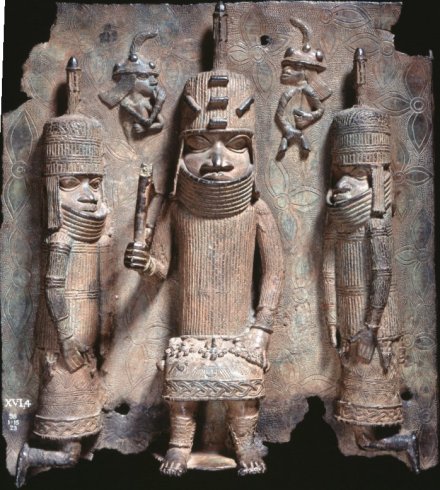
Great Britain’s punitive expedition also resulted in the capture of many hundreds of metal objects scattered to European museums and collections — collectively known as the Benin Bronzes. (It’s a misnomer: they’re actually brass.)

Hocked to defray the expense of their plundering, their diffusion around the empires’ continent helped broaden European appreciation for African art, and influenced modernist art movements. (Notably (pdf) German expressionism: tons of the bronzes ended up in Germany, and many can still be seen at Berlin’s Ethnological Museum.)

Nigeria, and the successor obas of Benin, have for decades besought their return in vain.


Cultural encounter: this Benin “bronze” shows the oba with two attendants, and the smaller floating heads of two European (Portuguese) traders.

More on this object, and its place in the story of Benin and Europe, in this episode of the BBC’s History of the World in 100 Objects; or, at the “bronze’s” page at the British Museum website.

On this day..