On this date in 1535, Catholic prelate John Fisher was beheaded on Tower Hill for refusing to endorse Henry VIII as the head of the Church of England.
The longtime Bishop of Rochester had only been elevated to the cardinalate weeks before by the new Pope Paul III, in the vain hope that the sublimity of the position would induce King Henry to ease the prelate’s imprisonment.
Henry eased it, all right. Permanently.*
Forbidding the official hat to be delivered to Albion, Henry declared he would dispatch its owner’s head to Rome instead.
A jury including the father of the usurping queen who had occasioned all this trouble — Anne Boleyn, of course, bound for the block herself in less than a year — condemned the aged ecclesiastic to death for treason.
He was hustled to the scaffold on this date to beat the June 24 feast day of his patron and namesake Saint John the Baptist, Christ‘s Biblical precursor who was … beheaded by a ruthless king whose marriage the Baptist had denounced. Struck a little too close to home, that.
Fisher’s friend and fellow-traveler both spiritual and temporal, Sir Thomas More, followed the cardinal’s footsteps to Calvary a fortnight later.
* It’s possible Henry had been out for Fisher’s blood for some time. As a foe of the king in his so-called Great Matter of many years’ standing, Fisher was the presumed target of a 1531 assassination-by-poison attempt that resulted in a horrific execution by boiling alive.
It’s at dawn on this date in 1800 that the republican Mario Cavaradossi is shot at Castel Sant’Angelo in the climax of the Puccini opera Tosca.
This opera was adapted from the play La Tosca, by Victorien Sardou. That author does this site the considerable favor of exactly dating the action; a character at the end of Act 1, Scene 1 announces, “this evening, 17 June, a celebration at the Palazzo Farnese in honor of this victory.” The remaining story unfolds over that night and into the next morning.
En route to Marengo: Jacques-Louis David‘s heroic picture of Napoleon crossing the Alps comes from this campaign.
“This victory” worth the proposed palazzo party is the Austrian defeat of Napoleon at the Battle of Marengo during Bonaparte’s 1800 invasion of Italy.
But there’s a minor problem. Said seesaw battle went not to Austria but (decisively) to Napoleon, after a late French rally.
The action of Tosca takes place in a Rome which has received an initial, incorrect notice of Austrian victory. This is of particular import in the Eternal City because it’s under the temporary receivership of the Hapsburg Queen Maria Carolina, a virulent foe of the French Republic as befits a sister of Marie Antoinette.
(France-supported Italian revolutionaries had already deposed Maria Carolina once; the Corsican’s reappearance on her peninsula gave her good cause to fear that it would happen again.*)
At any rate, “Queen Caroline” and her husband Ferdinand were not above spilling blood to hold down the republican elements in Rome. Harold Acton pegged their harvest at “8,000 political prisoners … 105 were condemned to death, six of whom were reprieved.”
Our date’s fictional principal would reckon among those.
We meet him as a painter with subversively liberal inclinations, in love with the titular heroine as she with him — but opposed by police chief Scarpia: his profession is to pursue revolutionaries; his passion, to pursue Tosca.
Scarpia captures, and tortures, Cavaradossi for aiding an escaped official of the recently destroyed Roman Republic, and forces Tosca to yield herself to him in exchange for her lover’s life.** This is Tosca’s aria lamenting her position:
One thing: because Scarpia doesn’t want to be implicated in the release of a dangerous radical, he insists on a mock-execution in which the prisoner will appear to be shot and feign death, the better to spirit Cavaradossi away and on to happily-ever-after.†
And because Scarpia is a villain, he arranges for his rival’s “mock” execution to be not so mock after all … to the suicidal horror of Tosca.
Aaaaaand curtain.
There are scads more Tosca excerpts on YouTube. Here’s an Italian-English libretto, and here a handy summary.
On this date in 1955, Barbara Graham was gassed at California’s San Quentin Prison, along with two confederates in the brutal murder of an elderly widow.
Following the classic sob-story vector from orphan to juvenile delinquent to petty criminal, Graham found her calling as femme fatale.
She entered adulthood with World War II, and spent the war years alternating between failed marriages and the working-girl beat for Pacific military bases.
“Sure, I was a prostitute — and a damn good one,” she later confided to a reporter. “Why do people make so much of sex anyway? It’s part of our natural make-up, like getting hungry for food. If you want to eat, you go to a grocery store or a restaurant. If you need sleep, you sleep. If you want sex, why not get it?” (Source, a thorough .doc file)
Police made a bigger deal of perjury when she unwisely tried to help out some underworld friends by swearing to a demonstrably bogus alibi for them. She did some real time, tried to go straight in a boring Nevada town, and inevitably — for the likes of this site — returned to the siren lures of California.
It was back to the familiar job servicing the familiar hunger … but now with a new hunger of her own: heroin.
And heroin meant a now-ravenous appetite for cash.
Barbara Graham’s trip to the gas chamber and to California crime history began when she and some fellow-addicts tried to satiate that latter craving by burgling the Burbank home of Mabel Monohan, who was rumored to live alone with a lot of portable valuables.
The job was a botch from beginning to end: someone bludgeoned the crippled woman to death, but nobody found the supposed boodle. And as the police investigation led back towards the culprits, two of them flipped on their confederates.
(The first of them was kidnapped and murdered to prevent his testimony while everyone was still on the lam. The second happily took his place as the stool pigeon once everyone was in custody. Graham, proving that those who do not learn from history are doomed to repeat it, got caught on a wire trying to suborn perjury on her own behalf, dramatically destroying her alibi defense mid-trial.)
Shock murder authored by vamp courtesan? (The informant would testify that Graham personally pistol-whipped the victim into a bloody heap.) Hellooooo, California noir.
In its day, Graham’s case prompted all the moralistic hand-wringing familiar to the condemned-hottie tableau down to our present age. And at least that much unconcealed voyeurism. On the eve of her death, the Los Angeles Times palpitated:
“Nothing can be done now — I’m lost,” Mrs. Graham sobbed yesterday when told that Federal judges here and in San Francisco had turned down the latest bids for a stay of execution …
Two years in prison waiting for death have taken their toll of the once attractive convicted murderess.
Her reddish-blond hair has reverted to its natural black color. She has lost about 30 pounds. She is gaunt, tense and near hysteria.
The two men who shared her crime, her sentence, and her fate, did not endure a similar public microscope. Why would they? Jack Santo and Emmett Perkins — and this is the first we’ve even bothered to name them in this post — were just two dude hoods from central casting. Three hours after “Bloody Babs” succumbed to the fumes,* Santo and Perkins were gassed together as the forgettable postscript, “chatt[ing] amiably” with one another in the little metal shed while San Quentin’s personnel did all the preparatory business. (Los Angeles Times, June 4, 1955)
Graham’s persistence with a decreasingly plausible innocence story similarly amplified the pathos of her situation.
A 1983 television remake starred former Bionic Woman Lindsay Wagner.
* Given the standard advice for gas chamber clientele that breathing deeply makes it all go down easy, Graham aptly retorted, “How in the hell would you know?”
The fourth Duke of Norfolk, he inherited the title from the third Duke of Norfolk — his eponymous grandfather, the scheming courtier who had maneuvered nieces Anne Boleyn and Catherine Howard into disastrous matrimony with Henry VIII.
Having run afoul of his ruthless sovereign, this elder Howard then had the distinction of dodging execution only because the king himself dropped dead the very day before Howard was to have been beheaded.
The Norfolk title, however, did skip a generation, because grandpa Howard’s son Henry Howard was not so lucky, and abdicated his birthright at the block.*
That left our day’s principal, a mere boy of 10 when his father got axed, as his lucky grandfather’s heir apparent — to carry on the Howard scheming against his second cousin, Anne Boleyn’s lucky daughter Queen Elizabeth.
And young Thomas Howard would prove to be a chop off the old block.
Howard’s sympathies for Catholicism and for swinging an ever-bigger dick led him into a machination to wed Elizabeth’s northern rival Mary, Queen of Scots.
Lucky to get off with just a slap on the codpiece, Howard went right back at it with an unabashed Spanish-supported conspiracy to depose Elizabeth, again in favor of Mary — the Ridolfi Plot.
This chicanery was sniffed out by Elizabeth’s pervasive spy network, and while Mary’s royal status enabled her to survive the revelation, Norfolk had already got down to his last chance.
The conflict between Elizabeth and Norfolk, heavily fictionalized and climaxing in the Ridolfi Plot, is essentially the plot of of the 1998 movie Elizabeth.
Having endured so much trouble from these nettlesome Howards, the crown left the Duke of Norfolk title vacant for nearly a century after this date’s beheading. It was finally restored to a mentally deficient Howard descendant with the post-Cromwell Stuart restoration.
* And that’s just on the dad’s side. His maternal grandfather and great-grandfather from the Stafford family also met their ends on the scaffold.
On this date in 1307, radical preacher Fra Dolcino was gruesomely put to death in a daylong public torture at the Piedmontese town of Vercelli.
Dolcino was the millenarian successor of Gerard Segarelli, whose itinerant commune of impoverished penitents — Apostles, they called themselves, to the chagrin of the Church hierarchy — had attracted followers for near half a century before the powers that be smashed it.
The shade of the burned firebrand (and the corporeality of his refugee onetime followers) haunt the murderous monastery of Umberto Eco’s The Name of the Rose. Here, the paternal Franciscan unraveling the novel’s mystery explains Fra Dolcino’s illicit movement to his naive protege.
We were talking about those excluded from the flock of sheep. For centuries, as pope and emperor tore each other apart in their quarrels over power, the excluded went on living on the fringe, like lepers … all of them were ready to hear, or to produce, every sermon that, harking back to the word of Christ, would condemn the behavior of the dogs and shepherds and would promise their punishment one day. The powerful always realized this. The recovery of the outcasts demanded reduction of the privileges of the powerful, so the excluded who became aware of their exclusion had to be branded as heretics, whatever their doctrine …
the movements of spiritual renewal were blocked; they were channeled within the bounds of an order recognized by the Pope. But what circulated underneath was not channeled. It flowed, on the one hand, into the movements of the flagellants, who endanger no one, or into the armed bands like Fra Dolcino’s …
From the cinematic adaptation of The Name of the Rose. The monk’s semi-coherent summons to “penitenziagite” is significant because it marks him as a former adherent of the penance-focused movement. An Italian metal band called Dolcinian had a song (and album) of that exact title.
But were they really an “armed band”?
Executed Today is pleased to mark this portentous anniversary in conversation with historian Dr. Jerry Pierce, currently working on a book about the outlaw movement.
JP: A lot of people get kind of caught up in the Dolcino part. It’s not about him until the very end.
The group itself originated in 1260, and it lasted 40-some years before it ran into any trouble. Their whole goal when they start is essentially, live a life of poverty like the original Apostles. And apparently that’s a problem for people later.
That’s really all it was about. It’s communal living, it’s not owning things at all, including houses. By 1260, they were better Franciscans than the Franciscans were.
And the Franciscans had a big presence in the city of Parma, where this thing got started, so they were slightly peeved.
So it’s a challenge to the Franciscans?
It’s not trying to show up the Franciscans, but it becomes a challenge.
The “Apostles” wander around, they beg for their food, they tell people to do penance.
The early Franciscans started off the same way, all about poverty, but once they became established, the order became all about money.
And the Apostles are not the only ones mounting this challenge.
Right. Waldensians in France predate the Franciscans by about 30 years or so.* You just have a guy in France who’s a businessman who hears a reading of the gospel saying to give up your possessions and follow Christ. And that’s what he does. He even pays someone to translate the Bible into vernacular French, which is a big no-no.
His group and Segarelli’s group are not an issue as long as they don’t say anything about the doctrine. So long as they don’t say anything about the Trinity or the Eucharist, they’re just calling people to penance — they’re okay.
But the reason these groups come along is that in that period, around 1150 — Europe is experiencing a big economic change. The haves are on the side of the church. This is the core of all of them, and it’s the core of the Dolcino philosophy as well — the church is preaching poverty, but it’s living wealthy.
So they were doing something within the practice of the Church’s community for decades. How did they get so dangerously on the outs?
The bishop of Parma actually patronizes the Apostles and grants indulgences to people who give money to them. They’re not just some kooky group that’s out there even though the main writings about them are by their opponents.**
But what happens is they become really, really popular, and people start following them, and the Franciscans get the hierarchy involved.
There’s nothing doctrinal about them until Dolcino that becomes heresy.
And what specifically is that?
You take Segarelli’s stuff about poverty and radical egalitarianism, and you have Dolcino either witness or know about the execution of Segarelli, and that sort of crystallizes for him that members of the Church are forces of evil.
Basically, Dolcino says that if they would kill this guy for preaching nothing other than poverty, which is their own message, then there’s something wrong.
Because of the persecution — Segarelli’s execution, the Inquisition moving in and questioning people — that kind of pressure is what spurs Dolcino to take off to the northern mountains. That’s sort of the catalyst for him to become apocalyptic.
But even suppressing that takes the Church years.
The chronology is muddy because we only have about three sources, but we think he joined the order before Segarelli was executed. And between 1300 and 1302 or 1303, he’s off in the northeast of Italy near Trento.
He’s from Valsesia, a river valley in the Piedmont, and he eventually returns with a bunch of followers across the mountains — between Novara and Vercelli. It’s an important area because the bishops of the two cities have been fighting each other for access to the valleys, and fighting the local feudal lords, the Biandrate.
This family that’s been controlling the region, they’ve been extending their influence far up the river valley and the farther you go up the valley, the more independent the people are up there; they hate people who encroach on their autonomy and they’ve recently rebelled and kicked them out.
Essentially, Dolcino enters this sovereign territory, and he’s saying to the inhabitants, the wealthy church and the people who live down on the plain are wicked and they’re going to assault you, and sure enough …
And that’s the rebellion that takes place, it’s these farmers and families who live up there against the Crusader army.
A Crusade?
The Pope† allowed a papal indulgence for people going on Crusade up there. They essentially recruit a mercenary army.
The irony of it is that the things that Dolcino and his followers are accused of is raiding people’s houses and stealing all their stuff, and raiding churches and stealing all the gold. Well, guess who actually did that? And all the mercenaries needed to say when they plundered was, “uh, yeah, Dolcino did that.”
You have these non-Valsesian Crusaders and mercenaries who sort of move into these territories and basically get beat by the locals several times.
We know there was this final pitched battle. The Dolcinians flee to a mountaintop awaiting the End Times. Essentially what the Crusader army did was they starved them into submission, basically just blockaded the whole area, and then overran a bunch of starving women and children.
“On that day more than a thousand of the heretics perished in the flames, or in the river, or by the sword, in the cruellest of deaths. Thus they who made sport of God the Eternal Father and of the Catholic faith came, on the day of the Last Supper, through hunger, steel, fire, pestilence, and all wretchedness, to shame and disgraceful death, as they deserved.” (Source)
Dolcino also had a female opposite number, and the sect preached egalitarianism. Did they have an egalitarian gender politics as well?
The woman, Margaret or Margherita, it’s hard to tell exactly who she is — there’s all this embellishment. She’s sometimes called the “wife” of Dolcino, or sources call her the “mistress”, which makes it sound seedier. But we don’t actually know if they were involved or not involved. She was a former nun, and we know a little bit about her family, but there’s just not much about her.†
As to gender generally, the sources will say, these Apostles believed that nobody should own any property so they shared all their things and even their women.
So you’re meant to think that they just pass them around, but that wasn’t the case at all; there weren’t orgies and such. In this case, they did stress radical egalitarianism.
This is actually the ideology of the Christians in the first century: they also say, the world we live in is wrong, and it’s about to end — one of the things about the world they live in is, it’s patriarchal, and they come up with radical egalitarianism because there’s not supposed to be any distinctions in heaven and they’re looking forward to that.
We don’t exactly know if, in the end, it was the Dolcinians themselves fighting or the inhabitants of the area who protected them. But whoever it was, the [anti-Dolcino] sources on the battles also say, basically, “oh my God, the women are wearing pants and fighting next to the men.”
What’s the legacy of this whole movement?
In its own time, there were remnants of the Order of the Apostles still in Parma and the area for the next 20 or 30 years. It’s not heresy to be part of the group per se. There are references to sort of straggler parts of the group in France, in Spain, for the next 100 to 200 years, but it’s really hard to tell.
We do know they spread out pretty far. At one point under Segarelli they sent people to Jerusalem.
The people who live in Valsesia still today totally revere Dolcino. You can go on Dolcino hiking tours!
And there’s been this long history of appropriating his meaning.
“Thou, who perchance
Shalt shortly view the sun, this warning thou
Bear to Dolcino: bid him, if he wish not
Here soon to follow me, that with good store
Of food he arm him, lest impris’ning snows
Yield him a victim to Novara’s power,
No easy conquest else.”
-Mohammed, in Dante’s Inferno (He sounds prophetic, but Dante wrote after Dolcino’s death, with the action set while the heresiarch was still alive.)
In 1407, members of the Church went out and built a church consecrated to the fight aganist the heretics near the site where the Dolcinians were wiped out, and the local populace was outraged.
In 1907, Dolcino was appropriated by the Italian socialists. There was a workers’ group that planted a big red flag, and then they built a monument to him, with a plaque on it with the lines from Dante‘s Inferno.
There’s pictures of this monument, with tons of people up on the mountainside and they’re all dressed in their best.
And the monument lasted until the mid-1920s when the fascists blew it up with pro-fascist clerics. It was rebuilt in 1974, and you can see the old Catholic church from it — two opposing claims on Fra Dolcino.
Obviously you’re pretty sympathetic to this movement. What do you think we ought to make of them?
I think for me the key to understanding the whole order is not just to say, “well, everyone understands it wrong.” There’s a sort of willful wrongness to it, that whenever you put apocalypticism in it, it immediately puts people in the crazy category.
But in this period, when people talked about the end of the world, it didn’t necessarily mean they were nuts.
And then the other thing is, they’re not as violent and threatening as they appear on first read. I’m not even sure that they ever lifted a finger against the Crusaders, they may have just fled. Which in a sense means that they hold true to their values to the end.
‡ Margaret was also executed — allegedly turning down several smitten suitors’ offers to marry her if she would abjure. (Margaret was rich.) Although she’s most picturesquely shown burnt to death in front of Fra Dolcino during or before the latter’s torture, the sources seem to be unreliable as to whether she was in fact also executed on June 1, or on some other date.
This site is occasionally prepared to stray outside its execution-anniversary beat to cover especially fascinating manifestations of the death penalty in history.
So for this date, we observe the anniversary not of a punishment, but of the crime itself: a capital homicide in the capital of the world that changed art forever.
NNDB summarizes Caravaggio as a “temperamental painter,” but a less generous interlocutor might prefer a descriptor like “lowlife.”
Painter, he certainly was.
Caravaggio’s pioneering realism and flair for the dramatic …
Caravaggio’s Judith Beheading Holofernes, 1598-1599. Though the young painter on the make would hardly want for models of public decapitation in 16th century Rome, the gendered intimacy with the act invites consideration of Caravaggio’s likely attendance at the execution of Beatrice Cenci.
… made him a rock star on the canvas.
Though the papacy in its dogmatic counter-reformation aspect may have viewed Caravaggio’s eye-catching chiaroscuro with suspicion, there were scudi enough to burst the coinpurse of a talent who could grace a chapel with awe-inspiring stuff like this:
However many souls his stark brushwork won for the Church, Caravaggio’s reverential fare belied the creator’s own distinctly profane pastimes: gambling, boozing, brawling, and whoring around. He needed the intervention of well-placed patrons to duck prosecution on several occasions.
May 29, 1606 finds our “temperamental” antihero encountering a wealthy scoundrel by the handle of Ranuccio Tomassoni and a problem that would outstrip any political pull the artist could muster.
Allegedly, the two met to settle a paltry tennis wager, although this may have been a cover story for a rivalry over a courtesan.*
On whatever pretext, the young hotheads fell into a melee. Caravaggio won … and Tomassoni bled to death from the gash his foe dealt to his femoral artery.**
Caravaggio now had mortal blood on his hands. Homicides were treated very harshly by the authorities. Caravaggio was about to have a price put on his head, and if he were caught, that head would be summarily removed from his body and hung on a public street. Allies of Ranuccio bent on revenge were likely to be after him as well. … Caravaggio, the celebrated Italian painter, was now a notorious wanted killer. (Source)
Condemned an outlaw by Pope Paul V — himself fruit of Rome’s Borghese family, great patrons of art in their own right — Caravaggio fled the Eternal City. His brilliance went with him, perhaps even amplified by the exile.
“The fall from grace was huge,” a curator of late Caravaggio works argued. “It had a profound impact. He started expressing the psychological essence of the stories he is telling.”
The painter and killer had four years left to him — an exile spent sleeping clothed and armed, forever looking over his shoulder. But what his jangled nerves could still spare for the canvas would helplaunch the baroque artistic epoch and still influences us today.
Flight, fancy, and fortune took Caravaggio to Malta and to Sicily, but the year or so he spent as Naples’ visiting genius would make his artistic legacy: that city’s succeeding generations of painters took enthusiastic inspiration from Caravaggio’s Neapolitan offerings — like a Seven Works of Mercy that must have carried a very personal meaning for the hunted man.
He was reportedly as arrogant and hot-tempered on the run as he had been in Rome, but Caravaggio’s art in exile also traces his desperate attempts to undo the consequences of his bad behavior.
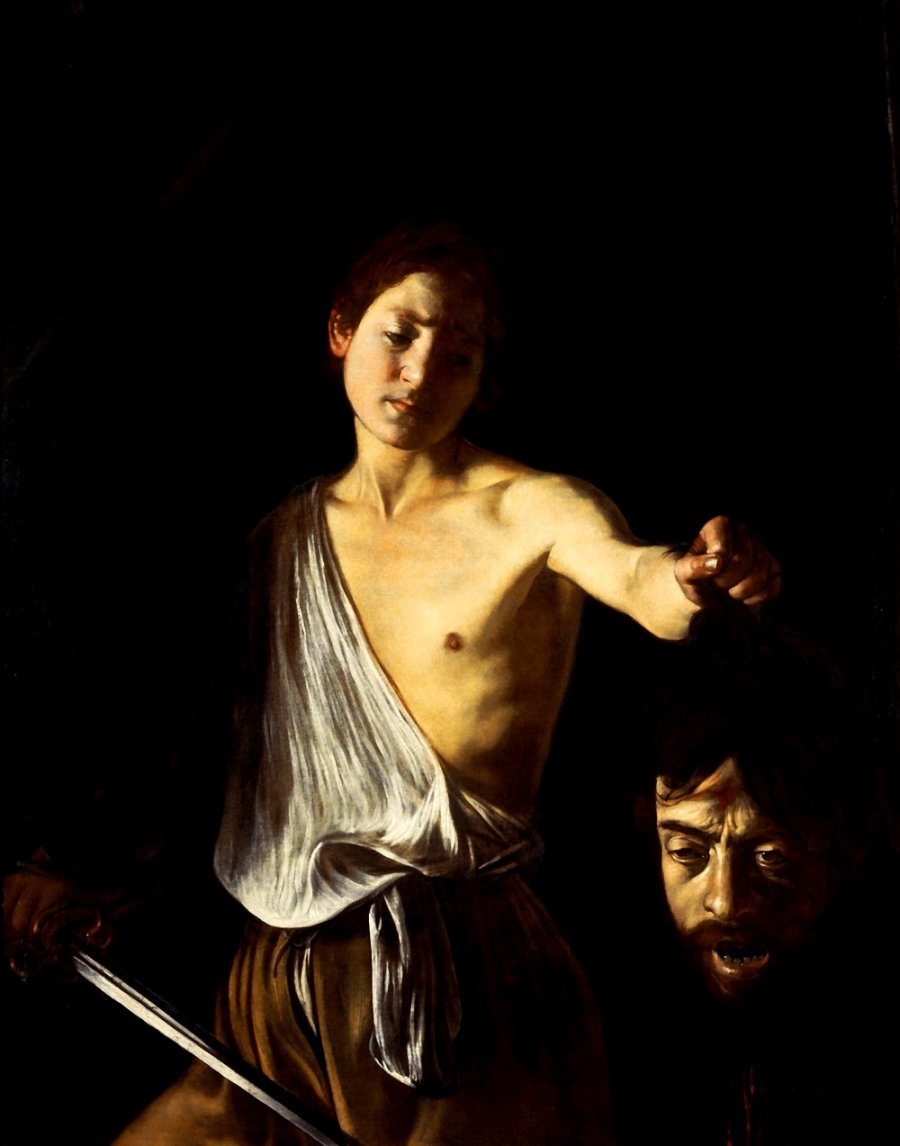
Exploiting his apparent affinity for the sawing off of heads, Caravaggio rendered his own head in a severed state in at least two apparently penitential paintings during this vulnerable period.
While David with the Head of Goliath seems to have been created shortly before Caravaggio’s own death for the pope’s art-hounding “Cardinal Nephew” Scipione Borghese, in a bid to earn a pardon. Caravaggio’s self-portrait as the dead man, and Latin inscription “humility kills pride” on the Israelite hero’s sword, suggest an attempt to effect through his creative virtuosity his own execution in effigy.
That would be, at any rate, the only execution Caravaggio ultimately had to endure. He died in the summer of 1610 under unclear — and inevitably suspicious — circumstances while attempting to return to Rome.
A few biographical books about Caravaggio …
… and some Caravaggio art books
* Ranuccio Tomassoni was the pimp and lover of a prostitute named Fillide whom Caravaggio had painted years before, and become enamored of. This Fillide was also Caravaggio’s model for Judith in the arresting painting of the Biblical heroine in mid-decapitation above.
** Possibly, if you like the love triangle angle, in a botched attempt to castrate his rival.
“Two weeks ago,” mused the May 26, 1911 Tulsa World “Deputy Sheriff George H. Loney went to the Nelson home in search of some stolen meat. He found it and started to make an arrest when he was shot and killed. Both the Nelson woman and her son at first claimed to have fired the fatal shot, but it was later admitted that it was the son who fired it.”
So Laura found her way into the annals of lynched women by that most quintessentially maternal act: attempting to protect her child.
As is typical in lynchings, the perpetrators remained permanently wink-wink “unknown”; indeed, the resulting investigation contributed some outstanding exemplars of racist patronizing — like the investigating judge’s charge to his grand jury of “the duty devolv[ing] upon us of a superior race and of greater intelligence to protect this weaker race from unjustifiable and lawless attacks.”
Thanks?
At least that compared favorably on the sympathy scale to the state’s governor, who slated the NAACP for stoking mob violence when the latter pressed for more vigorous anti-lynching action.
If your organization would interest itself to the extent of seeing that such outrages as this [i.e., the appointment of black federal officials in the state] are not perpetrated against our people, there would be fewer lynchings in the South than at this time, and you can do a great deal more to aid the Negro by seeing that other people of our section of the country are considered in these matters than you can issuing abusive statements against this country when a crime of this kind is committed.
Actually, a tweak here and there and that paragraph could go right into a present-day stump speech. The past, as they say, is not even past.
One face in the crowd — his exact role in the lynching seems to be unknown — was a local real estate hustler by the name of Charley Guthrie.
This blustery conservative southern Democrat would, the next year, name his third child for the Confederate-friendly academic Woodrow Wilson, who was then making a run for the White House that would see the U.S. to the nadir of its race relations.
Young Woodrow Wilson Guthrie — you know him as Woody — grew up with some different principles from dad; the counterculture folk troubadour was sufficiently haunted by his father’s proximity to this horrific exercise of mob justice to expiate it in song.
* Many web sites give the date as May 23, but the primary sources are unequivocal; the correct date is May 25.
On this date in 1883, Britain set about the grim work of avenging the assassination of its Irish plenipotentiaries by hanging Joe Brady at Kilmainham Gaol.
“He was brought up as a stonemason,” the May 15, 1883 London Times recalled of the by-then-hanged man, “of herculean strength, his occupation developing the muscular power of his arms, which told with such terrible effect when he drove the knives into the bodies of his victims.”
Those knife-driven bodies belonged to Irish civil servant Thomas Henry Burke (a quisling figure, in the eyes of Irish nationalists) and the English politician Lord Frederick Cavendish, who were jumped while taking a stroll in a Dublin park on May 6, 1882.
The authors of their destruction — beyond Joe Brady, personally — were the splinter of radical Fenians known as “the Invincibles”, who figured on the vincibility of the collaborators and informers who made British control of Ireland possible. Especially their vincibility to stonemason-wielded surgical knives.
Efficient, and surely less than genteel, police work busted up the cell after those spectacular homicides, inducing leadership figures to turn state’s evidence against their subordinates. Four more men consequently hanged in the month following Brady’s execution. The stool pigeons got to walk.
History did not delay her verdict on these characters.
While Invincible-turned-informer James Carey was promptly murdered in retaliation, Brady et al joined nationalist mythology as martyrs who “died a Fenian blade.”
I am a bold undaunted youth, Joe Brady is my name,
From the chapel of North Anne Street one Sunday as I came,
All to my surprise who should I espy but Moreno and Cockade;
Says one unto the other: “Here comes our Fenian blade”.
I did not know the reason why they ordered me to stand,
I did not know the reason why they gave me such a command.
But when I saw James Carey there, I knew I was betrayed.
I’ll face death before dishonour and die a Fenian blade.
They marched me up North Anne Street without the least delay,
The people passed me on the path, it filled them with dismay.
My sister cried, “I see you Joe, if old Mallon gives me lave,
Keep up your heart for Ireland like a true-born Fenian Blade.
It happened in the Phoenix Park all in the month of May,
Lord Cavendish and Burke came out for to see the polo play.
James Carey gave the signal and his handkerchief he waved,
Then he gave full information against our Fenian blades.
It was in Kilmainham Prison the Invincibles were hung.
Mrs Kelly she stood there all in mourning for her son.
She threw back her shawl and said to all:
“Though he fills a lime-pit grave,
My son was no informer and he died a Fenian blade.”
And if the Times‘ report (the same May 15 article) is to be believed (reporters weren’t actually allowed to witness the execution itself), Brady wore that invincible conviction to the scaffold.
“Up to the last moment,” the paper reported, “he retained the animal courage which he displayed in the deed itself, which, though dastardly as regards the unarmed men whom he attacked, was daring in its other circumstances.”
Speaking of animal courage.
Our man Brady, very famous in Ireland around the turn of the century, makes a little appearance in the referential soup of James Joyce’s Ulysses* for animal spirits of a different sort: a conversation about his hanging provides the departure point for a Joycean meander into the phenomenon of scaffold priapism.
–There’s one thing it hasn’t a deterrent effect on, says Alf.
–What’s that? says Joe.
–The poor bugger’s tool that’s being hanged, says Alf.
–That so? says Joe.
–God’s truth, says Alf. I heard that from the head warder that was in
Kilmainham when they hanged Joe Brady, the invincible. He told me when they cut him down after the drop it was standing up in their faces like a poker.
–Ruling passion strong in death, says Joe, as someone said.
–That can be explained by science, says Bloom. It’s only a natural phenomenon, don’t you see, because on account of the …
And then he starts with his jawbreakers about phenomenon and science and this phenomenon and the other phenomenon.
The distinguished scientist Herr Professor Luitpold Blumenduft tendered medical evidence to the effect that the instantaneous fracture of the cervical vertebrae and consequent scission of the spinal cord would, according to the best approved tradition of medical science, be calculated to inevitably produce in the human subject a violent ganglionic stimulus of the nerve centres of the genital apparatus, thereby causing the elastic pores of the CORPORA CAVERNOSA to rapidly dilate in such a way as to instantaneously facilitate the flow of blood to that part of the human anatomy known as the penis or male organ resulting in the phenomenon which has been denominated by the faculty a morbid upwards and outwards philoprogenitive erection IN ARTICULO MORTIS PER DIMINUTIONEM CAPITIS.
* As was Brady’s getaway driver James “Skin-the-Goat” Fitzharris, who became a national celebrity by serving a long prison sentence for refusing to inform on anyone.
On this date in 1730, career criminal James Dalton was executed at Tyburn.
Detail view (click for full image) of James Dalton’s wig box depicted in the boudoir of prostitute Moll Hackabout in Hogarth’s A Harlot’s Progress.
Crime ran in the family for young master Dalton; his father hanged upon the information of notorious (and himself eventual gallows-bird) Jonathan Wild. According to the Ordinary of Newgate’s report, our day’s principal “went between his Father’s Legs in the Cart, to his fatal Exit at Tyburn.”*
Who knows but what naughty urchins (or parents) in the throng were deterred by that affecting spectacle. For the Daltons, it was more like Take Your Child to Work Day.
While the elder Dalton’s skills ran towards card-sharping, young master James went in for the more conventional varieties of larceny — both those practiced by stealth, and those practiced by force.
These pursuits saw him twice transported to America, for which we have to thank the English judiciary on account of Dalton’s resultant biography at Early American Crime.
(In)famous for his many dalliances, Dalton’s exploits could move copy in their day — and their author transgress the lines between the underworld and “legitimate” celebrity.
“In the height of all our Robberies” [Dalton] and his companions “used to go to the Playhouse, dressed like Gentlemen,” and that once, while watching The Beggar’s Opera, “Captain Macheath’s Fetters happening to be loose,” one of them “call’d out, Captain, Captain, your Bazzel is undone.” The real thieves, having shown up the actors with their superior knowledge of both irons and cant, then retired in style to an alehouse, “in four Chairs, with six Lights before each Chair.”**
Just another hanged thief.
Except, also not — because while his career in malefaction would undoubtedly have added up to a death sentence, his condemnation was secured upon the word of a perjurer upon a very doubtful charge.
A character named John Waller, an “affidavit man” whose profession was supplying bogus testimony to hang whomever could be hanged where a reward was available, insisted that Dalton had robbed him upon the roads. Dalton vigorously denied (and even rebutted with evidence) this charge even while admitting his general life of crime, but it was upon this dubious offense against Waller that he stretched his neck. Dalton died at Tyburn with three others, though a fifth member of their party, one Hugh Norton or Haughton, managed to cheat the executioner by hanging himself in his cell.†
It was the rough justice of the 18th century, a time frequently admitting opportunity to repay tit for tat.
In this case, the professional perjurer who hanged Dalton was two years later convicted himself after making a bogus accusation of highway robbery. Waller was condemned by the court to stand in the pillory at the Seven Dials — a dangerous punishment cousin to the era’s death penalty, inasmuch as the mob violence thereby invited not infrequently proved fatal.
John Waller bombarded with refuse in the pillory.
Waller had quite a reputation, but the fury of the crowd was nothing next to that of James Dalton’s brother, Edward — who, with a confederate, brazenly climbed onto the platform, wrenched the “assize man” out of his pillory, and savagely beat him to death.
** Andrea McKenzie, “The Real Macheath: Social Satire, Appropriation, and Eighteenth-Century Criminal Biography,” Huntington Library Quarterly, Vol. 69, No. 4 (December 2006), with the quotes supplied by a 1730 publication called “The Life and Actions of James Dalton (the Noted Street-Robber)”
† Norton/Haughton was posthumously hanged in chains the next day.
On this date in 1909, a Mexican bandit was executed by the police. Maybe. Unusually for these pages, the date is quite certain but the existence of the executed man is not.
If he existed — and this caveat is standard in practically every profile of the fascinating cultural phenomenon fathered by the man or phantom — Jesus Malverde was a Robin Hood-esque “social bandit” who preyed on Mexico’s plutocratic agricultural lords and distributed the spoils to the poor.
According to Patricia Price (“Bandits and Saints: Jesus Malverde and the Struggle for Place in Sinaloa, Mexico”, Cultural Geographies 2005; 12; 175), the Malverde of legend entered the world as Jesus Juarez Mazo, but his
own parents died of hunger or a curable illness, and that this was the catalyst for his turn to a life of crime. While Malverde was said to have worked variously on the railroads, as a carpenter, or as a tailor, he soon joined the ranks of bandits that roamed Mexico’s countryside at the end of the nineteenth century. He reportedly stole gold coins from the rich hacienda owners living in Culiacan and threw them in the doorways of the poor at night.
Truly a figure who, if he did not exist, it were necessary to invent.
All the particulars about his legendary exploits are a bit fuzzy, right down to his end on May 3, 1909 — possibly gunned down, possibly left to die of exposure with his feet hacked off, or possibly (and certainly more picturesquely) summarily hanged from a mesquite tree by a posse.
(In a version that appealingly combines these threads, he’s said to have been dying of gangrene after being shot, and in a last act of charity prevailed upon his friend to bring in his body to collect the reward. The police gibbeted his corpse.)
In the years since, Malverde has become a popular divine intercessor for the marginal social classes who could identify with such a figure, like Sinaloa’s poor farmers of corn and beans.
And other cash crops.
Malverde is also the patron saint — decidedly unofficial, of course — of the region’s robust narcotics trade.
His shrine stationed across the way from a government compound in Sinaloa’s capital city draws a bustle of devotees.* Offerings like produce and shrimp share space with icons of marijuana and AK-47s, and votive notes appreciating “how things turned out, and how nobody was grabbed.”Breaking Bad gave him a shout-out from the mouths of disdainful DEA agents north of the border.
the poorest, the handicapped, pickpockets, thugs, prostitutes, drug traffickers and drug addicts, in sum, the stigmatized who, in civil or religious iconography don’t find anyone who looks like them, in whom to confide and in whose hands to put their lives.

 The longtime Bishop of Rochester had only been elevated to the cardinalate weeks before by the new Pope Paul III, in the vain hope that the sublimity of the position would induce King Henry to ease the prelate’s imprisonment.

 Following the classic sob-story vector from orphan to juvenile delinquent to petty criminal,




 “He was brought up as a stonemason,” the May 15, 1883 London Times recalled of the by-then-hanged man, “of herculean strength, his occupation developing the muscular power of his arms, which told with such terrible effect when he drove the knives into the bodies of his victims.”


 If he existed — and this caveat is standard in practically every profile of the fascinating cultural phenomenon fathered by the man or phantom —

