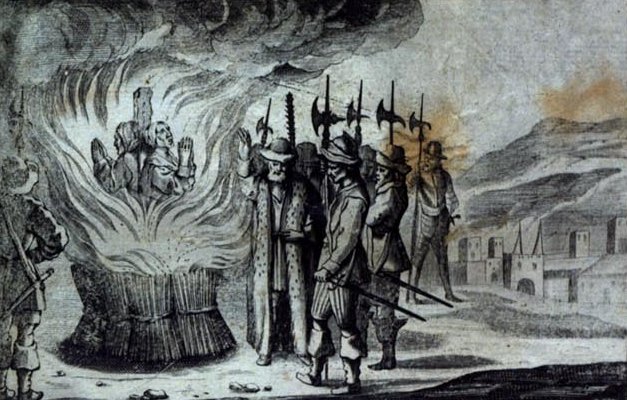
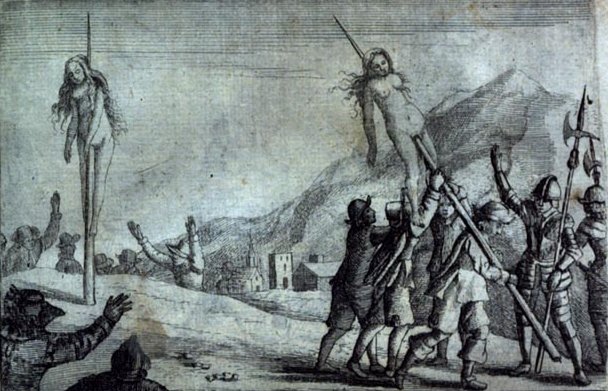
1655: Massacre of Waldensians

On this date in 1655, Catholic forces under the Duke of Savoy carried out a notorious massacre of Waldensians* in the Piedmont.

This interesting, excommunicate sect had persisted for centuries in those hard-to-reach places in Alpine foothills, intermittently ignored and hunted. After Martin Luther, many Protestants inclined to see them as a proto-Reformation movement, or even a counter-papal apostolic succession reaching back to ancient Christianity.

At any rate, they sure weren’t Catholic.

And our friend the Duke decided — perhaps piqued by the murder of a missionary Catholic priest, or for whatever other reason — to mount one of those heresy-extirpating sorties and make them Catholic in 1655.

On April 17, the Marquis of Pianezza appeared with an overwhelming force of mixed Piedmontese, French, and Irish** troops. They conducted a few skirmishes, then made nice with the Waldensian civic leaders and induced them to quartering their troops temporarily further to some expedient pretext.

Alas! alas! these poor people were undone. They had received under their roof the executioners of themselves and their families. The first two days, the 22d and 23d of April, passed in peace, the soldiers sitting at the same table, sleeping under the same roof, and conversing freely with their destined victims …

At last the blow fell like a thunderbolt. At four of the clock on the morning of the 24th April the signal was given from the Castle of La Torre. But who shall describe the scenes that followed? On the instant a thousand assassins began the work of death …

Little children were torn from the arms of their mothers, and dashed against the rocks; or, more horrible still, they were held betwixt two soldiers, who, unmoved by their piteous cries and the sight of their quivering limbs, tore them up into two halves. Their bodies were then thrown on the highways and the fields. Sick persons and old people, men and women, were burned alive in their own houses; some were hacked in pieces; some were bound up in the form of a ball, and precipitated over the rocks or rolled down the mountains … Some were slowly dismembered, and fire applied to the wounds to staunch the bleeding and prolong their sufferings; some were flayed alive; some roasted alive; others were disembowelled; some were horribly and shamefully mutilated, and of others the flesh and brains were boiled and actually eaten by these cannibals.

–Source, whose atrocity accounts channel those in this French tome

Without doubting the capacity of man’s inhumanity to man, the cannibalism charge reminds that we’re dealing with propaganda alongside historiography. And what great propaganda — like, babies-torn-from-incubators great.

Thumbnails (click for a larger, disturbing view) of selected images of this date’s atrocities from Samuel Morland’s The History of the Evangelical Churches of the Valleys of Piedmont

And there’s little doubt as to the overall savagery of the affair, which could well have become the opening salvo in a full-scale sectarian cleansing campaign. (A later addendum to Foxe’s Book of Martyrs narrates the ensuing Piedmontese armed struggle, petering out before any definitive resolution in the field.)

Outrage at this hecatomb spread in Protestant Europe — which would also refer to the day’s doings as the “Bloody Easter,” since it corresponded with the eve of that celebration as reckoned by the Julian Calendar (source).

It was felt especially in Protectorate England, which intervened diplomatically.

A “day of solemn fasting and humiliation” was promulgated in Albion, along with collections for the relief of the survivors. Oliver Cromwell personally put £2,000 into the kitty.

More importantly, he dispatched diplomat Samuel Morland† to force the House of Savoy to lay off the persecution; in fact, he threatened to disrupt high statecraft between England and France unless the French twisted arms on behalf of the Waldensians.

Written correspondence for Morland’s diplomatic tour addressed to Louis XIV of France and various other continental potentates, as well as a fiery bit of oratory that Morland delivered to Savoy, all seem to have originated from the pen of Republican scribbler John Milton — the future author of Paradise Lost.‡

Milton, for whom the whole thing was more than just a day job, was further moved to put his umbrage at the slaughter into sonnet form:

Avenge O Lord thy slaughter’d Saints, whose bones
Lie scatter’d on the Alpine mountains cold,
Ev’n them who kept thy truth so pure of old
When all our Fathers worship’t Stocks and Stones,

Forget not: in thy book record their groanes
Who were thy Sheep and in their antient Fold
Slayn by the bloody Piemontese that roll’d
Mother with Infant down the Rocks. Their moans

The Vales redoubl’d to the Hills, and they
To Heav’n. Their martyr’d blood and ashes sow
O’re all th’ Italian fields where still doth sway

The triple Tyrant: that from these may grow
A hunder’d-fold, who having learnt thy way
Early may fly the Babylonian wo.

* The Waldensians in question here are interchangeably known as the Vaudois for their geographic region, actually above the Piedmont and abutting the Swiss region also known as Vaud. (These pages have visited the latter.)

** Fresh from being on the receiving end of another infamous massacre.

† Morland is more regarded for his post-Restoration labors as an inventor; he created an early calculator and internal combustion engine.

‡ The speech in particular is not definitively attributed; see Robert Fallon, “Milton in Government: Denmark and Savoy,” Milton Quarterly, May 1989.

On this day..

Feast Day of St. George

This is the feast date, and the traditionally-ascribed execution date in 303, of St. George — legendary dragon-slayer and patron saint of half the world and darn near everything that the original apostles didn’t nail down.

Saint George is supposed to have been a well-favored officer in Diocletian‘s army who suicidally announced his Christian faith during the latter’s persecutions, and refused every sop and entreaty to renounce it. He was martyred at Nicomedia.

Pretty standard persecution fare — and there’s next to nothing that can be reliably verified about his life — but George did well by his future cult to get into the martyr’s game right before Christianity’s official triumph. Still, at the end of the day, it’s one of those unaccountable accidents of history that this particular fellow ended up as perhaps Christendom’s most widely venerated champion.

He’s most immediately recognizable for the story of having slain a dragon, a plain metaphor for paganism (and usable metaphor for anything and everything else) that’s been depicted in all its scaly corporeality by innumerable artists.

England has liked him jolly well ever since his suitability to the chivalric ethos positioned him to supplant Edmund the Martyr as that realm’s patron saint during the Middle Ages. The red cross on the English flag is a St. George’s cross.

And so there he is, too, in one of Shakespeare’s most rousing patriotic monologues:

I see you stand like greyhounds in the slips,
Straining upon the start. The game’s afoot:
Follow your spirit, and upon this charge
Cry ‘God for Harry, England, and Saint George!’

But George gets around, and England has to share him.

That St. George’s Cross also adorns the flag of Georgia (the country, that is: it’s so hard core that it’s named for the guy), and he’s claimed as a sponsor throughout Orthodox Christendom: Serbia (which celebrates a major holiday when April 23 hits on the Julian calendar); Bulgaria; Greece; Ethiopia; the city of Constantinople and its heir, the city of Moscow, and Russia generally. There were two George’s [Yuri’s] Days on Old Russia’s calendar, and the autumn one was marked as the one time in the year that serfs were permitted to change their landlords, at least until Boris Godunov canceled the privilege and left Russian with the idiom “so much for Yuri’s day!” to mark an expectation disappointed.

George is big in Spain, and even bigger in Portugal; through its Portuguese heritage, he’s also venerated in Brazil, where he’s the patron saint of the Corinthians football club. He’s the sponsor (via that dragon connection) of the snaky Hungarian military order that gave Vlad the Impaler the immortal sobriquet of Dracula.

There are other countries and any number of cities who also trust the dragon-slayer’s patronage; George accepts the further devotions of saddle-makers, lepers, animal husbandmen, shepherds, Crusader knights, butchers, the Maltese, gypsies, farmers, archers, syphilis-sufferers, cavalrymen and therefore also armored tankmen, Palestinian Christians, and the Boy Scouts of America. He’s generally got a stupendous worldwide collection of churches, art, legends, and devotional rites dedicated to his name.

On this day..

Unspecified year: Snowball’s animal fifth column

“Four days” after an unspecified “early spring” date in George Orwell’s classic allegory of Soviet communism, Animal Farm, a show trial and mass execution of animals purporting to work for the book’s Trotsky figure signals the titular farm’s unmistakable collapse into dystopia.

In the book, a revolution of animals displaces the farm’s human owner, Jones — the hated ruler of the ancien regime.

The farm’s early cooperative elan soon shatters, with a pig bearing the unsubtle name of Napoleon becoming the revolution’s autocrat, and fostering a paranoid security climate against phantasmal plots by his fellow swine and onetime comrade, the exiled Snowball.

Let’s watch.

Napoleon ordered all the animals to assemble in the yard. When they were all gathered together, Napoleon emerged from the farmhouse, wearing both his medals (for he had recently awarded himself “Animal Hero, First Class”, and “Animal Hero, Second Class”), with his nine huge dogs frisking round him and uttering growls that sent shivers down all the animals’ spines. They all cowered silently in their places, seeming to know in advance that some terrible thing was about to happen.

Napoleon stood sternly surveying his audience; then he uttered a high-pitched whimper. Immediately the dogs bounded forward, seized four of the pigs by the ear and dragged them, squealing with pain and terror, to Napoleon’s feet.0 …

The four pigs waited, trembling, with guilt written on every line of their countenances. Napoleon now called upon them to confess their crimes. … Without any further prompting they confessed that they had been secretly in touch with Snowball ever since his expulsion, that they had collaborated with him in destroying the windmill, and that they had entered into an agreement with him to hand over Animal Farm to Mr. Frederick. They added that Snowball had privately admitted to them that he had been Jones’s secret agent for years past. When they had finished their confession, the dogs promptly tore their throats out, and in a terrible voice Napoleon demanded whether any other animal had anything to confess.

The three hens who had been the ringleaders in the attempted rebellion over the eggs now came forward and stated that Snowball had appeared to them in a dream and incited them to disobey Napoleon’s orders. They, too, were slaughtered. Then a goose came forward and confessed to having secreted six ears of corn during the last year’s harvest and eaten them in the night. Then a sheep confessed to having urinated in the drinking pool — urged to do this, so she said, by Snowball — and two other sheep confessed to having murdered an old ram, an especially devoted follower of Napoleon, by chasing him round and round a bonfire when he was suffering from a cough. They were all slain on the spot. And so the tale of confessions and executions went on, until there was a pile of corpses lying before Napoleon’s feet and the air was heavy with the smell of blood, which had been unknown there since the expulsion of Jones.

When it was all over, the remaining animals, except for the pigs and dogs, crept away in a body. They were shaken and miserable. They did not know which was more shocking — the treachery of the animals who had leagued themselves with Snowball, or the cruel retribution they had just witnessed. In the old days there had often been scenes of bloodshed equally terrible, but it seemed to all of them that it was far worse now that it was happening among themselves. Since Jones had left the farm, until today, no animal had killed another animal.

Animal Farm was published in 1945. In this 1954 British animated feature, the downer of an ending — with the corrupt pig rulers becoming literally indistinguishable from people — was dumped in favor of an ending where the animals revolt again.

On this day..

1943: Elise and Otto Hampel, postcard writers

(Thanks to Meaghan Good of the Charley Project for the guest post. -ed.)

On this day in 1943, a working-class German couple were executed for treason and sedition in Berlin, Germany: Otto and Elise Hampel’s reign of postcard-writing terror had finally come to its conclusion.

On the surface, the Hampels seemed like two very ordinary people. Elise had an elementary school education and worked as a domestic servant before she married Otto in 1935. Otto, a World War I veteran six years older than Elise, was a factory laborer.


Two of the treasonous postcards.

They lived modest, anonymous lives in Berlin and doubtless would have continued to do so if Elise’s brother, a soldier in the German Army, had not been killed in action in France in 1940.

Elise’s brother’s death was the catalyst for the Hampels’ tragically brave and utterly ineffectual two-year campaign of resistance against Hitler’s Germany.

Together the couple hand-wrote over 200 postcards and leaflets speaking out against the Nazi regime. The postcards urged people not to serve in the German Army, to refuse to donate to Nazi organizations, and generally do everything they could to resist the government. Otto and Elise scattered the cards in mailboxes, stairwells and other locations all over Berlin. The idea was that people would find the cards, read them and show them others, and thus the seed of rebellion would take root.

What actually happened was that almost all the cards were delivered to the authorities immediately. Nobody wanted to be caught in possession of such dangerous words.

Because of the sheer number of postcards and the long duration of their distribution, the Gestapo at first thought they were dealing with a much larger group of traitors. Doubtless they were frustrated that this riffraff, who couldn’t even write properly (the postcards were full of grammatical errors and misspellings), were able to evade them for so long. But the Hampels’ resistance activities eventually caught up with them.

They were unrepentant after their arrests in October 1942, and had little to say for themselves, beyond Otto’s statement that he was “happy” about protesting against Hitler. Roland Freisler‘s People’s Court duly condemned them to die for “preparation for high treason” and “demoralizing the troops.” They were executed by guillotine in the Plötzensee Prison.

For some reason, unlike their equally courageous, foolish and doomed counterparts in the White Rose, the Hampels’ story didn’t really catch on with historians.

They were saved from oblivion by the dangerously unstable, drug-addicted author Rudolf Ditzen, aka Hans Fallada, who came upon their Gestapo file after the war.

His 1947 novel, Every Man Dies Alone, written in just 24 days, is closely based on Elise and Otto’s story. This book was Fallada’s swan song; he died weeks before its publication. Titled Jeder stirbt für sich allein in Germany, it was not translated into English until 2009 — but it then became a runaway bestseller in the United States and (under the title Alone in Berlin) in Great Britain.

On this day..

1590: Anne Pedersdotter, Norwegian witch

The most famous witchcraft execution in Norwegian history took place on this date in 1590, with the burning of Anne Pedersdotter.

Pedersdotter (English Wikipedia entry | Norwegian) was the wife of Lutheran minister Absalon Pedersson Beyer (Norwegian link), a reformist theologian in Bergen.

Anne may have become a target of her prominent husband’s enemies; she was first implicated for witchcraft in 1575 when her husband’s uncle dropped dead, clearing the way for Absalon to take his place as bishop.

While she repelled that round of allegations, Absalon himself soon followed his kin into the great hereafter, leaving his widow a bit shorter on political pull. She lived on as a near-hermit, forever shadowed by the intimation of infernal intercourse.

In 1590, Anne’s neighbors, and maid, accused her again; her fate was sealed when a forbidding storm broke during her trial. (So says Witch Hunts in the Western World)

Anne Pedersdotter’s execution has become a literary staple in Norway, with a (highly dramatized) play (available free online here) itself re-stylized into other notable cultural products — such as Danish director Carl Theodor Dreyer‘s 1943 Vredens Dag (Day of Wrath) …

… and two different operas, Edvard Fliflet Braein‘s Anne Pedersdotter, in Norwegian; and, Ottorino Respighi‘s more conventionally Italian-language La Fiamma:

On this day..

1945: Kim Malthe-Bruun, Yours, but not forever

(Thanks to Meaghan Good of the Charley Project for the guest post. -ed.)

On this day in 1945, Kim Malthe-Bruun was executed by firing squad in the Vestre Fængsel Prison in Copenhagen. His crime was being a member of the Danish Resistance Movement in German-occupied Denmark; he had stolen a customs boat and used it to smuggle arms from Sweden to Denmark to be used against the Nazis.

Kim was born in Saskatchewan, Canada in 1923, and moved to Denmark at the age of nine with his sister and mother. He quit school at seventeen to become a merchant seaman, then joined the Danish Resistance in 1944. Kim was arrested on December 19, 1944, held in various detention cells over the next few months, tortured, and condemned to die, along with three other members of his resistance group. Doubtless the Nazis were anxious to execute them all while they still could; Germany’s surrender was less than a month away.

In 1949, Kim’s mother, Vibeke Malthe-Bruun, published a collection of his letters and diary entries. The book, titled Kim, became a bestseller in Denmark and made Kim revered as a national hero. It was published in English in 1955, under the title Heroic Heart: the Diary and Letters of Kim Malthe-Bruun. Most of the sources about him are in Danish.

Kim’s writings reveal him to be a deeply sensitive and caring young man, wise beyond his years. On April 4, two days before his death, Kim wrote his last letter to his girlfriend, Hanne, urging her to go on with her life:

I don’t expect you to forget me. Why should you forget something so beautiful as that which existed between us? But you mustn’t become a slave to this memory … Don’t let it blind you and keep you from seeing all the wonderful things life has in store for you. Don’t be unhappy …

You will live on and you will have other beautiful adventures, but promise me — this you owe to everything I have lived for — that never will the thought of me come between you and life … Gradually as bigger and more important things appear, I shall glide into the background and be a tiny speck of the soil out of which your happiness and your development will keep on growing …

You see, Hanne, one day you will meet the man who will be your husband. The thought of me will flash through you, and you will perhaps deep down have a vague, uneasy feeling that you are betraying me or something in you which is pure and sacred. Lift up your head once more, Hanne, look straight into my eyes which are smiling at you and you will understand that the only way to betray me is by not completely following your natural instincts. When you see him, let your heart go out to meet him — not to drown your sorrow but because you truly love him.

He closed with:

Yours, but not forever.

The author Lois Lowry was inspired by Kim’s story and based a character on him in her book Number the Stars. The novel, which is about the rescue of the Danish Jews, won the 1990 Newberry Medal, one of the most prestigious awards in children’s literature.

On this day..

1393: John of Nepomuk, Bohemian rhapsody

This is the date in 1393 when the Catholic patron saint of Bohemia, John of Nepomuk (or John Nepomucene) was tossed from Prague’s Charles Bridge into the Vltava River to drown at the order of the Holy Roman Emperor Wenceslaus.

Baroque statue of John Nepomuk on the Charles Bridge from which he was hurled. (cc) image from Jaguar Julie

A relief detail ((cc) image from Charles Hoffman) on this statue depicts the moment of Nepomuk’s martyrdom.

This Wenceslaus — not be confused with the good King Wenceslaus of song — had a tetchy relationship with powers ecclesiastical and temporal.

But although Wenceslaus did martyr a fellow by the handle of John of Pomuk or Nepomuk, the latter makes this blog because of political tension centuries afterward. Despite the date of his corporeal death, John of Nepomuk is really a counter-reformation saint.

Between the late 14th century and Catholic Austria’s bloody 17th century triumph over Czech nationalism the historical Nepomucene parted company pretty definitively.

The real John of Nepomuk was the General Vicar of the local archbishop, John of Jenstein (or Jenzenstein), whose skirmishes with Wenceslaus over the boundaries of royal authority caused historian Albert Wratislaw to draw a Thomas a Becket comparison.*

In the event, the latest manifestation of that disputatious relationship — the king’s attempt to seize some monastic revenues — caused Wenceslaus to completely fly off the handle and arrest several of the archbishop’s advisors, among whom was our sainted martyr.

Wenceslaus personally oversaw their torture and ordered their drowning, but someone talked him out of the execution part. The king at that point had a sort of mini-Guantanamo Bay situation: he had in hand several people whom he had arrested arbitrarily and tortured, whose release would only further embarrass his own royal self. He therefore prevailed upon them to trade their silence for their liberty.

The other arrestees counted their blessings and accepted this expedient exchange. John of Nepomuk, perhaps because he was already tortured near to the point of death, refused. He was consequently “dragged through the streets to the bridge, there his hands were tied behind him, a piece of wood was thrust into his mouth, his feet were tied to his head in the form of a wheel, and he was thrown into the river.”*

The Nepomucene’s legend really grew after his death: in its most splendidly devotional form, as the proto-martyr for the seal of the confessional, which he supposedly kept as the queen’s confessor when Wenceslaus suspected her of infidelity. (An ironic inversion to say the least, since it was actually John’s more timorous co-accused who distinguished themselves with their silence.)

This is a much more edifying martyrdom altogether, so little wonder that the sourcing on John of Pomuk over the succeeding centuries is a hot mess; later scholars would actually speculate as to whether there might not have been two priests of this name who were both martyred by Wenceslaus, so dissimilar were the legends.

Nepomuk’s elevation to legend, and thereafter to the patron saint of Bohemia, would come in part thanks to a great Czech religious reformer who arose at the end of Wenceslaus’s reign — Jan Hus.

This other, heretical John became woven into the emerging Bohemian national sense; he still remains there today. When the Catholic authorities beat back a Protestant and nationalist revolt in 1620 and imposed Catholicism from above,** Saint John of Nepomuk, martyr, was ready at hand for propagandists of the new order. At least, the legendary, confessional-keeping Nepomuk was ready … because this was not a job for the random cleric-bureaucrat who’d been done to death in some forgotten dispute over rent.

For three hundred years two holy men have been rivals for the reverence of the Cech people. One of them, Saint John Nepomuk, was exalted by the Jesuits, who after the battle of the White Hill in 1620 sought to win back the Cechs to the Roman obedience. … His rival for the position of national hero has been Jan Hus, who, during the reign and under the favour of that same king Wenceslas, led the revolt of the Cechs against the ecclesiastical domination of Rome and the secular domination of Germany, and was martyred as a heretic and rebel at the council of Constance in 1415. From that date until the extinction of the independent Bohemian state by the forces of the Empire and the Counter-Reformation in 1620, Hus was publicly honoured by his fellow-countrymen as the champion of national and religious liberty. From 1620 to 1918 his rival was exalted in his place …†

John of Nepomuk today is depicted in statuary on the Charles Bridge (the spot on the bridge where he was thrown over is also marked with a plaque) and is well-represented throughout Catholic central and eastern Europe. Owing to his patronage portfolios of bridges and flood victims, you might also find the Nepomucene in many a topical posting throughout the world — like the very spot of Christianity’s European triumph, Rome’s Milvian Bridge.

(Somewhat less gloriously, the promulgation of this saint’s name and fame mean it also attaches to John Nepomuk Schrank, a Bavarian immigrant to the U.S. who attempted in 1912 to assassinate former president cum presidential candidate yet again Theodore Roosevelt.)

* Wratislaw, “John of Jenstein, Archbishop of Prague, 1378-1397,” Transactions of the Royal Historical Society, Vol. 7 (1878), pp. 30-57. Wratislaw wrote a now-public-domain book about St. John available here.

** Bohemia’s Catholicization is perhaps the classic case in early modern Europe of the Reformation being rolled back from above and from afar. The recent (and none too affordable) book Converting Bohemia: Force and Persuasion in the Catholic Reformation takes a nuanced survey of Bohemia’s transformation from a Protestant to a Catholic bastion … and as the title suggests, finds many of the Catholic components home-grown.

† R.R. Betts, “Jan Hus,” History, Volume 24, Issue 94 (September 1939), pp. 97–112.

On this day..

1906: Pyotr Schmidt, Sevastopol uprising leader

On this date* in 1906, tsarist Russia executed the naval officer who had made bold to style himself Commander of the rebellious Black Sea Fleet.

During the unsuccessful 1905 Russian Revolution, our firebrand Pyotr Schmidt was lieutenant commander of a destroyer stationed at the Black Sea port of Sebastopol/Sevastopol.

Schmidt made an impassioned revolutionary speech that got him arrested, and was in turn freed by protesting workers and soldiers.

So they knew just the guy to call when a collection of Black Sea Fleet vessels finally out and mutinied. And Pyotr Schmidt knew how to talk the talk.

The glorious Black Sea Fleet, sacredly devoted to the people, demands Your Majesty to immediately call a meeting of the Constituent Assembly, and no longer obeys orders of Your ministers.

Commander of the Fleet P. Schmidt.

Nicholas II decided he was better advised to just order the mutinying ships stormed, and Schmidt was taken prisoner.

The most famous ship under Schmidt’s “command” was, of course, the battleship Potemkin, which trumps the cruiser Aurora as the revolutionariest hulk of floating steel in the Russian fleet by virtue of Sergei Eisenstein‘s silent cinematic celebration of the Sevastopol mutiny, The Battleship Potemkin.

With this sort of insurrectionary credential, Schmidt was a popular choice for Soviet-era naming and renaming — streets, bridges, other naval vessels.

(And come this, er, sea change in fortunes, the commander of the firing squad that did Pyotr Schmidt to death was himself arrested, and shot in 1923 by the Cheka.)

Schmidt thereby contributed his name to an entirely different innovation in the Russian language: in one Ostap Bender novel, there’s a “Children of Lieutenant Schmidt” network of con artists each claiming (in a different part of that vast country) to be the martyred mutineer’s progeny and mooching the material comforts due such an impressive lineage.

So striking and popular was this portrayal that “children (or sons) of Lt. Schmidt” remains a going Russian idiom for anyone running a similar scam.

* March 19 was the Gregorian date; it was March 6 by the obsolete Julian calendar still hanging on in Russia at this time.

On this day..

1244: Two hundred-plus Cathars at Montsegur

On this date in 1244, over two hundred Cathar heretics submitted themselves to the stake rather than submit to the Catholic church.

Though not literally the last of the Cathars, that outlawed dualistic sect in the south of France whose extirpation occupied the papacy for much of the 13th century, this date was the last great stand and the signature massacre of the Albigensian Crusade. Afterwards, only minor outposts and isolated individuals would remain available for mop-up duty.

Heretical holdouts, fleeing a malevolent Inquisition established in the Languedoc by victorious Catholic armies, holed up at a few Cathar strongholds of which the most impressive was the mountain citadel of Montsegur.


The spectacular attraction of Montsegur tourists see today is not the legendary Cathar castle — which was razed by its conquerors — but a subsequent rebuild. (cc) image from SarahLouiseHathaway

Finally in 1243-1244, a massive Catholic army invested Montsegur; one can’t help but compare this hopeless confederation of fearless zealouts ranged against the mighty temporal powers to the Jews at Masada — and as with Masada, it were death to succumb to the besiegers.

When Montsegur finally surrendered, two hundred-some — the reported counts differ slightly — were burned at the stake for refusing to renounce their faith; many of them had actually taken sacred vows in the days before Montsegur fell.

They were Nazis, Dude?

The National Socialists’ weird quest to outrace Indiana Jones for mystical artifacts also brought the swastika to Montsegur, under the direction of the occult medievalist Otto Rahn.

Rahn thought the Holy Grail may have been secreted at Montsegur under Cathar protection, a half-literal, half-metaphorical secret goblet carrying the heretics’ forbidden gnostic wisdom from the day of Mani.

(Other Nazis, allegedly including Heinrich Himmler himself, favored the similar-sounding Spanish fortress of Montserrat. Dan Brown prefers the Knights Templar, who could have laid their gauntlets on the cup of Christ when a few Cathars allegedly slipped through Montsegur’s encirclement carrying some unidentified mysterious secret.)

On this day..

Unspecified Year: Bigger Thomas

The main character of Richard Wright’s Native Son was condemned to a March 3 electrocution by the state of Illinois.

In Number 666-983, indictment for murder, the sentence of the Court is that you, Bigger Thomas, shall die on or before midnight of Friday, March third,* in a manner prescribed by the laws of this state.

The Court finds your age to be twenty.

The Sheriff may retire with the prisoner.

Readers are not treated to the actual execution scene, but the hopelessness of Bigger Thomas’s situation is the book‘s whole context and theme. There is little room to entertain a reprieve.

“In the first draft I had Bigger going smack to the electric chair,” the author remarked. “But I felt that two murders were enough for one novel. I cut the final scene.”

The first Book of the Month club selection by an African American author was an instant best-seller, but hardly easy reading. Wright tackles the catastrophic “hatred, fear, and violence” suffusing negro life.

Inspired in part by a real-life Windy City murderer, Bigger Thomas grows up wretched and impoverished in Depression-era Chicago and eventually commits an accidental homicide, then rapes and murders his girlfriend. Wright took some heat for staging a character seemingly written to whites’ darkest fears of African-Americans, but it was his object to force the reader to relate to a violent man whose brutality is conditioned by the world he inhabits.

Bigger Thomas’s trial has his lawyer present an overt indictment of structural oppression as the true cause of Bigger’s crime.

“I didn’t want to kill,” Bigger shouted. “But what I killed for, I am! It must’ve been pretty deep in me to make me kill! I must have felt it awful hard to murder … What I killed for must’ve been good!” Bigger’s voice was full of frenzied anguish. “It must have been good! When a man kills, it’s for something … I didn’t know I was really alive in this world until I felt things hard enough to kill for ’em. It’s the truth …”

Whether Wright truly broke out of the existing literary genres may be a matter of debate.

James Baldwin considered Native Son to be of the Uncle Tom’s Cabin tradition, “self-righteous, virtuous sentimentality … the one uttering merciless exhortations, the other shouting curses.”

All of Bigger’s life is controlled, defined by his hatred and his fear … elow the surface of this novel there lies, as it seems to me, a continuation, a complement of that monstrous legend it was written to destroy … Bigger’s tragedy is not that he is cold or black or hungry, not even that he is American, black; but that he has accepted a theology that denies him life, that he admits the possibility of his being sub-human and feels constrained, therefore, to battle for his humanity according to those brutal criteria bequeathed him at his birth. But our humanity is our burden, our life; we need not battle for it; we need only to do what is infinitely more difficult — that is, accept it. The failure of the protest novel lies in its rejection of life, the human being, the denial of his beauty, dread, power, in its insistence that it is his categorization alone which is real and which cannot be transcended.

–“Everybody’s Protest Novel” (pdf)

“Protest novel” or otherwise, Native Son‘s mainstream success extended to the stage, where Orson Welles — fresh from the debut of Citizen Kane — directed a Wright-written adaptation in 1941. Less successfully, Wright himself played the title role in a 1951 Argentinian film.

“Bigger Thomas” is also the name of a long-running ska band.

Though the novel is not yet public domain in the United States, it is in some countries — and can be perused free here.

* For the finicky chronologist: Native Son was published in 1940. At that point, the most recent occasions March 3 had fallen on a Friday were 1939 and 1933.

On this day..