On this date in history, Anne Line was hanged for harboring Catholic priests in Elizabethan England.
There’s not too much question of her “guilt.”
I am sentenced to die for harbouring a Catholic priest, and so far I am from repenting for having so done, that I wish, with all my soul, that where I have entertained one, I could have entertained a thousand.
-Anne Line at the scaffold
She’d been disinherited from her Calvinist family for converting to Catholicism, and scratched out a living teaching and embroidering and keeping safe houses for forbidden Catholic clergy.
That house was raided in early February of 1601, and while the priest escaped, Anne Line did not.
Just one day after conviction, she hanged at Tyburn along with two priests, Roger Filcock and Mark Barkworth.
One of the possible interpretations (.doc) of Shakespeare’s recondite allegorical poem “The Phoenix and the Turtle” is that it’s about Anne (the phoenix) and her husband Roger Line (the turtledove; he predeceased her).
Death is now the phoenix’ nest;
And the turtle’s loyal breast
To eternity doth rest,
Leaving no posterity:–
‘Twas not their infirmity,
It was married chastity.
Truth may seem, but cannot be:
Beauty brag, but ’tis not she;
Truth and beauty buried be.
To this urn let those repair
That are either true or fair;
For these dead birds sigh a prayer.
It was perhaps on this date, that the prophet Mani — he of Manichaeism — underwent his Passion at the hands of the Sassanid Empire in a Gundeshapur prison.
The actual date of this event is an Aramaic (lunar) date whose year is unrecorded, so it attaches only uncertainly to the Julian calendar. (2 March 274 is another possibility, as are other dates in the mid-270s.)
Perhaps more to the point for this blog is that Mani’s “crucifixion” as celebrated by his followers was a literary exultation: the 60-year-old died in prison after 26 days in chains, maybe even sooner than his captors had intended. After Mani “rose [from his body] to the residences of his greatness [in] the heights, and he met his shape,” the Sassanids decapitated the corpse to make the whole scene more properly resemble the awful majesty of an offended sovereign.
But even as merely a metaphorical “execution,” Mani’s martyrdom merits mention.
Born into a Judaic-Christian sect, Mani (also known as Manes) experienced a conversion, went east for enlightenment, and returned with a syncretic theology of a good spirit world and an evil material one — and east-meets-west twist, in other words, on gnosticism, rooted in both Christianity and Buddhism. (And Zoroastrianism, dominant in Persia at this time — to Mani’s ultimate grief.)
This seems like the sort of thing that someone ought to have revived in California in the 1970’s.
Alas, though it once spanned the Eurasian landmass all the way to China, Manichaeism today is extinct except for its linguistic remnant … the word“manichean”.
The man wrote his own holy book, after all, and it’s a bit more elegant than the likes of neoconservative foreign policy.
the first precept for hearers is this: …they shall not kill …, [and] they shall forgive those creatures who provide them with meat for food so that they do not kill them as if they were evil people. But dead flesh of any animals, wherever they obtain it, be it dead or slaughtered, they may eat …
And the second precept for hearers is that they shall not be false and they shall not be unjust to one another … he shall walk in truth. And a hearer shall love [another] hearer in the same way one loves one’s own brother and relatives, for they are children of the living family and the world of light.
And the third precept is that they shall not slander anybody and not be false witnesses against anybody of what they have not seen and not make an oath in falsehood in any matter …
Manichaeism found favor (though not a conversion) with the broad-minded and long-reigning king Shapur I. (Shapur is most famous in the West as the Persian ruler who captured the Roman emperor Valerian.)
It seems they were able to make use of the prophet’s distaste for war to question his patriotism. Some things never change.
The founder’s laying down his life hardly slowed the faith’s growth; instead, it prospered as one of the more successful entrants in the confusing late-antiquity hustle and bustle of competing cults. Dualism was a hot mystical trend literally from ocean to ocean, and nobody proselytized it like Mani’s followers.
Had it stayed that way, there’d be endowed chairs of Manichean gnosticism at every university and politicians conspicuously rubbing shoulders with Manichean clergy and Major League sluggers with WWMD bracelets. Instead, it’s a metonym for naivete. Them’s the breaks.
In the West, at least, the lost sect’s unflattering reputation comes by way of no less a personage than St. Augustine of Hippo.
You know what they say about the zeal of converts? Well, Augustine used to know Manichaeism from the inside.
St. Augustine Sacrificing to a Manichaean Idol, 15th century painting by an unknown Flemish master.
After spending his twenties as an enthusiastic Manichean, the future Church Father (re)converted to orthodox* Christianity and turned on his former philosophy with vehemence.
His Confessions denounces a Manichean bishop with whom he once had an unsatisfying audience — “Faustus by name, a great snare of the devil.” That association might very well be the etymological root of that great literary devil-bargainer Dr. Faust.
One could, at the minimum, follow a thread from Augustine’s establishment anti-dualism to the Middle Ages practice of calling any dualistic heresy — Bogomilism, Catharism, whatever — “Manichean”, and the intertwining of those forbidden gnostic traditions with Christendom’s devil mythology.
Medieval image of St. Augustine confounding devilish heresies.
At the same time, Augustine’s philosophy draws much of its enduring appeal from that very dualism, absorbed at such a formative age that the writer late into life was still repelling Christian colleagues’ accusations of immutable Manichaeism — “like an Ethiopian can not change his skin, nor the leopard his spots.” Augustine’s City of God proceeds from opposing that virtuous spiritual metropolis to the corruption of the City of Man.**
Nowhere in the early church before 400 does there appear to be such a tender and appealing piety, along with such a prominent place given to the Christ, except for Augustine and the Manichaean writings … In some essential features of Augustine’s spirituality we may perceive one of the most important channels through which the Gnostic religion of Manichaeism has exercised a lasting influence on western culture.
* Manichaeism, at least in the North African context where Augustine engaged it, is probably best thought of as one of the competing strands within the Christian community rather than a rival religious edifice. (Gnosticism’s capacity to syncretize with varying spiritual traditions has always been essential to its appeal.) Manicheans themselves insisted that they were secta, within Christianity, not schisma, like the pagans.
** Augustine had particular cause to be down on the prospects of the City of Man: at the time of writing, Rome had just been sacked by the Visigoths.
It was on this date that notoriously corrupt Chinese minister of state Heshen or Ho-Shen was forced to commit suicide in lieu of execution.
The able child of a Manchu military officer, Heshen came of age in the long reign of the emperor Qianlong.
That Heshen rose above his modest station with this monarch’s favor was the source of no small resentment. Rumors circulated that the attractive young former bodyguard reminded the emperor of a lost, beloved concubine — with all that implies.
“Elegant in looks, sprucely handsome in a dandified way that suggested a lack of virtue,” a Korean diplomat described Heshen.
Whatever there might have been to the homosexuality angle, Heshen exploited the imperial protection to gorge himself on the state’s revenues; he’s reported to have filled the bureaucracy with clients who saw to it that Heshen got a yuan out of every tael that passed through state business in the last quarter of the 18th century. He even dynastically married his own son to one of Qianlong’s daughters.
It was the peak of the Qing dynasty’s glory, and the dawn of its imperial stagnation. Heshen — resplendent, omnipotent, and sunk in vice* — remains to this day its persona par excellence.
As long as the emperor lived, Heshen had a virtual free hand.
But as soon as the emperor died — on February 7, 1799, at the age of 87 — the successor** Jiaqing destroyed him.
Citing Heshen’s inability to suppress the nettlesome White Lotus and Miao rebellions, Jiaqing arrested and tortured the former retainer into copping to all manner of offenses both mortal and venial.
My thoughts dwell ever on the Confucian precept: ‘For three years after a parent’s death none of his former surroundings should be changed.’ …
But as regards Ho Shen, his crimes are too grave to admit of possible pardon … Ho Shen is a deep-dyed traitor, lost to all moral sense, who has betrayed his Sovereign and jeopardised the State. As self-constituted dictator he has usurped supreme authority.
Seeing the man’s abrupt change of fortunes, Heshen’s people in the bureaucracy fell over each other to denounce him.
He was condemned to the horrific expiation of “slow slicing”; however, given “the undesirability of executing the chief Minister of State like a common felon in the public square,” Jiaqing “allowed him the privilege of committing suicide, as a mark of high favour and out of regard to the dignity of the nation.”
A principal accomplice was made to witness Heshen ceremonially hanging himself; then the accomplice was reprieved of his own death sentence and sent into exile.
The new sovereign found his nation’s dignity sufficiently upheld by the doomed man’s melancholy inventory of loot destined (of course) for the re-appropriation of the Qing … and sufficiently outraged that, upon discovering weeks after the some artifact Heshen had failed to enumerate,
Had these facts come to Our knowledge before the 18th day of the 1st Moon [i.e., February 22], we should assuredly have decreed Ho Shen’s decapitation, even if We had spared him the lingering death and dismemberment.
However, he has already been permitted to commit suicide, and thus luckily escaped the extreme penalty of public execution. We do not, therefore, insist on his corpse being hacked to pieces.
Jiaqing had better to worry about his own now-declining state, which was about to be hacked to pieces by encroaching European powers.
Having made an example of Heshen and a handful of his most visible allies, he was still saddled with the endemic structural corruption Heshen had fostered in the institutions of Qing governance.
“Historians have tended to see Jiaqing’s failure of nerve in purging the bureaucracy of all tainted officials as something of an original sin whose commission predetermined the dynasty’s steady decline,” writes William T. Rowe of this turning point. “But given the need for at least some continuity in routine administration, it is not at all clear that he could have acted otherwise.”
And so Jiaqing struggled in vain to maintain China’s fading prestige; his reign would witness economic erosion and a burgeoning opium trade that eventually led it to war with the British and humiliating western domination.
Since a sclerotic bureaucracy at once crushing in its expanse, helpless in its effect, and riven with self-dealers, is a timeless theme (especially in China), Heshen persists as a lively emblem of corruption.
Heshen’s luxurious mansion — which was also among Jiaqing’s indictments — still stands; today, it’s a museum.
* It bears remembering that it is principally by the testimony of Heshen’s enemies that we know him.
** Technically, Jiaqing had been ruling since Qianlong symbolically “abdicated” in 1796; in reality, Qianlong continued to run the realm until his death.
In the year 1554, there was imprisoned at Ghent, in Flanders, for following Christ and living according to God’s commandments, a young brother named David, who, when examined, freely confessed his faith. Being asked what he thought of the sacrament, David said, that he considered it nothing else than idolatry. Then a priest said to him, “Friend, you err greatly, that you so readily confess your faith, for it will cost you your life, if you do not change your mind in time.” Thereupon David sweetly replied, “I am ready to shed my blood for the name of Christ, even though it should be here in this place; for God is my salvation, who will keep me, and preserve me from all evil.” The priest said, “It will not be as good as though you were put to death secretly here in this place; but you will be burnt publicly at the stake, for an everlasting reproach.” He was then brought into the court, where he was condemned to death, and his sentence was read, namely, that he had fallen from the true faith into heresy, and was therefore, according to the imperial edict, sentenced to be strangled and burned. David said, “No one will ever be able to prove by the Scriptures, that the faith for which I must now die is heresy.”
There was also sentenced to death with him a woman named Levina, who rather forsook, not only her six dear children, but also her temporal life, than her dear Lord and Bridegroom Jesus Christ. Arriving on the scaffold, David attempted to kneel down in order to offer up his prayer to God, but he was prevented, and they were immediately driven away to the stakes, standing at which, David said to Levina, “Rejoice, dear sister; for what we suffer here is not to be compared with the eternal good that awaits us.” (Rom. 8:18) When about to offer up their sacrifice, both exclaimed, “Father, into thy hands do we commend our spirits.” A little bag of gunpowder was tied to each of them, whereupon they were strangled and burned. But there happened a manifest miracle of God; for though they were completely burned, and the fire was as good as extinguished, David was seen to move his head, so that the people exclaimed, “He still lives.” The executioner seized the fork, and thrust it three times into his bowels, so that the blood flowed out; yet even after this he was still seen to move, hence, the executioner threw a chain around his neck, and bound him to the stake, and thus broke his neck.
Thus these two valiantly fought their way through, firmly trusting in God, who did not let them be confounded, since they had firmly built their building upon the only foundation; wherefore they shall never perish, but abide forever.
On this date in 1821, a first-time whaleship crewman named Owen Coffin was executed by a comrade to feed three starving mates.
Coffin was the second-to-last victim of an event which shocked the whaling community and inspired the novel Moby Dick.
Owen Coffin was a 17-year-old aboard a doomed whaling vessel called the Essex. He was cousin to George Pollard, Jr., who was making his first trek to the Pacific whaling grounds as a ship’s captain.
The Essex sailed from Nantucket Island in 1819, one of dozens of ships to leave port in search of whales and, ultimately, whale oil. In spite of the large numbers of whales slaughtered by whalers around the world, the Essex had the unfortunate honor of taking part in the first documented violent encounter by a sperm whale on a whaleship.
Of the whales available to the whalers of the day, the sperm whale was most prized: aside from the typical blubber found on all whales, which could be processed for its “oil” (actually a free-flowing form of wax), this whale’s head was filled with the clean-burning substance called spermaceti, a name inspired by its resemblance to the sexual fluid. Spermaceti fetched a high price at market when sperm whales were in sufficient abundance to hunt them.
At the time, Nantucket Island was the center of the whaling world.
The industry was primarily run by Quaker businessmen, who negotiated profit-sharing rates for young, largely local crews willing to risk their lives in search of whales. To fill out the ship numbers, poor non-Nantucketers were imported from other New England ports. The Essex was no different: the ship originally held 21 crewmembers, eight of whom came from off-island.
The ship’s journey began inauspiciously by being flattened in a squall, but after repairs, she continued on in pursuit of whales. The ship made its classic trip around the southern tip of South America, put in to port in Ecuador, then traversed 2000 miles of ocean westward in search of a recently-discovered sperm whale hunting ground.
The Essex being rammed by a sperm whale, sketched by crewmember Thomas Nickerson.
And the crew did find whales and made a mildly successful trip of it … until it really pissed off the wrong whale.
The Essex discovered a group of sperm whales consisting of two females and one male. When the call went out, the three small whaleboats — built to be light and fast for the pursuit — launched.
These boats separated the females from the male, and one of the crews made a kill. It was around that time that the male, probably already distraught at being partitioned from his group, first ran into the 38-foot Essex. The jostle, which may have been accidental, apparently further upset the abnormally large whale, which briskly left the area, made a sharp turn, then swam all-out on a direct collision course with the Essex.
The old timber ship didn’t stand a chance.
The crew which had stayed aboard the main vessel watched in horror as the Essex was shattered beneath them. Two of the whaleboat crews noted the sinking and returned quickly, and Captain Pollard immediately set his crew about saving as many of the provisions as they could, including water and food.
But the speed with which the Essex went under left them with too little of both. As the final whaleboat made its way to the carnage, it was clear that the full crew complement was doomed to a long trip on a trio of very small boats.
Call Me Ishmael
Pollard and first mate Owen Chase hatched a plan (crewman Thomas Nickerson indicates that it was largely Chase who pushed the plan) to set sail for South America, thousands of miles distant and through unfavorable currents and winds, rather than for the Pacific Islands, about half as far away and in the direction of both favorable winds and currents.
The choice was sealed by fear of the unknown and a century of tales of South Pacific cannibals. Hopefully they came to appreciate the irony.
The crew went through its supplies in the first month at sea, and finally came ashore at Henderson Island, a raised, uninhabited coral reef that they mis-identified.
The fortunate crew found a temporarily available freshwater spring from which to refill their casks, and they subsisted on local fauna for several days while deciding their next course of action. Though Tahiti lay just a few hundred miles westward (again, in the direction of favorable winds and currents), our wayfarers opted to continue towards South America.
Three of the crew decided to stay behind. The remaining 17 crewmembers set out in late December 1820, and again quickly depleted their supplies.
One of the ships — carrying the second mate but no navigational equipment — was separated from the others during a storm and never heard from again, leaving two to carry on under increasingly desperate circumstances.
Cannibal Corpse
Passengers on both boats began succumbing to want and exposure, and their starving former comrades had little choice but to devour their remains.
The boat containing Owen Chase, Thomas Nickerson, and Benjamin Lawrence was eventually rescued by the Indian off the coast of Chile, and both Nickerson and Chase wrote accounts of the the survivors’ cannibalism.
Yet it was aboard Pollard’s boat that the most gruesome events unfolded.
The deaths of two crewmen had provided for the others — but not nearly enough to hope for landfall.
Short on food and water and despairing of bringing all four remaining souls to port, Charles Ramsdell suggested that the quartet draw lots to both remove one consumer from the boat and provide for the remaining three. Pollard objected to subjecting his crew to such a fate, but Barzillai Ray and Owen Coffin agreed to the plan. The lots were cast, and Coffin pulled the black spot. The other three cast again to decide his executioner, and Ramsdell was chosen.
Pollard’s account indicates that he immediately spoke up for Coffin, offering himself up in place, but Coffin demurred and prepared himself for the execution.*
The following day, February 6, Coffin dictated a short note to his mother and declared, as per Pollard’s diary, that “the lots had been fairly drawn.”
Charles Ramsdell shot Owen Coffin, then joined Ray and Pollard in consuming his remains.
Ray died just days later, and Ramsdell and Pollard barely survived the next two weeks. When the Dauphin came up alongside the whaleboat on February 20, its crew thrilled to the spectacle of Ramsdell and Pollard sucking on the bones of their dead crewmates, emaciated beyond recognition.
Based on their statements about the events of the previous 95 days, a vessel was dispatched to find the three Henderson Island survivors. Because the crew had mis-identified the island, however, the search took longer than expected. Not until April 5, 1821, were the three located … out of fresh water and also scarcely alive.
A few books about the Essex
The Essex was a legend in its own time, and the story of the sinking and the harrowing events which followed continue to circle around Nantucket Island. Though the island’s economy collapsed less than 30 years later, Herman Melville kept the story alive through his literary classic Moby-Dick — which directly describes the Essex disaster in one of its many digressive expositions, and culminates in the vengeful captain’s ship being annihilated by the mighty whale.**
Closer to modern times, the rock group Mountain’s album and eponymous song “Nantucket Sleighride”, which was used as the theme song to London Weekend Television’s Weekend World, is dedicated to Coffin.
Coffin is not the only sailor adrift ever selected for cannibalism by lot, but his case is unusual because the particulars are so well-documented. Several other cases are provided in Philbrick’s In the Heart of the Sea. Arthur Gordon Pym uses a victim by the name of Richard Parker, coincidentally the same name as a man who was actually cannibalized in 1884‡ in an affair leading to the famous common law case R v Dudley and Stephens, wherein the killers were charged with murder and sentenced to 6 months in prison — unlike the 1835 incident of the Francis Spaight, which saw the crew acquitted for three such killings.
* One of the crueler accounts of such lot drawing occurred aboard the Peggy, where crewman David Flatt pulled the short straw. However, prior to the execution the following morning, the crew was rescued. Flatt, however, had a breakdown in the intervening hours and suffered mental illness which persisted even after their rescue.
** He was also inspired by the story of Mocha Dick, a notorious white whale which survived dozens of encounters with whalers and is now available in trenta sizes.
† Arthur Gordon Pym is Poe’s only full-length novel.
‡ Richard Parker was also the name of a man executed for the Nore Mutiny, as well as one killed in the wreck of the Francis Spaight in 1846 — not to be confused with the Francis Spaight on which cannibalism occurred 11 years prior.
(Thanks to Carl Pyrdum, III, the author of the hilariously incisive blog Got Medieval, for this guest post — which originally appeared as part of his decidedly irreverent Medieval Months stroll through the Catholic Church’s quirky calendar of saintly feast days. -ed.)
While not one of the Holy Helpers proper, St. Agatha, whose feast falls on February 5, has special powers to heal ailments of the breasts, on account of having had hers cut off for refusing to worship pagan idols.
Like Bartholomew, she is usually depicted in the unfortunate after state in iconography, carrying her severed breasts before her on a tray or plate.
Because detached breasts sort of resemble bells, she’s the patron saint of bellfounders, and because they also kind of resemble dough, she works double duty as the patron of bakers, too. Oh, and just to be clear, that last sentence isn’t one of those clearly nonsensical sentences I pepper my writing with for purposes of the comedy. Agatha is the patron saint of severed boobs and everything that kind of looks like a severed boob.
The treats on the left are a traditional Cataniacassata known as “Agatha’s breasts” or “Virgin breasts” (“Minni di Vergini”). Image (c) Gergely Sipos and used with permission.
On this date in 1879, Takahashi Oden was put to death for murder at Tokyo’s execution grounds — the last woman beheaded in Japanese history.
Oden confessed to slaying her lover, and was also suspected of poisoning off her husband.
This made her perhaps the most infamous of Japan’s dokufu, poison-women — a perceived epidemic of the early Meiji period. Oden’s infamy thrust her into the crime genre’s characteristic harvest pulp literature, like Takahashi Oden yasha monogatari. (Takahashi Oden, the She-Demon’s Tale)
“Oden’s body became part of a scientific discourse that worked to produce ‘knowledge’ about feminine norms based on determinist biological differences,” Sharon Chalmers observes. “Deviancy was also characterised in terms of ‘masculine’ traits … [and] female transgression was read as sexual excess.”
And the feeding frenzy of the popular press around each new dokufu only exaggerated the effect: the sexual rapacity angle moved media.*
Since Japan was all about divining the secrets of the human form from the condemned, Oden was dissected after her death.
According to Murder Most Modern: Detective Fiction and Japanese Culture, the anatomizing team was especially keen on delineating that scientific discourse of feminine deviance. And, of course, the pamphleteers were keen on publicizing it. In this case, standing as we do today outside the surgeons’ intellectual framework, we can readily discern the corpse’s role for these men as grist for the ideological mill.
Immediately following her execution, her body was taken to the hospital affiliated with the Metropolitan Police Office (Keishicho) and dissected by an army surgeon and three regular doctors. Some accounts of this autopsy reveal that these doctors focused their attention on Oden’s genitalia during the procedure. Her bizarre autopsy is said to have been prompted by a newly emerging field of study called zokaki ron, roughly “the study of (re)productive organs.” A cross between sheer superstition and legitimate study of anatomy, zokaki ron was getting much scholarly as well as popular attention as one of the branches of science recently introduced from the West. After the autopsy, the primary operating surgeon, Osanai ken (1848-85), made the following report on Oden: “Abnormal thickness and swelling of the labia minor. Over-development of clitoris. Enlargement of vagina.” For Osanai — a skilled physician who is credited with having performed the first operation in Japan with chloroform and even makes an appearance in Shibue Chusai (1916), a novel by Mori Ogai (1862-1922) about a doctor of Chinese medicine in late Edo period Japan — such physical abnormalities explained Oden’s violent nature: after all, she ruthlessly slit her victim’s throat and left him in a pool of his own blood, and it took several blows for the authorities to execute her as she kicked and screamed in resistance.
Autopsy of Takahashi Oden, from Takahashi Oden yasha monogatari.
Though a lot of water has passed under the bridge since Oden’s day, she was the subject of a 1958 Nobuo Nakagawa film, Dokufu Takahashi Oden.
Katsuko Wakasugi as the title character in Dokufu Takahashi Oden.
* For more on the Oden story as crime literature, see Mark Silver’s “The Lies and Connivances of an Evil Woman: Early Meiji Realism and ‘The Tale of Takahashi Oden the She-Devil'” in Harvard Journal of Asiatic Studies, June 2003 — or, his book Purloined Letters: Cultural Borrowing and Japanese Crime Literature, 1868-1937.
On an uncertain date in January 1474, a condemned archer* escaped the noose by volunteering to endure an experimental living vivisection for kidney stones.
The authority for this incident is a single medieval chronicle with just enough context to tantalize:
In January, 1474, an archer of Meudon was condemned for many robberies, and especially for robbing the church at Meudon, to be hanged at Paris. He appealed to the Parlement which confirmed the sentence. Then the physicians and surgeons of the city represented to the king that many and divers persons were grievously molested and tormented by stone, colic, and pains in the side, with which the said archer was also much troubled, and that Monseigneur du Bouchaige (a favourite courtier mentioned by Comines) was sorely afflicted by the said maladies, and that it would be very useful to see the places where these maladies are concreted, and that this could be best done by vivisecting a human being, which could be well effected on the person of the said archer, who was also about to suffer death. Which opening and incision was accordingly done on the body of the said archer, and the place of the said maladies having been sought out and examined, his bowels were replaced and he was sewn up again. And by the king’s command the wound was well dressed, so that he was perfectly healed within a fortnight, and he received a free pardon, and some money was given him as well.
Pretty cool, and possibly the earliest semi-convincingly documented case of human vivisection in Europe.
Assuming it did really go down, it seems to have made little immediate impression on contemporaries, but it was gradually recovered in centuries later — and the medical achievement really improved in retrospect.
These few lines inflated into a story, a myth of French medicine: in the first place, the unspecified ailment became identified with kidney stones; a heroic and brilliant Italian-trained French physician named Germain Colot (or Collot)** was fabricated as the genius behind the procedure; even Louis XI turns up personally to observe.
Antoine Rivoulon’s 1851 lithograph valorizes the mythical 19th century version of the Archer of Meudon’s surgery as the first kidney stone operation, undertaken by legendary surgeon Germain Colot, and in the very presence of the sovereign. The archer looks pretty chill himself, given his situation.
“Why this story has disappeared from view is almost as baffling as its origin,” observe Vivian and Christine Nutton in their fascinating survey† of the archer’s historiography. “”Patriotic’ history … has not entirely fallen out of favour.”
One major reason is not to be sought in a library but in the operating theater. Until the middle of the nineteenth century, this story could be seen as having a practical value: it provided proof that this or that procedure, whether to remove a stone from the bladder or the kidney, could be followed safely and effectively. A modern operation could thus be given historical support, which might tip the balance in deciding which of a number of competing possible courses should be followed. John Douglas’s reprinting of the relevant sections in Rousset was an avowed attempt to secure backing for his new and controversial operation for the stone. But with the advent of anesthesia and aseptic surgery, the priorities of surgeons themselves changed in choosing how to operate … There was no need to scrutinize the historical record to establish the most effective way to proceed.
* We digress to notice that the francs-archers to which our offender belonged were a peasant militia established by Charles VII: archers received tax abatements in exchange for regular practice with the bow.
Charles’s best-known military innovation was elevating raving teenager Joan of Arc to battlefield command. Since God helps those best who help themselves, Charles also evidently was cagey enough to take a warning from rival England’s devastating use of the longbow during the Hundred Years’ War. Nice idea, but by this point the archers were “havens for tax exemption … units of ill-disciplined men” — much like our marauding, but fortuitously afflicted, patient.
They were used rarely and ineffectively, and soon after making their mark in the annals of surgery, replaced entirely by foreign mercenaries.
** “Germain Colot” connected a lineage to French lithotomy by way of the historically verifiable 16th century doctor Laurent Colot. As of this writing, Laurent’s Wikipedia page still asserts the existence of this phantom ancestor.
† Nutton, Vivian and Nutton, Christine, “The Archer of Meudon: A Curious Absence of Continuity in the History of Medicine,” Journal of the History of Medicine and Allied Sciences, Volume 58, Number 4, October 2003, pp. 401-427
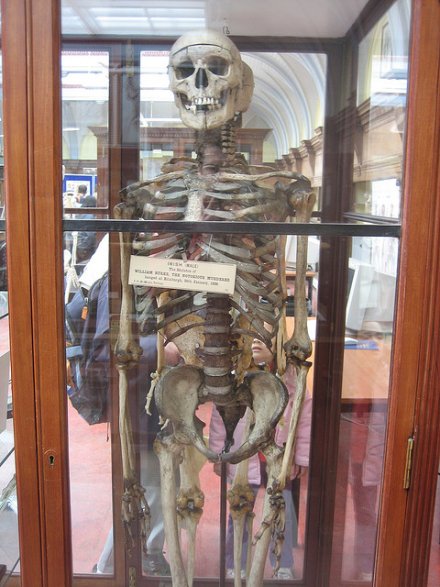
Wanted: corpses. Apply to Doctor Robert Knox, MD, FRSCEd, Professor of Medical Studies, Barclay’s Medical College, Surgeon’s Square, Edinburgh. Reference William Burke, hanged Jan. 28, 1829.
Robert Knox was a noted physician in his prime, in the early 1800s.
A surgeon, anatomist, and zoologist, Knox studied anatomy in London, then headed off to Africa in the army. Field surgery was a brutal business, and the poor anatomical knowledge at the time made it even more terrifying for those involved.
In 1821, Knox moved to France to work in the shadow of his heroes, Georges Cuvier and Étienne Geoffroy Saint-Hilaire; a year later, he was back in Edinburgh, making himself a career academic.
When his old professor came calling in 1826 with an opportunity to teach at Surgeon’s Square in Edinburgh, Knox jumped at the chance. As a partner to Barclay and curator of the school’s museum, Knox was well aware of the significant problem that faced the school: corpses were hard to come by.
And since the Royal College of Surgeons at Edinburgh certified the school as a prep course for entrance to University, coming up with bodies became a very important task.
If there’s one way to ruin your career, it’s to be caught paying a few pounds for fresh murder victims.
So it was for Knox, who gave out 7 pounds, 10 shillings for the body of an itinerant lodger who died in William Burke’s building in 1827.
This transaction led Burke to realize that such lodgers weren’t paying as much alive as dead. As a collector of bodies, Knox also had a strict no-questions-asked policy, and Burke and his partner William Hare exploited that to its fullest extent.
Almost a score of suspicious bodies later (and after the price had inflated to 10 pounds per), the pair was found out, given away as suspects by the lame and mentally disabled “Daft Jamie” Wilson, then caught when the late Marjory Campbell Docherty was found by a fellow tenant under one of Burke’s lodge’s beds.
Hare copped to a string of murders* and played stool pigeon in exchange for a lighter sentence.
Burke went to the gallows to “vehement cheering from every quarter, mingled with groans and hisses.” (London Times, Feb. 2, 1829)
“When the cheers had subsided, the wretched man was assailed with every epithet of contempt and abhorrence,” the Times continued. “Not a single indication of pity was observable among the vast crowd: on the contrary, every countenance wore the lviely aspect of a gala-day.”
William Burke’s hanging.
As a corpse himself, Burke made one final contribution to science’s insatiable desire for bodies: his cadaver went straight from the gallows to the practiced hands of one Dr Alexander Monro, who performed a complete lecture while dissecting the murderer’s corpse.
Knox, for his part, paid not with his neck but with his reputation.
Though never charged with a crime, the doctor was run out of the the lecturing business, first by subtle and not-so-subtle actions by the University, and eventually by the passage of the Anatomy Act of 1832.
He was also unable to obtain any surgical post after the incident and spent his later years writing academic books and papers, none of which have lasted like the doggerel that shadowed his steps.
Burke’s the butcher, Hare’s the thief,
Knox, the boy who buys the beef.
A few books about Burke and Hare
Anatomy of Anatomy
Robert Knox was operating under the Murder Act of 1751, which expressly forbade the burial of an executed murderer while permitting the malefactor’s dissection.
The Act had the dual effect of allowing the state to gibbet executed criminals (both hanging in chains and dissection were considered an added ignominy, beyond the punishment of the gallows), and of supplying the budding medical community with an immediate source of fresh bodies.
As courses in anatomy became more commonplace, though, the need for cadavers increased dramatically, and the business of selling bodies for science was born.
Typically, these sales manifested themselves in body-snatching — wherein “resurrectionists” illicitly exhumed a freshly buried corpse and conveyed it to some physician’s ready scalpel.
This grim trade in turn spawned a variety of security measures. The favored dead were defended by fences, watchtowers, and human lookouts. But nothing could eliminate the industry.
In particular, those with little money or no immediate relatives were unlikely to be buried in these gated graves; that left their remains ripe for the remaindering. As well, the increase in demand made so-called anatomy murder a possibility. Burke and Hare may have been notorious for the offense,** but they did not invent it.
In that case, two nurses (Jean Waldie and Helen Torrence) on death watch bartered a decent price of two shillings to sell the body of an ill child to a local surgical college. His death was delayed, and the nurses smothered him, possibly through simple carelessness.
Shortly after the Murder Act, simple economics made pikers of Torrence and Waldie. In the 17th century, England executed hundreds of prisoners a year, each a potential dissection. As Dr D.R. Johnson writes in his Introductory Anatomy:
The dissections performed on hanged felons were public: indeed part of the punishment was the delivery from hangman to surgeons at the gallows following public execution, and later public exhibition of the open body itself. …
Agents representing surgeons would bargain with condemned prisoners not under sentence of dissection (remember this only happened for murder: hanging was in vogue for stealing a sheep or even a loaf): occasionally prisoners struck a bargain to pay expenses, to provide for a family or to buy the customary decent apparel for the hanging.
Supply was unreliable, however: riots at public hangings became common, partly because of the paltry nature of hanging events, partly from superstition. The body was often reclaimed by relatives and the unpopular anatomists stoned, defeated and out of pocket. Competition was often so fierce that a rival anatomy school carried off the body.
Dissection was unpopular and other medical uses were to be found for a recently hung body – the cure of scofula, goitre, wens, ulcers, bleeding tumours, cancers and withered limbs for example. To prevent riots and disorder the Sheriff of London took all bodies of hanged men, except those sentenced to dissection, into his own custody and handed them to the relatives for burial.
Human Trafficking
Hanoverian Britain sure did keep the gallows busy. But the pace of hangings had abated by the 19th century just as demand boomed. The math didn’t add up.
Anatomy schools (officially) dissected some 592 corpses in 1825; at the time of the Burke and Hare murders, only about 50 executions were carried out annually, and each college was guaranteed just one a year.
That meant a shortfall of close to 550 bodies. With limited supply and significant demand, surgical colleges and anatomical lecturers were willing to pay top dollar for new cadavers … and the anatomical murder business really got legs.
And while the execution of Burke was met with applause from the community, in London, another group was already hard at work both body snatching and murdering its way into the classroom.
The London Burkers were caught in 1831 and convicted of murdering a 14-year-old whose cadaver they sold to St Bartholemew’s Hospital for 9 guineas.† The killers, Thomas Williams and John Bishop, had offed several others prior to the lad in question, making about the same price on each body.‡ In the grand, Burkean tradition of anatomical murderers, these miscreants were also dissected after their execution.§
Williams and Bishop were just two of a group of resurrectionists known collectively as the London Burkers, who claimed to have stolen upwards of 1,000 bodies from nearby cemeteries. That made the Burkers the largest known exploiters of the anatomical trade.
Over the decades after the Murder Act, though, resurrectionists were walking a dangerous line in their communities.
Reverence for the dead sparked community outrage when graves were found empty or disturbed, and it was often the anatomists themselves who felt the wrath of crowds.§§ In Glasgow in 1803, surgeons were threatened by an unruly mob and were forced to seek police protection; in 1813, an empty grave caused a similar furor. Punishments moved from fines to jail time as the surging demand made body-snatching an ever more lucrative trade.
A few books about body-snatching
By the time of the Burkers, anatomists were generally presumed to be body thieves in some capacity, a hostile sentiment graphically underscored during the Aberdeen riots of 1831. When a dog unearthed what looked like a human bone behind the Aberdeen surgical college, a mob coalesced and stormed the lecture hall.
The lecturer (“Dr Moir” — little else is known about the man) fled in terror as the hall was burned to the ground. Soldiers and police clashed with the crowd, which was thought to be over 10,000 strong. Hours later, the riot subsided, but Aberdeen was no longer a friendly place for a prospective medical talent.
And where Burke and Hare were still not quite sufficient to convince the House of Lords to take up a measure providing anatomists with alternatives for corpse acquisition, the Burkers and the Aberdeen riots apparently were.
The underground economy of resurrectionists was supplanted by the Anatomy Act of 1832, which allowed individuals to donate themselves or their unwilled kin to science for a pittance of compensation.
Anatomy murder is, of course, still the subject of horror movies. Like this one, or for the more classically inclined, this 1945 Boris Karloff/Bela Lugosi vehicle adapted from a Robert Louis Stevenson story inspired by Burke and Hare:
* The murders included at least one husband/wife pair, a mother and, later, her (adult) daughter, and a grandmother and her young grandson. They are also known as the West Port Murders.
** Burke entered the English language as a verb meaning … well, pretty much exactly what Burke got up to.
Dr. Murray, in the new English Dictionary, gives the following definition of the verb to ‘burke.’ ‘To murder in the same manner or for the same purpose as Burke did: to kill secretly by suffocation or strangulation, or for the purpose of selling the victim’s body for dissection,’ and the familiar lines are quoted from the Ingoldsby Legends: —
But when beat on his knees, that confounded De Guise
Just whipped out the “fogle” that caused all the breeze,
Pulled it tight round his neck until backwards it jerked him,
And the rest of the rascals jumped on him and burked him.
† 9 pounds, 9 shillings; by the time of the transactions, the guinea was no longer technically in use, but the term had stuck at the 21-shilling mark.
‡ Over the course of their 6 active months, the pair went from asking 8 guineas to asking 12 guineas; apparently 9 was the negotiated price with St Bartholemew’s.
§ The Burkers are the subject of the song “The Resurrectionist” by the Pet Shop Boys. (Lyrics)
§§ Edinburgh also had trouble as far back as 1742, when several surgeons’ homes were attacked by locals; a local beadle suspected of the crimes also had his home, dubbed resurrectionist hall, burned during the mob incident.
Four hundred years ago today, on Jan. 7 1611, three servants of the legendary “Countess of Blood” Elizabeth Bathory (Báthory Erzsébet, in the Hungarian) were tried, convicted, and immediately put to death for the noblewoman’s stupendous career of homicide.
This date’s entry is occasioned by the deaths of three subalterns — manservant Janos Ujvary, beheaded; and female attendants Ilona Jo and Dorottya Szentes, fingers ripped off and burned — but the headline attraction is their employer, who was never tried or condemned.
Bathory was rarefied Hungarian nobility, the niece of the King of Poland, which is also the biography of countless aristocrats you’ve never heard of.
The world remembers Elizabeth Bathory because she exploited her rank to butcher hundreds of peasant girls, allegedly to bathe in their rejuvenating blood.
On one occasion, a lady’s-maid saw something wrong in [Elizabeth Bathory’s] head-dress, and as a recompence for observing it, received such a severe box on the ears that the blood gushed from her nose, and spirted on to her mistress’s face. When the blood drops were washed off her face, her skin appeared much more beautiful — whiter and more transparent on the spots where the blood had been.
Elizabeth formed the resolution to bathe her face and her whole body in human blood so as to enhance her beauty.
These scrub-ups are what the Countess of Blood is best remembered for, but however striking the visual, it’s an atrocity that actually doesn’t turn up in the trial records.
But she could hardly complain of the embroidery, having given her interlocutors so much material.
Elizabeth Bathory is supposed to be responsible for over six hundred deaths, starting while her husband was away on campaign, and then carrying on into a wholesale operation after he died. When she and her servants were finally busted at Csejte Castle the end of 1610, their captors found a dead girl, a dying girl, and several others imprisoned and awaiting that fate.
Elizabeth Bathory, a sexually charged 1893 painting by Hungarian impressionist Istvan Csok depicting one of the countess’s victims being drenched in icy water for death by exposure.
So although the confessions the servants made this date to seal their own fates were undoubtedly torture-adduced, the documentary record turns out to be amazingly strong for such a fantastical spree. Hungarian King Matthias II convened a tribunal that examined 200 to 300 witnesses.
One can postulate that the woman ran afoul of a patriarchal culture affronted by her exercise of power or that she became a parable for the “unnatural” lust of a middle-aged woman … but so far as we are left to understand, Erzsebet Bathory really did lure young girls to her castle, and then inflict (pdf) a Nazi doctors’ litany of sadism on them … like jabbing them with needles to drain out their blood. She even kept a log of the victims in her own hand.
So, locals disappearing into the creepy castle, never to be seen again, or possibly to turn up pallid and dead. (Disposing of all those corpses became a logistical problem for the creepy castle.) No surprise to find it associated with the vampire legend.*
And no surprise that the tale became magnified, twisted, and reconfigured by popular culture.
In 1817, as accounts of the testimonies about the alleged murders and sadistic tortures were published for the first time, national and international headlines sensationalized the already misconceived story. From that on [sic], the literary countess took on a life of her own: the Grimm brothers wrote a short story about her, the romantic German writer, Johann Ludwig Tieck (1774 – 1853), cast her as a Gothic femme fatale, Swanhilda, in his short story Wake Not the Dead. It is alleged that Sheridan le Fanu shaped his female vampire Carmilla on Elizabeth Bathory. If we can believe some etymological explanation the compound English word blood-bath is of mid-nineteenth century origin possibly connected to the bloody countess’ rising popularity in England.
-László Kürti, “The Symbolic Construction of the Monstrous — The Elizabeth Bathory Story,” Croatian Journal Of Ethnology and Folklore Research, Jan. 2009
A few books about Erzsebet Bathory
To say nothing of the death porn (link not safe for work).
The noblewoman never faced an executioner herself, owing to her rank; she was shut up in the castle.

 There’s not too much question of her “guilt.”
 The


 The able child of a


 Oden confessed to slaying her lover, and was also suspected of poisoning off her husband.



 Almost a score of suspicious bodies later (and after the price had inflated to 10 pounds per), the pair was found out, given away as suspects by the lame and mentally disabled “Daft Jamie” Wilson, then caught when the late Marjory Campbell Docherty was found by a fellow tenant under one of Burke’s lodge’s beds.