1939: Joe Arridy, on Woodpecker Hill

Update: Embargoed as of this post’s publication, Joe Arridy’s growing ranks of supporters had submitted to Colorado Gov. Bill Ritter an application for a posthumous pardon. On January 7, 2011, Gov. Ritter granted that pardon — a fitting conclusion to a cinematically heart-rending story.

“Granting a posthumous pardon is an extraordinary remedy. But the tragic conviction of Mr. Arridy and his subsequent execution on Jan. 6, 1939, merit such relief based on the great likelihood that Mr. Arridy was, in fact, innocent of the crime for which he was executed, and his severe mental disability at the time of his trial and execution. Pardoning Mr. Arridy cannot undo this tragic event in Colorado history. It is in the interests of justice and simple decency, however, to restore his good name.”

-Gov. Bill Ritter


On this date in 1939, Joe Arridy “walked to his death with the faith of a child” (Los Angeles times, Jan. 7, 1939) up “Woodpecker Hill” — where the victims of Canon City, Colorado’s gas chamber (since retired) were buried.

Shortly before execution, Joe Arridy gives away the toy train he received from warden Roy Best to a fellow prisoner.

A young Syrian-American with the mental age of a six-year-old riding the rails during the Depression, Arridy was picked up for a teenage girl’s rape-murder in a literal lynch-mob environment: he was nearly pulled from his cell for summary punishment.

Instead, the good citizens let justice run its course to the same conclusion.

The damnable thing — well, the other damnable thing — is that we have about as much reason to believe Joe Arridy committed the crime as we do you or I.

He was linked to the murder by nothing but an evolving series of unreliable confessions fed by the sheriff to his suggestible prisoner (and, later, a single “matched” hair with a suspicious chain of custody; matching hair without DNA is still an unreliable forensic technique today). The real murderer was even in custody, and was executed for the same crime while Joe Arridy’s appeals ran their futile course.

“Believe me when I say that if he is gassed, it will take a long time for the state of Colorado to live down the disgrace,” Arridy’s appellate lawyer pleaded to a deaf court.

Robert Perske’s Deadly Innocence, about Joe Arridy.

Executed Today is honored to welcome Robert Perske, a pioneering pastor to the intellectually and developmentally disabled whose book Deadly Innocence helped pull the Arridy case out of obscurity.

This post is an edited version of Perske’s affidavit to the governor’s office in support of the pardon.


On March 28, 1992, Sociologist Richard Voorhees sent me a poem from an out-of-print book that described a warden weeping as he watched a man in a death row cell playing with a toy train before being walked to a gas chamber (“The Clinic” (.doc) by Margeurite Young in Moderate Fables, 1944).

“The man you kill tonight is six years old,
He has no idea why he dies,”
Yet he must die in the room the state has walled
Transparent to its glassy eyes.

I sent a copy of the poem to Watt Espy, Director of the Capital Punishment Archives, in Headland, AL. Espy researched and responded with information that tied the poem to the life and trials of Joe Arridy who at age 23 was executed on January 6, 1939.

During the next two years after receiving the poem, I traveled up and down the Eastern Slope of the Rocky Mountains from Cheyenne to Pueblo, and to Grand Junction on the Western Slope. News stories were discovered from the reading of old microfilm rolls in The Pueblo Chieftain, The Denver Post, The Rocky Mountain News (Denver), The Daily Sentinel (Grand Junction) and Wyoming Tribune (Cheyenne). Archivists and historians were interviewed at The Regional History Division of Western Colorado (Grand Junction), Wyoming State Archives (Cheyenne), District Archives of the Pueblo Public Library, Local History Center of the Cañon City Public Library, and the Colorado State Archives (Denver).

Joe Arridy’s Earliest Years

Joe Arridy was born to non-English speaking Syrian immigrants in Pueblo, Colorado on April 29, 1915. He attended the first grade in Bessemer Elementary School. At the beginning of his second year, the principal called on the Arridy family and told them that their son could not learn and asked them to keep him at home. The parents reported that for the next four years, Joe stayed around the house. He was a passive but happy child. According to his parents he was the happiest when he was alone playing all by himself. His favorite pastime was making mud pies.

Intelligence Testing and Institutionalization

At age 10, Joe was committed to the Colorado State Home and Training School for Mental Defectives, in Grand Junction. He was administered the Binet-Simon Test. The results showed that he was unable to repeat four digits (4-3-7-9). When shown the color red, he said it was black and that green was blue. He usually spoke in incompete two or three word sentences. As the questions became harder to answer, he remained silent. The examiner listed him as “an imbecile with an IQ of 46.” Later his institutional records showed no critical incident reports. For the most part he was a shy and quiet loner.

Nine months later, Joe’s father missed his son. He asked for his son to be returned home. The request was granted. Upon his return, he tended to take lonely walks all over town. These walks continued for three years.

At age 14, the walks came to an end when a probation officer caught a gang of boys performing sexual acts on him. The officer wrote an angry letter to the court, labeling Joe as “one of the worst mental defective cases that I have ever seen.” The court ordered his immediate return to the institution in Grand Junction.

During the next seven years at the institution, his records show that he was incapable of working on the farm crews or sitting in classrooms. Therefore, he was given a “day activity,” working side by side with a kindly kitchen worker, “Mrs. Bowers.” The worker reported that Joe was only capable of “Tasks of not too long duration, can wash dishes, do mopping of floors, can do small chores and errands. He depends on others for leadership and suggestions.”

Railroad Boxcar Riding

At age 22, he and a few other inmates watched men riding on top of railroad boxcars that passed the institution. So together they wandered off the institution grounds and also jumped on boxcars. They took the 24-hour ride through the mountains to Pueblo. Later they took the trip back. Joe was last seen in Grand Junction on the evening of August 13, 1936. He was believed to have jumped onto a boxcar either that night or on the next morning.

After that, Arridy disappeared from sight until he walked up to the kitchen car of a railroad work gang on August 20, in the East Railroad Yards of Cheyenne, Wyoming, dirty and hungry.

Rape and Murder in Pueblo

On Saturday evening, August 15, 1936, slightly before or after midnight, Dorothy Drain, 15, and Barbara Drain, 12, were bludgeoned about their heads while sleeping together in the same bed, at 1536 Stone Avenue in Pueblo. Dorothy was raped and beaten to death. Barbara was near death, but survived. Later, she identified Frank Aguilar as the attacker at his trial. She was not present at Joe Arridy’s trial. She did not even identify Joe Arridy as a co-attacker.

Sheriff Gets a Confession from Arridy Even Though the Real Killer is Already in Custody

On August 26, 1936, Joe Arridy was arrested by two railroad detectives and turned over to Sheriff George Carroll. Carroll, like all law officers in all of the towns up and down Colorado’s Eastern Slope, was actively picking up suspects and interrogating them regarding the attacks on the Drain girls in Pueblo.

After an hour and a half of questioning, Carroll called a reporter and told him that he had just received a complete confession for the Pueblo crime from Arridy. He recited to at least one reporter a long series of wordy, complete sentences that Arridy purportedly uttered. According to Carroll, Arridy was the lone killer and he committed the crime with a club.

At first, when Pueblo Police Chief J. Arthur Grady received news of the confession, he was shocked. The real killer, Frank Aguilar, a former WPA worker who had been supervised by the Drain girls’ father, had already been arrested for the crime.

Aguilar had been arrested during the funeral of Dorothy Drain. The Pueblo police had even recovered the weapon used in the crime. It was the head of a hatchet with nicks that matched the wounds on the girls. The Pueblo police kept all this evidence in silence because Aguilar vehemently denied committing the crime.

Following that, Sheriff Carroll changed his story. After conducting another interrogation, he then reported to the press that a hatchet—not a club—was used in the crime. He also claimed that Arridy did not do the crime alone. According to Carroll, Arridy said he did it “with Frank.”

Sheriff Carroll was a famous but loquacious individual who was known to talk long and loud about being in the posse that finally caught up with and finished off the notorious Barker gang.

Now with his regular announcements to the press he remained at his long-worded best. Carroll had been so totally verbal in his interrogations of Arridy, nothing was written down on paper. Nor was any confession signed. Consequently the confessions and changes in them were dictated daily to reporters.

Later, in the trial of Arridy, Sheriff Carroll became the star of the case. He spoke in his heroic, over-wordy style. According to the press, he did not speak from a single note. He simply testified from memory.

Frank Aguilar is Quickly Convicted

Aguilar’s trial came quickly, starting on December 15, exactly four months after the crime. It ended seven days later. His executed came quickly, too: on August 15, 1937, just two days short of the anniversary of Dorothy Drain’s murder.

Aguilar Identified as Lone Murderer in an Identical Crime in the Same Neighborhood

After the death sentence, Aguilar was brought face to face with Mrs. R. O. McMurtree, 58, who identified Aguilar as the lone attacker in a similar crime that happened two weeks earlier and just three blocks away from the Drain crime. She and her aunt, Sally Crumply, 72, were sleeping in the same bed when Aguilar attacked. He beat them on the heads as he had done in the Drain home. Like Dorothy Drain, Sally Crumply was bludgeoned to death.

Sheriff Carroll Assumes Leadership in all Aspects of the Arridy Investigation

After announcing Arridy’s first confessions to reporters and Chief Grady, two Pueblo detectives sped through the night to Cheyenne. The next morning, they joined in an added interrogation with Carroll leading it. Then they drove back to Pueblo.

Later that day, Carroll drove Arridy to Pueblo. He was present at the Pueblo Police Station when Arridy and Augilar may have been brought together. He took leadership when Arridy was taken to the Drain home and the crime was reenacted. He was present at the prison in Cañon City when Aguilar gave a signed confession that marginally included Arridy’s initials in a lower left column. That confession was printed in its entirety in the Pueblo Chieftain but was withdrawn and was never heard in a court.

Sheriff Carroll Became Chief Presenter of Evidence Against Arridy

During the prosecutor’s evidentiary presentations, Sheriff Carroll took the stand five different times. The transcript shows how Carroll was allowed to launch forth as a riveting story teller. He testified that Arridy was in complete control of his thoughts, and speaking in clear sentences that described the colors on the walls in the bedroom and the colors of nightgowns that the girls wore, and even the colors of the dresses the girls would be wearing when they went to the Sunday church services.

The Joe Arridy that Carroll described was a far cry from the Arridy who often spoke in unfinished sentences and did not know who Franklin Delano Roosevelt was. Nor did he know what a hatchet was or that his own father was present in the courtroom.

The Defense Loses in a Sanity Hearing, and Eschews an Evidentiary Defense

The defense argued at a pre-trial sanity hearing that Arridy was “Not Guilty by Reason of Insanity”. The question before the court: “Does Joe Arridy have the capacity to tell good from evil and right from wrong?” If not, he should be found to be insane and not guilty. Three psychiatrists testified that Arridy did not know right from wrong, but they hedged by saying that he was not insane. According to them, one needed to be normal first before ever being insane, and they claimed that Arridy had never been normal.

The jury deadlocked at six to six, but an hour later, voted that Arridy would have to go on trial for murder.

As strange as it may seem today, the defense attorney had conducted no investigation in the case. At the beginning of the trial he announced that he would not present an evidentiary defense and would only cross-examine witnesses for the prosecution.

He then requested that the judge set aside the earlier sanity trial verdict and that he be given permission to argue a sanity case one more time. He furthermore requested permission to make his opening argument only after the prosecution had completed with its evidentiary case. The judge agreed to all of these conditions.

The same three psychiatrists (joined by a fourth) gave the same testimony once again.

But Sheriff Carroll voiced his views unchallenged. After touting his 30 years of experience and claiming that he interrogated Arridy for “six or seven hours,” the prosecutor asked him, “Based on your experience [is] Joe Arridy capable of distinquishing right and wrong?” Carroll responded, “I think there is no doubt, whatever, but what he is”.

A verdict of “guilty” was rendered on April 17, 1937, and Arridy was sentenced to death.

On August 13, 1937, Frank Aguilar was executed, and on the same day, Sheriff Carroll and two railroad detectives received a $1000 reward for making the arrest of Joe Arridy in Cheyenne.

For a year and a half, a pro bono “Citizen Lawyer” Gail Ireland fought valiantly to save the life of Joe Arridy. During that period, Ireland managed to win at least six stays.

On January 6, 1939 at 6:15 p.m., the Colorado Supreme Court voted 4-3 to deny the last petition. Governor Teller Ammons called the warden at 6:30 p.m. and ordered that the execution be carried out.

The chaplain administered the Roman Catholic Church’s “Last Rites for a Child.” It called for the Chaplain to recite each phrase of “The Lord’s Prayer,” one at a time with Arridy repeating it, all the way to the “Amen.”


Joe Arridy’s rusty motorcycle plate served as his grave marker for 71 years, until it was replaced with a headstone reading Here Lies an Innocent Man

This volume by Perske addresses the criminal justice system’s (mis)handling of the developmentally disabled. He’s written a number of other books, fiction and nonfiction, humanizing this.

Robert Perske also graciously agreed to address a few additional questions that we had for him.

ET: How did you come to this case?

RP: It’s almost a magical thing to me. Back in 1991, I got a poem from a valued colleague of mine who is a professor, a sociologist. He was digging through some old books in Greenwich Village, and he found a poem about a warden weeping before the pellets were dropped and all of that, and how the warden cried, and how he complained about how this man playing with a toy train would die.

And I got ahold of it and went down to my buddy Watt Espy [of the Espy file -ed.], and he found it. He really dug for me, what a guy, and he found it and I headed for Pueblo and dug and dug and dug from 1991 to 1995.

What motivated me was that after coming out of World War II, I went to school and became a chaplain at an institution for mentally disabled people in Kansas. I worked my ass off to be a good pastor to them, and so when I found this much, I really started digging.

Did they lead him into the confession?

Oh, yes. He was arrested in the railyard by Sheriff George Carroll. And Carroll was a swashbuckler. He was a hero, and he was a mouthy sonofagun, and he pretty well set up the case.

As soon as he got the so-called confession, he [Carroll] didn’t call the police chief first — he called the press. He said he had the guy who did it.

But they already had the guy in Pueblo, Frank Aguilar.

Was there outright misconduct by the investigators here? Did they realize, or should they have, that they might be railroading someone?

Here’s the deal. People with so-called mental retardation were seen as nobodies in those days. They didn’t have community services, so they all went like Joe, to the institution.

In the year I was born, 1927, Oliver Wendell Holmes issued his ruling that all such people could be sterilized.

Carroll knew he had somebody like that in Joe. There was a lynch mob starting to form in Pueblo, because this head of the WPA was a good solid citizen, and when his daughters were hit, and one killed and raped, there was a lot of hiding of people.

I’ve known a lot of Joes. And he’s lovable, and he’s trusting, and he’s naive, and he’s concrete-thinking, so half of the things he says, he doesn’t really understand. But on the other hand, very dependable, and very lovable. Nobody in Pueblo saw that, but [Warden Roy] Best picked it up, and then the inmates in prison picked it up too.

In their hearts of hearts, yeah, they knew. But they figured he wasn’t worth anything. He was retarded, mentally defective was the word they used. They knew they had the real killer, but they go back and get Joe to amend the confession and now he was there “with Frank”.

If you’ve got a serious mental limitation and you’re facing a capital charge in the criminal justice system today, what’s going to happen to you?

In the year 2002, Atkins v. Virginia, they banned the death penalty in those cases. And they played around with the IQ number, but in some states they’re going farther than that because you have all kinds of other disabilities. I’d say by and large, except for Texas, people are looking at these people — not more kindly, but not looking at them as people who should be executed.

If we would have had that for Joe, he would not have been executed.

Can you give us a lay definition of developmental disability?

The most prominent one I’ve seen when I worked in the institution, and yet today when I work the streets and agencies and group homes and that sort of thing, is the inability to abstract from concrete things. For example, I’ve had guys say to me, I’d say, “why did you waive the right?” and they say, “you’ve got to waive it the right, you can’t waive it the wrong.”

Barry Fairchild, down in Arkansas — Barry thought that the reading of the rights was some kind of opening prayer.

These people survive on the basis of having abstract thinkers as their friends and protectors, so consequently guys like Richard LaPointe had cops as their friends, because they leaned on authority figures. And of course the police department are committed to secure the safety of the neighborhood, but then if there’s a terrible murder and somebody starts to blame them, they’re going to cooperate with that.

I’ve got one where, on a tape recorder, they’re saying, “if you tell us, we’ll all go home”. So that’s concrete thinking that my guys usually have.

Richard Lapointe is still in prison, not on death row. He has hydrocephalus, it’s called Dandy-Walker syndrome, so he’s a guy with all kinds of disabilities. He’s not athletic at all and gets dizzy when he stands up or stops suddenly, and yet they got him to confess to a highly athletic murder of a woman with multiple violent stab wounds and moving the body.

On this day..

1917: Sub-Lt. Edwin Dyett, shot at dawn

On this date in 1917, Edwin Dyett was shot for desertion and cowardice.

After the disastrously ineffective Somme offensive in late 1916, British Field Marshal Douglas Haig decided to pick up the men’s spirits. And what better way to motivate than by shooting more officers?

If one proceeds from the premise of the British brass that the main problem with its military ineffectiveness was the men in the field, there was something in the cruelly “progressive” about the order: luckless enlisted fellows from the lower classes were smoking last cigarettes by the bushel, but gentry-stock officers were more liable to get the kid-gloves treatment .

Haig was taking the kid gloves off.

“A soldier’s tale cut in stone to melt all hearts,” said Winston Churchill of this pathbreaking novel thought to be based on Edwin Dyett. The first novel about executed World War I deserters, it is thought to have influenced later portrayals of such executions and the sub-heroic literary context for the Great War.

Within two months of that order, our man Dyett was up against the stake at St. Firmin, France — perhaps the most famous shooting among the officer corps.

Perhaps presuming upon the traditional leniency extended to the better classes, Dyett had little inkling of his fate during the weeks after his arrest. He’d been collared during the aforementioned Somme campaign for “deserting” for two days when he’d taken umbrage at being directed to the front by an inferior officer and instead returned to headquarters for orders.

As late as Christmas Eve, he was still keeping his parents in the dark, certain that the misunderstanding was not enough to even “cause a sitting.”

That sitting, however, occurred forthwith on Boxing Day, with only a half-hour for the defense to prepare. That defense was less than robust, and the court clearly disinclined to a sympathetic reading of the circumstances.

Dyett had only just turned 21, but clemency appeals around youth and the confusion of the situation would cut no ice. “”If a private behaved as he did,” wrote the officer charged to review it, “it is highly likely he would be shot.”

Lt. Dyett had only a single evening from hearing the bad news to prepare himself for what must have seemed to him a shocking turn of events. This time, he posted a different sort of missive to the home front.

Dearest Mother Mine, I hope by now you will have had the news. Dearest, I am leaving you now because He has willed it. My sorrow tonight is for the trouble I have caused you and dad. Please excuse any mistakes, but if it were not for the kind support of the Rev. W.C. — who is with me tonight, I should not be able to write myself. I should like you to write to him, as he has been my friend. I am leaving all my effects to you, dearest; will you give a little — half the sum you have of mine? Give dear Dad my love and wish him luck. I feel for you so much and I am sorry for bringing dishonour upon you all. Give — my love. She will, I expect, understand – and give her back the presents, photos, cards, etc., she has sent me, poor girl. So now dearest Mother, I must close. May God bless and protect you all now and for evermore. Amen.

Dad didn’t take it with the stiff upper lip; after a futile campaign to clear the boy, he renounced his citizenship and emigrated to America.

The Shot At Dawn site dedicated to executed first World War soldiers maintains a detailed (and very pro-Dyett) page about our day’s principal. There’s also a recent nonfiction book, Death for Desertion, which pleads Dyett’s case.

On this day..

1786: Elizabeth Wilson, her reprieve too late

On this date in 1786, Elizabeth Wilson was hanged in Chester, Pennsylvania for the murder of her infant twins.

“One of the melodramas of the early American republic,” our Elizabeth (sometimes called “Harriot Wilson” in the accounts) was a farmer’s daughter of Chester County who got knocked up by a passing sailor. When this gentleman declined to make an honest woman of her after she had borne the bastards, the kids disappeared — later to be discovered dead in the woods by a hunter.

The fallen woman denied having killed them directly, but “acknowledged having placed the children by the road-side, in order that any person passing that way, and who had humanity enough, might take them up.”

She would eventually, after condemnation, accuse her lover of having slain the children.

Elizabeth’s brother William Wilson vigorously undertook on this basis to secure her a pardon at the hands of the Commonwealth’s executive authority, the Supreme Executive Council — then under the leadership of no less august a character than Benjamin Franklin.

And he found a sympathetic audience. Council Vice-President Charles Biddle* “firmly believed her innocent, for to me it appeared highly improbable that a mother, after suckling her children for six weeks, could murder them … there was a large majority would have been for pardoning her.”

Instead of an outright commutation, it granted a stay of execution for William Wilson to investigate further, which he did to no successful effect.

“But here we must drop a tear!” exclaims the Faithful Narrative of Elizabeth Wilson, a popular pamphlet (pdf) sensationalizing the case. “What heart so hard, as not to melt at human woe!”

For William Wilson’s suit on behalf of his sister had succeeded in earning, on the eve of the Jan. 3 hanging, a second respite on Biddle’s certain anticipation that clemency would be forthcoming. Ill himself, William took the stay of execution from Biddle’s own hands and raced through a fearful storm on the 15-mile ride from Philadelphia to Chester … but

did not arrive until twenty-three minutes after the solemn scene was closed. When he came with the respite in his hand, and saw his sister irrecoverably gone, beheld her motionless, and sunk in death, who can paint the mournful scene?

Let imagination if she can!

Imagination can do quite a lot with this sort of material, and so the tale of Elizabeth Wilson — the intrinsic pathos of the condemned, her widely-suspected innocence, her evangelical-friendly repentance, the cliffhanger conclusion — became widely re-circulated, and undoubtedly embroidered.

Quaker colonial diarist Elizabeth Drinker (who had firsthand experience of official injustice, when suspicious-of-Quakers revolutionaries had banished her husband from Philadelphia) was still seeing these publications over a decade after Wilson’s death.

May 16 [1797]. Unsettled. Wind variable. Read a narrative of Elizabeth Wilson, who was executed at Chester, Jany ’86, charged with the murder of her twin infants. A reprieve arrived 20 minutes after her execution, by her brother from Philadelphia. She persisted to the last in her account of the murder being committed by the father of the children, which was generally believed to be the truth. I recollect having heard the sad tale at the time of the transaction.

The Wilson story actually persisted (and persists) for centuries yet. Her shaken brother, William, withdrew himself from society and lived out his last years in a cave: he entered folklore as the Pennsylvania Hermit, affixed with his tragic sister to all manner of spook stories, like a spectral horseman galloping to Chester, or a ghostly woman rummaging the leaves where the bodies were found. You’ll hear all about the Pennsylvania Hermit when touring his former stomping grounds, now open to the public (for a fee, my friend) as Indian Echo Caverns.

* Biddle was a future U.S. Senator, but he’s probably best known through his son. Born just five days after Elizabeth Wilson’s execution, Nicholas Biddle was a bitterly controversial character as one of antebellum America’s original banksters.

Charles Biddle’s notes on the case veer into the era’s philosophical concern with the timeless problem of making a just response to infanticide.

“Perhaps,” he muses “the punishment of death is too great for an unmarried woman who destroys her child. They are generally led to it from a fear of being exposed … [and] while death is the punishment, a jury will seldom find a verdict against them.”

On this day..

1479: Bernardo di Bandino Baroncelli, sketched by Leonardo da Vinci

On this date in 1479, a fugitive of the previous year’s Pazzi Conspiracy — an ill-starred attempt by the Pazzi family to overthrow the Medici — was hanged in Florence.

Bernardo Baroncelli had actually struck the first blow on the Pazzi conspiracy’s big day, planting a dagger in the chest of Giuliano di Piero de’ Medici in the theatrical setting of Florence’s Duomo, with the theatrical declaration, “Here, traitor!”

Must’ve been a sight to see. Giuliano wound up dead, but the rest didn’t work out so well.

Baroncelli, however, managed to evade the resulting paroxysm of civic vengeance and hightail it to Ottoman Istanbul, where he had some contacts.

Unfortunately for Bernardo, Florence had some contacts there, too. Ottoman relations with the various Italian city-states were actually quite strong, and Florence in particular enjoyed lucrative trade arrangements bringing its wool textiles to Bursa to exchange for silk.

So you can understand the effusion for Mehmet the Conqueror* (and the interest of said Mehmet the Conqueror) in this bit of Florentine diplomatic correspondence quoted in The Papacy and the Levant:

By letters of Bernardo Peruzzi we have learned with great pleasure how that most glorious prince [Mehmet] has seized Bernardo Bandini, most heinous parricide and traitor to his country, and declares himself willing to do with him whatever we may want — a decision certainly in keeping with the love and great favor he has always shown toward our Republic and our people as well as with the justice of his most serene Majesty … although as a result of the innumerable benefits done by his most glorious Majesty in the past for the Republic and our people, we owe him the greatest indebtedness and are the most faithful and obedient sons of his Majesty, nevertheless because of this last benefit it would be impossible to describe the extent to which our obligation to his most serene Majesty has grown.

A Florentine representative quickly sailed for the Ottoman capital to make the arrangements, and returned with the hated Bandini on Dec. 24. Five days later, he was hanged over the side of the Bargello.

Florentine native son Leonardo da Vinci sketched the hanging man (the sketch is now in the Musee Bonnat), diligently noting his clothing.

A tan colored skull-cap, a doublet of black serge, a black jerkin, lined and the collar covered with a black and red stippled velvet.
A blue coat lined with fur of fox’s breasts.
Black hose.
Bernardo di Bandino Baroncelli.

In the video game Assassin’s Creed II, one of the missions (assigned by Giuliano’s surviving brother, Lorenzo the Magnificent) is to kill Bernardo Baroncelli … but not with trade relations and diplomacy.

* Conqueror of Istanbul/Constantinople, among other things.

On this day..

Unspecified Year: The Robbers of Nordenshaw

This Yule, we present an ancient Danish ballad which “is probably too true a picture of the lawless conduct of men of the highest rank, and of a state of things not confined at that period to the islands of Denmark.”

The Robbers at Nordenshaw

The Robbers lurking at Nordenshaw*
From out the green-wood creep,
And march by night to the farmer’s house,
Their Yule with him to keep.**

They’ve march’d away to the farmer’s house
With each in hand a spear;
“Come, cousin, see, we are kith and kin,
“Tap us thy Christmas beer.

“And, farmer, lodge us all tonight,
“And well with liquor ply,
“And with us leave thy pretty wife,
“Or, farmer, thou shalt die.”

“I’ll freely pour my mead and ale,
“And well I’ll serve you too;
“But, Sirs, by all that’s good above,
“No outrage on us do.

“Now if upon my house ye seize,
“And lord it at your will,
“And if ye put my wife to shame,
“That were outrageous ill.”

Some on the table threw their swords,
Some cloaks of fur so fine,
Some bade the honest farmer’s wife
Bring in the beer and wine.

A cloth of woven silk she took,
And over the table spread;
And there her ale and wine they drank,
And ate her meat and bread.

A cautious wife was Oaselille,
And used her words with care;
She rose and told the robber guests
She would their beds prepare.

No thought had she, good Oaselille,
With them to share her bed;
But left them feasting, and for help
Through the dark forest sped.

With hurried step through bush and field
Ran on the lusty dame,
And after four long weary miles
To Drost Sir Peter’s† came.

She reach’d Sir Peter’s courtyard gate,
Drew on her mantle blue,
And boldly up to the upper room,
Sir Peter’s chamber, flew.

“Wake up, Drost Peter Hoseale, wake,
“No moment longer sleep;
“The thieves, that lurk’d at Nordenshaw,
“With us their Christmas keep.

“What! still, Sir Peter, slumbering on
“Nor yet but half awake?
“Those robbers twelve are at the Grange,
“All twelve are now to take.”

Then rose the Drost and call’d his men,
And bade them all to arm;
“Wake up, my men, there’s come tonight
“Good news from yonder farm.

“Wake up, no moment more delay,
“And d’on your trusty mail;
“For Nilus Ufridson is there,
And not the man to quail.”

“Where,” ask’d those sturdy robbers twelve,
They’d drunk of ale so deep,
“Where’s now the farmer’s pretty wife?
“We’ll have her here to sleep.”

“Chide not, good Sirs, a short delay”
The grey-coat farmer said;
“She is even now to the chamber gone
“To make her guests their bed.”

The farmer out of his window look’d,
And saw the Drost’s array;
“There stop here thirty men at arms,
“Are dress’d like cushats gray.”

Then answer’d Nilus Ufridson,
“Of such I’m not afraid,
“If but my comrades stand as firm,
“And faithful prove my blade.”

“No,” answer’d Lave Rimordson,
“And scann’d the troop afield,
“For such men care we not a bean,
“To them we’ll never yield.”

They beat the door with sword and spear
And rais’d a fearful shout;
“Up up, Sir Nilus Ufridson!
“Thy gang and thou come out.”

“Seven tons of gold I’ll give thee, Drost,
“And silver other five,
“To let us hence in peace depart
“My men and me alive.”

“Thy silver, Nilus, heed I not,
“As little heed thy gold;
“Through thee weeps many an orphan child
“For friends beneath the mould.”

Hard fought Sir Nilus Ufridson,
And well he kept his ground,
And heavy were from bar and beam
The blows he dealt around.

Nor less did Lave Rimordson,
But fought with might and main
Till at the hilt by dint of blows
He broke his sword in twain.

He dash’d the hilt against a stone,
The blade stuck in the mould;
“And now, my only chance of life,
“I’ll try good words and gold.

“Drost Peter Hoseale, spare my life,
“And do me no disgrace;
“I’m near of kin to the Danish Queen
“And of an Emperor’s race.”

“If near of kin to the Queen thou art,
“And all so nobly born,
“Why to the Farmer’s didst thou go,
“And treat his rights with scorn?”

So seized Sir Peter all the twelve,
And townward march’d them off;
And set them side by side on poles,
The people’s jest and scoff.

And there they lie on rack and wheel
To bear the heat and cold;
But to the King the Drost has brought
Twelve heavy chests of gold.

* Located on the Danish island of Fyen, Fyn, or Funen.

** The Danish Jul runs all through December up to Christmas Eve, Dec. 24; that date, Christmas Eve, is the big Yule celebration in Denmark.

† I situate this execution in the 13th century based on Drost Peter’s appearance in this historical romance of Danish King Erik VI Menved‘s youth.

On this day..

1942: Sasha Filippov, during the Battle of Stalingrad

(Thanks to Meaghan Good of the Charley Project for the guest post. -ed.)

On this day in 1942 in Stalingrad, Russia, seventeen-year-old shoemaker and spy Sasha Fillipov was executed by the German Army for espionage. The Battle of Stalingrad, which had been in progress since July, was bleeding the city white and would continue to do so until the following February. Young Sasha would be just one of over two million casualties.


One death, millions of deaths. Stalin had a quote about that.

Sasha, who had already become a master cobbler, simultaneously volunteered his shoemaking services for the invading German Army and his spying services for the Russian Army. He became a regular behind German lines, and as he made and repaired their shoes and boots he also stole documents, made note of whatever military activity he could see, eavesdropped on conversations and reported it all to the Russians.

Eventually he was discovered, and two days before Christmas he and two other teenagers were led barefoot through the snow and hung from acacia trees on Bryanskaya Street. His parents were there to witness the execution, but his father couldn’t bear to watch and ran away. He also left a ten-year-old brother.

In 1944 he was posthumously awarded the Order of the Red Banner for his services to Russia. The street where he died was renamed after him, as was a school on that street. Today, however, Sasha is most remembered for being a minor character in the wildly-inaccurate-but-still-a-thrill-to-watch film, Enemy at the Gates. Sasha in the movie is portrayed as a much younger boy, about twelve years old, and is played by Gabriel Thomson.

On this day..

1909: Valgrand in place of Fantomas

On this date* in 1909, in the first novel of the hit French Fantomas crime serial, the title character escapes the guillotine by having a duped actor beheaded in his place.

Fantomas’s Wikipedia entry calls the character “a transition from Gothic novel villains of the 19th century to modern-day serial killers“: he’s a swashbuckling anti-hero who’s a master of disguise and perfectly okay with getting his hands bloody.

His own personal Javert, an inspector by the name of Juve who has stalked him for years,** has finally managed to have Fantomas convicted of a murder and sent to await execution. (Here’s a synopsis of the book.)

The widow of that crime’s victim — also Fantomas’s lover — subsequently contrives to arrange a tete-a-tete with an actor then portraying Fantomas’s lurid crime spree on the Parisian stage. She wants him to come in costume, which excites the actor as a seriously macabre kink: little does this Valgrand suspect that his own tete will be swapped for the murderer’s by next light.

That following day finds a drugged Valgrand infiltrated into Fantomas’s cell, in a sort of travesty of the noble Sydney Carton‘s guillotine switcheroo. Still suffering the effects of the potion his supposed inamorata has plied him with only hours before, and still made up to resemble the condemned man, he’s incapable of objecting as he’s hustled to the scaffold.

Juve was watching the unhappy wretch, and could not restrain a word of admiration.

“That man is a brave man! He has not even turned pale! Generally condemned men are livid!”

The executioner’s assistants had bound the man upon the plank; it tilted upwards. Deibler grasped the head by the two ears and pulled it into the lunette, despite one last convulsive struggle of the victim.

There was a click of a spring, the flash of the falling knife, a spurt of blood, a dull groan from ten thousand breasts, and the head rolled into the basket!

But Juve … sprang towards the scaffold. He thrust the assistants away, and plunging his hands into the bran that was all soaked with blood, he seized the severed head by the hair and stared at it.

…

“Good God!” he cried in tones of anguish.

“It isn’t [Fantomas] who has just been put to death!” Juve panted brokenly. “This face has not gone white because it is painted! It is made up — like an actor’s! Oh, curses on him! Fantomas has escaped! Fantomas has got away! He has had some innocent man executed in his stead! I tell you Fantomas is alive!”

And so he was … to the tune of a staggering 32 books over three years. Eat your heart out, J.K. Rowling.

Fantomas on the silver screen

This series has enjoyed a number of adaptations to the screen, and indeed it’s a media milestone as well since the books were cranked out at record pace by a team of writers working simultaneously on modular chapters to meet publication deadlines that fed immediately into cinema deals. There were also comic and radio spinoffs, though they’re not known to have been forward-thinking enough to have had a website.

In the classic first silent adaptation of Fantomas in 1913 (the book was published in 1911), poor Valgrand catches a break: he’s recognized and spared beheading at the last moment. There’s a very thorough guide for viewing that film here.

* The book situates the action where Valgrand is seduced and tricked on December 18, and the narrative makes it clear that the execution itself is at dawn the next morning.

It can be placed in 1909 because a guard mentions the execution of Henri Duchemin, a real historical figure guillotined earlier in 1909. (That year marked a resumption of executions in France; a death penalty opponent serving as President of the Third Republic systematically blocked executions from 1905 through 1908.)

Lady Beltham, whose feminine wiles spring the master criminal, subsequently commits suicide in 1910, which leaves only the one possibility.

** Juve is a big fan of the then-trendy, now-discredited system of Bertillonage; Fantomas consistently runs circles around this “scientific” crime-fighting. Academics, if you please?

Through the incorporation of Alphonse Bertillon’s anthropometrics — the dominant mode of criminal investigation at the time –, as both the narratological and criminological impetus for its exponentially serialized representations of criminality, Fantomas articulates resistance to the representational strategies of the numerical classification of criminals as a means of social and “scientific” control, while compelling the ongoing modern capitalist cycle of mass literary production and consumption.

-Nanette Fornabai, “Criminal Factors: ‘Fantômas’, Anthropometrics, and the Numerical Fictions of Modern Criminal Identity,” Yale French Studies, No. 108 (2005)

On this day..

1640: Bishop John Atherton, buggerer

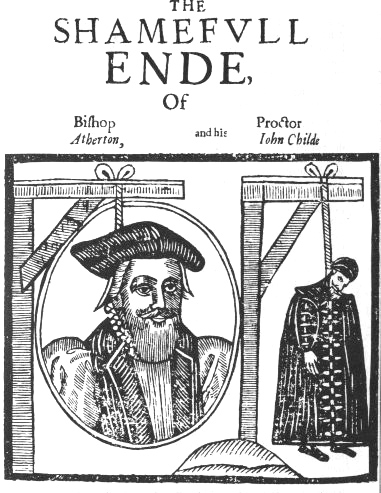
On this date in 1640, John Atherton achieved the unenviable distinction of being the only Anglican bishop hanged for buggery.* (His proctor, and alleged lover, John Childe, got the same treatment a few months later.)


Suppose a Devill from th’infernall Pit,
More Monsterlike, then ere was Devill yet,
Contrary to course, taking a male fiend
To Sodomize with him, such was the mind
Of this Lord Bishop, he did take a Childe
By name, not years, acting a sinne so vilde
-From the text of the pamphlet this image decorates

The Oxford-educated Englishman was appointed Lord Bishop of Waterford and Lismore by King Charles‘s hated governor Thomas Wentworth.

It may well have been the internecine politics of the day that claimed Atherton’s life, just as the civil wars they engendered in the ensuing decades claimed the original trial records.

While posterity is left to speculation, Atherton was defended in print in those years as well. (Defended as no homo, that is — not defended on principle against ubiquitous anti-gay laws.) If it wasn’t really a voracious sexual appetite (not exclusively same-sex**), goes this argument, it was intra-Protestant infighting, with Atherton’s successful clawback of land for the weak Irish Anglican church stepping on the toes of the local land barons who had recently expropriated it.

This politics outside the boudoir argument gets compelling treatment in Mother Leakey and the Bishop, a historical investigative thriller that links Atherton to a weird ghost story† in his native Somerset — that of “Old Mother Leakey,” the Minehead ghost.

Mother Leakey was Atherton’s mother-in-law, and Somerset family members claimed she haunted them — including with a message for the bishop that one of his sisters-in-law actually went to deliver in Ireland. The message isn’t known; in legend, this was a warning from beyond against the prelate’s ungodly behavior; in reality, it was more probably a family shakedown.‡

Despite the skepticism of the Leakey family’s own contemporaries, the facts, allegations, suppositions, and pure flights of fancy somehow managed to blend and recombine into a lasting tale of the paranormal that Minehead still retails to this day.

And it goes right back to the public opprobrium Bishop Atherton endured — as described in that 1641 hanging pamphlet:

“demonstrates the link between the stories of Mother Leakey and Bishop John Atherton … in a highly readable and often entertaining fashion”

… through pride, high fare, and lustfull life,
Incest committed with the Sister of his wife,
For which he sued his pardon, and then fled
To Ireland, where a worser life he led

…

He surely warned was to mend his life,
By his own Sister Master Leakies wife,
Which Master Leakies Mother being dead,
And in her life-time conscious how he led
His lustfull life, her Ghoast in gastful wise
Did oft appeare before her Sisters Eyes,
But she feare-strucken durst not speak unto it,
Till oft appearing forced her to doe it:
Then thus she spake, Mother in Law what cause
You from your rest, to my unrest thus drawes?
Who answered, daughter tis the wicked life
Your Brother leads, warne him to mend his life;
If not, then plainely tell him tis decreed,
He shall be hangd, bid him repent with speede:
Then shall my restless spirit be at rest,
And not till then; Thus vanisht. She addrest
Herselfe for travaile, Into Ireland went
With this sad message unto him was sent:
Which how he tooke to heart may plaine appeare
By the slight answer he returned her,
What must be, shalbe: If I must, I must dye,
Mariage, and hanging, come by destiny.
Thus scoft her counsell, sent her back, and when
Shee was returnd, he grew farre viler then
He was before, if Viler man may be,
For one bad Act before, committed three.

* According to Who’s Who in Gay and Lesbian History, Atherton and Childe were the second pair of alleged homosexual lovers executed in the British Isles. The first was the Earl of Castlehaven in 1631, along with his manservants.

** “[O]ne should note the compound sexual nature of the ‘sodomy’ charge in this context, a portmanteau omnibus of non-procreative sex, which is what ’sodomy’ was widely held to be.”

† Walter Scott footnotes this legend in Rokeby: “Mrs Leakey … dispatched her [daughter-in-law] to an Irish prelate, famous for his crimes and misfortunes, to exhort him to repentance, and to apprize him that otherwise he would be hanged; and how the bishop was satisfied with replying, that if he was born to be hanged, he should not be drowned.”

‡ Archbishop William Laud dispatched a team of ghost-whisperers to investigate the Leakey story well before the ectoplasm hit the fan for Atherton, and they weren’t buying: “certainly it is a fiction and a practice … it may be some money business.” Bishop Atherton had left home under a cloud with the suspicion that he’d had an affair with his wife’s sister, and this was part of the eventual Irish complaint against the horny goat.

On this day..

1327: Adso’s lover in The Name of the Rose

On an unspecified date presumably around early December of 1327 — the timeframe is approximated by action’s story’s commencing on “a beautiful morning at the end of November” — the Inquisition burns the nameless peasant lover of the narrator in Umberto Eco’s novel The Name of the Rose.

Adso of Melk is apprenticed to the scientific-minded William of Baskerville — a deliberate allusion to Sherlock Holmes — when the monk is dispatched to an Italian monastery to sniff about for heresy.

The Name of the Rose unfolds a labyrinthine murder mystery around a literal labyrinth (a maze-like library) as William and Adso fight crime and the superstitious dogmatism of the Church. Well … William fights these things. Young Adso mostly comes along for the ride and keeps the action signposted for the reader with his cluelessness.

As a teenage boy, Adso has his own demons to confront.

During their short stay at the monastery, Adso has a chance, and scorching, sexual encounter with a peasant girl from the lands owned by the monks. This subplot intersects with a relentless Inquisitor — the real-life historical figure Bernard Gui* — in pursuit of refugee Dolcinians and other heretical types who were actually running around northern Italy at this time.

The long and short of it is that the girl is condemned to the stake as a sorceress on ridiculous circumstantial evidence that the reason-favoring duo is in no position to repel, and that Gui is eager to trump up further to politically muscling Dolcinian-friendly monks.

The very watchable 1986 cinematic adaptation of the novel, starring Sean Connery as Brother William and Christian Slater as Adso, takes some liberties with Eco’s text on the matter of the girl.

In the novel, her execution happens “off-camera” but with a numbing certitude; it’s an evil in the world that no protagonist can prevent, and Adso just has to get used to the idea.

I was tempted to follow her … William, grim, restrained me. “Be still, fool,” he said. “The girl is lost; she is burnt flesh.”

Directly after convicting the girl for witchcraft, and nabbing two heretical monks in the process, Gui departs the convent towards the papacy’s then-residence at Avignon for a gratifying show trial. The monks are the real prize; Brother William prophesies that the girl

will be burned beforehand, along the way, to the edification of some Catharist village along the coast. I have heard it said that Bernard is to meet his colleague Jacques Fournier (remember that name: for the present he is burning Albigensians, but he has higher ambitions), and a beautiful witch to throw on the fire will increase the prestige and the fame of both.

The smitten Adso is heartbroken over this cruelty.

“So the cellarer was right: the simple folk always pay for all, even for those who speak in their favor … who with their words of penance have driven the simple to rebel!”

…

The only sure thing was that the girl would be burned. And I felt responsible, because it was as if she would also expiate on the pyre the sin I had committed with her.

I burst shamefully into sobs and fled to my cell, where all through the night I chewed my pallet and moaned helplessly, for I was not even allowed — as they did in the romances of chivalry I had read with my companions at Melk — to lament and call out the beloved’s name.

This was the only earthly love of my life, and I could not, then or ever after, call that love by name.

The film indulges a happier and very implausible fate for Adso’s hot little number: in this version, the executions take place on-site at the monastery, and other peasants riot, murder the Inquisitor, and free our oblate’s muse. Hey, in a work that’s all about faith, why not a little deus ex machina?

Warning: Spoilers The Name of the Rose is a detective story, and the clips below intercut the execution scene with the mystery’s big reveal. Don’t watch them if you want to approach the film or the book without knowing how it all plays out.

The movie’s softhearted approach has the benefit of allowing a more cinematic and literal presentation of Adso’s choice between the life of the mind/soul and the life of the flesh. The clip below is spoiler-safe, since you already know which one he chooses.

To geek out on this book’s complex tapestry of allusions, you could do worse than this archived study guide.

* Played by F. Murray Abraham in the film. Gui wrote a notable tract on examining heretics; dust off your Latin to read it on Google books here, or get the gist with this English-translated excerpt.

On this day..

1499: Perkin Warbeck, Princes in the Tower pretender

(Thanks to Meaghan Good of the Charley Project for the guest post. -ed.)

On this day in 1499, Perkin Warbeck, pretender to the English throne, was hung at Tyburn for treason. He didn’t fare as well as the previous royal pretender, Lambert Simnel, who was pardoned by King Henry VII and made a spit-turner in the royal kitchens.

Warbeck claimed he was Richard, Duke of York, the younger son of King Edward IV. Richard and his older brother, the would-be Edward V, mysteriously vanished around 1483, allegedly murdered by their allegedly evil uncle Richard III, who had already had them declared illegitimate. (Shakespeare made this version — which was congenial to the ruling Tudor dynasty of his time — the standard in Richard III; the play channeled Thomas More‘s history of Richard.)

The murder story has never been proven and the princes’ bodies were never identified, leaving a yeasty petri dish for pretenders to grow and multiply — and so they did.

Warbeck, who later admitted he was actually born in Tournai, in Flanders, in approximately 1474 (his father is described by one source as “a renegade Jew”) first claimed to be the Duke of York either while at the court of Burgundy in France in 1490, or while serving a silk merchant in Ireland in 1491.

He did bear a strong resemblance to Edward IV, but there is no evidence that he was really Richard of York or that he and the late king were related in any way.

Nonetheless, his claim was soon recognized by Charles VIII, King of France … and it naturally appealed to the fledgling Tudor dynasty’s potential internal rivals, too.

Margaret of Burgundy, who was Edward IV’s sister and the disappeared Duke of York’s aunt, was one of these educated the pretender about “his” history and the ways of the English court, and she helped finance Warbeck’s attempted conquest of England in 1495. It went badly from the beginning: Warbeck’s army was trounced and 150 of his troops were killed on the beach in Kent before he even made it ashore. Warbeck fled to Ireland and then Scotland.

Warbeck had more success in his second invasion attempt, in Cornwall in 1497 on the heels of the Cornish Rebellion.

Warbeck promised an end to the exorbitant taxes levied on the citizenry, which welcomed both pretender and promise with open arms. His army grew to 6,000 or 7,000 men, and Warbeck began calling himself Richard IV of England, but when he found out King Henry was after him he panicked and deserted his men.

He was captured and imprisoned at the infamous Tower of London, but not before being “paraded through the streets on horseback amid much hooting and derision of the citizens.”

The execution was not until 1499, and only after it was alleged that Warbeck tried to escape with a real royal claimant, Edward Plantagenet, Earl of Warwick. On November 23, Warbeck was taken from the Tower to Tyburn, where he read out a confession and was hanged. His wife, Lady Catherine Gordon, a cousin of the King of Scotland, had a better fate; she was given a pension and a job of lady-in-waiting to the Queen.

At least she didn’t have to turn a kitchen spit.

On this day..