Feast Day of St. Cecilia, patron of music

This is the feast day of the early Christian saint Cecilia.

There’s more than serendipity in that name’s pop culture connection: Cecilia is the patron saint of music for the rather slight reason that her heart sung only for God even when she was forced to marry the pagan Valerian. Seriously, Christianity didn’t have any early martyr with a stronger biographical context for a portfolio as significant as music?*

Being the go-to divine intermediary for something this big made Cece a popular saint centuries after her martyrdom, supposed to be either later in the 2nd century or early in the 3rd. (As with many other martyrs’ legends, Cecilia survives several executions before the Romans finally manage to cut her head off.)

Musician and songwriter Paul Simon knew enough St. Cecilia lore to explicitly use her in her musical-patronage role in a different song, “The Coast” (lyrics). The song “Cecilia” deepens immensely if it’s understood as mixed frustration and exaltation with the minstrel’s inconstant artistic muse.

Nor would that be the only 20th century musical homage for this accessible saint. In a more traditional vein, Benjamin Britten set to music a W.H. Auden poem about Cecilia, creating the Hymn to St. Cecilia.

Blessed Cecilia, appear in visions
To all musicians, appear and inspire:
Translated Daughter, come down and startle
Composing mortals with immortal fire.

Fans of classical music should hit YouTube for Handel’s Ode for St. Cecilia’s Day, which appropriately premiered on this date in 1739. Here’s a nibble:

* So far as we know, blogging remains a niche of divine patronage as-yet unfilled. We propose to accept the protection of the patron saint of lost causes.

On this day..

1920: Bloody Sunday in Ireland

Sunday, Nov. 21 in 1920 was “Bloody Sunday” in Ireland, a date begun with the IRA execution of British agents in Dublin, and concluded with three IRA men killed in British custody.

Thirty-one people lost their lives on this 1920 Bloody Sunday, a signal event of the Irish War of Independence; the thirteen of them who were British intelligence officers or assets targeted for an en masse morning liquidation suffices to qualify the affair for these grim pages.

“Executions”, assassinations or otherwise, the killings were ordered by Irish revolutionary Michael Collins in the escalating dirty war between his Irish Republican Army and the Black and Tans dispatched by London to crush the IRA.

My one intention was the destruction of the undesirables who continued to make miserable the lives of ordinary decent citizens. I have proof enough to assure myself of the atrocities which this gang of spies and informers have committed. If I had a second motive it was no more than a feeling such as I would have for a dangerous reptile. By their destruction the very air is made sweeter. For myself, my conscience is clear. There is no crime in detecting in wartime the spy and the informer. They have destroyed without trial. I have paid them back in their own coin.

-Michael Collins, on the executions

There were a couple of hitches in the plan: most particularly, that out of an initial list of 50 targets, Collins had been forced by his own government to trim to 35 … and then his hit teams “only” actually managed to get about a third of them.

And, of course, it drew a British rampage that day, most famously at a football match at Croke Park* concluding when Dirk McKee, Peadar Clancy and Conor Clune were killed that evening in a British police station — “trying to escape.”

But in all, the day was a coup for the Republicans, who crippled British intelligence in Dublin and gave any future recruits grave reason to think twice about the engagement, while reaping a public relations bonanza both domestic and international from the indiscriminate English response against civilians.

Occurring as it did while the fight for Ireland everywhere intensified — and that fight culminating in Ireland’s independence** — 1920’s Bloody Sunday is a sacred day for Irish nationalism.

Just to be clear, however, this is not the Bloody Sunday of U2 “Sunday Bloody Sunday” fame, which was an altogether different bit of carnage in 1972. “Bloody Sunday” actually has a disturbingly populous Wikipedia disambiguation page, with at least four Ireland-related entries and others from Turkey, Canada, South Africa, and points beyond.

* An England-Ireland rugby match in that stadium in 2007 grabbed headlines for its associations this date; you can see the respective anthems played before a respectful Irish crowd here.

** Leading, of course, to further assassinations, including Michael Collins’s own, and the internecine Irish Civil War.

On this day..

1903: Tom Horn

On this date in 1903, Tom Horn hanged in Cheyenne — a frontier legend lost in the post-frontier world.

Tom Horn passed the months between trial and execution braiding rope. Legend obviously holds that he made the noose that hanged him.

Horn‘s forty-three colorful years traced the waning days of the Wild West: he was a cavalry scout who helped capture Apache warrior Geronimo, a Pinkerton agent, a hired gun in the murderous Wyoming cattle wars. (He made a side trip to Florida during the Spanish-American War to organize Teddy Roosevelt’s supply train before the Battle of San Juan Hill.)

He had hunted many rustlers to their deaths, though he may have swung for a killing he didn’t do; the verdict against him in the murder of 14-year-old Willie Nickell is still hotly disputed to this day. It turned on a dubious liquor-induced “confession” as recorded by the lawmen who wanted to arrest him.

Horn’s death, to the hymn of “Life’s Railway to Heaven”, is a milestone in the passing of the frontier West; too, it was a milestone in a weird experimental cul-de-sac for modern America’s fascination with technological innovation on the scaffold. A contraption called the “Julian gallows,” named for the man who designed it, used the prisoner’s weight on the trap to open a water valve that filled a barrel that knocked over a post supporting the trap, causing the prisoner to eventually drop without any hangman’s hand on a lever.

A steady,* solitary man, Horn took it all in with equanimity. Maybe it was written: not for this rugged plains gunslinger to lurk on as a relic into the age of flight, cubism, trench warfare. Already in his lifetime the frontier had disappeared into kitsch.

Tom Horn lives on in Wyoming lore, and the tale has no greater curator than Wyoming’s Chip Carlson. Carlson manages www.tom-horn.com and is the author of Tom Horn: Blood on the Moon; he was good enough to chat with Executed Today about our day’s subject.

First things first — did Tom Horn actually do the crime for which he hanged?

Tom Horn was convicted because of social pressure (the fact that he represented the cattle barons) and the political ambitions of the prosecutor and presiding judge.

So what was different in Wyoming after Horn’s execution?

The cattle barons and other big business entities (e.g., mining barons, railroad barons, etc.) had much less influence on public affairs.

He seems like an almost self-consciously inscrutable character. What drove him?

He was a faithful and reliable employee, but seemed to thrive on adrenaline.

Was he just, at the end, a man who couldn’t change as his world changed around him?

Yes, he was out of date and out of the times.

Did people of his own time also see him as a part of the frontier West that was no more?

Yes.

How did you become so interested in Tom Horn? As the go-to expert on his life, what do you find draws others to him, and what sorts of lessons do people draw from his story?

He is the number one Name in Wyoming history, because of the controversies about whether he killed 14-year-old Willie Nickell (tom-horn.com page) and how his trial was conducted. (tom-horn.com page)

I had read every book published about him up till the time I started researching him, and when contrasting the various testimonies in the inquest with the trial, puzzled, how the hell could they have ever convicted him? All this is laid out in my book, Tom Horn: Blood on the Moon.

Two films about Tom Horn — Mr. Horn, starring David Carradine, and Tom Horn, starring Steve McQueen — were released within months of each other in 1979-80.

* His reported last words were coolly directed at one of his executioners who showed anxiety — “Ain’t losing your nerve, are you, Joe?”

On this day..

1865: Henry Wirz, for detainee abuse

On this date in 1865, Henry Wirz was hanged in Washington, D.C. for running a notorious Confederate prison camp.

A Swiss-born doctor (“Henrich” was the real handle) whom time and tide found practicing in Louisiana at the onset of the Civil War, Wirz apparently got into the prison-guarding ranks when a war injury left him unfit for the front lines.

But it was front-line fitness in the northern army that would set the scene for his controversial hanging.

The North’s advantage in men and materiel shaped Union strategy as the war progressed, and it eventually caused the Union to halt prisoner exchanges. Exchanging casualty for casualty was a winning strategy on the battlefield, so why return to your enemy a man for a man? Besides,

[Grant] said that I would agree with him that by the exchange of prisoners we get no men fit to go into our army, and every soldier we gave the Confederates went immediately into theirs, so that the exchange was virtually so much aid to them and none to us.

–Benjamin Butler (we’ve met him before)

As designed, then, the South began piling up more and more POWs to maintain with its ever-straitened resources late in the war. And if exchange was out, that really only left one form of “release”.


Andersonville Prison survivor John L. Ransom’s view of the prison, from the Library of Congress.

Andersonville — officially, Camp Sumter, located near the tiny Georgia town of Andersonville — was only established in 1864, but acquired considerable notoriety in northern propaganda for the year and change that Wirz ran it. The prisoners didn’t enjoy it much, either.

Wuld that I was an artist & had the material to paint this camp & all its horors or the tounge of some eloquent Statesman and had the privleage of expresing my mind to our hon. rulers at Washington, I should gloery to describe this hell on earth where it takes 7 of its ocupiants to make a shadow.

–Union prisoner diary, July 1864. Note the prisoner’s anger at Washington — whose refusal to exchange naturally infuriated its stranded POWs

Out of some 45,000 prisoners held at Andersonville during its existence (not all at one time), nearly 13,000 succumbed to disease and malnutrition.* After the war, photos of wasted survivors inflamed (northern) public opinion, already tetchy over Abraham Lincoln’s assassination. Walt Whitman wrote of Andersonville,

There are deeds, crimes that may be forgiven but this is not among them. It steeps its perpetrators in blackest, escapeless, endless damnation.

Damnation is up to higher powers, of course, but the North wanted somebody to answer for Andersonville on this mortal coil. Lincoln’s successor Andrew Johnson overruled mooted charges against Confederate President Jefferson Davis and his Secretary of War James Seddon, leaving — in that great American tradition — Heinrich Wirz holding the bag.**

Shatner sighting!

The trial had an undeniable aspect of victor’s justice.† Even at the gallows, the Union guards chanted, “Wirz, remember Andersonville!” as the condemned man was readied for the noose, and then dropped. The hanging failed to break the man’s neck, and he strangled as the chant continued.

Southern efforts to reshape the story of Andersonville began in the lifetimes of Wirz’s contemporaries; this fulsome volume supporting the charges answered Jefferson Davis in terms that sound strikingly contemporary:

So long as Southern leaders continue to distort history (and rekindle embers in order to make the opportunity for distorting it), so long will there rise up defenders of the truth of history … To deny the horrors of Andersonville is to deny there was a rebellion. Both are historic facts placed beyond the realm of doubt.

But of course, it does not require denying the horrors of Andersonville to notice the circumstances — the privation of the entire South late in the war — and to wonder that Wirz and Wirz alone was held to account. Plenty of people think he got a bum rap.


Daughters of the Confederacy monument to Wirz. (cc) image from divemasterking2000.


Pro-Wirz marker in Andersonville, Ga. (Click for easier-on-the-eyes version, reading in part, “Had he been an angel from heaven, he could not have changed the pitiful tale of privation and hunger unless he had possessed the power to repeat the miracle of the loaves and fishes”). (cc) image from Mark D L.

Recommended for general reading: the UMKC Famous Trials page on this case, several of whose pages have been linked in this entry. A number of nineteenth-century texts by (or citing) Andersonville survivors are available from Google books, including:

Since this is a controversy of the Civil War — and one that can be engaged without having to get into that whole slavery thing — there have been thousands of published pages written about it, with many more sure to come in future years.

A few books about Henry Wirz and Andersonville

As an interesting aside, Civil War POW camps including Andersonville (but not only Andersonville) gave us the term “deadline,” which had a more startlingly literal definition in the 1860s — a perimeter beyond which prisoners would be shot on sight, which policy could make a handy stand-in for walls. Gratuitously killing an insane prisoner who crossed Camp Sumter’s “dead line” was one of the atrocities laid to Wirz, who we take it would not have been at home to the word’s decreasingly urgent appropriation in the wider culture.

* Wirz’s defense showed, to no avail, that the prisoners and the guards received the same rations, with similarly deleterious effects among both, and that the commandant was on record pleading with his superiors for more.

** Wirz’s attorney claimed that his man was offered (and refused to take) a last-minute pardon on November 9 in exchange for implicating Jefferson Davis.

† Wirz and borderlands guerrilla Champ Ferguson were the only Confederates executed for their “war crimes”. There was at least one other prison guard who faced similar charges of prisoner maltreatment, John Henry Gee; Gee was acquitted and released in 1866. (For more on the latter, see “A Little-known Case from the American Civil War: The War Crimes Trial of Major General John H. Gee” by Guénaël Mettraux in the Journal of International Criminal Justice, 2010.)

On this day..

1920: James Daly, Connaught Rangers mutineer

The British Empire administered its last execution for mutiny on this date in 1920 — that of Irish Private James Daly of the Connaught Rangers.

A Dublin cemetery preserves a monument to Daly and his comrades.

You can take the Irishman out of Ireland, but not Ireland out of the Irishman. Something like that.

Daly was shot in Dagshai prison, India, but the reason for his death was that old familiar of his homeland’s history: nationalism.

Half a world away, London was playing the bad guys in the Irish War of Independence.

It was a conflict uniquely suited for dividing comrades; little wonder that it also divided comrades in arms.

Having lately bled for His Majesty in the War to End All Wars, plenty of Irish enlistees were nonplussed to see troops deployed to their own neighborhoods, Black and Tans shooting up their friends and family.*

From June 1920, a number of Irish Connaught Rangers “grounded arms” for their brethren in Eire, refusing to serve Britain while British troops occupied Ireland. One thing led to another, and a group (led by Daly, and his brother William) ended up trying to rush an armory to recover its weapons, opposed by other Rangers who remained loyal to the crown.

Fourteen death sentences were handed down for this show of indiscipline, but Daly’s was the only one actually carried out. The Rangers were disbanded two years later with the formation of the Irish Free State. And everyone lived happily ever after.

* Connaught Rangers had been used (without incident) to suppress the Easter Rising in 1916.

On this day..

1492: Sir Nicholas de Mimsy-Porpington, Nearly Headless Nick

(Thanks to Elizabeth M. Hull for the guest post. -ed.)

Post-mortem resident of Gryffindor House, Hogwarts School of Witchcraft and Wizardry, Hogsmeade, U.K.

A minor character in J.K. Rowling’s Harry Potter saga, Nearly Headless Nick remains one of the most memorable. Executed — badly — on Halloween of 1492, Sir Nicholas de Mimsy-Porpington became the ghost of Gryffindor House. The school has about 20 resident ghosts: the Grey Lady (Helena Ravenclaw) and the Bloody Baron of Slytherin House died violently as well, in a murder-suicide.

Rowling says that her editor suggested that she cut a ballad Mimsy-Porpington wrote about himself from The Chamber of Secrets. In the song, the ghost claimed to have been executed for “a mistake any wizard could make,” a “piffling error,” a case of wizardry gone wrong. Asked by Lady Grieve (otherwise unknown) to straighten her teeth, Mimsy-Porpington seems to have given her a tusk. “They” imprisoned the piffler immediately, though he cried all night that he could fix his mistake, and his beheading followed the next morning.

Unfortunately for Mimsy-Porpington, his was not the only incompetence: “they’d mislaid the rock/Where they usually sharpened the axe”! The “cack-handed twit” of a headsman said “this may sting a bit” to the gibbering wizard, and swung the axe in the air. Alas, unable to sharpen the blade, the executioner was reduced to bestowing numerous blows: “But oh the blunt blade! No difference it made,” the ghost sang,

My head was still definitely there.
The axeman he hacked and he whacked and he thwacked,
“Won’t be too long,” he assured me,
But quick it was not, and the bone-headed clot
Took forty-five goes ’til he floored me.

(The full ballad is here and here; the original handwritten version can be seen here.)

After repeated strokes of the edgeless axe, Mimsy-Porpington finally expired. On festival occasions, he re-enacts his near-beheading, a show quite popular with the Hogwarts student body (Prisoner of Azkaban, p. 159).

However, the bone-headed, cloddish headsman was unable to completely behead the wizard. As Ron Weasly notes, the ghost is merely nearly headless.


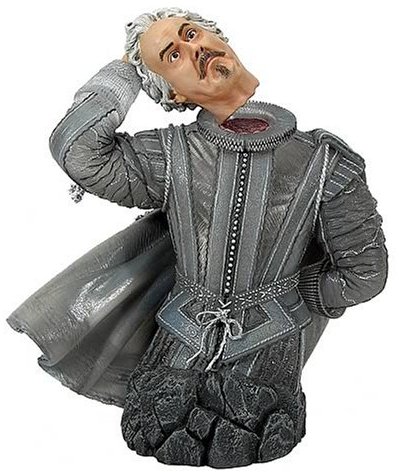
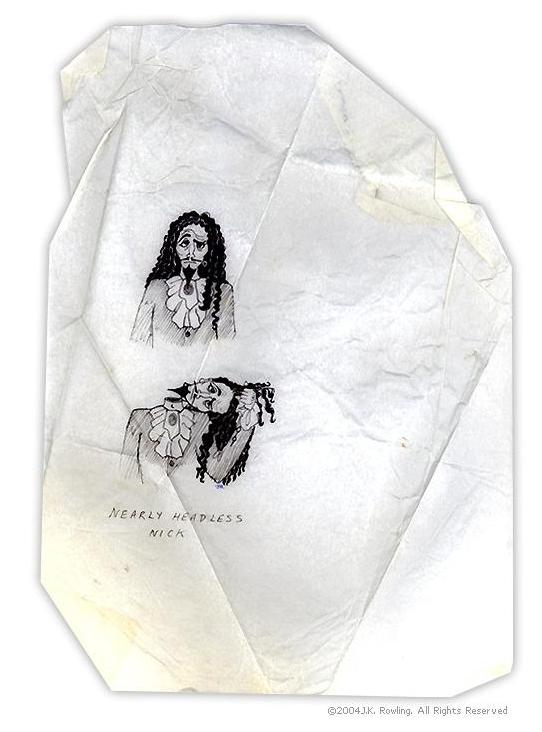
Nick, as played in the Harry Potter films by John Cleese. Rowling’s own original sketch of Nearly Headless Nick is here.

While he gets a great deal of pleasure from entertaining Hogwarts residents by swinging “his whole head . . . off his neck and . . . onto his shoulder as if it was on a hinge” (Sorceror’s Stone, p. 124), his condition limits his access to the dizziest heights of post-mortem society. Beheading was an aristocratic execution, meant to bring a swift death to the privileged, those able to hunt legally in their lifetime. In the afterlife, the beheaded aristocrats have established a “Headless Hunt” Club, and have blackballed Mimsy-Porpington, who misses their entrance requirements by that much: “‘half an inch of skin and sinew holding my neck on.'” Unable to participate in Club sports like “Horseback Head-Juggling and Head Polo,” Mimsy-Porpington is denied admission into the elite society (Chamber of Secrets, p. 124).

Sadly, their scorn for his crippling condition is not limited to exclusion from their company.

Mimsy-Porpington’s five hundredth Deathday anniversary party, held on Halloween 1992, welcomes hundreds of ghosts from as far away as Kent to a feast of rotten fish, putrid, “maggoty haggis,” and a tombstone cake with grey icing, while an orchestra of 30 musical saws plays waltzes. The Deathday Boy’s speech is interrupted by the members of the Headless Hunt: “Sir Properly Decapitated-Podmore” begins a game of Head Hockey, sending his own head sailing past the humiliated Mimsy-Porpington as he tries to address his guests (Chamber of Secrets, p. 132-7).

Somehow the courageous Gryffindor ghost overcomes this diabolical heads-up-manship and several months as a petrified cloud to live a useful afterlife, helping Harry many times. Most significantly, in the final pages of The Order of the Phoenix, a traumatized and grieving Harry turns to Mimsy-Porpington, hoping to discover a way to keep his dead friend and guardian Sirius Black alive. “‘You’re dead,'” Harry says, “‘But you’re still here, aren’t you? … People can come back, right? As ghosts. They don’t have to disappear completely.'” Mimsy-Porpington gently tells Harry that he can only “‘walk palely'” where his living self once trod, “‘neither here nor there,'” hovering between life and death for fear of the unknown. However, Black risked his life joyously and died laughing; he will not linger between death and life. Harry must live on without him.

There may be historical precedent for Mimsy-Porpington’s death in the botched execution of James Scott, Duke of Monmouth (1685), when the notorious Jack Ketch took five blows to kill the rebel, and finally had to use a knife to sever the last “skin and sinew” connecting the head to the corpse. Monmouth’s hairstyle in portraits from the late 1600s resembles that drawn by Rowling in her sketch of Nearly Headless Nick, although that sketch shows a beard style from the early 1600s, nearly 70 years earlier. Moreover, the ghost enters Harry Potter’s life wearing an Elizabethan neck ruff and says that he has not eaten in nearly 400 years, implying a death in the late 1500s.

In spite of this wibbly-wobbly timeline, Mimsy-Porpington’s deathdate establishes the firm chronology of Rowling’s series: the five hundredth anniversary of his death in 1492 would fall in 1992; therefore the events of Chamber of Secrets (published in 1997) must occur in 1992. The dating of the series is confirmed five books later by the tombstones of Harry’s parents, who died on Halloween Day, 1981 (Deathly Hallows, p. 328). For J.K. Rowling, death, the last enemy — not life — marks the measure of this world’s time.

On this day..

1268: Conradin of Swabia

On this date in 1268, 16-year-old boy-king Conradin was beheaded in Naples with his best friend.

This short-lived son of German king Conrad IV inherited his call on the purple at the age of 26. 26 months.

While the infant king worked on his ABC’s in Swabia, different regents tried to keep his Sicily and Jerusalem thrones warm in the far-flung empire.

Knowing an opportunity when he saw it, Conradin’s uncle and “regent” Manfred usurped him in Sicily, tipping over the first domino in a peninsular political chain that would fell both relatives. With Manfred’s accession, the rival power of the papacy now faced an active military strongman at its doorstep — and it, in turn, sponsored French noble Charles of Anjou to oppose, and eventually overthrow, Manfred.

By the time all this played out, Conradin was, if not exactly a seasoned man of the world, at least old enough to hear his voice cracking and start noticing girls. By the standards of medieval Europe, that was plenty old enough to press his injured rights in battle.

Accordingly, Conradin — Corradino, to the Italians — led Hohenstaufen boots down the boot to reclaim Sicily. No dice.

His captor’s attitude was summed up in the sentiment, Conradi vita, Caroli mors — “Conrad’s life is Charles’s death,” somewhat doubtfully ascribed to the counsel of Pope Clement IV — so when you think about it, it was no more than self-defense to cut short that vita. And his buddy’s, too, since the scaffold was already hired for the day.


Conradin of Swabia and Frederick of Baden Being Informed of Their Execution in Prison in Naples, by Goethe buddy Johann Heinrich Wilhelm Tischbein. Did either try the Sicilian Defence?

He turns to clasp with longing arms his friend,
And turning, sees the fatal blow descend,
Then presses with his lips the severed head,
Last greeting of the dying to the dead.
One quivering flash, a shock that is not pain,
And those he parted death unites again.
So perished Conradin, but legends tell
That as the trenchant blade descending fell,
An eagle, that, unseen by human eyes,
Had poised aloft, down swooping from the skies,
For one short instant hovered o’er the slain,
And dyed his pinions with a crimson stain,
Then wildly shrieked, and upward soaring sped
To witness for the blood unjustly shed.

-Tribute in purple poetry by William John Rous (Here’s a more prose-y review of Conradin’s campaign and demise)

This upward-soaring, crimson-pinioned raptor saw off the Hohenstaufen dynasty of the Holy Roman Empire.

In the unstable years that followed, as rival princes and factions jockeyed for influence, there’d be some serious nostalgia for the bygone Hohenstaufens. But there is opportunity as well as peril in change, and though it may be that this fractious realm was neither Holy, nor Roman, nor an Empire, it emerged from its interregnum with its first Habsburg ruler — of many.

What’s left of Corradino di Svevia (and Frederick of Baden) lies entombed at a Neapolitan church, watched over by a monumental 19th century marble sculpture of the youth.

On this day..

1943: Leonard Siffleet, beach beheading

On this date in 1943, Australian World War II commando Leonard Siffleet was beheaded on Aitape Beach in Papua New Guinea, along with two Ambonese, H. Pattiwal and M. Reharing

A photograph of the Japanese soldier Yasuno Chikao an instant before he strikes off Siffleet’s head was taken from the body of a Japanese casualty later in the war. Published in Life magazine, it became one of the war’s most iconic photos.

On this day..

1401: Klaus Stortebeker, Victual Brother pirate

On this date in 1401,* “Victual Brother” Klaus Störtebeker was beheaded in Hamburg.

Statue of Klaus Stortebeker. (cc) image from blariog

This legendary freebooter terrorized the Hanseatic League‘s trading channels from Novgorod to London in the 1390s.

He was the most famous of a company of privateers who’d been hired out in 1392 to place their thumb on the scale of Scandinavian dynastic politics** — notably, supplying Stockholm during a siege, from which service they obtained† the nickname Victual Brothers. It stuck, even when operations had moved far beyond the larder.

In the mid-1390s, the “brothers” turned against Danes and Hanse alike, raiding coasts and plundering sea trade from their base in the shattered port of Visby.

Klaus, the most famous of them, is still remembered today “like Che Guevara, a freedom fighter, but also like Robin Hood, because he fights the rich in the name of the poor”:‡ folk hero-outlaws, men of the pirate utopia.

Whatever debunking that legend might invite, its existence speaks to that timeless romance of the road. And then there’s that kernel of truth, or so one hopes: after Stortebeker’s death, the remnants would persist as the Likedeelers, “those who share equally.”

The buccaneer’s end, after capture by Simon of Utrecht, was equally legendary: he’s supposed to have made a scaffold pact with the headsman to spare any of his mates he could walk past once decapitated.

Rising from the chop like St. Denis, the headless trunk of Stortebeker lurched past 11 of them before the executioner himself tripped it up. (In the most embroidered version of this story, Hamburg not only didn’t honor the promise, it executed the executioner when all was said and done. But we’re pretty comfortable saying that once we reach the headless zombie pirate part of the story, the reader has carte blanche to rewrite anything not to liking.)

Drink up me hearties yo ho! “Stortebeker” itself just means, “quaff the mug.”

Klaus Störtebecker is our master
advised by Godeke Michels!
Shoot through the waves like storm, just faster
The Flying Dutchman’s godfather
Gaffer is the ships goblin
Let’s tackle, crew!
Life is bauble!
We are the hell of Helgoland

Our bloody flag is cracking the mast
Rats scurrying on the floor
A skeleton is our guest
On the sail there are strange shadows
The mermaid is swimming in our wake
Laugh, crew!
Life is bauble!
Still ruling is the hell of Helgoland

And when our ship makes its last run
Laugh while like a coffin she goes down
We die an ancient pirate’s way
Today we fight, tomorrow we drown
In green algae and white sand
Land ho, crew, land!
Life is bauble!
Such dies the hell of Helgoland

-Folk song honoring Klaus Stortebeker
(translated here)

* As often for events at this distance of time, the dates are a little bit shaky; 1400, rather than 1401, has been proposed for the actual year of Stortebeker’s execution; October 21 rather than October 20 is also given on some sites. Folklore more so than almanac blogs has the luxury of indifference to such particulars.

** The Victual Brothers were initially retained to oppose the adroit Danish Queen Margaret. She would face (and brush aside) even weirder challenges to her rule en route to lashing together the Kalmar Union under Danish regional hegemony.

† Alternate explanation: food-based euphemisms for piracy trace to armies’ victual officers, and their unscrupulous methods of filling the mess hall.

‡ In a continuing spirit of democratic larceny — or as a gang symbol for the local Hell’s Angels, whatever — our man’s alleged skull was stolen from a Hamburg museum earlier this year.

On this day..

1975: The Balibo Five, before the invasion of East Timor

On this date in 1975, five Australia-based journalists were slain in East Timor: executed (ahem, “allegedly”) by Indonesian security forces preparing to invade the former Portuguese colony.

The Balibo Five — Australians Greg Shackleton and Tony Stewart; Britons Brian Peters and Malcolm Rennie; and New Zealander Gary Cunningham — worked for two different Australian networks, but were together filing reports from the village of Balibo during the tense run-up to the December 1975 Indonesian invasion.

Just weeks before this date, the more Indonesian-friendly faction in the newly-independent statelet had been routed into Indonesian West Timor by the revolutionary Fretilin. Indonesian security forces were “covertly” probing into East Timor; to those on the ground, it was obvious that an attack was imminent.

Just three days after Greg Shackleton filed that broadcast, he was dead, along with all those colleagues who had been so moved by their Timorese hosts.

The Anglo journos had counted on their passports to protect them, and prominently advertised their Australian affiliations, believing that Indonesia’s western-backed dictatorship would not risk alienating its Cold War allies. By the official story — it’s still Indonesia’s official story — the Balibo Five nevertheless managed to all find their way into the crossfire when Indonesian troops overran Balibo on October 16.

But western sponsorship of this impending incursion went much deeper than the reporters imagined.

Much to the dismay of the men’s families, Canberra proved quite amenable to burying the matter rather than create a diplomatic incident. It even took a pass on the subsequent execution of another Australian who came to Timor Leste to investigate what happened to the Balibo Five — and was himself killed during Indonesia’s full-scale invasion.

Nevertheless, a considerable body of evidence has accumulated to the effect that the journalists’ death was the cold-blooded elimination of eyewitnesses who “could have testified that there was indeed an invasion by Indonesian troops.”

Australian filmmaker Robert Connolly last year fired new interest in the case by releasing Balibo, a dramatic feature film (shot on location in Balibo with Timorese extras) based on Jill Jolliffe’s book about the journalists.

Balibo is endorsed by East Timor’s president, and banned in Indonesia.

On this day..