On an unspecified date around this time in the late 1820s, the narrator of Victor Hugo’s Last Day of a Condemned Man leaves off his diary — bound for the guillotine.
An illustration from The Last Day of a Condemned Man.
The young Hugo‘s first major work of fiction, this 1829 story dramatizes the torment of an unnamed man doomed for an unstated crime. By abstracting its central character, Hugo generalizes its unabashed anti-death penalty message … but one of the few morsels of specificity places the man’s conviction on “a beautiful morning at the close of August,” with the action unfolding over the ensuing six weeks until his date with the guillotine.
They say that it is nothing,–that one does not suffer; that it is an easy death. Ah! then, what do they call this agony of six weeks,–this summing-up in one day? What, then, is the anguish of this irreparable day, which is passing so slowly and yet so fast? What is this ladder of tortures which terminates in the scaffold? Are they not the same convulsions whether life is taken away drop by drop, or intellect extinguished thought by thought?
…
Now I must fortify myself, and think firmly of the Executioner, the cart, the gendarmes, the crowd in the street and the windows.
I have still an hour to familiarize myself with these ideas. All the people will laugh and clap their hands, and applaud; yet among those men, now free, unknown to jailors, and who run with joy to an execution,–in that throng there is more than one man destined to follow me sooner or later, on the scaffold.
More than one who is here to-day on my account, will come hereafter on his own.
Hungarian painter Mihaly Munkacsy‘s The Last Day of a Condemned Man has no relationship to Hugo’s book, but deals in a similar mood. It won an award from the Paris salon in 1870.
* The prisoner finds in his cell the names of then-notable criminals who previously occupied it — a concession to period specificity. The last of these names is Castaing, meaning our man’s story takes place after that poisoner’s 1823 beheading. A subsequent reference to Louis-Auguste Papavoine, executed in 1825, would push the execution to the even narrower window of October 1825, 1826, 1827, or 1828.
Execution of Cristeros by federal soldiers on the outskirts of San Gabriel, Jalisco, October 8, 1927. On the same site, the soldiers were ambushed, suffering the same fate.
On this date in 1553, the capable heir apparent to Ottoman Emperor Suleiman the Magnificent was strangled at dad’s order — casualty of the the realm’s lethal harem politics.
If ’tis state thou seekest like the world-adorning sun’s array,
Lowly e’en as water rub thy face in earth’s dust every day.
Fair to see, but short enduring is this picture bright, the world;
‘Tis a proverb: Fleeting like the realm of dreams is earth’s display.
Through the needle of its eyelash never hath the heart’s thread past;
Like unto the Lord Messiah bide I half-road on the way.
Athlete of the Universe through self-reliance grows the Heart,
With the ball, the Sphere—Time, Fortune—like an apple doth it play.
Mukhlisi, thy frame was formed from but one drop, yet, wonder great!
When thou verses sing’st, thy spirit like the ocean swells, they say.
The racket: when the current sultan dies, all his sons by his various concubines make a rush from their provincial outposts for the capital and fight it out, the winner killing off his half-brothers to consolidate his rule.
This disorderly ascension made, while dad still lived, for fraught internal politicking among the sons for the inside track: the most prestigious positions, and the assignments closest to Istanbul. The various mothers of the contenders jockeyed just as aggressively on behalf of their various entrants in the imperial sweepstakes.
Mustafa was the capable eldest son in a kingdom at its very acme,* but to his misfortune, and the empire’s too, he found himself pitted against one of the ablest women ever to call the Ottoman harem home: Hürrem Sultan, also known as Roxelana (or Roxolana).
A Ukrainian woman kidnapped to the harem by Tartar slavers, Roxelana enchanted Suleiman and soon became his favorite. Therefore, Roxelana also became the rival, with her son and her own potential heir, to Mustafa and his mother.
As the story is told, Roxelana at length contrived to convince Suleiman that Mustafa was in cahoots with the rival Safavid Empire to supplant Suleiman on the throne; Suleiman had his firstborn summoned to his tent on campaign in Anatolia, and straightaway put to death. He’s supposed to have sat by the body in grief for days afterwards, and barely averted a revolt by his elite Janissaries, who much favored the talented Mustafa.
“This terrible tragedy exercised an effect on Ottoman affairs resembling that which the Massacre of St. Bartholomew had on the history of France,” according to The Cambridge Modern History (vol. 3). Roxelana’s unimpressive son “Prince Selim, in whose favour the crime was committed, was the first of a series of degenerate Sultans, sunk in pleasure-seeking or stricken with Imperial mania, under whose sway the Empire went to ruin.”
Consequently, Mustafa is still mourned in Turkey as a tragic turning-point; visitors pay homage to his tomb at Bursa.
Westerners had word of this fascinating palace intrigue through diplomatic correspondents who were not privy to the actual harem, and adopted the story themselves while imaginatively filling in the orientalizing details. Inevitably these imaginings have helped shape the story as it comes to us.
The scenario blending the familiar and the exotic — a European in the court of the Turk; a slave woman dominating the conqueror; fratricidal princes and the alluring seraglio — all set in the heart of the feared Muslim state proved irresistible to literary interlocutors. These made of Suleiman, Mustafa (Mustapha), and Roxelana moral fables, theater (endorsed by Samuel Pepys!), symphony …
* The PBS documentary Islam, The Empire of Faith does engrossing coverage of Suleiman (including his relationship with Roxelana and the execution of Mustafa) in these video segments: 3, 4, 5.
Between September 29 and September 30 in 1941, the Nazis, specifically Einsatzgruppe C, shot some 34,000 Jewish people at Babi Yar, a ravine outside of the Ukrainian city of Kiev.
The United States Holocaust Memorial Museum gives a suspiciously specific death count of 33,771. This is considered the single largest mass murder of World War II, and for Kiev it was just the beginning.
In the days prior to the massacre the Nazis put up posters around the city reading:
Kikes of the city of Kiev and vicinity! On Monday, September 29, you are to appear by 08:00 a.m. with your possessions, money, documents, valuables, and warm clothing at Dorogozhitskaya Street, next to the Jewish cemetery. Failure to appear is punishable by death.
The Jews believed they were being resettled. They had no knowledge of Nazi atrocities, as the Soviet press had supressed such accounts. By the thousands they arrived at the cemetery with their belongings, expecting to be loaded onto trains.
Instead they were forced to strip naked and leave their clothes, shoes and possessions at designated places, all while being beaten by the Nazis and their Ukrainian accomplices.
The naked Jews were led into a ravine which measured approximately 150 m long, 30 m wide and 15 m deep. Two or three narrow entrances led to the ravine, through which the Jews were driven. When they arrived at the edge of the ravine they were taken by Schupo officers, and laid down on top of Jews who had already been shot. All this happened very quickly. The corpses were neatly stacked. As soon as a Jew lay there, a Schupo marksman came with an mp and shot him in the neck. The arriving Jews were so shocked when they saw this horrible scene that they were absolutely submissive. It even happened that some lay themselves down and awaited the shot.
There were only two marksmen who carried out the shootings. One marksman was at one end of the ravine, the second one at the other end. I saw the marksmen standing on the already piled-up corpses while shooting one person after another. As soon as a Jew was killed by a shot, the marksman climbed over the corpses of the killed to the next supine Jew, and shot them. This went on again and again, without any distinction being made between men, women, and children. The children were led to the ravine with their mothers, and killed with them.
Babi Yar survivor Dina Pronicheva
Much of what is known about the massacre comes from Dina Pronicheva, a survivor who later testified at the war crimes trials in 1946 and whose story is told in the most graphic terms in Anatoly Kuznetzov‘s memoir/documentary history Babi Yar: a Document in the Form of a Novel.
Contrary to popular belief, Pronicheva was not the only survivor — there were at least three or four others — but she is the most famous one and the only one to testify at the war crimes trials.
Pronicheva, an actress at the Kiev Puppet Theater, tore up her identity card when she realized what was happening. Her last name and her appearance were not typically Jewish, and she told one of the Nazis that she was a Ukrainian who had been seeing someone off and gotten caught up in the crowd.
She was told to stand aside with a group of other people in the same situation. The Nazis decided to shoot them anyway, however, as they could not allow witnesses to come back to the city and tell what they knew.
When it was her turn, Pronicheva jumped into the ravine without waiting to be shot, and played dead among the mass of bodies. As Kuznetzov put it:
It seemed to her she fell for ages — it probably was a very deep drop. When she struck the bottom she felt neither the blow nor any pain, but she was immediately spattered with warm blood, and blood was streaming down her face, just as if she had fallen into a bath of blood. She lay still, her arms stretched out, her eyes closed.
All around and beneath her she could hear strange submerged sounds, groaning, choking and sobbing: many of the people were not dead yet. The whole mass of bodies kept moving slightly as they settled down and were pressed tighter by the movements of the living.
The Germans went around the ravine firing their revolvers into anyone who appeared to be still alive. One SS man got suspicious of Pronicheva’s appearance. He kicked her hard in the chest and then stomped on her hand until the bones cracked, but she managed to remain limp and silent and he went away without shooting her. Eventually she was able to crawl out of the ravine and make good her escape.
Babi Yar continued to absorb bodies throughout the Nazi occupation of Kiev: Jews, Gypsies, Ukrainians, political activists and basically anyone who pissed the Nazis off. The total number of victims will never be known because before they were driven from the area by the Russians, the Nazis dug up the ravine and burned the corpses.
Mass execution of Soviet civilians at Babi Yar. (Source)
A guesstimate would be between 70,000 and 120,000, but some accounts run as high as 300,000. Some traces were left, as Kuznetzov remembers:
The river bed was of good, coarse sand, but now for some reason or other the sand was mixed with little white stones. I bent down and picked one of them up to look at it more closely. It was a small piece of bone … in one place we saw that the sand had turned to gray. Suddenly we realized we were walking on human ashes …
Nearby there had been a fall of sand, following the rains, which had exposed an angular projection of granite and a seam of coal about a foot thick. There were goats grazing on the hillside with three little boys, each about eight years old, looking after them. They were hacking away diligently at the coal with little picks and breaking it up on a granite block.
The coal was brown and crumbly, as though it was a mixture of ashes from a railway engine and carpenter’s glue.
“What are you doing?” I asked.
“See here!” And one of them pulled from his pocket a handful of something that glittered where it was not covered in dirt, and spread it out in his hand.
It was a collection of half-melted gold rings, earrings and teeth. They were digging for gold.
Babi Yar was filled in after the war and the site is now part of a residential neighborhood in Kiev. There were manyinternationalprotests in 2009 after the city’s mayor announced plans for a hotel on the site, but he changed his mind.
While we know the schism from the comfort of retrospection, those present for its 16th century inception (and long afterward) had the task of sorting out winners and losers on blood-soaked scaffolds.
So we pause this date to note the extirpation September 20 and 21 of the Babington Plot, a half-baked scheme to re-establish the Old Faith that turned into one of history’s signature achievements of espionage.
Its namesake, young Sir Anthony Babington, was a secret Catholic with more money than sense; like many a Catholic of this time, he bristled under the rule of Elizabeth I, the daughter of the very woman who started all this English Reformation trouble.
Besotted with fellow-Catholic Mary Queen of Scots after having served as her page in his youth, Babington was easy prey for the fellow invariably described as Elizabeth’s “spymaster” — Francis Walsingham.
Not one for scruples where his own security or his sovereign’s was concerned, Walsingham had long considered Mary Queen of Scots too dangerous to be left alive: every Catholic plot against Elizabeth intended to replace her on the throne with this Catholic cousin.
Trying to overcome Elizabeth’s reluctance to off fellow royalty — dangerous precedent, in these dangerous times — Walsingham entrapped Babington and a coterie of other Catholics into designing and documenting a scheme to assassinate Elizabeth and support a Spanish invasion.
And most importantly to Walsingham, they got Mary to sign off on it.
Though the design was grandiose, the real danger was pretty much nil — since Walsingham, a Renaissance reconnaissance man famous for his continent-spanning intelligence network, had penetrated the circle months before.* Walsingham let the conspiracy ripen long after he had the goods on the likes of Babington, intending to make it the instrument of Mary’s destruction. He succeeded.
Coded correspondence that Mary thought she was smuggling in and out of her cell was in fact being intercepted and decrypted.
When Babington wrote to her, alluding to his intent with “six noble gentlemen” to murder Queen Elizabeth, Mary doomed herself with a favorable reply:
The affair being thus prepared, and forces in readiness both within and without the realm, then shall it be time to set the six gentlemen to work; taking order upon the accomplishment of their design, I may be suddenly transported out of this place.
Within days, all — Mary, Babington, six gentlemen, and more — were in chains, and the commoners were being tortured into confessions and implications.**
The reckoning for Mary Queen of Scots would not arrive for some months yet.
But those of lesser breeding were dispatched with dispatch. Tried in two bunches, there were 14 in all condemned; on this date, Babington, was hanged, drawn and quartered for treason, along with accomplices John Ballard, Thomas Salisbury, Robert Barnewell, John Savage, Henry Donn and Chidiock Tichborne — the last of these leaving behind this doleful poetic adieu:
My prime of youth is but a frost of cares,
My feast of joy is but a dish of pain,
My crop of corn is but a field of tares,
And all my good is but vain hope of gain;
The day is past, and yet I saw no sun,
And now I live, and now my life is done.
The spring is past, and yet it hath not sprung;
The fruit is dead, and yet the leaves be green,
My youth is gone and yet I am but young,
I saw the world and yet I was not seen;
My thread is cut and yet it is not spun,
And now I live, and now my life is done.
I sought my death and found it in my womb,
I looked for life and saw it was a shade,
I trod the earth and knew it was my tomb,
And now I die, and now I am but made;
My glass is full, and now my glass is run,
And now I live, and now my life is done.
-Chidiock Tichborne
(Hear this bummer of a verse read aloud here and here.)
The torture these first seven unfortunates endured as their entrails were ripped from their still-living bodies was so horrible that Elizabeth ordered the seven others awaiting execution the next day simply to be hanged to death before all the disemboweling business.†
A few books about spymaster Francis Walsingham
* Walsingham had plenty of plots to contend with, but did Elizabeth even greater service keeping tabs on the buildup of the Spanish Armada through a spy network in Italy — even using it to delay the invasion by a crucial extra year by drying up Spain’s credit line with Italian bankers. (Source, via (pdf))
Incidentally, and completely off topic: the subversive, forward-thinking philosopher Giordano Bruno — an Italian who was eventually executed by the Inquisition — has been alleged to be one in Walsingham’s employ.
** Luckily for Elizabeth, the treasonous Protestants who supported her back when she was at the mercy of her Catholic half-sister Mary Tudor were better able to hold their tongues under duress.
† One of those executed on September 21, Charles Tilney, has an oblique Shakespeare connection: he’s one possible author of the play Locrine, which Shakespeare might have revised and/or staged; Locrine is in the Shakespeare Apocrypha.
On this date in 1772, straw effigies of the (in)famous French libertine Marquis de Sade and his servant Latour were executed in Marseilles for sodomy.
“It is always by way of pain one arrives at pleasure.”
The aristocrat christened Donatien Alphonse François (even the name would become taboo for later use among his family) was at this point just 32 years old, but already cultivating the reputation that would make his name a byword for violent sex. He had in 1768 got the boot from Paris in view of the many courtesans who complained of his mistreatment.
Five more would do so for the incident that triggered his “execution”: de Sade took his baroque pleasure from these “very young girls” obtained by his manservant Latour (who also took part in the bisexual debauch). The whole scene was spiced with liberal dosage of the poison/aphrodisiac* spanish fly.
“Cruelty, very far from being a vice, is the first sentiment Nature injects in us all.”
One of these working girls seriously overindulged on the the love potion and spent the next week puking up “a black and fetid substance.” The authorities got interested, and de Sade and Latour bolted to Italy.**
Back in Marseilles, proceedings against the fugitives saw them sentenced for (non-fatal) poisoning and sodomy
for the said Sade to be decapitated … and the said Latour to be hanged by the neck and strangled … then the body of the said Sade and that of the said Latour to be burned and their ashes strewn to the wind.
This was duly carried out against straw effigies of de Sade and Latour on September 12, 1772.
“Lust is to the other passions what the nervous fluid is to life; it supports them all, lends strength to them all: ambition, cruelty, avarice, revenge, are all founded on lust.”
Although the Marquis eventually got this sentence overturned, it did in a sense mark an end to his life as it had been. Later in 1772, he’d be arrested in Italy; though he escaped and went back on the orgy circuit, most of the four-plus decades left to his life would be spent imprisoned or on the run — an ironic situation for the man Guillaume Apollinaire would celebrate as “the freest spirit that has yet existed.”
(Astonishingly, de Sade also avoided execution during the French Revolution: he was supposed to have been in the last batch guillotined before Robespierre fell; either through bureaucratic bungling or efficacious bribery, he avoided the tumbril.† De Sade also cheated death when a man whose daughter the marquis had outraged attempted to shoot him point-blank … only to have the gun misfire.)
“My manner of thinking, so you say, cannot be approved. Do you suppose I care? A poor fool indeed is he who adopts a manner of thinking for others!”
From this latter half of the infamous satyr’s life — when he often had time on his hands not available to dispose in more corporal pursuits — date the pornographic/philosophic writings that would stake de Sade’s disputed reputation for posterity.
** With another lover, his sister-in-law Anne … who was also a Benedictine canoness.
† It was on some firsthand authority, then, that de Sade took a dim view of capital punishment: “‘Til the infallibility of human judgements shall have been proved to me, I shall demand the abolition of the penalty of death.” This and other pithy de Sade quotes in this entry are from here.
On this date in 1764, Pierre-Paul Sirven and his wife — who lay beyond the reach of the law, in Switzerland — were burned in effigy at Mazamet, France, for murdering their daughter.
The Sirvens actually had three daughters; the purported victim, Elisabeth, was mentally unbalanced. The Protestant Pierre-Paul Sirven had had a recent run-in with the Catholic hierarchy in his native Castres, when Elisabeth was shanghaied to a convent for Catholic indoctrination under a lettre de cachet.
The Sirvens moved away to Saint Alby, near Mazamet, but when Elisabeth turned up dead in a well there early in 1762, the official presumption was that her schismatic parents had done her in to prevent her returning to the true church. It could have been that she just fell down the well accidentally, or went and committed suicide; as often in such cases, investigations commencing from a suspicion of foul play are liable to find that suspicion self-affirming.
To make matters worse, all this transpired during the dangerous run-up to the execution of Jean Calas in Toulouse, another instance where a doubtful criminal case was pursued against a Protestant.
Wisely, the Sirvens (parents and two remaining daughters) blew town.
They made it to Switzerland, where they holed up with Voltaire. Back in Mamazet, the parents were condemned to death and the other two children to exile for participating in the purported murder of Elisabeth. “This judgment was equally absurd and abominable,” Voltaire wrote.
If the father, in concert with his wife, had strangled his daughter, he ought to have been broken on the wheel, like Calas, and the mother to have been burned — at least, after having been strangled — because the practice of breaking women on the wheel is not yet the custom in the country of this judge. To limit the punishment to hanging in such a case, was an acknowledgment that the crime was not proved, and that in the doubt the halter was adopted to compromise for want of evidence.
The death sentences — further compromised by the absence of their objects — were nevertheless carried out in effigy on September 11, 1764.
Meanwhile, Voltaire turned his pen to the service of the Sirven cause; a French pamphlet he wrote vindicating both the Sirvens and Calas can be perused here. (Deadly religious persecution in France kept Voltaire quite preoccupied in the 1760s.)
After spending the decade trying to clear the family name from abroad, Pierre-Paul Sirven sensed an opening to return and gave himself up in 1769. The anti-Protestant hostility of the early 1760s had cooled by this time; the Calas execution was widely regretted.
Pierre-Paul Sirven was officially tried and exonerated in 1771, leading Voltaire to remark,
It only took two hours to sentence a virtuous family to death and it took us nine years to give them justice.
This date is the 550th anniversary of (in)famous Wallachian dictator/vampire prototype Vlad III Tepes‘s destruction of the town of Amlas, impaling all its surviving citizens.
The signature execution form of “Vlad the Impaler” was as nasty as it sounds: still-living victim mounted on a long, oiled stake driven through the rectum and emerging through the mouth to expire agonizingly over a period of hours or days. Or, alternatively, stuck through the midsection, leaving the subject horizontally mounted like a flopping fish.
And he had frequent recourse to it during his long struggle for power in the treacherous 1450s and 1460s, the period* when Vlad III became famous for the iron-willed cruelty required to exercise power in a Wallachia squeezed between the expanding Ottoman Empire and Hungary.
(Bram Stoker didn’t invent the vampire myth, and the notion that Vlad Dracula “is” Count Dracula is one of those bits of popular folklore that’s become academically unfashionable. But still.)
The historical Vlad has his latter-day defenders, who see him as a nation-builder. Certainly, both the man himself and his vulnerable frontier principality were menaced by innumerable threats both foreign and domestic.
This date’s massacre was to deal with one such, Germans in the territory of Transylvania, which lay to the north of Vlad’s own Wallachia. Both realms are part of present-day Romania, and they were closely connected in Vlad’s time as well; the young Dracula himself was born in Transylvania, and Transylvanian towns had helped him take the Wallachian throne with the support of Hungary.
So far, everyone was on the same page. But when a power struggle erupted for the Hungarian throne in 1457, the “Saxon” emigres who formed the upper crust of merchants in Transylvania (supported by a vast sea of Romanian peasants) backed the Holy Roman Emperor while Vlad supported the usurping Hunyadi family that had so ably patronized him.** It’s quite a bit more dizzyingly complex than that, but the bottom line is that commercial and political conflicts soon saw Vlad Dracula mounting a campaign of Transylvanian terror from 1458 onward.
During the summer of 1460 Dracula organized his final raid on Transylvania. This time he attacked townships and villages in the district of Amlas known as the “Land of the Forest” or Unterwald … The meistersinger Beheim gives the exact date of the attack as falling on the feast day of Saint Bartholomew in the year 1460: August 24. Dracula struck in the early morning after “passing through the great forest” with his cavalry force. He burned the town of Amlas and impaled all the citizens, a priest having led the procession to the burial scene …
Dracula’s raid on Amlas was aimed at eliminating any remaining dissident resistance and at killing rival contenders to his throne … Dracula knew, for instance, that … the boyar Bogdan Doboca, was hiding in the village of Sercaia, in the Fagaras district. So he had the entire village razed to the ground; it had to be completely repopulated in the following century. Similar was the fat of the village of Mica. The narrator Beheim tells us that Dracula burned or destroyed half the communities in the Amlas district, including the capital city by that name. He “assembled all the citizens and all those he could find” from other villages and hanged them on hooks and pitchforks, after having had his men hack them to pieces with knives, swords, and sabers. Amlas was reduced to a ghost town, as it still is today, and other villages such as Saliste, Apodul de Sus, and Tilisca were similarly destroyed. Beheim claims that altogether some 30,000 Germans were killed during this Dracula raid on the district of Amlas.
Impressive as this date’s butchery would have been — although we know it from German propagandists who figure to have made the most of it — it was simply of a piece with Vlad’s Transylvanian campaign. To this campaign, Florescu and McNally attribute an impressive catalogue of atrocities, such as:
Slaughtering all the inhabitants of a village named Bod
Impaling one of his own captains who reported an inability to take an enemy position “for the inhabitants are brave and well fortified”
Boiling alive 600 Saxon merchants
Impaling as spies 41 Saxons who came to Wallachia to learn the Romanian language
Forcing one captured rival claimant with Saxon support to go through a Mass for the dead clothed in funerary vestments before personally beheading him
Fleeing Germans carrying spine-tingling eyewitness accounts and rumors of even worse made a happy match with that new media technology, the printing press, giving Dracula continental infamy and a purchase on future literary immortality.
“The horror genre conformed to the tastes of the fifteenth-century reading public as much as it does today,” observe those same authors Florescu and McNally in another volume. “No fewer than thirteen different fiteenth- and sixteenth-century Dracula stories have been discovered thus far in the various German states.”
The St. Bartholomew’s Day 1460 events are seemingly sometimes conflated† with a more famous bloodbath during the spring of 1459, when Vlad arranged a demonstrative mass impaling on the outskirts of Brasov.‡
All those whom he had taken captive, men and women, young and old, chlidren, he had impaled on the hill by the chapel and all around the hill, and under them he proceeded to eat at table and enjoyed himself in that way.
It’s this 1459 event that provides us the most horribly recognizable images of Dracula’s reign, with the insouciant Wallachian prince enjoying his repast amid a thicket of impaled wretches.
* 1456 to 1462, specifically, which was the second (and most consequential) of the three different periods Vlad III was Prince of Wallachia. The Ottomans drove him out in 1462, and he took refuge in Hungary before a return bid in 1476, which ended in his own death in battle.
** And specifically, Mihaly Szilagy (Hungarian link), the uncle of the ascendant king Matthias Corvinus. The latter would seek to woo Saxon support, and he had an on-again, off-again relationship with Vlad Dracula. Wallachia was a small buffer state from the standpoint of a greater power like Hungary, and Wallachia’s ruler a political instrument no matter how much impaling he might do.
† Perhaps because Brasov’s Church of St. Bartholomew was among the targets ravaged by Dracula’s force?
‡ Attack staged from picturesquely vampiric Castle Bran.
We have now reached a stage of the case the details of which shake one’s confidence in the whole course of the proceedings and reveal a situation which undermines the respect usually to be accorded to a jury’s verdict.
America our nation has been beaten by strangers who have turned our language inside out who have taken the clean words our fathers spoke and made them slimy and foul
their hired men sit on the judge`s bench they sit back with their feet on the tables under the dome of the State House they are ignorant of our beliefs they have the dollars the guns the armed forces the powerplants
but do they know the old words of the immigrants are being renewed in blood and agony tonight do they know the old American speech of the haters of oppression is new tonight in the mouth of an old woman from Pittsburgh of a husky boilermaker from Frisco who hopped freights clear from the Coast to come here …
the men in the deathhouse made the old words new before they died.
Let us abandon then our gardens and go home
And sit in the sitting room.
Shall the larkspur blossom or the corn grow under this cloud?
Sour to the fruitful seed
Is the cold earth under this cloud,
Fostering quack and weed, we have marched upon but cannot conquer;
We have bent the blades of our hoes against the stalks of them.
Let us go home, and sit in the sitting room.
Not in our day
Shall the cloud go over and the sun rise as before,
Beneficent upon us
Out of the glittering bay,
And the warm winds be blown inward from the sea
Moving the blades of corn
With a peaceful sound.
Forlorn, forlorn,
Stands the blue hay-rack by the empty mow.
And the petals drop to the ground,
Leaving the tree unfruited.
The sun that warmed our stooping backs and withered the weed uprooted
We shall not feel it again.
We shall die in darkness, and be buried in the rain.
What from the splendid dead
We have inherited —
Furrows sweet to the grain, and the weed subdued —
See now the slug and the mildew plunder.
Evil does overwhelm
The larkspur and the corn;
We have seen them go under.
Let us sit here, sit still,
Here is the sitting-room until we die;
At the step of Death on the walk, rise and go;
Leaving to our children`s children this beautiful doorway,
And this elm,
And a blighted earth to till
With a broken hoe.
If it had not been for these things, I might have lived out my life talking at street corners to scorning men. I might have died, unmarked, unknown, a failure. Now we are not a failure. This is our career and our triumph. Never in our full life could we hope to do such work for tolerance, for justice, for man’s understanding of man as now we do by accident. Our words — our lives — our pains — nothing! The taking of our lives — lives of a good shoemaker and a poor fish-peddler — all! That last moment belongs to us — that agony is our triumph.
“Alone in a hotel room with Fred [Moore], I begged him to tell me the full truth … He then told me that the men were guilty, and he told me in every detail how he had framed a set of alibis for them … I faced the most difficult ethical problem of my life at that point … I had come to Boston with the announcement that I was going to write the truth about the case.”
But Sinclair had reasons beyond the “ethical” to tell what he saw as the larger truth. From a different letter:
“My wife is absolutely certain that if I tell what I believe, I will be called a traitor to the movement and may not live to finish the book … Of course, the next big case may be a frame-up, and my telling the truth about the Sacco-Vanzetti case will make things harder for the victims … It is much better copy as a naïve defense of Sacco and Vanzetti because this is what all my foreign readers expect, and they are 90% of my public.”
Well, the dying time came, the legal midnight hour,
The moment set by law for the Chair to be at work,
To substantiate the majesty of the State of Massachusetts
That hour was at hand, had arrived, was struck by the clocks,
The time for two men to be carried cool on a cooling board
Beyond the immeasurably thin walls between day and night,
Beyond the reach of airmail, telegrams, radiophones,
Beyond the brotherhoods of blood into the fraternities
Of mist and foggy dew, of stars and ice.
The time was on for two men
To march beyond blood into dust —
A time that comes to all men,
Some with a few loved ones at a bedside,
Some alone in the wilderness or the wide sea,
Some before a vast audience of all manking.
Now Sacco saw the witnesses
As the straps were fitted on
Tying him down in the Chair —
And seeing the witnesses were
Respectable men and responsible citizens
And even though there had been no introductions,
Sacco said, “Good-evening, gentlemen.”
And before the last of the straps was fastened so to hold
Sacco murmured, “Farewell, mother.”
Then came Vanzetti.
He wished the vast audience of all mankind
To know something he carried in his breast.
This was the time to tell it.
He had to speak now or hold his peace forever.
The headgear was being clamped on.
The straps muffling his mouth were going on.
He shouted, “I wish to forgive some people
for what they are now doing.”
And so now
the dead are dead????
-Carl Sandburg, “Legal Midnight Hour”
(The executions took place just after midnight Aug. 22-23)
THE names of the “good shoe-maker and poor fish-peddler” have ceased to represent merely two Italian workingmen. Throughout the civilised world Sacco and Vanzetti have become a symbol, the shibboleth of Justice crushed by Might. That is the great historic significance of this twentieth century crucifixion, and truly prophetic, were the words of Vanzetti when he declared, “The last moment belongs to us–that agony is our triumph.”
…
Vanzetti was right when he declared that his execution was his greatest triumph, for all through history it has been the martyrs of progress that have ultimately triumphed. Where are the Caesars and Torquemadas of yesterday? Who remembers the names of the judges who condemned Giordano Bruno and John Brown? The Parsons and the Ferrers, the Saccos and Vanzettis live eternal and their spirits still march on.
On the 20th of August, 1672, the city of the Hague, always so lively, so neat, and so trim that one might believe every day to be Sunday, with its shady park, with its tall trees, spreading over its Gothic houses, with its canals like large mirrors, in which its steeples and its almost Eastern cupolas are reflected,–the city of the Hague, the capital of the Seven United Provinces, was swelling in all its arteries with a black and red stream of hurried, panting, and restless citizens, who, with their knives in their girdles, muskets on their shoulders, or sticks in their hands, were pushing on to the Buytenhof, a terrible prison, the grated windows of which are still shown, where, on the charge of attempted murder preferred against him by the surgeon Tyckelaer, Cornelius de Witt, the brother of the Grand Pensionary of Holland was confined.
…
the whole town was crowding towards the Buytenhof, to witness the departure of Cornelius de Witt from prison, as he was going to exile; and to see what traces the torture of the rack had left on the noble frame of the man who knew his Horace so well.
Yet all this multitude was not crowding to the Buytenhof with the innocent view of merely feasting their eyes with the spectacle; there were many who went there to play an active part in it, and to take upon themselves an office which they conceived had been badly filled,–that of the executioner.
There were, indeed, others with less hostile intentions. All that they cared for was the spectacle, always so attractive to the mob, whose instinctive pride is flattered by it,–the sight of greatness hurled down into the dust.
That ominous mob got its spectacle this date in 1672, lynching the Dutch Republic’s longtime de facto head of state, Johan de Witt along with his brother Cornelis/Cornelius.
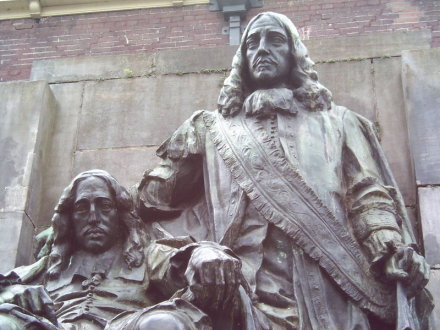
A statue of Johan (standing) and Cornelis de Witt in their native Dordrecht.
The mercantile powerhouse that was the 17th century Dutch Republic was the stage for a long-running conflict between the Orange monarchists (hence the soccer uniforms) and the Republican merchant class.
With the sudden death of the young William II, Prince of Orange in 1650, leaving the (non-hereditary) executive office of stadtholder vacant, the Republicans became ascendant.
And the outstanding figure of the First Stadtholderless Period was Johan de Witt, scion of a Dordrecht merchant family powerful enough that William II had imprisoned de Witt’s own father during a power struggle.
While all these guys were landing themselves in their respective canons, Johan de Witt was trying to keep the age Golden.
Having only relatively recently broken free of Spain, the small country was an up-and-comer on the horns of a serious security dilemma: its leading commercial position put it into maritime competition with England, while its continental location made it vulnerable to the enormous army of the neighboring continental hegemon, France. Ultimately, even with its trade wealth, it did not have the resources to keep up with both of western Europe’s leading powers.
For a generation, de Witt’s statecraft kept the men of the Low Countries out of that predicament, while his brother Cornelis chipped in with a couple of timely naval victories. (Actually authored by Michiel de Ruyter, but Cornelis rode shotgun.)
In 1654, Johan brought the First Anglo-Dutch War to a close, making with Oliver Cromwell a secret pact he was only too happy to enforce never to allow William II’s son, the eventual William III, to be named stadtholder. Reason being: William III was the grandson of the Stuart king Cromwell beheaded, Charles I, and thus a potential claimant to the English throne. Both Protestant Republics had a distinct interest in keeping this monarchist well away from power. (Both would be sorely disappointed.)
A decade and a Stuart Restoration later, de Witt maintained (mostly) Dutch dominance of the seas in the Second Anglo-Dutch War, then held off France (with the help of a timely alliance with the recent adversary, England) in the War of Devolution.
In each case, he kept at least one of England or France on the sideline, or in his own camp.
But the Third Anglo-Dutch War was the charm — as it was also the Franco-Dutch War, and therefore 1672 was Rampjaar: disaster year. While the Dutch were aces on the waves, a massive French invasion easily overwhelmed them on terra firma.
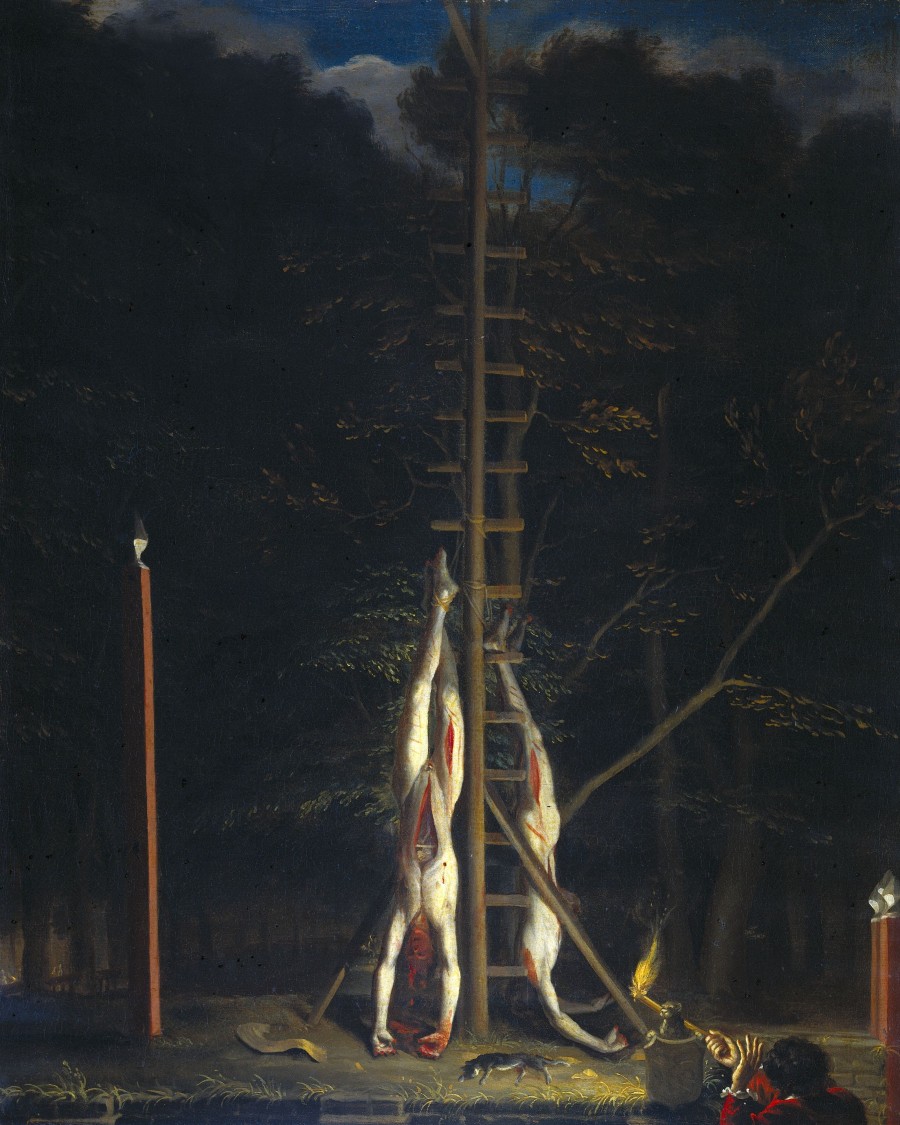
Detail view (click for the full image) of a grisly painting of the mutilated de Witt brothers strung up at The Hague. It’s attributed to Jan de Baen, who in better times took Johan de Witt’s portrait.
De Witt’s never-beloved mercantile oligarchy speedily collapsed with the military reverses, and the now all-grown-up William III was there to pick up the pieces to popular acclaim. Arrested for treason, Cornelis sustained torture without confessing, but when Johan visited him in prison — and William III incriminatingly withdrew the cavalry protecting the brothers — the mob quenched its fury with the de Witts’ blood.
every one of the miscreants, emboldened by his [Johan’s] fall, wanted to fire his gun at him, or strike him with blows of the sledge-hammer, or stab him with a knife or swords, every one wanted to draw a drop of blood from the fallen hero, and tear off a shred from his garments.
And after having mangled, and torn, and completely stripped the two brothers, the mob dragged their naked and bloody bodies to an extemporised gibbet, where amateur executioners hung them up by the feet.
Then came the most dastardly scoundrels of all, who not having dared to strike the living flesh, cut the dead in pieces, and then went about the town selling small slices of the bodies of John and Cornelius at ten sous a piece.
-Dumas
The word “ungrateful” comes to mind.
De Witt stood altogether on a lower plane than Cromwell. We regard him rather as a man of rare and singular talent, than as one of the chosen great ones of the earth, which Cromwell was. He stands far above the common run of men; and he was head and shoulders above nearly all the notable men of his time. He would have been greater if the movement of his limbs had been less burdened with the Dutch governing apparatus … He is not one whom the world can ever greatly admire or love.
(Here’s another, and here’s a 17th century volume de Witt himself coauthored.)
The rise of William III came with the decline of that Dutch Golden Age: the country fended off the immediate military threat, but it increasingly slipped behind its larger neighbors. Costly as was the Franco-Dutch War, it is a step on the path towards the present-day Europe, and this gives us enough excuse to notice that the Eurovision lead-in tune is actually from a Te Deum composed to mark its end.
But William’s own ascent to this wealthy sovereignty was just the beginning for him. Sixteen years later, the House of Orange’s champion vindicated Cromwell’s trepidation about him and gained a far more satisfactory position from which to do battle with his Gallic rival Louis XIV by stunningly overthrowing the Stuart dynasty and becoming King of England in the Glorious Revolution.**
* The Dutch remained the sole western contact of closed Japan until 1854, which is why Japan’s eventual period of scientific advancement became known as ‘Dutch Learning’.
** Albion did not forget the de Witts, either: according to this 1785 cant dictionary, the term “dewitted” had a 17th-18th century run in English to denote — well, exactly what happened to Cornelis and Johan.


 The aristocrat christened