1776: Neptune, as witnessed by John Gabriel Stedman

On or around this date in 1776,* a couple of blacks in Suriname (both slave and free) were executed for unrelated crimes … notably a free man named Neptune whose coolness under horrific torture is related by John Gabriel Stedman in The Narrative of a Five Years Expedition against the Revolted Negroes of Surinam.

Dutch-born and of Scottish descent, Stedman was a soldier who volunteered to serve in the West Indies and found himself in Suriname fighting those “revolted negroes” — Maroons fled from slavery who had established independent communities and episodically (most of the 1770s were one such episode) fought the white colonies.

Maroon settlements in Suriname still pesist to this day.

Though that was Stedman’s business on the Caribbean coast of South America, the culprits whose deaths he witnessed today were not among the “revolted”, but more prosaic criminal fare. Prosaic, that is, until Neptune’s insouciantly comedic discourse in the midst of the most appalling torture.

Stedman sets the scene for us with the more everyday depravities prevailing in the colonial capital, Paramaribo

If, as I have just mentioned, cruelties were become less common in the rivers by the rebels, barbarities still continued in a shocking degree in the metropolis; where my ears were deafened with the clang of the whip, and the shrieks of the negroes. Among the most eminent of these tyrants was a Miss Sp—n,who lived next door to Mr. de Graav, and who I saw with horror from my window give orders that a young black woman should be flogged principally across the breasts, at which she seemed to enjoy peculiar satisfaction. To dissipate the impression this scene had left on my mind, I got into a whiskey, and rode out; when the first thing I saw was a negro girl fall naked from a garret window on a heap of broken bottles: this was indeed an accident, but she was so mangled, though not dead, that she exhibited a spectacle nearly as wretched as the other.—Cursing my unlucky fate, I turned the horses, and drove to the beach, as the only place to avoid every scene of cruelty and misery; but here I had the mortification to see two Philadelphia sailors (while they were fighting on the forecastle of their vessel) both fall over the ship’s bow into the stream, where they sunk, and were no more seen. On board another American brig, I discovered a little tar defending himself from the cross-trees with a hatchet, against a serjeant and four armed men, for a considerable time; till they threatening to shoot him out of the rigging, he at last surrendered, and being brought ashore, was dragged to Fort Zelandia, in company with two others, by a file of musketeers, where, for having been drunk on duty, they received a fire-cant each, at the captain’s request; that is, they were bastinadoed or beaten on the shoulders by two corporals with bamboo canes, till their backs were black, and swelled like a cushion. However arbitrary this mode of correction, the captain endeavoured to explain the necessity of it; the private American sailors being of a turbulent spirit indeed when drunk, although when sober they may be fairly classed among the best seamen in the world.

But the narrator is just getting warmed up, and after a good night’s sleep …

Early the next morning, while musing on all the different dangers and chastisements to which the lower class of people are exposed, I heard a crowd pass under my window. Curiosity made me start up, dress in a hurry, and follow them: when I discovered three negroes in chains, surrounded by a guard, going to be executed in the savannah. Their undaunted look, however averse I may be to the sight of cruelties, so attracted my attention, as to determine me to see the result, which was thus:— The sentence being read in Low Dutch (which they did not understand) one was condemned to be flogged below the gallows, and his accomplice to have his head struck off with an axe, for having shot a slave who had come to steal plantains on the estate of his mistress. The truth however was, that this had been done by that lady’s absolute command; but the murder being discovered, she, in the hopes of saving her character, besides the expence of paying the penalties, gave up her valuable slave, and permitted the unhappy man to be thus sacrificed. He laid his head upon the block with great indifference, stretching out his neck; when, with one blow of the axe, it was severed from his body.

The third negro, whose name was Neptune, was no slave, but his own master, and a carpenter by trade; he was young and handsome, but having killed the overseer of the estate Altona, in the Para Creek, in consequence of some dispute, he justly forfeited his life. The particulars, however, are worth relating: This man having stolen a sheep, to entertain a favourite young woman, the overseer, who burnt with jealousy, had determined to see him hanged; to prevent which, the negro shot him dead among the sugar canes; for these offences of course he was sentenced to be broken alive upon the rack, without the benefit of the coup de grace or mercy-stroke. Informed of the dreadful sentence, he composedly laid himself down on his back on a strong cross, on which, with arms and legs expanded, he was fastened by ropes: the executioner, also a black man, having now with a hatchet chopped off his left hand, next took up a heavy iron bar, with which, by repeated blows, he broke his bones to shivers, till the marrow, blood, and splinters flew about the field; but the prisoner never uttered a groan nor a sigh. The ropes being next unlashed, I imagined him dead, and felt happy; till the magistrates stirring to depart, he writhed himself from the cross, when he fell on the grass, and damned them all, as a set of barbarous rascals; at the same time removing his right hand by the help of his” teeth, he rested his head on part of the timber, and asked the by-standers for a pipe of tobacco, which was infamously answered by kicking and spitting on him; till I, with some American seamen, thought proper to prevent it. He then begged that his head might be chopped off; but to no purpose. At last, seeing no end to his misery, he declared, “that though he had deserved death, he had “not expected to die so many deaths: however, (said he) you christians have missed your aim at last, and I now care not, were I to remain thus one month longer.” After which he sung two extempore songs (with a clear voice) the subjects of which were, to bid adieu to his living friends, and to acquaint his deceased relations that in a very little time he should be with them, to enjoy their company for ever in a better place. This done, he calmly entered into conversation with some gentlemen concerning his trial; relating every particular with uncommon tranquillity—”But,” said he abruptly, “by the sun it must be eight o’clock; and by any longer discourse I should be sorry to be the cause of your losing your breakfast.” Then, casting his eyes on a Jew, whose name was De Vries, “A-propos, sir,” said he, “won’t you please to pay me the ten shillings you owe me ?” — “For what to do ?” — “To buy meat and drink, to be sure—don’t you perceive I am to be kept alive?” Which speech, on seeing the Jew stare like a fool, this mangled wretch accompanied with a loud and hearty laugh. Next, observing the soldier that stood sentinel over him biting occasionally on a piece of dry bread, he asked him ” how it came to pass, that he, a white man, should have no meat to eat along with it ?” — ” Because I am not so rich,” answered the soldier. — “Then I will make you a present, sir,” said the negro; “first, pick my hand that was chopped off clean to the bones, next begin to devour my body, till you are glutted; when you will have both bread and meat, as best becomes you;” which piece of humour was followed by a second laugh; and thus he continued, until I left him, which was about three hours after the dreadful execution.

Wonderful it is indeed, that human nature should be able to endure so much torture, which assuredly could only be supported by a mixture of rage, contempt, pride, and the glory of braving his tormentors, from whom he was so soon to escape. [ here a footnote is marked in the original text, whose content is: “At Demerary, so late as October, 1789, thirty-two wretches were executed in three days, sixteen of whom suffered in the manner just described, with no less fortitude, and without uttering one single complaint.” -ed. ]

Though I never recal to my remembrance, without the most painful sensation, this horrid scene, which must revolt the feelings of all who have one spark of humanity, I cannot forbear exhibiting to the public the dreadful spectacle in the annexed drawing.


Detail view of William Blake‘s illustration of Neptune’s breaking on the rack. (Click for full image.)

If the reader, however, should be offended with this shocking exhibition, and my dwelling so long on this unpleasant subject, let it be some relief to his reflection, to consider this punishment not inflicted as a wanton and unprovoked act of cruelty, but as the extreme severity of the Surinam laws, on a desperate wretch, suffering as an example to others for complicated crimes; while at the same time it cannot but give me, and I hope many others, some consolation to reflect that the above barbarous mode of punishment was hitherto never put in practice in the British colonies.

I must now relate an incident, which, as it had a momentary effect on my imagination, might have had a lasting one on some who had not investigated the real cause of it, and which it gave me no small satisfaction to discover. About three in the afternoon, walking towards the place of execution, with my thoughts full of the affecting scene, and the image of the sufferer fresh in my mind, the first object I saw was his head at some distance, placed on a stake, nodding to me backwards and forwards, as if he had really been alive. I instantly stopped short, and seeing no person in the savannah, nor a breath of wind sufficient to move a leaf or a feather, I acknowledge that I was rivetted to the ground, where I stood without having the resolution of advancing one step for some time; till reflecting that I must be weak indeed not to approach this dead skull, and find out the wonderful phenomenon, if possible, I boldly walked up, and instantly discovered the natural cause, by the return of a vulture to the gallows, who perched upon it, as if he meant to dispute with me for this feast of carrion ; which bird, having already picked out one of the eyes, had fled at my first approach, and striking the skull with his talons, as he took his sudden flight, occasioned the motion already described. I shall now only add, that this poor wretch, after living near six hours, had been knocked on the head by the commiserating sentinel, the marks of whose musket were perfectly visible by a large open fracture in the skull.

Stedman’s work details a number of other atrocities against Suriname’s African (primarily slave) population, many of them powerfully illustrated by William Blake with near pornographic effect. These sorts of things were of ancient vintage in the realm.

The Narrative itself became both an important anti-slavery text, and an invaluable historical reference. (Where I have clipped the text, Stedman is about to segue into a discourse on the local vulture population, just the sort of detail that present-day researchers might have a hard time sourcing for 18th century Suriname.)

But even though contemporary abolitionists made use of the Narrative, Stedman’s 18th century publisher actually played down the author’s tone on the subject. A version much more overtly critical of slavery and the savage corporal punishments that upheld it has recently been published from the original manuscripts. (An abridged version of that original is also available.)

* Stedman’s narrative mingles chronological journal-style entries with general observations about his environs. The text is slightly ambiguous as to the date, but the chapter in question begins by situating the action on Aug. 12, digresses into a description of the regional landscape, then returns to the narrative where this blog entry picks it up. It’s not completely explicit that the metropolitan atrocities he witnesses also occur on the 12th, but the text invites that inference — with the execution taking place the next morning after.

The next date explicitly named is Aug. 24, the birthday of the Prince of Orange, so if Neptune did not die on Aug. 13, it was within only a very few days after.

On this day..

1856: Elizabeth Martha Brown, Tess of the D’Urbervilles inspiration

On a drizzly morning this date in 1856, Elizabeth Martha Brown (or Browne) was hanged for murder as a young and fascinated Thomas Hardy looked on.

Brown was born Clark(e), but she took the name of a husband 20 years younger than she, which is how she got into this mess.

Said John Brown was rumored to have made the match for money, though his older wife sure seems to have held her own in the looks department. (More on that in a bit.)

In due time, John afflicted their already-tempestuous wedded life with an affair — courtesy of one Mary Davis, a young woman stuck in her own unhappy May-December marriage.

According to the confession Elizabeth provided two days before her own death, she had a fantastic row with her drunken husband when he came home at 2 a.m. one night and Elizabeth accused him of being

“to Mary Davis’s?”

He then kicked out the bottom of the chair on which I had been sitting, and we continued quarrelling until 3 o’clock, when he struck me a severe blow on the side of the head, which confused me so much I was obliged to sit down.

He then said (supper being on the table at the time) “Eat it yourself and be damned,” and reached down from the mantelpiece a heavy hand whip, with a plaited head and struck me across the shoulders with it 3 times, and every time I screamed out I said “if you strike me again, I will cry murder” He replied “if you do I will knock your brains through the window,” and said hoped he should find me dead in the morning, and then kicked me on the left side, which caused me much pain.

He immediately stooped down to unbuckle his boots, and being much enraged, and in an ungovernable passion at being so abused and struck, I seized a hatchet that was lying close to where I sat, and which I had been making use of to break coal for keeping up the fire to keep his supper warm, and struck him several violent blows on the head – I could not say how many – and he fell at the first blow on his side, with his face to the fireplace and he never spoke or moved afterwards.

Unfortunately, this confession broke a protracted* attempt to stick to an implausible “the horse kicked him dead” story whose maintenance seriously complicated any bid to secure clemency for the woman.

She received, instead, a different kind of life: literary immortality that hardly any in Dorchester that gray morning could have aspired to.

Thomas Hardy, not yet the canonical novelist famous enough for his own Monty Python sketch but a 16-year-old architectural apprentice, was among the three or four thousand who braved the inclement weather to witness Brown’s hanging** — the mandatory sentence then for a circumstance the courts would handle differently today.

Even seven decades later, Hardy could recall the vividly sensual effect of this macabre scene.

I saw — they had put a cloth over the face — how, as the cloth got wet, her features came through it. That was extraordinary.

and

I remember what a fine figure she showed against the sky as she hung in the misty rain and how the tight black silk gown set off her shape as she wheeled half round and back.

Recent film adaptations of Tess of the D’Urbervilles. The book is available free from Gutenberg.org.

In both her tragic life and her hempen death, Brown is thought to have informed Hardy’s title character in the 1891 novel Tess of the D’Urbervilles, slyly subtitled “A Pure Woman Faithfully Presented.”

“Justice” was done, and the President of the Immortals, in Aeschylean phrase, had ended his sport with Tess.

-Thomas Hardy, Tess of the D’Urbervilles

* Everything is relative, of course. In Brown’s instance, less than five weeks separated murder from execution, so she had scarcely had time to be obstinate about withholding the confession.

** Brown was said to have died with great firmness, and the report from the scaffold brings us the classically Victorian detail that executioner William Calcraft, having departed the platform to spring the trap after pinioning his prisoner, was obliged to make a return trip when he realized he’d forgotten to tie down her dress against any immodest billowing.

An ironic precaution, given that we remember this hanging precisely because of Hardy’s captivation with the more refined eroticism of the “wet hanging gown contest” tableau.

Part of the Themed Set: Thomas Hardy.

On this day..

Themed Set: Thomas Hardy

English poet and novelist Thomas Hardy, whose gloomy cast of mind makes him particularly suitable for these pages, lived most of his nearly 90 years right next door to death.

Hardy’s work spans the English experience from the Napoleonic Wars to the First World War, ever haunted by tragedy and loss. This guy wrote “Dead Man Walking” before Dead Man Walking.

I am but a shape that stands here,
A pulseless mould,
A pale past picture, screening
Ashes gone cold.

Bummer.

For the next few posts, Executed Today catches a young Thomas Hardy as witness to public hangings … and an aged Hardy as witness to a world at war.

On this day..

1936: The Sacred Heart, by Spanish leftists

On this date in 1936, anticlerical leftists in the Spanish Civil War allegedly subjected a monumental statue of Christ to a ritual “execution”.


“This picture, taken by a Paramount News-reel representative and received by air from Madrid yesterday, illustrates an outrage which has no parallel in the photographs published by “The Daily Mail” of the Spanish Reds’ war on religion. It shows a Communist firing squad aiming at the colossal Monument of the Sacred Heart on the Cerro de los Angeles, a hill a few miles south of Madrid which is regarded as the exact centre of Spain.” (Source)

This outstandingly incendiary image made for great recruiting for the Francoist enemies of the “firing squad” and gave credence to a “crusade” lexicology that insured the devout would break overwhelmingly against the Republic. (Nearly 7,000 men and women in religious orders whose deaths during the war are charged to the Republican account also helped.)

Maybe that was inevitable, anyway.

George Orwell, the English leftist who volunteered for the Spanish Republicans, noted in his Homage to Catalonia that

the people in this part of Spain must be genuinely without religious feeling — religious feeling, I mean, in the orthodox sense. It is curious that all the time I was in Spain I never once saw a person cross himself; yet you would think such a movement would become instinctive, revolution or no revolution. Obviously the Spanish Church will come back (as the saying goes, night and the Jesuits always return), but there is no doubt that at the outbreak of the revolution it collapsed and was smashed up to an extent that would be unthinkable even for the moribund C. of E. in like circumstances. To the Spanish people, at any rate in Catalonia and Aragon, the Church was a racket pure and simple. And possibly Christian belief was replaced to some extent by Anarchism, whose influence is widely spread and which undoubtedly has a religious tinge.

Be that as it may, Republican types suspected photographic fakery.

Just like its inspiration is reported to have done, this statue survived its “execution” in fine shapewas resurrected by public subscription, and can still be seen at Cerro de los Angeles outside Madrid.


The “executed” statue today. (cc) image from bigchus.

On this day..

1976: Valery Sablin, Hunt for Red October inspiration

On this date in 1976, the real-life Soviet political officer whose naval mutiny inspired Tom Clancy’s Cold War thriller The Hunt for Red October was shot in Moscow for treason.

No, unlike his fictional counterpart Marko Ramius (Sean Connery, in the 1990 cinema adaptation excerpted above), Valery Sablin didn’t make it to the West.

But the real Valery Sablin wasn’t trying to make it.

Sablin was the political officer aboard the submarine-killer Storozhevoy. He was also a dedicated Leninist incensed at the notoriously corrupt gerontocracy of the Leonid Brezhnev era.

When he led his mutiny in Riga, his plan was to take the Storozhevoy to St. Petersburg and, Aurora-like, sound the tocsin for a Soviet Tea Party to restore the ideals of the Revolution.

Basically, Sablin had the exact opposite intent of his literary offspring.

This being the 1970s, when figuring out what the devil was happening in the black box of the USSR constituted its own academic discipline, the incident was misinterpreted in the western media — but understandably so.


View Larger Map

The sea route from Riga to St. Petersburg begins in a westerly direction, towards Sweden, and the spectacle of Soviet fighters turning back a vessel steaming for Gotland (combined, of course, with the natural susceptibility of the western audience to the notion) suggested that the mutineers had aimed not at revolution, but at defection.

Under the headline “Newspaper Reports Soviet Ship Mutiny” sourced to Agence France-Presse and datelined Stockholm, Jan. 22, the Jan. 23, 1976 Washington Post reported:

Crewmen on board a Soviet coast guard vessel in the Baltic mutinied and tried to sail the ship into Swedish territorial waters in November, the evening newspaper Expressen said today.

Citing foreign visitors recently returned from Riga, the paper said the mutiny took place Nov. 7 after celebrations in Riga marking the Soviet revolution.

The paper said a Soviet submarine and a number of helicopters forced the ship to return to Riga.

This was the version of the story that aspiring spy novelist Tom Clancy encountered. In his reworking, it became the bold (and successful) defection of a state-of-the-art Soviet submarine and its deft commander … effected, of course, with a little help from the derring-do of the spooks at Langley.

Moscow was pleased to let this be the version that people heard, to the extent they heard anything at all of the incident. Though not exactly flattering, it was much less threatening than the potential storyline of “Soviet officers are so fed up with party corruption that they’re trying to revolt”.

Not until 1990 did the real story get out.

It’s pretty safe to say that the Valery Sablin who died this day would not have had a lot of sympathy for Marko Ramius,* and still less for the Reaganite writer who turned Sablin’s deed inside-out and made it the cornerstone of his own personal mint.

Trust the fact that history will judge events honestly and you will never have to be embarrassed for what your father did. On no account ever be one of those people who criticise but do not follow through their actions. Such people are hypocrites — weak, worthless people who do not have the power to reconcile their beliefs with their actions. I wish you courage, my dear. Be strong in the belief that life is wonderful. Be positive and believe that the Revolution will always win.

-Sablin’s last letter to his son

Russian speakers may enjoy this documentary about the Sablin mutiny.

* Another inversion: in order to make his break for the Free World, the fictional (and, significantly, ethnically Lithuanian) Ramius murders the ethnically Russian political officer, Ivan Putin, assigned to his ship; the real Sablin was himself that zealous political officer, and imprisoned the ship’s captain in the course of the mutiny.

On this day..

1419: The (first) Defenestration of Prague

(Thanks to Meaghan Good of the Charley Project for the guest post. -ed.)

On this day in 1419, an angry mob of Hussite peasant rebels stormed the town hall on Charles Square in Prague and threw the judge, the mayor and several city council members (either seven or thirteen; accounts differ) out the window. They all either died in the fall or were killed by the crowd outside.

The event has been the subject of several paintings, as well as being beautifully illustrated in Lego form and also reenacted.

Hussites followed a Christian reformer, Jan Hus, who was one of the forerunners of the Protestant Reformation. Hus was eventually excommunicated and burned as a heretic. The cause of the July 30 riot was the city council’s refusal to release from custody several Hussite prisoners.

The mob, led by the Hussite priest Jan Želivský and future general Jan Žižka, marched to the town hall, but they only became violent after someone inside the building threw a stone at them. After that there was no stopping them.

The riot had far-reaching consequences, inasmuch as it is seen as the start of the Hussite Wars, which lasted until 1434 or so and involved government-sponsored military action against the Hussites as well as Hussites fighting amongst themselves.

This event has come to be known as the First Defenestration of Prague. That is, I’m sure we all can agree, an AWESOME name, and probably the principal reason the riot is still remembered today. The word “defenestration” comes from Latin: de-, meaning “out of,” and fenestra, “window.”

The Czechs have a habit of throwing people out of windows at critical junctures in history; since 1419 there has been at least one more (nonfatal, but more famous) Defenestration of Prague, in 1618. A couple of similar events since then have sometimes been called the Third Defenestration of Prague, though this is not universally agreed upon.

On this day..

Special: One Thousand and One Nights for One Thousand and One Deaths

July 26, 2010 marked the 1,000th consecutive consecutive day of fresh death content delivered since this here site debuted on Halloween 2007.

Since rounding the milestone of 500, traffic has grown (nearly 80% of this site’s pageviews have occurred during the second half of its existence to date), awards have been garnered, and many, many heads have been harvested.

Quite a journey.

To celebrate the start of Executed Today‘s second thousand days, we are pleased to welcome scholar Elizabeth M. Hull for a feature excursion into what we flatter ourselves is our literary mirror, One Thousand and One Nights … which is the story of 1,001 stories, each related by the wife of the sultan to stave off her own execution.

By the way: the post below checks in right at 1,001 words.


1,001 Arabian Nights, when no one (real) was executed.

Once there was a young girl named Shahrazad who outwitted death and an angry king. But like all stories, this one begins long before that.

It is said that Shah Zamán returned home unexpectedly and found his wife asleep in the arms of their black cook slave. Naturally, Shah Zamán “drew his scymitar and, cutting the two in four pieces with a single blow, left them on the carpet and returned presently to his camp.”

Sick from dwelling “on the deed of his wife,” Shah Zamán witnessed the daily orgy between his brother Shahryár’s concubines and slaves, while Shahryár’s Queen’s “slobbering” slave “winding his legs round hers, as a button loop clasps a button, … threw her and enjoyed her.”

King Shahryár’s greater power should have made him safe from women’s treachery; it did not. When the brothers discovered that even the wife of a powerful Jinn had cuckolded her husband 600 times, they concluded that “they all do it and that there is no woman but who cuckoldeth her husband.”

After slaying his wife, his ten concubines, and their lovers, Shahryár initiated his famous wedding policy, “marrying a maiden every night and killing her the next morning” before she could betray him. The slaughter went on every day for three years, until “there remained not in the city a young person fit for carnal copulation.”

The real story of Shahrazad is the story of damaged masculine honor and the holocaust it requires: 1,108 women and 11 men, until there is no one left to kill. The fundamental condition of this fictional world is men’s inability to control women’s sexuality — or even to control their own sexual desires. After all, the king does not give up sex; instead he kills his partners. His shame, jealousy, grief, rage, and power empty his city of life.

Shahrazad’s own story begins in this empty city.

The virgin whose father has carried out the executions volunteers to marry Shahryár. Her father warns her not to be like the Bull in the tale, and she eagerly asks for the story, which he frames in another cautionary tale. She still marries the king, but her father’s stories set the pattern for her stratagem: play upon natural human curiosity and the love of a good yarn, wrapped in another good yarn, rolled into a tangle of story threads.

Shahrazad tells her husband the story of the Trader who mistakenly killed his wife, and, famously, dawn comes just as he is about to kill his son, “knife in hand — And Shahrazad perceived the dawn of day. … ‘What is this to that I could tell thee on the coming night, were I to live and the King would spare me?’ Then said the King in himself, ‘By Allah, I will not slay her, until I shall have heard the rest of her tale.’ So they slept the rest of that night in mutual embrace.”

The cliffhanger involves the trader’s love for his wife and his child, feelings Shahryár long ago killed in himself, since by executing his wives he has eliminated any children they might have borne. An empty city, and a sterile palace.

A complicated dance develops between Shahrazad and Shahryár, its rhythm set by the nights he spends with her between the setting and rising of the sun, metaphorical death and birth.

The classic Richard Francis Burton translations of the Book of the Thousand Nights and a Night are also available free on Gutenberg.org.

The stories themselves are a kind of life, not just in the liveliness of adventure, love, sexual humor, and trade. Like life they are full of interruptions, new stories springing from old ones, proliferating, fertile, oozing the kindness and evil in the hearts of man and woman.

The tales reflect the conflict between men and women in Shahryár’s past. Often, women are adulterous, jealous, abusive, and rapacious; occasionally men are angry and brutally violent. Most especially, death fills the tales, thousands of deaths, mostly murders and executions. The famous hero Sindbad, for example, cast into the tomb with his dead wife, murders other widows and widowers for their food and water, takes their valuables, and becomes rich. Sharazad’s world is Darwinian: survival justifies killing.

Sometimes, women govern better than men. In the final story, Ma’aruf finds a ring that controls a Jinn, loses it to his father-in-law, who loses it to his Wazir, who loses it to Ma’aruf’s wife. When her husband tells her to give the ring to him or to her father, she says: “I will keep the ring myself, and belike I shall be more careful of it than you. … So fear no harm so long as I live.” Indeed, they remain happy until she dies.

The point could have been that Shahryár’s life will be happy as long as Shahrazad lives –- if her story ended there. Instead, Ma’aruf’s jealous first wife tries to steal the ring; she is killed by his son in one last conflict with a wicked stepmother. The story ultimately suggests that good women protect their husbands, but so do children.

Sharazad will base her appeal for clemency not just on her own value and but also on her children’s. By now, “Shahrazad had borne the King three boy children … one walking, one crawling and one sucking.” Connecting the stories to their sons, she says to Shahryár, “‘these thousand nights and a night have I entertained thee with stories,'” and asks him for her life: “‘for, an thou kill me, they will become motherless and will find none among women to rear them as they should be reared.’ When the King heard this, he wept and straining the boys to his bosom said, ‘… Shahrazad, I pardoned thee before the coming of these children, for that I found thee chaste.'”

We never learn how he knows that she is chaste. Perhaps giving him life, life created just for him, not only through children but through the stories that restored his own desire for tomorrow, was enough.

On this day..

1501: Antonio Rinaldeschi, bad gambler

This date in 1501,* the Italian city-state of Florence celebrated a “double feast”: that of St. Mary Magdalene, which marked a civic carnival every July 22; and, the hanging of sacrilegious gambler Antonio Rinaldeschi on the walls of the Bargello.

Eleven days prior, Rinaldeschi was having a bad run of wagering at The Fig Tree tavern.

Like Jesus is some people’s co-pilot, the Virgin Mary must have been Rinaldeschi’s card-counter — for, stalking out of the premises much the poorer, our doomed punter blasphemously uttered “words that are better kept silent” about her. Then, passing an image of Holy Mother at the piazza Santa Maria de Alberighi, he gathered up some nearby dung and flung it at the sacred pic.

This dry poo maybe should have just slid right off, but the Lord works in mysterious ways.

Write William Connell and Giles Constable in “Sacrilege and Redemption in Renaissance Florence: The Case of Antonio Rinaldeschi” (Journal of the Warburg and Courtauld Institutes, vol. 61 (1998), and the source of most of this entry’s narrative),

a portion of it, resembling a rosette (‘quasi pareva una rosetta secha’), stuck to the Virgin’s diadem, above the nape of her neck. The dirtied image drew much attention. The archbishop came to look. Candles and votive images were brought before the fresco, which quickly became an object of popular devotion.

Someone saw something and the trail led back to the ill-tempered cardsharp within days, who tried to stab himself to death when he realized what was about to go down. He copped to the crime pretty quickly (at least one source says it was so that he could be executed in preference to being lynched), and his corpse dangling out the Bargello window decorated the other Mary’s regularly-scheduled homage of parades and horse-races.

(And, now that it was no longer needed as evidence, the miraculous ordure was cleaned off the statue.)

Florence at the dawn of the 16th century was truly a place where religion could get you killed. This was the city that had elevated severe Dominican friar Savonarola to dictator and morals enforcer in the 1490s (Savonarola especially hated gambling), then overthrew and burned him in 1498.

Our authors think there’s some evidence that the first couple years of the 1500s were a period when the populist religious fanatics who once grooved on Savonarola’s violent party pooper act were back on the march as against, say, the more out-of-touch syphilitic reckless gambling blasphemer element that was now, post-Savonarola, enjoying free run of the town. Having one of the latter excrement-ize a Marian monument is the sort of thing that would have led the Florentine Fox News: naturally, he had to be made an example of.

To help you bear that example in mind, a nine-panel painting, “The History of Antonio Rinaldeschi”, attributed to the hanged man’s contemporary Filippo Dolciati, can be seen in Firenze’s Stibbert Museum.

Madonna + manure, meanwhile, has its own art legacy … and the combination is still good for raising a ruckus to this day.


The Holy Virgin Mary, by Chris Ofili: a black Mary smeared with elephant dung.

* The primary sourcing on the chronology of the execution is sketchy enough that it’s possible Rinaldeschi was hanged on July 21, before midnight — rather than in the dark early hours of July 22.

On this day..

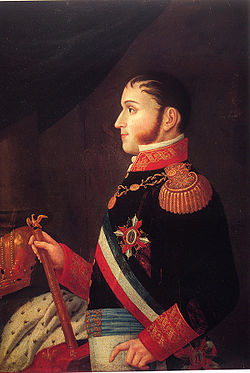
1824: Agustin de Iturbide, Emperor of Mexico

On this date in 1824, the Mexican officer who had made himself emperor was shot at the village of Padilla.

Iturbide‘s military acumen saw him through a meteoric rise in the service of what was then New Spain.

Iturbide rejected an early offer of generalship from the pro-independence leader Hidalgo in favor of spending the 1810s ably quashing the insurgency.

In a bizarre twist of fate, however, it would be Iturbide who would himself cement Mexican independence.

En route to try to finish off the last major rebel leader, Vicente Guerrero, Iturbide caught wind of the recent del Riego liberal revolt back in the mother country,* which had triggered civil war in Spain.

For the conservative royalist general, heir himself to a Basque noble lineage, the potential collapse of Bourbon authority in Spain raised the frightening specter of social upheaval.

All Iturbide’s work killing guerrillas for the sake of public order could come to naught if the Spanish monarchy collapsed or ceased projecting its power overseas … and then who knew what would emerge from the resulting power vacuum in Mexico?

So Iturbide cut a deal with Guerrero to consummate the Mexican War of Independence by separating from Madrid on an essentially conservative basis — a political breakaway without a social revolution. Independent Mexico would make nice with the Spaniards already living there, keep Catholicism as the official state religion, and get itself a constitutional monarchy of its own to insulate itself from the chance outcomes of continental politics across the ocean.

And when Iturbide marched into Mexico City and encountered a crowd conveniently imploring him to take the throne, well, who was he to deny them?

And so Iturbide transitioned smoothly from scourge of the revolution to its man on horseback,** immediately splintering the coalition that lifted him to power.


Contrary to this allegorical take on Iturbide’s coronation, he crowned himself — Bonaparte-like.

Only months after his July 1822 coronation, Iturbide shuttered Congress and began arresting the opposition. Meanwhile, Ferdinand VII had emerged from the Spanish fray as the (momentary) winner, leaving his upstart former subjects without international support.

A general that the freshly-minted emperor had himself had promoted, one Antonio Lopez de Santa Anna — yes, the Alamo guy — declared against Iturbide by the end of 1822, and come the following spring, Agustin I was a European exile, in the paradoxical position of drawing a pension from Mexico while also officially considered a traitor and outlaw.

In Tuscany and then England, Iturbide published an autobiographical justification — Statement of Some of the Principal Events in the Public Life of Agustín de Iturbide — then finally took up a much-asked-for invitation from Mexican conservatives to return and become the savior of his country against internal breakdown and a potential Spanish attack.

Founded on vainglory, this expedition was destined for fiasco; within five days of touching Mexican soil, Iturbide was serenading a firing squad with the last words, “Mexicans! I die with honor, not as a traitor; do not leave this stain on my children and my legacy. I am not a traitor, no.” Apparently they were serious about that injunction never to return.

When in Mexico City, relive happier times for our day’s subject at the Palace of Iturbide where he briefly maintained himself in the purple.


Iturbide’s palace. Creative Commons image from patricio00.

And do think twice about styling yourself Emperor of Mexico, since the only other person to claim that title also ended his reign in front of a firing squad.

* Ironically, it was a body of soldiers assembled for a reconquista of Spain’s independence–minded New World possessions that enabled del Riego to mutiny.

** Iturbide paused in the revolution’s good graces just long enough to design the Mexican flag.

On this day..

1749: Samuel Henzi, excluded

What happens to a dream deferred?

Does it dry up
like a raisin in the sun?
Or fester like a sore–
And then run?
Does it stink like rotten meat?
Or crust and sugar over–
like a syrupy sweet?

Maybe it just sags
like a heavy load.

Or does it explode?

–Langston Hughes

Those lines, written for 20th century America’s struggle with racism, are rooted in the timeless conflict between the haves and the have-nots, and those “exploding” dreams deferred have provided more than a few subjects for these morbid pages.

This date in 1749 saw the beheading of writer and reluctant revolutionary Samuel Henzi (German Wikipedia page), along with two fellow-conspirators in a plot to overthrow the aristocratic government of Bern(e).

Still operating off a 13th century constitution, Berne had ossified into an oligarchic society with privilege derived from heredity and the capable but low-born frustratingly locked out. This arrangement had provoked intermittent uprisings and challenges, but as of the mid-18th century, it was still going strong, and “patricians mockingly observed that the citizens must be stripped of their feathers, that they might not want to fly.” (Source)

Henzi was a man with the ambition and the talent to soar above his place.

Eloquent, cultured, a guy to bang out some French poetry on the side, Henzi had been among a group of lower gentry who in 1744 petitioned for a change to Bern’s governing council, which at that time had become a privately held dynastic trust among a few top burghers.

For a suggestion as incendiary as allocating council seats by lot the better to represent the class, Henzi was treated as a rebel and exiled to Neuchatel.

dass ein eingewurzelter Staatskrebs mit Demuth nicht geheilt werden kann; nein! man muss den Degen in die Faust nehmen, wenn man die verlorne Freiheit wieder erobern will.*

Returning on a pardon, he found that not much had changed. The doors to employment in the civil administration shut tight against him, and not being bought off with a minor sinecure he fell in with a circle of malcontents dreamily conspiring to blow the whole thing up.

These plotters were exposed and three considered ringleaders — merchant Samuel Niklaus Wernier, Stadtlieutenant Emanuel Fueter, and Henzi — were beheaded on this date, each reputedly requiring more than one stroke of the sword.

On embarking with their two sons to quit the Helvetic territory, the wife of Henzi exclaimed, “I would rather see these children sink in the Rhine-stream than they should not one day learn to avenge the murder of their father.” However, when the sons came to manhood, they displayed more magnanimity than their mother; and one of them, who rose to distinction in the service of the Netherlands, requited with good offices to the burghers of his native town the unmerited misfortunes which they had brought upon his family. (Source)


Henzi’s fate greatly excited German dramaturg (and original Conehead) Gotthold Lessing — indeed, he would remark that no other event moved him so deeply.

Almost immediately after Henzi’s decapitation, Lessing wrote his first tragedy, the never-finished but aptly-titled Samuel Henzi, which is available in the original German here.**

Wann man des Staates Flehn, der sie aus Gunst erkoren,
Der nur aus Nachsicht fleht, empfängt mit tauben Ohren;
Wann wer der Freiheit sich das Wort zu reden traut,
Zum Lohn für seine Müh ein schimpflich Elend baut;
Freiheit! wann uns von dir, du aller Tugend Same,
Du aller Laster Gift, nichts bleibet als der Name:
Und dann mein weichlich Herz gerechten Zorn nicht hört,
So bin ich meines Bluts –– ich bin des Tags nicht wert.

* That is, “humility cannot cure the cancer of the state; one must take the sword in fist.” The comment is cited in Edward M. Batley, “‘Tu executes comme tes maitres jugent!’ – The Henzi Affair and the question of Lessing’s political judgment”, German Life and Letters, July 1984.

** Lessing’s next stab at stagecraft in the key of seria produced what’s generally described as the German theater’s first domestic or bourgeois tragedy, Miss Sara Sampson (German Wikipedia entry).

On this day..