1810: Pedro Domingo Murillo, for Bolivian independence

Today is the bicentennial of the execution of Pedro Domingo Murillo and eight fellow martyrs to Bolivian independence.

Men like Gregorio Garcia Lanza and Juan Bautista Sagarnaga (both Spanish links) wagered their necks under the leadership of wealthy mestizo Murillo. (all links Spanish)

Something of a career troublemaker, Murillo had had a few scrapes with the crown’s agents over his patriotic aspirations for the territory the Spanish called Upper Peru.

On July 16, 1809, taking advantage of the confused political situation in Spain following Bonaparte’s conquest, he put himself at the head (Spanish) of a breakaway state.

Unfortunately for the self-proclaimed Junta Tuitiva, neither masses nor elites really rallied to their side, and the Spanish swiftly crushed the uprising.

July 16, the date these dreamers declared independence, is still celebrated in La Paz.

And why not? Though militarily overwhelmed, this quixotic enterprise turned out to be one of the opening acts in a (largely successful) generation-long struggle for independence throughout the Spanish possessions in the New World.

On this day..

1670: Claude Duval, gentleman highwayman

It’s been 340 years since the immortal highwayman Claude Duval (or Du Val, or Du Vall) went to the Tyburn gallows and was turned off into legend as the ne plus ultra of English gentleman thieves.

Duval, actually, was French, an import to Isles in the train of some forgotten noble migrating with the restoration of royal prerogatives.

On the English highway, this formerly impecunious retainer coruscated as a knight of the road, the very model of the chivalrous outlaw against whom the likes of Dick Turpin would be compared to disadvantage. Macaulay recorded

how Claude Duval, the French page of the Duke of Richmond, took to the road, became captain of a formidable gang, and had the honour to be named first in a royal proclamation against notorious offenders; how at the head of his troop he stopped a lady’s coach, in which there was a booty of four hundred pounds; how he took only one hundred, and suffered the fair owner to ransom the rest by dancing a coranto with him on the heath;


William Powell Frith‘s painting (1860) of Claude Duval dancing with his prey.

how his vivacious gallantry stole away the hearts of all women; how his dexterity at sword and pistol made him a terror to all men; how, at length, in the year 1670, he was seized when overcome by wine; how dames of high rank visited him in prison, and with tears interceded for his life; how the king would have granted a pardon, but for the interference of Judge Morton, the terror of highwaymen, who threatened to resign his office unless the law were carried into full effect; and how, after the execution, the corpse lay in state with all the pomp of scutcheons, wax lights, black hangings and mutes, till the same cruel judge, who had intercepted the mercy of the crown, sent officers to disturb the obsequies. In these anecdotes there is doubtless a large mixture of fable; but they are not on that account unworthy of being recorded; for it is both an authentic and an important fact, that such tales, whether false or true, were heard by our ancestors with eagerness and faith.

Gillian Spraggs justifiably observes that no matter how genuinely gallant the brigand, his profession entailed relieving others of their rightful produce by main force. But then, the same could be said of the lords of the realm.

No, although Duval’s legend invites debunking, this must be for another blog.

We take Duval here at his mythological acme: he is the patron saint of the early modern bandit, the Superman of English outlawry, succoring with the fantasy of freedom upon the road the thousands of porters and scullery maids and apprentices chained to their oars below-decks upon Britannia’s ship of state.

What matter the rest?

This day, we toast Claude Duval, the Knight of the Road, in the manner of the fetching inscription (since destroyed by fire) under which he was reportedly buried:

Here lies DuVall: Reder, if male thou art,
Look to thy purse; if female, to thy heart.
Much havoc has he made of both; for all
Men he made to stand, and women he made to fall
The second Conqueror of the Norman race,
Knights to his arm did yield, and ladies to his face.
Old Tyburn’s glory; England’s illustrious Thief,
Du Vall, the ladies’ joy; Du Vall, the ladies’ grief.

Part of the Themed Set: Resistance and Rebellion in the Restoration.

On this day..

1772: Susanna Margaretha Brandt, Faust inspiration

On this date in 1772, Susanna Margaretha Brandt was beheaded with a sword in Frankfurt am Main for murdering her infant child.

The orphaned maid (German Wikipedia entry), not yet 26, had the previous August given birth to the child of a passing goldsmith who had drugged and seduced/raped her.

Brandt got rid of the child, and when caught hysterically attributed the murder to infernal influence.

Faustian Bargain

Affecting as Brandt’s small tragedy might be, she is remembered today not in her own right but because of her proximity to a 22-year-old lawyer living a few hundred yards from her cell: Johann Wolfgang von Goethe.

Several of Goethe’s family and friends were directly involved in Brandt’s case, and her death through seduction and infanticide are widely taken (pdf) to have inspired the character Gretchen in Goethe’s Faust: the character and the infanticide plotline are additions the German author made to an age-old legend.

Goethe began Faust in this same year of 1772, and continued reworking it throughout his life.

And it was a historically timely juncture to incorporate the baby-killing angle into the old Satanic pact story: infanticide was the subject of philosophical and juridical debate, with the use of capital punishment in infanticide cases sharp declining in forward-thinking German states.

Infanticide likewise became a trendy literary topic; Faust is only the best-known example.

“Seduction, and during the second half of the century infanticide, are possibly the most popular themes in eighteenth-century German literature by men,” according to Susanne Kord.*

Lessing’s Sara Sampson and Emilia Galotti, Schiller’s Luise Millerin (Kabale und Liebe), Goethe’s Marie Beaumarchais (Clavigo) and countless other bourgeois heroines die as a direct result of a man’s — often a nobleman’s — sexual desire. Goethe’s Gretchen (Faust), Heinrich Leopold Wagner’s Evchen Humprecht (Die Kindermorderin), Lenz’ Marie (Zerbin) and many others are put to death for committing infanticide.

…

Like the woman-as-child, the woman-as-childkiller, fictional or not, teaches sexual morals; mounting the scaffold, the woman admits her guilt, speaks her warning, and, incidentally, absolves society of all blame.

That might be a little too pat. But despite rendering a sympathetic character in Margaret, Goethe’s own biography suggests the problematic nature of this widespread fascination with illicit sexuality.

The writer 11 years later found himself in the court of the Duke of Saxe-Weimar-Eisenach in position to help decide whether another infanticide should live or die.

Goethe voted for Johanna Catharina Höhn’s execution.

* “Women as Children, Women as Childkillers: Poetic Images of Infanticide in Eighteenth-Century Germany,” Eighteenth-Century Studies, Spring 1993. More in this vein on Goethe in “Infanticide as Fiction: Goethe’s Urfaust and Schiller’s ‘Kindsmörderin’ as Models” by Helga Stipa Madland, The German Quarterly, Winter 1989.

On this day..

1794: Maurice Joseph Louis Gigost d’Elbee, Vendean general

On this date in 1794, one of the great royalist generals of the Vendee revolt was shot by the French Revolution’s Republican forces at Nourmoutier.

The 1793 counterrevolutionary uprising in the Vendee had roused retired cavalryman Maurice Joseph Louis Gigost d’Elbee (English Wikipedia link | French), and he became the second commander of the Royal and Catholic Army upon the death of Jacques Cathelineau.

Unfortunately for d’Elbee, even with English support, the balance of force rather tipped in favor of Paris, and the Revolutionary government was obviously not shy about sealing its victories in blood.

D’Elbee suffered a grievous wound at the Battle of Cholet in October 1793, and for a couple of months was spirited one step ahead of the advancing Republicans.

As Charles MacFarlane writes in The French Revolution, Vol. 3, he ran out of room to run at the island of Noirmoutier.

D’Elbee was lying in bed between life and death; his wife might have escaped, but would not leave him: they were both taken. As Turreau’s soldiers entered their chamber the wounded royalist exclaimed, “Yes, here I am! Here is d’Elbee, your greatest enemy! If I had been strong enough to fight or stand upon my feet, you would not have taken me in my bed!” They kept him for five days, treating him with execrable barbarity, and then carried him in an arm-chair to the place appointed for fusilading the prisoners, and there shot him. His wife was fusiladed the next day, and her brother and brother-in-law perished in the same manner.


Mort du General d’Elbee, by Julien Le Blant, depicts the general shot with three other royalist officers. Not pictured: Hundreds of other Vendean prisoners massacred in the aftermath of the Battle of Savenay.

On this day..

c. 560 B.C.E.: Aesop, fabulist

On an unknown date around the 560s B.C.E., the storyteller Aesop is supposed to have been executed in Delphi by being hurled from the Hyampeia rock.

The semi-legendary fable-fashioner is not quite so irretrievable to history as, say, Homer, although assuredly many or all of the tales that have accrued under the heading “Aesop’s Fables” trace to origins other than this man.

Supposed to have lived from the late 7th to mid 6th centuries B.C.E., Aesop is first referenced by history’s first historian, Herodotus.

But by way of summation, we cannot improve upon Plutarch‘s succinct description of Aesop’s fate in his essay, “On God’s Slowness to Punish Evil”. (Available here; a different translation is free online here.)

I’m sure you know the story of how Aesop came here bringing gold from Croesus. He meant to make a magnificent offering to the god,* and also to give every inhabitant of Delphi four minas, but apparently he got angry and fell out with the locals; so he made the ritual offering, but sent the money back to Sardis, because he didn’t think that the people deserved a windfall. They then engineered a charge against him of temple robbery and executed him by pushing him from the famous cliff called Hyampeia.** Subsequently, the story goes on, divine wrath afflicted them with failed harvests and with all kinds of strange diseases, and as a result they used to visit all the festivals where Greeks were assembled and make an announcement inviting anyone who so wished to claim compensation from them for Aesop. Two generations later Idmon of Samos arrived at Delphi; not only was he not a relative of Aesop, but he was in fact a descendant of the people who had bought Aesop as a slave in Samos.† It was only when the Delphians had compensated him that their troubles ceased.‡ (We are also told that this incident was the reason for moving the place of punishment for temple robbers from Hyampeia to Aulia.)

There are many books and media under the Aesop’s Fables branding available for purchase, but you can also find the same content in the public domain at Gutenberg.org and elsewhere.

In any format, they’re timeless. “The Mischievous Dog”, for instance, could have been written especially for bloggers.

[audio:http://www.gutenberg.org/files/19616/mp3/19616-04.mp3]

* Referring to the sacred shrine occupied by the Oracle of Delphi, of course.

** When visiting Delphi, look for Hyampeia marked on your tourist map as “Phleboukos”, one of the Phaedriades surrounding the sacred site. Hyampeia/Phleboukos towers above the Castalian spring. It’s high.

† Besides being a slave, Aesop (at least, the Aesop as legend accumulated) was afflicted with other disadvantages suitable to elevate his mythological wisdom. According to The Life of Aesop:

AESOP (according to Planudes, Cameraius and others) was by Birth, of Ammorius, a Town in the greater Phrygia; (though some will have him to be a Thracian, others a Samian) of a mean Condition, and his Person deformed, to the highest degree: Flat-nos’d, hunch-back’d, blobber-lipp’d; a long mishapen Head; his Body crooked all over, big-belly’d, badger-legg’d, and his Complexion so swarthy, that he took his very Name from’t; for Aesop is the same with Aethiop. And he was not only unhappy in the most scandalous Figure of a Man, that ever was heard of; but he was in a manner Tongue-ty’d too, by such an Impediment in his Speech, that People could very hardly understand what he said.

Be sure to check The Life‘s account of Aesop’s demise, with the undiplomatic Aesop having enraged his hosts with his poor opinion of their digs … and the fables he tells in his defense falling very flat: “He was speaking on, but they pushed him off headlong from the Rock, and he was dashed to pieces with the Fall.”

‡ The Delphians’ search for compensation is directly described by Herodotus’ Histories, written little more than a century after Aesop’s death. Though the execution story itself could be apocryphal, its presence in Herodotus at least makes Greeks’ belief in the event as a real one of their recent past about as credibly documented as anything from 2500+ years ago.

That Aesop belonged to Iadmon is proved by many facts — among others, by this. When the Delphians, in obedience to the command of the oracle, made proclamation that if any one claimed compensation for the murder of Aesop he should receive it, the person who at last came forward was Iadmon, grandson of the former Iadmon, and he received the compensation. Aesop therefore must certainly have been the former Iadmon’s slave.

Evidently, Aesop’s reputation for sagacious wit was well-established in the 5th century B.C. Aristophanes makes respectful references to Aesop in his plays The Wasps, Peace and The Birds — in the latter, the birds’ ignorance is underscored because they haven’t read their Aesop.

On this day..

Feast Day of St. Stephen

The day after Christmas — or the second day of the twelve days of Christmas, in a more traditional coinage — is the feast of St. Stephen.*

St. Stephen is well-known as the “protomartyr”, the first Christian to die for his faith. (Jesus doesn’t count.) There’s a St. Stephen’s Gate in Jerusalem so named for its supposed proximity to the site of the protomartyrdom.

We get the Stephen story from the New Testament Acts of the Apostles, as given in this from the Tyndale-derived King James Version (Acts 6:8 – 8:3)

And Stephen, full of faith and power, did great wonders and miracles among the people. Then there arose certain of the synagogue, which is called the synagogue of the Libertines, and Cyrenians, and Alexandrians, and of them of Cilicia and of Asia, disputing with Stephen. And they were not able to resist the wisdom and the spirit by which he spake.

Then they suborned men, which said, We have heard him speak blasphemous words against Moses, and against God. And they stirred up the people, and the elders, and the scribes, and came upon him, and caught him, and brought him to the council, and set up false witnesses, which said, This man ceaseth not to speak blasphemous words against this holy place, and the law: For we have heard him say, that this Jesus of Nazareth shall destroy this place, and shall change the customs which Moses delivered us. And all that sat in the council, looking stedfastly on him, saw his face as it had been the face of an angel.

Then said the high priest, Are these things so? … [elided; Stephen preaches on at great length before he comes to the point]

Howbeit the most High dwelleth not in temples made with hands; as saith the prophet, Heaven is my throne, and earth is my footstool: what house will ye build me? saith the Lord: or what is the place of my rest? Hath not my hand made all these things?

Ye stiffnecked and uncircumcised in heart and ears, ye do always resist the Holy Ghost: as your fathers did, so do ye. Which of the prophets have not your fathers persecuted? and they have slain them which shewed before of the coming of the Just One; of whom ye have been now the betrayers and murderers: Who have received the law by the disposition of angels, and have not kept it.

When they heard these things, they were cut to the heart, and they gnashed on him with their teeth.

But he, being full of the Holy Ghost, looked up stedfastly into heaven, and saw the glory of God, and Jesus standing on the right hand of God, and said, Behold, I see the heavens opened, and the Son of man standing on the right hand of God.

Then they cried out with a loud voice, and stopped their ears, and ran upon him with one accord, and cast him out of the city, and stoned him: and the witnesses laid down their clothes at a young man’s feet, whose name was Saul.

And they stoned Stephen, calling upon God, and saying, Lord Jesus, receive my spirit. And he kneeled down, and cried with a loud voice, Lord, lay not this sin to their charge. And when he had said this, he fell asleep.

And Saul was consenting unto his death. And at that time there was a great persecution against the church which was at Jerusalem; and they were all scattered abroad throughout the regions of Judaea and Samaria, except the apostles. And devout men carried Stephen to his burial, and made great lamentation over him.

As for Saul, he made havock of the church, entering into every house, and haling men and women committed them to prison.

The persecuting “Saul” at the end of this text is, of course, Saul of Tarsus, the future St. Paul.

Here’s a set of Catholic devotionals for the day, and here’s a more secular vibe on the day’s various quirky Anglo traditions.

As for that song …

Good King Wencesla(u)s, a tenth-century Bohemian ruler, is himself a saint — the patron saint of the Czechs, as a matter of fact.

Wenceslas was murdered in a palace coup, supposedly leading his servant Podevin to avenge that death, for which said Podevin was in turn executed. The lyrics of the song “Good King Wenceslas” celebrate the king and his loyal page undertaking together the charitable works they were famous for.

“Mark my footsteps, my good page
Tread thou in them boldly
Thou shalt find the winter’s rage
Freeze thy blood less coldly.”

In his master’s steps he trod
Where the snow lay dinted
Heat was in the very sod
Which the Saint had printed
Therefore, Christian men, be sure
Wealth or rank possessing
Ye who now will bless the poor
Shall yourselves find blessing.

* At least, it’s the Feast of St. Stephen in the Latin rite. The occasion is observed on Dec. 27 in the Orthodox tradition.

On this day..

1624: Marco Antonio de Dominis, posthumously

On this date in 1624, the recently-deceased body of unscrupulous Croatian prelate Marco Antonio de Dominis was burned at Rome’s Campo dei Fiori, along with all his manuscripts.

Hypothesizing

As a precocious young man Dominis taught mathematics, rhetoric and philosophy; in 1611, he produced a scientific treatise on the formation of rainbows through light refraction, De radiis visus et lucis. A century later, Isaac Newton would write* in Opticks that

it is now agreed upon, that this Bow is made by Refraction of the Sun’s Light in drops of falling rain. This was understood by some of the Antients, and of late more fully discover’d and explain’d by the famous ANTONIUS DE DOMINIS Archbishop of Spalato.**

More opportune was his advocacy of a moon-induced tide, which idea his contemporary Galileo erroneously scorned.†

Though he makes a “great men of Croatian science” list, the scientific dabblings are not what the man was chiefly known for.

Apostatizing

A caricature of Dominis made an appearance, around the time of the man’s bodily demise, in Thomas Middleton’s play A Game at Chess, as the “fat bishop” who switches sides from black to white and back.

And that’s the man’s legacy, in a nutshell.

Elevated to Bishop of Senj, and then Spalato, he got the Inquisition after him and raised dust for England and the Anglican church in 1616.

They called you great-bellied-Doctour, made fat under Antichrist; and some there were also that sayd, that before you ranne away from the Pope, you got your owne Neece with child, and that feare to be punished for it, made you trudge away with your great load of flesh in such hast.

–John Floyd

In Albion the absconded archbishop settled into a fine tenured appointment on the king’s dole to denounce the papists like only a convert can do. As A Game at Chess would indicate, he also earned fame for his avarice and gluttony, and who knows how many other deadly sins.

The rep for opportunism grew when Dominis defected back to Holy Mother Church upon the election of an old intimate as Pope Gregory XV. His well-worn welcome in England as anti-papal vituperator had, too, become complicated by the progress of the proposed Spanish Match to wed Prince Charles to Europe’s leading Catholic monarchy — an ultimately abortive project, but nearing the acme of its fortunes at the time Dominis returned to Italy.

(The Spanish Match is the protracted political and diplomatic dance whose progress A Game at Chess allegorically tells. Dominis arranged his return to the Catholic fold through the Spanish ambassador in England, making the former a fit character for the playwright to project the double-dealing and skullduggery of the rivals’ negotiations.)

Theosophizing

Unfortunately for our unprincipled Renaissance man, Gregory himself yielded up the ghost almost immediately and left the Church in the hands of the aggressive Urban VIII. (Urban is the guy who forced Dominis’s old tidal rival Galileo to retract heliocentrism.)

Dominis — who seems to have been an ecumenical guy, maybe just a fancy way of saying he could accommodate any doctrine amenable to his ambition‡ — was evidently still trafficking with the unorthodox even after he returned, recanted, and renounced. (Renunciation in English | Latin).§

One contemporary reportedly said of Dominis

he was a malecontent knave when he fled from us, a railing knave while he lived with you, and a motley parti-coloured knave now he is come back.

The Inquisition imprisoned Dominis, and his death in Castel Sant’Angelo was not sufficient to end heresy proceedings against such as he left behind.

[H]is body was put into a well-pitched coffin, and that into another greater than it … until such time as the cause of the said Archbishop, still depending, should be determined by the Sacred Congregation; that according to their sentence, whatever justice did require, might be done upon him.

The sentence being framed and ready to be put in execution, the said body was … taken the twentieth of this present month of December, forth from the convent where it was left, and carried to the church of Minerva, and there laid upon a table in an eminent place, together with his picture and a little sack of books which he had printed; and where it stood all the night.

The next morning … the most illustrious and most reverend lods cardinals, supreme inquisitors, with many others … proceeded unto a definitive sentence, which was, to declare him unworthy of the favour of the Holy See apostolic, to deprive him of all his honour, benefit, or dignity, confiscate his goods, and give him over to the secular powers, as de facto they then gave him over, that he and his picture, together with the books he had written, should be burned …

INSCRIPTIO

MARCUS ANTONIUS DE DOMINIS,

LATE ARCHBISHOP OF SPALATRO,

Most impiously bent his style against the Church of God, which had extraordinarily well deserved of him; having wounded her and stabbed her through, he so left her without cure, and wretchedly betook himself to the English altars, that thence the swine might the more securely gruntle against the Pope and Catholics. Returning home again, but no convert, his apostatic spirit he forsook not. He died (and the voice of a penitent man would he had not uttered) impenitent. (Source)

* Dominis is still today sometimes credited as the first to explain both primary and secondary rainbows, in preference to Descartes, who nailed them 20 years later. According to The Rainbow Bridge: Rainbows in Art, Myth, and Science, that gave far too much credit to Dominis for either originality or accuracy, and may have been written intentionally to undercut Descartes. (R.E. Ockenden made the same claim about Newton’s exaggeration in “Marco Antonio de Dominis and His Explanation of the Rainbow” in the not-exactly-current Dec. 1936 Isis).

Maybe Newton explicator and Executed Today guest blogger Thomas Levenson of the Inverse Square blog could refract some light on this.

** Spalato, i.e., Split, the scenic Dalmatian city where the great Roman Emperor Diocletian famously retired to tend his cabbages.

† “Lately,” Galileo sniffed, “a certain prelate has published a little tract wherein he says that the Moon, wandering through the sky, attracts and draws up toward itself a heap of water which goes along following it.” As cited in Understanding the Heavens: Thirty Centuries of Astronomical Ideas from Ancient Thinking to Modern Cosmology.

There’s an interesting treatment of Galileo’s stubborn adherence to a wrong idea about the tides in a history-of-ideas context in “Galileo’s Claim to Fame: The Proof That the Earth Moves from the Evidence of the Tides,” by W. R. J. Shea in The British Journal for the History of Science, Vol. 5, No. 2 (Dec., 1970)

‡ Though he’s frequently read as a mere trimmer, it’s possible to give Dominis a much more sympathetic take. King James VI and I and the Reunion of Christendom argues that

it is difficult to explain his movements on this basis alone. Both in his journey to England and in his journey to Rome he took great risks, and in both cases gave up a reasonably secure position for one much less certain. Hacket, in the late seventeenth century, saw him not only as a place-seeker but as a man obsessed with an idea: “He lived and died with General Councils in his Pate, with Wind-Mills of Union to concord Rome and England, England and Rome, Germany with them both, and all other Sister-Churches with the rest, without asking leave of the Tridentine Council.” … [he] died for an ecumenical ideal which is only now, perhaps, beginning to be understood and appreciated … [and his] move [back to Rome] was the desperate attempt of a lonely, egotistical, and gifted man to find personal and spiritual fulfillment and, at the same time, to help to restore unity and coherence to a Europe being torn apart by religious conflict and war.

§ The Catholic Encyclopedia has Dominis re-relapsing when his pension expired along with Pope Gregory.

On this day..

1831: Gen. Jose Maria Torrijos y Uriarte and his liberal followers

On this date in 1831, one of the great Spanish liberal officers was shot along with dozens of comrades attempting to spark a revolution.

It was a dark time for Spanish liberals under the autocratic rule of Ferdinand VII.

Jose Maria Torrijos y Uriarte (Spanish Wikipedia page) was one of the heroes of that downtrodden cause from way back, a noble-born officer who had been made a captain at the precocious age of 13 and been around for all of Spanish liberalism’s greatest early 19th century tragedies.

He was in Madrid for the ill-fated uprising against its French occupiers in 1808, and was captured en route to aid Pedro Velarde‘s last stand.

Lucky for Torrijos, and luckier still: as a prisoner, he might have been in line for the ensuing mass execution, but an aide-de-camp of General Murat let him go in gratitude for chivalrously preserving a French officer from the Spanish mob.

A few years after the Peninsular War, with independent Spain yoked to a reactionary Bourbon-backed monarchy, Torrijos’ dangerous opinions made him a prisoner once more.

This time, he was liberated by the brief ascendancy of fellow-traveler Rafael del Riego. This effusion, too, was destined for grief upon the scaffold; once more, Torrijos escaped, this time to exile.


The execution of Rafael del Riego

Pushing forty and a bit emptyhanded for all his strivings, Torrijos’ restless soul was not satisfied knocking about the shores of England. He soon assembled a company of like-minded folk (such as Robert Boyd) to make another bid at liberating Iberia. But he was induced to put ashore under the misapprehension of support, and promptly rounded up.

The Malaga governor’s message to Madrid requesting instruction returned the simple order: shoot them all.* (Spanish link)


El fusilamiento de Torrijos y sus compañeros en la playa de Málaga, by Antonio Gisbert

“A la muerte de Torrijos y sus compañeros”
by José de Espronceda (from here (pdf))

Helos allí: junto a la mar bravía
cadáveres están ¡ay! los que fueron
honra del libre, y con su muerte dieron
almas al cielo, a España nombradía.

Ansia de patria y libertad henchía
sus nobles pechos que jamás temieron,
y las costas de Málaga los vieron
cual sol de gloria en desdichado día.

Españoles, llorad; mas vuestro llanto
lágrimas de dolor y sangre sean,
sangre que ahogue a siervos y opresores,

y los viles tiranos con espanto
siempre delante amenazando vean
alzarse sus espectros vengadores.


Monument to Torrijos at Malaga’s Plaza de la Merced.

* Around 50 or so were shot. The exact figure is differently accounted by various sources; I have been unable to determine if any among them are authoritative.

On this day..

1781: The slaves of the Zong, for the insurance

Beginning this day in 1781, the captain of the slave ship Zong began throwing his cargo overboard in a still-notorious case combining the horrors of the Middle Passage with the cruel rapacity of capital.

The Liverpool-based ship was en route from Africa to Jamaica, there to exchange its human chattel for New World produce bound for the European market.

Characteristically for slave ships, it was inhumanly packed: more economical for a slaver to overcrowd its captives and write off the ones who died than to maximize slaves’ chances of survival. And on this particular ship, malnutrition and disease claimed more than 60 slaves (as well as seven crew members).


Underwater sculpture off Grenada commemorating slaves thrown overboard during the Middle Passage.

With many more in danger of expiring, Captain Luke Collingwood reasoned that the cargo would be a loss if it succumbed, but that shippers’ insurance would reimburse the firm “when slaves are killed, or thrown into thrown into the sea in order to quell an insurrection.” Over a three-day span beginning Nov. 29, 1781, Collingwood had 133 still-living but sick slaves cast overboard;* “the last ten victims sprang disdainfully from the grasp of their executioners, and leaped into the sea triumphantly embracing death.” (Source)

This gave the ship’s owners — the good captain himself was not among them — the chance to attempt an insurance scam.

This historical-philosophical book (review, a pdf) analyzes the Zong affair as the emblematic “inauguration of a long twentieth century underwritten by the development of an Atlantic cycle of capital accumulation.”

When the Zong landed having lost in total more than half of its original 440 slaves (and Collingwood himself, that fastidious servant of his shareholders), its owners did indeed attempt to recoup the many who had been intentionally killed. Smelling fraud, the insurer refused to pay.

There followed the signal case of Gregson v. Gilbert, a dry insurance trial that also became a beacon of the slave system’s blood-chilling jurisprudential logic.

After a jury sided with the claimant shippers against the insurers, the matter hit a wide public on appeal before Lord Chief Justice Mansfield when abolitionist activists Granville Sharp and Olaudah Equiano seized upon its conscience-shocking quality.

While Sharp and Equiano agitated unavailingly for a homicide investigation, the insurer — which was itself in the very same business of human bondage as the shipper — self-righteously posed “as counsel for millions of mankind, and the cause of humanity in general.” (Source) Its interests, after all, would be served by the least possible indemnity for slaves murdered in passage.

Solicitor-General John Lee — “the learned advocate for Liverpool iniquity,” in Sharp’s estimation — successfully insisted upon limiting the case to its commercial considerations.

What is this claim that human people have been thrown overboard? This is a case of chattels or goods. Blacks are goods and property; it is madness to accuse these well serving honourable men of murder. They acted out of necessity and in the most appropriate manner for the cause. The late Captain Collingwood acted in the interest of his ship to protect the safety of his crew. To question the judgment of an experienced, well-travelled captain held in the highest regard is one of folly, especially when talking of slaves. The case is the same as if horses had been thrown overboard. (Quoted here; Wikipedia has it “as if wood had been thrown overboard.”)

Lord Mansfield agreed, “(though it shocks one very much) that the case of slaves was the same as … horses,” and simply found with the insurers that no liability attached them since the killings were voluntary rather than necessary.

Nobody was ever prosecuted.


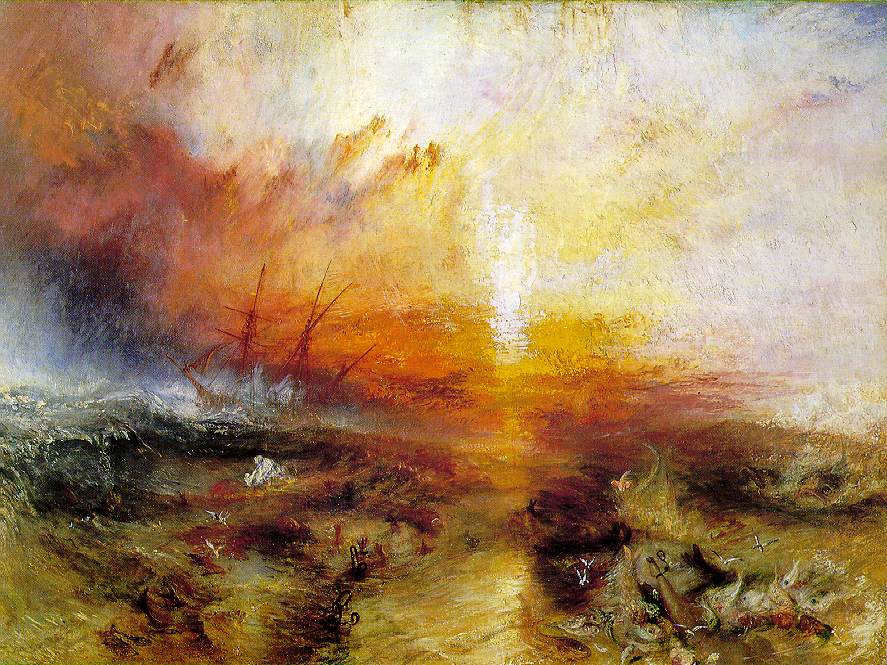
The disturbing 1840 Turner seascape “Slavers throwing overboard the Dead and Dying – Typon [sic] coming on”, also known simply as “The Slave Ship”, is widely thought to have been inspired by the Zong episode. The allusion would have been well-known to his contemporaries.

* One of the 133 survived by climbing back aboard the ship.

On this day..

1911: Ah Q

On this date in 1911, the fictional title character of Lu Xun’s The True Story of Ah Q was shot in “Weichuang village,” China.

Ah Q wins another victory. Image from the Marxist Internet Archive.

A modern masterpiece that remains standard reading in China, The True Story of Ah Q was also one of the first literary pieces in the vernacular. Published in 1921 and set in the events of the Xinhai Revolution ten years prior, the novella/short story acidly satirizes China through the biography of the absurdly hapless Ah Q.

Lu Xun (or Lu Hsun) presents the reader a peasant whose real name is literally unknown — an everyman, and no man at all — and proceeds to characterize this discomfiting allegory: a weakling, a bully, a chauvinist, a fool, whose pluck is all folly born of a bottomless capacity for convincing himself that each new failure and humiliation of his abject life is a victory. (In 1933, the American journalist Edgar Snow asked Lu Xun if there were still manh Ah Qs in China. “It’s worse now,” Lu Xun replied. “Now it’s Ah Qs who are running the country.”)

The second and third chapters detail many such “victories.” Through them, the Chinese tongue gained the phrase “the spirit of Ah Q” to indicate determined self-deception.

This story is well worth reading, which can be done for free here.

Though specific calendar dates are scarcely at all alluded to in the narrative itself, the timing of the “climactic” execution — it is an empty death tragic only in its dearth of tragedy, for a revolution that from the author’s standpoint of hindsight was still struggling with the country’s colonial legacy of weakness and backwardness — can be deduced from the text.

Its action takes place in the confused days immediately following the town’s going over to the revolution, which swept through the Chinese provinces in late October and early November of 1911.*

The robbery that precipitates Ah Q’s execution takes place on a night with “no moon”; according to the year’s lunar chart, there was a new moon on the night of Nov. 20. (The December new moon is much too late to make sense.) In the story, it is “four days later” that Ah Q is arrested at night, then drug out for interrogation the next morning (the 25th); returned to his cell and recalled the morning after (the 26th) to sign a confession;** and after one more night in custody,&dagger hauled to an execution he does not even realize is taking place until the last moment.

Suddenly it occurred to him — “Can I be going to have my head cut off?” Panic seized him and everything turned dark before his eyes, while there was a humming in his ears as if he had fainted. But he did not really faint. Although he felt frightened some of the time, the rest of the time he was quite calm. It seemed to him that in this world probably it was the fate of everybody at some time to have his head cut off.

He still recognized the road and felt rather surprised: why were they not going to the execution ground? He did not know that he was being paraded round the streets as a public example. But if he had known, it would have been the same; he would only have thought that in this world probably it was the fate of everybody at some time to be made a public example of.

…

Ah Q suddenly became ashamed of his lack of spirit, because he had not sung any lines from an opera. His thoughts revolved like a whirlwind: The Young Widow at Her Husband’s Grave was not heroic enough. The words of “I regret to have killed” in The Battle of Dragon and Tiger were too poor. I’ll thrash you with a steel mace was still the best. But when he wanted to raise his hands, he remembered that they were bound together; so he did not sing I’ll thrash you either.

“In twenty years I shall be another …”‡ In his agitation Ah Q uttered half a saying which he had picked up himself but never used before. The crowd’s roar “Good!!!” sounded like the growl of a wolf.

…

At that instant his thoughts revolved again like a whirlwind. Four years before, at the foot of the mountain, he had met a hungry wolf which had followed him at a set distance, wanting to eat him. He had nearly died of fright, but luckily he happened to have an axe in his hand, which gave him the courage to get back to Weichuang. He had never forgotten that wolf’s eyes, fierce yet cowardly, gleaming like two will-o’-the-wisps, as if boring into him from a distance. Now he saw eyes more terrible even than the wolf’s: dull yet penetrating eyes that, having devoured his words, still seemed eager to devour something beyond his flesh and blood. And these eyes kept following him at a set distance.

These eyes seemed to have merged into one, biting into his soul.

“Help, help!”

But Ah Q never uttered these words. All had turned black before his eyes, there was a buzzing in his ears, and he felt as if his whole body were being scattered like so much light dust.

…

As for any discussion of the event, no question was raised in Weichuang. Naturally all agreed that Ah Q had been a bad man, the proof being that he had been shot; for if he had not been bad, how could he have been shot? But the consensus of opinion in town was unfavourable. Most people were dissatisfied, because a shooting was not such a fine spectacle as a decapitation; and what a ridiculous culprit he had been too, to pass through so many streets without singing a single line from an opera. They had followed him for nothing.

* According to this footnote, it can be more specifically dated to the fall of Shaoxing, which would have been early November.

** Ah Q has no idea he is signing a confession; an illiterate, he makes his mark with a circle — fixated only on making it a perfect circle, at which endeavor he naturally fails “victoriously.”

† During Ah Q’s last night on earth, the scene cuts to two local officials arguing about the prisoner’s fate, where the man’s life is forfeit in some other mean contest of the municipal pecking order — “Punish one to awe one hundred! See now, I have been a member of the revolutionary party for less than twenty days, but there have been a dozen cases of robbery, none of them solved yet; and think how badly that reflects on me. Now this one has been solved, you come and argue like a pedant. It won’t do!”

‡ According to this footnote, “‘In twenty years I shall be another stout young fellow’ was a phrase often used by criminals before execution, to show their scorn of death.”

On this day..