1793: Sydney Carton posing as Charles Darnay

On an unspecified date in December 1793 is set one of literature’s immortal execution scenes, when ne’er-do-well Sydney Carton heroically goes to the guillotine in the place of his aristocratic doppleganger Charles Darnay at the climax of A Tale of Two Cities.

In Charles Dickens‘ classic 1859 novel of the French Revolution, Darnay, the good-hearted scion of the cruel Evremonde line, falls prey to the Revolutionary Terror.

The dissolute, tormented Carton is the respectable Darnay’s literary dark twin, whose appearance he also happens to strikingly resemble. Driven by an unrequited love for Darnay’s wife, who stands in danger not only of losing her husband but of following him to the scaffold, Carton contrives to switch places with the doomed noble.

While those saved by his sacrifice flee for England, Carton goes to the guillotine in a batch of 52 condemned prisoners,* one of them a sweet and frightened girl he comforts tenderly.

His prophetic thoughts as he awaits the blade form the conclusion of the novel, and the last sentence ranks among literature’s most recognizable lines.

“I see that I hold a sanctuary in their hearts, and in the hearts of their descendants, generations hence. I see her, an old woman, weeping for me on the anniversary of this day. I see her and her husband, their course done, lying side by side in their last earthly bed, and I know that each was not more honoured and held sacred in the other’s soul, than I was in the souls of both.

“I see that child who lay upon her bosom and who bore my name, a man winning his way up in that path of life which once was mine. I see him winning it so well, that my name is made illustrious there by the light of his. I see the blots I threw upon it, faded away. I see him, fore-most of just judges and honoured men, bringing a boy of my name, with a forehead that I know and golden hair, to this place — then fair to look upon, with not a trace of this day’s disfigurement — and I hear him tell the child my story, with a tender and a faltering voice.

“It is a far, far better thing that I do, than I have ever done; it is a far, far better rest that I go to than I have ever known.”

A Tale of Two Cities is one of thousands of public-domain books available for free at Project Gutenberg. Stanford’s “Discovering Dickens” community reading project guide annotates the novel here.

* Never one for understatement, Dickens crowds his mass execution tableau with far too many extras. “The Terror” is usually dated from September 1793 through July 1794, but only during its bloodiest last two months would so many as 52 have been guillotined together; at the time of Carton’s execution, half as many would have constituted a large group.

On this day..

1596: Francisca Nunez de Carvajal, her children, and four other crypto-Jews of her family

On this date in 1596, the Inquisition sent nine Jewish converts to Christianity to the stake in Mexico City for Judaizing — a cruel fate offering a window into a secret history of New World settlement.

When Spain expelled its Jews (and subsequently its Muslims), those who did not flee had to convert. Conversions at swordpoint being of suspect sincerity, the Inquisition spent much of the following centuries hunting Conversos — so-called “New Christians” — who secretly preserved their outlawed faiths.

For some crypto-Jews, the New World held an appeal akin to that which would draw later generations of northern Europe’s religious minorities.

Latin America in particular attracted considerable numbers of New Christians. The advantage of these territories was that they offered the New Christians a familiar culture and the possiblity of direct — even if infrequent — contact with the mother countries … These factors also helped permit [crypto-Jews] to practice Judaism.

The Carvajals (or Carabajals) were just such a family, settling in Monterrey under the aegis of their kinsman, Spanish governor Luis de Carvajal y Cueva.

But in 1590, the governor’s sister Francisa was tortured by the Inquisition into implicating her entire family in Judaism.

They got off with a humiliating public recantation, but evidence of a relapse a few years later resulted in Francisca being burned at the stake at an auto de fe — along with her children Isabel, Catalina, Leonor and Luis, and four of their in-laws. The 30-year-old Luis left a testimonial to his faith and his tortures.

A headstone in New Mexico, USA, suggests crypto-Jewish descent. Image used with permission.

Despite the grisly doings of this day, however, the Inquisition never could extirpate Jews from its American territory.

These hidden communities filtered into Mexico and north to the present-day United States, keeping adapted versions of Jewish traditions secretly alive.

Still, crypto-Jews produced scant potentially self-incriminating documentary evidence. Although DNA testing has latterly entered the scene, the true extent and nature of these populations has been the subject of lively scholarly controversy.

But the Carvajals and others like them, seemingly lost to the Inquisition’s depredations, are coming alive again. This day’s executions are the subject of a modern opera and a spring 2008 Texas A&M symposium.

And the wider community of crypto-Jews have their own umbrella organization and a burgeoning body of historical literature.

Books about crypto-Jews

On this day..

43 B.C.E.: Cicero

On this date in 43 B.C.E., the 63-year-old Roman statesman Cicero, fleeing the proscription of the Second Triumvirate, was caught and decapitated near his villa south of Rome.

Arrogant, eloquent and opportunistic, Cicero was a polarizing figure in his forty years in the public eye. He was a Senator from an upstart family who espoused the conservative Republican cause, and a master rhetorician. Twenty years earlier, he had received the honorific Pater Patriae for steering the Roman Republic through the Catiline conspiracy.

But not Cicero nor any other Roman had healed the social rot in which Catiline’s plot sank roots. The Republic continued to weaken even as Cicero poured out the volumes of rhetoric and philosophy for which later generations would celebrate him.

Ironically, Cicero survived the resumption of civil war in 49 B.C.E. despite backing the losing faction; it was the (momentary) peace between Marc Antony and Octavian that doomed him: to consolidate power, the dictators proscribed numerous political rivals.

Cicero, a bitter nemesis of the assassinated populist Julius Caesar and his heir apparent Antony, was among the casualties.

Plutarch described the scene:

[H]is assassins came to the villa, Herennius a centurion, and Popillius a tribune, who had once been prosecuted for parricide and defended by Cicero; and they had helpers … Herennius hastened on the run through the walks, and Cicero, perceiving him, ordered the servants to set the litter down where they were. Then he himself, clasping his chin with his left hand, as was his wont, looked steadfastly at his slayers, his head all squalid and unkempt, and his face wasted with anxiety, so that most of those that stood by covered their faces while Herennius was slaying him. For he stretched his neck forth from the litter and was slain, being then in his sixty-fourth year. Herennius cut off his head, by Antony’s command, and his hands — the hands with which he wrote the Philippics.

It would be too glib to say that the Republic died with him, for Cicero himself recognized that Caesar’s war had already fatally compromised it. When Antony and Octavian at length returned to arms to settle their accounts with one another, nothing but the pantomime would remain.

After a bloody century, Rome had her peace at last.

[T]he first example, prototype, and original of tyranny has been discovered by us in the history of our own Roman State, religiously founded by Romulus … We have observed Tarquin, not by the usurpation of any new power, but by the unjust abuse of the power which he already possessed, overturn the whole system of our monarchical constitution.
-Cicero, “On The Commonwealth”

The BBC’s In Our Time does Cicero in podcast form here.

Part of the Themed Set: The Fall of the Roman Republic.

On this day..

1952: Rudolf Slansky and 10 “conspirators”

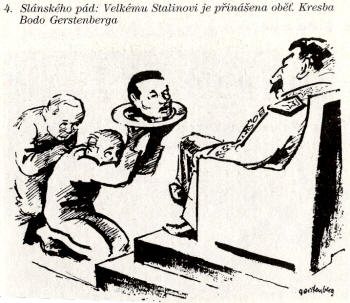
On this date in 1952, eleven high-ranking Czechoslovakian politicians were hanged at Prague’s Pankrac Prison two weeks after a show trial purging unreliable elements from the Communist party.

One of the most infamous show trials in Czechoslovakia saw 14 high-ranking Communists — eleven of them Jews — railroaded for a “Trotskyite-Titoist-Zionist activities in the service of American imperialism”. Three received life sentences. The other eleven went to the gallows.

While the roots of the persecution, especially the undertones of anti-Semitism, sink into the id of the Stalinist Eastern bloc, the most evident proximate cause was the USSR’s assertion of control over its satellite states at a time when Josip Tito was successfully charting a course of independent communism. Purges in Poland, Bulgaria and Hungary had taken place in the years before.

The Soviet agents rounding up suspects for Stalin did not trifle with small game. Rudolf Slansky was General Secretary of the Communist Party and therefore the second-most powerful man in the country; by the time he was tried, after a year in prison under torture, he was publicly denouncing himself.

Otto Sling, whose name became synonymous with forbidden heterodoxy, did likewise — “I was a treacherous enemy within the Communist Party … I am justly an object of contempt and deserve the maximum and the hardest punishment.”

And Vladimir Clementis, the Slovak Minister of Foreign Affairs, was erased from a photo taken with the Czechoslovakian President, a circumstance Milan Kundera reflected upon in The Book of Laughter and Forgetting:

In February 1948, the Communist leader Klement Gottwald stepped out on the balcony of a Baroque palace to harangue hundreds of thousands of citizens massed in Old Town Square … Gottwald was flanked by his comrades, with Clementis standing close to him.

…

The propaganda section made hundreds of thousands of copies of the photograph taken on the balcony where Gottwald, in a fur hat and surrounded by his comrades, spoke to the people. On that balcony the history of Communist Bohemia began. Every child knew that photograph, from seeing it on posters and in schoolbooks and museums.

Four years later, Clementis was charged with treason and hanged. The propaganda section immediately made him vanish from history and, of course, from all photographs. Ever since, Gottwald has been alone on the balcony. Where Clementis stood, there is only the bare palace wall.

The hanged were rehabilitated in 1963.

Artur London, who received a life sentence and was released after rehabilitation, wrote about his experiences in The Confession, subsequently a 1970 Costa-Gavras film. The wife and son of Deputy Minister of Foreign Trade (and Auschwitz survivor) Rudolf Margolius have also both written memoirs covering the trial.

The younger Margolius in particular, who has staunchly defended his father as an essentially apolitical man and not a Communist apparatchik, has been in the thick of present-day disputes in Czechoslovakia’s successor states over whom is due sympathy and recognition for bygone political crimes.

On this day..

1581: Edmund Campion, Ralph Sherwin and Alexander Briant

On this date in 1581, three English Catholic martyrs were hanged, drawn and quartered at Tyburn, casualties of the bloody confrontation between religious and secular power of the English Reformation.

Edmund Campion — later sainted — was the towering figure among them and the great attraction for those that thronged the Tyburn scaffold on a rain-drenched Friday.

A brilliant Oxford scholar once tipped as a possible future Archibishop of Canterbury, Campion abjured his Anglican holy orders in favor of Rome — a mortal peril in Elizabethan England.

He slipped away to Ireland, then to the continent and safety. But at age 40, after nearly a decade abroad, the missionary zeal of the converted called him back to Albion as part of a secret Jesuit mission. Hunted from the day he set foot back in Britain, he survived a year on the run, an underground minister to an illicit faith.

Though priestly investiture alone technically made him capitally liable, a government with millions of Catholic citizens grappled for some firmer ground upon which to condemn the renowned intellectual. Since Campion succumbed neither to torture nor to blandishments, nor to the surreal interludes when he was hauled out of his dungeon and made to debate with the Crown’s theologians, he was finally convicted on the strength of made-to-order witness testimony to the effect that his mission had some vague upshot of undermining Queen Elizabeth’s hold on her subjects.

In effect, it was very much like convicting him for his faith: the Anglican-Catholic conflict had crystallized, and dozens of priests would follow the route of Campion in the years to come. Between a mutually implacable state and church, either flesh or soul must burn.

Not a few of those who trod the martyr’s path would take inspiration from the beatific Jesuit — as young Henry Walpole, whose own route to Calvary is said to have begun when he was spattered by Campion’s blood this day and come full circle to his own execution 15 years later. Walpole’s embrace of martyrdom fairly glows from his proscribed tribute to Campion:

Hys fare was hard, yet mylde & sweete his cheere,
his pryson close, yet free & loose his mynde,
his torture great, yet small or none his feare,
his offers lardge, yet nothing coulde him blynde.
O constant man, oh mynde, oh vyrtue straunge,
whome want, nor woe, nor feare, nor hope coulde chaunge.

…

Yee thought perhapps, when learned Campion dyes,
his pen must cease, his sugred townge be still.
But yow forget how lowd his deathe yt cryes,
how farre beyond the sownd of tounge or quill.
yow did not know how rare and great a good
yt was to write those precious guiftes in bloode.

That famous eloquence was Campion’s legacy, so overwhelmingly so that he presents in the lineup of men who might have written Shakespeare.

His best-know work was “Campion’s Brag”, the scornful nickname his foes gave to an apologia he produced while underground in England … and to whose steady words Edmund Campion proved true this day:

[B]e it known to you that we have made a league — all the Jesuits in the world, whose succession and multitude must overreach all the practices of England — cheerfully to carry the cross you shall lay upon us, and never to despair your recovery [to Catholicism], while we have a man left to enjoy your Tyburn, or to be racked with your torments, or consumed with your prisons. The expense is reckoned, the enterprise is begun; it is of God, it cannot be withstood. So the Faith was planted: so it must be restored.

But Protestant England did withstand the enterprise. The generation to come saw Catholic ideas and writing put to withering siege, Campion’s not least among them. For all the tribute of history to the man of Christlike fortitude, it is by no means apparent that the enjoyments of Tyburn and the kindred “practices of England” did not, after all, lay a cross heavier than English Catholics could bear.

On this day..

1941: Zoya Kosmodemyanskaya

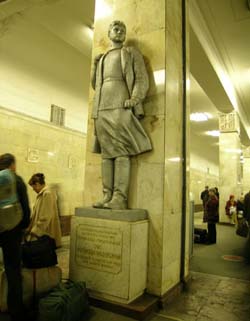
On this date in 1941, Soviet partisan Zoya Kosmodemyanskaya was hanged by the Wehrmacht for sabotaging buildings behind German lines near Moscow.

A statue of Zoya Kosmodemyanskaya stands vigil over Moscow’s World War II-era Partizanskaya metro station. Image used with permission.

One of the most famous Soviet war heroines and the first woman decorated as Hero of the Soviet Union during World War II, the 18-year-old had quit school to volunteer for a partisan unit only a few weeks before her hanging as Russia mobilized against Hitler’s race towards Moscow.

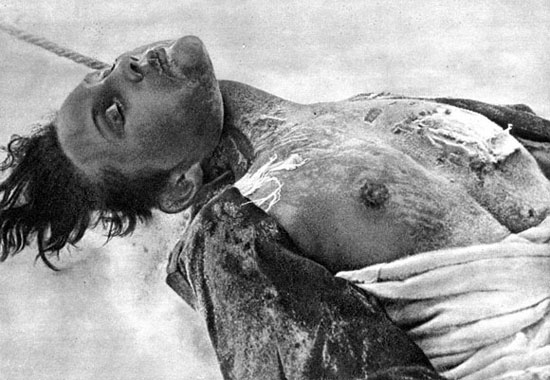
Known simply as “Tanya”, the nom de guerre which was the only information she volunteered during two days of torture, the power of the press offered her apotheosis into a propaganda coup for the Kremlin, and a symbol of courage that would long outlive Stalin. Before the public execution, the Nazis paused to photograph the scene; Kosmodemyanskaya availed the lull to harangue the Germans — “you can’t hang all 190 million of us!” — and call on the Russian villagers present to resist occupation.

Her bayoneted, mutilated body hung on the gibbet until the Red Army recaptured the village; witnesses related the tale of her dying heroism to a newsman.

It was only after the story of “Tanya” hit the press in January 1942 that her identity was established … and then promulgated widely. Anonymous and obscure in death, Zoya Kosmodemyanskaya would inspire millions and become the heroic emblem of other women partisans.


Soviet propaganda poster unabashedly modeled on the already-iconic image of Zoya Kosmodemyanskaya’s abused corpse.

Zoya, a 1944 Soviet film, was scored by Dmitri Shostakovich.

Part of the Themed Set: Women Against Fascism.

On this day..

1987: Jacek Lazar condemned

On this date in 1987, according to the sentence read to him in the climactic scene of The Decalogue no. 5,* Jacek Lazar was condemned to hang for the senseless murder of a taxi driver. (“Lazar” was fictional, but he had a real-life inspiration.)

The movie, plainly reflecting the director’s opposition to the death penalty, is the most overtly political of Krzysztof Kieslowski‘s ten-film cycle exploring the themes of the Ten Commandments. But it is far from tendentious.

The supposed date of the actual execution, depicted here, is not identified.

If one credits the dates, this hanging would be among the last performed in Poland. After April 1988, death sentences were no longer carried out, and Poland formally abolished the death penalty in the late 90’s — thanks in no small part to this film.

* Or Dekalog, per its Polish rendering. This particular installation of the series is also referred to as “A Short Film About Killing”.

On this day..

Feast Day of St. Catherine of the Wheel

This date annually is the feast of iconic — perhaps mythological — Christian martyr Saint Catherine, said to have been put to death in the 4th century for her faith.

St. Catherine in a 700-year-old stained glass at St. Mary’s Church of Deerhurst. Image courtesy of the Sacred Destinations Travel Guide.

One of the most popular Catholic saints, St. Catherine was reputed to have been a beautiful young maiden of Alexandria — so wise as to convert every pagan scholar sent to dispute her, so devoted as to be mystically betrothed to Christ.

Catherine was condemned by one of the last pagan rulers of Rome to torture on a breaking wheel, which shattered when it touched her — so she was simply beheaded. (The story is related in didactic iconography in this triptych.)

Despite this inauspicious debut, the breaking wheel was Catherine’s iconic attribute, by which her frequent appearances in devotional art can be recognized.

This gruesome instrument of torture was also known as the “Catherine wheel” in medieval Europe, from which English derives the deceptively winsome-sounding name of a firework.

The saint became the patron of those condemned to this horrific death as well as a diverse swath of the wider society: wheelwrights, mechanics, and other laborers who worked with wheels for apparent reasons; teachers, philosophers and scribes for her learning; girls, virgins and young maids for her purity. Single women seeking husbands still offer her supplication:

St. Catherine, St. Catherine, O lend me thine aid
And grant that I never may die an old maid.
A husband, St. Catherine.
A handsome one, St. Catherine.
A rich one, St. Catherine.
A nice one, St. Catherine.
And soon, St. Catherine.

Catholic recountings of the saint’s legend can be read here and here. More St. Catherine’s Day customs are enumerated here.

On this day..

1915: Joe Hill

On this date in 1915, songwriter, poet and labor activist Joe Hill was shot in Utah for the murder of a local butcher.

Even before his execution, the Swedish immigrant was widely thought to have been railroaded for his IWW affiliation.

Though state authorities had little use for the worldwide clemency bid whose backers included U.S. President Woodrow Wilson — powerless to intervene officially, since the execution was a state matter — Hill walked spryly into his martyrdom. The strange post-mortem career of his totemic ashes is the least of the ways Hill lives on.

His dauntless last message to fellow Wobbly Bill Haywood — “Don’t waste any time mourning. Organize.” — is a permanent fixture on pins and placards among every stripe of left activist. The songs he wrote remain in print — and in performance.

And the Depression-era tribute ballad “I Dreamed I Saw Joe Hill Last Night” can seamlessly serenade ripped-from-the-headlines footage, as a Paul Robeson rendition does in these clips of 1998 protests against then-New York City Mayor Rudy Giuliani.

On this day..

1720: Captain John “Calico Jack” Rackham

On this date in 1720Nov. 18, 1720, the pirate captain “Calico Jack” Rackham was hanged together with his crew by the British governor of Jamaica.

Nicknamed for his flamboyant clothing, the Bristol-born buccaneer plundered the West Indies during the “Golden Age of Piracy”, having ousted his former captain Charles Vane. Rackham is chiefly remembered to history for two who were not hanged with the rest of his crew: Anne Bonny and Mary Read, rare female pirates who served aboard Rackham’s ship.

Immortalized by Daniel Defoe in his pseudonymous A General History of the Pyrates, Bonny and Read came to piracy by different paths but were both every bit the part and leaders aboard their ship — “very profligate, cursing, and swearing much, and very ready and willing to do any Thing on board.” Bonny, at least, was Rackham’s lover — having eloped with him from her husband.

Upon capture, both women “pleaded their bellies” to escape the gallows, and though it’s unclear whether either really was pregnant, it seems the gambit spared both from execution.

Read died in prison shortly after, while Bonny vanished from history — prompting speculation that she had escaped, secured a pardon, been ransomed by her wealthy father, and/or returned again to piracy under a different guise. Reportedly, she castigated Rackham at their last meeting in prison for lying drunk below decks while only the women resisted the capture of their ship: “I am sorry to see you here Jack, but if you had fought like a man, you need not be hanged like a dog.”

As the world’s best-known women pirates, Bonny and Read are recalled as anything from sexualized historical curios to action heroines to proto-feminists.

They feature in Disneyland’s “Pirates of the Caribbean” ride, the Witchblade comic book series, utopian theorizing, popular history … and the occasional action figure.

Update: A much more detailed foray into the lives of these daring women is at Scandalous Women.

Also, I posted this under the wrong date: it should be Nov. 18. Balls.

On this day..