On this date in 1909, a Mexican bandit was executed by the police. Maybe. Unusually for these pages, the date is quite certain but the existence of the executed man is not.
If he existed — and this caveat is standard in practically every profile of the fascinating cultural phenomenon fathered by the man or phantom — Jesus Malverde was a Robin Hood-esque “social bandit” who preyed on Mexico’s plutocratic agricultural lords and distributed the spoils to the poor.
According to Patricia Price (“Bandits and Saints: Jesus Malverde and the Struggle for Place in Sinaloa, Mexico”, Cultural Geographies 2005; 12; 175), the Malverde of legend entered the world as Jesus Juarez Mazo, but his
own parents died of hunger or a curable illness, and that this was the catalyst for his turn to a life of crime. While Malverde was said to have worked variously on the railroads, as a carpenter, or as a tailor, he soon joined the ranks of bandits that roamed Mexico’s countryside at the end of the nineteenth century. He reportedly stole gold coins from the rich hacienda owners living in Culiacan and threw them in the doorways of the poor at night.
Truly a figure who, if he did not exist, it were necessary to invent.
All the particulars about his legendary exploits are a bit fuzzy, right down to his end on May 3, 1909 — possibly gunned down, possibly left to die of exposure with his feet hacked off, or possibly (and certainly more picturesquely) summarily hanged from a mesquite tree by a posse.
(In a version that appealingly combines these threads, he’s said to have been dying of gangrene after being shot, and in a last act of charity prevailed upon his friend to bring in his body to collect the reward. The police gibbeted his corpse.)
In the years since, Malverde has become a popular divine intercessor for the marginal social classes who could identify with such a figure, like Sinaloa’s poor farmers of corn and beans.
And other cash crops.
Malverde is also the patron saint — decidedly unofficial, of course — of the region’s robust narcotics trade.
His shrine stationed across the way from a government compound in Sinaloa’s capital city draws a bustle of devotees.* Offerings like produce and shrimp share space with icons of marijuana and AK-47s, and votive notes appreciating “how things turned out, and how nobody was grabbed.”Breaking Bad gave him a shout-out from the mouths of disdainful DEA agents north of the border.
the poorest, the handicapped, pickpockets, thugs, prostitutes, drug traffickers and drug addicts, in sum, the stigmatized who, in civil or religious iconography don’t find anyone who looks like them, in whom to confide and in whose hands to put their lives.
On this date in 1918, German coalminer Robert Prager was lynched near Collinsville, Ill., for making disloyal utterances against the United States as his adoptive country entered World War I.
Basically the most visible and famed victim of patriotic anti-German bellicosity, Prager ironically is rather difficult to reconstruct as an unambiguous anti-war activist. After his mob execution, a baker would even come forward to say that he had been thrown in the clink when Prager accused him … of badmouthing a patriotic display. Prager himself had tried to enlist in the Navy and been rejected for medical reasons.
“Prager was, in fact, as loyal to the United States as any native-born citizen, and his innocence was attested to by many who knew him,” according to Donald Hickey in the summer 1969 Journal of the Illinois State Historical Society. “Two of the men with whom he boarded attested to Prager’s loyalty. One said that although Prager was a radical socialist, he had said he was ‘all for the United States’ when this country entered the war.”
But he was a socialist, and a German, and seems like the sort whom others might have found personally unpleasant. It is in the midst of a tiresome local dispute with a union leader (the union also rejected him) that Prager came to the unwelcome attention of the rabble: the union leadership accused him of being a spy, which led Prager to post handbills around town denouncing this lot for their scurrilous accusation. This obviously did him more harm than good and as the public conviction that Prager was disloyal took hold, it overran the halfhearted efforts of the town’s putative authorities to keep a semblance of order.
A mob on April 4 captured Prager at his home, paraded him, made him kiss the flag — momentarily rescued and hustled off to jail by police and a mayor who tried to talk the mob out of its design — then shanghaied from his “protective” custody cell and taken to the outskirts of Collinsville for hanging on a tree.
Eleven men stood trial for the affair over three weeks. Once the matter was finally rested with the jury, they were instantly acquitted.
There was wild applauding and cheers from ‘most everyone present. Relatives, friends and acquaintances rushed toward the bar to shake hands with the defendants. …
There was a peculiar coincidence at the trial Saturday. The Jackie Band was in Edwardsville for a patriotic demonstration.
When a shower of rain came up the musicians were sent to the court house where it had been arranged to give a program. At 2:40 o’clock judge Bernreuter ordered a recess after the completion of arguments and before reading the instructions.
Then word was sent that the band might play until court re-convened. The first number of all concerts is the Star Spangled Banner and it was played Saturday.
The strains from the Jackie Band caused tears to flow down the cheeks of Riegel. He was still crying when he returned to the court room.
As the jury came in with its verdict the band was at the head of a procession of draft boys and in passing the court house played “Over There.”
While Prager’s murder stands as the most emblematic event of anti-German intimidation during America’s months in the Great War, it was far from the only one: many others nearly as ugly stopped just this side of homicide. Papers were rife with reports of German immigrants being made to kiss the flag; clapped in jail for suspect utterances; of being menaced by mobs.
A number of federal lawmakers, as well as former presidents William Howard Taft and Theodore Roosevelt, condemned the lynching, mostly in the familiar coded terms with which lynchings were opposed in those days: one would rather let justice take its course. Mob rule is itself disloyal. Etc. (See Hickey)
But the right-thinking potentates of the war party were also finding themselves relieved that a polity which had re-seated the current president on the slogan “he kept us out of war” would so pliably turn towards bellicosity. This charade so mechanically familiar in our time was still an arcane and uncertain art in America’s imperial adolescence.
“The recent lynching of a German in Illinois and violent outbreaks of the same character in other parts of the country,” intoned the Washington Post, “have awakened the Department of Justice to the need of a law which will enable government officers to prosecute pro-Germans rather than leave them to be dealt with by mob law.”
Oh. Danke very much.
An unsigned editorialist in the paper’s April 12 edition opined so nauseatingly brutal and specious that in another age it would have earned its author an immediate contract with Fox News:
The question whether or not the laxity of the laws against treasonable utterances has been responsible for the people’s acts in taking the law into their own hands has been much debated of late.
While sedition may have been encouraged to some extent because of the comparatively mild risks involved, it is quite probable that the pro-German intrigues would have been carried on if the risk had been greater. This suggests the thought that other reasons must be looked for to account for the general revulsion of public sentiment against the treason spreaders and the prompt punishment meted out to them in so many instances.
A plausible explanation is found in the fact that the open and ingenuous American mind had been fed up on German lies to the point where it broke out in fierce revolt. At the beginning of the war, and even after the entrance of America into it, there remaineddebatablepoints in many minds. Though of a minor nature and scarcely affecting the larger issue, these points were emphasized by enemy agencies which had been at work from the beginning. But as the truth has been laid bare the indignation of the people has grown stronger. The fact that the rounding-up process has been most vigorously conducted in the middle West tells its own story in this respect. It was that section which was slowest to wake up. There the enemy propaganda apparently worked with most success. So it is there that the people have arisen unitedly in their righteous wrath against the treason talkers.
The comparative absence of outbreaks of this character in the East is explainable on the same theory. In the East the public mind toward the war was much earlier divested of errors. Consequently the enemy agents were more wary in their utterances, not because of any greater stringency of the law, but because of their appreciation of the temper of the people.
In spite of excesses such as lynchings, it is a healthful and wholesome awakening in the interior part of the country. Enemy propaganda must be stopped, even if a few lynchings may occur. The people know what they want. They are not seeking to subvert law and order.
Other powerful institutions were not quite so sanguine as the Post: the lynching was discussed hours after it occurred in the U.S. cabinet, no doubt mindful that it was also being denounced in the German Reichstag. And indeed all concerned marshaled these animal spirits of the populace towards killing men by the thousands under the auspices of the state rather than singly by drunken small-town mobs.
Fears of German reprisals against American prisoners never seem to have materialized; neither is there any other documented lynching in the short course of America’s World War I involvement that was conducted on unambiguously “patriotic” grounds.
* Any number of other papers joined the Post in this campaign, including the St. Louis Post-Dispatch and the Chicago Tribune. A few weeks later, they got their wish — the Sedition Act, under which the Socialist Eugene Debs was arrested for speaking against the war.
Shortly after midnight on this date in 1913, Joe Richardson was hauled out of jail in Leitchfield, Kentucky, and lynched on the town square for attempting to assault an 11-year-old girl (white, of course).
“The little girl was on her way to school about 8 o’clock in the morning,” reported the Crittenden Record-Press (Oct. 9, 1913) “when, it is said, she was attacked by the negro who was frightened away by approach of the neighbors.”
photographs rendered the violence of a lynching visible and accessible to a wider audience. Although, as will be shown, the public for these images was imagined as relatively narrow or contained, they nevertheless seemed to punctuate the lynching as a public spectacle. Small posses that quickly lynched their victims outside town but paused long enough to take pictures intended their actions to be witnessed … ‘the [Richardson] mob worked quietly and most of the citizens of Leitchfield knew nothing of it until the body was found hanging from a tree early this morning … A large crowd congregated … after the hanging was reported.’ A photograph of Richardson’s hanging body was mounted on a card and peddled door-to-door by an unknown photographer.
This lynching site claims that it was only after the work was done that townspeople realized the hanged man was the local drunk, and had “merely stumbled into the child, and not even torn her dress.”
On the 20th of August, 1672, the city of the Hague, always so lively, so neat, and so trim that one might believe every day to be Sunday, with its shady park, with its tall trees, spreading over its Gothic houses, with its canals like large mirrors, in which its steeples and its almost Eastern cupolas are reflected,–the city of the Hague, the capital of the Seven United Provinces, was swelling in all its arteries with a black and red stream of hurried, panting, and restless citizens, who, with their knives in their girdles, muskets on their shoulders, or sticks in their hands, were pushing on to the Buytenhof, a terrible prison, the grated windows of which are still shown, where, on the charge of attempted murder preferred against him by the surgeon Tyckelaer, Cornelius de Witt, the brother of the Grand Pensionary of Holland was confined.
…
the whole town was crowding towards the Buytenhof, to witness the departure of Cornelius de Witt from prison, as he was going to exile; and to see what traces the torture of the rack had left on the noble frame of the man who knew his Horace so well.
Yet all this multitude was not crowding to the Buytenhof with the innocent view of merely feasting their eyes with the spectacle; there were many who went there to play an active part in it, and to take upon themselves an office which they conceived had been badly filled,–that of the executioner.
There were, indeed, others with less hostile intentions. All that they cared for was the spectacle, always so attractive to the mob, whose instinctive pride is flattered by it,–the sight of greatness hurled down into the dust.
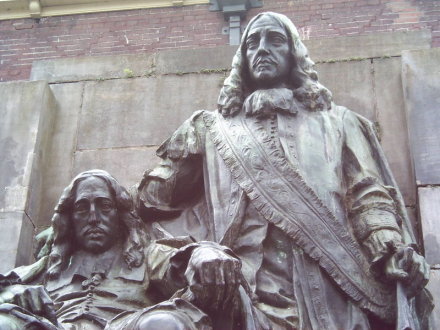
That ominous mob got its spectacle this date in 1672, lynching the Dutch Republic’s longtime de facto head of state, Johan de Witt along with his brother Cornelis/Cornelius.
A statue of Johan (standing) and Cornelis de Witt in their native Dordrecht.
The mercantile powerhouse that was the 17th century Dutch Republic was the stage for a long-running conflict between the Orange monarchists (hence the soccer uniforms) and the Republican merchant class.
With the sudden death of the young William II, Prince of Orange in 1650, leaving the (non-hereditary) executive office of stadtholder vacant, the Republicans became ascendant.
And the outstanding figure of the First Stadtholderless Period was Johan de Witt, scion of a Dordrecht merchant family powerful enough that William II had imprisoned de Witt’s own father during a power struggle.
While all these guys were landing themselves in their respective canons, Johan de Witt was trying to keep the age Golden.
Having only relatively recently broken free of Spain, the small country was an up-and-comer on the horns of a serious security dilemma: its leading commercial position put it into maritime competition with England, while its continental location made it vulnerable to the enormous army of the neighboring continental hegemon, France. Ultimately, even with its trade wealth, it did not have the resources to keep up with both of western Europe’s leading powers.
For a generation, de Witt’s statecraft kept the men of the Low Countries out of that predicament, while his brother Cornelis chipped in with a couple of timely naval victories. (Actually authored by Michiel de Ruyter, but Cornelis rode shotgun.)
In 1654, Johan brought the First Anglo-Dutch War to a close, making with Oliver Cromwell a secret pact he was only too happy to enforce never to allow William II’s son, the eventual William III, to be named stadtholder. Reason being: William III was the grandson of the Stuart king Cromwell beheaded, Charles I, and thus a potential claimant to the English throne. Both Protestant Republics had a distinct interest in keeping this monarchist well away from power. (Both would be sorely disappointed.)
A decade and a Stuart Restoration later, de Witt maintained (mostly) Dutch dominance of the seas in the Second Anglo-Dutch War, then held off France (with the help of a timely alliance with the recent adversary, England) in the War of Devolution.
In each case, he kept at least one of England or France on the sideline, or in his own camp.
But the Third Anglo-Dutch War was the charm — as it was also the Franco-Dutch War, and therefore 1672 was Rampjaar: disaster year. While the Dutch were aces on the waves, a massive French invasion easily overwhelmed them on terra firma.
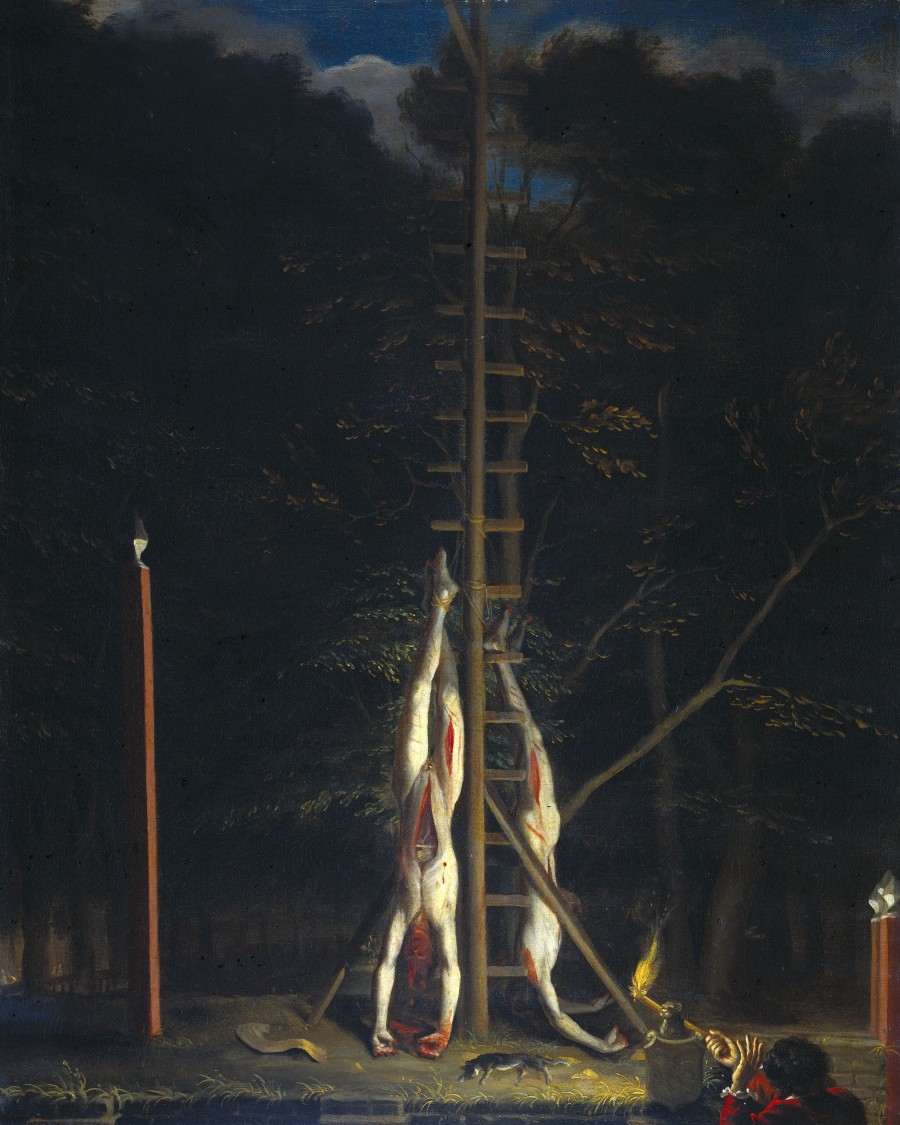
Detail view (click for the full image) of a grisly painting of the mutilated de Witt brothers strung up at The Hague. It’s attributed to Jan de Baen, who in better times took Johan de Witt’s portrait.
De Witt’s never-beloved mercantile oligarchy speedily collapsed with the military reverses, and the now all-grown-up William III was there to pick up the pieces to popular acclaim. Arrested for treason, Cornelis sustained torture without confessing, but when Johan visited him in prison — and William III incriminatingly withdrew the cavalry protecting the brothers — the mob quenched its fury with the de Witts’ blood.
every one of the miscreants, emboldened by his [Johan’s] fall, wanted to fire his gun at him, or strike him with blows of the sledge-hammer, or stab him with a knife or swords, every one wanted to draw a drop of blood from the fallen hero, and tear off a shred from his garments.
And after having mangled, and torn, and completely stripped the two brothers, the mob dragged their naked and bloody bodies to an extemporised gibbet, where amateur executioners hung them up by the feet.
Then came the most dastardly scoundrels of all, who not having dared to strike the living flesh, cut the dead in pieces, and then went about the town selling small slices of the bodies of John and Cornelius at ten sous a piece.
-Dumas
The word “ungrateful” comes to mind.
De Witt stood altogether on a lower plane than Cromwell. We regard him rather as a man of rare and singular talent, than as one of the chosen great ones of the earth, which Cromwell was. He stands far above the common run of men; and he was head and shoulders above nearly all the notable men of his time. He would have been greater if the movement of his limbs had been less burdened with the Dutch governing apparatus … He is not one whom the world can ever greatly admire or love.
(Here’s another, and here’s a 17th century volume de Witt himself coauthored.)
The rise of William III came with the decline of that Dutch Golden Age: the country fended off the immediate military threat, but it increasingly slipped behind its larger neighbors. Costly as was the Franco-Dutch War, it is a step on the path towards the present-day Europe, and this gives us enough excuse to notice that the Eurovision lead-in tune is actually from a Te Deum composed to mark its end.
But William’s own ascent to this wealthy sovereignty was just the beginning for him. Sixteen years later, the House of Orange’s champion vindicated Cromwell’s trepidation about him and gained a far more satisfactory position from which to do battle with his Gallic rival Louis XIV by stunningly overthrowing the Stuart dynasty and becoming King of England in the Glorious Revolution.**
* The Dutch remained the sole western contact of closed Japan until 1854, which is why Japan’s eventual period of scientific advancement became known as ‘Dutch Learning’.
** Albion did not forget the de Witts, either: according to this 1785 cant dictionary, the term “dewitted” had a 17th-18th century run in English to denote — well, exactly what happened to Cornelis and Johan.
On this day in 1419, an angry mob of Hussite peasant rebels stormed the town hall on Charles Square in Prague and threw the judge, the mayor and several city council members (either seven or thirteen; accounts differ) out the window. They all either died in the fall or were killed by the crowd outside.
Hussites followed a Christian reformer, Jan Hus, who was one of the forerunners of the Protestant Reformation. Hus was eventually excommunicated and burned as a heretic. The cause of the July 30 riot was the city council’s refusal to release from custody several Hussite prisoners.
The mob, led by the Hussite priest Jan Želivský and future general Jan Žižka, marched to the town hall, but they only became violent after someone inside the building threw a stone at them. After that there was no stopping them.
The riot had far-reaching consequences, inasmuch as it is seen as the start of the Hussite Wars, which lasted until 1434 or so and involved government-sponsored military action against the Hussites as well as Hussites fighting amongst themselves.
This event has come to be known as the First Defenestration of Prague. That is, I’m sure we all can agree, an AWESOME name, and probably the principal reason the riot is still remembered today. The word “defenestration” comes from Latin: de-, meaning “out of,” and fenestra, “window.”
The Czechs have a habit of throwing people out of windows at critical junctures in history; since 1419 there has been at least one more (nonfatal, but more famous) Defenestration of Prague, in 1618. A couple of similar events since then have sometimes been called the Third Defenestration of Prague, though this is not universally agreed upon.
Reunited in jail, the handsome outlaws were evidently a big hit with the ladies. As the Los Angeles Times reported on July 25, 1892,
The recent sentimental attitude of a number of women toward the prisoners as well as the line of defense adopted by their counsel, who has been evidently endeavoring to implicate Messenger [Amos “Buck”] Montgomery [the dead victim] as a party to the crime, had been denounced by a number of persons in the county and it is believed the lynching was due to those causes.
When the vigilantes came for him, John tried to buy the boys’ way out of trouble — or at least, buy Charley’s way out — by offering to reveal the location of his treasure.
The mob wasn’t interested, and the cache has never been found since. On the other hand …
The lynching of a brace of stage-robbers at Redding a few nights ago was not at all in accordance with law and order; but that it will have a discouraging effect on the “hold-up” industry, there is little question. It will be perfectly safe to indulge in stage rides in Shasta county, no doubt, for some time to come.
On this date in 2004, Bolivian Aymara peasants burned to death the mayor of Ayo Ayo.
Disgruntled residents of his fiefdom had accused Benjamin Altamirano (who was also Aymara) of corruption, and received no redress. Likewise had Altamirano complained to the central government of growing threats against him without receiving protection.
The situation came to a shocking head when Altamirano was kidnapped from the capital city of La Paz the night of June 14 and driven overnight to his home in Ayo Ayo. There, according to wire reports,*
[o]fficials said he was then burned to death inside his house, with his body later dragged through the streets and dumped in the town square. Witnesses said he was tied up, set aflame in the town square and hung upside down from a lamppost.
The Andean Altiplano region to which Ayo Ayo belonged was at this time being riven by the Bolivian gas war, a social conflict that would ultimately force the resignation of neoliberal President Carlos Mesa and lead to the election of leftist** indigenous leader Evo Morales.
From 2003 to 2005, the region (on both sides of the Peru-Bolivia border) was paralyzed with repeated peasant protests and the community expulsion of disagreeable state authorities (other government officials fled Ayo Ayo after Altamirano died).
‘We Aymara carry rebellion in our blood,’ said Ramón Coba, who heads the leading Ayo Ayo peasant organisation. ‘Bolivia is totally corrupt, not just the mayor. All of them should be finished in the same way, if not burnt then drowned or strangled or pulled apart by four tractors… It’s the only way they are going to learn.’
* This one ran in the St. Louis Post-Dispatch on June 16, 2004.
After more than 500 years, we, the Quechuas and Aymaras, are still the rightful owners of this land. We, the indigenous people, after 500 years of resistance, are retaking the power. This retaking of power is oriented towards the recovery of our own riches, our own natural resources such as the hydrocarbons. This affects the interests of the transnational corporations and the interests of the neoliberal system. Never the less, I am convinced that the power of the people is increasing and strengthening. This power is changing presidents, economic models and politics. We are convinced that capitalism is the enemy of the earth, of humanity and of culture.
Morales has floated elevating indigenous “communal justice” actions like Altamirano’s lynching into the stature of de jure law.
Last year on this date, a Central African Republic presidential guard summarily executed a man in a hospital to satisfy a lynch mob pursuing him for murdering his wife.
Amoudou Samassa was supposed to have stabbed his estranged wife to death, provoking an armed mob intent on dispensing street justice. After gendarmes pried him away unkilled, the incensed crowd jammed the streets of the capital Bangui.
Reuters reported that when negotiations to disperse them proved fruitless,
one guard officer, Lt. Jean-Claude Ngaikoisset, finally told the crowd: “If the death of this criminal is the only thing you’re asking for to clear these avenues, then I see no objection”.
One hundred years ago today, Will James was lynched as a murderer in Cairo, Illinois.
“The Frog” or “The Froggie” was a black man implicated in the murder of a white girl, captured in nearby Belknap and
taken to the most prominent square in the city and strung up. The rope broke and the man was riddled with bullets. The body was then dragged by the rope for a mile to the scene of the crime and burned in the presence of at least 10,000 rejoicing persons. Many women were in the crowd, and some helped to hang the negro and to drag the body.
Part of the mob then sought other negroes. Another part, at 11:15 o’clock, after battering down a steel cell in the county jail, took out Henry Salzner, a white man charged with the murder of his wife last August, and lynched him.* (New York Times, Nov. 12, 1912)
Other pictures related to the Will James lynching are at the Without Sanctuary site here (images 41 through 47).
The grey lady’s dim view of this jubilant scene prompted a letter to the editor in defense — the author’s disclaimer notwithstanding — of the lynching, which paints a grim and striking portrait of the town where it occurred.
CAIRO’S NEGROES.
Former Resident Says They Are Spoiled by Coddling and Are a Menace.
As a former resident of Cairo, Ill., where I was the editor of a daily newspaper for three years, I crave a word, not in defense of the double lynching which occurred there a few days ago, but in explanation of it. Cairo, at the extreme southern point of Illinois, at the junction of the Ohio and Mississippi Rivers, is peculiarly located. Across one river is Missouri; across the other is Kentucky, and Tennessee is only fifty miles away. Cairo thus becomes a buffer between the North and the South. It is probably the only town in the North which has a true race problem to deal with. … Out of a population of 13,000 in 1900, 5,000 of the inhabitants of Cairo were negroes. Of the 100,000 negroes in the State of Illinois 5 per cent are massed in this one little town. Aside from this, the floating colored population is unusually large, and Cairo, at some time or other, harbors most of the “bad niggers” from St. Louis, Cincinnati, Louisville, Memphis, Vicksburg, and New Orleans. It is these whom citizens fear the most, and for whom the police are constantly alert. Murders by negroes either of white men or negroes are alarmingly frequent, but the murderer usually escapes either to Kentucky or Missouri, and is never heard of again. Thus crime after crime is recorded against the name of Cairo, with no recompense in the name of the law. On the other hand, there is hardly a time when there are not forty or fifty Cairo negroes in the Southern Illinois Penitentiary, all convicted of theft or burglary.
The white people of Cairo have always dealt indulgently with the negro. For years it has been the policy to keep two negroes on the small police force, and there have been negro Justices of the Peace. A negro physician once came near being elected a member of the Board of Education. While they pay but little taxes, the negroes are provided with three public schools. The Sumner was the first colored High School ever established in the United States. Yet this negro population, coddled as it is, is a constant menace to the town. No white woman dare venture outside of the house at night alone for fear of assault. Many outrages of which the world has never heard have been attempted. This is why, as Mayor Parsons says, the effect of the recent lynching will be “salutary.”
Altogether it is not surprising that a lynching took place in Cairo. The only wonder is that one did not take place long ago.
W.L. CLANAHAN
New York, Nov. 14, 1909
That electric arch and celebratory mob are now long gone from Cairo: in the century since Will James was butchered, Cairo, Ill., has withered — striken in part by its own poisonous legacy of racism. (Also by flooding from the adjacent rivers, the routing of transportation corridors elsewhere, and the general deindustrialization of the heartland.)
During the civil rights struggle as played out in Cairo in the 1960’s and 1970’s (more in this pdf), the town’s white business owners made a name for themselves by refusing to integrate their workforces in response to black boycotts … preferring to go out of business and/or leave town.
On this date in 1789, two working stiffs literally became stiffs for a noteworthy bread riot during the French Revolution’s early days.
Ah, 1789.
It was the best of times, it was the worst of times … it was the season of Light, it was the season of Darkness; it was the spring of hope, it was the winter of despair. And we know how all that ends.
Just three months after the Bastille was stormed, France was merely pregnant with its coming Terrors. The Revolution was in its “moderate stage”.
Some moderation.
“Events of the 22nd of October, 1789: The hanging of a man named Francois, a baker”. Despite the title, sources (like this French-language study in the Annales historiques de la Revolution francaise, overwhelmingly date the baker’s murder to the 21st.
The tumbrils may not have been running (actually, the Revolution’s iconic execution device had not yet even been created), but the “October Days” had enough to scare you, especially if you were a sensible constitutionalist type like the Marquis de Lafayette.*
Like a mob dragging the King back to Paris from Versailles, with the heads of his royal guards on pikestaffs.
A drought had created a calamitous bread shortage, which in turn helped stir the Revolutionary pot. The mob that invaded Louis XVI‘s palace a couple of weeks before had celebrated his return to Paris singing “We Have the Baker, the Baker’s Wife, and the Baker’s Son. We Shall Have Bread.” When the king’s presence failed to ease the shortage, fresh disturbances followed.
On October 21, 1789,** the baker Denis Francois became the unfortunate focus of one such, when a famished woman spuriously denounced him a monopolist. A frenzied crowd lynched the hapless boulanger before he could get a word in edgewise.
This event occasioned the Constituent Assembly to pass a martial law decree, permitting a municipality to signal martial law by raising a red flag, whereupon anyone failing to disperse made him- or herself liable to summary military execution.
During the disturbance stirred up against the baker Francois, another one broke out in the Faubourg Saint-Antoine, the object of which was to unite with the Faubourg Saint-Marcel for purposes of reducing the price of bread, and for getting into the convents under the pretext of taking the muskets stored there. The National Guard, in breaking up these seditions, arrested the assassin of the baker [a dock porter named Blin] and the principal instigator of the faubourg [i.e., the Faubourg Saint-Antoine, namely a laborer named Michel Adrien†]. Both were judged and hanged the next day.
* We meet Lafayette here as captain of the National Guard; in a few years, the progress of the Revolution that he struggled to contain and direct will make him persona non grata in his country.
** Six Thousand Years of Bread: Its Holy and Unholy History gives the date as Oct. 20, though it’s not clear upon what authority. Archibald Alison placed it on the 19th. Whenever the murder of Francois occurred, the martial law decree’s passage on the 21st appears to be firmly dependable, which would mean the supposed malefactors’ deaths on this date should be as well.
† Revolutionary propagandist Camille Desmoulins later seized on the very skimpily justified Adrien execution — he “was judged and hanged in twenty-four hours for circulating a seditious flyer, although he didn’t know how to read” — to contrast with the outsized tenderheartedness shown for aristocrats who have “different weights on the scales of justice.” (Revolutionary Justice in Paris: 1789-1790)

 If he existed — and this caveat is standard in practically every profile of the fascinating cultural phenomenon fathered by the man or phantom — Jesus Malverde was a Robin Hood-esque “social bandit” who preyed on Mexico’s plutocratic agricultural lords and distributed the spoils to the poor.
 Basically the most visible and famed victim of patriotic anti-German bellicosity,

 photographs rendered the violence of a lynching visible and accessible to a wider audience. Although, as will be shown, the public for these images was imagined as relatively narrow or contained, they nevertheless seemed to punctuate the lynching as a public spectacle. Small posses that quickly lynched their victims outside town but paused long enough to take pictures intended their actions to be witnessed … ‘the [Richardson] mob worked quietly and most of the citizens of Leitchfield knew nothing of it until the body was found hanging from a tree early this morning … A large crowd congregated … after the hanging was reported.’