On this date in 1975, five Australia-based journalists were slain in East Timor: executed (ahem, “allegedly”) by Indonesian security forces preparing to invade the former Portuguese colony.
The Balibo Five — Australians Greg Shackleton and Tony Stewart; Britons Brian Peters and Malcolm Rennie; and New Zealander Gary Cunningham — worked for two different Australian networks, but were together filing reports from the village of Balibo during the tense run-up to the December 1975 Indonesian invasion.
Just weeks before this date, the more Indonesian-friendly faction in the newly-independent statelet had been routed into Indonesian West Timor by the revolutionary Fretilin. Indonesian security forces were “covertly” probing into East Timor; to those on the ground, it was obvious that an attack was imminent.
Just three days after Greg Shackleton filed that broadcast, he was dead, along with all those colleagues who had been so moved by their Timorese hosts.
The Anglo journos had counted on their passports to protect them, and prominently advertised their Australian affiliations, believing that Indonesia’s western-backed dictatorship would not risk alienating its Cold War allies. By the official story — it’s still Indonesia’s official story — the Balibo Five nevertheless managed to all find their way into the crossfire when Indonesian troops overran Balibo on October 16.
But western sponsorship of this impending incursion went much deeper than the reporters imagined.
Much to the dismay of the men’s families, Canberra proved quite amenable to burying the matter rather than create a diplomatic incident. It even took a pass on the subsequent execution of another Australian who came to Timor Leste to investigate what happened to the Balibo Five — and was himself killed during Indonesia’s full-scale invasion.
Nevertheless, a considerable body of evidence has accumulated to the effect that the journalists’ death was the cold-blooded elimination of eyewitnesses who “could have testified that there was indeed an invasion by Indonesian troops.”
Australian filmmaker Robert Connolly last year fired new interest in the case by releasing Balibo, a dramatic feature film (shot on location in Balibo with Timorese extras) based on Jill Jolliffe’s book about the journalists.
Balibo is endorsed by East Timor’s president, and banned in Indonesia.
On this date in 1553, the capable heir apparent to Ottoman Emperor Suleiman the Magnificent was strangled at dad’s order — casualty of the the realm’s lethal harem politics.
If ’tis state thou seekest like the world-adorning sun’s array,
Lowly e’en as water rub thy face in earth’s dust every day.
Fair to see, but short enduring is this picture bright, the world;
‘Tis a proverb: Fleeting like the realm of dreams is earth’s display.
Through the needle of its eyelash never hath the heart’s thread past;
Like unto the Lord Messiah bide I half-road on the way.
Athlete of the Universe through self-reliance grows the Heart,
With the ball, the Sphere—Time, Fortune—like an apple doth it play.
Mukhlisi, thy frame was formed from but one drop, yet, wonder great!
When thou verses sing’st, thy spirit like the ocean swells, they say.
The racket: when the current sultan dies, all his sons by his various concubines make a rush from their provincial outposts for the capital and fight it out, the winner killing off his half-brothers to consolidate his rule.
This disorderly ascension made, while dad still lived, for fraught internal politicking among the sons for the inside track: the most prestigious positions, and the assignments closest to Istanbul. The various mothers of the contenders jockeyed just as aggressively on behalf of their various entrants in the imperial sweepstakes.
Mustafa was the capable eldest son in a kingdom at its very acme,* but to his misfortune, and the empire’s too, he found himself pitted against one of the ablest women ever to call the Ottoman harem home: Hürrem Sultan, also known as Roxelana (or Roxolana).
A Ukrainian woman kidnapped to the harem by Tartar slavers, Roxelana enchanted Suleiman and soon became his favorite. Therefore, Roxelana also became the rival, with her son and her own potential heir, to Mustafa and his mother.
As the story is told, Roxelana at length contrived to convince Suleiman that Mustafa was in cahoots with the rival Safavid Empire to supplant Suleiman on the throne; Suleiman had his firstborn summoned to his tent on campaign in Anatolia, and straightaway put to death. He’s supposed to have sat by the body in grief for days afterwards, and barely averted a revolt by his elite Janissaries, who much favored the talented Mustafa.
“This terrible tragedy exercised an effect on Ottoman affairs resembling that which the Massacre of St. Bartholomew had on the history of France,” according to The Cambridge Modern History (vol. 3). Roxelana’s unimpressive son “Prince Selim, in whose favour the crime was committed, was the first of a series of degenerate Sultans, sunk in pleasure-seeking or stricken with Imperial mania, under whose sway the Empire went to ruin.”
Consequently, Mustafa is still mourned in Turkey as a tragic turning-point; visitors pay homage to his tomb at Bursa.
Westerners had word of this fascinating palace intrigue through diplomatic correspondents who were not privy to the actual harem, and adopted the story themselves while imaginatively filling in the orientalizing details. Inevitably these imaginings have helped shape the story as it comes to us.
The scenario blending the familiar and the exotic — a European in the court of the Turk; a slave woman dominating the conqueror; fratricidal princes and the alluring seraglio — all set in the heart of the feared Muslim state proved irresistible to literary interlocutors. These made of Suleiman, Mustafa (Mustapha), and Roxelana moral fables, theater (endorsed by Samuel Pepys!), symphony …
* The PBS documentary Islam, The Empire of Faith does engrossing coverage of Suleiman (including his relationship with Roxelana and the execution of Mustafa) in these video segments: 3, 4, 5.
On this date in 2008, Abura Apalalu of Longorinyangai village, Namalu Sub-county, in Nakapiripirit District of Uganda convened a traditional (but illegal) tribunal to try his two sons for raping their sister.
The incident illustrates the challenge of getting people in the Karamoja region, where traditional systems are used to serve justice, to conform to the rule of law as enshrined in Uganda’s constitution.
Last year alone, according to the UPDF 3rd Division spokesman, Capt. Henry Obbo, five people were hanged on orders of the Karimojong traditional clan court sitting at Namalu in Nakapiripirit District.
Nakapiripirit District Community Development Officer Michael Edikoi says under the traditional justice system, a person who kills is supposed to be killed. “You are told to dig two graves, one for the person you have killed and the other for yourself. Then you are forced to bury the dead before being stoned to death and buried in the other grave next to your victim,” he said.
Between September 29 and September 30 in 1941, the Nazis, specifically Einsatzgruppe C, shot some 34,000 Jewish people at Babi Yar, a ravine outside of the Ukrainian city of Kiev.
The United States Holocaust Memorial Museum gives a suspiciously specific death count of 33,771. This is considered the single largest mass murder of World War II, and for Kiev it was just the beginning.
In the days prior to the massacre the Nazis put up posters around the city reading:
Kikes of the city of Kiev and vicinity! On Monday, September 29, you are to appear by 08:00 a.m. with your possessions, money, documents, valuables, and warm clothing at Dorogozhitskaya Street, next to the Jewish cemetery. Failure to appear is punishable by death.
The Jews believed they were being resettled. They had no knowledge of Nazi atrocities, as the Soviet press had supressed such accounts. By the thousands they arrived at the cemetery with their belongings, expecting to be loaded onto trains.
Instead they were forced to strip naked and leave their clothes, shoes and possessions at designated places, all while being beaten by the Nazis and their Ukrainian accomplices.
The naked Jews were led into a ravine which measured approximately 150 m long, 30 m wide and 15 m deep. Two or three narrow entrances led to the ravine, through which the Jews were driven. When they arrived at the edge of the ravine they were taken by Schupo officers, and laid down on top of Jews who had already been shot. All this happened very quickly. The corpses were neatly stacked. As soon as a Jew lay there, a Schupo marksman came with an mp and shot him in the neck. The arriving Jews were so shocked when they saw this horrible scene that they were absolutely submissive. It even happened that some lay themselves down and awaited the shot.
There were only two marksmen who carried out the shootings. One marksman was at one end of the ravine, the second one at the other end. I saw the marksmen standing on the already piled-up corpses while shooting one person after another. As soon as a Jew was killed by a shot, the marksman climbed over the corpses of the killed to the next supine Jew, and shot them. This went on again and again, without any distinction being made between men, women, and children. The children were led to the ravine with their mothers, and killed with them.
Babi Yar survivor Dina Pronicheva
Much of what is known about the massacre comes from Dina Pronicheva, a survivor who later testified at the war crimes trials in 1946 and whose story is told in the most graphic terms in Anatoly Kuznetzov‘s memoir/documentary history Babi Yar: a Document in the Form of a Novel.
Contrary to popular belief, Pronicheva was not the only survivor — there were at least three or four others — but she is the most famous one and the only one to testify at the war crimes trials.
Pronicheva, an actress at the Kiev Puppet Theater, tore up her identity card when she realized what was happening. Her last name and her appearance were not typically Jewish, and she told one of the Nazis that she was a Ukrainian who had been seeing someone off and gotten caught up in the crowd.
She was told to stand aside with a group of other people in the same situation. The Nazis decided to shoot them anyway, however, as they could not allow witnesses to come back to the city and tell what they knew.
When it was her turn, Pronicheva jumped into the ravine without waiting to be shot, and played dead among the mass of bodies. As Kuznetzov put it:
It seemed to her she fell for ages — it probably was a very deep drop. When she struck the bottom she felt neither the blow nor any pain, but she was immediately spattered with warm blood, and blood was streaming down her face, just as if she had fallen into a bath of blood. She lay still, her arms stretched out, her eyes closed.
All around and beneath her she could hear strange submerged sounds, groaning, choking and sobbing: many of the people were not dead yet. The whole mass of bodies kept moving slightly as they settled down and were pressed tighter by the movements of the living.
The Germans went around the ravine firing their revolvers into anyone who appeared to be still alive. One SS man got suspicious of Pronicheva’s appearance. He kicked her hard in the chest and then stomped on her hand until the bones cracked, but she managed to remain limp and silent and he went away without shooting her. Eventually she was able to crawl out of the ravine and make good her escape.
Babi Yar continued to absorb bodies throughout the Nazi occupation of Kiev: Jews, Gypsies, Ukrainians, political activists and basically anyone who pissed the Nazis off. The total number of victims will never be known because before they were driven from the area by the Russians, the Nazis dug up the ravine and burned the corpses.
Mass execution of Soviet civilians at Babi Yar. (Source)
A guesstimate would be between 70,000 and 120,000, but some accounts run as high as 300,000. Some traces were left, as Kuznetzov remembers:
The river bed was of good, coarse sand, but now for some reason or other the sand was mixed with little white stones. I bent down and picked one of them up to look at it more closely. It was a small piece of bone … in one place we saw that the sand had turned to gray. Suddenly we realized we were walking on human ashes …
Nearby there had been a fall of sand, following the rains, which had exposed an angular projection of granite and a seam of coal about a foot thick. There were goats grazing on the hillside with three little boys, each about eight years old, looking after them. They were hacking away diligently at the coal with little picks and breaking it up on a granite block.
The coal was brown and crumbly, as though it was a mixture of ashes from a railway engine and carpenter’s glue.
“What are you doing?” I asked.
“See here!” And one of them pulled from his pocket a handful of something that glittered where it was not covered in dirt, and spread it out in his hand.
It was a collection of half-melted gold rings, earrings and teeth. They were digging for gold.
Babi Yar was filled in after the war and the site is now part of a residential neighborhood in Kiev. There were manyinternationalprotests in 2009 after the city’s mayor announced plans for a hotel on the site, but he changed his mind.
Shortly after midnight on this date in 1913, Joe Richardson was hauled out of jail in Leitchfield, Kentucky, and lynched on the town square for attempting to assault an 11-year-old girl (white, of course).
“The little girl was on her way to school about 8 o’clock in the morning,” reported the Crittenden Record-Press (Oct. 9, 1913) “when, it is said, she was attacked by the negro who was frightened away by approach of the neighbors.”
photographs rendered the violence of a lynching visible and accessible to a wider audience. Although, as will be shown, the public for these images was imagined as relatively narrow or contained, they nevertheless seemed to punctuate the lynching as a public spectacle. Small posses that quickly lynched their victims outside town but paused long enough to take pictures intended their actions to be witnessed … ‘the [Richardson] mob worked quietly and most of the citizens of Leitchfield knew nothing of it until the body was found hanging from a tree early this morning … A large crowd congregated … after the hanging was reported.’ A photograph of Richardson’s hanging body was mounted on a card and peddled door-to-door by an unknown photographer.
This lynching site claims that it was only after the work was done that townspeople realized the hanged man was the local drunk, and had “merely stumbled into the child, and not even torn her dress.”
On this date in 1944, six Spanish Jesuit missionaries were executed in Palau by the island’s increasingly desperate Japanese defenders.
Fr. Elias Fernandez Gonzalez, Fr. Marino de la Hoz, and Br. Emilio del Villar were on hand to spread Catholicism in the island, which fell into Japan’s lap at the end of World War I and was therefore incorporated into the Asian hegemon’s economic plans.
Taking no chances with these foreign proselytizers, Japan had them confined when the Pacific War broke out in 1941.
By 1944, with the writing clearly visible on the wall, they were joined by three other Jesuits captured from nearby Yap, now a part of the Federated States of Micronesia, Fr. Luis Blanco Suarez, Fr. Bernardo de Espriella, and Br. Francisco Hernandez.
After a few months’ confinement, all six were summarily executed. Their remains have never been recovered; they were allegedly exhumed and burned shortly before Allied occupation, a bit of evidence-destruction similar to Wake Island.
There was a Japanese officer arrested for these executions and other war crimes, but he committed suicide before he could face judgment.
Between September 5 and September 13 was the great deportation of vulnerable individuals from the Lodz Ghetto, one of the largest Nazi ghettos in Europe.
The 150,000-odd Jews within had starved, slaved and suffered for nearly two years, but what came next was almost too much to bear. The Nazis demanded that Mordechai Chaim Rumkowski,* the ghetto’s controversial chairman, turn over 20,000 non-working people for deportation, including the elderly and all children under the age of ten.
Those two groups constituted only 13,000 people altogether, so the gap had to be filled with the sick. The police and other Jewish authorities in the ghetto would have a chance to round up the deportees themselves. If they didn’t accomplish this, the Germans would do it themselves.
Rumkowski’s policy had always been one of accomodating to the Nazis’ demands and appeasing them with the goal of saving as many Jews as possible. He didn’t deviate from his plan even in this instance, and tried to explain himself to the ghetto population in an electrifying speech on September 4:
A grievous blow has struck the ghetto. They are asking us to give up the best we possess — the children and the elderly. I was unworthy of having a child of my own, so I gave the best years of my life to children. I’ve lived and breathed with children, I never imagined I would be forced to deliver this sacrifice to the altar with my own hands. In my old age, I must stretch out my hands and beg: Brothers and sisters! Hand them over to me! Fathers and mothers: Give me your children! […] I must perform this difficult and bloody operation — I must cut off limbs in order to save the body itself. I must take children because, if not, others may be taken as well — God forbid.
I have no thought of consoling you today. Nor do I wish to calm you. I must lay bare your full anguish and pain. I come to you like a bandit, to take from you what you treasure most in your hearts! I have tried, using every possible means, to get the order revoked. I tried — when that proved to be impossible — to soften the order. Just yesterday, I ordered a list of children aged 9 — I wanted at least to save this one aged-group: the nine to 10-year-olds. But I was not granted this concession. On only one point did I succeed: in saving the 10-year-olds and up. Let this be a consolation to our profound grief.
There are, in the ghetto, many patients who can expect to live only a few days more, maybe a few weeks. I don’t know if the idea is diabolical or not, but I must say it: “Give me the sick. In their place we can save the healthy.” I know how dear the sick are to any family, and particularly to Jews. However, when cruel demands are made, one has to weigh and measure: who shall, can and may be saved? And common sense dictates that the saved must be those who can be saved and those who have a chance of being rescued, not those who cannot be saved in any case. […]
Although it was never explicitly stated, the beaten-down, demoralized Lodz Jews harbored few illusions about the fate of deportees; most of them knew by now that deportation meant death.
Naturally there were cries of protest. People in the crowd suggested alternatives. They should all go together. Parents’ only children should not be taken; children should only be taken from families who had several. Rumkowski would have none if it:
These are empty phrases! I don’t have the strength to argue with you! If the authorities were to arrive, none of you would be shouting! I understand what it means to tear off a part of the body. Yesterday, I begged on my knees, but it did not work. From small villages with Jewish populations of 7000 to 8000, barely 1000 arrived here. So which is better? What do you want? That 80,000 to 90,000 Jews remain, or God forbid, that the whole population be annihilated? I have done and will continue doing everything possible to keep arms from appearing in the streets and blood from being shed. The order could not be undone; it could only be reduced.
One needs the heart of a bandit to ask from you what I am asking. But put yourself in my place, think logically, and you’ll reach the conclusion that I cannot proceed any other way. The part that can be saved is much larger than the part that must be given away!
In short, Rumkowski believed that only by cooperating with the German orders could he prevent even more lives from being lost.
He did have a point: The chairman of the Warsaw Ghetto, when faced with a similar deportation order, had committed suicide, and, as the Jewish authorities dragged their feet, the Nazis stepped in and, with much terror and bloodshed, forcibly deported close to 300,000 people over the course of six weeks. Resistance in Warsaw had made no appreciable difference in the death toll.
During the days that followed Rumkowski’s announcement, a general curfew was implemented and everyone was ordered to remain in their homes while the German SS and authorities, assisted by the Ghetto police and fire department (whose own families were exempted from the deportation) went from house to house to select their victims. The orphanages and old age homes were emptied, and Rumkowski himself supervised this to make sure no one was left behind.
People worked desperately to try to save themselves and the families. They knew the Germans would not be picky, would not be closely checking birth records or doctors’ certificates; it was enough for someone to simply look old or sick or very young.
Older men and women darkened their gray hair with coffee. Sick people dragged themselves out of bed and used makeup to brighten their faces. Children tried to hide, with their parents’ help, as Gordon J. Horwitz described in his book Ghettostadt: Lodz and the Making of a Nazi City:
Some children hid in furniture and bedding, others in basement, in heaps of garbage and laundry, or in woodpiles. Parents did whatever they could, concealing children “in barrels in the attics, in ditches in the field, covered with leaves and branches.” One child sought refuge in a tree but was shot dead when discovered. Another, thanks to his father’s efforts to fashion an unusual hideout, rode out the danger concealed in a chimney on the roof. Though isolated and abandoned by the time they had been assembled in the collection area, child captives fought and scratched at the walls in a last-ditch effort to resist removal.
One teenage girl, after many attempts, managed to escape the assembly point and hid inside a mattress until it was safe to come out. Six-year-old Sylvia Perlmutter, whose experiences were fictionalized in her niece’s verse novel Yellow Star, hid in the cemetery.
Most of these efforts were in vain, however.
The search was thorough and the hunters ruthless. On September 13, the Nazis announced that the deportation was over. The survivors could resume their daily lives. It was not as bad as it could have been; 20,000 were not taken, after all. 15,859 people had been packed into trains, taken to the Chelmno Extermination Camp and killed. A further 600 had been shot within the ghetto itself.
For a long time after this, there were no more deportations. The ghetto inhabitants, although many of them continued to perish from starvation, overwork and disease, dared to hope that perhaps the Nazis would let them survive as long as they worked. But in the end, they didn’t escape: in August 1944, with the approaching Russian Army just 60 miles away, the entire ghetto population was deported to Chelmno and Auschwitz. An overwhelming number, including Chairman Rumkowski, perished.
* It was an open secret that Rumkowski was a pedophile who sexually abused the children in his charge both before and during the war. See Lucille Eichengreen’s Rumkowski and the Orphans of Lodz, and Edward Reichter’s Country of Ash.
On this date in 1996, Oromo singer Ebbissaa Addunyaa was slain in his Addis Ababa home.
He “appeared to have been extrajudicially executed on suspicion of supporting the OLF,” according to Amnesty International. “No investigations were known to have taken place into allegations of torture, ”disappearance” or extrajudicial execution.”
“Extrajudicial execution” is a category challenge for these pages; Ebbisaa Addunyaa was not tried for anything, never mind convicted. His “execution” was a close cousin to simple murder … but a murder carried out by state security forces, targeting him specifically, and acting, if not under color of law, at least with legal impunity.
Ebbisaa and his friend Tana Wayessa
were at Ebbisaa’s home … north of the American Embassy in Addis Ababa, when gunmen burst in. Eyewitnesses claim the bodies were dragged from the house and put in a Land Rover with a government license plate. The security men, who carried out the murders, first cleared the street. Residents who looked out of their houses after the gunfire were told to get back indoors. The bodies were recovered [the] next day from the morgue at the Menelik II hospital.
All this took place in the turbulent 1990s wake of the collapsed Derg dictatorship. An initial multiparty post-Derg coalition government had included the Oromo Liberation Front — an organization upholding the rights of Ethiopia’s largest ethnic group — but the OLF soon withdrew from the coalition.
Ebbisaa was an OLF cadre who used his musical gifts for advocacy, and became a target when the outlawed OLF was forced underground.
A United Nations “Special Rapporteur” monitors “Extrajudicial, Summary or Arbitrary Executions” for the Economic and Social Council (ECOSOC).
Many of the Special Rapporteur’s reports dating back to the 1990s are available on the website of NYU’s Project on Extrajudicial Executions, and the 1997 country report (pdf) for Ethiopia reveals that Ebbisaa’s execution/assassination/murder was only one in a pattern.
The Special Rapporteur transmitted the following allegations of violations of the right to life concerning 16 identified persons and 13 unidentified persons: Ahmed Good Abdi, Ahmed Sanay Farah, Ahmed Sangaab and Hassan Ahmed Sagal, reportedly arrested and killed on 8 August 1996 in Toon-Ceeley by members of the Ethiopian armed forces; Ebissa Addunya, a singer and musician, and Tana Wayessa, reportedly shot and killed on 30 August 1996 by members of the Ethiopian security forces in the former’s house in Addis Ababa; 4 unidentified persons reportedly killed on 8 August 1996 in Gabababo; Awal Idire, aged 16, Awal Sani, aged 13, Badiri Shaza, aged 12, and Usen Kalu, aged 12, reportedly killed on 20 July 1996 by members of the Ethiopian armed forces because they had the initials of the Oromo Liberation Front tattooed on their hands; Mohamed Arabi Hirsi, Abdi Mohamed Yare, Gahnug Yusuf Aare, Mohamed Aw Farah Ga’iye, Haye Hirad, alleged to be tribal chiefs and clan elders, reportedly killed on 18 July 1996 by members of the Ethiopian armed forces; Sarecya Seerar Mohamed, her newborn child and eight other unidentified individuals, reportedly killed in mid-August 1996 by members of the Ethiopian armed forces in Qabridaharre (30 September 1996).
This date is the 550th anniversary of (in)famous Wallachian dictator/vampire prototype Vlad III Tepes‘s destruction of the town of Amlas, impaling all its surviving citizens.
The signature execution form of “Vlad the Impaler” was as nasty as it sounds: still-living victim mounted on a long, oiled stake driven through the rectum and emerging through the mouth to expire agonizingly over a period of hours or days. Or, alternatively, stuck through the midsection, leaving the subject horizontally mounted like a flopping fish.
And he had frequent recourse to it during his long struggle for power in the treacherous 1450s and 1460s, the period* when Vlad III became famous for the iron-willed cruelty required to exercise power in a Wallachia squeezed between the expanding Ottoman Empire and Hungary.
(Bram Stoker didn’t invent the vampire myth, and the notion that Vlad Dracula “is” Count Dracula is one of those bits of popular folklore that’s become academically unfashionable. But still.)
The historical Vlad has his latter-day defenders, who see him as a nation-builder. Certainly, both the man himself and his vulnerable frontier principality were menaced by innumerable threats both foreign and domestic.
This date’s massacre was to deal with one such, Germans in the territory of Transylvania, which lay to the north of Vlad’s own Wallachia. Both realms are part of present-day Romania, and they were closely connected in Vlad’s time as well; the young Dracula himself was born in Transylvania, and Transylvanian towns had helped him take the Wallachian throne with the support of Hungary.
So far, everyone was on the same page. But when a power struggle erupted for the Hungarian throne in 1457, the “Saxon” emigres who formed the upper crust of merchants in Transylvania (supported by a vast sea of Romanian peasants) backed the Holy Roman Emperor while Vlad supported the usurping Hunyadi family that had so ably patronized him.** It’s quite a bit more dizzyingly complex than that, but the bottom line is that commercial and political conflicts soon saw Vlad Dracula mounting a campaign of Transylvanian terror from 1458 onward.
During the summer of 1460 Dracula organized his final raid on Transylvania. This time he attacked townships and villages in the district of Amlas known as the “Land of the Forest” or Unterwald … The meistersinger Beheim gives the exact date of the attack as falling on the feast day of Saint Bartholomew in the year 1460: August 24. Dracula struck in the early morning after “passing through the great forest” with his cavalry force. He burned the town of Amlas and impaled all the citizens, a priest having led the procession to the burial scene …
Dracula’s raid on Amlas was aimed at eliminating any remaining dissident resistance and at killing rival contenders to his throne … Dracula knew, for instance, that … the boyar Bogdan Doboca, was hiding in the village of Sercaia, in the Fagaras district. So he had the entire village razed to the ground; it had to be completely repopulated in the following century. Similar was the fat of the village of Mica. The narrator Beheim tells us that Dracula burned or destroyed half the communities in the Amlas district, including the capital city by that name. He “assembled all the citizens and all those he could find” from other villages and hanged them on hooks and pitchforks, after having had his men hack them to pieces with knives, swords, and sabers. Amlas was reduced to a ghost town, as it still is today, and other villages such as Saliste, Apodul de Sus, and Tilisca were similarly destroyed. Beheim claims that altogether some 30,000 Germans were killed during this Dracula raid on the district of Amlas.
Impressive as this date’s butchery would have been — although we know it from German propagandists who figure to have made the most of it — it was simply of a piece with Vlad’s Transylvanian campaign. To this campaign, Florescu and McNally attribute an impressive catalogue of atrocities, such as:
Slaughtering all the inhabitants of a village named Bod
Impaling one of his own captains who reported an inability to take an enemy position “for the inhabitants are brave and well fortified”
Boiling alive 600 Saxon merchants
Impaling as spies 41 Saxons who came to Wallachia to learn the Romanian language
Forcing one captured rival claimant with Saxon support to go through a Mass for the dead clothed in funerary vestments before personally beheading him
Fleeing Germans carrying spine-tingling eyewitness accounts and rumors of even worse made a happy match with that new media technology, the printing press, giving Dracula continental infamy and a purchase on future literary immortality.
“The horror genre conformed to the tastes of the fifteenth-century reading public as much as it does today,” observe those same authors Florescu and McNally in another volume. “No fewer than thirteen different fiteenth- and sixteenth-century Dracula stories have been discovered thus far in the various German states.”
The St. Bartholomew’s Day 1460 events are seemingly sometimes conflated† with a more famous bloodbath during the spring of 1459, when Vlad arranged a demonstrative mass impaling on the outskirts of Brasov.‡
All those whom he had taken captive, men and women, young and old, chlidren, he had impaled on the hill by the chapel and all around the hill, and under them he proceeded to eat at table and enjoyed himself in that way.
It’s this 1459 event that provides us the most horribly recognizable images of Dracula’s reign, with the insouciant Wallachian prince enjoying his repast amid a thicket of impaled wretches.
* 1456 to 1462, specifically, which was the second (and most consequential) of the three different periods Vlad III was Prince of Wallachia. The Ottomans drove him out in 1462, and he took refuge in Hungary before a return bid in 1476, which ended in his own death in battle.
** And specifically, Mihaly Szilagy (Hungarian link), the uncle of the ascendant king Matthias Corvinus. The latter would seek to woo Saxon support, and he had an on-again, off-again relationship with Vlad Dracula. Wallachia was a small buffer state from the standpoint of a greater power like Hungary, and Wallachia’s ruler a political instrument no matter how much impaling he might do.
† Perhaps because Brasov’s Church of St. Bartholomew was among the targets ravaged by Dracula’s force?
‡ Attack staged from picturesquely vampiric Castle Bran.
On the 20th of August, 1672, the city of the Hague, always so lively, so neat, and so trim that one might believe every day to be Sunday, with its shady park, with its tall trees, spreading over its Gothic houses, with its canals like large mirrors, in which its steeples and its almost Eastern cupolas are reflected,–the city of the Hague, the capital of the Seven United Provinces, was swelling in all its arteries with a black and red stream of hurried, panting, and restless citizens, who, with their knives in their girdles, muskets on their shoulders, or sticks in their hands, were pushing on to the Buytenhof, a terrible prison, the grated windows of which are still shown, where, on the charge of attempted murder preferred against him by the surgeon Tyckelaer, Cornelius de Witt, the brother of the Grand Pensionary of Holland was confined.
…
the whole town was crowding towards the Buytenhof, to witness the departure of Cornelius de Witt from prison, as he was going to exile; and to see what traces the torture of the rack had left on the noble frame of the man who knew his Horace so well.
Yet all this multitude was not crowding to the Buytenhof with the innocent view of merely feasting their eyes with the spectacle; there were many who went there to play an active part in it, and to take upon themselves an office which they conceived had been badly filled,–that of the executioner.
There were, indeed, others with less hostile intentions. All that they cared for was the spectacle, always so attractive to the mob, whose instinctive pride is flattered by it,–the sight of greatness hurled down into the dust.
That ominous mob got its spectacle this date in 1672, lynching the Dutch Republic’s longtime de facto head of state, Johan de Witt along with his brother Cornelis/Cornelius.
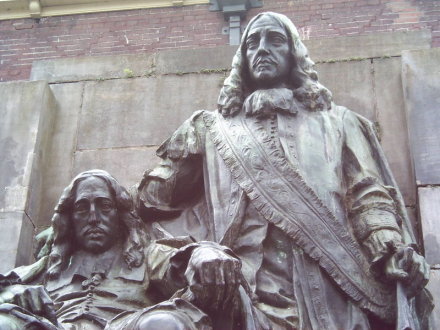
A statue of Johan (standing) and Cornelis de Witt in their native Dordrecht.
The mercantile powerhouse that was the 17th century Dutch Republic was the stage for a long-running conflict between the Orange monarchists (hence the soccer uniforms) and the Republican merchant class.
With the sudden death of the young William II, Prince of Orange in 1650, leaving the (non-hereditary) executive office of stadtholder vacant, the Republicans became ascendant.
And the outstanding figure of the First Stadtholderless Period was Johan de Witt, scion of a Dordrecht merchant family powerful enough that William II had imprisoned de Witt’s own father during a power struggle.
While all these guys were landing themselves in their respective canons, Johan de Witt was trying to keep the age Golden.
Having only relatively recently broken free of Spain, the small country was an up-and-comer on the horns of a serious security dilemma: its leading commercial position put it into maritime competition with England, while its continental location made it vulnerable to the enormous army of the neighboring continental hegemon, France. Ultimately, even with its trade wealth, it did not have the resources to keep up with both of western Europe’s leading powers.
For a generation, de Witt’s statecraft kept the men of the Low Countries out of that predicament, while his brother Cornelis chipped in with a couple of timely naval victories. (Actually authored by Michiel de Ruyter, but Cornelis rode shotgun.)
In 1654, Johan brought the First Anglo-Dutch War to a close, making with Oliver Cromwell a secret pact he was only too happy to enforce never to allow William II’s son, the eventual William III, to be named stadtholder. Reason being: William III was the grandson of the Stuart king Cromwell beheaded, Charles I, and thus a potential claimant to the English throne. Both Protestant Republics had a distinct interest in keeping this monarchist well away from power. (Both would be sorely disappointed.)
A decade and a Stuart Restoration later, de Witt maintained (mostly) Dutch dominance of the seas in the Second Anglo-Dutch War, then held off France (with the help of a timely alliance with the recent adversary, England) in the War of Devolution.
In each case, he kept at least one of England or France on the sideline, or in his own camp.
But the Third Anglo-Dutch War was the charm — as it was also the Franco-Dutch War, and therefore 1672 was Rampjaar: disaster year. While the Dutch were aces on the waves, a massive French invasion easily overwhelmed them on terra firma.
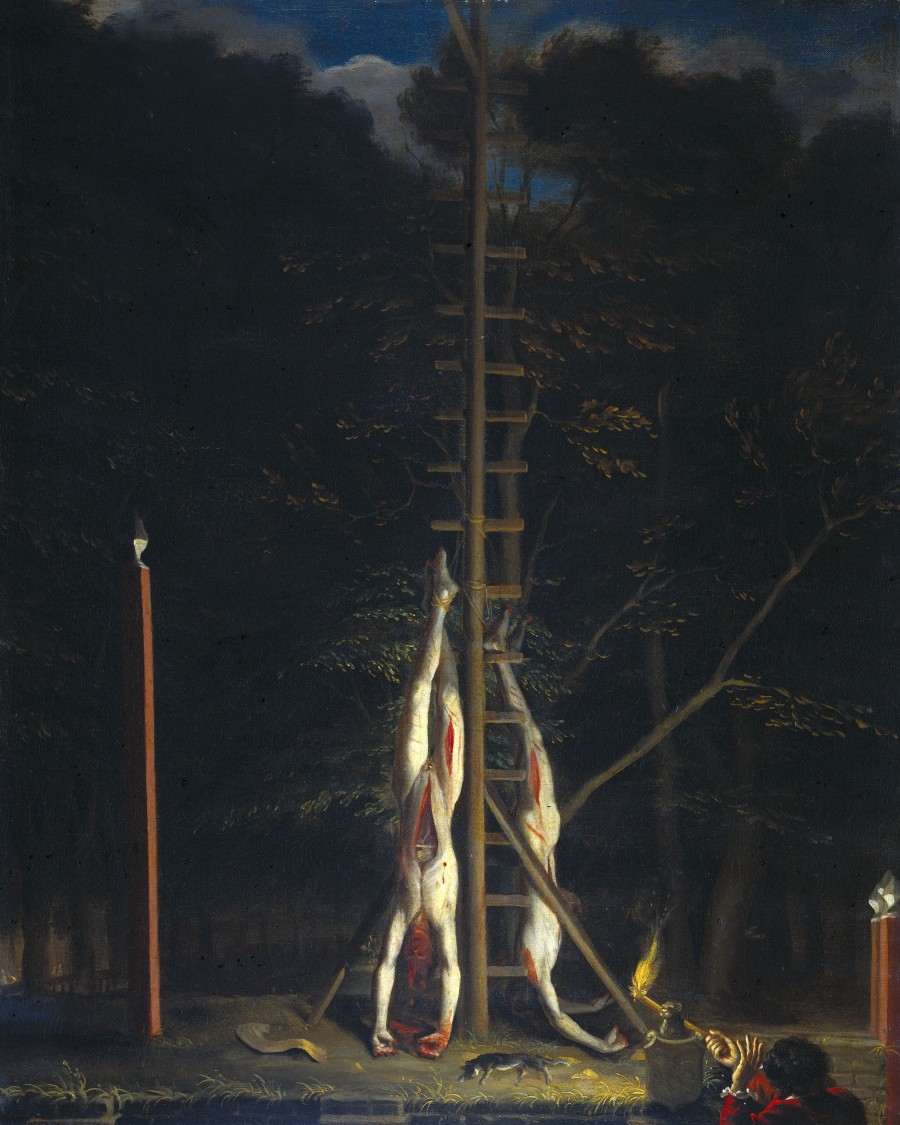
Detail view (click for the full image) of a grisly painting of the mutilated de Witt brothers strung up at The Hague. It’s attributed to Jan de Baen, who in better times took Johan de Witt’s portrait.
De Witt’s never-beloved mercantile oligarchy speedily collapsed with the military reverses, and the now all-grown-up William III was there to pick up the pieces to popular acclaim. Arrested for treason, Cornelis sustained torture without confessing, but when Johan visited him in prison — and William III incriminatingly withdrew the cavalry protecting the brothers — the mob quenched its fury with the de Witts’ blood.
every one of the miscreants, emboldened by his [Johan’s] fall, wanted to fire his gun at him, or strike him with blows of the sledge-hammer, or stab him with a knife or swords, every one wanted to draw a drop of blood from the fallen hero, and tear off a shred from his garments.
And after having mangled, and torn, and completely stripped the two brothers, the mob dragged their naked and bloody bodies to an extemporised gibbet, where amateur executioners hung them up by the feet.
Then came the most dastardly scoundrels of all, who not having dared to strike the living flesh, cut the dead in pieces, and then went about the town selling small slices of the bodies of John and Cornelius at ten sous a piece.
-Dumas
The word “ungrateful” comes to mind.
De Witt stood altogether on a lower plane than Cromwell. We regard him rather as a man of rare and singular talent, than as one of the chosen great ones of the earth, which Cromwell was. He stands far above the common run of men; and he was head and shoulders above nearly all the notable men of his time. He would have been greater if the movement of his limbs had been less burdened with the Dutch governing apparatus … He is not one whom the world can ever greatly admire or love.
(Here’s another, and here’s a 17th century volume de Witt himself coauthored.)
The rise of William III came with the decline of that Dutch Golden Age: the country fended off the immediate military threat, but it increasingly slipped behind its larger neighbors. Costly as was the Franco-Dutch War, it is a step on the path towards the present-day Europe, and this gives us enough excuse to notice that the Eurovision lead-in tune is actually from a Te Deum composed to mark its end.
But William’s own ascent to this wealthy sovereignty was just the beginning for him. Sixteen years later, the House of Orange’s champion vindicated Cromwell’s trepidation about him and gained a far more satisfactory position from which to do battle with his Gallic rival Louis XIV by stunningly overthrowing the Stuart dynasty and becoming King of England in the Glorious Revolution.**
* The Dutch remained the sole western contact of closed Japan until 1854, which is why Japan’s eventual period of scientific advancement became known as ‘Dutch Learning’.
** Albion did not forget the de Witts, either: according to this 1785 cant dictionary, the term “dewitted” had a 17th-18th century run in English to denote — well, exactly what happened to Cornelis and Johan.


 photographs rendered the violence of a lynching visible and accessible to a wider audience. Although, as will be shown, the public for these images was imagined as relatively narrow or contained, they nevertheless seemed to punctuate the lynching as a public spectacle. Small posses that quickly lynched their victims outside town but paused long enough to take pictures intended their actions to be witnessed … ‘the [Richardson] mob worked quietly and most of the citizens of Leitchfield knew nothing of it until the body was found hanging from a tree early this morning … A large crowd congregated … after the hanging was reported.’
  Fr. Elias Fernandez Gonzalez, Fr. Marino de la Hoz, and Br. Emilio del Villar were on hand to spread Catholicism in

 He “appeared to have been extrajudicially executed on suspicion of supporting the