2013: Vahid Zare pardoned while hanging

Last year on this date, an astonishing scene unfolded at a public hanging in Mashhad, near the Iran-Afghanistan border.

Vahid Zare, a robber who murdered a young military conscript pursuing him, was the man due for execution.

Moments after he was dropped and began strangling, the family of his victim pardoned him — their right under Iranian law. Zare was immediately rescued mid-hanging, and his executioner helped him off the gallows for transportation to a local hospital.

The graphic pictures that follow tell an astonishing story.

On this day..

1887: Theodore Baker, who knew how it feels to be hanged

On this date in 1887, Theodore Baker was hanged for murder in Springer, New Mexico.

Baker was taken on as a lodger and ranch hand in Colfax County by an acquaintance named Frank Unruh, and there struck up a liaison with Unruh’s pretty young wife Kate.

One jealous and alcohol-fueled argument later, Baker had shot Unruh dead.

Both Baker and Kate Unruh were arrested, but in December 1885 a mob decided to dispense with the legal niceties and broke into the jail, dragging Theodore Baker out to lynch him to a telegraph pole.

Just another Old West lynching.

Except this lynching had an unusual distinction: it was defeated by a sheriff’s posse, and Baker cut down after having strangled some minutes — unconscious, but alive. He had already survived execution and the trial hadn’t even happened.

But that didn’t mean he got to skip the trial.

After months of recovery, Baker finally went on trial for the murder of Frank Unruh, and with the damning if self-interested testimony of Kate Unruh was condemned on September 6, 1886 to face the noose once again.

Being that this was an age of mass communication, Baker — evidently somewhat garrulous — provided newspapers ample copy on the firsthand experience of execution. (Line breaks have been added to all the ensuing newspaper excerpts for readability.)

[A]t the gaol door I began to curse them, when one of the put the muzzle of his pistol to my ear and said — ‘Keep still, d— you, or I’ll put a bullet through you.’ I knew him by his voice, and knew he would do it, so I kept still.

A little further on we came to a telegraph pole. From the cross bar swung a new rope. One one end was a slipnoose.

They led me under the rope. I tried to stoop down and pull off my boots, as I had promised my folks I would not die with my boots on, but before I could do it the noose was thrown over my head and I was jerked off my feet.

My senses left me in a moment, and then I waked up in what seemed to be another world.

As I recollect now, the sensation was that everything about me had been multiplied a great many times.

It seemed that my five executioners had grown in number until there were thousands of them.

I saw what seemed to be a multitude of animals of all shapes and sizes.

Then things changed and I was in great pain. I became conscious that I was hanging by the neck, and that the knot of the rope had slipped around under my chin.

My hands were loosely tied, and I jerked them loose and tried to catch the rope above me. Somebody caught me by the feet just then and gave me a jerk.

It seemed like a bright flash of lightning passing in front of my eyes. It was the brightest thing I ever saw.

It was followed by a terrible pain up and down and across my back, and I could feel my legs jerk and draw up.

Then there was a blank and I knew nothing more until 11 o’clock next day …

My first recollection was being in the court room and saying, ‘Who cut me down.’

There was a terrific ringing in my ears like the beating of gongs. I recognised no one. The pain in my back continued.

Moments of unconsciousness followed during several days, and I have very little recollection of the journey here. Even after I had been locked up in this prison for safe keeping, for a long time I saw double. Dr. Symington, the prison physician, looked like two persons.

I was still troubled with spells of total forgetfulness. Sometimes it seemed I didn’t know who I was.

All that Baker gave out in the run-up to his actual trial.

As his (judicial) hanging neared, and his hopes for avoiding it vanished, our expansive man on death row got philosophical with a correspondent from the New York Sun. The Chicago Daily Tribune of May 23, 1887 reprints Baker’s remembrance — has it evolved from the previous year? — and Baker’s wider thoughts on life and death.

It is not the pain I fear at all. I have been hanged, and I know what I am talking about. What ails me is that I don’t want to die, and I don’t think I ought to.

Probably if you knew that in an instant you were to be blown to nothingness, so that you could experience no suffering whatever, you would appreciate how I feel about it.

As for the mode of death, you can say that it is as good as any other, and it don’t need to be too artistically done, either.

Why, when they hanged me first down here by the railroad track I was scared half to death. They had no modern appliances, and I made up my mind that they were going to give me a terrible struggle of it, but it was nothing of the sort. The mob swung me off from a telegraph pole like they would a log, and then one or two of them pulled my legs. That isn’t so almighty nice, but still it don’t hurt as you might think it would.

I must have been there ten or fifteen minutes before the Sheriff and his posse found me and cut me down.

Of course by that time I was unconscious, but I remembered enough of what occurred to banish any fear that I might have of death on the gallows. It’s death in whatever form it comes that I object to.

If I have got to go I had just as soon go by the rope as by the bullet, and I had a good deal rather go by the rope than by the knife or by poison.

You can say this much for the information and comfort of all the poor fellows who will have to swing when I am gone. Tell them to brace up and take it easy. They are going to die easier deaths than three-fourths of the fat old Judges who sentence them, and who expect to die in their beds.

There has been altogether too much writing and talking on the subject of the barbarity of the gallows. I’m in favor of abolishing capital punishment myself, but if a man must die, what’s the use of being too particular about the mode, so long as you have got a good enough scheme now?

Baker also gave his own version of the events that led to his death sentence. It should be said that his “kill or be killed” spin quite attenuates the court’s finding that Baker only wounded Unruh in their altercation, but then chased his bleeding cuckold down as far as a quarter-mile from the house to deliver the coup de grace.

Under all the circumstances my crime was not murder, anyway. I had become involved in a quarrel between Unruh and his wife, and, foolish as that was, it would have led to nothing more if Unruh had not attacked me. I had to kill him or be killed.

The woman swore against me in order to save herself. She was scared to death because they lynched me, and she was afraid that unless somebody swung for the crime she might be called on some dark night.

But whether my crime was deliberate murder or not, I think I have been punished enough. It is more than a year since the mob lynched me, and since that time I have lived with a rope around my neck all the time.

As I have said to you, my sufferings when I was being resuscitated were greater than they were when I was hanging. It took me three months to get over the effects of the lynching. Two or three times a day my brain would be in a whirl, and I would lose all control of myself. Then when I slept I would go through it all again.

At length, when I was brought to trial and was convicted and sentenced to death, I had th erope once more before me.

The anxiety about the trial, and later about my appeals, has worn on me until my nerves are in about as bad a condition as they were when I was in the hospital at Santa Fe, and the old complaint from which I suffered when I was recovering from the lynching has returned again.

I haven’t slept for months without hanging by the neck through it all. Can you imagine what it is to be conscious all the time of dangling in that way? Asleep or awake I have a rope about my neck, and I know exactly how it feels.

I think I have had enough of it, but as they seem to think not in these parts I suppose I shall have to take some more.

I can tell you, though, that I don’t want anybody to bring me to life this time.

When I go out tomorrow I will know just what is coming, and when I tell the Sheriff to let me slide I will be the first man in America who has lived a year and a half to say that a second time to a hangman.

This same article says — though this already sounds like folklore — that Baker went fearlessly to the gallows, and his last words were addressed to the hangman as he adusted the knot around Baker’s neck: “That’s right. I have been in the habit of having it a little higher up.”

On this day..

1789: Not Mary Wade, 11-year-old thief

Thanks to Aaron Molyneux for the guestpost. It’s just an excerpt of a much more detailed treatment Molyneux first made of this case on PrisonVoices.org. I’ve made a handful of minor edits to compress this excerpt, and added or moved some links. -ed.

On Wednesday the 14th of January 1789 Mary Wade stood in court at the age of just 11 years old and received the verdict that her life was to be cut short. For the robbery of one cotton frock, a linen tippet and a linen cap she was found guilty and sentenced to hang. Judged to have committed an adult’s crime, she would face an adult’s punishment.

Although in modern Britain theft may seem a quite unremarkable crime, in Mary Wade’s age robbery was dealt with by extreme punishment. The court suggested that Mary’s theft was equal to “holding a pistol to the breast of a grown person”. Whether or not Mary Wade was aware of the hard-lined punishments given to those who stole remains unknown but having committed a very similar crime at the age of eight, only to get away with it because of her young age, she did know it was a crime and therefore it would seem that there was an air of desperation about Mary’s actions.

Sentenced to die by hanging Mary was taken away from her mother and marched out of the Old Bailey. For a girl of Mary’s age this situation must’ve been a frightening ordeal. Being sent to Newgate prison was not for the faint hearted. It was a vile place deemed so unhealthy that Physicians often refused to go in. By the time Mary entered, Newgate was London’s main jail and Mary joined many others waiting to be hanged before huge crowds outside the prison doors. Arriving in irons Mary would have been faced with open sewage, disease and lack of water. It would be a shock to the system for anybody never mind an eleven year old girl. If those entering had enough money they would enter the Master’s side or the press yard where they would have beds, heat and have their irons removed. But those who could not afford would be thrown into the Common Felons side. These would go without bedding or proper clothing and be forced to slum in the overcrowded, rat-infested cells. Mary almost certainly would have been with the fellow women convicts in the Common Felons side.

More than likely alone, vulnerable and scared Mary would spent a total of ninety three days waiting to be marched out in front of the baying crowds which gathered outside the prison walls to watch convicts hang for their crimes. Ninety three days in which she would wait for her death.

Then, on the 16th of March 1789, in celebration of King George III‘s recovery from madness, Mary Wade’s death sentence was respited along with all other condemned women. Instead of hanging, she would be transported to New South Wales on the convict ship Lady Juliana.

Read on at Prison Voices for more on Mary Wade’s offense, and for her story as a transported convict — where she became the ancestor of a huge number of latter-day Australians.

On this day..

1820: Not Stephen Boorn, saved by newsprint

January 28, 1820 was the scheduled hanging-date for Stephen Boorn in Vermont, who was spared by the stroke of luck in one of the Republic’s seminal wrongful conviction cases. For all its vintage, it has a disturbingly current feel.

Stephen Boorn and his brother Jesse were farmers in Manchester living with their possibly feebleminded brother-in-law Russell Colvin when Colvin suddenly vanished in May 1812. Vanishing unexplained for weeks on end was actually an established behavior for this peculiar gentleman, so it was only gradually that suspicion of foul play accumulated. There was some bad blood known to exist between Colvin and his brothers-in-law; they had even been seen in a violent quarrel just before Russell Colvin disappeared (pdf). There were whispers, but never any real evidence.

And so weeks stretched into months, and then to years. Many years. Was it possible two neighbors of the good people of Manchester, Vt., had gotten away with murder plain as day and gone about bringing in their crops just like nothing happened?

The break arrived in 1819 courtesy of the brothers’ aged uncle Amos Boorn. Amos reported that Russell Colvin had appeared to him in a dream and accused his former in-laws of murder. Now a dream couldn’t be read in evidence, but it proved sufficient to re-open a cold case and endow the investigation with official “tunnel vision” so familiar to the staging of a wrongful conviction.

The other classic trappings of that scene followed anon: shoddy evidence, a jailhouse snitch, and even a false confession.

Once under the pall of suspicion, random events around the Boorns began to seem sinister. The dream-Russell’s accusation led to a cellar-hole being excavated, which turned up some random junk (a penknife, a button); was it Colvin’s random junk? A barn on the Boorn farm burned down; had it been torched to conceal evidence? A boy found bones at a stump on the property; were they human remains? (They turned out to be animal remains.)

Stephen Boorn had moved to Denmark, New York, but Jesse Boorn was taken into custody for interrogation. There he was parked in a jail cell with a forger named Silas Merrill.

Lo and behold, Jesse Boorn immediately spewed to his bunkmate the awful secret of the murder. Yup, after keeping it quiet for seven years he detailed it all to Silas Merrill one “night, when he and Jesse had waked from their sleep, and without any previous persuasion or advice on the subject” and also just happened to tie in all that random sinister stuff from the investigation like the barn and the bonestump. Naturally, Merrill was released for relaying to his jailers this valuable and in no way impeachable information.

Now cornered, Jesse confessed to the murder. The causes of false confessions are complex, but the advent of DNA exonerations has underscored the alarming frequency of this phenomenon. A strictly rationalist explanation might postulate that Jesse thought he could avoid hanging by taking responsibility for a crime he was now certain to be convicted of, and framing it in the least culpable possible light; the murkier fathoms of human psychology might suggest a desire to please his captors or a conscience conforming itself to the conviction of his neighbors. Whatever the case, the confession got Stephen extradited from New York, and under interrogation Stephen too confessed. Stop confessing to things, people! (In fact, best say nothing at all.)

Despite retracting the confession, the brothers were convicted with ease in a trial held at the town’s church, the better to accommodate huge crowds that would have overflowed the courtroom. They were both slated to hang on January 28.*

While Jesse Boorn won a commutation his brother appeared doomed.

As an almost literal last gasp, Stephen took out newspaper advertisements searching for Russell Colvin. And they worked. At least, this is the version of the story as it is commonly recounted, dating I believe to this 1932 volume on wrongful convictions. The primary sources referenced there actually appear to me to indicate that the Boorn-saver, a New Jersey gentleman named Taber Chadwick, responded with a letter to the editor to a simple news report of the case, which report naively credited the dream-driven conviction as “divine providence”.


From the New York Evening Post, Nov. 26, 1819.

Luckily, Mr. Chadwick realized that he knew a Russell Colvin from Manchester whose mental state was thoroughly addled.


New York Evening Post, Dec. 10, 1819.

A fortnight after this letter hit the press, Colvin was back in Manchester … and this time, it was not in a dream.

Colvin confirmed that his brothers-in-law hadn’t hurt him at all and both Boorns — who, we remind you, had each previously confessed to killing a man who was now here in the flesh and blood to exonerate them — both these Boorns walked free.

Update: Embarrassingly not noticed by my own self in researching this post, a comment from the outstanding 19th century crime blog Murder By Gaslight flags the hypothesis that the entire exoneration was staged using an imposter to weasel the Boorns out of prison.

* According to this biography of the African-American divine Thomas Lemuel Haynes, Haynes was the Boorns’ confessor while they awaited execution, and one of the only people to believe the brothers’ protestations of innocence. Haynes was eventually moved to spend his own money on the famous advertisement hoping that “any person who can give information of the said Colvin may save the life of an innocent man.” If there’s one Vermonter who comes out of this astonishing story smelling like a rose, it’s Reverend Haynes.

On this day..

1730: Neither James Prouse nor James Mitchel, much to their surprise

January 14, 1730, was the date appointed for the public hanging in Philadelphia of James Prouse and James Mitchel for burglary.

Prouse, for his part, admitted the crime but insisted that James Mitchel had nothing to do with it — and Mitchel insisted the same. This ultimately generated considerable support for clemency which the authorities did not seem inclined to act upon.

Naturally the young newspaperman Benjamin Franklin — just turning 24 in January 1730 — was keen to publish this affecting story in his Philadelphia Gazette. Through the magic of public domain, he’s generously allowed us to republish his account from the January 20, 1730 Gazette as our guest post today.

Hyperlinks are, as one may surmise, Executed Today‘s own annotations.


We think our Readers will not be displeased to have the following remarkable Transaction related to them in this particular Manner.

Wednesday the 14th Instant, being the Day appointed for the Execution of James Prouse and James Mitchel for Burglary, suitable Preparations were accordingly made. The tender Youth of one of them (who was but about 19) and the supposed Innocence of the other as to the Fact for which they were condemned, had induced the Judges (upon the Application of some compassionate People) to recommend them to His Honour‘s known Clemency: But several Malefactors having been already pardoned, and every Body being sensible, that, considering the great Increase of Vagrants and idle Persons, by the late large Importation of such from several Parts of Europe, it was become necessary for the common Good to make some Examples, there was but little Reason to hope that either, and less that both of them might escape the Punishment justly due to Crimes of that enormous Nature. About 11 o’Clock the Bell began to Toll, and a numerous Croud of People was gathered near the Prison, to see these unhappy young Men brought forth to suffer. While their Irons were taken off, and their Arms were binding, Prouse cry’d immoderately; but Mitchel (who had himself all along behaved with unusual Fortitude) endeavoured in a friendly tender Manner to comfort him: Do not cry, Jemmy; (says he) In an Hour or two it will be over with us, and we shall both be easy. They were then placed in a Cart, together with a Coffin for each of them, and led thro’ the Town to the Place of Execution: Prouse appear’d extreamly dejected, but Mitchel seemed to support himself with a becoming manly Constancy: When they arriv’d at the fatal Tree, they were told that it was expected they should make some Confession of their Crimes, and say something by Way of Exhortation to the People. Prouse was at length with some Difficulty prevailed on to speak; he said, his Confession had been taken in Writing the Evening before; he acknowledged the Fact for which he was to die, but said, That Greyer who had sworn against him was the Person that persuaded him to it; and declared that he had never wronged any Man beside Mr. Sheed, and his Master. Mitchel being desired to speak, reply’d with a sober compos’d Countenance, What would you have me to say? I am innocent of the Fact. He was then told, that it did not appear well in him to persist in asserting his Innocence; that he had had a fair Trial, and was found guilty by twelve honest and good Men. He only answer’d, I am innocent; and it will appear so before God; and sat down. Then they were both bid to stand up, and the Ropes were order’d to be thrown over the Beam; when the Sheriff took a Paper out of his Pocket and began to read. The poor Wretches, whose Souls were at that Time fill’d with the immediate Terrors of approaching Death, having nothing else before their Eyes, and being without the least Apprehension or Hope of a Reprieve, took but little Notice of what was read; or it seems imagined it to be some previous Matter of Form, as a Warrant for their Execution or the like, ’till they heard the Words PITY and MERCY [And whereas the said James Prouse and James Mitchel have been recommended to me as proper Objects of Pity and Mercy.] Immediately Mitchel fell into the most violent Agony; and having only said, God bless the Governor, he swooned away in the Cart. Suitable Means were used to recover him; and when he came a little to himself, he added; I have been a great Sinner; I have been guilty of almost every Crime; Sabbath-breaking in particular, which led me into ill Company; but Theft I never was guilty of. God bless the Governor; and God Almighty’s Name be praised; and then swooned again. Prouse likewise seemed to be overwhelmed with Joy, but did not swoon. All the Way back to the Prison, Mitchel lean’d on his Coffin, being unable to support himself, and shed Tears in abundance. He who went out to die with a large Share of Resolution and Fortitude, returned in the most dispirited Manner imaginable; being utterly over-power’d by the Force of that sudden Turn of excessive Joy, for which he had been no Way prepared. The Concern that appeared in every Face while these Criminals were leading to Execution, and the Joy that diffused it self thro’ the whole Multitude, so visible in their Countenances upon the mention of a Reprieve, seems to be a pleasing Instance, and no small Argument of the general laudable Humanity even of our common People, who were unanimous in their loud Acclamations of God bless the Governor for his Mercy.

The following are Copies of the Papers delivered out by Prouse and Mitchel the Evening before, with little or no Alteration from their own Words.

I James Prouse was born in the Town of Brentford in Middlesex County in Old England, of honest Parents, who gave me but little Education. My Father was a Corporal in the late Lord Oxford’s Regiment of Horse, (then named the said Lord’s Blues) and I was for some Time in the Care of an Uncle who lived at Eling near Brentford aforesaid, and who would have given me good Learning; but I being young would not take his good Counsel, and in the 12th Year of my Age came into Philadelphia, where I was recommended to one of the best of Masters, who never let me want for any Thing: But I minding the evil Insinuations of wicked People, more than the good Dictates of my Master, and having not the Fear of God before my Eyes, am deservedly brought to this wretched and shameful End. I acknowledge I justly merit Death for the Fact which condemns me; but I never had the least Design or Thought of the like, until often press’d, and at length seduced to it by John Greyer, who was the only Person that ruined me. He often solicited me to be guilty of other Crimes of the like Nature, but I never was guilty of any such, neither with him or any one else; neither did I ever wrong any Man before, save my too indulgent Master; from whom I now and then pilfer’d a Yard or the like of Cloth, in order to make Money to spend with the said Greyer. As for James Mitchel who dies for the same Fact with me, as I hope to receive Mercy at the great Tribunal, he the said James Mitchel is intirely innocent, (*) and knew nothing of the Fact until apprehended and taken. I am about Nineteen Years of Age and die a Protestant.

JAMES PROUSE.

(*) N. B. He declared the same Thing at the Bar just before he received Sentence.

The Speech or Declaration of James Mitchel written with his own Hand.

I James Mitchel, was born, at Antrim in the Kingdom of Ireland, of good and honest Parents, and brought up with them until the Age of 13 Years, and had a suitable Education given me, such as being taught to read and write English, with some Latin; and might have been further instructed, but at my earnest Request was bound Apprentice to a Book-binder, and served 4 Years to that Trade; after which I left the Kingdom and went for England in order to be further improved in my Business; but there had the Misfortune to be press’d on board the Berwick Man of War, commanded by the Honorable George Gordon, and having been at several Parts abroad, returned to England in Octob. 1728. where I was by Sickness reduced to a very sad Condition, through which I came over to this Country a Servant; here I was it seems unfortunately led into bad Company, and one Evening by James Prouse was raised out of my Bed to go and drink with him and one Greyer, the which Greyer after parting gave to the said James Prouse Six-pence, which was all the Money I saw that Night and till next Morning, and then James Prouse took out of his Pocket a 15 Shilling Bill, and desired me to get it changed for him, in order to spend some of it; but coming unto Town I was apprehended for the robbing of Mr. George Sheed, and now am to die for the same. I die a Protestant.

JAMES MITCHEL.

On this day..

1864: Samuel Wright, by contrast

Samuel Wright and George Townley both murdered romantic partners late in 1863. Both were tried, convicted, and condemned to hang in very short order and both the subjects of intense pressure for a crown commutation of sentence.

Only one of those men hanged. It was 150 years ago today.

George Townley

Townley lived near Manchester and was courting a young woman named Bessie Goodwin from Derbyshire. Described as a man from a respectable upper middle class family with “refined manners,” and an intelligent linguist* to boot, Townley was nevertheless a rung or two below Miss Goodwin on the wealth and status ladder.

He was, accordingly, frustrated of his designs when the young lady accepted a clergyman’s proposal and broke off her previous engagement to Townley. Despite being disinvited by ex-fiancee, Townley took a train to her village and pressed his company on her. The two went for a walk that evening, and Townley stabbed her in the throat — a fact which he confessed on the scene to the first person who responded to the commotion and found Miss Goodwin staggering towards her home with a fatal gash in her neck.

In the great tradition of weird stalkers everywhere, Townley then helped the Good Samaritan carry the dying woman home, and kissed her tenderly, all the while bemoaning to arriving gawkers his guilt. “She has deceived me, and the woman who deceives me must die,” he responded chillingly to the inquiries of his would-be father-in-law. “I told her I would kill her. She knew my temper.”

This is all a very bad hand to deal a defense barrister.

Having little to work with, his superstar attorney — remember, the family had money — went with an insanity defense, aided by the lunacy diagnosis of prominent psychiatrist Forbes Winslow.** There was some history of insanity in his family, and everyone seemed agreed on the point that Townley didn’t set out with the intent to commit murder, but impulsively — madly? — took that course as he realized during his interview that he would surely not be putting a ring on that.

The legal standard of the time gave no purchase to this sort of thing. Townley’s judge instructed the jury to find insanity only if he “was under delusions … [and] supposed a state of things to exist which did not exist, and whose diseased mind was in such a condition that he acted upon an imaginary existence of things as if those things were real.” This is the M’Naghten rule, a historically pivotal and also highly restrictive insanity definition dating to 1843.

On December 12, 1863 Townley was sentenced to death for the murder, with the hanging scheduled for the approaching New Year’s Day. According to the London Times report the next week (Dec. 18), the sentence “has not made the slightest alteration in his demeanour. He partakes of his meals heartily, sleeps well, and repeatedly asserts that he was perfectly justified in taking away his victim’s life, and that he feels no remorse for the deed.”

Nevertheless, Townley’s well-off family and friends had enough pull to pry open a previously little-known legal escape hatch.

Upon the judge’s own request, the crown empaneled a committee to adjudicate Townley’s sanity for his mercy petition. But a sloppily written law actually allowed any two doctors plus any two magistrates to issue a formal certification of madness which would compel the prisoner’s removal to the asylum. Townley’s own solicitor simply assembled himself a quartet so minded and presented their finding to the Home Secretary, forcing his hand — to a great deal of public outrage once the obscure mechanism became known.

“Good friends and abundant means may give a convicted criminal unexpected advantages over an ordinary offender,” the Times complained in an editorial. (Jan. 27, 1864) Plus ça change.

Samuel Wright

Samuel Wright was not a man of means or linguistic gifts, but a bricklayer who lived in a Waterloo Road public house in Surrey, on London’s southern outskirts.

On December 13, 1863, he slashed the throat of his live-in lover Maria Green after they’d both been on a drinking bout. On December 16, mere three days later, Wright voluntarily pleaded guilty and received a death sentence.

A hue and cry for Wright’s sentence to be abated soon arose among London’s working classes, especially in the wake of Townley’s commutation. Wright had a good reputation, while Green was known for her violent temper. Wright intimated that she had menaced him with a knife during a quarrel.

Was this not a case like George Townley’s, only more so?

The contrast in the fates between the two murderers did not flatter. The crimes were analogous even to the mode of slaying.† If anything, the rich man’s suggested a more egregious context: Townley’s victim appeared more sympathetic, and Townley had gone out of his way to track her down in order to kill. Why was Townley’s heat of passion “insanity” but Wright’s was motive and deliberation?

The Home Secretary offered his sympathy but not his mercy. After all, Wright himself agreed that he intentionally killed Green. “To commute the sentence on the grounds on which it has been pressed would, in fact, be to lay down a rule of law as to the distinction between murder and manslaughter contrary to that which is well established,” wrote a Home Office spokesman on Jan. 7 in response to three separate petitions submitted on Wright’s behalf. Maybe they thought the same thing about Townley … but that decision was out of their hands.

In one of the period’s characteristic hanging broadsides, the balladeer has Wright lament,

Friends, for me have persevered,
To save me from the gallows high;
Alas! for me there is no mercy,
Every boon they did deny,
While others who was tried for murder,
And doomed to die upon a tree,
Through friends and money has been pardon’d
who deserved to die as well as me.

But, oh! my friends, you must acknowledge
what I say has oft been said before.
Some laws are made to suit two classes,
One for the rich, one for the poor;
So it is with me and Townley,
A reprieve they quickly granted he,
He was rich, and I was poor, —
And I must face the fatal tree.

The mood of the populace for the hanging at Horsemonger Lane Gaol this date in 1864‡ was decidedly ugly. On the night of the 11th, when it became clear that the many last-ditch bids for commutation — directed not only at the Home Secretary but even to Queen Victoria and even to the Prince of Wales appealing for a boon on the occasion of his first son‘s January 8 birth§ — a handbill circulated in the prison’s neighborhood entreating its denizens to protest the execution by shuttering all windows. “Let Calcraft and Co. do their work this time with none but the eye of Heaven to look upon their crime.”

Indeed this summons was widely obeyed.

A small crowd only turned out for the occasion, and shouted their disgust for the proceedings: “Shame!” and “Judicial murder!” and “Where’s Townley?” Even many months later, at the controversial August 10 hanging of Richard Thomas Parker, the crowd chanted Townley’s name, now the emblem of the unequal justice of the law.

One diarist’s entry for the day recalled that “[t]he blinds were down in all the neighbouring streets and the military were called out in case of an attempted rescue. When the unfortunate man appeared on the scaffold, loud cries of ‘Take him, take him down’ were heard in every direction, to which the unhappy man responded by repeated bows to the multitude, he still continued bowing and was actually bowing when the drop fell.”

Postscript

The language of the law that permitted Townley his backdoor commutation was revised by Parliament within weeks.

As to Townley himself, another panel appointed by the Home Office found him fully cogent, which meant that officially, he had become insane after his death sentence and the insanity abated thereafter. While this finding theoretically reinstated the death penalty, actually hanging him after these circumstances was thought to be inhumane, and he was reprieved. One supposes there must have been some thought for the potential disturbance Townley’s hanging would have occasioned.

On February 12, 1865 — a year and change after escaping the noose that claimed Samuel Wright — George Townley hurled himself headlong off a high staircase onto a stone floor in Pentonville Prison, where he had been transferred as an ordinary inmate. He died on the spot.

* Of course, he could never hope to match the linguistic’s fields most famous English murderer.

** You might recognize this distinctive name from our Winslow’s son, L. Forbes Winslow, a figure in the Jack the Ripper investigation.

† An additional unflatterering comparison point to Derbyshire contemporaries: a proletarian named Richard Thorley had been hanged in Derby in 1862 for a very similar crime: he slashed his girlfriend’s throat when she tried to break up with him.

‡ Among the very last public hangings at Horsemonger Lane Gaol. All UK hangings were conducted behind prison walls by 1868.

§ This infant, Prince Albert Victor, is the royal eventually identified with Jack the Ripper by a particularly inventive hypothesis.

On this day..

1875: William Wilson, taking the priest with him

From The Fabulous Frontier, 1846-1912. (The entire text below is a single large paragraph in that book, so line breaks have been added for readability.)

On August 2, 1875, Robert Casey was shot and killed by William Wilson in Lincoln with a bullet fired from a Winchester rifle. Wilson was tried, convicted by a jury and sentenced to be hanged.

On December 10, 1875, the appointed day, a large crowd gathered in the Lincoln* jail yard to witness the hanging. Ash Upson** was present as a representative of the press, but left shortly after the trap was sprung, probably to get a drink.

After being suspended by a rope for nine and one-half minutes by the Sheriff’s watch, Wilson’s body was taken down from the scaffold and placed in the coffin.

Spectators nudged the Sheriff and told him that Wilson was not yet dead.

Red-faced and embarrassed the Sheriff and several helpers lifted William Wilson from his wooden coffin, escorted him once more to the scaffold. The rope was again tied around the condemned man’s neck and he was suspended for an additional twenty minutes, at the end of which time there was not much doubt that the demands of the law had been satisfied.

Father Antonio Lamy, twenty-eight years old, a native of France, a nephew of Archbishop John B. Lamy of Santa Fe, had been a reluctant witness to the hanging … Padre Lamy had been in Lincoln on a missionary tour. He called at the jail to offer spiritual consolation to William Wilson, soon to be hanged. Wilson prepared himself for death under Father Lamy’s direction and accepted his offer of company to the scaffold.

The hanging and rehanging of Wilson proved too much for the frail young man of God.

Rather desperately ill, suffering from chills and high temperature, the Padre insisted on returning on horseback to Manzano a few days after William Wilson had been hanged. Arriving in Manzano, Father Lamy’s condition rapidly became worse. He died there on February 6, 1876.

The remains of the priest were buried under the floor of the parish church at Manzano. The story of Padre Lamy’s death has for many years been kept alive in the Manzano community. His grave in the church has long been a silent sermon in opposition to the brutality of capital punishment.

* Lincoln was a little hit and miss with its necktie parties: it’s also the town where Billy the Kid escaped a hanging.

** Ghostwriter of Pat Garrett‘s memoir, The Authentic Life of Billy the Kid.

On this day..

1927: Baldomero Rodrigues, and then Baldomero Rodrigues again

On this date in 1927, Cuban murderer Baldomero Rodrigues was garroted in Pinar del Rio prison.

But when his body was laid out on a stretcher for disposal and the official witnesses were filing out of the death chamber, Rodrigues began showing signs of life.

It was “a defect in the garrote or due to careless adjustment of the metal band which fits about the victim’s neck to cause strangulation,” an Associated Press wire report ran.*

In present-day Iran, one of the most aggressive death penalty states going, a drug dealer managed to survive a hanging just weeks ago as I write this in 2013. That man got shipped to the hospital and placed on life support, with the justice minister eventually announcing that he wouldn’t be noosed again.

Gerardo Machado‘s Cuba was not so squishy.

With nary a pause to await further instruction, the execution-chamber guards forcibly subdued Rodrigues, who had reanimated sufficiently to “put up a furious struggle.” They forced their thrashing victim back onto the garrote, double-checked the metal band this time,** and tightened it until it asphyxiated Rodrigues a second time … then left the now-actually-lifeless body on the machine a full 22 minutes to make good and certain of their work.

* Here quoted from the Oct. 30, 1927 Los Angeles Times. Also see the New York Times from the same date for a truncated paraphrase of the same report.

** Presumably.

On this day..

1803: Joseph Samuel survives three hangings

On this date in 1803, Joseph Samuel just wouldn’t hang.

Transported to Australia in 1801 for theft, Joseph Samuel was part of a cohort of Sydney Cove convicts who, on the night of August 25-26, burgled a house.

The band was surprised by constable Joseph Luker, himself a former convict. One or more of the thieves battered him to death on the spot with whatever was at hand: recovered with Luker’s broken body at morning’s light were a bloodied wheelbarrow wheel, and the hilt of Luker’s own cutlass, buried in his brains. Luker was the first policeman killed on duty in Australia, and his name can be found on the country’s National Police Memorial.

But the order of the day in 1803 was a different sort of memorial. “Avenging Heaven directs the Hand of Justice, and the Manes of the Deceased inspires us with Indignation and Resentment,” the Sydney Gazette fulminated. The need to cut a deal for crown’s evidence with one of Samuel’s compatriots eventually meant that Samuel was the only one to bear the vengeance of Luker’s Manes. (A third man, Isaac Simmonds, was acquitted at trial, but he was so heavily suspected that he was made to attend the execution.)

We’ll pick up the narration of the Sydney Gazette (Oct. 2, 1803):

James Hardwicke were brought, in pursuance of the sentence passed upon them on the preceding Friday.

Both prisoners conducted themselves with becoming decency; and when the Reverend Mr. MARSDEN had performed the duties of his function, and quitted Hardwicke, he turned to Samuels (who being a Jew, was prepared by a person of his own profession) and questioning him on the subject of the murder of Luker, he solemnly declared, that during the interval of his confinement in the cell with Isacc [sic] Simmonds, nicknamed Hikey Bull, they in the Hebrew tongue exchanged an oath, by which they bound themselves to secrecy and silence in whatever they might then disclose.

Conjured by that GOD before whom he was shortly to appear, not to advance any thing in his latter moments that would endanger his salvation, he now repeated with an air of firmness what he had before declared ; and appearing deeply imprest with a becoming sense of his approaching end, appealed to Heaven to bear him testimony that Simmonds had, under the influence of the oath by which they were reciprocally bound, acknowledged to him that Luker had accidentally surprised him … and that he, in consequence thereof, had “knocked him down, and given him a topper for luck!” … [and] that he would hang 500 Christians to save himself.

Simmonds, as we’ve noted, was right there in forced attendance at the public hanging, and as Samuel’s accusations started the audience murmuring, Simmonds tried to interject his denials. The very fact that the words were spoken by a man on the brink of death and presumably in fear for his soul made Samuel a credible accuser in the eyes of the populace, “in whose breasts a sentiment of abhorrence was universally awakened … and the feelings of the multitude burst forth into invective.” Yikes.

While the gendarmes moved to protect Simmonds from the possible wrath of his neighbors, and Hardwicke received a last-minute pardon,* Samuel commenced the inadvertently superlative finishing act of his persuasive performance.

at length the signal was given, and the cart drove from under him; but by the concussion the suspending cord was separated about the centre, and the culprit fell to the ground, on which he remained motionless with his face downwards. The cart returned, and the criminal was supported on each side until another rope was applied in lieu of the former: he was again launched off, but the line unrove, and, continued to flip until the legs of the sufferer trailed along the ground, the body being only half suspended.

All that beheld were also moved at his protracted sufferings; nor did some hesitate to declare that the invisible hand of Providence was at work in the behalf of him who had revealed the circumstances above related. To every appearance lifeless, the body was now raised, and supported on men’s shoulders, while the executioner prepared anew the work of death. The body was gently lowered, but when left alone, again fell prostrate to the earth, this rope having also snapped short, close to the neck.

Compassion could no longer bear restraint; winged with humanity, the Provost Marshal sped to His EXCELLENCY‘S presence, in which the success of his mission overcame him; A Reprieve was announced — and if Mercy be a fault, it is the dearest attribute of GOD, and surely in Heaven it may find extenuation!

Samuells when the Provost Marshal arrived with the tidings which diffused gladness throughout every heart, was incapable of participating in the general satisfaction. By what he had endured his reasonable faculties were totally impaired; and when his nerves recovered somewhat from their feebleness, he uttered many incoherences, and was alone ignorant of what had past. Surgical assistance has since restored him; And MAY THE GRATEFUL REMEMBRANCE OF THESE EVENTS DIRECT HIS FUTURE COURSES!

It didn’t.

In 1806, Samuel made an escape attempt with some other convicts by boat. It was swept away in a tempest, with all presumed lost at sea.

* A number of sources claim that Hardwicke did hang successfully while Samuel’s rope repeatedly broke. We think the eyewitness newspaper report days after the execution to the effect that Hardwicke was reprieved is by far the more credible report.

On this day..

1876: Jesse Pomeroy’s sentence commuted

(Thanks to Meaghan Good of the Charley Project for the guest post. -ed.)

On this date in 1876, serial killer Jesse Pomeroy was reprieved by a 5-3 vote of the Governor’s Council of Massachusetts. Rather than hanging him, they elected to bury him alive instead.

With a “mere” two deaths to his name, at first glance Jesse Pomeroy may not seem like much of a serial killer. In fact, according to some definitions that require a higher body count, he wasn’t a serial killer at all. But give the kid some credit: he was only fourteen years old when he was caught. What’s more, his two murders were committed in a most brutal, sadistic manner.

Jesse was born in Massachusetts in 1860, the son of a violent and abusive father and a doting mother. He’d always been considered a “difficult” child and had tortured the family pets, but his known criminal career didn’t begin until he was twelve years old.

Over the course of nine months, he lured eight young boys between five and eight years old to remote areas and attacked them, beating them badly with a stick, a belt or his hands. In his later attacks he took to biting, and started using a knife as well. He tried to stick a needle into one child’s eyes, another boy, age six, was stabbed between the shoulders and had his penis nearly half cut off. Eventually Jesse would let his victims go, leaving them physically and mentally scarred for life.

Each attack was worse than the last, and each time the intervals between them got shorter. There were three months between the first assault and the second, and only five days between the seventh incident and the eighth (which was the last).

In his biography of Pomeroy, Fiend: The Shocking True Story of America’s Youngest Serial Killer, Harold Schechter described the assaults vividly:

The seventh attack occurred … on Wednesday, September 11. This time the “boy torturer” lured a seven-year-old named Joseph Kennedy to a vacant boathouse near the salt marshes of South Boston bay. Once inside the building, he slammed his victim’s head against the wall, stripped him naked, and administered a ferocious beating, breaking the little boy’s nose and knocking out several of his teeth. Then, pulling out his pocketknife, he forced the seven-year-old to kneel and ordered him to recite a profane travesty of the Lord’s Prayer, in which obscenities were substituted for Scripture.

When young Joseph refused to commit this blasphemy, his tormentor slashed him on his face, his back, his thighs. Then he dragged the bleeding child down to the marsh and — laughing delightedly at the little boy’s suffering — doused his wounds with salt water.

Most serial killers have a basically normal appearance, and some are downright handsome.

Jesse, however, actually did look pretty creepy. His head was too large for his body, he was blind in his right eye and the eyeball was covered by a whitish film that was deeply unsettling to look at. One of the boys he attacked said the eye looked like a “milkie,” a white marble. After that, the press often referred to the unknown assailant as “The Boy with the Marble Eye.”

On the day of his arrest on September 20, 1872, the police brought Joseph Kennedy, one of Pomeroy’s victims, around to various local schools to see if the child could find his attacker in the classrooms.

When little Joseph entered Jesse’s classroom, Jesse lifted his head when the teacher told him to but kept his gaze directed down at his desk. Joseph couldn’t see his deformed eye and didn’t recognize him. That afternoon, however, for some reason Jesse decided to pop in to the local police station on the way home from school. The boy was there and this time he recognized him.

Arrested and subjected to several hours of grilling, Jesse quickly confessed to his crimes, saying he “could not help himself” and wasn’t sure why he’d done such terrible things.

His victims identified him as the boy who had hurt them, and five of them testified against him in juvenile court. Jesse was sent off to the Lyman School for Boys, a juvenile reformatory.

The authorities were supposed to keep him locked up until he turned 18, but Pomeroy, who was no fool, read the fine print in his sentencing and discovered that if he “reformed,” he would be released early.

He immediately set about becoming an absolutely angelic inmate. He obeyed all the rules, did all the work assigned to him and didn’t talk back to the staff. When the other boys tried to bully him, he ignored them.

Before long, he was awarded the coveted position of dormitory monitor, with some responsibility over the other boys. On the outside, his devoted mom, who never believed in his guilt, kept up a letter-writing campaign, asking anyone with influence to help get her son released.

Jesse’s good behavior was rewarded and he was paroled to his mother’s custody in February 1874. He had been in custody for less than a year and a half. By then, his mother had left his father and was running a small store in South Boston.

On March 18 that year, six weeks after Jesse was released from the reformatory, ten-year-old Katie Curran disappeared. She was last seen when she went into the Pomeroy family’s store to buy a notebook for school. A neighbor boy saw her go into the store, where Jesse was manning the counter, but no one ever saw her come out.

Shockingly, in spite of his antecedents, the police at the time didn’t consider him a suspect in Katie’s disappearance, didn’t thoroughly search the store, and accepted his story that he hadn’t seen Katie at all that day.

This may have been because Jesse had never been known to attack little girls. In any case, over the ensuing six weeks the search instead concentrated on the Boston Wharf, on the theory that she’d accidentally fallen off a dock and drowned. Another theory was that she had been kidnapped.

The investigation went nowhere.

On April 22, Jesse accosted four-year-old Horace Millen while the child was on the way to the bakery with a few pennies to buy a sweet. Numerous witnesses saw them together, hand in hand, walking to the harbor; most of them assumed they were brothers out for an adventure.

What happened next is unprintable.

Suffice it to say that at 4:00 p.m., Horace’s body was found beyond a hill in a remote area near the shore. He’d been stabbed eighteen times in the chest, his throat was cut, and his face and genitals were mutilated. His fists were still clenched, the nails biting into his palms, indicating he’d been conscious during the attack and died in considerable pain.

As the police began their murder investigation, someone remarked that Horace’s injuries were remarkably similar to the attacks Jesse Pomeroy had committed before he was locked up two years ago.

As soon as the cops discovered Jesse was in fact on parole, they rushed to his house and took him into custody. His boots were caked with mud and grass was stuck to the soles, his face was scratched and his pocketknife was bloodstained.

At first, Jesse denied having done anything wrong. But when he was confronted with Horace Millen’s corpse, he cracked and started sobbing. “Please don’t tell my mother,” he pleaded. “Put me somewhere, so I can’t do such things.”

Unaccountably, more than a month passed from the time Jesse was arrested until Katie Curran’s body was found, and it was located by accident. Jesse’s mother and brother had to move out of their store in the wake of the murders. A new tenant moved in to the building and decided to refurbish the basement. Workers found Katie’s body. Her throat had been cut and her genitals mutilated.

When confronted with the news about Katie, Jesse denied any knowledge of her death and seemed indignant. “After all,” Harold Schechter noted, “aside from the fact that he was already in custody for child-murder and the little girl’s decomposed corpse had been found in the cellar of his family’s store, there was no reason in the world suspect him.”

Jesse ultimately confessed to killing the girl as well. He said he’d lured Katie down into the basement by saying there were some notebooks down there for her to look at. As soon as they reached the bottom of the steps, he took hold of her and cut her throat. He hadn’t even concealed her body very well, just tossing it in the ash heap.

The police search of the Pomeroys’ store must have been perfunctory indeed to have missed it.

(Jesse would later retract both confessions and claimed, to the end of his days, that he had never harmed a child in his life and was the victim of circumstances, coercive tactics by the police and a deliberate frame up.)

At his trial, his defense was one of insanity.

Three psychiatrists, or “alienists” as they were known in those days, examined him, one for the defense and two for the prosecution. Jesse told them he would get “a sudden feeling” that prompted his violence to small children and “I could not help doing it.”
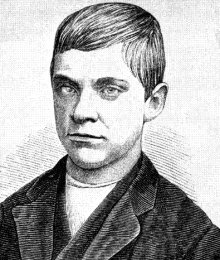

Jesse Pomeroy, young and old.

The doctors noted his lack of remorse or any sympathy for his victims. They believed Jesse would always be dangerous to society. His attorney argued that he should be found not guilty by reason of insanity and then locked away in a mental institution for good.

In the end, the jury convicted him of first-degree murder, for which the mandatory penalty was hanging. However, they issued a recommendation of mercy on account of his youth.

Although juveniles had been executed in the United States before and would be again, the state of Massachusetts had never hanged a boy of fourteen. On the other hand, Jesse had committed no ordinary crimes. By any standard he was a monster. His case was extremely controversial and the governor, William Gaston, was besieged with petitions both for and against clemency.

Gaston didn’t want to hang Jesse Pomeroy and stalled on the issue for as long as he could. It may well have cost him re-election. But his successor, Alexander Rice, didn’t want to hang Jesse either, campaign promises to the contrary.

So in August 1876, two years after Jesse’s murder conviction, by which time the furor in the press had died down, Rice commuted the now-sixteen-year-old’s sentence to life in prison. But there was a catch: the sentence had to be served in solitary confinement.

He would spend 41 years in a tiny cell, isolated from the world. His mother visited him once a month until her death. The only other people he saw were the guards. He was allowed to exercise alone in the prison yard and was allowed to read books. He wrote some bad poetry. Most of his efforts, however, were concentrated on escape. Schechter records:

Nothing — no amount of time locked in a dungeon, no beatings administered with a brass-tipped cane, no efforts at reinforcing his cell — discouraged Jesse for long. When plates of boiler-iron were bolted to his walls to keep him from digging at the stones, he set to work prying loose the bolts. When the walls were painted with a white preparation that would make even a pin-scratch conspicuous, he turned his attention to the floor, cutting loose one of the heavy boards, then digging at the ground underneath … Over the course of fifty years, virtually everything that fell into his hands became a potential implement of escape … He managed, over the decades, to fashion an amazing assortment of tools: awls, chisels, saws, drills, files, pry bars.

He never even came close to breaching the prison walls and his escape attempts mainly just made him a pain in the prison’s collective ass. Then again, a man needs a hobby.

In 1887, his ninth year in the solitary cell, he caused an explosion that blasted a hole in the ceiling and temporarily blinded him but didn’t get him anywhere. Only in 1912 was he ever able to actually make it out of the cell, something that took three years of work to accomplish — and he was caught within minutes. By then he was fifty-two.

His sentence was relaxed in 1917 and he was allowed into the general population. By then, Jesse’s health was failing, and his crimes were passing out of local memory. New inmates to the prison no longer recognized his name, something that deeply upset him. In 1929, he was transferred to the prison farm at Bridgewater. He took a car to get there, his very first automobile ride, but didn’t he didn’t seem interested in his surroundings. One reporter described him as “a deadened creature gazing with lusterless eyes upon a world that means nothing to him.”

He died at the Bridgewater Prison Farm on September 29, 1932, having spent sixty of his seventy-two years behind bars.

On this day..