1860: Juan Rafael Mora Porras, President of Costa Rica

This date is the sesquicentennial of former Costa Rican president Juan Rafael Mora Porras’s death by firing squad, for attempting to retake that office from his brother-in-law after being ousted in a coup.

In the mid-19th century, coffee was king in Costa Rica — say, wouldn’t you enjoy a refreshing cup right now? — and Juan Rafael Mora was the young country’s wealthy leading exporter of the ground black gold.

Little wonder he held the presidency for most of the 1850s.

(Signal achievement: allied with American tycoon Cornelius Vanderbilt to help drive filibuster William Walker out of neighboring Nicaragua. Unfortunately, Mora’s army returned home bearing something besides the enemy standards: a cholera epidemic that decimated — literally, killed 10% of — the Costa Rican populace.)

In 1859, while making unwelcome sounds about a national bank not controlled by the coffee barons, Mora was overthrown by another coffee baron — Jose Maria Montealegre.

Rather than leave well enough alone, Mora regrouped in exile and launched an 1860 bid to regain power.

While Juan Rafael Mora was introduced to a firing squad for his trouble, one of his party who was spared that indignity was Mora’s nephew Manuel Arguello Mora, a future novelist and Costa Rican Supreme Court justice.

On this day..

1669: Roux de Marsilly, employer of the Man in the Iron Mask?

On this date in 1669, a French Huguenot agent was publicly broken on the wheel in Paris.

On the dangerous political chessboard of 17th century Europe, the allegiance of Restoration England — governed once again by a dynasty with known Catholic sympathies — was a great prize for contending Catholic and Protestant powers on the mainland.*

While Charles II of England and the Catholic Louis XIV of France maneuvered towards a secret accord that would lead to devastating war against the Protestant Netherlands, Roux de Marsilly was busy in London trying to enlist England into a Protestant alliance against France.

Finding the avenues blocked, Marsilly retired to Switzerland and was there abducted by French spies who knew what he was up to.

A trumped-up rape charge served that country’s statecraft, and despite an offer by the prisoner to spill some beans in exchange for his life — and then a suicide attempt —

hee wounded himself … for he knew before hee should dye, butt he thought by dismembering himself that the losse of blood would carry him out of the world …

— Roux could not avoid his fate. In fact, out of fear that Marsilly could still succumb to his self-injury, they

sent word … which made his execution be hastened. Saturday about 1 of the clock he was brought on the skaffold before the Chastelet and tied to St. Andrew’s Crosse all which was while he acted the Dying man and scarce stirred, and seemed almost breathless and fainting …

they went to their worke and gave [Marsilly] eleven blows with a barre and laid him on the wheele. He was two houres dying.

(Both quotes above from this correspondence.)

For all those two agonizing hours, Roux de Marsilly really only merits a footnote in a different story.

The Man in the Iron Mask

The mysterious Man in the Iron Mask was first documented in French custody later in the summer of 1669, and he would remain a guest of the Bourbon dungeons until 1703.

The identify of this person — or maybe persons, since it’s been argued that there are multiple threads conflated into the one legend — has never been conclusively established, much to the profit of literature.

One of the stronger contenders for the crownmask, however, is a prisoner named “Eustace Dauger”, who may in fact have been Roux de Marsilly’s former valet, one “Martin”.

The case for Martin-as-Dauger-as-masked-man is made most comprehensively by Andrew Lang in The Valet’s Tragedy and Other Stories.

The hypothesis, roughly outlined, is that England and especially France were trying to tie up the loose ends of whatever plots Marsilly had authored, and got hands on his servant to interrogate him about the highly sensitive machinations he might have been privy to.

Possibly having established that Martin/Eustace had no actual information to betray, he still remained under lock and key out of some admixture of bureaucratic inertia and the remorseless paranoia of the security state. Crazy.

[T]he Man in the Iron Mask (if Dauger were he) may have been as great a mystery to himself as to historical inquirers. He may not have known WHAT he was imprisoned for doing! More important is the probable conclusion that the long and mysterious captivity of Eustache Dauger, and of another perfectly harmless valet and victim, was the mere automatic result of the ‘red tape’ of the old French absolute monarchy. These wretches were caught in the toils of the system, and suffered to no purpose, for no crime. The two men, at least Dauger, were apparently mere supernumeraries in the obscure intrigue of a conspirator known as Roux de Marsilly.

Marsilly was publicly tortured to death in Paris on June 22, 1669. By July 19 his ex-valet, Dauger, had entered on his mysterious term of captivity. How the French got possession of him, whether he yielded to cajolery, or was betrayed by Charles II., is uncertain. … By July 19, at all events, Louvois, the War Minister of Louis XIV., was bidding Saint-Mars, at Pignerol in Piedmont, expect from Dunkirk a prisoner of the very highest importance–a valet! This valet, now called ‘Eustache Dauger,’ can only have been Marsilly’s valet, Martin, who, by one means or another, had been brought from England to Dunkirk. It is hardly conceivable, at least, that when a valet, in England, is ‘wanted’ by the French police on July 1, for political reasons, and when by July 19 they have caught a valet of extreme political importance, the two valets should be two different men. Martin must be Dauger.

* And, of course, for the Catholics and Protestants in England. This struggle would come to a head in due time, to the grief of the Stuarts.

On this day..

1554: Thomas Wyatt the Younger, with the Queen’s life in his hands

On this date in 1554, rebel leader Thomas Wyatt the Younger tied on his own blindfold and laid his head on the block, having declared that not “any other now in your durance [i.e., the Tower] was privy to my rising”.

That remark exculpated the Princess Elizabeth, who just days before had been ominously rowed to the Tower on suspicion of having known of or involved herself in Wyatt‘s abortive revolt.

And Wyatt had had to do more than talk the talk to keep the future Queen Elizabeth I out of the executioner’s way.

Sore afraid that Wyatt’s rebellion had been engineered with the connivance of her Protestant half-sister, the Catholic Queen Mary Tudor had had Wyatt tortured to implicate her.

Wyatt held firm to Elizabeth’s innocence.

Had he not, the princess might have followed her mother to the scaffold, instead of becoming one of the realm’s most illustrious monarchs* — a fraught situation aptly portrayed at the outset of the 1998 Cate Blanchett flick Elizabeth.

It wasn’t only religion that made the political situation in 1550s England so perilous.

Mary Tudor’s marriage to Philip of Spain had roused fears of Spanish political domination. This, much more than theology, triggered the plot that took Thomas Wyatt’s head off his shoulders.

Against this specter of Iberian influence, Wyatt and some fellow-nobles attempted to raise coordinated insurrections in early 1554. Most fizzled or were busted by authorities before they could get going. Wyatt’s alone, in quarrelsome Kent, ignited: he marched 4,000 men on the city of London and for a moment seemed to have a real prospect of capturing it before the crown rallied the city.

A paroxysm of vengeful executions in February 1554 claimed nearly 100 participants in the rebellion, their mutilated bodies demonstratively hung up around town. (It also claimed Lady Jane Grey, the lately defeated rival contender for Mary’s throne, whom the latter now realized was too dangerous to be left alive.)

It could have been uglier, though.

Despite her “Bloody Mary” reputation, the Queen went fairly easy on this dangerous challenge to her authority, making some high-profile examples but paroling most of the rank-and-file traitors in a hearts-and-minds clemency campaign.

The namesake rebel, however, was never going to be in that bunch. He was kept on a bit in the Tower while Mary’s goons “laboured to make Sir Thomas Wyatt confess concerning the Lady Elizabeth … but unsuccessfully, though torture had been applied.”

“Much suspected by me, nothing proved can be, Quoth Elizabeth prisoner”

Having kept his head under torture, Wyatt lost it on this date — and readied Elizabeth’s to wear the crown.


If you find the Elizabethan age worth celebrating, spare an extra thought this date for Thomas Wyatt the Younger’s eponymous old man.**

This Henrician poet is supposed to have been Anne Boleyn‘s last lover before Henry VIII.

In Henry’s snakepit, youthful frolics could come back to bite you; Wyatt the elder was actually imprisoned for adultery with the queen, only ducking the fatal charge thanks to some pull with Thomas Cromwell.

Wyatt pere wrote a melancholy poem about this depressing turn of his fortunes, but considering his times, you’d have to say he was born under a good sign.

A few years later, he was again on the hook for treason, and (Cromwell having been beheaded in the interim) saved by the fortuitous influence of Queen Catherine Howard, who was herself not long before a fall and a chop. (After that, Lady Wyatt, famous for her gallantries, was supposed to be in the running to become King Henry’s sixth wife even though she was still married to Thomas.)

The elder Wyatt managed to die naturally before trying his luck with a third treason charge.

* Many a slip ‘twixt a cup and a lip, but that turn of ill fate for Elizabeth could have set Mary, Queen of Scots on her way to becoming one of England’s most illustrious monarchs, instead of going to the scaffold.

** The illustrious family ties go the other direction, too. Thomas Wyatt the Younger was the grandfather of Francis Wyatt, the first English royal governor of the New World territory named for Queen Elizabeth: Virginia.

On this day..

1938: Arkadi Berdichevsky, Jon Utley’s father

On this date in 1938, Arkadi (or Arcadi) Berdichevsky, a Russian Jew run afoul of the (pre-KGB) NKVD, was executed in the Arctic Circle prison town of Vorkuta for leading a prisoners’ hunger strike.

Though the powerful whom Stalin purged are well-known to the student of Russian history, Berdichevsky is just one of the countless obscure Soviet citizens who disappeared into the gulag never to emerge again.

Berdichevsky had something most of his fellow-victims did not: an English wife.

Freda Utley and her son Jon Utley — the couple cannily gave the boy his mother’s foreign last name to make it easier to emigrate if it should come to that, as indeed it did — left the USSR and Freda’s communist youth for fame as (paleo)conservative giants.

While young Jon — just two years old when his father was whisked out of their Moscow flat by the spooks — came of age, Freda Utley naturalized as an American and turned against her former ideology with the zeal of the converted.

Berdichevsky’s widow, Freda Utley, published this book in 1940 about her disillusionment with communism. This work and many others by Utley are also available as free pdfs from FredaUtley.com.

She savaged the U.S. government officials who “lost China”, and testified at Sen. Joseph McCarthy’s behest in the latter’s 1950’s red-hunt. (Utley also supplied McCarthy some research. She defended Tailgunner Joe until her death in 1978.)

Along the way, Freda Utley learned the date of her husband’s death, but never the circumstances.

That discovery fell to Jon Utley, who made his own fortune in business and became a conservative activist/intellectual himself, notable for his anti-imperialist position. (Utley writes regularly for antiwar.com, and opposed the recent Iraq blunder.)

In 2004, Jon Utley finally obtained the remarkably detailed records revealing that it was a firing squad rather than cold or malnutrition that took his father’s life. Utley then personally visited the sites of that Calvary in the Komi region of Russia.

Jon Utley gives a video interview about the experience and about his own path as an anti-communist here, but most especially recommended for our purposes is his written account of finding his father: HTML form here; pdf here.

On this day..

1955: Gerald Albert Gallego, like father like son

On this date in 1955, murderer Gerald Albert Gallego became the first client of Mississippi’s new gas chamber.*

It was a botched job, though that didn’t stop Mississippi from retaining the gas chamber into the 1990s.

Gallego coughed, choked, and wheezed on a less than lethal cloud of cyanide poisoning. Finally, after some forty-five minutes while officials feverishly worked to correct the problem, the repairs were completed and Gallego quickly died. An additional step was then added to the required testing of the chamber prior to an execution: an animal, usually a rabbit, would be placed in a cage in the chamber chair and cyanide gas was released to make sure the mixture was sufficiently lethal.

Gallego killed a cop, then engineered a prison break out of death row by giving a guard a faceful of acid and a fatal beating.

But if you think he was bad, get a load of his son.

The younger Gerald Gallego drew two gas chamber sentences of his own, in California and Nevada, for a far more diabolical crime spree (though he ultimately died in prison, not at the hands of an executioner).

The son’s story is the subject of The Sex Slave Murders: The Horrifying True Story of America’s First Husband-and-Wife Serial Killers, whose author gave an interview to indefatigable true-crime blogger Laura James here.

Despite the familial resemblance in lawbreaking, the father and son never met in this life.

According to The Sex Slave Murders, a prison conversion gave Gallego pere a care for his next life, and on his last walk this day to the gas chamber, he handed the Mississippi sheriff a note that read in part,

Sheriff, if at any time you should have young men in your jail, please tell them that I was once like them, and should they continue, there is no reward but hardships and grief for their parents.

* Mississippi’s gas chamber replaced the electric chair.

On this day..

1535: Etienne de la Forge, John Calvin’s friend

On this date in 1535, as a 25-year-old religious dissident named John Calvin fled Paris, the merchant who had hosted his circle’s Protestant salons was reduced to ashes in Paris.

Though France would ultimately remain Catholic, the Protestant Reformation found rich soil and enjoyed a measure of early official tolerance for reasons of statecraft.

But a sharp crackdown was provoked when Protestants engineered the placement of anti-Catholic posters in several towns during a single night in October 1534 — the so-called Affair of the Placards.

This spelled the end of the circle of dissidents who met at the Rue Saint-Martin.* Young Calvin high-tailed it out of town — a period of wandering and living incognito that would wash him up on the shores of Lake Geneva — but the owner of that Rue Saint-Martin house, Etienne de la Forge (aka Stephanus Forgeus) was denounced to the authorities.

The date for this execution comes from The Century of the Renaissance, a public domain book available free from Google. It’s also backed in the roster of execution dates from Michelet’s Histoire de France. This looks to me as if it comes from primary documentation, but Feb. 15 is sometimes also reported.

* Calvin apparently had an appointment during this period in Paris to meet a scholar he would later execute, Michael Servetus, but the tete-a-tete never came off.

On this day..

1461: Owen Tudor, sire of sires

A Welsh courtier with the boldness to bed the queen lost his head this date in 1461 … but his career in usurpation was just getting started.

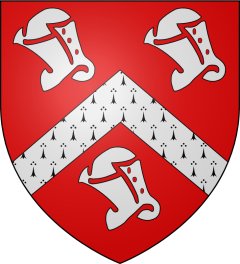
Owen Tudor’s coat of arms.

The House of Tudor that would come to rule England counted Owen its sire; the four-year-old grandson he left at his death grew up to become the first Tudor monarch, Henry VII.

Owen produced the root of this august line with Dowager Queen Catherine of Valois, the French princess Henry V had extracted as part of the price of peace after Agincourt.

That union was supposed to join the two great realms, but Henry V unexpectedly kicked the bucket in 1422, leaving an infant son who was not only unable to hold the French throne … he was too unstable to hold the English throne, either.

Unless he was a seer, suave Owen must not have been thinking dynasties when he took the Queen as his lover (and eventually his wife via a secret marriage in the early 1430s).

They produced six children, but it wasn’t the bedroom politics that did our prolific father in, at least not directly. Only decades later, when ownership of the crown was up for grabs in the War of the Roses and Owen loyally led Lancastrian forces at a battle he was unwise enough to lose, did he give up his head for the pedestrian crime of backing the wrong horse.

Owen reportedly thought he had stature enough to expect a reprieve until the very last moment, when the executioner’s ripping his collar caused him to sigh,

The head which used to lie in Queen Catherine’s lap, would now lie in the executioner’s basket.

In time, Owen’s descendants would get to pull the same trick, because the doomed cause in whose service Owen Tudor lost his life swept clear England’s political chessboard and made possible his own line’s accession.

Elizabethan poet Michael Drayton later versified Owen’s prodigious conquest in “Owen Tudor to Queen Catherine”.

When first mine eyes beheld your princely name,
And found from whence this friendly letter came;
Is in excess of joy, I bad forgot.
Whether I saw it, or I saw it not:

My panting heart doth bid mine eyes proceed,
My dazzled eyes invite my tongue to read,
Which wanting their direction, dully mist it:
My lips, which should have spoke, were dumb, and kist it,

And left the paper in my trembling hand,
When all my senses did amazed stand :
Even as a mother coming to her child,
Which from her presence hath been long exil’d,

With gentle arms his tender neck doth strain,
Now kissing it, now clipping it again;
And yet excessive joy deludes her so,
As still she doubts, if this be hers, or no.

At length, awaken’d from this pleasing dream,
When passion somewhat left to be extreme,
My longing eyes with their fair object meet,
Where ev’ry letter’s pleasing, each word sweet.

It was not Henry’s conquests, nor his court,
That had the power to win me by report;
Nor was his dreadful terrour-striking name,
The cause that I from Wales to England came:

For Christian Rhodes, and our religion’s truth,
To great achievement first had won my youth:
Th’ brave adventure did my valour prove,
Before I e’er knew what it was to love.

Nor came I hither by some poor event,
But by th’ eternal destinies’ consent;
Whose uncomprised wisdom did foresee,
That you in marriage should be link’d to me.

By our great Merlin was it not foretold,
(Amongst his holy prophesies enroll’d)
When first he did of Tndor’s name divine,
That kings and queens should follow in our line?

And that the helm (the Tudors ancient crest)
Should with the golden flow’r-de-luce be drest ?
As that the leek (our country’s! chief renown!)
Should grow with roses in the English crown –

As Charles his daughter, you the lilly wear;
As Henry’s queen, the blushing rose you bear;
By France’s conquest, and by England’s oath,
You are the true-made dowager of both :

Both in your crown, both in your cheek together,
Join Tether’s love to yours, and yours to Tether.
Then cast no future doubts, nor fear no hate,
When it so long hath been fore-told by fate ;

And by the all-disposing doom of Heav’n,
Before our births, we to one bed were giv’n.
No Pallas here, nor Juno is at all,
When I to Venus yield the golden ball:

Nor when the Grecians wonder I enjoy,
None in revenge to kindle fire in Troy.
And have not strange events divin’d to us,
That in our love we should be prosperous ?

When in your presence I was call’d to dance,
In lofty tricks whilst I myself advance,
And in a turn my footing fail’d by hap,
Was’t not my chance to light into your lap ?

Who would not judge it fortune’s greatest grace,
Sith he must fall, to fall in such a place ?
His birth from Heav’n, your Tudor not derives,
Nor stands on tip-toes in superlatives,

Although the envious English do devise
A thousand jests of our hyperbolies;
Nor do I claim that plot by ancient deeds,
Where Phoebus pasture his fire-breathing steeds:

Nor do I boast my god-made grandsire’s scars,
Nor giants trophies in the Titans wars:
Nor feign my birth (your princely ears to please)
By three nights getting, as was Hercules:

Nor do I forge my long descent to rim
From aged Neptune, or the glorious Sun:
And yet in Wales, with them that famous be,
Our learned bards do sing my pedigree

And boast my birth from great Cadwallader,
From old Caer-Septon, in mount Palador:
And from Eneon’s line, the South-Wales king,
By Theodor, the Tudors’ name do bring.

My royal mother’s princely stock began
From her great grandame, fair Gwenellian,
By true descent from Leolin the great,
As well from North-Wales, as fair Powsland’s seal.

Though for our princely genealogy
I do not stand to make apology:
Yet who with judgment’s true impartial eyes,
Shall look from whence our name at did first rise,

Shall find, that fortune is to us in debt
And why not Tudor, as Plantagenet?

Nor that term Croggen, nick name of disgrace
Us’d as a by-word now in ev’ry place,
Shall blot our blood, or wrong a Welshman’s name,
Which was at first begot with England’s shame.

Our valiant swords our right did still maintain,
Against that cruel, proud, usurping Dane,
Buckling besides in many dang’rous fights,
With Norway, Swethens, and with Muscovites;

And kept our native language now thus long,
And to this day yet never chang’d our tungue:
When they which now our nation fain would tame,
Subdu’d, have lost their country and their name.

Nor ever could the Saxons’ swords provoke
Our British necks to hear their servile yoke:
Where Cambria’s pleasant countries bounded be
With swelling Severn, and the holy Dee:

And since great Brutus first arrived, have stood
The only remnant of the Trojan blood.
To every man is not allotted chance,
To boast with Henry, to have conquer’d France:

Yet if my fortune be thus rais’d by thee,
This may presage a further good to me;
And our Saint David, in the Britons’ right,
May join with George, the sainted English knight:

And old Caer-merdin, Merlin’s famous town,
Not scorn’d by London, though of such renown.

Ah, would to God that hour my hopes attend,
Were with my wish brought to desired end !
Blame me not, madam, though I thus desire,
Many there be, that after you inquire;

Till now your beauty in night’s bosom slept,
What eye durst stir, where awful Henry kept ?
Who durst attempt to sail but near the bay,
Where that all-conqu’ring great, Alcides lay ?

Your beauty now is set a royal prize,
And kings repair to cheapen merchandise.
If you but walk to take the breathing air,
Orithia makes me that I Boreas fear:

If to the fire, Jove once in light’ning came.
And fair Egina makes me fear the flame:
If in the Sun, then sad suspicion dreams
Phoebus should spread Lucothoe in his beams:

If in a fountain you do cool your blood,
Neptune, I fear, which once came in a flood:
If with your maids, I dread Apollo’s rape,
Who cous’ned Chion in an old wife’s shape :

If you do banquet, Bacchus makes me dread,
Who in a grape Erigone did feed :
And if myself your chamber-door should keep,
Yet fear I Hermes coming in a sleep.

Pardon (sweet queen) if I offend in this,
In these delays love most impatient is:
And youth wants pow’r his hot spleen to suppress,
When hope already banquets in excess.

Though Henry’d fame in me you shall not find,
Yet that which better shall content your mind;
But only in the title of a king
Was his advantage, in no other thing:

If in his love more pleasure you did take,
Never let queen trust Briton for my sake.
Yet judge me not from modesty exempt,
That I another Phaeton’s charge attempt;

My mind, that thus your favours dare aspire,
Shows, that ’tis touch’d with a celestial fire:
If I do fault, the more is beauty’s blame,
When she herself is author of the same;

“All men to some one quality incline,”
Only to love is naturally mine.

Thou art by beauty famous, as by birth,
Ordain’d by Heav’n to cheer the drooping Earth :
Add faithful love unto your greater state,
And be alike in all things fortunate.

A king might promise more, I not deny,
But yet (by Heav’n) he lov’d not more than I.
And thus I leave, till time my faith approve,
I cease to write, but never cease to love.

Aficionados of old tyme history novelizations can also kick back with Owen Tudor: An Historical Romance.

On this day..

1818: Abdullah ibn Saud, last ruler of the first Saudi state

On this date in 1818, the last ruler of the first state established by the Al Saud who rule the modern state of Saudi Arabia lost his head to the Ottoman Sultan.

The Ottoman state and its (largely independent) vassal Egypt begged to dispute the Wahhabi tribe’s authority in the Arabian peninsula (and its proclivity for raiding Ottoman caravans) and made war on the House of Saud throughout the 1810’s.

The Battle of ad-Dir’iyah in 1818 settled the matter, with our day’s principal Abdullah I surrendering to the Egyptian general Ibrahim Pasha.

We pick up the action from the third-hand, well-after-the-fact reports of the London Times. This, printed on Jan. 16 1819 under the “German Papers” heading:

FROM THE TURKISH FRONTIERS, DEC. 16.

The last victory over the Wechabites puts an end to the war at once. Ibrahim Pacha, who commanded the Turkish army, sends the captive Abdallah to Constantinople, but he first had his head shaved, and all his teeth pulled out.

On Feb. 6, the Times channeled the Dutch and Flanders mail:

Intelligence from Constantinople, dated the 24th December, states, that the Chief of the Wechabites, Abdallah, and his Iman, were brought prisoners into that capital on the 16th of the same month. After being led, in chains, through the principal streets, they were taken to prison and put to the torture. On the following morning, they were brought before the Sultan and beheaded. Their naked bodies were exposed during three days, and then delivered to the populace.

In addition to Abdullah himself, this affair finished off the city of Diriyah as a Saudi capital.

But of course, the Saud and their state were just getting started.

On this day..

1941: Olga Kameneva, Christian Rakovsky, Maria Spiridonova and many others by the NKVD

On this date in 1941, as Nazi armies surged into the USSR, the Soviet NKVD summarily executed a reported 157 prisoners held in the soon-to-be-Nazi-occupied city of Oryol (Orel).


Kameneva (top), Rakovsky (middle) and Spiridonova.

Most prominent among them were:

  • Olga Kameneva, a pol in the 1920’s, she was the sister of recently-murdered Communist heretic/Stalin gadfly Leon Trotsky, and she was the widow of executed Old Bolshevik Lev Kamenev.
  • Christian Rakovsky, internationalist Bulgarian revolutionary turned Soviet diplomat. Rakovsky, Dmitry Pletnyov and Sergei Bessonov had been the only three to avoid execution at the Trial of the 21, one of Stalin’s red-letter purges. But all three were shot together this day.
  • Prominent Left SR Maria Spiridonova, a revolutionary who had taken four decades of beatings from tsarist and Bolshevik alike, and who Emma Goldman saluted as “one of the most sincere, well-poised, and convincing” opponents of the Soviet regime.

Many other political transgressors less memorable than these went along with them, leftover targets of opportunity from a generation’s internecine purges and counterpurges.

Why bother to spend the resources evacuating an enemy of the people? By this time, Operation Barbarossa was nearly three months old, and mass prisoner executions ahead of the advancing Germans were a practiced art. One difference this day: this hecatomb was not in the western Soviet Republics, but in Russia proper.

In the autumn of 1941, the Left SRs Spiridonov, Izmailovich, and Mayorov, the Maximalist Nestroyev, and the SR Timofeyev were among the 157 prisoners shot in the Medvedevsky woods. (A Century of Violence in Soviet Russia

As many of them might have been denounced as “fascist” in their time for not hewing the correct revolutionary line, one doubts they would have enjoyed any more comfortable treatment at the hands of the Wehrmacht, which overran Oryol on Oct. 3.

On this day..

1626: Henri Talleyrand, Comte de Chalais

The name Talleyrand is generally synonymous with the famed “Prince of Diplomats” who spanned the Republic, Empire, and Kingdom.

But that Talleyrand — Charles Maurice de Talleyrand-Périgord, multiply French foreign minister, former Bishop of Autun, one-time Prince of Benevento, Ambassador to the United Kingdom — was just one in a long line of the Talleyrand-Perigords (pdf link) who made a name for themselves.

In 1626, Henri de Talleyrand-Périgord, Comte de Chalais, head of wardrobe to King Louis XIII, was one member of that house whose neck was shortened for an offense against the king’s court.

Henri — as he shall be herein known, so as not to confuse him with his many relatives — was the youngest of three children. Born in 1599, he served in the military at the unsuccessful Siege of Montauban in 1621 and 1622. (The defeat (temporarily) preserved Huguenot rights in France.)

In 1623, Henri returned from war and married Charlotte de Castille (not to be confused with the modern porn star!). It was not long after that rumors of Castille’s impropriety started making the rounds, as immortalized in Tallemant de Réaux‘s verse, whose rough translation is as follows:

Pontgibault boasts,
On seeing the slit
Of the Countess of Alais
Who likes the strong ballet,
And says hers is more charming
Than the Chalais’.

And that, not so roughly translated, is why Pontgibault received a visit from an irate Henri.

Henri is alleged to have challenged a duel, where he cock-blocked his cuckold — permanently. The European ideals of chivalry yet persisted, so there was some question whether this affair constituted murder, and the trial was the talk of France through the winter of 1623.

It was at this trial that the lines were drawn: Henri was joined in his effort to fight the charges by the Grand Prieur Alexandre de Vêndome, Monseiur Gaston d’Orléans (brother to the king), Jean-Baptiste d’Ornano, Louis de Bourbon (Comte de Soissons), and others.

Henri successfully defended himself, but this did not put the fire back into the marital bed. Instead, Henri’s loins turned toward Marie de Rohan-Montbazon, duchesse de Chevreuse.

Madame de Chevreuse, former lover of Henry Rich (later Earl of Holland), had a string of lovers, and it’s questionable whether Henri was among them. Whether he was or not, she ignited in him a passion that would lead to his execution.

The impetus for this execution was ostensibly a plot to save Gaston d’Orléans, who, by decree of Louis XIII, was to marry Marie de Bourbon, duchesse de Montpensier. The union would bring significant wealth into the family of Louis XIII.

Backed by his First Minister Cardinal Richelieu, the king was insistent. For several years, Richelieu had also been reducing the power of the nobility and consolidating central authority around the king, which was not the way Madame de Chevreuse envisioned the world.

Instead, she sought to install Gaston d’Orléans on the throne, thus advancing her agenda to restore power to the nobility. The forced marriage became a convenient excuse to enact her plan against Richelieu. And her charming way with men made it easy to find participants.

Madame de Chevreuse and d’Ornano were at the heart of the conspiracy, but their reach extended as far as England and Spain. She was also supported by Anne of Austria, who is thought to have played a critical role in organizing the conspirators. At the very least, the collective hope was to make Monseiur abandon Louis XIII’s court and seek an alliance with the Hugenots, who would be sympathetic to a cause against the Catholic Church.

The juicy details of the winter of 1625-1626 are cataloged in H. Noel Williams’ A Fair Conspirator Marie De Rohan, Duchesse De Chevreuse, but a summary version is sufficient here.

At some point, Richelieu caught wind of d’Ornano’s involvement in a conspiracy against the throne; not knowing the extent of the effort, he had d’Ornano detained. Lest their plot be found out, the conspirators encouraged Gaston to initiate a war; this was particularly true of Comte de Soissons, who posted a reward should Monseiur take up arms against his brother.

Gaston hesitated, and a new plan was enacted.

Instead, some of the conspirators would take audience with Richelieu and either detain or kill him, depending on the story. Needless to say, the plan failed, and the conspirators were found out. Chalais tried to lay low while the plot against the king and his minister unfolded, but he did not sufficiently distance himself from Madame de Chevreuse: Gaston was exposed and named names, and Chalais, not well-connected enough to fight the charges against him, was captured at Nantz on July 8.

Henri de Talleyrand-Périgord, Comte de Chalais, was sentenced to death by beheading for lèse-majesté, and on August 19, 1626, he mounted the scaffold at Place de Bouffay in Nantz. In a last, cruel twist, the conspiracy had bought off the town executioner in hopes that, lacking a practitioner of the macabre art, Chalais might be spared. But a replacement had been hastily found: a man himself condemned to death:

The [replacement] was so unskillful that, besides two blows from a Swiss sword, which had been purchased on the spot, he gave him thirty-four with an adze such as carpenters use; and was obliged to turn the body round to finish the severing of the neck, the patient exclaiming up to the twentieth blow: ‘Jesus, Maria et Regina Cali!’

No other conspirators were put to the sword, and Gaston and his brother eventually made up. Richelieu, meanwhile, gained more power and transitioned France from a feudal state to an absolute monarchy under Louis XIII and his successor, Louis XIV. His dealings form the backdrop of The Three Musketeers.

As for Madame de Chevreuse — who also figures in The Three Musketeers, scheming behind the scenes against Richelieu and crushed on by Aramis — she fled to Château d’Dampierre, then was exiled to England, where she fell in with the Duke of Lorraine (and became his mistress); she attempted to organize several more coups against the Red Eminence, but each fell short of the mark.

Madame de Chevreuse eventually ended up in Spain, then moved back to England, then shipped out to Flanders, where she connected once again with the Comte de Soissons and attempted to usurp the throne before it could be passed to Louis XIV. When Richelieu finally passed, she sought to oust his replacement, this time relying on César de Bourbon, duc de Vendôme, who was also involved in the Chalais conspiracy. After this failure, Madame de Chevreuse retired to Gagny.

Elizabeth Stone writes of Madame de Chevreuse in Political Women, “It was not she evidently who made of Buckingham a species of paladin without genius; a brilliant adventurer of Charles IV of Lorraine; of Chalais a hair-brained blunderer, rash enough to commit himself in a conspiracy against Richelieu, on the faith of the faithless Duke d’Orleans; of Châteauneaf, an ambitious statesman, impatient of holding second rank in the Government, without being capable of taking the first.”

Be that as it may, she is a compelling historical figure, and the Chalais conspiracy formed the basis for the operatic tragedy Maria di Rohan.

The conspiracy has also been used in an unusual modern form as an audio drama episode of Doctor Who.

(A complete discussion of Talleyrand-Périgord’s life can be found here. (French link) Breathless French court gossip in a 19th century biography of Chevreuse here.)

On this day..