1851: Col. William Logan Crittenden, nephew of the Attorney General

“An American kneels only to his God, and always faces his enemy,”* declared William Logan Crittenden, refusing to kneel before his executioners in Havana this date in 1851.
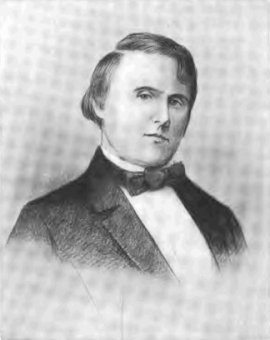
This well-bred** Kentuckian veteran of the Mexican-American War ditched a New Orleans customs-house gig when Narciso Lopez formed a private filibustering expedition to try to steal Cuba from the Spanish.

Placed at the head of one of Lopez’s three battalions, Crittenden’s force was cut off and overwhelmed by the Spanish. (The detailed progress of the campaign is described here.)

He and 50 of his command captured with him were all ordered for immediate execution, six at a time, as pirates, with just a few hours’ allowance to take down official statements and scribble their hasty goodbyes. With “not the heart to write to any of my family,” Crittenden sent one to a friend giving his farewells … then, just before the end, dashed off another addressed to the Attorney General of the United States — his uncle, John J. Crittenden.†

Dear Uncle: In a few moments some fifty of us will be shot. We came with Lopez. You will do me the justice to believe that my motive was a good one. I was deceived by Lopez — he, as well as the public press,‡ assured me tat the island was in a state of prosperous revolution.

I am commanded to finish writing at once.

Your nephew,
W.L. Crittenden

I will die like a man

(Some other affecting last letters from Crittenden’s party can be perused here.)

All this scene, including a post-mortem mutilation by the enraged mob of onlookers, became a bloody banner for U.S. Southerners — since expanding the slave power was core to the entire filibustering project.

When word of the shootings reached New Orleans, a crowd sacked the Spanish consulate.

But in the international relations game, the U.S. had disavowed filibustering and its raiders enjoyed no special diplomatic protection. When a number of the later prisoners were returned in chains to Spain, the Millard Fillmore administration asked their release, but had no grounds to demand it. It was a touchy diplomatic situation … one that our late Crittenden’s uncle, as a member of cabinet, was right in the middle of.

Fillmore eventually secured the captives’ release, atoning the insult to the European power’s agents by causing the Spanish colors to be saluted in New Orleans in honor of the birth of the Infanta Isabella.

All this mincing instead of brawling struck a certain variety of hothead as distinctly unmanful.

Our flag has been wantonly insulted in the Caribbean sea … captured citizens of our country [were] sent in a slave ship to the coast of Spain, fettered, according to the custom of that inhuman traffic, and released, not as an acknowledgement of wrong on demand of our government, but as a gracious boon accorded to a friendly suit … Whilst the dying words of Crittenden yet rung in the American ear, and the heart turned sickening away from the mutilated remains of his liberty-loving followers; whilst public indignation yet swelled at the torture which had been inflicted on our captive countrymen, even then we were called upon to witness a further manifestation of the truckling spirit of the administration …

Jefferson Davis (yes, that one)

* An alternative version has Crittenden declaring that Kentuckians kneel only to their God.

** According to this public domain book (pdf; it’s also on Google books) of the Lopez expedition, William Crittenden’s cousin George Bibb Crittenden — eventually a Confederate general — was among the Texan filibusters to survive the Black Bean Lottery.

William Crittenden’s brother Thomas Theodore Crittenden fought on the Union side of the Civil War, and became Governor of Missouri in 1881. He’s noteworthy for having issued the bounty on outlaw Jesse James that led to the latter’s assassination by Robert Ford.

† Family in the president’s cabinet was just no guarantee of preferential treatment, abroad or at home; just a few years before, a son of the sitting Secretary of War had been hanged at sea for mutiny.

‡ The Spanish press likewise excoriated American yellow journalism in terms that no few present-day scribes would also deserve.

New Orleans papers, there is your work! There is the result of your diragations, of your iniquitous falsehoods, of your placards with large black letters, and your detestable extras … This blood must flow, drop by drop, upon your heads — this blood will torment you in your sleep, for they have lost their lives when you were in security in your houses.

On this day..

1798: Henry Joy McCracken

On this date in 1798, Henry Joy McCracken was hanged by the British for that year’s Irish Rebellion.

The Belfast Presbyterian and cotton trader co-founded the republican Society of United Irishmen in 1791, and spent that revolutionary decade trafficking in ideas that the British crown did not approve at all.

He got busted in 1796 for his radical politics, but ill health prompted his release from prison shortly before the misfortunately ill-organized rising.

McCracken led an attack on Antrim — he dated his call to arms with a French Revolution-esque calendar reboot, “the first year of liberty” — but lost the fight and was captured a few weeks later.

He spurned offers of clemency in exchange for informing on his comrades and was parted at the gallows from his sister, Mary Ann McCracken — herself one of Ireland’s best renowned social reform activists. (She lived to the ripe old age of 96, a furious anti-slavery activist to the end.)

Say what you will about those Irish Republican revolutionaries, they know how to commemorate a body in song:

On this day..

1876: Kenneth Brown, father of Edith Cowan

Australian liberal campaigner Edith Cowan — a notable suffragist, and later an activist for disadvantaged children — enjoys the distinction of being her country’s first female Member of Parliament.

But Cowan was disadvantaged herself in her own childhood by the hanging on this date in 1876 of her father, explorer Kenneth Brown.

While Kenneth entered this world in England, his family emigrated to Australia in his infancy, and there established the pastoral outpost Glengarry Station.

Is this sufficient to justify a wholly unrelated excerpt from Glengarry Glen Ross? Reader, it is.

Kenneth Brown would come to spend a lot of time at that station, in between jaunts exploring Western Australia. Edith Cowan — nee Edith Brown, obviously — was born there, though her mother (Brown’s first wife) died in childbirth a few years later.

Brown’s remarriage to Mary Tindall was less than an unqualified success.

He and Mary regularly argued about both Kenneth’s drinking, and his suspicion that Mary was unfaithful. After an afternoon of drinking and arguing, Kenneth shot and killed Mary. There were three trials and two juries were discharged before a third reached a guilty verdict, all amid embarrassing publicity and gossip. Brown’s appeal for clemency was denied and in 1876, when Edith was 15, he was executed for his wife’s murder. More than 100 years later, Edith Cowan’s grandson wrote that the effect on the family was crippling, and extended on into later generations. (Source)

Even “crippled” by the family tragedy, Edith went on to earn the Order of the British Empire and grace Australia’s $50 note.

Edith Cowan isn’t the only notable family connection for this date’s featured act: Kenneth Brown’s younger brother was politician Maitland Brown, infamous to Australia’s aboriginals as the leader of the La Grange expedition/massacre.

On this day..

1982: Khalid Islambouli and the assassins of Anwar Sadat

With Egyptian President Hosni Mubarak’s recent unwilling separation from power, we remember today how he got into power in the first place — for this was the execution date in 1982 for the assassins of his predecessor, Anwar Sadat.

Here’s some raw-er footage:

The murdered president inherited the office from the first name in pan-Arab nationalism, Gamal Abdel Nasser.

Sadat led Egypt through the turbulent 1970s, fighting a war against Israel and then making peace with its Jewish neighbor to regain the Sinai, and generally proving himself more adept at the job than many had assumed.

But the secular dictatorship was increasingly afflicted by that then-emerging, now-familiar specter, Islamic fundamentalism — specifically aggrieved by those Camp David Accords, but also confronting Sadat’s neoliberal economic realignment and political disaffection.

Khalid Islambouli, the man who actually got Sadat, was a 26-year-old officer with an illicit affiliation to the Egyptian Islamic Jihad.

At an October 6, 1981 military parade, Islambouli led an orchestrated hit, leaping from military vehicles to bombard the presidential dais with grenades and automatic weapon fire.

Sadat was dead before he reached the hospital, and his office assumed by his vice president — Hosni Mubarak.

Unsurprisingly, he played rough with the assassins.

A military tribunal ultimately convicted 22 people of participating in the plot, sentencing five to death. While the state press was obviously supportive of the verdict,

Many Egyptians interviewed by Reuters considered the death sentences fair. “It is up to President Mubarak now to show his people that terrorism is unacceptable in Egypt by approving the sentences”, a shopkeeper said.*

And Mubarak did … albeit carefully.

Five self-proclaimed Muslim fundamentalists convicted of assassinating President Sadat of Egypt were executed at dawn today hours after their plea for mercy had been rejected by President Mubarak.

The two assassins who had been in the Army were executed by firing squad and the others, civilians, were hanged at a remote military base outside Cairo …

News of the executions was carried briefly on Cairo radio, then dropped from subsequent broadcasts. The evening newspaper did the same, an indication that the authorities may be sensitive to possible public reaction, Muslim fundamentalism being widespread in all the Egyptian universities.**

The precaution was, perhaps, well-taken.

Muslim fundamentalism would gain steam in Egypt during the years ahead, drawing a severe state response.

Islambouli’s younger brother Showqi almost accomplished an all-in-the-family twin killing by coming within a whisker’s breadth of assassinating Mubarak in 1995. The family name is still honored in the breach by other Muslim militants: there’s an “al-Islambouli Brigades of al-Qaeda” in Pakistan and an “al-Islambouli Brigades” in Chechnya.

* London Times, March 8, 1982

** London Times, April 16, 1982 (under an April 15 dateline)

On this day..

1872: Yoarashi Okinu, geisha

On this date in 1872, geisha Yoarashi (“Night Storm”) Okinu was beheaded at Tokyo’s Kozukappara execution grounds after killing her lover to run away with a kabuki actor.

A notorious dokufu, so-called “poison-women” that captivated that country in the late 19th century, Night Storm (English Wikipedia entry | Japanese) was of humble origins but became a sought-after geisha in Edo.

Her celebrity affairs are treated here (reliability: unknown), but the reason she’s in this here blog is poisoning off the second-last of them with arsenic in order to get free to run off with kabuki actor Arashi Rikaku.

Rikaku himself was up to his eyeballs in this same plot, and was arrested — our source says, during a kabuki performance! — and initially condemned to death. Since Okinu was pregnant, however, her execution was put off pending childbirth; eventually, Rikaku’s sentence was moderated from capital punishment altogether.

Okinu’s head was cut off, and displayed in public for several days. Her lover served three years in prison, then rebuilt his kabuki career as Ichikawa Gonjuro.

* The date was the “20th day of the 2nd month of the fifth year of Meiji”, using Japan’s system of dating years from the start of the current emperor’s reign. Helpful in nailing down the date: Tokyo’s first daily newspaper published its first issue on the very next day.

On this day..

1716: Lords Kenmure and Derwentwater but not Lord Nithsdale

This date in 1716 saw the beheading of two Jacobite lords, but it was more famous for the third who ducked the executioner in one of the Tower of London’s greatest escapes.

Lord Nithsdale, Escape from the Tower by Emily Mary Osborn(e)

Three were doomed to the block this date:

They were the fruit of Parliament’s impeachment of Jacobite leaders. Six of these fellows threw themselves upon the mercy of the Commons, and were rewarded with a death sentence by William Cowper. Only half managed to wrangle mercy from the crown.

On the eve of this date’s execution, Lord Nithsdale received a visitation of his wife, Winifred … who helped him swap clothes with one of her maids, in which garb he audaciously marched out the Tower gates in the train of his spouse.

The king whom Nithsdale had purposed to dethrone was a good sport about it. “It was the best thing a man in his condition could have done,” he declared.

The fugitives managed to cross the channel — that required another bit of dress-up, in the livery of the Venetian ambassador — and absconded to Rome. William Maxwell, Lord Nithsdale, outlived his appointment with the headsman by 28 years.

They are gone — who shall follow? — their ship’s on the brine,
And they sail unpursued to a far friendly shore,
Where love and content at their hearth may entwine,
And the warfare of kingdoms divide them no more.

“The Dream of Lord Nithsdale”

A letter detailing the escape from the pen of the intrepid Lady Nithsdale herself is well worth the read.

Her reputation as a romantic heroine (only enhanced by the romantic futility of the Jacobite struggle itself) has lent itself to all manner of literary expropriation, like this 19th century historical novel.

All very well for these two lovebirds. But the remaining 67% of the day’s scaffold carrion did not escape the Tower in women’s clothing, or men’s, and paid with their heads as scheduled.

Derwentwater went out with a peevish scaffold a ballad, “Lord Derwentwater” (or “Lord Allenwater”, or several similar variants), and another aptly titled “Derwentwater’s Farewell”.

His partner at the chop, Lord Kenmure,** also made the folk playlist in “O Kenmure’s On And Awa, Willie”, one of the ditties gathered by Robert Burns.

Having beheld all these various exemplars, Derwentwater’s brother and fellow Stuart supporter Charles Radclyffe decided to emulate them all.

Later that same year, Charles Radclyffe also made a successful prison break and got to the continent.

As a result, he was still around to participate in the 1745 Jacobite rising … and finally get executed for that.

(All part of God’s mystical plan for Radclyffe: look sharp and you’ll find him succeeding Isaac Newton as CEO of the legendary Holy Grail-keeping secret society Priory of Sion in Holy Blood, Holy Grail and its pulp novel knockoff The Da Vinci Code.)

* It’s impossible not to notice that this cross-dressing escape foreshadows that of Bonnie Prince Charlie when the Jacobite cause flamed out for good thirty years later.

** And like Lord Nithsdale, he was also blessed with a perspicacious wife — albeit one who wasn’t able to extricate him from the Tower.

On this day..

1945: Carl Goerdeler, as penance for the German people

On this date in 1945, Carl Friedrich Goerdeler, godfather of the anti-Hitler resistance that had bid unsuccessfully for his assassination, was hanged at Plotzensee Prison. With him went fellow regime foes, Johannes Popitz and Father Alfred Delp.

The monarchist pol Goerdeler enjoys pride of place as one of the first German elites to opposite Hitler, though that opposition was not quite so early as the very beginning. Goerdeler was a creature of the pre-Nazi establishment, and shared many of perspectives that prepared that world to accommodate national socialism: Goerdeler bitterly opposed the Versailles Treaty, wanted to take a bite out of Polish territory, and had the customary strictly-within-legal-bounds anti-Semitism of his class. Even lying under sentence of death late in 1944, having denounced the Holocaust to his Gestapo interrogators, his “Thoughts of a Condemned Man” reflected,

We should not attempt to minimize what has been happening, but we should also emphasize the great guilt of the Jews, who had invaded our public life in ways that lacked all customary restraint.

A German patriot, then, committed to a “a purified Germany with a government of decent people”; a humanist Liberal from a bygone age, who had no weapons to fight a terror state.

As Mayor of Leipzig, he openly opposed the Third Reich’s excesses and pushed to moderate its policy.* In 1937 he copped a principled resignation and started cultivating contacts abroad, warning of Hitler’s aggression — also managing to impress his foreign interlocutors with his incapacity to affect events himself. His many memoranda urging Hitler to moderate this or that outrage went for naught.

The resistance circle around Goerdeler, which drew in his fellow-sufferer Popitz,** would be marked throughout the war years by that incapacity — a monument to high-minded failure, eternally short of the last ounce of will or that one key resource.

Goerdeler’s name adorned the ministry of many a fanciful post-Hitler government, but he himself, according to his friend and fellow-conspirator Gerhard Ritter, “preferred to begin with a debate rather than a power stroke”.

To be sure, the man looked in vain for some decisive form of aid: within the Reich, the sympathetic Wehrmacht brass couldn’t quite see their way to something as radical as breaking their loyalty oaths; without, he got no terms short of unconditional surrender from the Allies.

But even come the summer of 1944 when all was well past lost, Goerdeler entertained delusions of persuading Hitler to give up power voluntarily, and opposed Stauffenberg‘s assassination gambit.

Indecision would be no defense when he was hailed before bloodthirsty judge Roland Freisler for treason.

Goerdeler and Popitz, both viewed as influential with Germany’s Western enemies, were kept alive for months after the judicial purges commenced: Himmler‘s hope for a back channel deal. Our man had many hours in this Gethsemane for that essential contemplation of the 20th century.

In sleepless nights I have asked myself whether a God exists who shares in the personal fate of men. It is becoming hard to believe it. For this God must for years now have allowed rivers of blood and suffering, mountains of horror and despair for mankind … He must have let millions of decent men die and suffer without moving a finger.

-Carl Goerdeler (Source)

We do not know what account Goerdeler gave of himself to the afterlife; even the account he left of himself for our terrestrial posterity is disputable.

“I ask the world to accept our martyrdom as penance for the German people,” he wrote in prison. Is it enough to accept for Goerdeler himself? His actions, intrepid by the standards of most countrymen, were fatally unequal to the heroism demanded of his circumstance. By any measure, his is a very human tragedy.

Carl Goerdeler’s brother Fritz shared the same fate a few weeks later. Other family members were imprisoned at Dachau; Carl’s son, Reinhard Goerdeler, became an accountant after the war and is the “G” in the big four firm KPMG.

* Including Berlin’s heretically expansionary economic policy. Goerdeler hated Keynes; his prescription for the capitalist crisis of the 1930s was falling wages, low deficits, a mighty Reichsmark, and free trade. (The April 1938 Foreign Affairs published a Goerdeler essay entitled “Do Government Price Controls Work?” Answer: no.)

It would be too much to say that Berlin’s profligacy outraged him as much as the fact that it was being squandered on dishonorable war, but said profligacy was definitely on the bill of attainder.

** Father Delp, the other man hanged this date, was involved in the resistance but even Freisler’s court decided he wasn’t in on the July 20 plot.

On this day..

1936: Aberra Kassa and Asfawossen Kassa, Ethiopian royalty

On this date in 1936, Italian forces consolidating control of occupied Ethiopia mopped up a couple of royal relatives who had resisted a bit too long.

Brothers Aberra Kassa and Asfawossen Kassa had briefly become, with the flight to exile of their ally Haile Selassie, symbolic leaders of Ethiopia’s domestic resistance to Mussolini’s imperialism.

Along with another brother, these sons of Ras Kassa mounted an abortive July 1936 attack on Addis Ababa, precipitating a furious Italian response.

The rebels were hunted to their retreat: the other brother was caught in a cave and summarily executed, which must have been at the back of Aberra and Asfawossen’s mind when they surrendered under a pledge of safe conduct.

‘Now I tell you to surrender’, wrote Graziani, ‘and I assure you nothing will happen to you. Why do you want to die uselessly?’

Only his cousins had remained with Dejaz Aberra: Mesfin Sileshi and the two younger men, Lij Merid Mangasha and Lij Abiye Abebe. They suspected Italian treachery. ‘If you want to be killed’, said Mesfin, ‘shall I kill you?’ …

The exact sequence of the events that followed is difficult to disentangle … Aberra and Asfawossen finally decided to submit. Aberra however sent his wife and baby son away with Mesfin and the two cousins, a last-minute concession to their pleas and threats.

A letter was sent up to General [Ruggero] Tracchia who had now occupied Fikke:

“To General Tracchia

“As you have assured me in your letter ot me that our lives will be spared, we shall assemble our armies and receive you by peaceful parade in a place called Bidigon.

“Aberra Kassa”

Ras Hailu in person led Aberra and Asfawossen to General Tracchia’s camp. While they were in the tent drinking coffee with the General, the men of their escort were disarmed, apparently without difficulty, and taken away (they were released the next morning). A group or carabinieri entered the tent and arrested the two brothers. It was 21 December, three days after Ras Imru had surrendered. At 7 p.m. the men in the escort heard a volley of shots in the centre of the town.

Tracchia sent a laconic cable to Graziani: ‘Dejaz Aberra and brother shot dusk in piazza of Fikke’. Graziani sent a cable to Lessona (Italian link) repeating Tracchia’s message and adding ‘Situation Salale liquidated’.

This reference to the Salale or Selale branch of the Ethiopian royal family was not entirely correct, however.

Not liquidated was the youngest brother, Asrate Kassa, who had escaped to exile and would return with Haile Selassie’s post-Mussolini government. Asrate ultimately qualified for these dolorous pages himself, however, as one of the victims of the 1974 Derg purge.

Of more immediate concern for Graziani and his ilk: Abera Kassa’s widow Kebedech Seyoum (French link) legendarily rose from childbirth after learning of her husband’s execution to become one of the Ethiopian resistance’s greatest military leaders. She’s a national hero in Ethiopia … and there’s also a Laboratorio Femminista Kebedech Seyoum in Rome, dedicated to the study of ant-fascist women.

On this day..

1209: The Oxford clerks

On an uncertain date speculatively identified with December 6, in either 1208 or (more usually attributed) 1209, the near-riotous townspeople of Oxford hanged two or three student “clerks” at that settlement’s famous university.

About this time, a certain clerk engaged in the liberal arts at Oxford killed a certain woman by accident and when he found that she was dead he decided to flee.

But when the mayor of the city and many others who had gathered found the dead woman they began to search for the killer in his house which he had rented together with three of his fellow clerks.

Not finding the man accused of the deed they seized his three fellow clerks who said they were wholly ignorant of the murder and threw them into prison; then a few days later they were, by order of the King of the English, in contempt of the rights of the church, taken outside the city and hanged.

When the deed had been done, both masters and pupils, to the number of three thousand clerks, left Oxford so that not one remained out of the whole university; they left Oxford empty, some engaging in liberal studies at Cambridge and some at Reading.

The Flowers of History, as translated for the Beeb

This ugly affair rooted in the ancient conflict between university and town caused much of the ancient academy‘s student population to flee town — some proceeding to found Oxford’s rival institution Cambridge. (This pdf short story on the Cambridge site dramatizes events.)

The conflict between the town and university at Oxford over this bloodletting persisted until 1214 when a Papal legate settled the dispute in favor of the university.

The authors of the hanging were required to carry the bodies to an honorable resting place, and the town was required to host a dinner for poor students once every year — on St. Nicholas‘s day, Dec. 6, which on that basis has become associated with the otherwise never-specified date of the unfortunate clerks’ demise.

On this day..

1793: Philippe Egalite, hoisted on his own petard

On this date in 1793, Philippe Egalite was hoisted on his own petard.

To hoist with one’s own petard actually has an older derivation, dating to siege warfare engineers whose primitive bombs, petards, were liable to detonate unexpectedly and gave their makers a “hoist.”

Still, the phrase sounds like something that ought to come right out of the French Revolution, redolent (as are petards themselves: the explosive word is from the French “to fart”) of angry mobs hoisting aristocrats, as was their wont, up on pikestaffs and lampposts and … petards. Whatever those are.

Philippe Egalite — the Duke of Orleans, as he was known for most of his life — was such an aristocrat: in fact he was royalty, the First Prince of the Blood and a cousin to Louis XVI.

And he was the member of the royal house who most vibed on the revolutionary spirit of the times, literally bankrolling the Jacobins before the Revolution. Hilary Mantel* notes that Orleans made the Palais Royal “into a sort of demagogue’s shopping centre — Paris’s most volatile public space, crammed with cafés and bookshops, a gathering place for the disaffected. In July 1789, three days of orchestrated violence began there, and culminated in the taking of the Bastille.”

Now that is a petard.

Philippe’s class-traitor politics obviously exposed him to the wrath of the monarchists — a particular irony since the man’s son Louis-Philippe, was France’s last king from 1830 to 1848 — but as usual in Paris during the Terror, it was the the Revolution devouring its children that did him in.

Despite taking up during the Revolution the very Republican name Egalite by which we know him, and despite Egalite‘s vote in the Convention in favor of guillotining Louis XVI (this is sometimes described with more melodrama than accuracy as the “decisive” vote), and despite his many years’ prior revolutionary sympathy, the Duke of Orleans was rounded up with the rest of the available Bourbons when the French General Dumouriez‘s spring 1793 defection prompted a panicky revolutionary purge in Paris. Philippe’s own son, the future king, had gone over with Dumouriez to the Austrians.

Rosebud

The Duc d’Orleans employed Choderlos de Laclos, author of the notoriously delicious Dangerous Liaisons.

As an individual citizen turned politician turned guillotinee, Egalite doesn’t much stand out in those perilous years: one more vulnerable Convention delegate outmaneuvered by Robespierre et al.

As the Daddy Warbucks of the Rights of Man, however, Egalite was a titanic figure for his contemporaries. Not many held him in high personal esteem, but movements need moneybags, and the Prince of the Blood bankrolled his from the bottomless revenues he earned on estates that would dwarf entire departements.

The Duke of Orleans and those around him, according to George Armstrong Kelly in “The Machine of the Duc D’Orléans and the New Politics” (The Journal of Modern History, Dec. 1979)

invented something novel in the history of French politics: the massive use of wealth, research, and propaganda** for the purpose of forming public opinion and swaying public policy. No doubt there are analogues among the Romans and the eighteenth-century English; but here we are almost reminded of the Rockefellers and Kennedys.

Orleans was accused of generating all this mayhem to make his own bid for the throne; those accusations may even hold a bit of truth. Such machinations remain for the conspiratorial among posterity a shadow-play upon the wall; one is left to guess at their potential dimensions from shreds of evidence and the vying vituperations of various contemporary revolutionary factions.

But if extant, such schemes were fatally compromised by the mediocrity of the figurehead who lost his head this day. Though a revolutionary in his philosophy, he was still a doughy Bourbon scion in his soul, and heir to the many shortcomings that characterized that dynasty in its decadence.

Dissolute in the enjoyment of privilege; irresolute in the conquest of power; blithely rearing wolves to his own destruction. That was some petard.


Philippe Egalite and his onetime lover Grace Elliott are the titular characters of the 2001 Eric Rohmer movie The Lady and the Duke.

* Hilary Mantel is the same author who penned the acclaimed historical novel Wolf Hall, about Thomas Cromwell.

** Kelly claims that Egalite funded Marat.

On this day..