1782: Bartolina Sisa, indigenous rebel

September 5 is International Indigenous Women’s Day, in honor of the torturous execution in Bolivia on this date in 1782 of the Aymara peasant rebel Bartolina Sisa.

Sisa (English Wikipedia entry | Spanish) shared with her husband Tupac Katari leadership of a huge indigenous uprising against the Spanish.

Eighteen months before Bartolina’s execution, she and Tupac Katari — Julian Apasa, to use his given name before he staked out a nom de guerre claiming the inheritance of Tupac Amaru and Tomas Katari — laid La Paz* under siege with an army 40,000 strong. Over the course of that spring summer, the Bolivian capital lost 10,000 souls and teetered on the brink of collapse — actually in two separate three-month sieges with a brief interim between.

Bartolina Sisa was recognized by the rebels as the coequal of her husband; the two took command decisions together in consultation.

As such, when the siege was finally relieved and the natives defeated that October, Sisa was in line to share her husband’s fate. This was easy to effect because she had been betrayed into Spanish hands between the first and second sieges. Her enemies refused Tupac Katari’s every blandishment to exchange her, and in time had the cruel pleasure of forcing her to watch her defeated husband’s butchery. Nearly a year later Sisa tasted a like fate, and her body was thereafter chopped up to display as a warning in various towns to cow potential future native insurgents.

A present-day peasant women’s union bears Sisa’s name, the Bartolina Sisa Confederation; the president of Brazil’s 2006 Constituent Assembly that drafted the country’s current constitution was an indigenous Quechua woman named Silvia Lazarte, who was the Bartolina Sisa Confederation’s former executive secretary.

* The city‘s full original name was Nuestra Señora de La Paz, “Our Lady of Peace”. It was founded in 1548 at the site of a former indigenous village and the “peace” referred to is the restoration of calm after Gonzalo Pizarro‘s rising.

On this day..

1526: 2,000 Hungarian prisoners after the Battle of Mohacs

The Sultan, seated on a golden throne, receives the homage of the viziers and the beys, massacre of 2,000 prisoners, the rain falls in torrents.

-Sultain Suleiman the Magnificent (writing of himself in the third person), diary, 31 August 1526

On this date in 1526, two days after the pivotal Battle of Mohács, the Ottomans executed all their Hungarian captives from that battle.

After the 1490 death of Hungary’s greatest king Matthias Corvinus, the Hungarian kingdom began to crumble. Ottoman incursions ate away at that realm’s Balkan possessions.

Squeezed between two stronger empires, Hungary’s King Lajos II put a ring on the non-Turkish one by marrying a Habsburg princess. Fair enough.

Less successful statecraft was his decision not to cut a deal for peace with the Turks and instead force a decisive confrontation … especially since that battle was a tactical debacle. Eschewing a coy retreat towards nearby friendly forces, the belligerent Hungarian nobles hurled their heavy cavalry straight at the numerically superior Turks, basically duplicating the gameplan that the West’s last Crusaders had used when they got their lances handed to them by the Ottomans a century before at Nicopolis.

And those who did not learn from history were here doomed to repeat it. “The Hungarian nation will have twenty thousand martyrs on the day of the battle, and it would be well to have them canonized by the Pope,” a priest is reported to have said when he heard about the decision. By sundown, the Hungarians were routing in disarray, the wounded Lajos himself falling into the Danube in the disorder and drowning in his heavy armor.


Well, we’re boned. The Battle of Mohacs, by Hungarian painter Mor Than (1856).

“May Allah be merciful to him, and punish those who misled his inexperience,” said Suleiman of his 20-year-old opposite number. “It was not my wish that he should thus be cut off, while he had scarcely tasted the sweets of life and royalty.”

Not so tender were Suleiman’s pities for those 2,000 anonymous prisoners of war … and, for that matter, for anyone in the surrounding countryside unfortunate enough to find him- or herself in the path of the now-unchecked Ottoman force.

The cavalry, knowing no mercy, dispersed into the provinces of the wicked one like a stream overflowing its banks and, with the fiery meteors of its sparkling sabers, burned every home to the ground, sparing not a single one…. The contemptible ones were slain, their goods and families destroyed…. Not a stone of the churches and monasteries remained.

Within the fortnight the Turks were sacking defenseless Buda(pest); they would take it for good in 1541 and hold it for 145 years, pressing the Ottoman frontier deep into Europe. It wouldn’t be a Hungarian polity that recaptured it, but the Habsburg empire into which the Magyar wreckage was subsumed — retaking Buda in 1686 in the counterattack after the failed Ottoman Siege of Vienna.

On this day..

1806: Johann Philipp Palm, press martyr

Gentlemen, you must not mistake me. I admit that the French Emperor is a tyrant. I admit that he is a monster. I admit that he is the sworn foe of our nation, and, if you will, of the whole human race. But, gentlemen, we must be just to our great enemy. We must not forget that he once shot a bookseller.

–Thomas Campbell

Nuremberg bookseller Johann Philipp Palm was shot on this date in 1806 for publishing a manifesto against the French occupation.

For centuries a proud Free Imperial City, Nuremberg had over the few months preceding Palm’s martyrdom been smushed up by the conquering Grande Armee into an amalgamated French client, the Confederation of the Rhine.

This was a huge political shakeup. Even the Empire of which Nuremberg had been a Free Imperial City was no more: the 854-year-old Holy Roman Empire was dissolved in 1806, a casualty of the Battle of Austerlitz. At just 25,000 residents and far removed from its mercantile preeminence of yesteryear,* Nuremberg wasn’t even one of the Confederation of the Rhine’s 16 constituent polities: it had been rolled up into Bavaria, in a partial cleanup of the tiny Kleinstaaten pocking the old German map.

Nuremberg’s prostration in this arrangement mirrored Germany’s as a whole vis-a-vis the Corsican. Napoleon was the official “protector” of the Confederation of the Rhine, and its end of the protection racket entailed shipping conscripts to the French army.

The Confederation of the Rhine ultimately included four kingdoms, five grand duchies, 13 duchies, 17 principalities, and the Free Hansa towns of Hamburg, Lübeck, and Bremen, and covered much of the territory of present-day Germany (sans Prussia). For some odd reason, Germans whose dreams of national unification were beginning to stir weren’t too enthusiastic about having it marshaled by France.

In July of 1806, Palm gave voice to the sentiment by publishing a 144-page treatise, Germany in its Deep Humiliation. (It’s available online in an 1877 printing at archive.org.) The identity of the seditious author(s) he resolutely kept secret, but it’s commonly attributed now to Count Friedrich Julius Heinrich von Soden.

Palm had the fortune or sense to be safely away in Prussia by the time irate Frenchmen raided his shop, but was caught after he boldly slipped back into the city against all sensible advice. He was transferred to a fortress at Braunau am Inn, and shot there.

His death made him an early national martyr (“involuntary hero”, in the words of a 2006 Braunau bicentennial remembrance), and his name is still preserved on a variety of streets in German cities. In Palm’s native Schorndorf, the Palm Pharmacy building sports plaques honoring the martyr. And a Palm Foundation awards, every two years, a Johann Philipp Palm Prize journalism prize. It’s announced on this date, each even-numbered year. (Update: Salijon Abdurakhmanov of Uzbekistan and Nazikha Saeed of Bahrain received the 2014 Palm awards.)

A publishing house, Palm und Enke, actually founded post-Napoleon by the uncle under whom our Johann Palm completed his apprenticeship, still exists today. (It is no longer in the control of any Palm relative, however.)

Braunau am Inn, now a charming little burg of 16,000 just over the border into Austria, is probably best recognized in the wider world these days as the birthplace of Adolf Hitler … and it turns out the little future Nazi was deeply stirred by Palm’s model of patriotic sacrifice, albeit less so his model of an independent press. We find out all about Hitler’s admiration of Palm in the very first stanzas of Mein Kampf.

Volume 1: A Reckoning

CHAPTER 1
IN THE HOUSE OF MY PARENTS

Today it seems to me providential that Fate should have chosen Braunau on the Inn as my birthplace. For this little town lies on the boundary between two German states which we of the younger generation at least have made it our life work to reunite by every means at our disposal.

German-Austria must return to the great German mother country, and not because of any economic considerations. No, and again no: even if such a union were unimportant from an economic point of view; yes, even if it were harmful, it must nevertheless take place. One blood demands one Reich. Never will the German nation possess the moral right to engage in colonial politics until, at least, it embraces its own sons within a single state. Only when the Reich borders include the very last German, but can no longer guarantee his daily bread, will the moral right to acquire foreign soil arise from the distress of our own people. Their sword will become our plow, and from the tears of war the daily bread of future generations will grow. And so this little city on the border seems to me the symbol of a great mission. And in another respect as well, it looms as an admonition to the present day. More than a hundred years ago, this insignificant place had the distinction of being immortalized in the annals at least of German history, for it was the scene of a tragic catastrophe which gripped the entire German nation. At the time of our fatherland’s deepest humiliation, Johannes Palm of Nuremberg, burgher, bookseller, uncompromising nationalist and French hater, died there for the Germany which he loved so passionately even in her misfortune. He had stubbornly refused to denounce his accomplices who were in fact his superiors. In thus he resembled Leo Schlageter. And like him, he was denounced to the French by a representative of his government An Augsburg police chief won this unenviable fame, thus furnishing an example for our modern German officials in Herr Severing‘s Reich.

In this little town on the Inn, gilded by the rays of German martyrdom, Bavarian by blood, technically Austrian, lived my parents in the late eighties of the past century; my father a dutiful civil servants my mother giving all her being to the household, and devoted above all to us children in eternal, loving care Little remains in my memory of this period, for after a few years my father had to leave the little border city he had learned to love, moving down the Inn to take a new position in Passau, that is, in Germany proper.

* Back when being the executioner of Nuremberg was a plum assignment.

On this day..

1944: Durga Malla

Seventy years ago today, the British in Delhi hanged Gurkha soldier Durga Malla for spying against them — and on behalf of the army of the Japanese-backed nationalist provisional government, the Azad Hind.

World War II catalyzed India’s long-running national movement and helped lead directly to postwar independence. But during the war itself, it was a delicate relationship with the British Empire that still ruled the Raj.

Activists at the time took different views of how to proceed in wartime. For Gandhi, and this was also the predominant position of his Congress Party, India’s national rights overrode the mother country’s wartime exigencies: India must be free to choose her own part in the affair, as a coequal nation.

Unsurprisingly, London saw it differently. (The Raj sent over two million soldiers into the British ranks in these years.)

This led in August of 1942 to the Quit India movement, an attempted civil disobedience campaign against continued British rule. It was suppressed with difficulty — and with mass detentions, including of Gandhi himself. But hours before the arrest that would land him in British custody for the balance of the war, he delivered his Quit India speech, which warned in part against

hatred towards the British among the people. The people say they are disgusted with their behaviour. The people make no distinction between British imperialism and the British people. To them, the two are one. This hatred would even make them welcome the Japanese. It is most dangerous. It means that they will exchange one slavery for another.

Which brings us to Durga Malla.

For Gandhi himself, there was no question of going so far as to collaborate with Britain’s wartime enemies to force the issue. But not everyone eschewed the “enemy of my enemy” line, and behavior at once treasonable and intensely patriotic has excited controversy from the moment the guns stilled down to the present day. Azad Hind established itself as a government-in-exile in Japanese-occupied Singapore, making plans to invade British India. The fervidly patriotic Durga Malla joined that exile government’s army, and was eventually caught reconnoitering British deployments, then given a military tribunal and hanged. His last words on the gallows affirmed his purpose, and would be vindicated with the passage of just a few years.

“I am sacrificing my life for the freedom of my motherland … The Sacrifice I am offering shall not go in vain. India shall be free. I am confident, this is only a matter of time.”

There are public monuments in present-day India to Durga Malla.

On this day..

1714: Constantine Brancoveanu and his sons

Three centuries ago today, Wallachian prince Constantine Brancoveanu was beheaded in Istanbul with his four sons.

Brancoveanu (English Wikipedia entry | Romanian) had fallen foul of the Sublime Porte, which dominated Wallachia, by dallying with the Ottomans’ European rivals, the Habsburgs and the Russians.

During the then-current installment the oft-renewed Russo-Turkish War derby, he actually massed armies for a potential swing all the way to the anti-Ottoman team. Breaking those up and returning Peter the Great’s gifts after the Russian clock got cleaned did not a tribute of loyalty make in the eyes of Turkey.

Not only Contantine but his entirely family — wife, four sons, and six daughters — were carried thereafter to Istanbul prisons. On the Feast Day of the Blessed Virgin, in the presence of the Sultan himself and of Christian diplomats who would be sure to put the word out, his four sons Constantine, Stefan, Radu and Matei were beheaded in his presence, as was the Wallachian treasurer Enache Vacarescu. The 60-year-old prince exhorted them as they endured their martyrdoms to remain steadfast, until at last he too lost his head. (Istanbul Christians managed to give the bodies honorable burials after fishing them out of the Bosphorus. The remains were later translated to Bucharest.*)

Most of the web sites about Branacoveanu and family are in Romanian; he was in his quarter-century reign a great cultural patron. The first Romanian Bible was completed in his time, and he undertook a great building program whose distinctive architectural stile still bears his name — Brancovenesc.

The Romanian Orthodox church conferred upon the martyred family the laurels of sainthood in 1992, a fine time to honor Romanian independence from foreign domination although of course by that time the Ottomans were yesteryear’s news and the outside heavy in question was the Russians.


Brancoveanu and his sons, from a mural at a monastery Brancoveanu founded.

Constantine also has a full panoply of secular miscellany in his honor: roads, statues, ballads, a metro station named after him, and so forth.

* At least, the alleged remains; it is well not to turn a forensic lens on saintly relics, and when Brancoveanu’s tomb was opened at the bicentennial of his death the skeleton therein appeared by the state of its teeth to be that of a man half Brancoveanu’s age. (Source)

On this day..

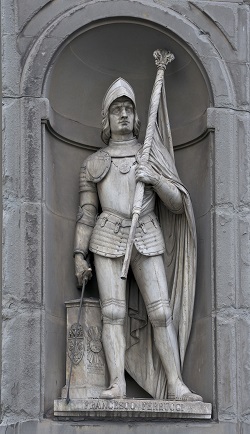
1530: Francesco Ferruccio, victim of Maramaldo

On this date in 1530, Francesco Ferruccio (or just Ferrucci) and his executioner Fabrizio Maramaldo clinched their immortality at the Battle of Gavinana.

The battle was the tragic final scene of the War of the League of Cognac, in which an alliance of Italian city-states tried to expel the Habsburg Holy Roman Emperor Charles V from the peninsula. Charles had already in effect decided matters by forcing the French out of the fight, which also brought about the capitulation of the Vatican.

Left alone in the fray, doughty Florence — ever so briefly at this moment restored as a Republic, having given the Medici the boot — continued to hold out against impossible odds. A vast imperial army swollen by landsknechts whose mercenary arms were now unnecessary elsewhere in Italy besieged Florence on October 24, 1529.


The Siege of Florence, by Tuscan Renaissance Man Giorgio Vasari.

The intrepid Florentine commander Francesco Ferruccio (English Wikipedia entry | Italian) strove to take his hopeless fight to the enemy. After a plan to coerce papal support by striking Rome was vetoed, Ferruccio mounted a march through the Apennines to threaten the Imperials’ rear.

He was intercepted at Gavinana, a battle decided by the arrival of landsknecht reinforcements under the command of the notoriously cruel condottiere Fabrizio Maramaldo.

Maramaldo would elevate himself for posterity out of the ranks of his merely brutal brethren by finding Ferruccio, badly wounded, his prisoner, and putting him to immediate death by his own hand — an execution that resulted in Florentine capitulation one week later, and the installation of Alessandro de’ Medici as Duke of the now ex-Republic.*

While admittedly borderline as an “execution” suitable for this here site, Ferruccio’s defiance in the face of his killer and his last denunciation of Maramaldo — “Coward, you kill a dead man!” — became the stuff of legend in a later Italy. (It also helped Ferruccio’s case for the nationalist pantheon that he died fighting against the Germans, not against the next city-state over.)

The romantic novelist Francesco Domenico Guerrazzi** made Ferruccio the subject of his magnum opus L’Assedio di Firenze, and before you knew it the name was on the lips of every risorgimento Tom, Dick and Francesco. Garibaldi invoked him in speech; Goffredo Mameli wrote him into the national anthem.


Every man has the heart
and hand of Ferruccio …

Under the Italian state those men helped to make, Ferruccio was appropriated as the name of a battleship; fascist Italy especially found Ferruccio congenial to the national-pride project and valorized the martyr relentlessly.


1930 Fascist Italy stamp depicting — for the 400th anniversary of the occasion — Fabrizio Maramaldo murdering his prisoner Francesco Ferruccio. Other Februccio stamps from the same period can be found on the man’s Italian Wikipedia page.

For Maramaldo, a less flattering but possibly more durable legacy: Italian gained the noun maramaldo, the adjective maramaldesco, and the verb maramaldeggiare to signify bullying or cruel domineering.

* Alessandro had a reputation for despotism, and was assassinated a few years later by his cousin Lorenzino de’ Medici in a tyrannicide that was Brutus-like in both its motivation and effect. That later affair is the subject of the 19th century play Lorenzaccio.

** Guerrazzi also did his bit for the legend of Beatrice Cenci.

On this day..

2005: Steven Vincent, Iraq War journalist

On this date in 2005, U.S. journalist Stephen Vincent was abducted off the streets of Basra by a Shia militia. Before the day was out, he had been extrajudicially executed on the outskirts of town — along with his assistant and translator, who managed to survive the execution.

Vincent, originally from California, had been a New York journalist (most prominent on the arts scene) for more than twenty years when he stood on his apartment’s roof on September 11, 2001, and watched United Airlines Flight 175 smash into the South Tower of the World Trade Center.

Deeply shaken by the specter of Islamic terrorism and wanting to, as he put it, “do my part in the conflict”, Vincent took an abrupt turn from his Gotham haunts and in 2003 bought his own ticket to Iraq to venture into the war zone with nothing but wits honed by a lifetime’s freelancing. Free of both institutional control and institutional protection, and picking up his Arabic on the fly, the dauntless Vincent reported from the ground in war-ravaged Iraq, eyed by perplexed officials who could scarcely help but suspect him a spy.

His 2004 book In the Red Zone: A Journey into the Soul of Iraq captures his impressions.

In April 2005, Vincent returned to Iraq — this time, to Muqtada al-Sadr‘s* bastion in the Shia south where, as he put it in a post on his still-extant blog, “militant Shiites … have transformed once free-wheeling Basra into something resembling Savonarola‘s Florence.”

One of few Western journalists in British-occupied but increasingly Sadr-controlled Basra, Vincent filed numerous stories raising the alarm on fundamentalism and Iranian influence.

“Basran politics (and everyday life) is increasingly coming under the control of Shiite religious groups,” Vincent wrote in a July 31, 2005 New York Times piece that would prove to be his last. “And unfortunately, the British seem unable or unwilling to do anything about it.”

Vincent traces the early cracks that would widen into Iraq’s now-familiar sectarian fracturing, and the ruins of a secular society as institutions like the university dare not shoo away self-appointed purity monitors of students’ dress and conduct lest they invite the wrath of the Iranian-backed Shia parties (and Shia police).

An Iraqi police lieutenant, who for obvious reasons asked to remain anonymous, confirmed to me the widespread rumors that a few police officers are perpetrating many of the hundreds of assassinations — mostly of former Baath Party members — that take place in Basra each month. He told me that there is even a sort of “death car”: a white Toyota Mark II that glides through the city streets, carrying off-duty police officers in the pay of extremist religious groups to their next assignment.

This passage prefigures Vincent’s own fate, and it’s thought to be the fact of his filing reports like this one that sealed it. Returning on the afternoon of August 2 from a Basra currency exchange with his translator Nouriya Itais Wadi (or Nouri al-Khal; Steven Vincent referred to her as “Leyla” in the personal dispatches he posted on his blog),** the pair was seized in broad daylight by armed men in a white police vehicle. Hours later, their bodies were recovered just a short drive away. Or rather, Vincent’s body was recovered: his aide, left for dead by her executioners, was clinging to life despite multiple gunshot wounds.

There’s an Open Source Radio interview with Vincent’s widow Lisa Ramaci-Vincent from August 10, 2005, available as a podcast here. After yet another journalist was abducted and murdered in Basra a few weeks later, Ramaci-Vincent launched the Steven Vincent Foundation “to assist the families of indigenous journalists in regions of conflict throughout the world who are killed for doing their jobs, and to support the work of female journalists in those regions.” She also helped Nouriya, who survived her injuries, to emigrate to the U.S.

Muqtada al-Sadr, who survived a 2008 attack by the American-backed Iraqi army on Basra, remains today one of the dominant figures in Iraqi politics.

* Saddam Hussein — a Sunni — had the name “Muqtada” chanted at him by his executioners during the fiasco of his hanging.

** Vincent’s relationship with his unmarried translator has also been cited as a possible factor in their murder. He was apparently planning to marry her opportunistically to help her escape Iraq, a plan that his wife knew about and supported.

On this day..

1868: Stefan Karadzha, Bulgarian national hero

On this date in 1868, the Ottoman Turks executed Bulgarian revolutionary Stefan Karadzha.

Karadzha was one of several nationalist cheta (guerrilla) leaders aspiring to father the future sovereign Bulgaria.

Operating from adjacent, and conveniently independent, Romania, around 1866-1867, Karadzha and others of his ilk — Hadzhi Dimitur Nikolov, Filip Totyu, and the dramatically mustachioed Panayot Hitov — slipped over the mountainous border to organize revolutionary cells and foment ill-feeling towards the Sublime Porte.

In Bulgaria’s late 19th century progress towards independence, these figures are transitional characters between the vanguard leadership of Georgi Rakovski, and the ensuing primacy of Vasil Levski.

Levski himself was a guerrilla in this period; after the cheta legions suffered some backbreaking defeats in the field — one of which saw our man Karadzha captured so badly wounded that he was “half-dead before the emergency Turkish court”* when condemned to hang — Levski set about honeycombing his country with the revolutionary network that would shape the future revolutionary struggle.

A national hero of lesser stature than Levski, which is sure no disgrace, Karadzha has a village named after him.

* The quote is from the unimpeachable source of Karadzha’s Wikipedia page.

On this day..

1731: Jose de Antequera, Paraguayan comunero rebel

On this date in 1731, Jose de Antequera had his head cut off in Lima for leading a comunero rebellion against the Spanish crown in Paraguay.

Antequera, a judge, began his revolution legally in 1721 by affirming an impeachment the city council of Asuncion (Paraguay’s present-day capital) against the unpopular Spanish governor. Antequera, conveniently, also happened to be the guy who would succeed the unpopular territorial governor.

The conflict between the two would-be governors spiraled into a wider revolt for local autonomy pitting criollo settlers against the crown, though it would likely be overstating matters to call this a true bid for independence. One notable sore spot between the two parties was the prerogatives of Jesuit Reductions: these mission settlements for Christianizing natives (particularly prominent in Paraguay for the Guarani people) had originally been placed at the far fringes of Spain’s New World reach, and they enjoyed a wide autonomy, sustaining themselves economically with the yerba mate trade. For the Guarani, these were also welcome refuges from the brutal encomiendas; Guarani militias stoutly repelled slave raiders.

For these prerogatives, the Jesuits and the Guarani were loyal to the Spanish crown as against the local settlers better inclined to view the Reductions (and the potential slaves who inhabited them) as assets they’d like to get their own hands around. Antequera accordingly expelled the Jesuits near Asuncio and for a few years his word was law in Paraguay. Guarani troops mustered by the crown helped put the rebellion down, taking Antequera into custody and forwarding him to the notoriously severe Marquis of Castelfuerte, the Peruvian viceroy.

Society at Lima was in [Antequera’s] favor. Great efforts were made to delay his trial. But the viceroy was resolved to punish him, and sentence of death was passed. The judges, the university, the municipality, petitioned for pardon, as well as the people of all classes. The stern old marquis refused to listen, and Antequera was brought out for execution in the great square of Lima on July 5, 1731. There were cries for pardon, and the mob began to throw stones. Hearing the tumult, the viceroy came out on horseback and ordered his guards to fire. Antequera fell dead, as well as the two priests by his side, and several others. The viceroy then ordered the body to be taken to the scaffold and beheaded. His conduct received the approval of the king by decree of September, 1733. (Source)

The Spanish had not heard the end of Antequera.

During his imprisonment, Antequera befriended and inspired a fellow-prisoner named Fernando Mompo. After Antequera’s execution, Mompo returned to Paraguay brandishing the late rebel governor’s banner: “The authority of the commune is superior to that of the King himself!” Mompo launched a recrudescence of the comunero rebellion in the early 1730s. Mompo too shared Antequera’s fate.

A change in the political winds decades later led to the Spanish king Charles III himself expelling the Jesuits — and posthumously exonerating Jose de Antequera.

On this day..

1817: Two-fifths of the condemned in Valenciennes

From the York Herald and General Advertiser (York, England) of Saturday, Aug. 16, 1817.

Five English soldiers being on guard, the 18th of June last, at one of the gates of Valenciennes, committed a robbery on the house of an individual, and were condemned to be hanged. They were conducted, by the orders of Lord Wellington, on the 3d of July, outside the walls of the town, to undergo their punishment.

The people followed the culprits, invoking, in accents of sorrow, the pity of their officers, and crying “Mercy! Mercy!”

Two of them were executed, and the other three received their pardon at the very moment they were about to part with life. At this news the joy of the numerous spectators was extreme, and the thanks they addressed to the English General were no doubt less eloquent than the joy from which they emanated.

On this day..