1649: Robert Lockyer, Leveller

On this date in 1649, Robert Lockyer (or Lockier) was shot before the scenic backdrop of London’s St. Paul’s Cathedral* for the Leveller-inspired Bishopsgate mutiny.

These weeks following the epochal execution of the late king Charles I were also the climax of a pivotal intra-party conflict among the triumphant Parliamentarians … one whose class dimensions map a lot more readily to a modern template. Levellers were, “in a small way, the precursors of the ‘Socialists’ of 1849” in the words of this popular history.

The prosperous gentry represented by the Grandee faction were just fine with the whip hand they’d obtained in government by overturning the monarchy; against them were arrayed the more radical Levellers (or “Agitators”) who could not fail to notice that they had no say in electing the Parliament upheld by their victorious arms, and an oligarchy governing them that bore a suspicious resemblance to the supposedly defeated nobility.

So there was that.

Meanwhile, up in high statecraft, Oliver Cromwell was preparing to make his name accursed of Ireland by smashing up the island and the Grandees hit upon an arrangement as expedient for fiscal ambitions as for territorial: the soldiers assigned to this expedition would have the opportunity to opt out of it, for the low low price of forfeiting the substantial back pay they were due from those years of civil war — pay whose fulfillment was naturally a chief Leveller demand.

How did this cunning plan to pillage the soldiery’s pensions to conquer Ireland go over in the ranks? Reader, not well.

Since the same reason that shall subject them unto us in generall, or any of us singly, may subject us unto them or any other that shall subdue; now how contrary this is to the common interest of mankind let all the world judge, for a people that desire to live free, must almost equally with themselves, defend others from subjection, the reason is because the subjecting of others make(s) the subdued strive for Dominion over you, since that is the only way you have left them to acquire their common liberty.**

So there was that, on top of that.

Grumblings gave way to refusals to march, and the refusal by a regiment stationed in Bishopsgate to leave London lest it also leave its leverage soon became the eponymous mutiny of this post — the Bishopsgate Mutiny.

Grandees quelled this particular insubordination without need of bloodshed, but thought it meet to deliver a little anyway as proof in this fraught political environment against the next such affair. Six of the soldiers drew military death sentences; Cromwell pardoned five, but let known Leveller/Agitator firebrand Lockyer go to his death over the appeals of Leveller leaders like John Lilburne and Richard Overton.

The signal was unmistakable — certainly to the thousands who donned Leveller colors to follow Lockyer’s funeral procession through London.

In the days following Lockyer’s execution, several Leveller-inspired regiments would openly rise … what proved to be the movement’s last great stand, efficiently crushed by Cromwell.

*The Parliamentarians had twisted high church dogmatists by putting Old St. Paul’s Cathedral to profane use as a cavalry stable, which employment actually made it a sort-of suitable place for a military execution. (The current structure was rebuilt on the same site after the previous church succumbed to the Great Fire of London.)

** From Mercurius Militaris, quoted by Norah Carlin, “The Levellers and the Conquest of Ireland in 1649,” The Historical Journal, June 1987 — which, however, makes the case that while the Levellers were obviously not cool with the pay expropriation, their opinion on the Ireland conquest in the abstract was far from uniformly anti-imperial.

On this day..

1534: Elizabeth Barton, the Holy Maid of Kent

On this date in 1534, Elizabeth Barton was hanged at Tyburn with her “conspirators” for having prophesied the death of Henry VIII and (in the words of the parliamentary attainder against them) “traterously attempted many notable actes intendyng therbye the disturbaunce of the pease and tranquyllytie of this Realm.”

A country servant-girl, this Elizabeth Barton had begun having divine visions around Easter 1525, and developed a popular following for her gift of prophecy, generally delivered during spooky (perhaps epileptic) fits and trances.

This was all just fine with everyone, since King Henry was still a good Catholic at the time; Barton took orders in the St. Sepulchre Nunnery and continued her career in the seer business.

Elizabeth Barton wasn’t going to leave her place in Henrician England … but to paraphrase Ronald Reagan, Henrician England was about to leave her.

And like so many entries that age has given this site, it all went back to Henry’s leaving his first queen, Catherine of Aragon.

If one likes to see in the prophetic tradition a refracted expression of popular sentiment, speaking a religious rather than a political language, Elizabeth Barton’s divine gift set her up to be the mystical exponent of the English populace’s visceral reaction against Henry’s ascending paramour, Anne Boleyn.

Rather rashly, Barton began publicly warning her sovereign against his bedchamber gambit, threatening that if the proposed Boleyn union should come to pass, he “should no longer be King of this realm…and should die a villain’s death.”

That would be compassing the death of the king — which is treason.

Barton articulated a fear of Henry’s policies which was shared by many of his subjects. The anticipated breach with Rome made the citizens of England insecure about the future stability of the realm, and prognostications concerning the state of the country abounded. Barton was not alone in foretelling that wars and plagues would soon rack the country; or in prophesying that the King would be overthrown, that his death was imminent, that he would die as a villain. Many people were discussing such prophecies, by means of which they could “objectify their fears and hopes” in an age of change and disruption.

-Diane Watt, “Reconstructing the Word: the Political Prophecies of Elizabeth Barton (1506-1534)”, Renaissance Quarterly, Spring 1997

So it’s probably only fitting that this creature of her times would be devoured by the Tudor state which made its Reformation from the top.

Devoured, not only bodily.

As the Tudor king breaks with Rome, Barton becomes almost totally obscure to us, the real person who dared to stand openly against her king subsumed entirely by the edifice of state propaganda. As Watt observes, “as a result of her fate … almost all the first-hand evidence concerning Barton’s life and revelations has been destroyed” and “the surviving image of her has therefore been shaped by those who suppressed her visions and prophecies.”

We have her mystical utterances mostly indirectly, through the interlocutors charged with refuting her, and we have the expedient charges against her of fraud, contumacy, and (of course) sexual indiscretion leveled by her foes.


“The Imposture of the Holy Maid of Kent”

Arrested with a circle of supporters, Barton was forced into a public recantation in November 1533 by her persecutors. One supposes such a recantation was in any event obtained under some duress; undoubtedly it was, as the disgusted Spanish ambassador recorded, staged “to blot out from people’s minds the impression they have that the Nun is a saint and a prophet.” (Cited by Watt)

If said duress included an easing of the charges against herself or her associates, Barton was to be disappointed.

She was attainted for treason* in January (the evidence against her being insufficient for a judicial verdict of treason); the bill of attainder also required the public to hand over any writings about her alleged prophecies or revelations, like the popular pamphlets that had circulated with official approval in the 1520’s: there would be nothing to nurture a people’s cult for this exponent of resistance. Over the decades to come, the early writings sympathetic (and proximate) to Barton would be almost completely annihilated, supplanted by Protestant works that rendered Barton a trickster, a puppet, a sham — magnified her retraction into the definitive statement. It was a propaganda victory almost as chilling as Barton’s corporeal fate: even her potentially sympathetic Catholic audiences can latterly make no reliable judgment about her.

And so Barton moulders.

In April 1534, the usurping consort once more apparently pregnant with Henry’s long-sought heir, the once-popular, now-deflated prophetess of the old queen and the old faith was emblematically put to death with her former adherents on a most significant day in the city of London.

[T]his day the Nun of Kent, with two Friars Observant, two monks and one secular priest, were drawn from the Tower to Tyburn, and there hanged and headed. God, if it be his pleasure, have mercy on their souls. Also this day the most part of this City are sworn to the king and his legitimate issue by the Queen’s Grace now had and hereafter to come, and so shall all the realm over be sworn in like manner.

-Letter from John Husee to Lord Lisle, April 20, 1534 (Source)

We trust everybody got the message.

But in case anyone missed the point, there would be plentiful reminders still to come.

* Chancellor Thomas More had some traffic with Barton — very cautious, as befits a skeptical elite’s approach to a loose cannon commoner — and was briefly in some danger of being named in the indictment against her. When his loyal daughter Meg joyously reported to him that he’d been cleared, he’s supposed to have replied, “In faith, Meg, ‘quod differtur non aufertur’, what is put off is not put away.” But it probably didn’t require heavenly foresight for More to perceive the wheel of fortune about to turn on him, too. By the time of Barton’s actual execution, More had already been clapped in the Tower himself.

On this day..

1457: The Wallachian boyars

This date was Easter Sunday in 1457, which would make it the date associated with one of the more memorable displays of theatrical brutality by Wallachian proto-vampire Vlad Tepes, aka Vlad Dracula or Vlad the Impaler.

Having only just ascended the less-than-secure throne of Wallachia, a frontier principality pinched between the Hungarian and Ottoman Empires, the 25-ish prince and onetime Ottoman hostage had a bone-chilling inauguration plan to shore up his security both internal and external.

He threw a big party in Targoviste for the nobles of the realm … and had a little surprise waiting for them. It wasn’t an Easter egg hunt.

He asked the assembled noblemen:
“How many princes have you known?”
The latter answered
Each as much as he knew best.
One believed that there had been thirty,
Another twenty.
Even the youngest thought there had been seven.
After having answered this question
As I have just sung it,
Dracula said: “Tell me,
How do you explain the fact
That you have had so many princes
In your land?
The guilt is entirely due to your shameful intrigues.”

With ample proof of the boyars’ deceit and treacherous intents, Dracula decided it was timely to inflict upon them an exemplary punishment … mass impalement …

The oldest Romanian historical chronicle records the event two centuries later. It had taken place in the spring of 1457, during the Easter celebrations that the boyars were attending at the palace … “when Eastern Day came, while all the citizens were feasting and the young ones were dancing he [Dracula] surrounded them [the boyars] … led them together with their wives and children, just as they were dressed up for Easter, to Poenari, where they were put to work until their clothes were torn and they were left naked.” In actual fact, this episode, which is also recalled by the Greek historian Chalcondyles and firmly anchored in popular folklore, involved some two hundred boyars and their wives, as well as leading citizens of Tirgoviste … They were seized by Dracula’s men as they were finishing their meal in the main banqueting hall of the palace, following the elaborate Easter ritual at the Paraclete Chapel. In Dracula’s ingenious mind, one aspect of the punishment had a utilitarian purpose: the reconstruction of the famous castle high up on the Arges … On the way out of the chapel the old boyars and their wives were apprehended by Dracula’s henchmen and impaled beyond the city walls. The young and able-bodied were manacled and chained to each other and then marched northward under the vigilant eye of Dracula’s men.

This was revenge a decade in the making for the boyar class having toppled Vlad’s father and murdered Vlad’s elder brother in 1447.

But personal score-settling aside, Vlad’s sanguinary housekeeping had a statecraft dimension as well. It enabled him to centralize power in his own person, and had the happy side effect of speeding creation of a secure mountain fastness — Poenari Castle, which is one of several structures answering to the lucrative name of Castle Dracula.

While Vlad is (in)famous for his iron fist (and well-oiled spikes), it’s perhaps harder to say with confidence how much good this slaughter did him. Wallachia’s security situation was fundamentally defined by its neighbors no matter how cruel Vlad Tepes might be.

Vlad got some more impaling under his belt defending his country from Ottoman invaders (you’ll be shocked to learn that many boyars were more than happy to help the sultan get rid of this tyrant), but he was clapped in prison by the Hungarian ruler Matthias Hunyadi in 1462, lived most of the rest of his life in exile, and then died in battle attempting a Wallachian comeback in 1476. So basically, he got a few good years in … plus that whole latter-day afterlife he enjoys as tourist magnet, alleged literary inspiration, and nationalist icon.

And that’s more than one can say for most of the 15th century rulers who weren’t impaling their boyars.

On this day..

1783: Philip, a negro slave of Henry Garrett

From the Chronicles of the Scotch-Irish settlement in Virginia

Called Court on Philip, a negro slave of Henry Garrett, and formerly property of Major Thomas Johnston, of Louisa County, charged with murdering Alexander Hunter, of Augusta County, and wounding the wife of Samuel Henry.–Guilty and to be hanged on 16th April next at 10 o’clock a. m. His value is fixed at £65.

On this day..

1982: Khalid Islambouli and the assassins of Anwar Sadat

With Egyptian President Hosni Mubarak’s recent unwilling separation from power, we remember today how he got into power in the first place — for this was the execution date in 1982 for the assassins of his predecessor, Anwar Sadat.

Here’s some raw-er footage:

The murdered president inherited the office from the first name in pan-Arab nationalism, Gamal Abdel Nasser.

Sadat led Egypt through the turbulent 1970s, fighting a war against Israel and then making peace with its Jewish neighbor to regain the Sinai, and generally proving himself more adept at the job than many had assumed.

But the secular dictatorship was increasingly afflicted by that then-emerging, now-familiar specter, Islamic fundamentalism — specifically aggrieved by those Camp David Accords, but also confronting Sadat’s neoliberal economic realignment and political disaffection.

Khalid Islambouli, the man who actually got Sadat, was a 26-year-old officer with an illicit affiliation to the Egyptian Islamic Jihad.

At an October 6, 1981 military parade, Islambouli led an orchestrated hit, leaping from military vehicles to bombard the presidential dais with grenades and automatic weapon fire.

Sadat was dead before he reached the hospital, and his office assumed by his vice president — Hosni Mubarak.

Unsurprisingly, he played rough with the assassins.

A military tribunal ultimately convicted 22 people of participating in the plot, sentencing five to death. While the state press was obviously supportive of the verdict,

Many Egyptians interviewed by Reuters considered the death sentences fair. “It is up to President Mubarak now to show his people that terrorism is unacceptable in Egypt by approving the sentences”, a shopkeeper said.*

And Mubarak did … albeit carefully.

Five self-proclaimed Muslim fundamentalists convicted of assassinating President Sadat of Egypt were executed at dawn today hours after their plea for mercy had been rejected by President Mubarak.

The two assassins who had been in the Army were executed by firing squad and the others, civilians, were hanged at a remote military base outside Cairo …

News of the executions was carried briefly on Cairo radio, then dropped from subsequent broadcasts. The evening newspaper did the same, an indication that the authorities may be sensitive to possible public reaction, Muslim fundamentalism being widespread in all the Egyptian universities.**

The precaution was, perhaps, well-taken.

Muslim fundamentalism would gain steam in Egypt during the years ahead, drawing a severe state response.

Islambouli’s younger brother Showqi almost accomplished an all-in-the-family twin killing by coming within a whisker’s breadth of assassinating Mubarak in 1995. The family name is still honored in the breach by other Muslim militants: there’s an “al-Islambouli Brigades of al-Qaeda” in Pakistan and an “al-Islambouli Brigades” in Chechnya.

* London Times, March 8, 1982

** London Times, April 16, 1982 (under an April 15 dateline)

On this day..

1647: Domenica Gratiadei and her coven of witches

This date in 1647 marked the execution of five supposed witches in Trentino.

Secular and modernist as this grim site‘s curators confessedly stand, we have perhaps given too little credence to those devout officers of the law who labored in those years to uphold the throne of heaven besieged by Satan’s varied earthly minions.

Montague Summers

In an effort to balance the record, we present this date’s account as rendered by a guy who took the supernatural a bit more seriously: Montague Summers.

Summers is a weird figure, but if he wasn’t really a throwback believer in Rome’s phantasmagoric early modern theology, he was the century’s most sublime performance artist.

Converting to Catholicism as an Anglican deacon, he went about in spooky clerical robes although his ordination status remains unclear to this day, immersed his capacious mind in supernatural arcana, and penned voluptuously eloquent books credulously treating the spectral evidence another era had given against sorcerers, vampires, lycanthropes, and suchlike habitues of the Monster Manual.*

I have endeavoured to show the witch as she really was -– an evil liver: a social pest and parasite: the devotee of a loathly and obscene creed: an adept at poisoning, blackmail, and other creeping crimes: a member of a powerful secret organization inimical to Church and State: a blasphemer in word and deed, swaying the villagers by terror and superstition: a charlatan and a quack sometimes: a bawd: an abortionist: the dark counselor of lewd court ladies and adulterous gallants: a minister to vice and inconceivable corruption, battening upon the filth and foulest passions of the age.

Summers projected (perhaps intentionally) a mysterious and vaguely sinister persona and did not disdain to cultivate a friendship with nefarious occultist Aleister Crowley, his contemporary. There were even rumors of an unwholesome interest in pederasty.

We’re confident that none of this has done his sales a bit of harm. So who are we social pests and parasites of the blogosphere not to batten upon it ourselves?

The below is drawn from Summers’ The Geography of Witchcraft — and as the reader will perceive, Geography at least purports to treat the flying-off-to-infernal-orgy stock in trade of those bygone witch hunters as legitimate evidence of the lead crone’s “attendance at the Sabbat, sometimes, no doubt, an experience on the psychic plane, for she was undoubtedly a medium of unusual powers, and sometimes in actual fact.”

A typical case of Witchcraft, and one which owing to its prominence and the meticulous investigations of the authorities has luckily been reported in full, attracted considerable attention in the winter of 1646 and the following spring. It will, moreover, be found to present so many factors and features, which occur again and again in the contemporary trials of wellnigh every European country, that it may profitably be dealt with in some detail.

A certain old woman of Castelnovo, Maria Salvatori, nicknamed “la Mercuria,” who had long been suspected of sorcery, was arrested on 26 October, 1646, and formally examined. At first the two principal charges, sufficiently damning in themselves, seem to have been that at her communions she did not swallow the Sacred Host, but kept It in her mouth to spit It out secretly and reserve It for some abominable purpose, and also that by her ecbolic spells she had caused the young Marchesa Bevilacqua to miscarry in childbirth. She was again interrogated on 8 November and put to the torture of the cord when she accused Domenica, the widow of a certain Tomaso Camelli, and Domenica’s daughter, Lucia, the wife of Antonio Caveden, both of whom dwelt at the hamlet of Villa, of being rank witches. She also avowed she had taken a Host from her mouth to give to Lucia Caveden, who thereby confected a charm which caused the abortion of the Marcioness. She added that she had also bewitched Cristoforo Sparamani, the son of Cecilia Sparamani, and that a certain Delaito Cavaleri was a necromancer and a worshipper of Satan. A further interrogation followed on 15 November, as a result of which the court, consisting of Paride Madernino, delegate in all criminal and civil cases in the districts of Castelnovo and Castellano, and his assessor Giovanni Ropele, doctor utriusque iuris, promptly gave orders to GiuseppeCoriziano, “bargello di questa turia,” to arrest Domenica and Lucia. This was done, and on Saturday, 24 November, 1646, at Nogaredo, the proceedings against the witches were formally opened. “Processus Criminalis pro destructione lamiarum.” On 27 November Domenica Carnelli was questioned by the judges, but they got little enough out of her. Two days following Lucia Caveden was brought before the tribunal. She vehemently declared that the charges were all malice; the hag Salvatori was her enemy; and with many cries she called Heaven to witness her innocence, repeatedly exclaiming “per grazia del Signor Iddio no son una stria” But the next day she proved less firm and implicated yet another woman, Domenica Gratiadei, who was immediately thrown into prison, a number of suspicious objects being found in her house when it was closely searched by the officers. Certain pots of a dark unguent and a mysterious powder being produced in court, Lucia Caveden confessed that these were for the destruction of human life and cattle. Seeing that the game was up Domenica Gratiadei, upon being put to the torture, soon laid bare all the secrets of the infernal sisterhood. She had made this unguent with which she annointed herself to attend the Sabbat “trasformata in gatto,” she had cast the evil eye on Cristofero Sparamani, she had renounced her baptism, defiled the Blessed Sacrament, adored Satan with divine honours. The judges were filled with horror, and trembled at the hideous tale of diabolism these women poured forth. Cecilia Sparamani, a plain honest woman, was next summoned as a witness and told how her son fell into fits of no ordinary kind. The doctors had acknowledged their skill baffled, and in spite of the prayers of two Capuchin fathers and the exorcisms of Monsignore the Bishop of Brondolo, this preternatural sickness still persisted. She informed the court that as soon as summer came and the roads were passable she intended to take the boy to the shrine of S. Antony at Padua, to whom she had a special devotion.

On 18 December, 1646, Benvenuta, the daughter of Domenica Gratiadei, made a startling confession. She declared that she had been taken by her mother “as if in a dream” to a place where there was dancing and singing, where she had been welcomed by a large number of revellers, and especially by a young man, who having kissed and fondled her awhile afterwards had connexion with her. This was, her mother averred, Satan himself. When closely questioned as to these proceedings the girl could only reply: “Tutto mi sembra, come ho detto, un sogno: e parevami che sempre vi fosse il diavolo in forma di quel giovene.” It would seem from these very striking and significant words that the girl was a hypnotic subject, entirely under her mother’s control, and that on these occasions she passed into a semi-trance state. The case dragged on throughout the months of January and February, 1647. There were interminable interrogations, and a large number of persons were gradually implicated.

On 2 January 1647, Domenica Gratiadei gave a detailed description of the Sabbats she had attended. She and an old warlock named Santo Peterlino always led the coven. “The rest followed in the shape of cats; but the Devil went first of all.” They enjoyed banquets, dances, plays, music, songs, and afterwards all worshipped Satan, presenting him with Hosts which they kept from their last communion. Before attending the Sabbat she anointed herself with an unguent made of “the Blessed Sacrament, the blood of certain small animals, Holy Water, the fat of dead babies” which was mixed with horrible imprecations and blasphemies to confect the charm.

On 10 January, a strange figure, Maddalena Andrei, nicknamed “La Filosofa,” first appears in the case. She confessed that she had assisted in the making of the ointment and had also adored the Devil who frequently appeared to her, “brave, like a gallant captain, dressed all in red.” On 9 March, when Giuseppe Goriziano entered the cell of La Filosofa to summon her to court he found her lying dead upon the floor. The common people believed that she had been carried off by Satan, especially as the Archpriest of Villa, Don Giovanni Bragliardi, shrewdly suspecting that the unhappy woman had committed suicide, refused her sepulture in consecrated ground.

This long and complicated Witchcraft-trial at length came to an end in April 1647. The court was throned with an excited yet hushed crowd, when the judge Paride Madernino and his assessors the Counts of Lodrone and Castel-Romano delivered the sentences. Domenica Camelli, Lucia Caveden, Domenica Gratiadei, Catterina Baroni, Zinevra Chemola, Isabella and Plonia Gratiadei, and Valentina Andrei were condemned to death. Maria Salvatori, “la Mercuria,” and Maddalena Andrei, “la Filosofa” had expired in prison. The condemned were beheaded and their bodies burned. It would seem, however, that Isabella and Polonia Gratiadei and Valentina Andrei managed to escape and could not be traced. The execution of the rest took place on 14 April, 1647, when Leonard Oberrdorfer the common hangman carried out the judicial sentence.

The chief witches here naturally fall into four groups each constituted of one old and one young woman, Domenica Camelli and Lucia her daughter; Domenica Gratiadei and Benvenuta her daughter; Isabella Gratiadei and Plonia her daughter; Maddalena Andrei and her daughter Valentina. The chief of the coven was undoubtedly Domenica Gratiadei, whose vile confessions, a mixture of most horrid blasphemies and lewdest obscenity, convince her of being a wretch wholly devoted to evil, and an active propagandist of the Satanic cult. It was she who had debauched her own daughter to “the Devil,” that young man whose name and individuality do not appear, but who may be guessed to have been a noble of the district, using the witches for his own ends and, presumably, supplying them with money to carry out his dark designs. That the whole gang frequently attended the Sabbat, at which he was not unseldom present, there can, I think, be no question.

This case is recounted in much greater detail in Italian in this Google book; this page has another summary, also in Italian.

* “[I]n every way a ‘character,’ and in some sort a throwback to the Middle Ages,” the London Times blurbed Summers at his death (obituary in the Aug. 11, 1948 issue). But his “preoccupations with the supernatural, however, represented only one side of his nature. His solid services to learning lie rather in his copious editorial and critical work on the English Restoration drama — a field in which he possessed the most comprehensive and expert knowledge.”

Summers’ edited compendium of 17th century playwright Aphra Behn‘s works is available free at gutenberg.org.

For exemplars of the stuff more topical to this post, one can also peruse free online his The Vampire: His Kith and Kin and his translation of the notorious witch-persecution manual Malleus Maleficarum.

On this day..

1705: Captain Thomas Green and two of his crew on the Worcester

On this date in 1705, another century’s supposed terrorist was hanged on Leith Sands with two of his “pirate” crew by a Scottish court “drunk with patriotic prejudice.”*

This execution took place in the feverish run-up to England and Scotland’s Acts of Union welding the neighboring realms into Great Britain in 1707.

Arising as it did from the same causes that animated that national marriage of convenience, Green’s execution also endangered it: Daniel Defoe, who was at this time a pro-Unionist mole (and prolific pamphleteer) for English pol Robert Harley, described this hanging as one of the six crises that had to be overcome en route to the Union.

A Man, A Plan, A Calamity

Panama.

That’s where it all started, for Green and Union alike.

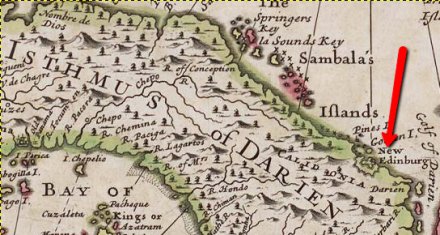
Mired in economic backwardness as neighboring European states carved up the world, Scotland made a bold, doomed bid for a chit in the empire game: the Darien scheme. One part visionary and (at least) two parts daft, this venture attempted to establish a Scottish colony on the Isthmus of Panama (aka the Isthmus of Darien) with a view to porting freight across the narrow strip of land separating Atlantic and Pacific, and dominating the dramatically more efficient east-west trade route that would result.


The intended Scottish colony in Panama; map from this University of Glasgow exhibit.

Students of the Panama Canal project will be aware that this malarial tropic would not be described as especially hospitable; to the natural disadvantages of the climate were added the political interpositions of England herself, whose hostility to the advent of her Caledonian neighbor as a New World rival was expressed in legislation choking the Darien adventure of foreign aid.

(Also a problem: Spain. The colony was abandoned at last under Spanish siege.)

So Scotland went it intrepidly, injudiciously alone in this last bid for real independent muscle in Europe. The hyperbole of the Isthmus’s publicists eventually sucked in 20 percent or more of the capital circulating in Scotland. And when Darien-dot-com went bust by 1700 at the cost of a couple thousand lives, it cratered the Scottish economy too. That set the stage for Edinburgh’s partnership in a different scheme: Great Britain.

Green with Envy

In the years following the Darien catastrophe, the Scottish corporation chartered to undertake it was still throwing stuff against the wall in the world trade game, trying to get something to stick to at least take the edge off the losses.

This company (theoretically a potential rival of England’s own East India Company) had suffered the further national indignity of having one of its ships, the Annandale, seized in the Thames for infringing the East India Company’s royal monopoly. Its appeals for redress falling on deaf ears, the Darien company apparently induced Scottish authorities to undertake the retaliatory seizure of an English merchant ship, the Worcester, that had the ill luck to weather a storm at the Firth of Forth.

Rumor soon connected this ship to another vanished Darien company vessel overdue from its return trip from the East Indies … and, as it quickly became understood by all right-thinking Scots, overtaken in the Indian Ocean by this same Worcester and its crew butchered.

Captain Thomas Green and his English crew were hailed before an Admiralty court** on piracy charges on this extremely fantastical connection in a virtual mob atmosphere.

It never was clearly established that an act of piracy had been committed as a distinct fact, but by putting certain circumstances together it was inferred that Green was guilty of piracy. The very shape in which the accusation is set forth, shows that the accusers could not point to the specific act of piracy which had been committed …

[There] was no specification as to the vessel taken, which might enable the accused to prove that it had not been taken; no names of parties murdered, who might be shown still to be alive; no ownership of cargo, which might admit of proof that the owner’s goods had arrived safe. As Green himself is made justly to say in the document published as his dying speech, “We are condemned as pirates and murderers on a coast far distant from this place — is there any of you who wants either a friend whom we have murdered, or whose goods we have taken?”

Worcester Sauce

The Worcester‘s Malabari cook provided a highly dubious charge — dubious, for he was not yet among the crew when it last called at the location he claimed the crime took place — of Green and crew hatchet-murdering approximately ten English-speaking mariners on an unnamed vessel off the Indian coast.

Upon this evidence, 14 or more members (the ready sources are a little loose on the total number) of the Worcester crew were condemned for piracy, and initially slated for three batches of hangings. Queen Anne‘s personal intervention managed a stay,

The Scottish Privy Council unto the very last hours debated what to do with the diplomatic appeals, with evidence forwarded from London to the effect that the crew these Worcester men had supposedly slaughtered were alive, their vessel having been hijacked in another place, by another man.

But a surging Scottish mob aggrieved by the preceding years’ misadventures and the impending shotgun marriage to Westminster rather than anything Green himself had really done was already engorged on the blood of the supposed English corsairs. Most of the Council thought better than to deny them their sacrifice.†

The Streets fill’d with Incredible Numbers of Men, Women and Children, calling for Justice upon those ENGLISH Murtherers. The Lord Chancellor Seafield‘s Coach happening to pass by, they stop’d it, broket he Sashes, haul’d him out, and oblig’d him to promise Execution should speedily be done before he could get from ’em … According to the Chancellors promise, soon after, on the same Day, being Wednesday, Captain Green, Madder [the mate], and Sympson [the gunner] were brought out, and convey’d to Execution, which was at Leith Road upon the Sands, and all the way was Huzza’d in Triumph as it were, and insulted with the sharpest and most bitter Invectives. Being come to the place of Execution, Good God! what a moving sight was it to see those Men stand upon the very Varge of Life, just launching in to Eternity, and at the same time see the whole Multitudet ransported with Joy!”

-From an anonymous Letter From Scotland To a Friend in London, quoted by James Kelly, “The Worcester Affair,” The Review of English Studies, Feb. 2000

In the event, these three were the only ones actually hanged; passions cooled enough for the other “pirates” to be quietly released.

But the wider, national passions unleashed by this date’s executions would long provide fodder for intemperate patriotic recrimination, and specifically anti-Unionist propaganda — on both sides of the border.

Competing propagandistic broadsides framed and re-framed the events, as the affair of unscrupulous English buccaneers or perfidious highland barbarians. (Defoe, maneuvering for Union, wrote to chill such bad-for-business hostility: “Nothing could be more horrid, than that the Scots should Execute these Men on a meer Pique at the English Nation. Nothing can be more like it, than to conclude rashly, that it is so, and improve it on purpose to Exasperate our People against the Scots.” (Kelly))

And that, of course, is precisely the viewpoint that prevailed.

While the hemp neckties issued to Green et al this date threatened to (ahem) scotch the Union project, that very danger might have ultimately hastened its completion — as elites recognized, in Defoe’s words, that Union represented “the only way to preserve the publick Tranquillity, and prevent the certain Mischiefs that threatened the whole Body,” (Kelly, again) and rammed it through with dispatch.‡

* English historian G.M. Trevelyan.

** A lengthy account of the trial can be found in this Google books freebie

† In their very scanty defense, the Scottish magistrates had reason to fear Scottish citizens.

‡ The ebb and flow of national resentment continued long after the Acts of Union, of course; continuing Scottish support for the restoration of the Stuart monarchy was one expression of Scottish nationalism and anti-Union sentiment.

On this day..

Unspecified year: Snowball’s animal fifth column

“Four days” after an unspecified “early spring” date in George Orwell’s classic allegory of Soviet communism, Animal Farm, a show trial and mass execution of animals purporting to work for the book’s Trotsky figure signals the titular farm’s unmistakable collapse into dystopia.

In the book, a revolution of animals displaces the farm’s human owner, Jones — the hated ruler of the ancien regime.

The farm’s early cooperative elan soon shatters, with a pig bearing the unsubtle name of Napoleon becoming the revolution’s autocrat, and fostering a paranoid security climate against phantasmal plots by his fellow swine and onetime comrade, the exiled Snowball.

Let’s watch.

Napoleon ordered all the animals to assemble in the yard. When they were all gathered together, Napoleon emerged from the farmhouse, wearing both his medals (for he had recently awarded himself “Animal Hero, First Class”, and “Animal Hero, Second Class”), with his nine huge dogs frisking round him and uttering growls that sent shivers down all the animals’ spines. They all cowered silently in their places, seeming to know in advance that some terrible thing was about to happen.

Napoleon stood sternly surveying his audience; then he uttered a high-pitched whimper. Immediately the dogs bounded forward, seized four of the pigs by the ear and dragged them, squealing with pain and terror, to Napoleon’s feet.0 …

The four pigs waited, trembling, with guilt written on every line of their countenances. Napoleon now called upon them to confess their crimes. … Without any further prompting they confessed that they had been secretly in touch with Snowball ever since his expulsion, that they had collaborated with him in destroying the windmill, and that they had entered into an agreement with him to hand over Animal Farm to Mr. Frederick. They added that Snowball had privately admitted to them that he had been Jones’s secret agent for years past. When they had finished their confession, the dogs promptly tore their throats out, and in a terrible voice Napoleon demanded whether any other animal had anything to confess.

The three hens who had been the ringleaders in the attempted rebellion over the eggs now came forward and stated that Snowball had appeared to them in a dream and incited them to disobey Napoleon’s orders. They, too, were slaughtered. Then a goose came forward and confessed to having secreted six ears of corn during the last year’s harvest and eaten them in the night. Then a sheep confessed to having urinated in the drinking pool — urged to do this, so she said, by Snowball — and two other sheep confessed to having murdered an old ram, an especially devoted follower of Napoleon, by chasing him round and round a bonfire when he was suffering from a cough. They were all slain on the spot. And so the tale of confessions and executions went on, until there was a pile of corpses lying before Napoleon’s feet and the air was heavy with the smell of blood, which had been unknown there since the expulsion of Jones.

When it was all over, the remaining animals, except for the pigs and dogs, crept away in a body. They were shaken and miserable. They did not know which was more shocking — the treachery of the animals who had leagued themselves with Snowball, or the cruel retribution they had just witnessed. In the old days there had often been scenes of bloodshed equally terrible, but it seemed to all of them that it was far worse now that it was happening among themselves. Since Jones had left the farm, until today, no animal had killed another animal.

Animal Farm was published in 1945. In this 1954 British animated feature, the downer of an ending — with the corrupt pig rulers becoming literally indistinguishable from people — was dumped in favor of an ending where the animals revolt again.

On this day..

1590: Anne Pedersdotter, Norwegian witch

The most famous witchcraft execution in Norwegian history took place on this date in 1590, with the burning of Anne Pedersdotter.

Pedersdotter (English Wikipedia entry | Norwegian) was the wife of Lutheran minister Absalon Pedersson Beyer (Norwegian link), a reformist theologian in Bergen.

Anne may have become a target of her prominent husband’s enemies; she was first implicated for witchcraft in 1575 when her husband’s uncle dropped dead, clearing the way for Absalon to take his place as bishop.

While she repelled that round of allegations, Absalon himself soon followed his kin into the great hereafter, leaving his widow a bit shorter on political pull. She lived on as a near-hermit, forever shadowed by the intimation of infernal intercourse.

In 1590, Anne’s neighbors, and maid, accused her again; her fate was sealed when a forbidding storm broke during her trial. (So says Witch Hunts in the Western World)

Anne Pedersdotter’s execution has become a literary staple in Norway, with a (highly dramatized) play (available free online here) itself re-stylized into other notable cultural products — such as Danish director Carl Theodor Dreyer‘s 1943 Vredens Dag (Day of Wrath) …

… and two different operas, Edvard Fliflet Braein‘s Anne Pedersdotter, in Norwegian; and, Ottorino Respighi‘s more conventionally Italian-language La Fiamma:

On this day..

1918: Robert Prager lynched during war hysteria

On this date in 1918, German coalminer Robert Prager was lynched near Collinsville, Ill., for making disloyal utterances against the United States as his adoptive country entered World War I.

Basically the most visible and famed victim of patriotic anti-German bellicosity, Prager ironically is rather difficult to reconstruct as an unambiguous anti-war activist. After his mob execution, a baker would even come forward to say that he had been thrown in the clink when Prager accused him … of badmouthing a patriotic display. Prager himself had tried to enlist in the Navy and been rejected for medical reasons.

“Prager was, in fact, as loyal to the United States as any native-born citizen, and his innocence was attested to by many who knew him,” according to Donald Hickey in the summer 1969 Journal of the Illinois State Historical Society. “Two of the men with whom he boarded attested to Prager’s loyalty. One said that although Prager was a radical socialist, he had said he was ‘all for the United States’ when this country entered the war.”

But he was a socialist, and a German, and seems like the sort whom others might have found personally unpleasant. It is in the midst of a tiresome local dispute with a union leader (the union also rejected him) that Prager came to the unwelcome attention of the rabble: the union leadership accused him of being a spy, which led Prager to post handbills around town denouncing this lot for their scurrilous accusation. This obviously did him more harm than good and as the public conviction that Prager was disloyal took hold, it overran the halfhearted efforts of the town’s putative authorities to keep a semblance of order.

A mob on April 4 captured Prager at his home, paraded him, made him kiss the flag — momentarily rescued and hustled off to jail by police and a mayor who tried to talk the mob out of its design — then shanghaied from his “protective” custody cell and taken to the outskirts of Collinsville for hanging on a tree.

Eleven men stood trial for the affair over three weeks. Once the matter was finally rested with the jury, they were instantly acquitted.

There was wild applauding and cheers from ‘most everyone present. Relatives, friends and acquaintances rushed toward the bar to shake hands with the defendants. …

There was a peculiar coincidence at the trial Saturday. The Jackie Band was in Edwardsville for a patriotic demonstration.

When a shower of rain came up the musicians were sent to the court house where it had been arranged to give a program. At 2:40 o’clock judge Bernreuter ordered a recess after the completion of arguments and before reading the instructions.

Then word was sent that the band might play until court re-convened. The first number of all concerts is the Star Spangled Banner and it was played Saturday.

The strains from the Jackie Band caused tears to flow down the cheeks of Riegel. He was still crying when he returned to the court room.

As the jury came in with its verdict the band was at the head of a procession of draft boys and in passing the court house played “Over There.”

While Prager’s murder stands as the most emblematic event of anti-German intimidation during America’s months in the Great War, it was far from the only one: many others nearly as ugly stopped just this side of homicide. Papers were rife with reports of German immigrants being made to kiss the flag; clapped in jail for suspect utterances; of being menaced by mobs.

Outrageously, Germany made propagandistic use of these events, which the virtuous Entente powers would certainly never do.


Washington Post, April 11, 1918.

A number of federal lawmakers, as well as former presidents William Howard Taft and Theodore Roosevelt, condemned the lynching, mostly in the familiar coded terms with which lynchings were opposed in those days: one would rather let justice take its course. Mob rule is itself disloyal. Etc. (See Hickey)

But the right-thinking potentates of the war party were also finding themselves relieved that a polity which had re-seated the current president on the slogan “he kept us out of war” would so pliably turn towards bellicosity. This charade so mechanically familiar in our time was still an arcane and uncertain art in America’s imperial adolescence.

“The recent lynching of a German in Illinois and violent outbreaks of the same character in other parts of the country,” intoned the Washington Post, “have awakened the Department of Justice to the need of a law which will enable government officers to prosecute pro-Germans rather than leave them to be dealt with by mob law.”

Oh. Danke very much.

An unsigned editorialist in the paper’s April 12 edition opined so nauseatingly brutal and specious that in another age it would have earned its author an immediate contract with Fox News:

Stamping Out Treason

The question whether or not the laxity of the laws against treasonable utterances has been responsible for the people’s acts in taking the law into their own hands has been much debated of late.

While sedition may have been encouraged to some extent because of the comparatively mild risks involved, it is quite probable that the pro-German intrigues would have been carried on if the risk had been greater. This suggests the thought that other reasons must be looked for to account for the general revulsion of public sentiment against the treason spreaders and the prompt punishment meted out to them in so many instances.

A plausible explanation is found in the fact that the open and ingenuous American mind had been fed up on German lies to the point where it broke out in fierce revolt. At the beginning of the war, and even after the entrance of America into it, there remained debatable points in many minds. Though of a minor nature and scarcely affecting the larger issue, these points were emphasized by enemy agencies which had been at work from the beginning. But as the truth has been laid bare the indignation of the people has grown stronger. The fact that the rounding-up process has been most vigorously conducted in the middle West tells its own story in this respect. It was that section which was slowest to wake up. There the enemy propaganda apparently worked with most success. So it is there that the people have arisen unitedly in their righteous wrath against the treason talkers.

The comparative absence of outbreaks of this character in the East is explainable on the same theory. In the East the public mind toward the war was much earlier divested of errors. Consequently the enemy agents were more wary in their utterances, not because of any greater stringency of the law, but because of their appreciation of the temper of the people.

In spite of excesses such as lynchings, it is a healthful and wholesome awakening in the interior part of the country. Enemy propaganda must be stopped, even if a few lynchings may occur. The people know what they want. They are not seeking to subvert law and order.

Other powerful institutions were not quite so sanguine as the Post: the lynching was discussed hours after it occurred in the U.S. cabinet, no doubt mindful that it was also being denounced in the German Reichstag. And indeed all concerned marshaled these animal spirits of the populace towards killing men by the thousands under the auspices of the state rather than singly by drunken small-town mobs.

Fears of German reprisals against American prisoners never seem to have materialized; neither is there any other documented lynching in the short course of America’s World War I involvement that was conducted on unambiguously “patriotic” grounds.

* Any number of other papers joined the Post in this campaign, including the St. Louis Post-Dispatch and the Chicago Tribune. A few weeks later, they got their wish — the Sedition Act, under which the Socialist Eugene Debs was arrested for speaking against the war.

On this day..