1909: Valgrand in place of Fantomas

On this date* in 1909, in the first novel of the hit French Fantomas crime serial, the title character escapes the guillotine by having a duped actor beheaded in his place.

Fantomas’s Wikipedia entry calls the character “a transition from Gothic novel villains of the 19th century to modern-day serial killers“: he’s a swashbuckling anti-hero who’s a master of disguise and perfectly okay with getting his hands bloody.

His own personal Javert, an inspector by the name of Juve who has stalked him for years,** has finally managed to have Fantomas convicted of a murder and sent to await execution. (Here’s a synopsis of the book.)

The widow of that crime’s victim — also Fantomas’s lover — subsequently contrives to arrange a tete-a-tete with an actor then portraying Fantomas’s lurid crime spree on the Parisian stage. She wants him to come in costume, which excites the actor as a seriously macabre kink: little does this Valgrand suspect that his own tete will be swapped for the murderer’s by next light.

That following day finds a drugged Valgrand infiltrated into Fantomas’s cell, in a sort of travesty of the noble Sydney Carton‘s guillotine switcheroo. Still suffering the effects of the potion his supposed inamorata has plied him with only hours before, and still made up to resemble the condemned man, he’s incapable of objecting as he’s hustled to the scaffold.

Juve was watching the unhappy wretch, and could not restrain a word of admiration.

“That man is a brave man! He has not even turned pale! Generally condemned men are livid!”

The executioner’s assistants had bound the man upon the plank; it tilted upwards. Deibler grasped the head by the two ears and pulled it into the lunette, despite one last convulsive struggle of the victim.

There was a click of a spring, the flash of the falling knife, a spurt of blood, a dull groan from ten thousand breasts, and the head rolled into the basket!

But Juve … sprang towards the scaffold. He thrust the assistants away, and plunging his hands into the bran that was all soaked with blood, he seized the severed head by the hair and stared at it.

…

“Good God!” he cried in tones of anguish.

“It isn’t [Fantomas] who has just been put to death!” Juve panted brokenly. “This face has not gone white because it is painted! It is made up — like an actor’s! Oh, curses on him! Fantomas has escaped! Fantomas has got away! He has had some innocent man executed in his stead! I tell you Fantomas is alive!”

And so he was … to the tune of a staggering 32 books over three years. Eat your heart out, J.K. Rowling.

Fantomas on the silver screen

This series has enjoyed a number of adaptations to the screen, and indeed it’s a media milestone as well since the books were cranked out at record pace by a team of writers working simultaneously on modular chapters to meet publication deadlines that fed immediately into cinema deals. There were also comic and radio spinoffs, though they’re not known to have been forward-thinking enough to have had a website.

In the classic first silent adaptation of Fantomas in 1913 (the book was published in 1911), poor Valgrand catches a break: he’s recognized and spared beheading at the last moment. There’s a very thorough guide for viewing that film here.

* The book situates the action where Valgrand is seduced and tricked on December 18, and the narrative makes it clear that the execution itself is at dawn the next morning.

It can be placed in 1909 because a guard mentions the execution of Henri Duchemin, a real historical figure guillotined earlier in 1909. (That year marked a resumption of executions in France; a death penalty opponent serving as President of the Third Republic systematically blocked executions from 1905 through 1908.)

Lady Beltham, whose feminine wiles spring the master criminal, subsequently commits suicide in 1910, which leaves only the one possibility.

** Juve is a big fan of the then-trendy, now-discredited system of Bertillonage; Fantomas consistently runs circles around this “scientific” crime-fighting. Academics, if you please?

Through the incorporation of Alphonse Bertillon’s anthropometrics — the dominant mode of criminal investigation at the time –, as both the narratological and criminological impetus for its exponentially serialized representations of criminality, Fantomas articulates resistance to the representational strategies of the numerical classification of criminals as a means of social and “scientific” control, while compelling the ongoing modern capitalist cycle of mass literary production and consumption.

-Nanette Fornabai, “Criminal Factors: ‘Fantômas’, Anthropometrics, and the Numerical Fictions of Modern Criminal Identity,” Yale French Studies, No. 108 (2005)

On this day..

1789: The Canadian Burglars

“More solemnity was perhaps never observed at any execution before” the hanging this date in 1789 of William Mooney Fitzgerald and John Clark in St. John, New Brunswick.

The fate of these two Irish career criminals is one of many arresting stories told on the Early American Crime blog, whose entry (and complementary podcast) this site could hardly improve upon.

Connoisseurs of historical executions are well-advised to subscribe.

On this day..

1942: Klava Nazarova, Hero of the Soviet Union

On this date in 1942, Klava Nazarova and five other Soviet partisans were hanged by the Wehrmacht in and around Ostrov.


Image from a fantastic collection of illustrations of Soviet female heroes at this Dutch-language forum thread.

Nazarova was a 21-year-old Komsomol member in the town of Ostrov when Nazi Germany invaded the Soviet Union in 1941.

The Germans overran Ostrov’s Pskov oblast en route to Leningrad for that city’s legendary siege, leaving Nazarova to apply her leadership talents to the finer points of partisan warfare.

She was captured with five other resistance members in November 1942, and the six executed in a traveling spectacle of the macabre this date: Nazarova and another young woman, Nura Ivanova, were hanged together in the main square of Ostrov; then, the party rolled out to the neighboring village of Nogino for the hanging of a middle-aged husband-and-wife couple; last, Nikolai Mikhailov and Konstantin Dmitriev got that treatment in yet another nearby village, Ryadobzha.

Klava Nazarova is one of three women from the Great Patriotic War designated as Heroes of the Soviet Union. (The others are Maria Kislyak and Zoya Kosmodemyanskaya.) We think it meet to mark her martyrdom to the strains of the great Soviet war anthem “Svyaschennaya Voyna” (“Holy War”).

Rise up, huge country,
Rise up for a fight to the death!
With the dark fascist force,
With the damned horde.

[audio:http://download.sovmusic.ru/m/saintwar.mp3]

On this day..

1718: Stede Bonnet, gentleman pirate

On this date in 1718, the Barbados buccaneer Stede Bonnet was hanged for piracy in Charleston, S.C.

Bonnet had few of the typical swashbuckler’s resume-builders during this Golden Age of Piracy: he was neither a mariner by trade nor a desperate outlaw by circumstance, but a wealthy English landowner in Bermuda.

“He had the least Temptation of any Man to follow such a Course of Life, from the Condition of his Circumstances,” wrote the pseudonymous author (alleged to be Daniel Defoe) of A General History of the Pyrates. But as age thirty hove into view and the seven-year itch demanded scratching, Bonnet undertook an abrupt career change “said to have been occasioned by some Discomforts he found in a married State.”

Bonnet’s version of a cherry-red convertible was a six-gun sloop named Revenge,* which he tricked out from his ample inherited fortune and took cruising for action on the North American coast.

Or, just get this Victorian satire free from Google books.

He raided from New England to the Carolinas, fell in with Blackbeard (which more credible cutthroat charismatic promptly appropriated Bonnet’s hireling** crew), lost his ship, got it back, turned himself in, got a pardon … the rich guy packed plenty of adventure into little more than a year of raiding, but he never seems to have advanced his freebooting skills past the “gentleman hobbyist” level.

South Carolina ships captured Bonnet near Cape Fear, which is actually North Carolina, but never mind: South Carolinians well remembered this character from his involvement with Blackbeard’s recent blockade of Charleston.

Bonnet got gentleman’s quarters upon detention, and his elite education enabled him to favor the colony’s governor with a simpering plea for clemency.

Honoured Sir,

I have presumed, on the Confidence of your eminent Goodness, to throw my self, after this manner, at your Feet, to implore you’ll graciously be pleased to look upon me with tender Bowels of Pity and Compassion; and believe me to be the most miserable Man this Day breathing: That the Tears proceeding from my most sorrowful Soul may soften your Heart, and encline you to consider my dismal State …

if I had the Happiness of a longer life in this World … I’ll voluntarily put [wickedness] ever out of my Power, by separating all my Limbs from my Body, only reserving the Use of my Tongue, to call continually on, and pray to the Lord, my God, and mourn all my Days in Sackcloth and Ashes to work out confident Hopes of my Salvation …

Good grief.

All of which pathos was unwisely belied by an escape attempt which made pardon completely untenable.

Most of Bonnet’s captured crew was hanged en masse on Nov. 8; Bonnet managed to drag on several stays of execution before he followed them from his comfortable digs to the common gallows. A stone monument marks the spot.

* There were many pirate ships Revenge, including that of famous women pirates Anne Bonny and Mary Read and that of the Dread Pirate Roberts. There’s also a band “The Pirateship Revenge”.

** Bonnet paid his crew out of his own pocket, a practice at odds with the more egalitarian pirate norm of crews taking like shares and choosing (or demoting) their own captains.

On this day..

1828: Joseph Hunton, forger

On this date in 1828, Quaker forger Joseph Hunton was hanged at Newgate Prison.

The very model of petit bourgeois hustle, Hunton was a versatile businessman who variously engaged in slop-selling, linen-draping, sugar-baking, and warehousing, before turning his craft to that most lucrative of all trades, money-minting.

Hunton circulated bills of exchange fraudulently drawn on dead people, and easily traced back to his hand. Ever the assiduous merchant, Hunton was arrested trying to flee England — with a letter in his pocket to post for the Times correcting that paper’s inflated account of his graft to a more modest figure.

Since the reputation that preceded him was otherwise a good one, and since executions for white-collar crime suffered declining popularity, Hunton had “every reason to expect that the mercy of the Crown will be extended to the unhappy object of public commiseration.” (The London Times, Nov. 21, 1828, evidently an error-prone source on the subject of J. Hunton.) Even Nathan Mayer Rothschild, one of the founders of that family’s banking empire, signed a petition for Hunton along with other eminences of the London financial district. This sentiment, the Times observed (Dec. 6, 1828)

proves sufficiently that in the opinion of the commercial public, fraud is not an appropriate subject for capital punishment … The human heart, we say, in the 19th century, revolts at such a retribution for such a transgression … [which] flies in the face of those feelings which attest, because they go far to constitute, the advancement of mankind in civilization and humanity. The penalty of death was enacted for the sake of the monied interest,–the monied interest, by this petition, loudly proclaim that they deem the penalty unnecessary!

Little wonder the Newgate Calendar noticed “a very general belief … that a respite would most certainly arrive for him even so late as on the morning fixed for his death. His safety was considered almost certain, and many were scarcely persuaded that he would really suffer even at the moment when the fatal cord encompassed his neck.”

But it was not so.


Some things never change.

Though 1828 is many decades before England developed its exacting “drop tables” calculating the precise length of rope meant to hang a fellow of a given stature, the accounts of Hunton’s hanging are at pains to note that, because Hunton himself was so short, his rope was made longer than that of the three unconnected fellow-convicts who hanged with him. Table or no, the executioner knew his craft: Hunton died instantly, or appeared to.

(Another Quaker once an intimate of Hunton later became notable gallows fodder himself, John Tawell. Tawell was the first criminal captured with use of the telegraph.)

On this day..

1209: The Oxford clerks

On an uncertain date speculatively identified with December 6, in either 1208 or (more usually attributed) 1209, the near-riotous townspeople of Oxford hanged two or three student “clerks” at that settlement’s famous university.

About this time, a certain clerk engaged in the liberal arts at Oxford killed a certain woman by accident and when he found that she was dead he decided to flee.

But when the mayor of the city and many others who had gathered found the dead woman they began to search for the killer in his house which he had rented together with three of his fellow clerks.

Not finding the man accused of the deed they seized his three fellow clerks who said they were wholly ignorant of the murder and threw them into prison; then a few days later they were, by order of the King of the English, in contempt of the rights of the church, taken outside the city and hanged.

When the deed had been done, both masters and pupils, to the number of three thousand clerks, left Oxford so that not one remained out of the whole university; they left Oxford empty, some engaging in liberal studies at Cambridge and some at Reading.

–The Flowers of History, as translated for the Beeb

This ugly affair rooted in the ancient conflict between university and town caused much of the ancient academy‘s student population to flee town — some proceeding to found Oxford’s rival institution Cambridge. (This pdf short story on the Cambridge site dramatizes events.)

The conflict between the town and university at Oxford over this bloodletting persisted until 1214 when a Papal legate settled the dispute in favor of the university.

The authors of the hanging were required to carry the bodies to an honorable resting place, and the town was required to host a dinner for poor students once every year — on St. Nicholas‘s day, Dec. 6, which on that basis has become associated with the otherwise never-specified date of the unfortunate clerks’ demise.

On this day..

1640: Bishop John Atherton, buggerer

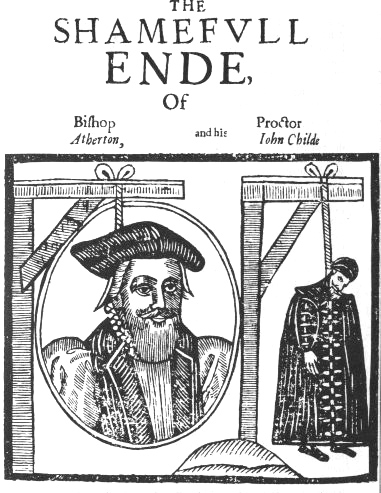
On this date in 1640, John Atherton achieved the unenviable distinction of being the only Anglican bishop hanged for buggery.* (His proctor, and alleged lover, John Childe, got the same treatment a few months later.)


Suppose a Devill from th’infernall Pit,
More Monsterlike, then ere was Devill yet,
Contrary to course, taking a male fiend
To Sodomize with him, such was the mind
Of this Lord Bishop, he did take a Childe
By name, not years, acting a sinne so vilde
-From the text of the pamphlet this image decorates

The Oxford-educated Englishman was appointed Lord Bishop of Waterford and Lismore by King Charles‘s hated governor Thomas Wentworth.

It may well have been the internecine politics of the day that claimed Atherton’s life, just as the civil wars they engendered in the ensuing decades claimed the original trial records.

While posterity is left to speculation, Atherton was defended in print in those years as well. (Defended as no homo, that is — not defended on principle against ubiquitous anti-gay laws.) If it wasn’t really a voracious sexual appetite (not exclusively same-sex**), goes this argument, it was intra-Protestant infighting, with Atherton’s successful clawback of land for the weak Irish Anglican church stepping on the toes of the local land barons who had recently expropriated it.

This politics outside the boudoir argument gets compelling treatment in Mother Leakey and the Bishop, a historical investigative thriller that links Atherton to a weird ghost story† in his native Somerset — that of “Old Mother Leakey,” the Minehead ghost.

Mother Leakey was Atherton’s mother-in-law, and Somerset family members claimed she haunted them — including with a message for the bishop that one of his sisters-in-law actually went to deliver in Ireland. The message isn’t known; in legend, this was a warning from beyond against the prelate’s ungodly behavior; in reality, it was more probably a family shakedown.‡

Despite the skepticism of the Leakey family’s own contemporaries, the facts, allegations, suppositions, and pure flights of fancy somehow managed to blend and recombine into a lasting tale of the paranormal that Minehead still retails to this day.

And it goes right back to the public opprobrium Bishop Atherton endured — as described in that 1641 hanging pamphlet:

“demonstrates the link between the stories of Mother Leakey and Bishop John Atherton … in a highly readable and often entertaining fashion”

… through pride, high fare, and lustfull life,
Incest committed with the Sister of his wife,
For which he sued his pardon, and then fled
To Ireland, where a worser life he led

…

He surely warned was to mend his life,
By his own Sister Master Leakies wife,
Which Master Leakies Mother being dead,
And in her life-time conscious how he led
His lustfull life, her Ghoast in gastful wise
Did oft appeare before her Sisters Eyes,
But she feare-strucken durst not speak unto it,
Till oft appearing forced her to doe it:
Then thus she spake, Mother in Law what cause
You from your rest, to my unrest thus drawes?
Who answered, daughter tis the wicked life
Your Brother leads, warne him to mend his life;
If not, then plainely tell him tis decreed,
He shall be hangd, bid him repent with speede:
Then shall my restless spirit be at rest,
And not till then; Thus vanisht. She addrest
Herselfe for travaile, Into Ireland went
With this sad message unto him was sent:
Which how he tooke to heart may plaine appeare
By the slight answer he returned her,
What must be, shalbe: If I must, I must dye,
Mariage, and hanging, come by destiny.
Thus scoft her counsell, sent her back, and when
Shee was returnd, he grew farre viler then
He was before, if Viler man may be,
For one bad Act before, committed three.

* According to Who’s Who in Gay and Lesbian History, Atherton and Childe were the second pair of alleged homosexual lovers executed in the British Isles. The first was the Earl of Castlehaven in 1631, along with his manservants.

** “[O]ne should note the compound sexual nature of the ‘sodomy’ charge in this context, a portmanteau omnibus of non-procreative sex, which is what ’sodomy’ was widely held to be.”

† Walter Scott footnotes this legend in Rokeby: “Mrs Leakey … dispatched her [daughter-in-law] to an Irish prelate, famous for his crimes and misfortunes, to exhort him to repentance, and to apprize him that otherwise he would be hanged; and how the bishop was satisfied with replying, that if he was born to be hanged, he should not be drowned.”

‡ Archbishop William Laud dispatched a team of ghost-whisperers to investigate the Leakey story well before the ectoplasm hit the fan for Atherton, and they weren’t buying: “certainly it is a fiction and a practice … it may be some money business.” Bishop Atherton had left home under a cloud with the suspicion that he’d had an affair with his wife’s sister, and this was part of the eventual Irish complaint against the horny goat.

On this day..

1896: Fred Behme, evangelical Methodist

On this date in 1896, McLeansboro, Ill. hosted its only hanging.

German emigre Fred Behme was settled into married life when he converted from Catholicism to Methodism.

Unfortunately — so Behme saw it — his wife Mary didn’t hew to the old cuius region, eius religio principle where the man of the house was concerned, and stuck with the bishop of Rome for the salvation of her immortal soul.

And there’s just something about the zeal of a convert.

Fred Behme’s domestic missionary work grew more violent (pdf), and eventually his battered spouse moved out; when Fred coaxed her back, and found out that she’d baptized their infant son into idolatrous Catholicism while living apart from him, he chose Easter Sunday to commit what one newspaper called “one of the most hideous and blood-thirsty crimes that ever stained the good name and honor of McLeansboro”: Fred got the other kids out of the house, he attacked Mary with an axe,

drug her by the hair into the yard, and beat in the side of her head. He covered the body with corn fodder. He then took the little boy [whom Mary had baptized] to the barn and hanged him by the neck until he died. (Source)

Though the hanging was invitation-only, it was visible from McLeansboro’s public square and large crowds gathered to witness the hirsute Protestant check out with a short speech in German.

Wikipedia alleges (without a clear source indication) that one G. Phil Hanna was among this multitude, and that seeing Behme strangle to death on an inexpertly deployed rope launched a lifelong interest in the hangman’s craft that would culminate when Hanna pinch-hit on the execution team that carried out America’s last public hanging 40 years later. Others of less august accomplishment no less vividly recalled their (and their town’s) one-time walk through the valley of death.


The family that prays together … (The perp is the bearded man; the victims are the woman seated next to him, and the child in her lap.)

On this day..

1849: Anna Koch of Appenzell

This date’s pastoral story of adolescent avarice — and impressive disobedience at the scaffold — comes to us from the tiniest of Swiss cantons,* as related in this public-domain text


Anna Maria Koch and Magdalene Fessler were girls — each about seventeen years of age — living in Gonten in the year 1849. On June 12 of that year the dead body of the latter was found lying in a ditch in one of the village pastures. There were upon it no marks of violence, and a coroner’s jury was led to conclude that the girl had come to her death by falling into the ditch in the dark. A little later, the discovery was made that on June 10 Anna Koch had sold to a silversmith in Gonten a chain, a locket, and a rosary. These articles on examination were proved to have belonged to Magdalene Fessler. Anna Koch was placed under arrest and asked to make explanation. The story related by her is as follows: –On the Sunday following Frohnleichnamsfest she met Jean-Baptiste Matezenauer, a young man of the village, and he gave her the articles of jewellery, saying that he had found them. He told her that she must sell the things and put the money in a bag which she was to hide in a field. She must then take with her a friend, stroll through the field and, as though by chance, spy the bag, pick it up and say, “Oh! I have found something!” With the money she was to buy a wedding dress, Matzenauer promising in a short time to marry her. Matzenauer was arrested and confronted with his accuser. He protested innocence, but the girl adhered to her story. She did even more, she enlarged upon it. She said that on the morning of Frohnleichnamsfest she had been in Matzenauer’s company; that he had then told her he meant to kill Magdalene Fessler in the afternoon, and had asked her to station herself in the field where the ditch was. This, she said, she had done, and that while there she saw Matzenauer drag thither the body of his victim. Despite the inherent improbability of her whole account, the girl vehemently reiterated it, each time challenging Matzenauer to a denial. At last the bewildered inquisitorial fathers before whom the examination was being conducted — perhaps with some recollection of the efficacy of torture in eliciting actionable testimony in the case of Landamman Suter — ordered Matzenauer to be brought under the lash. This was done, but without the hoped-for result. Matzenauer remained obdurate.

The case dragged on till November 13. It was then suddenly terminated by the confession of Anna Koch that she alone had planned and committed the murder. The details of the confession were substantially these: –She, a poor girl, had for a long time felt hurt in pride that she had not the money with which to provide herself the chains and trinkets commonly worn by the girls of her acquaintance. So keen was this feeling that finally she resolved to purchase a chain from one of the silversmiths of Gonten and trust to fortune to enable her to pay for it. She obtained the chain, but failing to pay for it by the time agreed on with the silversmith, was asked to return it. The necessity of doing so was fully impending when, on Frohnleichnamsfest, she met Magdalena Fessler in the churchyard, at the beginning of afternoon service. The latter had about her neck a beautiful chain, and Anna Koch, seeing it, was prompted to kill her, take the ornament, sell it, and with the money realised meet her own debt to the silversmith. She told her friend that she had lost her rosary, and asked her to go with her to find it. The two girls walked on together, soon passing into the field containing the ditch. As they were crossing the latter on a plank Anna Koch pushed Magdalene Fessler, causing her to lose her footing and fall into the water. She then jumped into the ditch herself, seized the head of her victim and, holding the mouth open with her fingers, kept the head under water until death ensued from strangulation. Having made her confession, Anna Koch asked that she might suffer the extreme penalty for her crime. Young people of her acquaintance petitioned the Great Council for a pardon. This was refused, the vote standing only six for pardon and ninety-six for punishment. Decree was then entered that the guilty one be beheaded on the block.

The day before that fixed for the execution (the latter being December 3) the condemned girl spent quietly in prayer and in communion with her confessor. She expressed herself as being entirely reconciled to her fate and, in fact, as anxious to meet it. But when led forth on the day of execution, her manner changed. The wild instincts of her Appenzell nature reasserted themselves. She declared that she could not and would not die, and with fierce cries drowned the voice of the officer who read her death-warrant before the people. The reading finished, four strong men seized the girl and bound her on a sled. Thus secured she was dragged to the headsman’s block in the market-place. But here a fresh difficulty was encountered. On being released from the sled her struggles were so frantic and determined that the executioner could not perform his task. After several vain attempts he sent the Reichsvogt (the same mediaeval official personage that had figured at the execution of Dr. Anton Leu and Landamman Suter) to report the situation of affairs to the Great Council and ask advice. The reply returned was that the headsman must do his duty. After an hour and a half of cries and resistance on the part of the condemned, her head was firmly secured to the block by the braids of her hair, and the fatal stroke given.


Gonten (it’s the long collection of buildings along the valley road, at the base of the slope) and environs. (cc) image from Michael Beat.

* Appenzell Innerrhoden is the smallest canton by population, and is larger by area only than the urban canton of Basel-City.

On this day..

1327: Adso’s lover in The Name of the Rose

On an unspecified date presumably around early December of 1327 — the timeframe is approximated by action’s story’s commencing on “a beautiful morning at the end of November” — the Inquisition burns the nameless peasant lover of the narrator in Umberto Eco’s novel The Name of the Rose.

Adso of Melk is apprenticed to the scientific-minded William of Baskerville — a deliberate allusion to Sherlock Holmes — when the monk is dispatched to an Italian monastery to sniff about for heresy.

The Name of the Rose unfolds a labyrinthine murder mystery around a literal labyrinth (a maze-like library) as William and Adso fight crime and the superstitious dogmatism of the Church. Well … William fights these things. Young Adso mostly comes along for the ride and keeps the action signposted for the reader with his cluelessness.

As a teenage boy, Adso has his own demons to confront.

During their short stay at the monastery, Adso has a chance, and scorching, sexual encounter with a peasant girl from the lands owned by the monks. This subplot intersects with a relentless Inquisitor — the real-life historical figure Bernard Gui* — in pursuit of refugee Dolcinians and other heretical types who were actually running around northern Italy at this time.

The long and short of it is that the girl is condemned to the stake as a sorceress on ridiculous circumstantial evidence that the reason-favoring duo is in no position to repel, and that Gui is eager to trump up further to politically muscling Dolcinian-friendly monks.

The very watchable 1986 cinematic adaptation of the novel, starring Sean Connery as Brother William and Christian Slater as Adso, takes some liberties with Eco’s text on the matter of the girl.

In the novel, her execution happens “off-camera” but with a numbing certitude; it’s an evil in the world that no protagonist can prevent, and Adso just has to get used to the idea.

I was tempted to follow her … William, grim, restrained me. “Be still, fool,” he said. “The girl is lost; she is burnt flesh.”

Directly after convicting the girl for witchcraft, and nabbing two heretical monks in the process, Gui departs the convent towards the papacy’s then-residence at Avignon for a gratifying show trial. The monks are the real prize; Brother William prophesies that the girl

will be burned beforehand, along the way, to the edification of some Catharist village along the coast. I have heard it said that Bernard is to meet his colleague Jacques Fournier (remember that name: for the present he is burning Albigensians, but he has higher ambitions), and a beautiful witch to throw on the fire will increase the prestige and the fame of both.

The smitten Adso is heartbroken over this cruelty.

“So the cellarer was right: the simple folk always pay for all, even for those who speak in their favor … who with their words of penance have driven the simple to rebel!”

…

The only sure thing was that the girl would be burned. And I felt responsible, because it was as if she would also expiate on the pyre the sin I had committed with her.

I burst shamefully into sobs and fled to my cell, where all through the night I chewed my pallet and moaned helplessly, for I was not even allowed — as they did in the romances of chivalry I had read with my companions at Melk — to lament and call out the beloved’s name.

This was the only earthly love of my life, and I could not, then or ever after, call that love by name.

The film indulges a happier and very implausible fate for Adso’s hot little number: in this version, the executions take place on-site at the monastery, and other peasants riot, murder the Inquisitor, and free our oblate’s muse. Hey, in a work that’s all about faith, why not a little deus ex machina?

Warning: Spoilers The Name of the Rose is a detective story, and the clips below intercut the execution scene with the mystery’s big reveal. Don’t watch them if you want to approach the film or the book without knowing how it all plays out.

The movie’s softhearted approach has the benefit of allowing a more cinematic and literal presentation of Adso’s choice between the life of the mind/soul and the life of the flesh. The clip below is spoiler-safe, since you already know which one he chooses.

To geek out on this book’s complex tapestry of allusions, you could do worse than this archived study guide.

* Played by F. Murray Abraham in the film. Gui wrote a notable tract on examining heretics; dust off your Latin to read it on Google books here, or get the gist with this English-translated excerpt.

On this day..