1697: Godfrey McCulloch, on the maiden

On this date in 1697, Godfrey McCulloch was beheaded for murder.

A lesser Scotch noble, McCulloch was heir to a family that had seen better times. His forebears had built and laid their [attached] heads at cozy Cardoness Castle, but hard times had seen the Gordon clan foreclose a bum McCulloch mortgage, and that put the families at pistols drawn.*

A minor confrontation between Godfrey McCulloch and Sir William Gordon saw McCulloch plant in Gordon’s leg a bullet wound that festered into a fatal infection.

McCulloch fled to the continent, but eventually — there’s no place like home — returned, and was recognized in Edinburgh.

One boring scaffold speech later, and that was that … unless you credit the legend that his headless body sprang up and ran 100 yards.

McCulloch was beheaded on the Maiden, a guillotine precursor that automated the chopping process.

He seems to have the distinction of being the last person so executed. (Update: Perhaps not.)

* McCulloch, who was also a member of the Scottish Parliament, held a sheriff’s commission in Wigton. Although anti-Covenanter, he washed his hands of the Wigtown martyrs case.

On this day..

1699: William Chaloner, Isaac Newton’s prey

(Thanks to Thomas Levenson of the Inverse Square Blog. Prof. Levenson is head of the Graduate Program in Science Writing at MIT, and author of the forthcoming Newton and the Counterfeiter.)

Early in the morning of March 22, 1699, William Chaloner raged.

Chaloner, a convicted coiner, refused the Newgate Jail Chaplain’s plea to show proper penitence, shouting with “more Passion than Piety,” of his wronged state and unmerited destination (according to his anonymous biographer in the one surviving account of his life). In time, he calmed sufficiently to accept the sacrament, and so proceeded to the execution convoy to be borne from Newgate to the hanging tree at Tyburn (now Marble Arch, just to the west of the old City of London).

There Chaloner’s fury mounted again, and he shouted to the crowd, drawn as always to the spectacle of public hanging days, that “he was murder’d … under pretence of Law.” He mounted the ladder to the top of Tyburn’s gibbet. He prayed, and then pulled the hood over his eyes without aid. When the moment came, the executioner’s men pulled the ladder out of the way and Chaloner dangled, twitching and jumping (the “hangman’s dance”) as long as it took –- minutes, at least — for life to choke out of him. Richer men often paid the hangman to pull on their legs to speed death. Not the destitute Chaloner. He had to choke till he drooped, to the greater amusement of the crowd.

The investigator who had sent Chaloner to the noose was not present; or at least nowhere in his copious notes and letters did he admit to curiosity about the fate of a man whose pursuit occupied him for almost three years. The Warden of His Majesty’s Mint had more pressing duties to perform, and so Isaac Newton allowed the date of Chaloner’s death to pass unmarked.

Isaac Newton? That Newton?
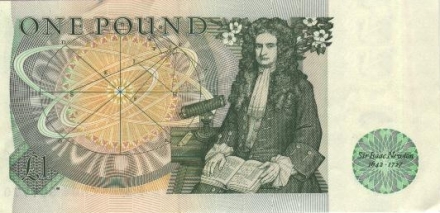

Appropriately, Newton himself wound up on the currency.

The accidents of place and time that brought the man who was recognized in his own day as the greatest mind of the age into conflict with Chaloner, an uncommonly gifted common criminal have fascinated me since I first learned of them through reading Chaloner’s last, piteous letter to the implacable Newton, written days before the hanging. In it Chaloner begged, writing “O dear S[i]r nobody can save me but you O God my God I shall be murderd unless you save me.”

What I wanted to answer was the obvious question: how and why did Isaac Newton come to pass judgment on the life of any other man? I had always thought of him as the nearly cloistered scholar of Trinity College, Cambridge, his home for more than thirty years. It was there he performed the experiments and the calculations that led him, in 1687, to write his masterwork, Philosophiae naturalis principia mathematica the Mathematical Principles of Natural Philosophy — better known simply as the Principia -– as well as pursuing his decades-long program of alchemical research.

So how, I wondered, did he end up in London, wallowing in the muck with the capital’s criminal underground?

Not to put too fine a point on it, finding out has turned into a book Newton and the Counterfeiter, published by Houghton Mifflin Harcourt and scheduled for release on June 4. But, to anticipate that longer story, here is the gist: Newton, after Principia found himself an international celebrity, and, as one of Cambridge University’s representatives to the Convention Parliament of 1689 that legitimized William of Orange‘s seizure of the English throne from the deposed Stuart King James II, he had nearly a year to enjoy the acclaim of London and Europe’s thinking and political elites before returning to the quiet of Cambridge, then a small town of about 5,000 inhabitants. It was an intellectual backwater too, especially compared to the big city in which he encountered figures like Robert Boyle, John Locke, Robert Hooke (whom he despised), Samuel Pepys (whom he did not) and so on. So he started, with Locke’s help, to seek a patronage appointment that would allow him to live comfortably in London. It took six years to find the right one, but ultimately he was offered the Warden’s post at the Mint. That job was supposed to be a sinecure, a nearly no-show position that would pay him a very comfortable wage.

And so it would have turned out were it not for the terribly debased state of England’s silver coinage, which had deteriorated to about half its legal weight for a whole host of reasons. So Newton arrived at a time when (a) the Mint was attempting to recall and recoin the entire stock of silver money for the entire country –- all the smaller units of money essential to everyday transactions –- and (b) coining, counterfeiting, was flourishing as enterprising men and women set out to get rich by filling in the gaps in the money supply with coins that never felt the stamp of an official Mint die. As Warden, it became Newton’s duty to see that legal money was produced fast and fairly, and to pursue all those who set up on their own.

Of those who did none were more technically skilled or ambitious than William Chaloner. His is a fascinating story, told at much greater length in my book, in which you see the currents of rapid economic change, class and ambition all converge within this one, barely remembered life. He was born desperate poor, a weaver’s son in Lincolnshire. He ran from his first apprenticeship to London, where he started out at the very bottom of the criminal ladder, hawking porn on street corners. He rose rapidly, first with his clearly impressive gift of gab, and then, after falling in with someone who knew how to gild surfaces, as the central figure in a series of ever grander schemes to counterfeit gold and silver money. He had sidelines as an informer, betraying conspiracies that he would himself set up, but his central gift and fascination was in the creation of fakes. Ultimately, he was one of the first to recognize the power of paper, and he started to counterfeit a variety of the early experiments with paper money and bank instruments.

In this sense Chaloner’s career –- and Newton’s urgent pursuit of him –- offer a window into the birth of the modern idea of money, of finance. And one of the things that fascinated me about this case is the degree to which this old story tracks some of our immediate problems. England’s and Europe’s economies were in rapid revolution in the late seventeenth century. The old idea of money as a chunk of metal with a pretty picture on it could no longer come close to accommodating the kind of enterprises governments and individuals wanted to undertake, from war to the funding of global webs of trade. And so people came up with all kinds of different ways of trying to represent value and exchange and even the idea of the changing worth of an investment over time. And the people making these experiments did not fully understand the implications of each expedient they tried. The last piece of paper Chaloner counterfeited was called a Malt Lottery Ticket, and it was at once simply paper money, a bond, and a gamble. Traders attempted to value these kinds of things in embryonic financial markets -– which would in a couple of decades blow up in a financial collapse that possess some striking similarities to our current predicament. Newton himself would lose a considerable fortune in that collapse, a sum worth a couple of million pounds, maybe more, in 21st century money.

It was that sense of precariousness that made the pursuit of counterfeiters so urgent in the midst of the late 17th century; England’s money supply was genuinely at risk, and no one had a good grasp of what it would take to make both the daily experience of small transactions and the high finance of war and trade go smoothly. So anyone threatening either or both levels of money was public enemy number one.

Of those who tried their hand at currency crime, Chaloner was the most accomplished, and notorious. By his own admission he counterfeited on the order of 30,000 pounds worth of currency over a seven- or eight-year career, an enormous fortune for the day. His big mistake, though, was to challenge Newton directly, accusing him in public of incompetence or fraud in his management of the recoinage of silver money between 1696 and 1698. He laid that charge both in testimony to Parliament and in a pamphlet he had printed for public distribution, and the scandal could genuinely have wounded Newton, were it not for the influence of his friends in power in Parliament at the moment.

It was enough, certainly, to propel Newton into an extraordinary investigation, an exercise of what may be seen as true non-fiction scientific detection. He set up a net of agents and informers throughout the worst neighborhoods and pubs in London, tracking any instance of coining he could find, interrogating suspects at the Tower or in jail, trying to build a web of connections around Chaloner. That story is contained within a collection of several hundred depositions and summaries of interrogations, all signed by Newton, that have survived, largely unexamined until now. Those records show that it took Newton almost two years in all, but aided in the end by listeners whose lives he held at his disposal inside Chaloner’s cell at Newgate, he managed to collect a sufficient weight of testimony to ensure that he could convict a prisoner clever enough to have escaped several previous attempts at prosecution.

The trial itself was something of a sham. Chaloner had feared being charged on the Malt Lottery Ticket forgery, (as we know from the accounts in Newton’s files of informers in the cells) but Newton actually presented evidence of a coining spree that almost certainly did not take place as described. Among other confounding facts, Chaloner was supposed to have made six different denominations of both silver and gold coins in a single day, which would have involved an enormous confusion of tools and materials that ran counter to basic counterfeiting practice.

No matter: the sheer volume of precise detail that Newton’s witnesses were able (or convinced) to provide produced a conviction within a very short time –- the whole trial took no more than an hour or so on March 3, 1699. There was a truncated appeal process -– really just a request for clemency from the crown, which was denied, and Chaloner’s sentence came down.

Formally, he had been found guilty of high treason, an assault upon the crown in the form of the king’s likeness and authority represented on the face of England’s coins. The punishment for high treason was essentially that suffered by William Wallace of Braveheart fame: to be strangled to the point of death, to be disemboweled whilst still living, to be beheaded and then quartered. By the date of Chaloner’s execution, the punishment had eased this far: convicted coiners were drawn to the place of execution on a rough sledge, subject to all the filth and abuse London’s open-sewered streets possessed; then hung until dead, and then, on rare occasions, to suffer post-mortem dismemberment. Chaloner himself was not, so far as any records revealed, actually cut into pieces. (As a gesture to public decency, women convicted of coining or other capital crimes were not supposed to be hung, lest their twitching at rope’s-end seem lewd. So they were burnt instead – though by the eighteenth century it was common to strangle them to death before lighting the pyre. Mercy, after the fashion of the times.)

Levenson lectures on his book at the MIT Writer’s Series.

One last note in a post gone much too long: Newton was involved in a number of counterfeiting investigations, and by some reckonings at least two dozen people went to their deaths as a result. Some historians, notably Frank Manuel, have speculated that Newton pursued this work with implausible eagerness, out of a kind of frustrated blood lust born of his abandoned and unhappy childhood.

This seems to me to be nonsense. The specific historical context matters here: Newton did not author the bloody code, nor did he send everyone he could to the gallows. Rather, the record of his depositions shows him to be simply a relentless practical man doing his job. He used little fish to catch big fish, and at least some of those low on the ladder received their escape from the gibbet. What you can see here, surprisingly, is the birth of a modern idea of a civil service. The Warden -– even Isaac Newton — was simply a man in a job doing the functions of that job, which included organizing the investigation and prosecution of counterfeiters.

What’s striking, of course, is that this civil servant, this bureaucrat, happened to possess the greatest scientific mind in history. And that’s the real sting in this tale. There is a connection between Newton’s pursuit of counterfeiters and his attempts to understand nature. He did employ the same resources of concentration and logical organization in his criminal investigations that he did when he tackled any problem. But more than the commonality of work habits, there is, I think this link: Newton can be seen as many people: the mathematician, the theoretical physicist, the empirical experimentalist, the alchemical mystic, the heretically devout religious thinker –- and the government functionary too.

And yet he was, of course, a single man, one with many interests, but ultimately with a consistent ambition, to reduce to order the complexity of any problem which was posed to him. Newton did not expect as Warden to have to chase crooks; when he found out that was part of the job he wrote a rather whiny letter to the Treasury to see if he could wriggle out of the duty. When he found he could not, he responded as he always had to the job at hand.

As one consequence, on this day three hundred and ten years ago, William Chaloner died.

On this day..

1809: Mary Bateman, the Yorkshire Witch

It’s the bicentennial today of the unnatural passing of the Yorkshire witch.

Mary Bateman ran her fraudulent fortune-telling business under the name “Mrs. Moore”, and had some years’ success separating fools from their money without running afoul of the law.

In fact, she outlived her fatal crime — plying with poisoned puddings a bilked couple, lest they realize their medium was defrauding them — by months, even continuing to leach money off the surviving husband after her ministrations had killed the wife.

Let’s just say she knew how to pick her clientele.

When the sucker finally got wise to the scam,* the jig was up for Mary in a sensational trial. (It’s recounted at length here — and capped by what must have a grimly comic spectacle when Mary attempted to plead her belly and the women in the courtroom bolted for the exits to avoid impaneling on a jury of matrons to adjudge the claim. The judge ordered the doors shut up before his jury pool could escape.)

Three days after conviction, she was hanged at York Castle before a crowd of thousands, who subsequently paid (.pdf) to see her corpse (and to get cured cuts of her skin as charms: even unto death, Mary had ’em swallowing her snake oil).

After execution, Mary Bateman’s body was given over for dissection in Leeds — remaining a curio worthy of public preservation to this day at that city’s Thackray Medical Museum. (Update: The museum reports that Ms. Bateman’s remains were only on loan from Leeds University, and have since been returned.)

* Source of enlightenment? Not the death of his wife, but the fact that magical financial windfalls promised by the Yorkshire witch had failed to materialize after two-plus years of paying her.

On this day..

1789: Catherine Murphy, Britain’s last burning at the stake

On this date in 1789, Catherine Murphy was led past the hanging bodies of her husband and their other male codefendants at Newgate Prison, secured to a stake, and put to the last burning at the stake in English history.

The convicted coiners — counterfeiting rated as high treason at the time — were the last heirs to gender-specific execution methods before the Treason Act of 1790 gave coin-shaving ladies equal access to the halter.

Though Murphy thereby earned an unenviable historical footnote, the de facto practice on the scaffold had long since been changed to spare lawmen the spectacle of a woman roasting to death. Murphy, in fact, was killed by hanging — and the “burning” part of the sentence only imposed upon her corpse. (This, however, was still more than enough: NIMBYing prison neighbors appalled by the stench of burning flesh had lent their support to the Treason Act’s reforms.)

On this day..

2005: Mohammed Bijeh, the desert vampire

On this date in 2005, Iran “desert vampire” was flogged to the point of collapse and hanged before a bloodthirsty throng in Pakdasht.


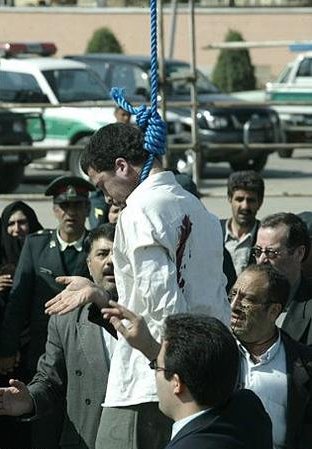
Mohammed Bijeh collapses during his flogging (top); then, as he is hoisted by a crane — with what one would take to be the stab wound from a victim’s brother visible on his back. More frightful photos of this execution here.

Bijeh confessed to raping and murdering 16 boys age 8 to 15 over a yearlong spree.

His modus operandi? Lure them into the desert on the pretext of hunting animals.

Unsurprisingly a figure of intense public hatred, Bijeh stolidly endured his own death before a jeering mob.

Riot police held back the angry crowd, but at one point a brother of one of the victims managed to break through and stab Bijeh in the back.

After 100 lashes, the desert vampire was noosed to a crane arm by one of the victims’ mothers, and hoisted 10 meters into the air for public strangulation, to the cheers of onlookers who had to be restrained from savaging the body when it was finally brought down.

An accomplice, Ali Baghi, somehow avoided execution and got off with whipping and a prison term.

On this day..

1551: Alice Arden, husband killer

On this date in 1551, Alice Arden was put to death for one of 16th century England’s most shocking crimes.

Stuck in what one gathers was a dull marriage of political convenience, Alice Arden took up with a lover, Richard Mosby.

Although the whole scene was tolerated by her husband, Alice and Richard conspired to have Thomas murdered, because nobody would ever suspect the vivacious wife and her paramour to be behind the unexplained death of her husband. (And, Alice reckoned, Thomas “was so evil beloved that no man would make inquiry after his death.”) Holinshed‘s chronicle saw fit to include this tabloid-esque crime in its narrative of English history.

Arden’s wife, Mistress Alice, young, tall, and well favoured of shape and countenance, formed a criminal connection with a paramour, named Mosbye, a black, swart man. Mosbye had been servant to Sir Edward North, Alice’s father in law; and then settled as a tailor in London. The infatuated wife, lost to all sense of duty and morality, conspired with Mosbye to put an end to her husband’s existence, in order that she might marry the profligate black, swart man.

They employed as their confederates one John Green, a Faversham tailor; George Bradshaw, a goldsmith of the same town; and one Black Will, of Calyce (Calais), a murderer, which murderer was privily sent for to Calyce by the earnest sute, appoyntment, and confederate of Alice Arden and Thomas Mosbye.

The conspirators watched Master Arden walking in Poule’s (St. Paul’s Cathedral, the nave of which was a public promenade in those days), but could not find an opportunity to murder him; they then lay in wait for him on Rainham Down, and a second time in the Broomy Close (two places near Faversham), but on all these occasions failed in obtaining an opportunity.

The wicked wife then laid a plot for murdering her husband in his own house. She procured the services of Mosbye’s sister, Cicely Pounder, and of two of Arden’s domestic servants, Michael Saunderson and Elizabeth Stafford. On a particular day selected Sunday, too Black Will was hidden in a closet at the end of Arden’s parlour. After supper, Arden sat down to play some kind of game with Mosbye; Green stood at Arden’s hack, holding a candle in his hand, to shaddowe Black Will when he should come out; and the other conspirators had their cue. At a given signal in the game, Black Will came with a napkyn in his hand, and sodenlye came behind Arden’s back, threw the said napkyn over his hedd and face, and strangled him; and forthwith Mosbye stept to him, and strake him with a taylor’s great pressing iron upon the scull to the braine, and immediately drew out his dagger, which was groat and broad, and therewith cut the said Arden’s throat.

Having failed to convincingly position the body, and thereby leading police straight back to her house, Alice was immediately implicated in the crime. The conspiracy unraveled and the various people involved were brought to swift and merciless justice, including one poor bastard who had known nothing of the plot but had inadvertently supplied the credentials of that colorful assassin “Black Will” by decrying him as a murderous villain.

Alice Arden herself was burned in Canterbury while her confederates suffered various executions in various places around a country duly scandalized by the bold crime.

Six lives were taken for that of a worthless miser who connived at his wife’s infidelity. It was a sign of the horror inspired by husband murder among the Elizabethans. (Source*)

Indeed, the homicide and resulting executions kept as public scandal so long that the tale was reproduced as an Elizabethan tragedy, Arden of Faversham, in the 1590’s.

A possible uncredited Shakespeare play, it can be read for free in The Shakespeare apocrypha

Gentlemen, we hope youle pardon this naked Tragedy,
Wherin no filed points are foisted in
To make it gratious to the eare or eye;
For simple trueth is gratious enough,
And needes no other points of glosing stuffe.

FINIS.

Intriguingly, Richard Helgerson argues in Adulterous Alliances: Home, State, and History in Early Modern European Drama and Painting that this play restores some relevant political context to the Arden crime that Holinshed, perhaps deliberately, obscures. The Arden of Faversham victim is an apparatchik of the Duke of Somerset, a connection perhaps exaggerating Thomas Arden’s rank but not his position as the king’s man, with some important sponsors. Alice Arden and Richard Mosby, too, were national-level elites, Helgerson says.

The very (still-standing) Arden house was obtained through the English Reformation‘s dissolution of the monasteries; the London transplant Arden apparently used his (some must have felt) ill-gotten lands and power to impinge upon the prerogatives of his neighbors.

Helgerson doesn’t quite have an ah-ha conclusion to the tale, but the suggestion of a more layered meaning lurking behind what typically plays as straight Tudor police blotter throws a different light on the affair.

Arden’s appropriation of the abbey lands in Faversham finds its counterpart in Mosby’s appropriation of Alice Arden’s body … Seen this way, adultery is no longer a purely private crime … [but] rather a vehicle for thinking about history, for thinking, in particular, about that “improvement in the sovereignty” that was responsible both for the emergence of politic history and for the dissolution of the English monasteries, including Faversham Abbey.

* This source also supplies the date of March 14. However, the date is difficult to come by generally, and it may not be fully dependable.

On this day..

1858: Felice Orsini, Italian revolutionary

On this date in 1858, Italian revolutionary Felice Orsini calmly lost his head for the nation.

Something of a celebrity revolutionary, Orsini joined the independence movement of Giuseppe Mazzini and embarked on a generation’s worth of conspiracy, covert operations and prison spells and prison breaks which he himself voluptuously recounted in hot-selling autobiographical tomes.

Orsini became convinced that French ruler Louis Napoleon* was the chief obstacle to Italian unification, and accordingly chucked a bomb at the dictator’s carriage on January 14, 1858.

Ever theatrical, the condemned Orsini addressed a letter to Louis Napoleon while awaiting execution. In it, he urged the emperor to take up the Italian cause.

Whether mindful of the prospect of another Orsini waiting for his carriage, remembering his own youthful plotting with the Italian carbonari, or simply for reasons of French statecraft, Napoleon did just that. His alliance with the Piedmont state in northwest Italy (for which France received Savoy and the French Riviera in exchange) helped it absorb most of what now constitutes the Italian state.

Within three years of Orsini’s death, only a reduced papal enclave around Rome and the Austrian holdings around Venice separated the peninsula from unification.

In life, Orsini had been a prominent advocate of the Italian cause and played to packed houses in England. In death, he was felt further afield than that.

Tacking to a moderate stance on slavery abolition ahead of his presidential campaign, Abraham Lincoln condemned the late radical abolitionist John Brown as another Orsini — “an enthusiast [who] broods over the oppression of a people till he fancies himself commissioned by Heaven to liberate them. He ventures the attempt, which ends in little else than his own execution.”

Among Lincoln’s officers in the coming Civil War would be Charles DeRudio, the anglicized name of Orsini co-conspirator Carlo di Rudio.

Di Rudio had drawn a death sentence himself for the Orsini plot but was spared (pdf) by the clemency of his intended victim. He would go on to fight in the Battle of the Little Bighorn where he once again managed to cheat death.

* aka Napoleon III. He was the grandson of Josephine’s guillotined first husband.

On this day..

1960: Hoang Le Kha, NVA cadre

On this date in 1960, the former French colony of Vietnam made its last use of that most characteristically Gallic killing-machine: the guillotine.

Communist cadre Hoang Le Kha of the Vietnam People’s Army — the insurgent force also known at different times, in different manifestations, and through different eyes as the Viet Minh, the North Vietnamese Army (NVA) and the Vietcong* — earned the unpleasant distinction. According to a disappointingly truncated article (.pdf) from the Texas Tech University Vietnam Archive, the beheading took place notwithstanding an appeal pending before the International Control Commission, the multinational body charged with overseeing the supposedly temporary partition of Vietnam.

So, six years after Dien Bien Phu, what was independent Vietnam using this hated machine for?

Why, the same thing the French used it for: Terror.

The demonstrative device was redeployed in 1959 by Ngo Dinh Diem — a man whose obliviousness to blowback would soon land him in these pages — for exacting frightful, visible justice on subversive types.

According to that troubled former Secretary of Defense Robert McNamara,

On May 6, 1959, Diem signed Law 10/59, which, in an ironic bow to the former French colonial masters, inaugurated the era of death by beheading, as Diem’s lieutenants traveled the countryside with mobile guillotines and platforms, looking for “communists.” Article 1 of Law 10/59 called for “sentence of death, and confiscation of the whole or part of his property” for anyone convicted of crimes ranging from murder to stealing farm implements and water buffalo. Article 3 proclaimed that anyone belonging to “an organization designed to help to prepare or to perpetrate” such crimes “will be subjected to the sentences provided for” — that is, they will also be beheaded. … Article 16 announced: “The decisions of the special military court are not subject to appeal, and no appeal is allowed to the High Court.”

He then cites Hanoi historian Tran Van Giau’s recollection of the period.

“In 1959, the most difficult period of the revolution in South Vietnam, the Ngo Dinh Diem puppet regime dragged the guillotine everywhere and carried out a bloody fascist repression.”

Though officially downplayed overseas, all-but-summary beheadings were intentionally publicized in Vietnam in an effort to cow rebels.

The Diem government had many public executions. A lot of people in the West denied that it happened but Diem made no bones about it. They advertised the executions and there were pictures in the paper of people getting their heads chopped off by a guillotine. … In 1959, when I went around with the map teams there were many military outposts where they summarily chopped off the heads of people they thought were Communists. They put the heads on stakes right in front of their outposts, sometimes with two cigarettes up the nostrils. They even invited people to take pictures of it. They were very proud of themselves.

It didn’t work.

As a result, the guillotine itself, an archaic French model, can be seen among other dreadful mementos of that horrific war at Ho Chi Minh City’s War Remnants Museum.

Right alongside it is a picture of Hoang Le Kha.

(Many images — some of them graphic or disturbing — available at this Vietnamese page.)

* This is a very hasty lumping-together; the terms are not synonymous.

On this day..

1615: St. John Ogilvie

On this date in 1615, Scotland’s only post-Reformation Catholic martyr was hanged at Glasgow Cross.

The Protestant-born Ogilvie had been educated in Europe and there fallen under the sway of the Catholic faith forbidden in his homeland. He converted, trained as a Jesuit, and at his own request returned to minister to the secret Catholic population in Glasgow.

Within a year he was in irons, awaiting a death sentence he refused to spurn with a timely submission to King James‘ spiritual supremacy. Ogilvie greeted his conviction for treason — and like most Catholic martyrs in the British Isles, he protested his loyalty in vain — with the words,

God have mercie upon mee! … if there bee heere anie hidden catholikes, let them pray for me, but the Prayers of Heretickes I will not have.


John Ogilvie? (See Update below)

There’s a multilingual Jesuit text celebrating Ogilvie available free from Google books.

Glaswegians can watch for more demonstrative tribute at St. Andrew’s Cathedral, which is poised to produce a monumental mural by Peter Howson.

Part of the Themed Set: The Church confronts its competition.


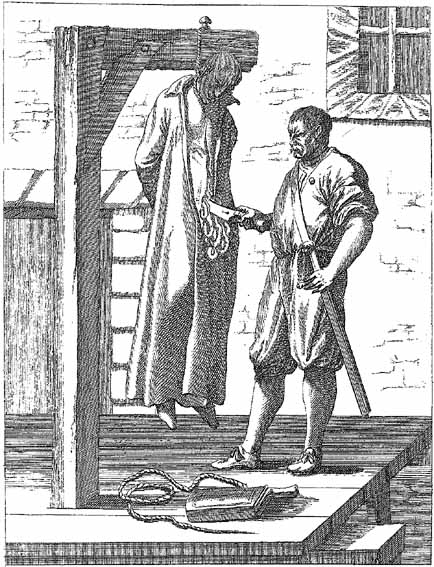
Update: Friend of the blog Louise Yeoman, whose guest post on a witchcraft execution remains one of the best pieces in this humble space, has an interesting correction to offer on Saint J.O. According to Yeoman, disemboweling “was not part of Scots law until 1708, when the British government wanted to hang draw and quarter some of those involved in the abortive Jacobite uprising of that year and were shocked to find that Scotland had no such penalty.” She’s backed by this contemporaneous account of Ogilvie’s death, which observes that even the “quartering” part of the sentence was not carried out.

So, what gives with the image, if Ogilvie’s corpse wasn’t carved up?

It’s from this (U.S.) Library of Congress page which marks it as a representation of Ogilvie in a late 17th-century text of Bohemian Jesuit propagandist Matthias Tanner. That provenance, of course, would be consistent with a bit of sanguinary exaggeration. It’s also possible that it’s mislabeled on the Library of Congress page, whose identification of it seems a bit oblique.

Working as I am from secondary sources, I tread cautiously here and welcome further clarification or correction.

On this day..

1323: Andrew Harclay, too chummy with the Scots

On this date in 1323, Andrew Harclay was hanged, drawn and quartered in London for having attempted to conclude peace with Scotland.

A commoner whose abilities lifted him into the nobility, Harclay may have been northern England’s ablest military commander during ceaseless warfare between Robert the Bruce of Scotland (yes, that one) and the English King Edward II, the latter struggling to maintain the conquests of his father, Edward I “Longshanks”.

It was the defeat of a domestic enemy — Edward had no shortage of foes — that elevated Harclay into the peerage; he engineered English victory at the Battle of Boroughbridge over the rebellious Earl of Lancaster.

Campaigns against the Scots were less to the king’s liking; Robert the Bruce consistently thwarted English expeditions, establishing an ever-firmer grasp on Scotland and raiding into the frontiers — Harclay’s lands included. Settlement of the fruitless conflict was the order of the day, and it was Edward’s intransigence that withheld it. As a century-old volume on England’s political history puts it, “To such a pass had England been reduced that those who honestly desired that the farmers of Cumberland should once more till their fields in peace, saw no other means of gaining their end than by communication with the enemies of their country.”

Secretly, Harclay ventured to work out the terms of a peace with Scotland, an act outside his station which he evidently intended to present as a fait accompli. Here is the contemporaneous account from the Chronicle of Lanercost:

Wherefore, when the said Earl of Carlisle perceived that the King of England neither knew how to rule his realm nor was able to defend it against the Scots, who year by year laid it more and more waste, he feared lest at last he [the king] should lose the entire kingdom ; so he chose the less of two evils, and considered how much better it would be for the community of each realm if each king [Edward II and Robert the Bruce] should possess his own kingdom freely and peacefully without any homage, instead of so many homicides and arsons, captivities, plunderings and raidings taking place every year. Therefore on the 3rd January [1323] the said Earl of Carlisle went secretly to Robert the Bruce at Lochmaben …

Now the Earl of Carlisle made the aforesaid convention and treaty with the Scots without the knowledge and consent of the King of England and of the kingdom in parliament; nor was he more than a single individual, none of whose business it was to transact such affairs. … But after all these things had been made known for certain to the King and kingdom of England, the poor folk, middle class and farmers in the northern parts were not a little delighted that the King of Scotland should freely possess his own kingdom on such terms that they themselves might live in peace. But the king and his council were exceedingly put out (and no wonder!) because he whom the king had made an earl so lately had allied himself to the Scots, an excommunicated enemy, to the prejudice of the realm and crown, and would compel the lieges of the King of England to rebel with him against the king; wherefore they [the king and council] publicly proclaimed him as a traitor.

….

[A]lbeit he merited death according to the laws of kingdoms, his aforesaid good intention may yet have saved him in the sight of God.

Debate continues over just how treasonous — grossly so, or only “technically” — was this fatal negotiation; that it was practical cannot be gainsaid. Twelve weeks after Edward sent this key noble to the block for his unauthorized collaboration with the enemy, England herself concluded a similar truce. Although this version did not acknowledge the Bruce’s kingship, the peace it established would, ere the decade was out, lead to England legally recognizing Scotland’s independence.

On this day..