1894: Auguste Vaillant, bomb-throwing anarchist

“For too long a time, our voice is responded to with prison, the rope or the fusillade, but don’t delude yourselves: the explosion of my bomb is not only the cry of Vaillant in rebellion, but is the cry of an entire class that calls for its rights and will soon join its acts to its words.”

–Auguste Vaillant

On this date in 1894, bomb-throwing anarchist — literally — Auguste Vaillant was beheaded in France.

The preceding December, the young Vaillant (French Wikipedia link) went from impoverished obscurity to national bogeyman by hurling a bomb into the Chamber of Deputies — reprisal for the 1892 execution of the anarchist Ravachol.

This bomb’s symbolic effect greatly exceeded its injury to life and limb: Vaillant said he had not been intending to kill, and in fact he did not. (Vaillant himself was among the wounded. His nose was blown off.)

But his political affiliations brought a suppression of anarchists and their press, and, of course, this day’s operation of the guillotine.*

“Mort à la société bourgeoise! Vive l’anarchie!”

Vaillant’s dying sentiment was taken up by Emile Henry, who bombed a Paris cafe the next week, and Sante Geronimo Caserio, an Italian immigrant who assassinated French President Marie Francois Sadi Carnot four months later.

* “Between the time of Vaillant’s arrival at the guillotine and the closing of the baskets containing his remains,” says the New York Times’ account, “scarcely more than twenty seconds elapsed.”

On this day..

1968: Nguyen Van Lem

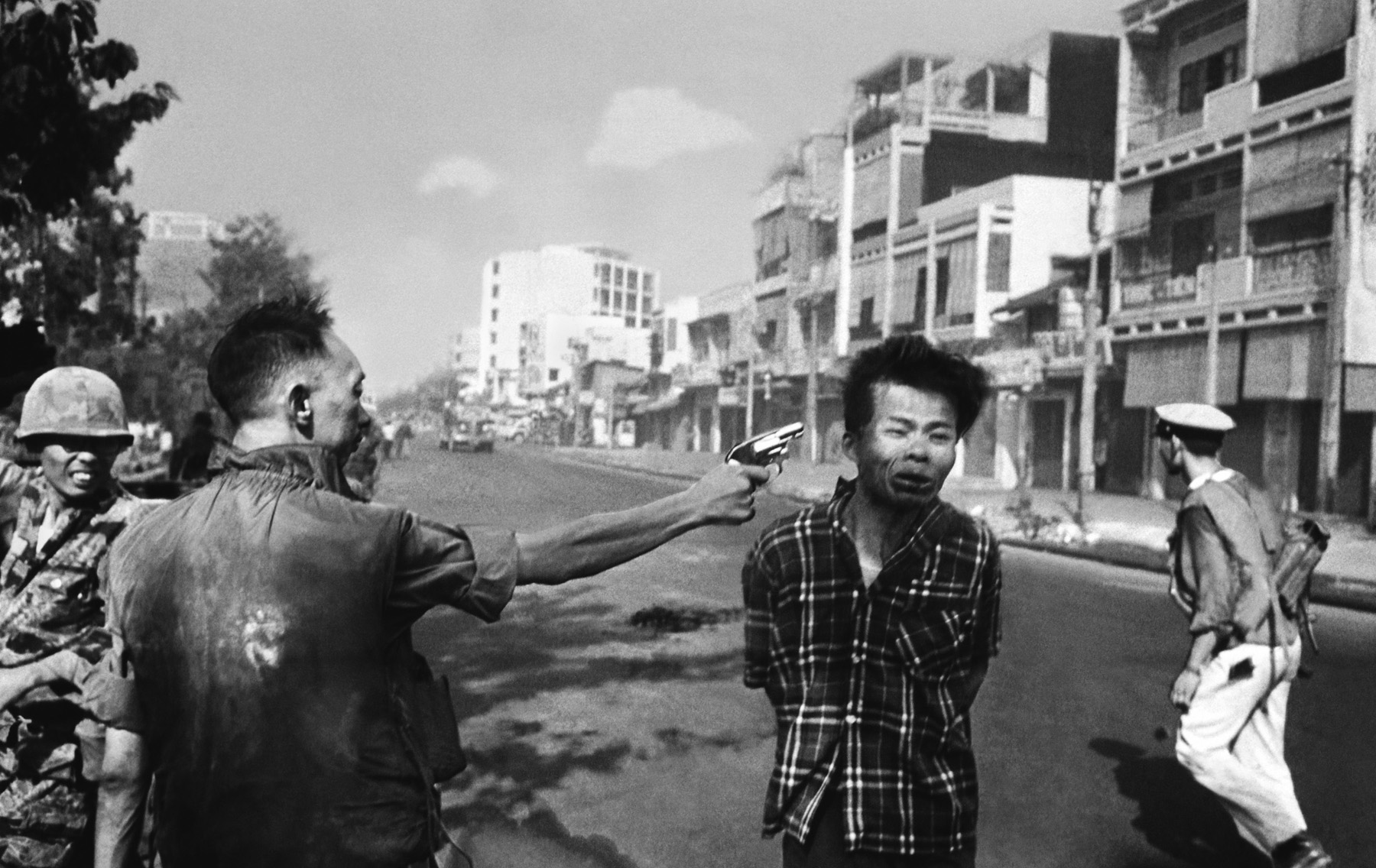
Around noon of February 1, 1968, in the opening days of the communist Tet Offensive, South Vietnamese General Nguyen Ngoc Loan summarily executed a Viet Cong prisoner on the streets of Saigon — and photographer Eddie Adams captured perhaps the war’s most unforgettable image.

An American cameraman also captured it in on celluloid. Caution: This clip shows … well, a man being shot in the head at point-blank range.

Though the image brought Adams the Pulitzer Prize, he would express discomfort with it later in life, and eulogized General Loan in Time magazine when he died in the U.S. in 1998.

The general killed the Viet Cong; I killed the general with my camera … photographs do lie, even without manipulation.

For Adams, the lie was the omission of context — that the plainclothes Lem had allegedly just been caught having murdered not only South Vietnamese police but their civilian family members; that Loan was a good officer and not a cold-blooded killer.

Adams’ editor has said that many such summary executions were taking place during the Battle of Saigon — a broader context to the image no matter its specific fairness to the executioner.

But of course, the shot gained its deeper resonance from the growing disgust with the Vietnam War … and from its concise tableau of a century’s brutality. Here is a frozen image of Orwell’s boot stamping on a human face, forever.

Like any great work of art, Adams’ serendipitous photograph took on a life of its own … and a tapestry of meanings richer than its creator could ever have intended.

On this day..

1661: Oliver Cromwell, posthumously

On this anniversary date of King Charles I’s beheading, the two-years-dead corpse of the late Lord Protector Oliver Cromwell was hung in chains at Tyburn and then beheaded, along with the bodies of John Bradshaw and Henry Ireton.

The great-great-grandnephew of ruthless Tudor pol Thomas Cromwell rose higher than any English commoner, high enough to be offered the very crown he had struck off at Whitehall. Oliver Cromwell declined it in sweeping Puritan rhetoric just as if he hadn’t spent weeks agonizing over whether to take it.

“I would not seek to set up that which Providence hath destroyed and laid in the dust, and I would not build Jericho again.”

The House of Stuart never could rebuild its Jericho while the Lord Protector ran the realm* — thirteen years, writes Macaulay, “during which England was, under various names and forms, really governed by the sword. Never, before that time, or since that time, was the civil power in our country subjected to military dictation.”

“Cromwell lifting the Coffin-lid and looking at the body of Charles I”, by Hippolyte (Paul) Delaroche — a French painter with an affinity for English execution scenes. The painting is based on an apocryphal but irresistible legend, also used by Nathaniel Hawthorne in a tedious short story.

And not only England. Cromwell’s prodigious depredations in Ireland — justifiably or not — remain a source of bad blood.

The English Commonwealth foundered after Cromwell’s death, however, and restoration of the monarchy — a rock, as it turned out, on which the Puritans’ bourgeois revolution could erect its colossus — came with the price of a few examples being made.

Of course, “executing” dead guys displays about as much strength as it does sanitation, and for all Charles II‘s demonstrative vengeance, the politically circumscribed throne he resumed was very far from his father’s dream of absolutism. Between the late dictator and the new king, the future belonged to the corpse clanking around on the gibbet.

When the able Charles II followed Cromwell into the great hereafter, his brother James II promptly fumbled away the crown with his anachronistic insistence on royal authority and his impolitic adherence to Catholicism.**

In the emerging England of the century to come, the divine right would depart the Stuarts for another dynasty more amenable to the rising authority of the parliament whose sword Oliver Cromwell once wielded.

* Resources on the particulars of Cromwell’s career, the English Civil War, et al, are in plentiful supply online. This BBC documentary is a very watchable overview: part I; part II; part III; part IV.

** James II remains England’s last Catholic monarch.

On this day..

1795: Unspecified Robespierrists

On this date in 1795, a Balzac story La Comedie humaine reaches its climax as the tumbrils of the Thermidorian Reaction wind their way to the scaffold.

In “An Episode Under the Terror”, a mysterious man appears to a priest in hiding and prevails upon him to say a secret mass for the recently executed Louis XVI.

It transpires in an exchange between the two that the stranger’s own conscience is somehow troubled.

“Remember, my son, [said the abbe] that it is not enough to have taken no active part in the great crime; that fact does not absolve you. The men who might have defended the King and left their swords in their scabbards, will have a very heavy account to render to the King of Heaven — Ah! yes,” he added, with an eloquent shake of the head, “heavy indeed! — for by doing nothing they became accomplices in the awful wickedness—-”

“But do you think that an indirect participation will be punished?” the stranger asked with a bewildered look. “There is the private soldier commanded to fall into line — is he actually responsible?”

We have no more answer in the text than we have in life.

Spoiler (That You Saw Coming) Alert

The stranger returns on the anniversary of the king’s martyrdom, but he remains enigmatic, until the abbe is caught up in a crowd watching the procession to the guillotine.

“What is the matter?” [the abbe] asked Madame Ragon.

“Nothing,” she said; “it is only the tumbril cart and the executioner going to the Place Louis XV. Ah! we used to see it often enough last year; but to-day, four days after the anniversary of the twenty-first of January, one does not feel sorry to see the ghastly procession.”

“Why not?” asked the abbe. “That is not said like a Christian.”

“Eh! but it is the execution of Robespierre‘s accomplices. They defended themselves as long as they could, but now it is their turn to go where they sent so many innocent people.”

The crowd poured by like a flood. The abbe, yielding to an impulse of curiosity, looked up above the heads, and there in the tumbril stood the man who had heard mass in the garret three days ago.

“Who is it?” he asked; “who is the man with—-”

“That is the headsman,” answered M. Ragon.

Meaning (though unnamed as such by Balzac), the phenomenally prolific Sanson.

On this day..

1552: Edward Seymour, deposed Lord Protector

The set of any given Tudor-era costume drama is a walking Who’s Who of scaffold superstars, most notably, of course, the wives of Henry VIII. That king’s bed did not cease exuding power and danger with Henry’s death.

With Henry’s demise, the crown fell to the only legitimate son the old man had produced in a lifetime of trying, the sickly 9-year-old Edward VI, son of Henry’s beloved* third wife Jane Seymour.

Jane’s brothers had leveraged their late sister’s favor into political muscle, and Edward Seymour smoothly outmaneuvered rival factions late in Henry’s life to set himself up as the true ruler of England during the boy king’s regency.

Created Duke of Somerset and Lord Protector,** Edward ran the country for going on three years, executing the other Seymour sibling as a rival along the way.

But the power of the king’s office without the attendant legitimacy turned out to be a double-edged blade.

Edward inherited a campaign against Scotland (and France) to secure the betrothal of the king to the young Mary Queen of Scots, then just beginning her own lifetime as a political and matrimonial football.

That wearisome (and costly) military scenario could only exacerbate the enmities a somewhat tin-eared Somerset generated in the course of everyday politics at the treacherous Tudor court. Catholics resented his liberal religious policy (Thomas Cranmer produced the first Book of Common Prayer on Edward Seymour’s watch); noble rivals wheedled and flattered the youthful king in his charge; and Edward Seymour’s populist political style rubbed stodgier nobles the wrong way without quite satisfying discontent among commoners† who rebelled widely in 1549, a year of terrible harvests and economic breakdown. By October of 1549, he had been politically isolated and was supplanted by John Dudley. (Guess what happened to him.)

Interestingly, that transition initially looked to be as bloodless a coup d’etat as 16th century England could enjoy: Seymour did a couple months in the Tower of London but accepted his place and not only rejoined the Privy Council but dynastically married his daughter to Dudley’s heir.

All it took, however, was an ounce of paranoia on Dudley’s part to suspect the former Lord Protector of plotting against him. The peers of the realm wouldn’t convict him of a trumped-up treason charge, but “compromised” with a felony conviction that had, for old man Somerset, the exact same result.

We have an account of the Duke’s oddly portentous end from diarist Henry Machyn, whose record of the scene in the original text of Early Modern English we present here beside its “translation” — courtesy of Machyn diaries here and here.

[The xxij of January, soon after eight of the clock in the morning, the duke of Somerset was beheaded on Tower hill. There was as] grett compeny as have bene syne . . the kynges gard behynge there with ther ha[lbards, and a] M1. [i.e., a thousand] mo with halbards of the prevelege of the Towre, [Ratcliffe,] Lymhowsse, Whyt-chapell, Sant Kateryn, and Strettford [Bow], as Hogston, Sordyche; and ther the ij shreyfs behyng th[ere present] seyng the execusyon of my lord, and ys hed to be [smitten] of, and after shortely ys body was putt in to a coffin, [and carried] in to the Towre, and ther bered in the chyrche, of [the north] syd of the qwyre of sant Peters, the wyche I beseeche [God] have mercy on ys sowlle, amen! And ther was [a sudden] rumbelyng a lytyll a-for he ded, as yt had byn [guns] shuttyng [i.e., shooting] and grett horsys commyng, that a M1. [i.e., a thousand] fell [to the] grond for fere, for thay that wher at the on syd [thought] no nodur butt that one was kyllyng odur, that [they fell] down to the grond on apon anodur with ther halb[ards], they thought no nodur butt that thay shuld . . . . . sum fell in to [the] dyche of the Towre and odur plasys, . . . and a C. [i.e., 100] in to the Towre-dyche, and sum ran a way for [fear.] He [the Duke of Somerset] was beheaded soon after eight o’clock in the morning, being brought to his execution the sooner to prevent the concourse of the people, who would be forward to see the last end of one so well beloved by them. It was the greatest company as have been seen. The King’s guard being there with their arms, there were a thousand more with halberds of the privilege of the Tower, from Ratcliff, Limehouse, Whitechapel, St. Katherine, and Stratford Bow, as Hoxton, Shoreditch.

And there the two sheriffs being there present seeing the execution of my lord. And his head to be off. And after shortly his body was put into a coffin and carried into the Tower and there buried in the church of the north side of the choir of St. Peter. The which I beseech God have mercy on his soul. Amen.

And there was a sudden rumbling a little before he died as it had been guns shooting and great horses coming, that a thousand fell to the ground for fear. For they that were at the one side thought no other but that one was killing other. That they fell down to the ground, one upon another with their halberds. They thought no other but that they should flee. Some fell into the ditch of the Tower and other places, and a hundred into the Tower ditch, and some ran away.

* Henry was buried next to Jane, a meek spouse who had stayed out of politics, given him an heir, and died from the birth.

** Not the realm’s most famous Lord Protector, of course, but the last to exercise the office as it had been traditionally understood, for the protection of an underage sovereign.

† Notably, Somerset ordered a commission to look into nobles enclosing common land, a burning issue throughout the century. Some think this raised hopes in the hoi polloi for a resolution to the great class conflict that the Duke didn’t have the juice to implement.

On this day..

1758: Francois Macandal, forgotten black messiah

(Thanks to Mark Davis of macandal.org for the guest post on a remarkable historical parallel to today’s inauguration of Barack Obama. -ed.)

The world was astounded when Barack Obama was elected to the Presidency in 2008 knowing the cultural barriers minorities have faced for hundreds of years. The date of inauguration, January 20, also happens to be the anniversary of the burning at the stake of a virtually unknown man, Francois Macandal,* whose epic war against cultural barriers has been buried for centuries.

Read some of his story and judge if the historic election of Barack Obama could have occurred without the man they called “Macandal.”

The parallels with Barack Obama’s journey are numerous, but the life of Macandal was perhaps even more remarkable, reaching great heights and falling into the darkest chasms of despair, yet succeeding in spite of staggering odds. Macandal’s travails may be about finding one’s purpose and dreaming of victory even when condemned by a majority, as he was relentlessly pursued by soldiers and hounded by countless naysayers.

251 years ago on January 20, 1758, Macandal was chained to a post on a platform before thousands of slaves brought together to witness his brutal torture and execution. Because of his importance, the French gathered slaves from hundreds of plantations throughout the colony of St. Domingue (now Haiti and the Dominican Republic). They believed such a horrific spectacle would quash Macandal’s Revolution, which he began to end French rule and abolish slavery, 12 years before.

Around 1746 Macandal escaped his plantation, united thousands of escaped slaves along with many still enslaved, and proclaimed that he would lead them all to independence and freedom. This declaration, from someone who had only six years before been taken from his home in the Congo, was unprecedented, since no slave colony had ever defeated a European nation. Then Macandal mobilized tens of thousands and may have inspired millions to end slavery and defeat colonial hegemony in the Haitian Revolution consummated decades after his death.

But ironically even the famous, black Marxist writer C.L.R. James, attributed one of the greatest revolutions in history to something akin to ‘spontaneous rioting’ by 500,000 black slaves in 1791. Since 1791 almost every historian has reduced the “Haitian Revolution,” the only successful overthrow of a colonial power by black slaves, to a ‘collective rage,’ inspired by the whites of the “French Revolution.” Yet it may have been Macandal’s Revolution, not the starving peasants of France, that inspired their uprising in 1789.

The true story of Macandal represents obscure but recorded testimonies about his life and explains why the slave revolt of 1791 was in fact, “Macandal’s Revolution,” almost 50 years in the making. Macandal foretold the end of slavery, then planned it, plotted it and began it. His story shatters a myth that has gone unchallenged for over 200 years: that the Haitian Revolution of 1791 was a spontaneous slave uprising inspired by the French peasants who had charged the Bastille Prison in Paris two years earlier.

The Haitian Revolution ultimately ousted the French, defeating Napoleon and numerous French generals. It also succeeded against the vaunted British army and established a new government run by former slaves. It was the first domino in a series of colonial defeats and changes in law that led to the end of institutional slavery; and Macandal started it all.

Correcting the Historical Record

Macandal is rarely the focus of historians and when mentioned only his insignificance is noted. But the popular version of his story was immortalized by the original French writers themselves, in the interest of bolstering a self-image of innate superiority as a nation and a race. To have recognized Macandal’s brilliance would have acknowledged slavery’s illegitimacy, so Macandal’s real story had to be trivialized and buried.

This telling of Macandal’s journey from a free child in Africa to slavery and then revolution, relies less on popular writings and more on a review of all of the records in context. For example French writers claimed Macandal broke free because he was tied with ropes and the post was made of rotted wood that fell apart when he was set ablaze. Historians have repeated this without scrutiny. The French on St. Domingue regularly burned slaves to death at the town square of the capital, “Cap Francais.” At Macandal’s execution they gathered thousands of slaves as witnesses, to insure a humiliating defeat and halt his widely supported rebellion. Yet, despite this grandiose staging, we are supposed to believe Macandal was insignificant. And we must accept that the French military was so inept they forgot how to execute and did not know that ropes burn and untreated, rotted wood is flammable. Many such dubious “facts,” are still repeated blithely about Macandal and few Westerners grant him his bravery, genius or impact.

Interestingly, the U.S. Bill of Rights guaranteeing equality for all was also adopted in 1791, but it would be more than seven decades before slavery was outlawed in the U.S. and almost two centuries before equal opportunity laws were passed and enforced. For one tiny nation, Macandal enabled this to occur over 200 years ago.

Background

I began researching the life of Macandal 20 years ago, startled and inspired by one chapter in Wade Davis’ popular book The Serpent and the Rainbow, which focused on secret societies, Voodoo and Zombification. His version of Macandal’s story was dictated to him by Rachel Bouvoir-Dominique, a Haitian Anthropologist I interviewed in 1997, at her office in Cap Haitien. Working under the tutelage of well-known author and expert on Haitian history Michel Laguerre, a professor at U.C. Berkeley, I received grants for a field study and documentary on the subject of Macandal.

Anthropologists often allocate greater weight to oral history, informal observer accounts, burial remains, maps and gravures, re-evaluating more accepted published works historians rely on, and so this account reflects my perspective and research as an Anthropologist. I examined European gravures (illustrations) and colonial records cited commonly more skeptically, because they were clearly burdened by religious, sexist and racial paradigms of the day. For example illustrations portrayed slaves with happy smiles and sanguine facades, enjoying their lives in idyllic settings on the plantations. Yet slaves faced torture, rape, separation of family and death from over-work, every day. Blacks were often drawn with monkey features (toes, ears etc.) and other demeaning caricatures.

Western writers were fiercely loyal to provincial rhetoric, including the gender and racial bias then considered crucial foundations of Christian theology. Western scholars dehumanized natives and women to rationalize slavery, prejudice and justify the infamous “hierarchy of being,” which granted “white men” a closeness to God that no one else could approach. This endowed them with the right to use others as they saw fit.

There were many reasons colonial authorities destroyed or buried the noteworthy exploits of slaves. Few accounts of courageous acts from among the ranks of millions of Africans during 400 years of slavery were recorded and preserved, primarily to maintain the perception that slavery was justified, necessary and Nubian Africans were not truly human but beasts of burden. There are literally thousands of articles, books and films about individuals among the six million Jews who died during the holocaust but only a scant few from among the 100-200 million indigenous peoples killed during the colonial expansion; all the more reason to re-evaluate slaves like Macandal.

A Brief History of Macandal

During the early 18th century, around the age of 12, Macandal was taken from the west coast of Africa, probably the Loango Kingdom in the Congo. I claim the date of his birth was 1728 primarily because oral historians in Haiti I interviewed believed him to be 30 when he was fastened to a post before thousands and set on fire in 1758.

The French called him Macandal which may derive from a city in the Congo called “Makanda.” The town of Makanda no longer exists due to civil war but could have ancient roots and slaves were often named after the places they came from. His name may have been taken from the term makanda (plural form of “kanda”) referring to African societal groups. Some written accounts report that Macandal claimed to be descended from a ranking societal group and the son of a Chief or King.

Amazingly, Macandal could speak, read and write Arabic fluently. Some believe this is because he was raised Muslim, yet the Congo was Christianized long before Macandal was born. Portuguese mercenaries, missionaries and armies had combed every square inch of the Congo beginning in the late 1400’s, searching for gold, diamonds and slaves, forcing conversion to Christianity. However Macandal’s words and actions reveal a unique knowledge of both Christianity and Islam. His ancestors may have emigrated from the east coast where Muslims and Asians had allied with Swahilis to build beautiful cities and schools before the Portuguese invasion. His family may have then hidden themselves for centuries.

Conversion to Christianity was also a requirement for slaves on colony plantations but Macandal defied the French by learning the underpinnings of Christianity, to understand the roots of slavery and challenge newly acquired doctrines. Despite many influences the adult Macandal claimed no affiliation with Christianity, Islam, Voodoo or Animism.

As a child Macandal was educated and known to be accomplished in both music and art, including painting and sculpture. His dedication to learning was apparent throughout his life. He displayed a vast knowledge of plants, became a doctor on the plantation he was taken to and was sought by even the French themselves for treatment of diseases and ailments. Yet the vegetation on St. Domingue was completely different from that of the Congo; therefore, Macandal had to study his new environment and learn the properties of perhaps hundreds of plants. He secretly taught himself French and became so eloquent that the French aristocrats remarked that he could speak it better than they themselves, though education was strictly forbidden for slaves.

Based on historical records and interviews, it appears that Macandal was first sentenced to death on his plantation, around 1746 at the age of 18, for falling in love with the plantation owner’s favorite lover, a young and beautiful house slave. He underwent a scene of heinous torture intended to culminate in his death in front of many witnesses, but escaped mysteriously and fled into the hills. The French replaced this account with a tale about Macandal becoming handicapped from losing a hand in a sugar mill and then being left unguarded. His escapes were always attributed to poor guard oversight.

Though Macandal probably began his new life of freedom with the intention of bringing vengeance to his former owner Lenormand de Mezy and rescuing his true love, for some reason his objective evolved. Perhaps because of the totality of his traumatic experiences or because of the influence of Maroons (ex-slaves already living in the distant mountains) Macandal met after escaping, he began working for a new goal of freedom for all.

Macandal led a sweeping and unwavering revolution during the 12 years after his escape from the plantation. Unlike other escaped slaves, Macandal actually made the end of slavery his stated mission. He became the first to unite thousands of disparate Maroons who were living free but divided by tribal affiliation and known to be ardently dedicated to the destruction of each other. His uniting of these groups was an extraordinary accomplishment and he is the first known black leader and ex-slave to do so.

He began calling himself the “Black Messiah” and gave rousing speeches in secret locations to recruit slaves. He made dangerous and daring appearances on plantations during the night to urge loyalty and inspire hope. The name “Black Messiah” had great meaning to Macandal as evidenced by one of his famous speeches at a secret recruitment meeting. The words exposed Macandal’s understanding of Islam and Christianity and their link to institutional slavery. The term was a powerful catalyst he used to preempt religious and ethical indoctrination of blacks and free them from the ideological bonds of slavery. He had to usurp the authority of the Church and French government to convince slaves they deserved equality, freedom, family sanctity, education and self-government.

Macandal became a brilliant strategist and had a large, organized camp with lieutenants, captains and other ranks. He led countless attacks and escaped capture mysteriously many times. His tactics were unique and devastating. They were known to be carried on after his disappearance despite the brutal efforts of the French to extinguish illegal grassroots activity. During his reign as a Maroon leader he may have recruited half or more of the 100,000 slaves living on the plantations as secret agents of his revolution.

Maroons and slaves apparently employed his tactics for decades after his disappearance in 1758. During the decade before the final thrust for overthrow in 1791, and despite harsh measures to thwart rebellion, Maroon activity greatly increased. This activity was so secret that virtually nothing is known about this period and is one reason historians assume the war for independence was unplanned, even though the first massive attack was led by Boukman Dutty, formerly a cruel black overseer who was a contemporary of Macandal. His gathering, which launched the war, was convened at a hidden location where Macandal formerly gave his speeches, the symbolism of which cannot be denied.

Generals that followed Boukman used ingenuity and unique strategies to win the 13-year war and Toussaint L’Ouverture is given most of the credit for the victory. But Toussaint refused to support the war until after it had begun; its inevitability certain. He was 13 when Macandal was sentenced to death in 1758. A voracious reader and student of warfare he was well aware of Macandal but content as a slave under a liberal planter.

It is my thesis the “Macandal Revolution” continued through the three decades preceding the Haitian Revolution. No other slave is known to have prophesied and promised the end of slavery yet Macandal predicted that blacks would defeat the French, become free and independent of colonial rule and control the colony of St. Domingue. His rally cry and pronouncement repeatedly rang throughout the colony despite opposition and betrayal from many slaves who greatly feared the French and did not believe victory was possible.

The Haitian Revolution remains the only successful movement by black slaves to defeat a colonial power and achieve complete independence. It stands alone as a towering victory against incalculable odds. Though it is characterized as a ‘riot’ that generated its own momentum, 500,000 slaves and free blacks mysteriously rose up in unison, using sticks and stones, against over 50,000 heavily armed soldiers, landowners and henchmen.

The Fall of Colonialism

As Macandal’s victories mounted I propose that word of his revolution spread to Europe and bolstered many anti-colonial movements. For example one of his closest secret allies was a French Jesuit priest and the Jesuits along with other religious leaders in Europe began fomenting rebellion during this period. Before news of Macandal’s revolt spread, many in Europe believed the slave trade was not only profitable but philanthropic. It had long been heard in the churches that slaves were heathens being brought to Christ and treated well in the process. His uprising no doubt made many Europeans aware that slaves were not being treated well and were desperate. Macandal’s shocking victories may have provoked Europeans to finally condemn colonialism and slavery. His fearless attacks and disregard for colonial might may have also seeded the French Revolution.

What really happened on January 20, 1758? Macandal endured great agony during an intense and excruciating punishment. He did this so that slaves everywhere might become free. The French claim Macandal was burned alive at the town square in Cap Francais.** Admitting he broke free and leaped out of the fire, they wrote that soldiers reclaimed Macandal and threw him back in. However some observers claimed Macandal broke his chains and fled, never to be seen again. How he broke free during any of his escapes despite being surrounded by guards and soldiers, is not known. It is interesting to note that his remains were never found and there is no burial site. Given the French proclivity for making examples of slaves to increase fear and enforce discipline, a successful execution should have been commemorated by another French monument.

For most historians, January 20, 1758, came and went with barely a mention in official memorandums. Yet a detailed search of documents reveals a massive cover-up, confusion and consternation. Macandal’s Revolution was not quashed or even slowed; instead it was impelled and sent wildly rumbling down a path of manifest destiny. Plantation owners later discovered their most trusted slaves were working for the revolution. New restrictions were put on all blacks throughout the colony and 4-5 rebels were burned at the town square every month to strike fear into the rest. Intense interrogation and torture revealed ever more depth to the conspiracy. Macandal’s execution day inflamed slaves and intensified their commitment to him and they became more united and fervently bent on winning freedom. Jesuits were banned from St. Domingue five years later.

As the first U.S. President with African roots is inaugurated on January 20, no one will speak of Macandal or Macandal’s Revolution, which led to equal rights in 1804 for one small nation. January 20, 1758, the day the French sought to secure colonialism and slavery in perpetuity, became a day of victory for Macandal and a watershed event which brought colonialism down. Though Macandal has been denied his place, his actions may have ended slavery and paved the way for people like Barack Obama to make history.

Mark Davis received his Bachelor of Arts degree in Anthropology from U.C. Berkeley and a Master’s in Anthropology from the University of Hawaii. He is the foremost authority on Macandal and his one hour documentary The Black Messiah was broadcast on PBS in 1997. He publishes information through his website at www.macandal.org.

* The man’s true name is lost to us; the one he was given by the French can be alternately spelled “Mackandal” or “Makandal” or “Mackendal”.

** Renamed Cap Haitien after Haiti won its independence.

On this day..

1870: Jean-Baptiste Troppmann, mass murderer

Outside Paris’s La Roquette prison this morning in 1870, mass murderer Jean-Baptiste Troppmann was guillotined for the sensational butchery of a family of eight.

Katherine Taylor’s In the Theater of Criminal Justice conceptualizes Troppmann‘s crime and trial as a test case for the evolving public performance of justice.

The Alsatian-born Troppmann, or Traupmann (French Wikipedia page | German) was apprehended trying to catch a ship for America shortly after a murdered woman and her five murdered children were discovered on the Plaine de Pantin on the outskirts of Paris.

The horrific state of the bodies (caution: link displays grisly post-mortem photos) produced a public sensation with the curious phenomenon of mass citizen pilgrimmages to the “field of cadavers” such that the Parisian police chief would later remember that “[i]t was necessary to close the entrance gate of the train station on the crowd that could no longer go in or out, that screamed from every direction in explosions of terror and rage: ‘Yet another victim of Pantin!'”

Troppmann had last been seen accompanying family father Jean Kinck on a business trip from which the latter was destined never to return … and it soon came to light that Jean Kinck had been the first of Troppmann’s victims, followed by the eldest son, interspersed with letters written to Kinck’s unwitting widow requesting bank transfers in the name of his deceased business partner.

As a judicial matter, this case was open and shut; Troppmann was convicted three months after his arrest, and went under the blade three weeks after that.

But the immense public fascination he generated would be a milestone in the development of the French tabloid press, which did brisk business* stoking the lucrative hysteria.

Small wonder such a staggering throng assembled for the dawn beheading — assembled even from the previous evening, to catch a glimpse of the grim apparatus being assembled for the next day’s play.

Among the multitude were various intellectual worthies, including the liberal Russian author Ivan Turgenev. His subsequent “Kazn’ Tropmana” (“The Execution of Troppmann” — the link is in Russian; I haven’t found a full English version), which includes meeting the remorseless prisoner and witnessing his pre-execution “toilette,” reflects the writer’s discomfiture with Madame Guillotine. Too appalled to watch the beheading, he turns away and narrates its sound.

a light knocking of wood on wood — that was the sound made by the top part of the yoke with the slit for the passage of the knife as it fell round the murderer’s head and kept it immobile … Then something suddenly descended with a hollow growl and stopped with an abrupt thud … Just as though a huge animal had retched … I felt dizzy. Everything swam before my eyes. … None of us, absolutely none looked like a person who realized that he had been present at the implementation of an act of social justice; each one tried mentally to turn aside and, as it were, throw off any responsibility for this murder

“I will not forget that horrible night,” Turgenev later wrote to a friend (pdf link), “in the course of which ‘I have supp’d full of horrors’ and acquired a definite loathing for capital punishment in general, and in particular for the way it is carried out in France.”

Most others present are presumed to have experienced the opposite sensation, as made plain in this more democratic English-language account freely available from Google books. Nevertheless, Troppmann enjoyed a literary afterlife with a poetic name-check in Maurice Rollinat’s Les Nevroses (French link; “Soliloque de Troppmann” is about 75% of the way down the page); and as noted in Richard Burton’s Blood in the City, death-obsessed Georges Bataille used the infamous surname for both a pen name and the name of a main character in two separate works more than half a century later. (Update: Victor Hugo got in on the act, too. See the comments.)

Although Troppmann’s name appears on some lists of serial killers, his eight homicides do not fit the term’s usual definition of a compulsive pattern of murders spread over time. Troppmann’s blood offerings were meant for no other idol but Mammon.

* According to Thomas Cragin’s Murder in Parisian Streets: Manufacturing Crime and Justice in the Popular Press, 1830-1900, the circulation of everyman broadsheet Le Petit Journal surged by 50% overnight after the discovery of Troppmann’s victims — “But just as cases such as this one could boost sales, their absence temporarily reduced circulation … [and] its publishers tried to ensure a steady supply [of murder stories].”

On this day..

1803: George Foster, and thence to the reanimator

It’s not too often that a typical convicted murderer becomes a source for not just law, but also literature and science. George Foster (sometimes spelled George Forster despite few, if any, contemporaneous spellings as such) managed just that on this date in 1803, and his legacy lives on to this day.

Foster’s case was, in the annals of capital punishment, unremarkable.

He was accused in the drowning of his wife and youngest child in the Paddington Canal, one of the many canals being improved at the time to connect various parts of England by water. Foster was found guilty based on circumstantial evidence and sentenced to hang at Newgate Prison on 18 Jan 1803.

Shortly after 8 a.m., Foster was executed; minutes later, he was a science experiment.

Professor Giovanni Aldini was the nephew of biological electricity guru Luigi Galvani, and he wanted to electrify a body. Galvani had shown that frog legs responded to electricity, twitching when current was passed through the muscle, and he was in academic competition with his associate and sometime dissident Alessandro Volta over why this occurred. Galvani claimed that an electrical fluid flowed through the corpse, activating the muscles; Volta said that the cells passed electrical signals between one another. It was this latter assertion that led to the development of Volt’s first battery, a voltaic pile.* Aldini was convinced that his uncle was right about electrical fluid, but he was keen on Volta’s ideas for creating portable electricity.

His stated reason for delving into what was known as galvanic reanimation was to aid the recently drowned, who, he said, might be resuscitated. Galvani leaned on some earlier experience with beheaded victims in Bologna, as well as animal experiments, to convince British government agents of the viability of the plan. As one witness to those events stated:

A very ample series of experiments were made by Professor Aldini which show the eminent and superior power of galvanism beyond any other stimulant in nature. In the months of January and February last, he had the courage to apply it at Bologna to the bodies of various criminals who had suffered death at that place, and by means of the pile he excited the remaining vital forces in a most astonishing manner. This stimulus produced the most horrible contortions and grimaces by the motions of the muscles of the head and face; and an hour and a quarter after death, the arm of one of the bodies was elevated eight inches from the table on which it was supported, and this even when a considerable weight was placed in the hand.

Which is not to say it was really difficult to get permission.

Aldini’s experiments were a very public roadshow demonstration of Galvani’s ideas. London’s Royal College of Surgeons was, at that time, fascinated with the boundaries of life and death, and Aldini was more than happy to offer his services. As well, the 1751 (or 1752) Murder Act would not allow hanged criminals to be buried, and their corpses were often used for scientific discovery. Foster’s body, which had hung for an hour in slightly sub-zero temperatures, was the first complete corpse Aldini acted upon, but he wasn’t the first to get a chance.**

The Newgate Calendar summarizes the events:

On the first application of the process to the face, the jaws of the deceased criminal began to quiver, and the adjoining muscles were horribly contorted, and one eye was actually opened. In the subsequent part of the process the right hand was raised and clenched, and the legs and thighs were set in motion. Mr Pass, the beadle of the Surgeons’ Company, who was officially present during this experiment, was so alarmed that he died of fright soon after his return home.


An illustration of Aldini’s experiments with executed corpses. His notes of George Foster record that “the jaw began to quiver, the adjoining muscles were horribly contorted, and the left eye actually opened … The action even of those muscles furthest distant from the points of contact with the arc was so much increased as almost to give an appearance of re-animation … vitality might, perhaps, have been restored, if many circumstances had not rendered it impossible.” (cited in Mary Shelley: Her Life, Her Fiction, Her Monsters)

Aldini’s act was yet another public showcase of strange new technologies, this time sparking the imaginations of the Brits. Within a generation, Scottish experimenters were performing similar feats, and the College of Surgeons had, after further attempts similar to Aldini’s, revived the heart of another convicted murderer, John Bellingham. It was the first recorded heart shock revival in modern medical history.† (Even today’s scientists turn to electricity to instantiate life’s precursors in trying to solve the riddle of abiogenesis.)

But even more than that was the effect these results had on popular culture, where Mary Shelley, well aware of Aldini’s work (as well as that of Erasmus Darwin, a proponent of evolution well before the concept of “natural selection” was framed by his more famous grandson), used the idea of reanimation — such as was attempted on her husband’s first wife after she drowned — to inspire her signature characters, Victor Frankenstein and his “monster.”

As a cultural icon, Frankenstein did exceedingly well. Considered a true Gothic novel, the story was remade for stage as early as 1887, turned into a variety of films which were subsequently parodied (c.f. The Rocky Horror Picture Show, “Treehouse of Horror II”, The Re-Animator, etc.), retold on radio, brought up in song, and re-written in novels.

Galvanization was never mentioned directly in that book, but the studies at the College of Surgeons were clearly an inspiration. And galvanization transcended that book, striking a chord in the public imagination. It continued to pop up in publication for decades after the Aldini/Foster event, for instance in the 1836 illustration “A Galvanized Corpse”, in which the editor of the Washington Globe, Francis Preston Blair, is shown being “galvanized” by two demons, who represent the interests of Andrew Jackson.

* The Voltaic pile was originally used to disprove Galvani’s fluids theory. However, the two were largely non-adversarial, so Volta actively advanced Galvani’s name through the word “galvanism” and, by the time of Foster’s death, “galvanize.” The term “galvanized” metal refers to a conductive element coated with something non-conductive and dates from the late 1830s. Volta, of course, is the recognizable source of the the electrical potential unit of the “Volt.”

** Indeed, the College of Surgeons was receiving all hanging victims from London since 1752, and most were put through rigorous postmortems. Such scientific experimentation is also often blamed for the revival of Patrick Redmond in 1767, who received a windpipe incision following his hanging in Cork, Ireland; Redmond, however, was documented as hanging for just nine minutes, only slightly longer than the average person takes to die if deprived of oxygen.

† Those interested in the history of cardiology in general should take a look at Louis J. Acierno’s The History of Cardiology; those interested in the use of human remains in medical science should seek out Human Remains: Dissection and Its Histories by Helen MacDonald.

On this day..

1759: The Tavora family

Two and a half centuries ago today, Portugal’s noble Tavora family was extirpated in Belem.

[A] scaffold eighteen feet in height was erected in the market-place of Lisbon, during the night of the 13th, round which was drawn up a cordon of military. Precisely at 7 o’clock in the morning, the old Marchioness of Tavora, as the most guilty, was brought upon the scene, her hands bound, and a rope round her neck. She was placed on a chair, and her eyes being bound, the executioner struck her head off without the previous utterance by her of any complaint. After her came the twenty-one-year-old son, Joseph Maria de Tavora. They bound him on a cross raised aloft, broke his arms and legs with iron clubs, and then strangled him with a rope. The same fate befell [Tavora son-in-law] Jeronimo de Ataide, Count of Atouguia, the young Marquis Luiz Bernard de Tavora, colonel of cavalry, his servant Blasius Joseph Romeiro, Corporal Emanuel Alvarez Fereira, valet of the Duke of Aveira, and the body-page, John Michael. Their corpses were all flattened upon wheels, which were placed on poles, and this proceeding took up so much time that fully half an hour elapsed before another execution could be proceeded with.


Other outstandingly gory images of this day’s business are here.

After the page Miguel or Michael, the executioner took the old Francis d’Assis de Tavora, bound him on a St. Andrew’s cross, gave him three blows on the chest with an iron rod that resounded to a distance, shattered his arms and legs, and then gave him his coup de grace through the heart. The executioner’s men then, amidst wild shrieks, shattered the arms, legs, and thighs of the ninth victim, the old Duke of Aveiro, while still alive, then killed him by a blow on the chest, and threw him into the blazing fire. Finally, the tenth delinquent, the valet Anton Alvarez Fereira, brother of the above-mentioned Emanuel, was conducted before the corpses of the nine who had been previously executed, each one being shown to him; he was then bound to a stake, round which was placed a heap of wood, and this being set fire to, was raked together until he was completely consumed* … When the execution was over, the scaffold, together with all the dead bodies, was set on fire and burnt to ashes, which were thrown into the Tagus.

Oh, and one last thing:

[T]he palaces of the high nobility who had been executed were pulled to pieces and levelled to the ground, and salt strewed on the places where they had stood, as a sign that they should never be built up again.

Yikes.


This stone marker was placed on the site of the razed palace of Jose Mascarenhas, the Duke of Aveiro. “On this infamous land,” it announces, “nothing may be built for all time.” Copyrighted image courtesy of Ludgero Paninho.

Seems someone got the idea that the Tavoras tried to kill (and more problematically, failed to kill) Portuguese king Joseph I.

Circumstantial, torture-adduced evidence put the scheming Marchioness Eleonora de Tavora and clan behind an apparent assassination attempt, wherein a couple of assailants had shot at the king’s unmarked carriage as it returned on a little-used road from a rendezvous with his mistress. (One of the circumstances was that the mistress was a Tavora, which put the accused in a position to know the king’s secret travel plans. Others argue the gunmen might have just been common highwaymen who had no idea they were setting upon the royal person.)

Whatever the facts of the matter, obscure behind a quarter-millennium, its attribution to the Tavoras and the spectacular revenge thereupon visited was effected by the king’s competent and ruthless minister, Sebastião José de Carvalho e Melo, the future Marquis de Pombal.


A monumental plinth surmounted by Pombal dominates the present-day Lisbon plaza named for him.

His able handling of the recent Lisbon earthquake had cemented his position as the throne’s right-hand man in a trend of centralizing absolutism not much appreciated by the old aristocracy (nor by the hidebound clerical orders, which explains why the aforesaid gory account of the execution ground comes from a German anti-Jesuit polemic).

And he would not miss the opportunity an attack on the king’s person gave him to sweep away his opponents.

The peers of the realm were summoned to witness their fellow blue-bloods so nauseatingly dispatched, and the Jesuits — “reported to have inflamed the Tavora family to their [the Jesuits’] desired pitch … in revenge for what had justly been done to them in South America”** — were forthwith suppressed.

(Functionally a progressive secular dictator — or an enlightened despot, to use a more 18th-century description — Pombal would eventually push political conflict with Rome so near the brink of outright schism that the Catholic Encyclopedia’s entry on Melo characterizes it as “a sort of disguised Anglicanism,” adding that “many of the evils from which the Church now suffers are a legacy from him.” His ascendancy is the “Pombaline Terror” in Catholic annals.)

Melo/Pombal exercised the power of the state for the rest of Joseph’s life, but the king’s daughter and successor Maria I dismissed him — though she did not take punitive action against Pombal for his persecutions, as his enemies demanded.

* Also doomed to burning alive was one Joseph Policarpo, who was able to escape the mass arrest a few weeks before and fled the kingdom. He was executed by effigy.

** This comment is from the letters of Christopher Hervey, an Englishman abroad in Portugal at the time of the execution whose 100+ pages’ worth of correspondence include live-at-the-scene reporting and English translations of the public pronouncements against the supposed culprits. As to the South American roots of Pombal’s conflict with the Jesuits, the order had resisted Pombal’s early schemes to reorganize and rationalize Portugal’s New World holdings in order to make the country a more competitive colonial power. Jesuit resistance to giving up the order’s control of education, and its humanitarian efforts to protect Indians, had been seen as contributing to an Indian rebellion that broke out in Jesuit-controlled territory — even to the point that Jesuits themselves were suspected of arming Indians in an effort to carve out church-controlled states. Hervey’s version has the Jesuits behind the plot in order to eliminate Pombal’s threat to their power. Others share this opinion … and Pombal, obviously, was keen to have his rivals inculpated for lese majeste in the public mind.

On this day..

1980: Islamic extremists for the Grand Mosque seizure

At dawn this date in 1980, the kingdom of Saudi Arabia publicly beheaded over 60 Islamic extremists who had seized Mecca’s holy Al-Masjid al-Haram the preceding November — one of the formative and strangely forgotten events in the birth of radical Islam.

Saudi Arabia’s uneven but unmistakable modernization generated friction extending to the royal family itself.

On November 20, 1979, with 100,000-plus pilgrims bustling in Islam’s holiest shrine on the hajj, a few hundred multinational messianic militants took it over with a cache of smuggled firearms.

For two embarrassing weeks, the Saudi government struggled to respond, bumbling a couple of military operations and delicately negotiating the ecclesiastical permission it would require to commit violence within the Grand Mosque. (Strict Moslim prohibitions against same had left the kingdom’s unarmed guards essentially defenseless against the initial takeover.)

In exchange for that fatwa, the House of Saud struck a Faustian bargain: agreeing to roll back secularization and impose strict Islamic law.

The balance of military materiel, of course, would prove to be no contest at all; Riyadh had troops, heavy armament, and now, permission to use them (and to damage the mosque … which they did). Most of the Mahdists were slain in the decisive assault; the survivors* (except for a few who were underage) were publicly beheaded in various cities around Saudi Arabia on this date, including the operation’s leader, Juhayman al-Otaibi.

But their deed — second-tier news at the time in a United States distracted by the Iranian Revolution — would have dramatic long-term repurcussions. Though intimations of deeper bin Laden family involvement** seem sketchy, it certainly appears to have inspired the 22-year-old Osama bin Laden; he soon made his way to fight the Soviets in Afghanistan, a war that began in earnest just days after the end of the siege and to whose prosecution Saudi Arabia and the west would gratefully direct Islamist energies.

Meanwhile, the Saudi government’s pact with the clergy that gained it permission to assail the Grand Mosque saw it subsequently bankroll Wahhabi religious instruction in Saudi Arabia and beyond … arguably the hand that rocked the cradle of present-day Islamic radical movements like al-Qaeda.

Much of what is latterly recalled about this affair by Anglophones comes courtesy of journalist Yaroslav Trofimov’s recent book The Siege of Mecca: The 1979 Uprising at Islam’s Holiest Shrine. (Review | Another | Book home page).

In this clip, the author discusses the legacy of the siege with Fareed Zakaria.

* The Saudi government put out the figure of 63 executions. Some sources now report 67.

On this day..